Young men dropping out of the job market to spend time in an alternate reality(1843magazine.com)
1843magazine.com
Young men dropping out of the job market to spend time in an alternate reality
https://www.1843magazine.com/features/escape-to-another-world
529 comments
One thing that's great about gaming as an addiction: it's very inexpensive. This has been changing for the worse with all the pay to win stuff, but there's still a fair amount of cheap gaming out there. With a gaming addiction, never leaving the house and a minimal food budget I wonder how much the average gamer subsists on each month.
I had a friend whose brother would go to work and come home and play video games every day. That was literally it. Work, pay rent, game, eat sleep. I watched him repeat this cycle when we were hanging out. He didn't even have much to say most days.
The hikomori in Japan are already adopting this terminal frugality en masse.
I had a friend whose brother would go to work and come home and play video games every day. That was literally it. Work, pay rent, game, eat sleep. I watched him repeat this cycle when we were hanging out. He didn't even have much to say most days.
The hikomori in Japan are already adopting this terminal frugality en masse.
> One thing that's great about gaming as an addiction: it's very inexpensive.
It can be extremely expensive in opportunity costs, unfortunately.
It can be extremely expensive in opportunity costs, unfortunately.
That assumes that the person has opportunities they're giving up. If they don't have them, or can't see that they have them, it's not nearly so expensive to them.
(Belief that you have opportunities, and motivation to take them, is very valuable. You can't just tell people this though, humans don't work like that)
(Belief that you have opportunities, and motivation to take them, is very valuable. You can't just tell people this though, humans don't work like that)
As with all addictions.
Well, it depends. Some other addictions, while they may consume parts of you, can on balance be more contained (if they don't kill you first). Video games, on the other hand, are sure to eat away inordinate amounts of that which you can never get back: time.
Is a addict really that much worser off? At the end, all that remains of life, is sugar encoded eletricity in a jelly-fish on a walking sausage.
They dont make copies of themselves though.
My grandfather had a collague, who build a fast-breeder reactor in germany. Then the political climate changed and the reactor- brand new was deconstructed, and the whole thing reverted to a grass-farmland.
Noting but memorys to show for it.
My grandfather had a collague, who build a fast-breeder reactor in germany. Then the political climate changed and the reactor- brand new was deconstructed, and the whole thing reverted to a grass-farmland.
Noting but memorys to show for it.
Sorry. But that is precisely the point of opportunity costs.
Building that reactor isn't just a job. That kind of a job generally has a future/career. You would learn so many things on the way you will likely land a better job sooner or later.
One of things that I keep saying to my younger cousins that pretty much everything I built at the start of my career in programming doesn't exist now.
All that remains is me, and along the way I've gathered skills.
Video games don't give you this.
Building that reactor isn't just a job. That kind of a job generally has a future/career. You would learn so many things on the way you will likely land a better job sooner or later.
One of things that I keep saying to my younger cousins that pretty much everything I built at the start of my career in programming doesn't exist now.
All that remains is me, and along the way I've gathered skills.
Video games don't give you this.
The reason it's seen as depressing is that game addicts are usually celibate
I would propose two counter conjectures: 1. There is no you. 2. There is no time.
*hikikomori
It can actually be extremely expensive if you are addicted to free to play games. There is literally no upper limit on how much you can spend in those games.
It's like the world is catching up to Japan and its problems: slow growth, deep government debt, ballooning social entitlement spending, and un/under-employed youth.
This is just like the Japanese Neets.
This is just like the Japanese Neets.
I've been predicting "planet Japan" for years due to slowing population growth, resource constraints, and market saturation.
Well at least I can look forward to better customer service and lower crime rates.
You need to have the cultural homogeneity for that.
I have to disagree. Apart from maybe post WW2 in America, the average person has always had to work much harder than the elite. There were sweatshops, Kings, slavery, and colonialism. If we look at American now, even with all of its issues, it is much better for the middle and lower class than it was 100 years ago.
Not sure how you come to that conclusion when the middle class is almost gone in this country.
Compared to 1917? The middle class was in its infancy at that point. Workers were still fighting for basic safety protections and one day off per week.
[deleted]
"I felt the game is rigged", you nailed it in this simple phrase.
In fact http://www.zerohedge.com/news/2017-03-16/new-york-assemblyma...
They ( the oligarchs through their politicians ) change the rules every day, but they say to us that the system is fair. Obviously it is lapalissian that the system isn't fair at all but it is massively rigged.
In the past centuries people would have revolted, now they imprison themselves in the virtual world.
In fact http://www.zerohedge.com/news/2017-03-16/new-york-assemblyma...
They ( the oligarchs through their politicians ) change the rules every day, but they say to us that the system is fair. Obviously it is lapalissian that the system isn't fair at all but it is massively rigged.
In the past centuries people would have revolted, now they imprison themselves in the virtual world.
Yeah, you don't see them in the streets, they're "out of sight, out of mind". Even if they understood what happened to them, they wouldn't have the confidence to do anything about it.
The brilliance of this terrible system is that it makes the victims accept the full the responsibility
of their failed lives upon themselves.
It's natural selection. People who need to feel short term rewards in their lives will be wiped out from the gene pool. People who can operate without any rewards (contentment/happiness) in their lives; basically, people who seek status over happiness will strive.
It's natural selection. People who need to feel short term rewards in their lives will be wiped out from the gene pool. People who can operate without any rewards (contentment/happiness) in their lives; basically, people who seek status over happiness will strive.
The Occupy protests around the world? Arab spring? 2011 UK riots? Black lives matter?
There's a definite undercurrent that politicians are barely keeping a lid on, the latest manifestations being Brexit and Trump.
There's a definite undercurrent that politicians are barely keeping a lid on, the latest manifestations being Brexit and Trump.
While you're right in those being reactions to a (correctly) perceived helplessness, have those things actually changed anything? I personally subscribe to Adam Curtis' argument [0] - from his works like Hypernormalisation and Oh Dearism - that they haven't changed anything fundamentally.
Sure, Brexit and Trump have had an effect, but are people truly better off? For all Trump's talk (whether you see that as positive or negative), I think we're seeing that even he's struggling against the whole system. And Brexit isn't really doing what anybody wants at the moment.
[0] Adam Curtis seems to come up regularly here on HN, for good reason. I can't believe it hasn't yet in this thread, but I'm happy to be the first. I strongly recommend all of Adam Curtis' work: https://thoughtmaybe.com/by/adam-curtis/
Sure, Brexit and Trump have had an effect, but are people truly better off? For all Trump's talk (whether you see that as positive or negative), I think we're seeing that even he's struggling against the whole system. And Brexit isn't really doing what anybody wants at the moment.
[0] Adam Curtis seems to come up regularly here on HN, for good reason. I can't believe it hasn't yet in this thread, but I'm happy to be the first. I strongly recommend all of Adam Curtis' work: https://thoughtmaybe.com/by/adam-curtis/
Large societal changes are fairly rare events. Personally I think the next stage is a new form of worker revolt, some new spin on Unions or Communism, the next Marx has yet to write his magnum opus yet though. Those words are still viewed as bad in the West, so it will need new terminology too.
And to be clear, I don't ascribe to communism or anything, I'm simply speculating that some sort of new ideology, with a focus on the common person, will arise in the next 50 years to direct and fuel the next revolt. You'll know it when you see it.
And to be clear, I don't ascribe to communism or anything, I'm simply speculating that some sort of new ideology, with a focus on the common person, will arise in the next 50 years to direct and fuel the next revolt. You'll know it when you see it.
Occupy and Black Lives Matter[1] have deep ideological differences to Tea Party[2] and Donald Trump. Do not trust those who classify all of those as the same kind of civil uprising.
[1] https://pjmedia.com/trending/2016/08/02/black-lives-matter-p...
[2] https://www.teaparty.org/about-us/
[1] https://pjmedia.com/trending/2016/08/02/black-lives-matter-p...
[2] https://www.teaparty.org/about-us/
Apples, oranges, and grapes have deep biological differences. Do not trust those who classify all of those as the same kind of fruit.
the only way they keep the ongoing strife from really effecting the political system is by keeping the left and right wings fighting each other over often minor disagreements.
Unfortunately, the disagreements are not minor anymore, as you can see on the social networks and in the streets of the USA.
many of the disagreements are being given hyperbolic treatment to the point where all Trump supporters are Nazis and liberals are all SJWs. That's not an environment that's conducive to talking about why e.g. the immigration ban is too far in defense of national security. It just becomes another "us vs them" black-and-white situation that can drive nothing but division.
It's the greater problem of the anti-science sentiment of the general public.
Even some of my brighter & more successful friends lack the self-awareness to have a constructive dialogue with the other side without "feelz" getting in the way of "realz". It doesn't help that none of them are policy experts or economists, but there it is.
Even some of my brighter & more successful friends lack the self-awareness to have a constructive dialogue with the other side without "feelz" getting in the way of "realz". It doesn't help that none of them are policy experts or economists, but there it is.
I fully agree that facts must supersede feelings, but that doesn't mean that one has to be a policy expert or economist -- that's yet another rigging of the system.
You don't have to have studied very specific disciplines to be suspicous about the fact that your parents went casually to work at offices without ever "disrupting markets" or "moving forward and breaking things" and yet they had 2 cars, villa at the sea, and 2 apartments. How? By showing up at work and working times less than you or me.
You don't have to have studied very specific disciplines to be suspicous about the fact that your parents went casually to work at offices without ever "disrupting markets" or "moving forward and breaking things" and yet they had 2 cars, villa at the sea, and 2 apartments. How? By showing up at work and working times less than you or me.
And a new iPhone every year
consumerism is just giving the people what they want. It might be distracting, but just because that's what people want to do - chat to friends, play games, buy fashionable clothes etc. Politics is where the manipulation happens.
Pushed enough they will crack, but our new masters know this, so they keep us as teetering on the edge as possible. I like Mark Blyths comment on the matter... The Hamptons, Long Islands is low lying and provides very little defence when the angry masses come for your blood.
as a native of the area, i had to chuckle a bit when i read your comment!
just don't invade the hamptons by car. there's only one real road in, and it is only one lane each way. traffic routinely piles up on it ^.^
and unless you are invading on memorial day, july 4th, a saturday in july/august, or labor day, the richest of the rich probably will be in NYC instead!!
just don't invade the hamptons by car. there's only one real road in, and it is only one lane each way. traffic routinely piles up on it ^.^
and unless you are invading on memorial day, july 4th, a saturday in july/august, or labor day, the richest of the rich probably will be in NYC instead!!
Hmm. Labor Day would be rather symbolic…
It's already not ending well. A seemingly sizable and growing fraction of these disaffected largely male unemployed or under-employed people are embracing full-blown fascism and other equally unhinged ideologies. Look into the intersection between online alt-right / neo-Nazi trolldom and the gamer/4chan/etc. orbit.
Humans don't like to live in zoos and alternate realities are ultimately unfulfilling.
I agree about your causal analysis too: the top of the pyramid have become so good at locking down wealth and power that they're closing the world down for everyone else. If this continues it will end very badly. We have nuclear weapons, drones, AI, and total surveillance, all of which are waiting for a truly unhinged demagogue to come to power.
World War III. Now there's a way to get out from under your student loans.
Humans don't like to live in zoos and alternate realities are ultimately unfulfilling.
I agree about your causal analysis too: the top of the pyramid have become so good at locking down wealth and power that they're closing the world down for everyone else. If this continues it will end very badly. We have nuclear weapons, drones, AI, and total surveillance, all of which are waiting for a truly unhinged demagogue to come to power.
World War III. Now there's a way to get out from under your student loans.
World war 3 is the dream for the disenfranchised.
The reality is more like dystopia and control/distraction of the average user, packaged as good deals/market solutions to help you get ahead.
The reality is more like dystopia and control/distraction of the average user, packaged as good deals/market solutions to help you get ahead.
>The reality is more like dystopia and control/distraction of the average user, packaged as good deals/market solutions to help you get ahead.
That's the status quo, sure. But nothing says that will remain stable.
That's the status quo, sure. But nothing says that will remain stable.
The trick is to stop caring about the 1%. There isn't limited wealth or happiness. I promise if you plan it out it's completely possible to retire with dignity and people are doing it all the time.
I promise if you plan it out it's completely possible to retire with dignity and people are doing it all the time
Unless, of course your planning counts on government sponsored health insurance or even Social Security since in today's political climate, there's no guarantee that either will be around for your retirement.
Unless, of course your planning counts on government sponsored health insurance or even Social Security since in today's political climate, there's no guarantee that either will be around for your retirement.
Pensions are the first to go. They already are in many places. Taxpayers will be unable to bail them out. If you think being 20 with a shitty job is bad then consider being 65 with no savings or income whatsoever.
> being 65 with no savings or income whatsoever.
I'm watching this happen to my own and friends' parents. Pensions gutted in industries / jobs that are dying or dead and nest eggs drying up very quickly to pay for health insurance and living costs. Most of these people did everything "right" that was within their means when it came to planning ahead and they are fucked.
If they were in an even lower economic rung of society, I would imagine what they are experiencing would be much worse. As in homelessness, malnutrition and death from easily treatable illnesses.
This is not something anyone wants for their future.
I'm watching this happen to my own and friends' parents. Pensions gutted in industries / jobs that are dying or dead and nest eggs drying up very quickly to pay for health insurance and living costs. Most of these people did everything "right" that was within their means when it came to planning ahead and they are fucked.
If they were in an even lower economic rung of society, I would imagine what they are experiencing would be much worse. As in homelessness, malnutrition and death from easily treatable illnesses.
This is not something anyone wants for their future.
If you're 65 and have no savings or income you really lived your life wrong.
I mean, even if you bought a house at 35 and just made minimum payments, at least that would be paid off. And I'm sure taxes could be paid by renting out one room..
I mean, even if you bought a house at 35 and just made minimum payments, at least that would be paid off. And I'm sure taxes could be paid by renting out one room..
This thread is in the context of a major economic downturn. Many @ 65 are not set up as defensively to survive one.
Counters to your example would be modern day Detroit, modern day Greece, and the Weimar Republic.
Counters to your example would be modern day Detroit, modern day Greece, and the Weimar Republic.
Agreed. Don't count on government sponsored health insurance or Social Security.
Definitely - people are doing it all the time: based on investments and savings made before the current market regime and rules.
Its not going to be the same for you and most people on HN today.
Its not going to be the same for you and most people on HN today.
Since we're talking about it in gamer terms, the 1% are the hardcore raiders. They have all the best gear you'll never have, they have heaps of gold from selling exclusive raid drops, they're untouchable unless you're lucky, well connected, AND dedicate your life to the game.
Don't let the mere fact of their existence stop you from enjoying yourself.
Don't let the mere fact of their existence stop you from enjoying yourself.
> I do think that the top 1% have gotten so skilled at trapping wealth and therefore opportunity that it's really screwing over everyone else.
This is well put and I would only add that the wealth trapping is occurring in a viral way, which means there should be some type of inoculation for the more harmful effects of it.
This is well put and I would only add that the wealth trapping is occurring in a viral way, which means there should be some type of inoculation for the more harmful effects of it.
This is a particularly ironic comment on HackerNews. While there indeed is a depression underway (as has been the case every 50-80 years in recorded history), opportunities have accrued to tech in an unprecedented fashion. Anybody can learn to code in their bedroom and open up options that require no connections or wealth (e.g. freelancing online). Combine that with unprecedented global mobility, and all of a sudden being an American programmer living and working in South America, Eastern Europe, SouthEast Asia etc means life is better than its ever been in history.
Sorry man - I'm an immigrant to the US, and this strikes me as a very classic first-world-problems type sentiment.
I think this is the most cogent synthesis of these issues that I've read.
https://newleftreview.org/II/87/wolfgang-streeck-how-will-ca...
https://newleftreview.org/II/87/wolfgang-streeck-how-will-ca...
I've been thinking about gradients in evolution, what directions are fruitful for an organism to evolve in. The acceleration in intelligence in our line would seem to require an ongoing survival-advantage gradient for intelligence (that somehow, wasn't available to other apes...).
It also relates to the brain-body ratio for species, because investing in intelligence works for them - it says something about that species' environment/niche, and not just the species itself.
If games now provide the best gradient of reward for effort...
Another solution is to change the problem: what if games did provide a survival or reproductive advantage? Quite possibly, social media already is, being better connected has long been an advantage ("it's who you know, not what you know").
It also relates to the brain-body ratio for species, because investing in intelligence works for them - it says something about that species' environment/niche, and not just the species itself.
If games now provide the best gradient of reward for effort...
Another solution is to change the problem: what if games did provide a survival or reproductive advantage? Quite possibly, social media already is, being better connected has long been an advantage ("it's who you know, not what you know").
I doubt we're more intelligent than apes. We just have some specialized language machinery that allowed a new parasitic species (memes) to evolve on top of us. We're just apes with a "copy" button in our brains. We look intelligent, but that's just because we're being farmed by memes.
The memes aren't smart either, but the 2-layer system is smarter than any 1-layer system.
The memes aren't smart either, but the 2-layer system is smarter than any 1-layer system.
Our brains are much larger than apes' (IIRC about 4x), but survival advantage based on memes could well have provided the gradient. BTW yes, I have read The Selfish Gene, where Dawkins coined the term and concept.
But you and Dawkins.. oh yes, you're much more intelligent than apes..
[deleted]
> I don't believe we ended up here due to some grand conspiracy,
> but I do think that the top 1% have gotten so skilled at trapping wealth and therefore opportunity that it's really screwing over everyone else.
I've got news people: the top 1% is not forcing you to watch Netflix, consume social media, or strap a VR headset on.
We live in a generation absolutely devoid of personal responsibility. And it's why ideas that would easily be dismissed as Marxist (which masquerade as "post-modern") 30+ years ago are on the rise today.
Oh, you're just oppressed.
Economic growth is over, we have to redistribute things now.
It's not you're fault that you're addicted. Here, take this medication every day.
Where's the hard work in today's generation? Where's the personal responsibility? Where's the discipline? Where's the can-do attitude?
And let's get straight-to-the-point on the article in question. Nobody cares about men whining. It's just reality. Call it politically incorrect, whatever. If you're a man and don't work to get what you think you deserve, you won't get it. Instead, there's just gonna be more single women and more jobs available for those that do choose to compete.
> but I do think that the top 1% have gotten so skilled at trapping wealth and therefore opportunity that it's really screwing over everyone else.
I've got news people: the top 1% is not forcing you to watch Netflix, consume social media, or strap a VR headset on.
We live in a generation absolutely devoid of personal responsibility. And it's why ideas that would easily be dismissed as Marxist (which masquerade as "post-modern") 30+ years ago are on the rise today.
Oh, you're just oppressed.
Economic growth is over, we have to redistribute things now.
It's not you're fault that you're addicted. Here, take this medication every day.
Where's the hard work in today's generation? Where's the personal responsibility? Where's the discipline? Where's the can-do attitude?
And let's get straight-to-the-point on the article in question. Nobody cares about men whining. It's just reality. Call it politically incorrect, whatever. If you're a man and don't work to get what you think you deserve, you won't get it. Instead, there's just gonna be more single women and more jobs available for those that do choose to compete.
This may be new to your information bubble but have you ever read about working poor phenomenon?
Your comment is perfect example of: https://en.wikipedia.org/wiki/Fundamental_attribution_error
Your comment is perfect example of: https://en.wikipedia.org/wiki/Fundamental_attribution_error
fundamental attribution error is a fancy way to tell someone they are self projecting, so why didn't you just say that? also you might have had disadvantages in life so you may be seeing as everyone else being disadvantaged to, the very thing you identified hes thinking with.
The reality is people are taking advantage of the generosity we have in our society and people who grow up comfortably will never know how to see someone below their standard of living as a leech but instead as oppressed. Redistributing wealth more and more creates less opportunity for the free market to lift people out of poverty.
The reality is people are taking advantage of the generosity we have in our society and people who grow up comfortably will never know how to see someone below their standard of living as a leech but instead as oppressed. Redistributing wealth more and more creates less opportunity for the free market to lift people out of poverty.
>Redistributing wealth more and more creates less opportunity for the free market to lift people out of poverty.
What? No it doesnt? How do you even
Is this satire?
What? No it doesnt? How do you even
Is this satire?
I should have used the word socialism instead of redistribution to make it more clear on my stance, but I didn't want to get political.
You are right though, butchering the middle and upper class with taxes then passing it around does help people out of poverty -- At the cost of making our future generations poorer, happens every time through out history. I am heavily against government welfare. For markets to survive it need competition, not cooperation through government bureaucracy!
https://www.youtube.com/watch?v=0e50fQLyebI
You are right though, butchering the middle and upper class with taxes then passing it around does help people out of poverty -- At the cost of making our future generations poorer, happens every time through out history. I am heavily against government welfare. For markets to survive it need competition, not cooperation through government bureaucracy!
https://www.youtube.com/watch?v=0e50fQLyebI
antisthenes(2)
[deleted]
I completely agree with this.
My immediate family and I came from having next to nothing. We busted ass and have money now. We aren't rich, but we're enjoying life in ways we couldn't growing up.
If we, instead, believed the rhetoric that life is screwed unless you came out of a "lucky vagina," we would still be broke, in Brooklyn, trying to make ends meet, and I would be another socially-inept dude that spends way too much time on games and "computers."
It's not just us either. I graduated with a bunch of people who came from similar situations and are now doing great.
Life is what you make of it.
My immediate family and I came from having next to nothing. We busted ass and have money now. We aren't rich, but we're enjoying life in ways we couldn't growing up.
If we, instead, believed the rhetoric that life is screwed unless you came out of a "lucky vagina," we would still be broke, in Brooklyn, trying to make ends meet, and I would be another socially-inept dude that spends way too much time on games and "computers."
It's not just us either. I graduated with a bunch of people who came from similar situations and are now doing great.
Life is what you make of it.
Confirmation bias?
Just because it worked for you, doesn't mean there aren't a thousand people who tried and failed at exactly the same thing.
Your chances are definitely higher than zero if you try, but unfortunately it's no guarantee that you'll succeed.
Just because it worked for you, doesn't mean there aren't a thousand people who tried and failed at exactly the same thing.
Your chances are definitely higher than zero if you try, but unfortunately it's no guarantee that you'll succeed.
There is no guarantee for anything. That is not a reason not to try.
There is literally nothing better to do with your life than try. So just try.
There is literally nothing better to do with your life than try. So just try.
This is the same kind of "advice" depressed people get. "Have you tried getting better"? "You just need to be happy". "Try my coping mechanism". "See a standup comedian". "Just try".
I hope I don't have to go through all the reasons this is fundamentally disconnected from the problem described in the article now.
I hope I don't have to go through all the reasons this is fundamentally disconnected from the problem described in the article now.
Thanks, but this gives me nothing actionable. What am I supposed to do with this? Just be depressed?
What's your alternative?
Professional therapy.
what if that doesn't work?
I'm not prepared for this hypothetical, who knows what I would do, I guess I might even launch a startup.
this comment is what a lifetime of philosophical thought, traveling, psychedelics, meditation, and experimentation has led me to as well.
"there is literally nothing better to do with your life than try. so just try."
"there is literally nothing better to do with your life than try. so just try."
The issue though is that a lot of the people mentioned in the original article don't think trying is worthwhile. So advice to "just try" is always going to fall short.
As advice it also ignores the structural issues that make trying easier and harder for various people. One way of encouraging people to try is to break down the real barriers that exists and make it harder for them than others.
As advice it also ignores the structural issues that make trying easier and harder for various people. One way of encouraging people to try is to break down the real barriers that exists and make it harder for them than others.
Your advice is for a problem which is different from that in the article and the larger Macro scenario.
People ARE trying. Its not really a good strategy as it gets no where. Its only a better strategy than not trying, as not trying gets you to being a depressing statistic, like joblessness in erstwhile manufacturing hubs.
People ARE trying. Its not really a good strategy as it gets no where. Its only a better strategy than not trying, as not trying gets you to being a depressing statistic, like joblessness in erstwhile manufacturing hubs.
So what's the alternative? Give up and cry before even trying?
Knowing that you might fail and flame out is the definiton of risk; you do it because the upside is worth it
Knowing that you might fail and flame out is the definiton of risk; you do it because the upside is worth it
Obviously the people who drop out of the labor force don't think the upside is worth it.
Otherwise they'd be out there, looking for work. Instead of dismissing the possibility that they act in their rational self interest, perhaps you can study how the actual risk/reward ratio evolved for these people over the course of the last few decades.
But that would be quite a bit harder than giving self-help advice on the internets.
Otherwise they'd be out there, looking for work. Instead of dismissing the possibility that they act in their rational self interest, perhaps you can study how the actual risk/reward ratio evolved for these people over the course of the last few decades.
But that would be quite a bit harder than giving self-help advice on the internets.
Okay, but you still haven't presented me with an alternative.
The point is you need to qualify by trying first.
"There is no point in trying, because you will fail" kind of attitude prevents you from trying at the first place.
There is one reason to be assured of failure, which is by doing nothing at all.
"There is no point in trying, because you will fail" kind of attitude prevents you from trying at the first place.
There is one reason to be assured of failure, which is by doing nothing at all.
It is too easy for people who have "made it" to say this. I have kind of made it too, so I could have the same attitude. The problem however is that anecdotes don't proof a point. You have to look at numbers. Numbers say that the majority of Americans are losing purchasing power year after year, and there are fewer middle class jobs. Somehow, the 1% have more privileges each passing day, they pay close to nothing in taxes and corporations can dodge taxes any way they want. As a result, there is less money to invest in people, and the same pattern is repeating itself in most countries around the world (globalization, remember).
Who are they going to invest the money they have in though? People who play computer games and watch Netflix all day? Probably not hey. If you want any chance you're going to have to do something. At least try something.
Enough with this. People who have money are not investing in productive things. They are mostly investing in hedge funds to play the market for the short term as a lottery, or in merger/acquisitions, which kills more jobs than creates. They also put money in assets like real estate that have their prices inflated because of the big rise in money looking for safe investments. When investors do something productive, it is just high technology that kills more jobs than it creates. In other words, the idea that wealthy people create jobs is a myth that is patently wrong in our times.
even if they were investing specifically for job creation, it would be less efficient than just redistributing the wealth and increasing the demand for products which would directly lead to job growth.
in other words, a restaurant owner isnt going to hire new employees unless hes got more customers, it doesnt matter how much 'investment' you give them, what creates job is demand.
in other words, a restaurant owner isnt going to hire new employees unless hes got more customers, it doesnt matter how much 'investment' you give them, what creates job is demand.
alternate theory. people who have money are desperately looking for things with potential for big returns. if you are one of those things or create one of those things there is more money looking for you than has ever looked for anyone in the history of the world.
i.e., they're looking for something that will concentrate wealth in their hands even more. This just exemplifies my point.
Where do you think rich people put their wealth? A savings account?
Caymans and investments. Most of those geared for quick and high returns, not sustainability, improving society or long term job creation.
I would argue that public securities and the stock market is exactly what provides sustainability and long term job creation.
Wrong. The stock market doesn't care about job creation. They care about wealth creation, which is mostly concentrated in the hands of a few. In fact, wall street loves when firms lay off workers. If every firm out there laid off 50% or their workers the price of stocks would greatly increase, because then more money would go directly to the hands of shareholders.
Some do
Same. Neither parents went to college. I went to college completely on the government's dime because my EFC was $0.
The only thing I had to do to get free grants was to show my parents didn't have money.
Their poverty became an enormous benefit for me when applying to college and receiving financial aid. It's an incredible and amazing country we live in.
The only thing I had to do to get free grants was to show my parents didn't have money.
Their poverty became an enormous benefit for me when applying to college and receiving financial aid. It's an incredible and amazing country we live in.
You are mostly correct. But IMO you miss something very important -- "busting ass" has zero correlation to "we have money now".
I busted my ass as a obedient worker bee for 15 years and now (at 37 years old) all I have are 4 debts and a bit of tech. No own apartment/house, no savings, no security of any kind. If I lose my job tomorrow, I am as good as homeless. Oh, and I have health problems for which I can't pay (having teeth with holes in them isn't fixed by home remedies, before you try that).
I am glad it worked for you. You have to understand what you say is a confirmation bias however.
Will I ever stop trying? No. I am changing approach drastically as I am typing this, changing the way I work and communicate with people, focusing more on what the business needs are instead of negotiating for meager salaries that barely cover my huge monthly expenses and food. I'll succeed eventually, simply because people who don't give up + change their way of doing things are inevitably bound to succeed. But again, don't try to push the message of "work hard and it will work out". No it won't, otherwise now my mother would have had respectable pension and wouldn't rely on me for shelter and food.
I busted my ass as a obedient worker bee for 15 years and now (at 37 years old) all I have are 4 debts and a bit of tech. No own apartment/house, no savings, no security of any kind. If I lose my job tomorrow, I am as good as homeless. Oh, and I have health problems for which I can't pay (having teeth with holes in them isn't fixed by home remedies, before you try that).
I am glad it worked for you. You have to understand what you say is a confirmation bias however.
Will I ever stop trying? No. I am changing approach drastically as I am typing this, changing the way I work and communicate with people, focusing more on what the business needs are instead of negotiating for meager salaries that barely cover my huge monthly expenses and food. I'll succeed eventually, simply because people who don't give up + change their way of doing things are inevitably bound to succeed. But again, don't try to push the message of "work hard and it will work out". No it won't, otherwise now my mother would have had respectable pension and wouldn't rely on me for shelter and food.
Marxism should never be "easily dismissed". It should be respected and fought for. The problem is that we're afraid to go out and actually fight the Permanent Revolution; because we've been cowed by those who currently hold the power.
"It should be respected and fought for. "
Sorry, 100 million dead bodies is more than enough to convince me that Marxism doesn't work.
Sorry, 100 million dead bodies is more than enough to convince me that Marxism doesn't work.
If you think Leninism is Marxism, you are a dupe of Leninist propaganda.
Ah, yes. "No true Scotsman".
Nope, not going to play that.
Edit:
At this stage, enough so-called "Marxist" governments have descended into slavery, starvation, and mass murder that the burden of proof should lie on those who advocate such governments, and that burden should be heavy indeed.
But nope, it's always "but that wasn't REAL Marxism".
After a century of trying, with dozens of attempts, it is quite clear that either those hellhole governments are "real Marxism" or, conversely, that "real Marxism" does not and cannot exist.
Otherwise someone would've gotten it right by now.
Nope, not going to play that.
Edit:
At this stage, enough so-called "Marxist" governments have descended into slavery, starvation, and mass murder that the burden of proof should lie on those who advocate such governments, and that burden should be heavy indeed.
But nope, it's always "but that wasn't REAL Marxism".
After a century of trying, with dozens of attempts, it is quite clear that either those hellhole governments are "real Marxism" or, conversely, that "real Marxism" does not and cannot exist.
Otherwise someone would've gotten it right by now.
Leninism directly reverses fundamental premises of Marxism, including the required initial conditions and path. It's not Marxism.
There has been real Marxism, though it's never been absolutely dominant in any society. Particularly, it has been a key driving force in replacing the system of Capitalism that 19th Century socialists identified and critiqued with the substantially different modern mixed economy as the dominant economic form of advanced societies, even though Marxists would claim that as far from a complete success, as the modern mixed economy is far from their desired end state.
There has been real Marxism, though it's never been absolutely dominant in any society. Particularly, it has been a key driving force in replacing the system of Capitalism that 19th Century socialists identified and critiqued with the substantially different modern mixed economy as the dominant economic form of advanced societies, even though Marxists would claim that as far from a complete success, as the modern mixed economy is far from their desired end state.
> Ah, yes. "No true Scotsman".
Refusing to back up certain or all interpretations of an idea by no means amounts to NTS.
You're making a fallacy by saying that these problems you mention are core to Marxist thought. Modern Marxist philosophers are almost dedicated to finding flaws in 20th century Marxist implementations, and doing research on other models such as anarchism, post-left anarchism and technocracy.
Dismissing this research as "lol no true scotsman, not playing that" is incredibly ignorant and facile.
Refusing to back up certain or all interpretations of an idea by no means amounts to NTS.
You're making a fallacy by saying that these problems you mention are core to Marxist thought. Modern Marxist philosophers are almost dedicated to finding flaws in 20th century Marxist implementations, and doing research on other models such as anarchism, post-left anarchism and technocracy.
Dismissing this research as "lol no true scotsman, not playing that" is incredibly ignorant and facile.
"You're making a fallacy by saying that these problems you mention are core to Marxist thought."
Nope. I recognize that "Marxist thought" doesn't specifically advocate such things.
Nonetheless, those things always happen.
So far the scorecard is about Murderous Hellhole: 100, Utopia:0.
Usually one only needs to be burned once or twice before deciding that touching a hot stove is a bad idea, even if that glowing burner does look really pretty.
Nope. I recognize that "Marxist thought" doesn't specifically advocate such things.
Nonetheless, those things always happen.
So far the scorecard is about Murderous Hellhole: 100, Utopia:0.
Usually one only needs to be burned once or twice before deciding that touching a hot stove is a bad idea, even if that glowing burner does look really pretty.
I don't think they must necessarily "always happen"; capitalism is much more developed now, much more advanced, and the conditions for revolution are more pertinent. I think you should move out of thinking of the way hitherto "Communist" states have been thought of. If you think that the kind of society Communism wants to acheive is desirable, I would also suggest that you help research and develop ideas for how to reach it.
You may be interested in anarchist writers, or Murray Bookchin.
You may be interested in anarchist writers, or Murray Bookchin.
I sometimes wonder if there are Neo-Nazis out there who argue that Hitlers regime was not real National Socialism.
The "interesting" thing about capitalism is that it kills millions of people every year and people defending it don't need to say that this isn't real capitalism. It is. And it made it common to die, kill and fight wars for money and resources.
> The "interesting" thing about capitalism is that it kills millions of people every year and people defending it don't need to say that this isn't real capitalism.
Actually, defenders of capitalism, when confronted with problems attributed to it, frequently argue that the problems are "the State" or "crony capitalism", and that the problems would not exist with "real capitalism".
Of course, both the State and cronyism are features of the system for which the name "capitalism" was coined by its critics, but that doesn't stop the defenders of capitalism for saying that those are separate and opposed things to "real capitalism".
> And it made it common to die, kill and fight wars for money and resources.
That was common long before capitalism.
Actually, defenders of capitalism, when confronted with problems attributed to it, frequently argue that the problems are "the State" or "crony capitalism", and that the problems would not exist with "real capitalism".
Of course, both the State and cronyism are features of the system for which the name "capitalism" was coined by its critics, but that doesn't stop the defenders of capitalism for saying that those are separate and opposed things to "real capitalism".
> And it made it common to die, kill and fight wars for money and resources.
That was common long before capitalism.
The two most murderous regimes in history have both been socialist ones. Capitalism has proven itself to be less deadly and more prosperous than both socialism and feudalism (which I assume you must be referring to with your "it made it common...", as if there was some idealistic pre-capitalist society to emulate).
>Sorry, 100 million dead bodies is more than enough to convince me that Marxism doesn't work.
Where did Marx and Engels write about 100M dead bodies?
Where did Marx and Engels write about 100M dead bodies?
Where did the people who invented thalidomide write about deformed babies?
Sorry, not seeing your point here.
If Very Bad Things happen every time a particular idea is put into practice, it's a bad idea, regardless of whether the Very Bad Things were explicitly mentioned when the idea was put forth.
Sorry, not seeing your point here.
If Very Bad Things happen every time a particular idea is put into practice, it's a bad idea, regardless of whether the Very Bad Things were explicitly mentioned when the idea was put forth.
> Where did Marx and Engels write about 100M dead bodies?
More to the point, where did Marx and Engels write about narrow vanguardism instead of broad class consciousness, bypassing capitalism rather than moving forward from it, or any of the other central points of Leninism, which (and not Marxism) is the common ideology shared by the people responsible for those 100 million dead bodies?
The only people trying to put Marxism, rather than Leninism, into effect have been in developed capitalist (and now, in part due to their efforts, post-capitalist mixed) economies.
More to the point, where did Marx and Engels write about narrow vanguardism instead of broad class consciousness, bypassing capitalism rather than moving forward from it, or any of the other central points of Leninism, which (and not Marxism) is the common ideology shared by the people responsible for those 100 million dead bodies?
The only people trying to put Marxism, rather than Leninism, into effect have been in developed capitalist (and now, in part due to their efforts, post-capitalist mixed) economies.
You're right, we've never had Real Marxism (TM), we just have to try a little harder next time.
> Capitalism (according to Marxist theory) can no longer sustain the living standards of the population due to its need to compensate for falling rates of profit by driving down wages, cutting social benefits and pursuing military aggression. The socialist system would succeed capitalism as humanity's mode of production through workers' revolution.
Do they mean that same capitalism that brings >1,000,000 Chinese people out poverty every month? Did Mao not try hard enough?
Newsflash, folks: we've had a few workers' revolutions. They're not all they're cracked up to be. Try talking to someone who lived through one of them.
> Capitalism (according to Marxist theory) can no longer sustain the living standards of the population due to its need to compensate for falling rates of profit by driving down wages, cutting social benefits and pursuing military aggression. The socialist system would succeed capitalism as humanity's mode of production through workers' revolution.
Do they mean that same capitalism that brings >1,000,000 Chinese people out poverty every month? Did Mao not try hard enough?
Newsflash, folks: we've had a few workers' revolutions. They're not all they're cracked up to be. Try talking to someone who lived through one of them.
Revolutions have failed in many ways, but they have an upside: putting pressure on the elite to do something in order to maintain what they have (and to keep their heads glued to the body). Why do you think we have working rights around the world nowadays? Because a bunch of crazy people decided to fight against the prevailing status in the beginning of XX century, and even run a revolution if necessary. Nowadays people are too afraid of doing anything, this is the perfect scenario for the downward social spiral that we're seeing in the XXI century.
>Do they mean that same capitalism that brings >1,000,000 Chinese people out poverty every month?
The idea that by pointing to some successes, it justifies the whole system of appropriating labour for profit is utterly falacious and false. I hope you can see that it's not sound reasoning.
A system can have merits; Marx was very clear that Capitalism has various merits, especially over its predecessors. His idea was that there is a further reachable goal. You have made no effort to dismiss this other than by saying "what we have now is pretty ok".
>Try talking to someone who lived through one of them.
Why would their experience be relevant to reformulations in theory? To be clear, I'm not advocating for Soviet-style Communism.
The idea that by pointing to some successes, it justifies the whole system of appropriating labour for profit is utterly falacious and false. I hope you can see that it's not sound reasoning.
A system can have merits; Marx was very clear that Capitalism has various merits, especially over its predecessors. His idea was that there is a further reachable goal. You have made no effort to dismiss this other than by saying "what we have now is pretty ok".
>Try talking to someone who lived through one of them.
Why would their experience be relevant to reformulations in theory? To be clear, I'm not advocating for Soviet-style Communism.
> Do they mean that same capitalism that brings >1,000,000 Chinese people out poverty every month?
No, they mean the dominant economic system of the developed West in the mid-19th through early-20th century (since replaced in the developed west by the modern mixed economy which is an unstable form with a danger of reverting back to capitalism because it retains central features of capitalism.)
What China has is a transitional form that is somewhere on the map between totalitarian centralization through a kind of neofeudalism (that relates to classical feudalism in the same what that Leninist/Stalinist/Maoist totalitarianism relates to monarchic absolutism) to something like capitalism. Which is certainly progress, just as Marx recognized that the transition from.feudalism to the kind of capitalism he and other contemporary socialist critiqued was progress.
But that it is progress from something worse earlier doesn't make it the ideal end state.
> Did Mao not try hard enough?
Mao tried quite hard at completely the wrong thing. Leninism and it's descendants abandoned key tenants of Marxism to create something that either (in the overly generous view) they thought could work in very different conditions than Marx addressed or (in the more cynical view) as served as convenient propaganda for authoritarian populism in the societies in which they operated.
No, they mean the dominant economic system of the developed West in the mid-19th through early-20th century (since replaced in the developed west by the modern mixed economy which is an unstable form with a danger of reverting back to capitalism because it retains central features of capitalism.)
What China has is a transitional form that is somewhere on the map between totalitarian centralization through a kind of neofeudalism (that relates to classical feudalism in the same what that Leninist/Stalinist/Maoist totalitarianism relates to monarchic absolutism) to something like capitalism. Which is certainly progress, just as Marx recognized that the transition from.feudalism to the kind of capitalism he and other contemporary socialist critiqued was progress.
But that it is progress from something worse earlier doesn't make it the ideal end state.
> Did Mao not try hard enough?
Mao tried quite hard at completely the wrong thing. Leninism and it's descendants abandoned key tenants of Marxism to create something that either (in the overly generous view) they thought could work in very different conditions than Marx addressed or (in the more cynical view) as served as convenient propaganda for authoritarian populism in the societies in which they operated.
A word of advice: avoid the word "Marxism" like a plague. If you believe there are some good ideas hidden in it, present those ideas directly, without assigning historical credit to anyone.
Why? Marxism refers to the work of Marx and Engels, who are forefathers of the criticism of capitalism (along with other 18th century anarchists and socialists). I see no reason to get rid of the term or use other terms; I base my reasoning of Marx's work and Engels's formulations and I'll be sure to give the great men their credit.
I'm not making the case that Marxism had good ideas here, I'm making the case that Marxism had ideas that led to change in the direction it seems, without collapse, in the places where actual Marxism is a thing, and that the collapsed systems that called themselves Marxist shared a common deviation from Marxism on fundamental points stemming from their shared point of departure, Leninism.
Also, treating Marxism the way you suggest empowers the people who will use association with Marxism (which whether or not people who think Marxism had good ideas avoid the name, people who don't can still draw the connections) as an attack against an idea, leveraging the failure of Leninist societies to suggest that anything associated with Marxism is bad. So, no, I'll continue to point out that that involves not only the ad hominem fallacy, but also the fallacy of equivocation.
Also, treating Marxism the way you suggest empowers the people who will use association with Marxism (which whether or not people who think Marxism had good ideas avoid the name, people who don't can still draw the connections) as an attack against an idea, leveraging the failure of Leninist societies to suggest that anything associated with Marxism is bad. So, no, I'll continue to point out that that involves not only the ad hominem fallacy, but also the fallacy of equivocation.
That kind of language policing is ridiculous. The words mean what they mean. If there is some taboo around a word like Marxism or feminism or islamism, that doesn't mean we need new words, it means there is resistance to the ideas. Over time the words depoliticize slightly and can be used freely again.
Giving in to people who are trying to cloud the meaning of words is the linguistic equivalent to negotiating with highjackers. You can do it, but you just make the job easier for the next highjacker.
I know it's a scary moment, where it feels like words have lost their meaning and insanity reigns, but that's just the zeitgeist. Words still mean things and that still had power.
Giving in to people who are trying to cloud the meaning of words is the linguistic equivalent to negotiating with highjackers. You can do it, but you just make the job easier for the next highjacker.
I know it's a scary moment, where it feels like words have lost their meaning and insanity reigns, but that's just the zeitgeist. Words still mean things and that still had power.
> Where's the hard work in today's generation? Where's the personal responsibility? Where's the discipline? Where's the can-do attitude?
Look out your window it's everywhere.
Look out your window it's everywhere.
> and soon, VR, to the equation,
I can guarantee you that VR will never be part of the equation.
There are far too many safety-related user-experience problems with it.
I can guarantee you that VR will never be part of the equation.
There are far too many safety-related user-experience problems with it.
I've watched this happen to my friends.
One that I graduated high school with in particular comes to mind. We all played video games back then. Half Life, Goldeneye, Starcraft, Everquest, etc. He was a smart guy, driven, usually made better grades than me (I was lazy in high school). Took a job at an medical supply company after graduating from high school intending to work for a few months before starting college.
Well, when it came time to start school, he tried to balance work, school and an ever increasing amount of time in front of the TV or computer playing games ... and failed. Dropped out of school after one semester. Got an apartment with a couple of his coworkers where they would mostly play games when they weren't working. I went over a few times. It was depressing to watch. You really want to say, "Dude, is this really what you want to do?"
Spent seven years working that same job stocking shelves and spent the rest of the time drinking and playing whatever the newest game was that month. He'd message me at like 12am asking if I was playing anything and I'd be like, nope, studying. He'd type "LOL" (back in the AIM days).
When World of Warcraft came out, he was instantly drawn into the WoW universe. He'd stay up all night playing. Broke up with his girlfriend because he was playing WoW literally every waking moment. Started being late to work, eventually lost his job and lost his apartment (I'm guessing his coworkers asked him to leave when he couldn't pay rent). Moved back in with his parents and still, just ... gaming. All the time. He'd just spend whole days sitting in front of WoW or some other video game. For three years that was all he did.
Eventually, his parents had to SHUT OFF THEIR INTERNET and have an intervention to reach him. Obviously I don't know the full story of what happened, but after that he did start to pull it together.
Got back into school at 29 and just recently graduated with a business degree. He's managed to "stay clean from games" (his exact words, BTW) for the last seven years. I can't imagine what an immense struggle that must be considering how ubiquitous they are now.
All told he lost more than 10 years of his life.
The whole time I'm looking on at this and thinking, if he was drinking, we would call this alcoholism. But what do we call it when it's video games?
One that I graduated high school with in particular comes to mind. We all played video games back then. Half Life, Goldeneye, Starcraft, Everquest, etc. He was a smart guy, driven, usually made better grades than me (I was lazy in high school). Took a job at an medical supply company after graduating from high school intending to work for a few months before starting college.
Well, when it came time to start school, he tried to balance work, school and an ever increasing amount of time in front of the TV or computer playing games ... and failed. Dropped out of school after one semester. Got an apartment with a couple of his coworkers where they would mostly play games when they weren't working. I went over a few times. It was depressing to watch. You really want to say, "Dude, is this really what you want to do?"
Spent seven years working that same job stocking shelves and spent the rest of the time drinking and playing whatever the newest game was that month. He'd message me at like 12am asking if I was playing anything and I'd be like, nope, studying. He'd type "LOL" (back in the AIM days).
When World of Warcraft came out, he was instantly drawn into the WoW universe. He'd stay up all night playing. Broke up with his girlfriend because he was playing WoW literally every waking moment. Started being late to work, eventually lost his job and lost his apartment (I'm guessing his coworkers asked him to leave when he couldn't pay rent). Moved back in with his parents and still, just ... gaming. All the time. He'd just spend whole days sitting in front of WoW or some other video game. For three years that was all he did.
Eventually, his parents had to SHUT OFF THEIR INTERNET and have an intervention to reach him. Obviously I don't know the full story of what happened, but after that he did start to pull it together.
Got back into school at 29 and just recently graduated with a business degree. He's managed to "stay clean from games" (his exact words, BTW) for the last seven years. I can't imagine what an immense struggle that must be considering how ubiquitous they are now.
All told he lost more than 10 years of his life.
The whole time I'm looking on at this and thinking, if he was drinking, we would call this alcoholism. But what do we call it when it's video games?
It's called gaming addiction, and it's become a more well known thing in the last decade or so. In a lot of ways, it's similar to gambling addiction.
[1](http://www.abc.net.au/catalyst/stories/3488130.htm) [2](http://www.webmd.com/mental-health/addiction/features/video-...)
[1](http://www.abc.net.au/catalyst/stories/3488130.htm) [2](http://www.webmd.com/mental-health/addiction/features/video-...)
AKA internet addiction
https://www.ncbi.nlm.nih.gov/pmc/articles/PMC3480687/
Saw this happen with some of my old friends, years ago. Not with WoW, but Final Fantasy XI... it was insane and scary, for sure.
Final Fantasy XI isn't even that good.
[deleted]
Lost? I'm not certain I'd put it like that. I'm assuming he at least enjoyed playing games all that time.
Yes, lost, because "normally" you'd gain something in those ten years that you could put into the coming years: money/savings, job experience which gives you a firmer hold on a self-sustaining life, relationships.
Drug addicts also enjoy doing drugs..
Would you really characterize this as a fulfilling and meaningful ten years? Do you think he was happy?
>>The whole time I'm looking on at this and thinking, if he was drinking, we would call this alcoholism. But what do we call it when it's video games?
The same forces that destroy a person, also make a person great.
Replace video games with 'work'. And with 10 years of doing it day and night, you would quite literally be a successful guy in any profession.
The same forces that destroy a person, also make a person great.
Replace video games with 'work'. And with 10 years of doing it day and night, you would quite literally be a successful guy in any profession.
And how does a period of 10 years of successfully plodding along in "any" profession, perhaps writing code for an ad platform that enables $people to sell some $shit to $other_people, that are in the habit of buying things they don't need, make a person great?
Doing work does not make a person great. It makes a person fed, clothed and housed, if the pay is decent. But that's about it.
Doing work does not make a person great. It makes a person fed, clothed and housed, if the pay is decent. But that's about it.
Hard to blame anyone for spending their time doing things where success is quantifiable and quickly displayed.
This is the Western countries' version of hikkikomori and there will only be more of it as education and good opportunities become out of reach for more people.
Men seem more likely to do this than women because of the societal pressures on them to get a job and run the rat race of dating and climbing a nonexistent corporate ladder.
For those people living in major job centers or major job creation industries it seems unfathomable, but there is an entire American generation out there experiencing this, being told that they're not shit if they don't go to college and work a 9 to 5 (which really is more of a 9 to 9). I don't blame them for opting out of such useless propaganda. Not everyone enjoys or is interested in computer programming, and starting your career in your 20s without an inherently marketable skill is terrifying for most people.
This is the Western countries' version of hikkikomori and there will only be more of it as education and good opportunities become out of reach for more people.
Men seem more likely to do this than women because of the societal pressures on them to get a job and run the rat race of dating and climbing a nonexistent corporate ladder.
For those people living in major job centers or major job creation industries it seems unfathomable, but there is an entire American generation out there experiencing this, being told that they're not shit if they don't go to college and work a 9 to 5 (which really is more of a 9 to 9). I don't blame them for opting out of such useless propaganda. Not everyone enjoys or is interested in computer programming, and starting your career in your 20s without an inherently marketable skill is terrifying for most people.
> and starting your career in your 20s without an inherently marketable skill is terrifying for most people
Not as terrifying as starting your career in your 40s without an inherently marketable skill because 20s and 30s were spent playing video games...
Not as terrifying as starting your career in your 40s without an inherently marketable skill because 20s and 30s were spent playing video games...
But you get some points for being mature because you're no longer the type to get drunk on weeknights and call in sick to work. This isn't always deserved though.
>Men seem more likely to do this than women because of the societal pressures on them to get a job and run the rat race of dating and climbing a nonexistent corporate ladder.
Women also have more options.
Women also have more options.
Like marry into money? If that's your point, it's not going to be valid much longer the way things are going, with women dominating more and more of the middle- and upper-middle-class jobs (glass ceiling problem notwithstanding).
I love how the first conclusion you jump to is "marrying into money". Really? You know that there are plenty of single-earner households outside of SF/SV, NYC, and the other tech hubs, right? (That aren't rich, if that needs to be stressed).
>If that's your point, it's not going to be valid much longer the way things are going, with women dominating more and more of the middle- and upper-middle-class jobs (glass ceiling problem notwithstanding).
White and Asian women*
Step out of your HN bubble for a moment, and try to think about the existence of groups that you don't normally acknowledge. It's "not going to be valid much longer" just because things are changing in the immediate regions that you typically spend time reading about. There's the rest of the country and even the world to take into consideration too.
>If that's your point, it's not going to be valid much longer the way things are going, with women dominating more and more of the middle- and upper-middle-class jobs (glass ceiling problem notwithstanding).
White and Asian women*
Step out of your HN bubble for a moment, and try to think about the existence of groups that you don't normally acknowledge. It's "not going to be valid much longer" just because things are changing in the immediate regions that you typically spend time reading about. There's the rest of the country and even the world to take into consideration too.
I think the social penalty of a young man dropping out is lower than a young women because their perceived social value is much lower. It is a lower height to fall from.
The social penalty is called opportunity cost in Economic terms. These men generally don't have big social networks that could have gotten them jobs in the first place, so there isn't much lost when they isolate themselves.
For women, losing their social network is losing a large chunk of their safety net (if they aren't receiving welfare otherwise), so it's almost unfathomable for them to do so of their own accord.
For women, losing their social network is losing a large chunk of their safety net (if they aren't receiving welfare otherwise), so it's almost unfathomable for them to do so of their own accord.
> Men seem more likely to do this than women because of the societal pressures on them to get a job and run the rat race of dating and climbing a nonexistent corporate ladder.
And perhaps because "taking care of themselves" pressure on women is much, much higher.
And perhaps because "taking care of themselves" pressure on women is much, much higher.
>Game designers often deploy a technique called “dynamic difficulty adjustment”. In many games, the software assesses a player’s skill and rebalances various attributes of the game accordingly, to keep the game fun and manageable for those of less ability. Gamers early in their careers, or who are simply struggling to pick up the skills necessary to succeed, are given a helping hand; their world might be more generously strewn with useful power-ups, for instance. As players advance, these helping hands are withdrawn.
This sounds really silly, but I honestly consider being thrown into the deep-end when learning how to play Tribes 1 (I started playing in 1999) and DOTA (started 2004) as a child greatly benefited my overall mindset and attitude as I grew older.
I think I qualify as a videogame addict. I've probably spent more than 1/3 of my waking hours since I was nine years old gaming. I'm approaching 5000 hours on DOTA2 alone since 2011, though I've played significantly less games in general within the past three years due to finally being employed. Programming feels just as good, and I get paid on top of it.
I think my social development was stunted, but I feel like I'm mostly normal now as an adult. I really don't have any regrets, and I plan to give my kids completely unrestricted access to their own computer and the internet as soon as they want it, barring any laws or regulations that prevent me from doing so legally.
This sounds really silly, but I honestly consider being thrown into the deep-end when learning how to play Tribes 1 (I started playing in 1999) and DOTA (started 2004) as a child greatly benefited my overall mindset and attitude as I grew older.
I think I qualify as a videogame addict. I've probably spent more than 1/3 of my waking hours since I was nine years old gaming. I'm approaching 5000 hours on DOTA2 alone since 2011, though I've played significantly less games in general within the past three years due to finally being employed. Programming feels just as good, and I get paid on top of it.
I think my social development was stunted, but I feel like I'm mostly normal now as an adult. I really don't have any regrets, and I plan to give my kids completely unrestricted access to their own computer and the internet as soon as they want it, barring any laws or regulations that prevent me from doing so legally.
I have pretty much the exact same experience with Dota. I think there's one thing it teaches better than any other game that's exemplified in your post. If you want to get good at Dota, you have to accept responsibility for yourself and the decisions you've made to get you to where you're at. At first in the small setting of the game, but as this gets drilled in over and over through all the hours of play, the habit grows outside the game.
It's proven a surprisingly good barometer for me on how I'm doing in my life. When I'm taking care of myself and actually growing elsewhere, even losses are fun. But when I'm running from something, the wins feel empty. I also notice that when I meet a 5k+ mmr player in real life, we're immediate friends, simply because they've accepted responsibility for themselves and have interesting theories on the world as a result.
It's proven a surprisingly good barometer for me on how I'm doing in my life. When I'm taking care of myself and actually growing elsewhere, even losses are fun. But when I'm running from something, the wins feel empty. I also notice that when I meet a 5k+ mmr player in real life, we're immediate friends, simply because they've accepted responsibility for themselves and have interesting theories on the world as a result.
[deleted]
When you look at UBI, you can consider it as the government supplying a "default job" to everyone, in the same sort of way it provides a few other "defaults" - mail (USPS) being a good example.
This provides a "minimum competition" against which any company must compete - FedEx is always going to have to be better than the USPS.
So notionally - if UBI provides a "default job", companies will have to offer better jobs than that, in order to attract any employees at all.
Except this article is pointing out that for a chunk of the population, that effect is already here, supplied by video games. The job (compensation considered) must be less shitty than playing video games all day.
This provides a "minimum competition" against which any company must compete - FedEx is always going to have to be better than the USPS.
So notionally - if UBI provides a "default job", companies will have to offer better jobs than that, in order to attract any employees at all.
Except this article is pointing out that for a chunk of the population, that effect is already here, supplied by video games. The job (compensation considered) must be less shitty than playing video games all day.
Interesting take, but isn't this also the motivation for companies to automate as much of their workforce as possible? Nobody really wants to take orders at McDonald's for $9/hour and Ronald McOwner doesn't want to pay his workers $15+ when the minimum wage gets raised so he installs automated kiosks to take customer orders. Theoretically, those workers who lost their jobs to the machines are "freed" to pursue more productive ventures, but what we've actually been seeing is the 1% capturing that capital even more (as the poster above noted).
I think we're getting to a point where society is going to have to accept that vast swaths of the population are simply not necessary or otherwise employable, in the modern labor force, and hopefully, treating "labor" as an expendable market resource becomes an archaic concept, similar to how we view human slavery.
The problem is, the 1% will not change on their own, that has never been the case. The incentives are just not there for them to want to.
I think we're getting to a point where society is going to have to accept that vast swaths of the population are simply not necessary or otherwise employable, in the modern labor force, and hopefully, treating "labor" as an expendable market resource becomes an archaic concept, similar to how we view human slavery.
The problem is, the 1% will not change on their own, that has never been the case. The incentives are just not there for them to want to.
That is how you got alt-right. Bad job market and on the other hand portrayed as oppressor and reminded to check your own privilege. Video game is just the surface of the underlying illness. It is cheap(per hour), and accessible source of pleasure.
I think this is also the origin of tumblrinas, so it all balances out.
I think I see what you're saying here: This story is about young unemployed people who have many hours to spare and use them gaming. There are similar young people who use those hours on the alt-right parts of 4chan, Reddit or other online communities.
Not quite. Actually, it is not coincidence, 4chan is primarily a video game/anime forum while being the one of the online centers of alt-righters.
Unemployment stays as the center of all issues here. Or bad employment if we look from a higher perspective. With low income and bad job, video game, as a way of pleasure, it is cheap per hour, very little requirement for room, easy obtain of the feeling of achievement, make it the best option of entertainment for frustrated young males out there.
Bad job market creates video game addicts. It is quite logical this demographic will find alt-right philosophy appeal to them. What I disagree with the author, is that a lot of young men don't have the luxury to live a more 'normal' life, which is getting more and more expensive every year, as the society demands.
Unemployment stays as the center of all issues here. Or bad employment if we look from a higher perspective. With low income and bad job, video game, as a way of pleasure, it is cheap per hour, very little requirement for room, easy obtain of the feeling of achievement, make it the best option of entertainment for frustrated young males out there.
Bad job market creates video game addicts. It is quite logical this demographic will find alt-right philosophy appeal to them. What I disagree with the author, is that a lot of young men don't have the luxury to live a more 'normal' life, which is getting more and more expensive every year, as the society demands.
I think you and others on HN also need to consider a very critical issue on game design:
SKinner boxes posing as games.
While youth unemployment in itself generates flight/distraction direct behavior, game designers themselves are creating absolutely unethical skinner boxes which will generate addictive behavior.
This is like dumping a slot machine into the hands (literally) of vulnerable children/young adults (also literally).
I argue very strongly that this shit needs to be banned, and people on HN need to pick up that torch fast. Because if its not carried by the tech industry to clean its own house, its going to be used by those inimical to it.
SKinner boxes posing as games.
While youth unemployment in itself generates flight/distraction direct behavior, game designers themselves are creating absolutely unethical skinner boxes which will generate addictive behavior.
This is like dumping a slot machine into the hands (literally) of vulnerable children/young adults (also literally).
I argue very strongly that this shit needs to be banned, and people on HN need to pick up that torch fast. Because if its not carried by the tech industry to clean its own house, its going to be used by those inimical to it.
This comment totally needs to be higher. Every other comment on this thread makes little to no mention of "Skinner Box Design", when design tactics like these are almost certainly the #1 factor for creating video game addicts.
The issues we're discussing in this thread start with the game designer. Cognitive flow is a real thing, and game designers have learned through decades of research and testing how to put players into a state of cognitive flow. They've only recently (within the last 5 or 10 years) begun learning how to monetize your cognitive ability, bringing players to the brink of a flow state only to hide reward behind a paywall. The player is psychologically conditioned into a purchase by simply playing the game.
Nearly everything else being discussed in this thread is a secondary issue stemming from the game designer's desire to increasingly monetize their game. This desire to monetize has given rise to the use of tactics that permeate the gambling industry. These tactics are designed to do little more than CREATE addicts - players who will return to your game and continually spend money.
This, I believe, is the root cause of this issue - game designers who do not respect their players or their time. Designers who have specifically chosen to abuse and extort the emotions of their players in order to increase profits.
These designs are evil, and as a game designer myself, I find the practice abhorrent. If you are a game designer reading this post, and you build games that fall into this category, YOU ARE THE PROBLEM.
The issues we're discussing in this thread start with the game designer. Cognitive flow is a real thing, and game designers have learned through decades of research and testing how to put players into a state of cognitive flow. They've only recently (within the last 5 or 10 years) begun learning how to monetize your cognitive ability, bringing players to the brink of a flow state only to hide reward behind a paywall. The player is psychologically conditioned into a purchase by simply playing the game.
Nearly everything else being discussed in this thread is a secondary issue stemming from the game designer's desire to increasingly monetize their game. This desire to monetize has given rise to the use of tactics that permeate the gambling industry. These tactics are designed to do little more than CREATE addicts - players who will return to your game and continually spend money.
This, I believe, is the root cause of this issue - game designers who do not respect their players or their time. Designers who have specifically chosen to abuse and extort the emotions of their players in order to increase profits.
These designs are evil, and as a game designer myself, I find the practice abhorrent. If you are a game designer reading this post, and you build games that fall into this category, YOU ARE THE PROBLEM.
Also a game designer here (and programmer). I think you should be clear that a game designer is not always the one who makes the decisions on how to monetize a game. Often it's the people who are in charge of financing the game's development, i.e. publishers or executives.
In fact, often game designers would rather not do this pay to win crap, although it's hard to ignore that it does seem to be the primary way people are willing to give you money in certain markets nowadays (mobile especially), and they would like to keep making games for a living, instead of making one game while ignoring current market trends, the game failing spectacularly, and the company shuts down as a result (I've worked for three game studios which have done basically exactly that, although two of them did try making free to play games eventually and still failed).
I would love to make mobile games where I just charge $1-3 and still see success, but the stats just do not back it up. Yes, there are people who have successes that way, but they are either much larger, much more networked in the industry and know how to get a ton of media coverage (Just getting 'some' coverage is not enough. I've worked on games that have gotten 'some' media coverage. They've done poorly), or have worked on something so beautiful and compelling people feel they have to share it with others (Monument Valley comes to mind).
I've actually mostly given up on video games right now and I'm focusing more on board games, where it's much easier to actually charge money for what you produce, since there's a physical component to it. That industry has exploded in the last 5 years also and it's starting to get harder to find success there as well, but I'm more passionate about that right now. Plus there's the bonus that you can make a video game version of your board game and existing fans would be willing to pay money for your app, as well as some cross-promotion between the two.
Personally I don't think there's a problem trying to make your game as fun as possible (and fun and addiction are very closely linked) as a designer, you almost have to in order to get people to talk about and share your game.
It's when you actively try to snare people into giving you a constant feed of money for virtual benefits that I think is a bit dodgy, but again the public has already voted with their wallet and said they won't download a mobile game unless it's free, so game developers/publishers have to get money for the game somehow.
In fact, often game designers would rather not do this pay to win crap, although it's hard to ignore that it does seem to be the primary way people are willing to give you money in certain markets nowadays (mobile especially), and they would like to keep making games for a living, instead of making one game while ignoring current market trends, the game failing spectacularly, and the company shuts down as a result (I've worked for three game studios which have done basically exactly that, although two of them did try making free to play games eventually and still failed).
I would love to make mobile games where I just charge $1-3 and still see success, but the stats just do not back it up. Yes, there are people who have successes that way, but they are either much larger, much more networked in the industry and know how to get a ton of media coverage (Just getting 'some' coverage is not enough. I've worked on games that have gotten 'some' media coverage. They've done poorly), or have worked on something so beautiful and compelling people feel they have to share it with others (Monument Valley comes to mind).
I've actually mostly given up on video games right now and I'm focusing more on board games, where it's much easier to actually charge money for what you produce, since there's a physical component to it. That industry has exploded in the last 5 years also and it's starting to get harder to find success there as well, but I'm more passionate about that right now. Plus there's the bonus that you can make a video game version of your board game and existing fans would be willing to pay money for your app, as well as some cross-promotion between the two.
Personally I don't think there's a problem trying to make your game as fun as possible (and fun and addiction are very closely linked) as a designer, you almost have to in order to get people to talk about and share your game.
It's when you actively try to snare people into giving you a constant feed of money for virtual benefits that I think is a bit dodgy, but again the public has already voted with their wallet and said they won't download a mobile game unless it's free, so game developers/publishers have to get money for the game somehow.
This is NOT going to work, You alone can do nothing.
There is NO way, an indie, or a Game firm, can afford to NOT make as much money as their competitor in the industry is making.
1) Margins and discovery is difficult in this industry.
2) If you are a public company, you will face management and market pressure to improve your numbers which means going ahead and making a skinner box.
This is straight up a case for legal frameworks and avenues for legal recourse to be made available.
So no - you wont manage it on your own. Its not possible.
You WILL manage it by connecting with other game devs, writers, reviewers, indies, game houses, parents, programmers - especially people who get why this is an issue (as opposed to the ones who are happy with the status quo)
I know that there is at least one other Game dev who recently spoke out against this (<5 months ago).
Also consider that NOT having addiction boxes as your competition means the hooks and attention grabbers in gamers are shallower. This both reduces the size of the population.
You are definitely not alone. This is precisely what needs collective effort at an international scale. Farmville/candy crush is as effective as it is in California, as it is in Cochin, or Trindiad.
Frankly, I wouldn't be damned surprised if eventually a law firm does catch on, and then targets the entire industry.
There is NO way, an indie, or a Game firm, can afford to NOT make as much money as their competitor in the industry is making.
1) Margins and discovery is difficult in this industry.
2) If you are a public company, you will face management and market pressure to improve your numbers which means going ahead and making a skinner box.
This is straight up a case for legal frameworks and avenues for legal recourse to be made available.
So no - you wont manage it on your own. Its not possible.
You WILL manage it by connecting with other game devs, writers, reviewers, indies, game houses, parents, programmers - especially people who get why this is an issue (as opposed to the ones who are happy with the status quo)
I know that there is at least one other Game dev who recently spoke out against this (<5 months ago).
Also consider that NOT having addiction boxes as your competition means the hooks and attention grabbers in gamers are shallower. This both reduces the size of the population.
You are definitely not alone. This is precisely what needs collective effort at an international scale. Farmville/candy crush is as effective as it is in California, as it is in Cochin, or Trindiad.
Frankly, I wouldn't be damned surprised if eventually a law firm does catch on, and then targets the entire industry.
I'm not sure what you're claiming I'm planning to do is not going to work. I'm not trying to fight the market trends, I understand they're bigger than me. My main job isn't even in the game industry right now, but in the healthcare industry.
My plan right now is design board games, get them published somehow (I'm slowly working on that front, my games have been evaluated by some publishers and professional designers, but nothing is signed yet), then developing an app/PC version in Unity and releasing that while promoting it on the channels I know people would be interested (i.e. board game sites). But I'm getting older and don't have the free time I used to, so it's going pretty slowly. I'm also not expecting to get rich off these games, it's more about getting things out there again and making some side money, hopefully more than a couple of games I worked on for other companies which sold abysmally due to some unfortunate timing and inadequate PR coverage (I've already made games and released them on my own that have performed better than those did, it's not a high bar to clear).
But yeah, I'm not really disagreeing with you. It is what it is. And if a much more well known game designer than I am, Jonathan Blow (Braid, The Witness), can rail against these types of games in multiple talks while having almost zero effect in changing the trends in the industry, then I, as an almost completely unknown designer, can not expect to make any significant changes.
It just makes me less excited to get back into mobile game dev industry when I'm almost guaranteed to work on a skinner box type game.
My plan right now is design board games, get them published somehow (I'm slowly working on that front, my games have been evaluated by some publishers and professional designers, but nothing is signed yet), then developing an app/PC version in Unity and releasing that while promoting it on the channels I know people would be interested (i.e. board game sites). But I'm getting older and don't have the free time I used to, so it's going pretty slowly. I'm also not expecting to get rich off these games, it's more about getting things out there again and making some side money, hopefully more than a couple of games I worked on for other companies which sold abysmally due to some unfortunate timing and inadequate PR coverage (I've already made games and released them on my own that have performed better than those did, it's not a high bar to clear).
But yeah, I'm not really disagreeing with you. It is what it is. And if a much more well known game designer than I am, Jonathan Blow (Braid, The Witness), can rail against these types of games in multiple talks while having almost zero effect in changing the trends in the industry, then I, as an almost completely unknown designer, can not expect to make any significant changes.
It just makes me less excited to get back into mobile game dev industry when I'm almost guaranteed to work on a skinner box type game.
My point is that This is an advocacy issue, not a design issue.
My deep concern is that this is also an issue with media and political legs. It's got "think of the children" and "evil video games." Built into it.
My deep concern is that this is also an issue with media and political legs. It's got "think of the children" and "evil video games." Built into it.
As an avid board game player to a board game designer:
Please make sure that the chance to win isn't determined purely by random chance (die rolls), or at the very least enough rolls to average out for the players, or, in the worst case, some way to optimize for the most probable die rolls (like Catan)
Losing a game from a critical success or critical failure from a die roll makes me never want to play the game again.
Please make sure that the chance to win isn't determined purely by random chance (die rolls), or at the very least enough rolls to average out for the players, or, in the worst case, some way to optimize for the most probable die rolls (like Catan)
Losing a game from a critical success or critical failure from a die roll makes me never want to play the game again.
I'm an avid board gamer as well. I've averaged over a hundred new board games tried every year the past 3 years. I'm pretty aware of the state of the hobby board game industry, and that's mostly what I'm targeting (albeit the simpler card game end, not the eurogame end, at least not yet. Think something like Arboretum, Parade, or Sushi Go). Tonight I'm excited I'm going to finally get to try Imperial out, and I'm going to try to get an older game I had to order from Canada, Pack & Stack, to the table.
That being said, there are benefits to having randomness. It helps to broaden its appeal. If you've got the time, I recommend checking out one of Richard Garfield's many talks on Luck vs Skill. He talks about his experiences with Magic the Gathering, as well as how Valve designed Team Fortress 2 based on his articles and juggling luck vs skill. Link: https://www.youtube.com/watch?v=dSg408i-eKw
I know how worrying it can be when a video game designer switches to board game design though. You get some that will just slap something together without considering the industry, and then you get something more akin to Exploding Kittens or some sprawling miniatures game that looks beautiful but plays like garbage.
That being said, there are benefits to having randomness. It helps to broaden its appeal. If you've got the time, I recommend checking out one of Richard Garfield's many talks on Luck vs Skill. He talks about his experiences with Magic the Gathering, as well as how Valve designed Team Fortress 2 based on his articles and juggling luck vs skill. Link: https://www.youtube.com/watch?v=dSg408i-eKw
I know how worrying it can be when a video game designer switches to board game design though. You get some that will just slap something together without considering the industry, and then you get something more akin to Exploding Kittens or some sprawling miniatures game that looks beautiful but plays like garbage.
This issue gets little traction, and has been going on for way too long.
I argue that this problem be posed as one of collective action as opposed to individual responsibility.
As comments have already shown, people will point out that if they don't do it, the competition will. IF the larger group uses abhorrent systems, people will just say its normal, and do nothing.
Individual responsibility will only get us as far as comments on social media.
There is instead a larger coalition of people ranging from devs, non dev coders, game houses, parents who will be able to collectively push for changes and organizations to manage this.
This will require legal frameworks and legal recourse. Private incentives are not aligned to create a healthy environment.
It is also possible that the entire industry can soon get sued, which I suppose is one way of attempting to deal with it.
I argue that this problem be posed as one of collective action as opposed to individual responsibility.
As comments have already shown, people will point out that if they don't do it, the competition will. IF the larger group uses abhorrent systems, people will just say its normal, and do nothing.
Individual responsibility will only get us as far as comments on social media.
There is instead a larger coalition of people ranging from devs, non dev coders, game houses, parents who will be able to collectively push for changes and organizations to manage this.
This will require legal frameworks and legal recourse. Private incentives are not aligned to create a healthy environment.
It is also possible that the entire industry can soon get sued, which I suppose is one way of attempting to deal with it.
I think what you are describing might be called 'Weaponized Flow State'. Flow states that arise while [acting, playing music, playing sports, programming] are really hard to generate. You have to develop those skills without "dynamic difficulty setting" that the author refers to. But when your basic skills are enough for you to do well, you can get drawn into a flow state much quicker.
I disagree that these flow states are difficult to generate. While they are extremely more common within designed experiences (such as video games), they can and have been applied with great effect to more "common" tasks, such as acting, playing music, or sports.
The very best article I've found on the subject is here: http://www.gamasutra.com/view/feature/166972/cognitive_flow_...
Highly recommended reading.
The very best article I've found on the subject is here: http://www.gamasutra.com/view/feature/166972/cognitive_flow_...
Highly recommended reading.
I've never been able to replicate the flow states I used to have from Starcraft/Civilization elsewhere (I've played very few games in the last couple years.) I don't miss the time spent playing them, but my life is much emptier without them.
Sort of exception is when everything breaks down at once and I have a ton of stuff to fix/do in emergency style. That's comforting.
Sort of exception is when everything breaks down at once and I have a ton of stuff to fix/do in emergency style. That's comforting.
What I'm saying is that 'common' tasks that generate flow states take much longer than video games to generate the same cognitive effect. For example, when I play guitar I _must_ deliberately practice. I play the same 30 second melody half as slow, then only a quarter slow, and then finally i try really hard to play it at the right rhythm, and after a little more practice I'm playing it mechanically. I now can enter a flow state much easier.
Looking at your link- I start out with low skill, but with something that has high difficulty. I wratchet my skill upwards until I enter flow state. Video games, on the other hand, use dynamic difficulty settings to change the difficulty to my skill. They generate the flow state programmatically.
Nice article though.
Looking at your link- I start out with low skill, but with something that has high difficulty. I wratchet my skill upwards until I enter flow state. Video games, on the other hand, use dynamic difficulty settings to change the difficulty to my skill. They generate the flow state programmatically.
Nice article though.
Look at it from another way - jobs don't intrinsically fill any need on Maslow's hierarchy. We do then to get the money we need to do the things that we want. Gaming - alone or in a group - does fulfill some high level human need. Obviously not for everyone, some people prefer getting drunk in company to sitting quietly at home, but that's what makes us human.
You're saying... feminists invented sexism?
You can't invent something like sexism, but some feminists did contribute to generating extra hatred towards the male gender.
The hate on all sides is understandable, but in the end, we all lose.
The hate on all sides is understandable, but in the end, we all lose.
Invent it where they kind find real sexism? Sure, they do that all the time.
How do u read that? Mind to illustrate me your thought process?
I think you got caught trying to humanize and understand people with reprehensible beliefs instead of condemning them, censoring them, and diagnosing them as sociopaths.
A hat trick of Poe's laws application in this thread.
I dropped out and retired at 31 to a third world country. I'm going to study whatever I'm interested in while the economy sorts itself out. I may never re-enter the job maket. I'm ok with that. I'm not rich but it's really cheap here. I don't want to be forced into a rental market or stock market. The jobs don't pay enough and the margins are too thin. The risk is too high and all of my statistical modeling is telling me that the debt fueled market ends in tears. Good luck with that. Count me out. Don't blame me if you can't find someone to help you build software.
whats the best country to retire in the way you have?
I'm in rual Panama. It's probably the best for tax and lifestyle reasons.
If you want to buy something from the US (perhaps a new computer), is it difficult and expensive to get stuff sent there?
How do you deal with citizenship/visas?
With lawyers. It cost me $8K and took 6 months. $3K of that was for a company and bank account.
How much did you save before you retired?
I have a $20K passive income of and living expenses of $10K. My hobbies are really cheap and centered around building skills. Programming / construction / sports. I do miss my friends in SF though. That's the biggest downside. I've been trying to encourage more to come down.
That still seems expensive. You can get by with that much in rural areas of the US or Detroit.
He's choosing to retire, so why not live beyond "getting by" if he can afford it and is happy to live where he can afford it?
He didn't say if it's per month or per year.
It's per year. Panama is more expensive than many areas of the US but the lifestyle is subjectively better. Plus you don't go broke trying to pay for medical coverage or treatment. And there is no tax on foreign sources of income.
I really like this read, something just smells off about blaming young people for "wasting years" on video games. We've got a horribly stacked real life "game" where the boomers and elites have horded everything and fucked future generations, blaming an individual for dropping out and not wanting to really participate in that trainwreck is being dishonest at best.
The "horribly stacked life" card is, in my experience, most often played by people trying to get by in the overly competitive environments of large cities.
I know a lot of people don't like to hear it, but I'll let you in on a little secret: if you don't feel like you're getting anywhere trying to work and live in a major city, do yourself a favor and move to a less-populated area.
Many cities have become extremely competitive, which naturally selects against all but the few who can manage to work for less (competition in the labor market drives down wages) and pay more to live (that same competitive environment drives the cost of living higher).
Get outside those inflated bubbles and life really does become easier for someone who just wants to earn a decent living.
Stop blaming other people for your choice to live in a place where the cost of living feels "out of reach".
I know a lot of people don't like to hear it, but I'll let you in on a little secret: if you don't feel like you're getting anywhere trying to work and live in a major city, do yourself a favor and move to a less-populated area.
Many cities have become extremely competitive, which naturally selects against all but the few who can manage to work for less (competition in the labor market drives down wages) and pay more to live (that same competitive environment drives the cost of living higher).
Get outside those inflated bubbles and life really does become easier for someone who just wants to earn a decent living.
Stop blaming other people for your choice to live in a place where the cost of living feels "out of reach".
If you go to rural Kentucky, you will see how wrong you are. Likewise, if you go to rural West Virginia, you will see that you are wrong.
Visit the farms in rural Arkansas, spend a few days, engage some farmhands in conversation. If you talk to at least 4 such people, then at least 1 of them will be addicted to meth. You can often detect this simply by looking at them. Often their teeth give them away.
Spend some time in rural Missouri. Go to small diners and try to engage the waitresses in conversation. If you stay a few weeks you will get to know them. You will hear stories about husbands and boyfriends who are unemployed, or who can only get sporadic work. Whole families surviving on what one woman can earn as a waitress at a small diner.
I've done a bit of traveling, and I've seen people struggling with hard times all over the USA.
And in the examples above, I'm talking about areas that are mostly white. If you really want to feel like Dante, and descend into Hell, go visit the mostly black counties in Mississippi.
For many decades now, the interior states of the USA have become increasingly poor. Wealth has been concentrating into the coasts. Farming has been mostly automated. Mining has been mostly automated. The number of coal jobs in the USA peaked in the 1940s and has declined (with some ups and downs) rather steadily over the last 7 decades.
As to automation in farming, remember that the novel "The Grapes of Wrath", by John Steinbeck, was published in 1939. The opening scene of that novel shows us a man trying to get home to his farm (after he spent some time in prison) and finding that his family has lost the farm due to the tractors, which both reduced demand for labor on the farms, and also allowed economies of scale that caused a great consolidation of the land into bigger and bigger corporate farms.
And remember too, in 1961, Ralph Abernathy (the right-hand man of Martin Luther King) gave a speech in which he warned people "The civil rights movement is in a race with the tractors." He meant that the tractors were rapidly replacing black labor on the farms, but the blacks had been kept out of most other professions, so it was urgent that the Civil Rights movement open up the rest of the economy to black people, before black people lost the last remaining farm jobs.
Most historians of agriculture in the USA will point to the 1920s as the era when farms hit their economic peak. The rural areas of the USA have been facing decline for 9 decades now.
In observance of the etiquette that is expected on Hacker News, I've tried to stick to the facts in responding to you. But I also want to be clear: your advice is terrible.
Visit the farms in rural Arkansas, spend a few days, engage some farmhands in conversation. If you talk to at least 4 such people, then at least 1 of them will be addicted to meth. You can often detect this simply by looking at them. Often their teeth give them away.
Spend some time in rural Missouri. Go to small diners and try to engage the waitresses in conversation. If you stay a few weeks you will get to know them. You will hear stories about husbands and boyfriends who are unemployed, or who can only get sporadic work. Whole families surviving on what one woman can earn as a waitress at a small diner.
I've done a bit of traveling, and I've seen people struggling with hard times all over the USA.
And in the examples above, I'm talking about areas that are mostly white. If you really want to feel like Dante, and descend into Hell, go visit the mostly black counties in Mississippi.
For many decades now, the interior states of the USA have become increasingly poor. Wealth has been concentrating into the coasts. Farming has been mostly automated. Mining has been mostly automated. The number of coal jobs in the USA peaked in the 1940s and has declined (with some ups and downs) rather steadily over the last 7 decades.
As to automation in farming, remember that the novel "The Grapes of Wrath", by John Steinbeck, was published in 1939. The opening scene of that novel shows us a man trying to get home to his farm (after he spent some time in prison) and finding that his family has lost the farm due to the tractors, which both reduced demand for labor on the farms, and also allowed economies of scale that caused a great consolidation of the land into bigger and bigger corporate farms.
And remember too, in 1961, Ralph Abernathy (the right-hand man of Martin Luther King) gave a speech in which he warned people "The civil rights movement is in a race with the tractors." He meant that the tractors were rapidly replacing black labor on the farms, but the blacks had been kept out of most other professions, so it was urgent that the Civil Rights movement open up the rest of the economy to black people, before black people lost the last remaining farm jobs.
Most historians of agriculture in the USA will point to the 1920s as the era when farms hit their economic peak. The rural areas of the USA have been facing decline for 9 decades now.
In observance of the etiquette that is expected on Hacker News, I've tried to stick to the facts in responding to you. But I also want to be clear: your advice is terrible.
However, the observation that our cities are extremely competitive is on point.
Between the two of you, the picture this paints is one of Americans jostling for position around twenty relatively small fires scattered amidst a large, cold, dark forest.
Between the two of you, the picture this paints is one of Americans jostling for position around twenty relatively small fires scattered amidst a large, cold, dark forest.
Amazing metaphor. I'm going to use that :)
Perhaps he's referring to one of the higher quality-of-life, lower rat-race cities in America, which have nearly all of the amenities of your megalopolis of choice without nearly the soul-crushing pressure. It's true, you'll never get famous living in flyover country, but you're more than able to live well.
[deleted]
Thank you for this reply. I especially appreciated the quote "The civil rights movement is in a race with the tractors." which seems extremely apposite given the pace of general automation.
Part of the issue is that for decades sprawl was preferred by many people and development followed this path while many more dense areas suffered from neglect. Now there's been a strong shift towards density, but the amount of people who want to live in dense areas is greater than the amount of desirable dense areas available.
At least around here, I've noticed that developers in the (often cheaper) suburbs are making a push towards building high-density walkable devevolopments.
It's worth noting that in many cities, there are still a lot of affordable options (some even cheaper than a few decades ago), but they're often not in the hip areas that people want to live. When people talk about how unfair it is that others got good values in the hip areas, they often don't realize that those areas were once the cheap undesirable areas.
At least around here, I've noticed that developers in the (often cheaper) suburbs are making a push towards building high-density walkable devevolopments.
It's worth noting that in many cities, there are still a lot of affordable options (some even cheaper than a few decades ago), but they're often not in the hip areas that people want to live. When people talk about how unfair it is that others got good values in the hip areas, they often don't realize that those areas were once the cheap undesirable areas.
This is excellent advice. I do agree with majority that games is rigged agains majority, but your advice is spot on.
This really hits home for me. Seems like every older family member I have just has tons and tons of useless stuff. I dont get it.
They also have the useful stuff, like property that was reasonably priced at the time of purchase.
I have more real estate than all of them combined actually, but that's not really what I meant. The stuff they have purchased and still own is baffling. It's all cheap, throw away, walmart crap. Compare this to the things I've saved from my grandparents and great grandparents which are mostly heirloom quality and the difference is striking.
The wastefulness is simply depressing.
The wastefulness is simply depressing.
careful, there. that line of reasoning smells a bit like "why is old music always so much better than the crap that comes out these days?"
only the high quality old music is still played and remembered today, and only the high quality old things survive long enough to be saved by great grandchildren. i imagine cheap throw away old crap has disintegrated long ago.
only the high quality old music is still played and remembered today, and only the high quality old things survive long enough to be saved by great grandchildren. i imagine cheap throw away old crap has disintegrated long ago.
But it's certainly true that mum has not even one item of 'heirloom quality' or higher.
I've said for a long time that millenials have more in common with their grandparents than their parents from a values point of view. (I consider a millenial anyone born early 80's to 18-20 now fwiw).
[deleted]
How else do you think grandma stores her priceless porcelain dolls and collectible thimbles? In that giant house that cost a year's salary when she got it, that's where.
And then rig the game to keep said stuff (e.g. Prop 13).
If you'd ever experienced real privation, you would understand why they hang on to that "useless" stuff.
Right now, the biggest pile of useless stuff I have is .. video games.
(~Twenty years ago I bought every Atari/Intellivision/Vetrex/etc game I could find at various flea market and thrift stores, and for the last ten I've been dreading getting rid these boxes of useless stuff.)
(~Twenty years ago I bought every Atari/Intellivision/Vetrex/etc game I could find at various flea market and thrift stores, and for the last ten I've been dreading getting rid these boxes of useless stuff.)
Useless is 3 different vacuums that have different brand names, colors, attachments, etc... but are all made by the same parent company and all break predictably after 2 years of use.
Collecting game systems that you play and use which are also not being made anymore isn't useless in the least. Comparatively, that is.
Collecting game systems that you play and use which are also not being made anymore isn't useless in the least. Comparatively, that is.
Rationing was still in place when my parents were children (they are early boomers), even after that material goods and many foods weren't readily available, you can see how they developed the attitude that accumulation is important.
Unfortunately they haven't been able to turn it off and their constant pursuit of comfort hasn't done them any good in the longer term.
Unfortunately they haven't been able to turn it off and their constant pursuit of comfort hasn't done them any good in the longer term.
I completely agree with the sentiment, but isn't your own comment being dishonest? There's plenty of land in the United States, and plenty of cities that have hardly been met with the "hoarding" you mention.
That being said, living in Boston, MA, I totally feel what you're saying (literally, most of the houses here are expensive, even in crappy areas).
That being said, living in Boston, MA, I totally feel what you're saying (literally, most of the houses here are expensive, even in crappy areas).
>There's plenty of land in the United States, and plenty of cities that have hardly been met with the "hoarding" you mention.
It doesn't matter how cheap the land/housing is if you can't get a job while living on it.
I'd love to be in a world where geography doesn't matter and everyone can work remotely. For now, only a small and elite subset of software engineers can pull US cost of living (even rural cost of living) from remote work.
It doesn't matter how cheap the land/housing is if you can't get a job while living on it.
I'd love to be in a world where geography doesn't matter and everyone can work remotely. For now, only a small and elite subset of software engineers can pull US cost of living (even rural cost of living) from remote work.
Sure, but it's a chicken and egg problem, unfortunately. Besides, there are other cheap cities that are way cheaper that have software jobs -- Salt Lake City, Dallas, Nashville, etc. It's not adtech, but hey...
"It doesn't matter how cheap the land/housing is if you can't get a job while living on it."
B.S.
Unemployment in the US is relatively low even on a long term basis.
The average home prices in the US is $188K. Most people can afford that.
There is more opportunity for mortgages and financial services than at any time in history.
There is more opportunity for mobility than at any time in history.
You have it easier than any generation in history - but all you can do is complain.
If you want to 'have it like the boomers did growing up' - well, you can skip going to college because few of them did - and you can do some crap job pushing paper for most of your life, in boring but steady employment, and buy a small, mediocre home in the burbs and mow your lawn. That was the 'steady, sable American dream'. You have opportunities that they never had - and that most kids in the world would kill for.
B.S.
Unemployment in the US is relatively low even on a long term basis.
The average home prices in the US is $188K. Most people can afford that.
There is more opportunity for mortgages and financial services than at any time in history.
There is more opportunity for mobility than at any time in history.
You have it easier than any generation in history - but all you can do is complain.
If you want to 'have it like the boomers did growing up' - well, you can skip going to college because few of them did - and you can do some crap job pushing paper for most of your life, in boring but steady employment, and buy a small, mediocre home in the burbs and mow your lawn. That was the 'steady, sable American dream'. You have opportunities that they never had - and that most kids in the world would kill for.
> Unemployment in the US is relatively low even on a long term basis.
Dear God save me from whatever unemployment you deem to be high. Over a third of the people in this country don't work and another third work part time.
Maybe you actually believe those numbers coming out of the gov on unemployment and don't pay attention to the people who have rolled off the unemployment benefits. I know people that have been looking for work for the better part of 5 years without luck.
Also, have to call bullshit on the "You have it easier than any generation in history" remark. This generation is the first generation since the inception of this country to not have it better than the previous one. Every person born today is born with upwards of 70k debt thanks to the drunken sailors in Congress. The bill will come due. It always does.
Dear God save me from whatever unemployment you deem to be high. Over a third of the people in this country don't work and another third work part time.
Maybe you actually believe those numbers coming out of the gov on unemployment and don't pay attention to the people who have rolled off the unemployment benefits. I know people that have been looking for work for the better part of 5 years without luck.
Also, have to call bullshit on the "You have it easier than any generation in history" remark. This generation is the first generation since the inception of this country to not have it better than the previous one. Every person born today is born with upwards of 70k debt thanks to the drunken sailors in Congress. The bill will come due. It always does.
Would you rather get drafted and go to war? Because everything you say hints at politicians creating a war just to divert attention and offer the unemployed "a job": playing a first person shooter with real victims.
Those sorts of wars are largely in America's past. The real money is made in high-tech munitions: cruise missiles, anti-missile missiles, and drones with missiles.
If you're a defense contractor, you're not interested in selling "hundreds of thousands of boots on the ground," but rather guns (weapons systems) and ammo.
As a corollary, no one is lobbying politicians on behalf of a force increase at the scale you're suggesting. Private military contractors just don't operate at the "give the hoards of unemployed young men some plausible way to die" scale.
The situation you're referring to is more of an issue in countries with weaker economies and geographically close potential enemies.
If you're a defense contractor, you're not interested in selling "hundreds of thousands of boots on the ground," but rather guns (weapons systems) and ammo.
As a corollary, no one is lobbying politicians on behalf of a force increase at the scale you're suggesting. Private military contractors just don't operate at the "give the hoards of unemployed young men some plausible way to die" scale.
The situation you're referring to is more of an issue in countries with weaker economies and geographically close potential enemies.
What I was saying was give the hoards of men games to play: piloting drones, UUVs, playing Red Alert with robotic infantry, mostly against a weaker economy, the real victims. And let's not forget the amount of jobs created to build those drones.
I find your lack of imagination disturbing. There are more types of games out there, others can be based around finding the best designs, or alternate fulfillment for a standard interface if materials are short.
We have entire video-games, and mods for games, that revolve around setting up factories and designs.
We have entire video-games, and mods for games, that revolve around setting up factories and designs.
The same is true out here in Australia.
Places like Melbourne and Sydney are crowded and expensive, but the cheaper properties are all out in rural areas, where your choice of employment is slim, especially if you made the "mistake" of training in any tech sector job.
Places like Melbourne and Sydney are crowded and expensive, but the cheaper properties are all out in rural areas, where your choice of employment is slim, especially if you made the "mistake" of training in any tech sector job.
Just live in the lame ass suburbs like everyone else. What the fuck is wrong with you people? Are you going to be on your deathbed wishing you had more squid ink pasta and museums in your life? No, you'll wish you spent more time your loved ones, which you can do anywhere.
My loved ones live in a town with the population of 1000 people and 400km from the city, where the only tech jobs are.
Not everyone grew up in the city suburbs. Not to mention, I am talking about the burbs not the CBD anyway. Rent is still %50 of my tech sector wage for an ancient two bedroom unit in the suburbs. Rent sharing is the only sane option, hooray living with strangers.
I don't mind, I enjoy and appreciate what I have, but you can't pretend like it's the same opportunity for everyone and the same opportunity as it was a few decades ago. Things are different, and it's different in ways wr can try and fix, hence the conversation on the topic.
Not everyone grew up in the city suburbs. Not to mention, I am talking about the burbs not the CBD anyway. Rent is still %50 of my tech sector wage for an ancient two bedroom unit in the suburbs. Rent sharing is the only sane option, hooray living with strangers.
I don't mind, I enjoy and appreciate what I have, but you can't pretend like it's the same opportunity for everyone and the same opportunity as it was a few decades ago. Things are different, and it's different in ways wr can try and fix, hence the conversation on the topic.
Little bit difficult to spend time with loved ones in Korea if I'm in SF, or the converse. I have money, but plane tickets ain't cheap
Adelaide, Perth, Brisbane, Canberra, The Gold Coast and Newcastle all have better prices for real estate.
Canberra is the most affordable city in the country.
Sydney and Melbourne just are not worth it any more unless you and a partner earn 200K+ or you have property there.
Canberra is the most affordable city in the country.
Sydney and Melbourne just are not worth it any more unless you and a partner earn 200K+ or you have property there.
You don't need to go rural. Just don't expect to live in a great house in a city.
Source: was a uni student for 10 years and survived.
Source: was a uni student for 10 years and survived.
If you're talking about real estate you need to check out San Francisco. I thought it was bad about 4 years ago when I moved to Japan and a 2 room was going for $3400.. it's even worse now.
[deleted]
Yeah, there's definitely a lot of truth in that. Still, the bit about the guy who went to law school and decided not to practice, opting instead to play video games, and for whom finances were no biggie because parents... Jiminy Christmas, WTF is up with that.
America has a surplus of lawyers, which makes running a successful practice or getting a job as a new graduate harder than it's ever been.
http://www.houstonchronicle.com/business/article/A-glut-of-l...
http://www.houstonchronicle.com/business/article/A-glut-of-l...
Right, but the author spent three paragraphs on Chris from Ipswitch who's a contractor in the health-sector who rarely gets work and can't get an employer to help train him. It's not exactly like Chris is running away from some lucrative alternative to spend his time playing videogames.
I'm sympathetic to the idea that many of these games are skinner boxes that our brains have relatively few defenses against, but Chris is a stupid example.
I'd also guess that many people who trash video games would happily say watching baseball, perhaps playing baseball, opera, or chess are somehow superior. It's not like those have much intrinsic value in them besides the enjoyment they may generate for the participant.
I'm sympathetic to the idea that many of these games are skinner boxes that our brains have relatively few defenses against, but Chris is a stupid example.
I'd also guess that many people who trash video games would happily say watching baseball, perhaps playing baseball, opera, or chess are somehow superior. It's not like those have much intrinsic value in them besides the enjoyment they may generate for the participant.
as far as stupid examples go, I was surprised at how low the quoted hours played were (the couple of times they were mentioned). the largest was 600 hours of KSP. I have more than 1000 hours each in Dota 2 and Eve Online. I'm not sure if I'm significantly more addicted than the interviewees or I play fewer games longer than them. I know I don't game hop much, but still. Worrying.
At least I have a dev job I'm happy with that scratches my problem-solving itch and that I partially got because of experience I gained writing tools for Eve. Haven't been playing anything as much these days because when I get home from work, I'm usually ready to take off my thinking cap for a while and most of my games very much require me to keep it on.
At least I have a dev job I'm happy with that scratches my problem-solving itch and that I partially got because of experience I gained writing tools for Eve. Haven't been playing anything as much these days because when I get home from work, I'm usually ready to take off my thinking cap for a while and most of my games very much require me to keep it on.
And how many of those boomers have themselves slipped into the alternate realities of drugs and alcohol? If you are going to distract yourself, videogames are better than drinking. The remark in the OP about the father having to change a baby while playing a game is telling. That father could put his gaming on pause. A generation ago, how many fathers in similar situations were catatonic with a bottle in one hand? Rather than being down at the local watering hole, the traditional place for forgetting life problems, this father was at home. That's progress.
I don't mean to derail because I think you have a valid point, but I believe alcoholism is still a way worse problem today. If I'm remembering correctly, it's something like the same number of people die due to alcohol every year in the US as shoot themselves death (~30k)... and that's just fatalities; if we're talking family problems it's way higher.
Historically, we (Americans at least, I hear Russians are quite a bit higher) aren't drinking much these days: ~2.25 gallons of pure alcohol a year. Compared to 6.6 gallons in 1770 [1] and 7.1 gallons in 1870 [2] (thus igniting the calls for Prohibition).
[1] http://www.motherearthnews.com/real-food/moonshine-whiskey-i...
[2] http://www.bbc.com/news/magazine-31741615
[1] http://www.motherearthnews.com/real-food/moonshine-whiskey-i...
[2] http://www.bbc.com/news/magazine-31741615
There is a big non-drinking movement amongst young people in Russia right now. Putin, love or hate him, has passed on an attitude to his young followers. I'm reminded of an interview with a British soccer hooligan about confrontations with Russian hooligans: "It's not fair when the other team is sober!"
People still drink in Russia, but it's much less about drinking their brain out and much more about socializing and sipping quality liquor.
Don't end up wasted except by accident. People usually drink in company, which acts as moderator.
This compared with Sovied men from 70-s and 80-s which would drink any alcohol-containing liquid immediately without even asking themself "why".
I don't think it's Putin related, not even economy related so much, it's just return to normalcy after a century of Soviet experiment.
Don't end up wasted except by accident. People usually drink in company, which acts as moderator.
This compared with Sovied men from 70-s and 80-s which would drink any alcohol-containing liquid immediately without even asking themself "why".
I don't think it's Putin related, not even economy related so much, it's just return to normalcy after a century of Soviet experiment.
Alcoholism is certainly still a thing, but there is a generation of young people these days who simply aren't drinking. Some do, and do so to an excess, but something like like half of collage-educated young people just don't. It isn't religion or ideology and so they aren't shouting it from rooftops. They just don't want to drink. For me it started at university. I was riding a motorcycle to class and a job with insane hours (film/TV). Drinking wasn't a practical option. (Riding in pouring rain, on a fiday night night, after 20+ hours of class and work... I would not have survived long.) Without making any decisions either way, one day I realized I hadn't had a drink in over a year.
"The proportion of 16-24-year-olds who do not drink increased by more than 40 per cent between 2005 and 2013. Today, one in five is teetotal."
"...wet sales at student union bars have dived in the last 10-15 years."
http://www.independent.co.uk/life-style/food-and-drink/featu...
"The proportion of 16-24-year-olds who do not drink increased by more than 40 per cent between 2005 and 2013. Today, one in five is teetotal."
"...wet sales at student union bars have dived in the last 10-15 years."
http://www.independent.co.uk/life-style/food-and-drink/featu...
This is interesting. Does this also carry over into startup-culture? In the US, many startups have normalized the consumption of alcohol to an alarming degree (in-office happy-hours, kegerators, beer-Fridays, etc.).
What does it look like in the UK? Are there equivalents (aside from the traditional round-at-the-pub-after-work, that is)?
What does it look like in the UK? Are there equivalents (aside from the traditional round-at-the-pub-after-work, that is)?
That's in the UK, do they have the same insanely high alcohol tax as Australia?
What was it when the boomers were starting families? If it was higher then, his point still stands even if there's work to do
I read that same passage and wondered who was paying attention to the kids? Great, Dad's got some buddies who will lay down some cover while he changes a diaper. What's the kid get out of that deal?
What's the kid entitled to? He has a father. He gets a clean diaper when he needs it, and likely extra attention. Compared to some of the kids of single moms I knew where video game protagonists WERE their father figure, the kid has it good.
Are you serious? The bar for being a not-shitty parent is not an alcoholic. Every child is entitled to a caretaker that is paying attention to them. The fact that some children don't get that does not mean they aren't entitled to it.
Not a rash, that's what the kids gets.
Edit - And yes, that's a big step for a lot of kids with alcoholic parents.
Edit - And yes, that's a big step for a lot of kids with alcoholic parents.
A clean nappie, but that's the bare minimum a child should expect from a parent. Guy should be interacting with his kid instead of playing some stupid bs video game.
Spot on. I've got a good job and it has gotten me almost nowhere. Land prices have outrun wage gains. No point working. If I didn't have kids I'd drop out.
Landlords, banks and boomers are disgusting.
Landlords, banks and boomers are disgusting.
Owning your own home has never been an optimal investing strategy anyway--consider index-based investing instead. Play with a compound interest calculator and see where you can get with 4-10% interest each year.
You don't get it at all. None of it. This goes to show how people who consider themselves financially literate have no idea how things work.
Banks create new money by lending. Most lending is issued against real estate. People who "invest" in holding the same piece of land to accrue the effort of others do not have 400K. They "borrow" it from the bank (the bank creates it).
Go to your bank and tell them you want to borrow 400k to invest in indexes.
Banks create new money by lending. Most lending is issued against real estate. People who "invest" in holding the same piece of land to accrue the effort of others do not have 400K. They "borrow" it from the bank (the bank creates it).
Go to your bank and tell them you want to borrow 400k to invest in indexes.
> where the boomers and elites have horded everything and fucked future generations
Sorry, but this is just bullshit.
But if it makes you feel better, it's normal to think this, every generation blames the previous.
(And the older generation thinks the latest is lazy)
Sorry, but this is just bullshit.
But if it makes you feel better, it's normal to think this, every generation blames the previous.
(And the older generation thinks the latest is lazy)
I feel like the Boomers were pretty happy with the Greatest. You know, defeating genocide, sowing the seeds for a decades long wave of economic expansion, technological advancement, and peace (albeit by not managing to swap nukes with the Soviets).
> I feel like the Boomers were pretty happy with the Greatest.
Yeah, there wasn't like a big youth counterculture in the 1960s-1970s rebelling against the previous generation that was then dominant in society and government over major international policy (Hello, Southeast Asia), domestic policy, notions of public and private morality, and, basically, every other aspect of life.
You might have a better case with Gen X not particularly blaming the Boomers (and focussing more on the trailing end of the influence of the "Greatest" Generation), and even better with Millenials not even paying attention to Gen X enough to blame them for anything (Boomers, sure, but Gen X? Not so much.)
Yeah, there wasn't like a big youth counterculture in the 1960s-1970s rebelling against the previous generation that was then dominant in society and government over major international policy (Hello, Southeast Asia), domestic policy, notions of public and private morality, and, basically, every other aspect of life.
You might have a better case with Gen X not particularly blaming the Boomers (and focussing more on the trailing end of the influence of the "Greatest" Generation), and even better with Millenials not even paying attention to Gen X enough to blame them for anything (Boomers, sure, but Gen X? Not so much.)
Point. Although I'd argue that the economic trends of the 1950s-1970s were in-spite-of rather than because-of the counterculture movement (Piketty, Capital, war being the greatest economic equalizer, etc). But the 60s definitely did hasten the unseating of previous thoughts and people in positions of power.
We're probably just starting to tip past Boomer-in-power to GenX-in-power in the upper echelon of power structures.
Which incidentally probably explains why older companies finally seem to be starting to "get" the internet, now that I think about it...
We're probably just starting to tip past Boomer-in-power to GenX-in-power in the upper echelon of power structures.
Which incidentally probably explains why older companies finally seem to be starting to "get" the internet, now that I think about it...
The generation pre-boomers might have defeated genocide but they also, you know, did a genocide.
But true, people don't normally think that.
But true, people don't normally think that.
"Why don't you all just f-f-fade away / and don't try 'n dig what we all say"
So why did the generations before the Baby Boomers do so well despite having a much worse game stacked against them? I think the crisis that Millenials are facing are a case of over-parenting/over-protection, increased secularization, the rise of feminism and demonization of masculinity, and a failed higher education system.
How exactly does increased secularization and "the rise of feminism and demonization of masculinity" contribute to a crisis for this generation?
Not the OP, but the theory I've seen with those terms posits that the increased upward marketplace pressure toward tech jobs and office work have drastically increased competition for the same jobs which were typically "feminine" roles, or at least "woman-friendly" roles. Meanwhile the masculine role-workers like coal miners are being pushed out due to environmental regulation and manufacturing is currently largely automated - and as the manufacturing becomes more and more automated, the upward pressure on tech increases because we don't need factory workers, we need robotics specialists and skilled machine operators.
petre(1)
I played plenty of computer and video games when I was young. I don't have as much time now but every once in awhile I'll go on a Rocket League or Overwatch binge and I wonder if modern games really do enrapture us more than 8-bit games ever could. It's not that older games weren't as well-designed as far as games go, but there's only so many times you can beat Super Mario Bros. 3/Super Metroid in a week, or in a lifetime. Whereas competitive multiplayer games with no defined ending has the tendency to make you lose track of time.
Games are absolutely more immersive, engrossing, and addictive than they used to be...and designed to be so. It's a higher-grade drug, if you will.
What is the labor market, if not an interminable, poorly designed MMORPG?
Most of us will be alive by the time there's enough economic incentive for all the things humanity needs, with only a token labor force. Many of the world's richest countries are already there, at least when it comes to their own citizens.
In the future (i.e. the present, in the software world), to the extent that employers need workers, they going to have to compete for them with high salaries and copious perks. We'll largely conquer poverty, and we'll have a very large lower-middle class working part-time, a smallish upper-middle class of knowledge workers, and tiny class of ultrawealthy capitalists.
Most of us will be alive by the time there's enough economic incentive for all the things humanity needs, with only a token labor force. Many of the world's richest countries are already there, at least when it comes to their own citizens.
In the future (i.e. the present, in the software world), to the extent that employers need workers, they going to have to compete for them with high salaries and copious perks. We'll largely conquer poverty, and we'll have a very large lower-middle class working part-time, a smallish upper-middle class of knowledge workers, and tiny class of ultrawealthy capitalists.
I imagine it's going to be more like a handful of kleptocrat authoritarians, a small class of knowledge workers, and the rest are the shock troops of the above or the people who's heads their cracking for even thinking about rebelling.
Inner Party, Outer Party, and the proles...
Your assumptions rest on some very big claims, such as being able to work part time as a low end labour worker. I can't imagine how that would come about in a natural market unless cost of goods dropped even further, and that's not possible through automation alone. Food for example, still needs huge resources and even if it's 100% automated you can't avoid the use of the finite resources required for it.
I do appreciate your optimism though, and I really hope we can work out how to arrive at a solution to the myriad of new problems without everything falling apart first.
We need to show initiative, as it's going to be a race between preserving quality of life with proactive policy and the very quickly changing labour landscape removing the means to participate in the way communities are currently structured.
I do appreciate your optimism though, and I really hope we can work out how to arrive at a solution to the myriad of new problems without everything falling apart first.
We need to show initiative, as it's going to be a race between preserving quality of life with proactive policy and the very quickly changing labour landscape removing the means to participate in the way communities are currently structured.
I see this part-time work happening via things like the informal economy and the sharing economy. We're certainly a long ways off from this dynamic playing out across the entire economy, but it seems to me to be the general direction we're headed.
So the majority of the population will make their income from gray market work? I can see this being feasible only if we have fusion power, some kind of benevolent dictator and a fully developed social safety net. I do _not_ see this as an inevitable equilibrium state extrapolated from the current economy and political thinking, so if it does happen it will have to be the result of decades of hard dedicated work, much like our 40 hour work week.
Sure, think fusion power and UBI. I'm talking beyond the immediate future.
And I don't think it's that crazy, current politics aside. People will eventually realize the factory jobs aren't returning and there will need to be a political solution.
Or, we're in store for a much bleaker future...I have predictions for that one too.
And I don't think it's that crazy, current politics aside. People will eventually realize the factory jobs aren't returning and there will need to be a political solution.
Or, we're in store for a much bleaker future...I have predictions for that one too.
[deleted]
Eh. Young men are "dropping out of the job market" due to a lack of ability to be accepted into it regardless of education or ability. And they're spending time doing lots more things than gaming, which you can see from rates of drug addiction and depression and suicide and so on.
Saying that they're dropping out of the job market to spend time gaming is bizarre and wrong. At various points in the article it hits vaguely onto the actual truth of the matter.
Saying that they're dropping out of the job market to spend time gaming is bizarre and wrong. At various points in the article it hits vaguely onto the actual truth of the matter.
Yeah but "young men find out the job market is shit and turn to various other vendors of dopamine" just doesn't have the same ring. It's those gosh darned rock and roll video games ya know.
I haven't played video games in years but I think that's it not video games causing young men to drop out of the work force. Rather, there are other societal causes and young men without prospects for their future are going to fill their unused time with something.
Usually love the Economist -- and I read it regularly -- but I think this article is bullshit. It's the same kind of nonsense people were writing in the mid and late-90s: that violent games cause violent tendencies. Luckily, those claims ended up being completely debunked by dozens of studies.
Now, we have a "gaming epidemic" that has gripped the unemployed, underemployed, and depressed? Give me a break. Gaming is simply the cheapest form of entertainment and escapism today. In the 70s, it was movies. In the 60s? I don't know, drugs?
My point is that gaming is used here as a red herring (heck the article even admits to this: "gaming isn't the problem" in one of the last paragraphs). Really, this has nothing to do with gaming, and everything to do with the growing pains of every generation. The article also tries to awkwardly criticize common-sense truisms, e.g.: "Many gamers (Guillaume among them) report that they are happy with the decision to work less and game more."
Uh.. duh? Even I would be happy working less and gaming more, and I have a pretty awesome job. Is it really some kind of poignant discovery that people would rather have fun than work? Here's another example: "For Emily, and for many others, games were not the luxury luring her away from career. They were a comfort blanket and distraction, providing some solace when the working world offered only bitter disappointment."
And.. why is this bad exactly? Why is it bad to take some time off and decompress if you have a horrible job you hate? What's the alternative? Work yourself to the bone, fall in love with someone you hate, have some kids that hate you, get a divorce, and die alone? What is Mr. Avent's point here? Because I don't see one.
Disclaimer: I played Counter-Strike competitively and professionally from around 17-22 (I'd say on average 5-6 hours a day). I still play every now and then, but don't compete at tournaments or in leagues. I'm 30 now. Not only was my experience irreplaceable and positive (I made many life-long friends and met many cool people), but it also helped me with many other aspects of "grown-up" life:
- I learned to be goal-oriented and focused
- I learned how to lead and work with a team to succeed at a common goal
- I learned how to weed out shitty people that poison the environment
- I learned what it truly takes and how hard it is to be the top 1% at anything (even at a stupid video game)
- I learned how to negotiate contracts and balance budgets
Now, we have a "gaming epidemic" that has gripped the unemployed, underemployed, and depressed? Give me a break. Gaming is simply the cheapest form of entertainment and escapism today. In the 70s, it was movies. In the 60s? I don't know, drugs?
My point is that gaming is used here as a red herring (heck the article even admits to this: "gaming isn't the problem" in one of the last paragraphs). Really, this has nothing to do with gaming, and everything to do with the growing pains of every generation. The article also tries to awkwardly criticize common-sense truisms, e.g.: "Many gamers (Guillaume among them) report that they are happy with the decision to work less and game more."
Uh.. duh? Even I would be happy working less and gaming more, and I have a pretty awesome job. Is it really some kind of poignant discovery that people would rather have fun than work? Here's another example: "For Emily, and for many others, games were not the luxury luring her away from career. They were a comfort blanket and distraction, providing some solace when the working world offered only bitter disappointment."
And.. why is this bad exactly? Why is it bad to take some time off and decompress if you have a horrible job you hate? What's the alternative? Work yourself to the bone, fall in love with someone you hate, have some kids that hate you, get a divorce, and die alone? What is Mr. Avent's point here? Because I don't see one.
Disclaimer: I played Counter-Strike competitively and professionally from around 17-22 (I'd say on average 5-6 hours a day). I still play every now and then, but don't compete at tournaments or in leagues. I'm 30 now. Not only was my experience irreplaceable and positive (I made many life-long friends and met many cool people), but it also helped me with many other aspects of "grown-up" life:
- I learned to be goal-oriented and focused
- I learned how to lead and work with a team to succeed at a common goal
- I learned how to weed out shitty people that poison the environment
- I learned what it truly takes and how hard it is to be the top 1% at anything (even at a stupid video game)
- I learned how to negotiate contracts and balance budgets
I kind of get what you're saying, but the phenomenon is new: this isn't the only source I've seen that discusses that there is a growing amount of un- or under-employment among young men that seems to be accepted comparatively happily, with the hypothesis that compelling computer games are part of the difference.
I'm pretty sure that the analogy with movies is weak, although probably the 80s equivalent was sitting around watching TV all day (the moral panic I remember from that period).
"Why is it bad to take some time off and decompress if you have a horrible job you hate? What's the alternative? Work yourself to the bone, fall in love with someone you hate, have some kids that hate you, get a divorce, and die alone? What is Mr. Avent's point here? Because I don't see one."
I think that if you're that annoyed about the idea of this article using strawmen to beat up on the idea of gaming, you should have a little more awareness of the phenomenon in your own writing/thinking... Yep, I'm pretty sure that it's either decompress or "work yourself to the bone and fall in love with someone you hate".
I'm pretty sure that the analogy with movies is weak, although probably the 80s equivalent was sitting around watching TV all day (the moral panic I remember from that period).
"Why is it bad to take some time off and decompress if you have a horrible job you hate? What's the alternative? Work yourself to the bone, fall in love with someone you hate, have some kids that hate you, get a divorce, and die alone? What is Mr. Avent's point here? Because I don't see one."
I think that if you're that annoyed about the idea of this article using strawmen to beat up on the idea of gaming, you should have a little more awareness of the phenomenon in your own writing/thinking... Yep, I'm pretty sure that it's either decompress or "work yourself to the bone and fall in love with someone you hate".
> I'm pretty sure that the analogy with movies is weak
Maybe. My point was only: take an arbitrary decade and [insert cheapest form of entertainment here].
> I think that if you're that annoyed about the idea of this article using strawmen...
I'm annoyed with the article using gaming as a red herring to get clicks. I'm being hyperbolic (or am I? divorce rates are pretty high[1]).
[1] http://www.pewresearch.org/fact-tank/2017/03/09/led-by-baby-...
Maybe. My point was only: take an arbitrary decade and [insert cheapest form of entertainment here].
> I think that if you're that annoyed about the idea of this article using strawmen...
I'm annoyed with the article using gaming as a red herring to get clicks. I'm being hyperbolic (or am I? divorce rates are pretty high[1]).
[1] http://www.pewresearch.org/fact-tank/2017/03/09/led-by-baby-...
I dunno, CS is one thing but I have played and know people who still play MMOs (EVE, WoW, FF, etc) and those tend to be a different beast. It's not hard to see why: the same desires and rewards that drive you forward in life can be instead applied in-game for a mere $15 a month. Actually in many regards WoW is more fun than real life, and when your friends are all playing the game.. yea that becomes life. I know what you mean by taking those in-game skills to real life... my success in real life comes somewhat from just applying the concept of grinding to a different domain ;)
As a thought experiment, what if we developed technology like the Matrix: full simulated reality you can plug into... you live in a simulated world that feels 100% real to you, except this simulated world is better than reality in various ways... I suspect it would be way more tempting than games are today, and certainly more tempting than movies to spent nearly all your time in the virtual world.
As a thought experiment, what if we developed technology like the Matrix: full simulated reality you can plug into... you live in a simulated world that feels 100% real to you, except this simulated world is better than reality in various ways... I suspect it would be way more tempting than games are today, and certainly more tempting than movies to spent nearly all your time in the virtual world.
> "For Emily, and for many others, games were not the luxury luring her away from career. They were a comfort blanket and distraction, providing some solace when the working world offered only bitter disappointment."
> And.. why is this bad exactly?
According to the article Emily left her first job voluntarily. Why is that not ideal?
- Felt bad about herself while unemployed/underemployed
- Opportunity cost of not building job skills/experience (for 2+ years)
- Opportunity cost of not building normal adult skills and attitudes, like understanding that work isn't always fun, and adult life is about accepting a balance between fun and responsibility
- The more tangible opportunity costs of not building savings, a salary history, or contributing to retirement savings, which due to compounding interest is significantly more effective the earlier it begins
- The Fallout games really aren't open-ended enough to provide enough entertainment to take the place of a career
> What's the alternative? Work yourself to the bone, fall in love with someone you hate, have some kids that hate you, get a divorce, and die alone?
No idea how any of this follows from staying employed until a better job is available.
> And.. why is this bad exactly?
According to the article Emily left her first job voluntarily. Why is that not ideal?
- Felt bad about herself while unemployed/underemployed
- Opportunity cost of not building job skills/experience (for 2+ years)
- Opportunity cost of not building normal adult skills and attitudes, like understanding that work isn't always fun, and adult life is about accepting a balance between fun and responsibility
- The more tangible opportunity costs of not building savings, a salary history, or contributing to retirement savings, which due to compounding interest is significantly more effective the earlier it begins
- The Fallout games really aren't open-ended enough to provide enough entertainment to take the place of a career
> What's the alternative? Work yourself to the bone, fall in love with someone you hate, have some kids that hate you, get a divorce, and die alone?
No idea how any of this follows from staying employed until a better job is available.
> No idea how any of this follows from staying employed until a better job is available.
If you're arguing that one should stick with a job they hate until something better comes along, I vehemently disagree. That's like saying "I understand your husband beats you, but don't leave him until you find someone else."
Maybe you haven't had any, but some jobs are soul-suckingly terrible and toxic. You only get one life, at least try to enjoy it.
If you're arguing that one should stick with a job they hate until something better comes along, I vehemently disagree. That's like saying "I understand your husband beats you, but don't leave him until you find someone else."
Maybe you haven't had any, but some jobs are soul-suckingly terrible and toxic. You only get one life, at least try to enjoy it.
You die at the end, didn't anyone tell you? Sorry.
https://www.youtube.com/watch?v=3LUCOcilwjA
https://www.youtube.com/watch?v=3LUCOcilwjA
I'm in a similar spot right now. There is nothing as satisfying to me as playing StarCraft and honing my skills. When I worked as a software developer I didn't feel like I was improving my skills past a few months at each company. It was more like doing the same boring work over and over again.
Even when I do the same builds in StarCraft over and over again there's always an element of the other player trying to mess you up. It adds an unpredictability element. You can ALWAYS do better by playing faster and more accurately. There is always more skills to work on.
Work pales in comparison. It's just not exciting.
Even when I do the same builds in StarCraft over and over again there's always an element of the other player trying to mess you up. It adds an unpredictability element. You can ALWAYS do better by playing faster and more accurately. There is always more skills to work on.
Work pales in comparison. It's just not exciting.
Good paying jobs are scarce and video games are relatively cheap for the amount of time you can spend on them. It's escapism. They are confusing correlation with causation.
> Video games are relatively cheap for the amount of time you can spend on them.
This has far-reaching consequences. With most goods, the consumer has to keep consuming (and thus creating demand). There's major concerns whether or not we can keep enough people working (and buying things) to keep the economy going, and video games don't contribute as much to aggregate demand. With an economic system that depends on continuous growth, we are trying to simultaneously squeeze more labor out of people while reducing the value of what people get out of it. This contradiction doesn't come with new luxury goods, but is a contradiction within capitalism that has been well described for almost two centuries: the dual nature of labour as capital and labour as a commodity.
>They are confusing correlation with causation.
Actually, this is one of the biggest questions of the paper cited, so the authors are not oblivious.
This has far-reaching consequences. With most goods, the consumer has to keep consuming (and thus creating demand). There's major concerns whether or not we can keep enough people working (and buying things) to keep the economy going, and video games don't contribute as much to aggregate demand. With an economic system that depends on continuous growth, we are trying to simultaneously squeeze more labor out of people while reducing the value of what people get out of it. This contradiction doesn't come with new luxury goods, but is a contradiction within capitalism that has been well described for almost two centuries: the dual nature of labour as capital and labour as a commodity.
>They are confusing correlation with causation.
Actually, this is one of the biggest questions of the paper cited, so the authors are not oblivious.
> video games don't contribute as much to aggregate demand
Perhaps, but consistent demand isn't everything. I mean, hard drugs keep people buying, but...
Perhaps, but consistent demand isn't everything. I mean, hard drugs keep people buying, but...
This is such bullshit. Right now you can walk into a long haul trucking job with zero years experience and be making $70k minimum with a $10-20k signing bonus after a short month long training. And that's one of myriad trades that are available today. The lie that has been sold to America's youth that everyone has a "right" to go to college and is entitled to a job upon graduation will go down as one of the greatest crimes committed against an entire generation.
What are the hours and benefits like for long haul trucking? I'd imagine it's not a job widely available in West Virginia or areas where there is mass unemployment. Genuinely asking and I don't think what I said is bullshit. There are definitely people who can't find full-time jobs and spend their time playing video games because it's a cheap hobby/luxury/entertainment. Why else do you think the labor participation rate is so low? Why don't all those people who lost manufacturing or coal jobs just follow your advice? I don't think you should dismiss millions and millions of people making minimum wage, working part-time, or out of the labor force altogether and just assume (without a shred of evidence) that they are simply choosing not to take well paid jobs that you describe as so freely available.
> What are the hours and benefits like for long haul trucking? I'd imagine it's not a job widely available in West Virginia or areas where there is mass unemployment.
The benefits are like any other salaried position, and the hours are restricted by federal mandate for safety reasons. The one downside is being away from home for extended periods of time, but... y'know... it's a job; if it were easy it wouldn't pay well.
The labor shortage in the trades is well documented:
http://www.career.org/news/shortage-of-skills-construction-s... http://www.centerforamerica.org/pledge/gr/AAMGA_Magazine_Rat...
> Why else do you think the labor participation rate is so low? Why don't all those people who lost manufacturing or coal jobs just follow your advice?
They should follow my advice. My guess as to why the participation rate is so low is because Millennials are living at home with their Baby Boomer parents, playing video games and avoiding the harsh realities of adult life. They were sold on the false dream that they could get any degree they wanted and walk right out of college into a high paying, indoor job. Dreams like that are hard to wake up from.
> I don't think you should dismiss millions and millions of people making minimum wage, working part-time, or out of the labor force altogether and just assume (without a shred of evidence) that they are simply choosing not to take well paid jobs that you describe as so freely available.
When we no longer have a labor shortage in the trades and other blue collar jobs, I'll stop dismissing the millions of people making minimum wage.
The benefits are like any other salaried position, and the hours are restricted by federal mandate for safety reasons. The one downside is being away from home for extended periods of time, but... y'know... it's a job; if it were easy it wouldn't pay well.
The labor shortage in the trades is well documented:
http://www.career.org/news/shortage-of-skills-construction-s... http://www.centerforamerica.org/pledge/gr/AAMGA_Magazine_Rat...
> Why else do you think the labor participation rate is so low? Why don't all those people who lost manufacturing or coal jobs just follow your advice?
They should follow my advice. My guess as to why the participation rate is so low is because Millennials are living at home with their Baby Boomer parents, playing video games and avoiding the harsh realities of adult life. They were sold on the false dream that they could get any degree they wanted and walk right out of college into a high paying, indoor job. Dreams like that are hard to wake up from.
> I don't think you should dismiss millions and millions of people making minimum wage, working part-time, or out of the labor force altogether and just assume (without a shred of evidence) that they are simply choosing not to take well paid jobs that you describe as so freely available.
When we no longer have a labor shortage in the trades and other blue collar jobs, I'll stop dismissing the millions of people making minimum wage.
>Millennials are living at home with their Baby Boomer parents, playing video games and avoiding the harsh realities of adult life
This is a terrible strawman and it really discredits the rest of the argument you're making. I'm a millennial and I don't know anyone like you're describing.
>labor shortage in the trades
Every time you hear "labor shortage" you need to add "at the offered salary/wage"--they need to offer more money.
Why do you think people would rather work a minimum wage job than take your advice? You offer literally no explanation and just make claims without any evidence. You are speaking from opinion, not fact.
This is a terrible strawman and it really discredits the rest of the argument you're making. I'm a millennial and I don't know anyone like you're describing.
>labor shortage in the trades
Every time you hear "labor shortage" you need to add "at the offered salary/wage"--they need to offer more money.
Why do you think people would rather work a minimum wage job than take your advice? You offer literally no explanation and just make claims without any evidence. You are speaking from opinion, not fact.
> This is a terrible strawman and it really discredits the rest of the argument you're making.
Uh.. did you even read the article we're commenting on? I'm speaking directly to its main thesis. If you're making a claim about it being a straw man, take it up with the author.
> I'm a millennial and I don't know anyone like you're describing.
And I'm a millennial too and I know plenty of people like the one I'm describing.
> Every time you hear "labor shortage" you need to add "at the offered salary/wage"--they need to offer more money.
It's not that simple. Many of the industries experiencing labor shortages are labor intensive and there are limits to the amount they can increase wages and remain economically viable.
> Why do you think people would rather work a minimum wage job than take your advice? You offer literally no explanation and just make claims without any evidence. You are speaking from opinion, not fact.
Frankly, Millennials aren't as money-motivated as previous generations were. They choose to accept the stigma of staying at home with their parents or working low wage service jobs over the life of a blue-collar worker. I don't even really fault them for it; money ain't everything. But they have to lie in the bed they make for themselves. They can't both live a bohemian lifestyle free from responsibility and have all the trappings of life that hard work provides.
Uh.. did you even read the article we're commenting on? I'm speaking directly to its main thesis. If you're making a claim about it being a straw man, take it up with the author.
> I'm a millennial and I don't know anyone like you're describing.
And I'm a millennial too and I know plenty of people like the one I'm describing.
> Every time you hear "labor shortage" you need to add "at the offered salary/wage"--they need to offer more money.
It's not that simple. Many of the industries experiencing labor shortages are labor intensive and there are limits to the amount they can increase wages and remain economically viable.
> Why do you think people would rather work a minimum wage job than take your advice? You offer literally no explanation and just make claims without any evidence. You are speaking from opinion, not fact.
Frankly, Millennials aren't as money-motivated as previous generations were. They choose to accept the stigma of staying at home with their parents or working low wage service jobs over the life of a blue-collar worker. I don't even really fault them for it; money ain't everything. But they have to lie in the bed they make for themselves. They can't both live a bohemian lifestyle free from responsibility and have all the trappings of life that hard work provides.
That requires that you're able to drive, and get a CDL on top of that. There are some people out there who are not disabled enough to actually earn Disability from the government, but whose physical or psychological issues prevent them from passing a driving test.
Where?
I have family that was/are long haul truckers and none of them made anywhere near $70k a year and certainly didn't get a signing bonus(?!)
From what I could find online median salary is around $50k, which is about right from my experience.
I have family that was/are long haul truckers and none of them made anywhere near $70k a year and certainly didn't get a signing bonus(?!)
From what I could find online median salary is around $50k, which is about right from my experience.
There's a massive shortage of long haul truckers right now. Industry turnover is at 100%. When was your family doing it? I know of quite a few places here in Minnesota that are offering $70k with a $10-20k signing bonus and still having a hell of a time retaining drivers.
Right now and in the past.
If the job was so high paid and cushy then why would there be 100% turnover? And 100%? You believe there's literally nobody who is a trucker for more than a year? You are not making any sense.
"Pay for truckers varies by distance and employer. Glassdoor estimates median pay for truckers drivers -- mostly long haul drivers -- is $54,000. The American Trucking Association says that truckers who work for a private fleet can earn up to $73,000 a year."
Up to, not minimum. For someone who's very experienced not some inexperienced bozo off the street who doesnt even have a CDL. Not even the frigging industry claims you're going to make $90k your first year.
If the job was so high paid and cushy then why would there be 100% turnover? And 100%? You believe there's literally nobody who is a trucker for more than a year? You are not making any sense.
"Pay for truckers varies by distance and employer. Glassdoor estimates median pay for truckers drivers -- mostly long haul drivers -- is $54,000. The American Trucking Association says that truckers who work for a private fleet can earn up to $73,000 a year."
Up to, not minimum. For someone who's very experienced not some inexperienced bozo off the street who doesnt even have a CDL. Not even the frigging industry claims you're going to make $90k your first year.
You are right, I was wrong about it being "minimum". $54k is still an absurdly high salary for any entry level employee, so my original point about there being plenty of jobs out there still stands.
And I know that turnover rate sounds absurd, but it's really that bad: https://www.forbes.com/sites/maryjosephs/2016/01/06/100-driv...
And I know that turnover rate sounds absurd, but it's really that bad: https://www.forbes.com/sites/maryjosephs/2016/01/06/100-driv...
"[Truck drivers] typically live paycheck-to-paycheck while employed, and then suffer a big step down in income when they retire with only social security."
Uh..... Doesn't sound like the ideal job you're making it out to be to me...
If turnover is so bad there's got to be a reason, thus the job must not be as cushy and perfect as you claim. If 100% of people are quitting their job there must be something very, very bad about that job.
Anyway, the point of that article was for some moron to say how awesome ESOPs are. I once worked for an employee owned company, ESOPs are no silver bullet to a toxic work environment. They aren't going to do anything at all on their own. If you go to a shitty company to work for and make them an ESOP that doesn't do anything. ESPOs help in that better companies to work for are the ones who tend to consider being employee-owned.
$54k is median salary, not starting, entry level, salary. Your starting salary is more around $35k-ish, from what I've seen.
Where are these magic 5 figure sign on bonuses for people without a CDL? Are you a truck driver? What was your sign on bonus? Did you have to get a CDL on your own time?
Uh..... Doesn't sound like the ideal job you're making it out to be to me...
If turnover is so bad there's got to be a reason, thus the job must not be as cushy and perfect as you claim. If 100% of people are quitting their job there must be something very, very bad about that job.
Anyway, the point of that article was for some moron to say how awesome ESOPs are. I once worked for an employee owned company, ESOPs are no silver bullet to a toxic work environment. They aren't going to do anything at all on their own. If you go to a shitty company to work for and make them an ESOP that doesn't do anything. ESPOs help in that better companies to work for are the ones who tend to consider being employee-owned.
$54k is median salary, not starting, entry level, salary. Your starting salary is more around $35k-ish, from what I've seen.
Where are these magic 5 figure sign on bonuses for people without a CDL? Are you a truck driver? What was your sign on bonus? Did you have to get a CDL on your own time?
From what I understand, long haul trucking is hell on your body.
As opposed to say.. programming?
Sitting in a chair all day coding isn't great, but
a) long haul truckers usually seem to work long hours
b) at a desk you can at least get up and walk around occasionally
c) usually truckers end up eating at fast food places/diners along the way, mostly unhealthy food
a) long haul truckers usually seem to work long hours
b) at a desk you can at least get up and walk around occasionally
c) usually truckers end up eating at fast food places/diners along the way, mostly unhealthy food
I got great grades. Didn't matter, no one with enough capital to employ human beings wanted me to do anything for them. So I have to come up with fake things to do. If you don't like it, maximize employment and start hiring people not for profitability but with an aim towards developing people into what you consider maturity to be. Our powerful people like the Uber CEO don't seem to be concerned with whether they are designing a society in which people can have thriving marriages and support children. The Uber CEO apparently believes that he himself is not mature.
you mean, the cruel world tell them to be ashamed of their gender, their country, their life - then they have to pay for their students debts and think about how they wont ever afford a house and they prefer going to an alternate reality? no way!
I personally love escaping reality by playing games. There's other ways, but it's a pretty fine one. Better than depression.
I personally love escaping reality by playing games. There's other ways, but it's a pretty fine one. Better than depression.
US seems to be centered around spending your whole life working. 10 days of vacation, are you serious? That is only 2 weeks per year. I can't imagine only 2 weeks of holiday with my 3 kids.
Maybe you should look more towards Europe for some solutions. More vacation days, flexible work system (4/5th, part-time, etc.), incentives to stay a couple of months at home.
Maybe those gamers would be perfectly happy having a part-time jobs and spending the rest of the time gaming.
As an example: one of our people managers here (in Belgium) is working 4/5th, and she's doing a great job.
Maybe you should look more towards Europe for some solutions. More vacation days, flexible work system (4/5th, part-time, etc.), incentives to stay a couple of months at home.
Maybe those gamers would be perfectly happy having a part-time jobs and spending the rest of the time gaming.
As an example: one of our people managers here (in Belgium) is working 4/5th, and she's doing a great job.
I played A LOT of competitive Magic: The Gathering from about age 14-21. We used to call it "cardboard crack" so we all understood that the game was addictive. I had a lot of fun and met some great people, but even back then I knew that I had a problem with the game and that I was addicted to it. This was before people talked about gaming addiction and I don't think American society understood that it could actually be a serious issue. I knew people who got addicted to EverQuest (aka EverCrack) and watched them go MIA for six months at a time from the Magic scene and drop out of high school to play EverQuest for 12 hours a day. This was back in 1999, so gaming addiction definitely isn't new.
I found that gaming addiction becomes self-reinforcing once you start putting a significant number of hours into gaming. Once you spend enough time gaming you'll end up not having enough hours to fulfill your real world commitments, like studying. Not fulfilling your real world commitments will cause you stress (failing a test) and you'll seek relief by going back to gaming. This can become a vicious cycle quickly as the more you game to relieve your stress, the more stress you end up creating for yourself by having even less time to fulfill your real world obligations.
The kids I knew who had the most unstable families were the ones who paid the highest price for their gaming addiction and ended up not graduating from high school. So I'm not surprised that unemployed young men who have unstable professional lives are getting hit hard by gaming addiction now. I hope they can break the cycle. I burned off a lot of hours playing Magic and I do sometimes wonder what could have come of that time if it had been spent elsewhere.
I found that gaming addiction becomes self-reinforcing once you start putting a significant number of hours into gaming. Once you spend enough time gaming you'll end up not having enough hours to fulfill your real world commitments, like studying. Not fulfilling your real world commitments will cause you stress (failing a test) and you'll seek relief by going back to gaming. This can become a vicious cycle quickly as the more you game to relieve your stress, the more stress you end up creating for yourself by having even less time to fulfill your real world obligations.
The kids I knew who had the most unstable families were the ones who paid the highest price for their gaming addiction and ended up not graduating from high school. So I'm not surprised that unemployed young men who have unstable professional lives are getting hit hard by gaming addiction now. I hope they can break the cycle. I burned off a lot of hours playing Magic and I do sometimes wonder what could have come of that time if it had been spent elsewhere.
I dunno, I also played a lot of competitive M:tG, between 17 and 22, but I found it very fulfilling. I made some of my life-long friends through it, I went to places all over Europe (for tournaments) and overall had a ton of fun. That was mostly before the advent of Magic Online, I understand that now Magic can be largely played like other online video games (plus the skill level is way higher, because the most obsessed people can just practice 100 hours per week), whereas in the past it explicitly required you to socialize to have playtesting partners, borrow cards, split rides to tournaments etc.
The social aspect of the game was definitely the best part for me as well. I met great people who were outside of my usual social circle through the game and that was fantastic. I never touched Magic Online, thankfully.
I was always trying to come up with some new combo or some deck that had never been tried before and because of that I had a tendency to think about the game a lot. I liked the mad science aspect of deck building, but that took up a lot of time. I don't play anymore, but I'm always right on the brink of getting back into the game and I follow the current competitive decks. Just the other day I spent several hours designing decks after I realized that you could exploit Key to the City by tapping it with Pacification Array in standard. After spending about 5 hours going down rabbit holes coming up with decklists, I realized I had just wasted most of the day and that I would have to commit further time to actually playing one of those decks at a FNM tournament. I was hit with a familiar feeling of regret for wasting time. That feeling often gnawed at me after having played Magic when I was younger. I guess you could say I have a love/hate relationship with Magic.
I was always trying to come up with some new combo or some deck that had never been tried before and because of that I had a tendency to think about the game a lot. I liked the mad science aspect of deck building, but that took up a lot of time. I don't play anymore, but I'm always right on the brink of getting back into the game and I follow the current competitive decks. Just the other day I spent several hours designing decks after I realized that you could exploit Key to the City by tapping it with Pacification Array in standard. After spending about 5 hours going down rabbit holes coming up with decklists, I realized I had just wasted most of the day and that I would have to commit further time to actually playing one of those decks at a FNM tournament. I was hit with a familiar feeling of regret for wasting time. That feeling often gnawed at me after having played Magic when I was younger. I guess you could say I have a love/hate relationship with Magic.
If people do not find this world worthwhile they will make one up.
My friends were getting addicted to "Evercrack" 15 years ago, playing for days on end, affecting school, work, and social life. Other games had similar effects (usually mmorpgs). Nothing new here
It is when it spreads from the AV club to the mainstream and the numbers start having tangible impact on jobs numbers / workforce participation rates.
Agreed. Plus, many of those EverCrack addicts just moved on to newer and even more addictive games.
Good! Those metrics are important to some, but not to others.
I'd argue those metrics are important to all of us because they are they suggest that all is not well in our society. It's hard to imagine how declining male participation rates are anything but a bad thing for society. These metrics indicate our society is in for some rough times ahead. When you get millions of people opting out of the economy (to paint it broadly) that is a very bad thing, and that is what these metrics indicate is already happening. Worse, this is just the beginning.
Scale and the surrounding economic/social circumstances are new.
This article provides absolutely no evidence of that.
> What these individuals are not doing is clear enough, says Erik Hurst, an economist at the University of Chicago, who has been studying the phenomenon. They are not leaving home; in 2015 more than 50% lived with a parent or close relative. Neither are they getting married.
Yes, that's very clear from many surveys & studies.
> What they are doing, Hurst reckons, is playing video games. As the hours young men spent in work dropped in the 2000s, hours spent in leisure activities rose nearly one-for-one. Of the rise in leisure time, 75% was accounted for by video games.
Ok, so people are playing more video games. That makes sense, not only as they become more ubiquitous and engaging, they take up new forms of media and are easier to acquire. There's even products marketed to people who never played a video game before. More people are gaming, and existing people are playing more. That's logical enough.
They also mention that at the same time, working hours dropped. Sure, in the 2000s we had a massive recession on the heels of a new generation about to join the workforce. Perhaps there were reasons other than gaming that people worked less hours. They don't speculate on that.
> It looks as though some small but meaningful share of the young-adult population is delaying employment or cutting back hours in order to spend more time with their video game of choice.
Uh.... What?
They go ahead and interview a handful of more people who have a story about how they like to game more than they like to work, or how it affected their life. This is anecdotal, cherry-picking, speculative fiction. And this is the only evidence they propose.
Why else would a young adult delay employment or cut back hours?
1. There aren't any jobs.
2. People are getting horrible loans they'll never pay back and can now afford a home with much less money (or none?), so their kids can stay at home longer and don't need to get a job yet.
3. There aren't any jobs.
4. There are less hours available to work, because the economy is crashing.
5. There aren't any jobs.
With those "opportunities" to stay at home, without a job, of course they're going to play video games. What else are they going to do, dig ditches? Go outside and play? These are millennials we're talking about.
The circumstances are new, and the scale of those circumstances is new, but there is no trending ramp in people not working in order to play video games. This isn't Japan.
> What these individuals are not doing is clear enough, says Erik Hurst, an economist at the University of Chicago, who has been studying the phenomenon. They are not leaving home; in 2015 more than 50% lived with a parent or close relative. Neither are they getting married.
Yes, that's very clear from many surveys & studies.
> What they are doing, Hurst reckons, is playing video games. As the hours young men spent in work dropped in the 2000s, hours spent in leisure activities rose nearly one-for-one. Of the rise in leisure time, 75% was accounted for by video games.
Ok, so people are playing more video games. That makes sense, not only as they become more ubiquitous and engaging, they take up new forms of media and are easier to acquire. There's even products marketed to people who never played a video game before. More people are gaming, and existing people are playing more. That's logical enough.
They also mention that at the same time, working hours dropped. Sure, in the 2000s we had a massive recession on the heels of a new generation about to join the workforce. Perhaps there were reasons other than gaming that people worked less hours. They don't speculate on that.
> It looks as though some small but meaningful share of the young-adult population is delaying employment or cutting back hours in order to spend more time with their video game of choice.
Uh.... What?
They go ahead and interview a handful of more people who have a story about how they like to game more than they like to work, or how it affected their life. This is anecdotal, cherry-picking, speculative fiction. And this is the only evidence they propose.
Why else would a young adult delay employment or cut back hours?
1. There aren't any jobs.
2. People are getting horrible loans they'll never pay back and can now afford a home with much less money (or none?), so their kids can stay at home longer and don't need to get a job yet.
3. There aren't any jobs.
4. There are less hours available to work, because the economy is crashing.
5. There aren't any jobs.
With those "opportunities" to stay at home, without a job, of course they're going to play video games. What else are they going to do, dig ditches? Go outside and play? These are millennials we're talking about.
The circumstances are new, and the scale of those circumstances is new, but there is no trending ramp in people not working in order to play video games. This isn't Japan.
I think if it wasn't possible to easy and irreversably delete FreeCiv savegames I'd be homeless.
How long do you think before we are in a Ready Player One world where we spend both our free and job time in an alternate reality?
Another comic, another perspective: http://www.smbc-comics.com/comic/2010-08-10
I sort of did this with Second Life when I was in my teens, logging on daily to have fun and hang out and also to script/build/sell things for real money, answer support requests in-world and so on. I don't go on nearly as much as I used to, but I still draw some passive income from my store there.
I was always curious about 2nd life but never tried it and I'm not sure why. What year was your store's peak revenue? Where do you think most 2nd lifers went? Is there a viable successor these days, maybe in its early stages?
Don't know about parent's store, but SL's peak year was 2009: http://taterunino.net/statcharts/mo_cmedian400full.jpg
My guess is most "2nd lifers" still among the living (people with disabilities and medical conditions seem to be overrepresented among users; death announcements are not uncommon) are still around, they just log on less frequently and spend more time in other online worlds.
The obvious successors in the works are Linden Lab's own Sansar,
https://www.sansar.com/
and SL cofounder Rosedale's High Fidelity:
https://highfidelity.com/
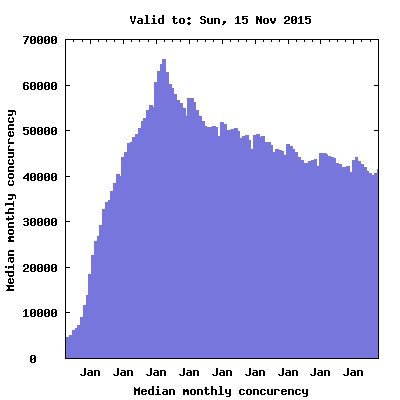
My guess is most "2nd lifers" still among the living (people with disabilities and medical conditions seem to be overrepresented among users; death announcements are not uncommon) are still around, they just log on less frequently and spend more time in other online worlds.
The obvious successors in the works are Linden Lab's own Sansar,
https://www.sansar.com/
and SL cofounder Rosedale's High Fidelity:
https://highfidelity.com/
Thanks!
Kinda already there.
https://xkcd.com/722/
https://xkcd.com/722/
I had a bout with game addiction for almost my first two years of college. At some point, I decided to fight it, and devote myself not just to breaking that addiction, but being dedicated to retaining the ability to break any addiction I wanted to.
I managed to survive college with dual BS degrees in mathematics and physics, and attend a prestigious graduate program in mathematics, although I had to pay my way via loans for two years because of the damage I did to my grades my first two years of college. I was secretly dejected after leaving graduate school after 4 years, but was fortunate to land in software engineering. I don't play too many games anymore just due to being busy, but I still am tied into the game industry due to my tight network of friends, many whom became successful in the game music industry, or games or music.
I managed to survive college with dual BS degrees in mathematics and physics, and attend a prestigious graduate program in mathematics, although I had to pay my way via loans for two years because of the damage I did to my grades my first two years of college. I was secretly dejected after leaving graduate school after 4 years, but was fortunate to land in software engineering. I don't play too many games anymore just due to being busy, but I still am tied into the game industry due to my tight network of friends, many whom became successful in the game music industry, or games or music.
I have found that the "Game of Life" as the author puts it is much more rewarding and meaningful. But then again, I guess I get to do what I like and I'm paid well for it.
I'm worried what our culture and life will be like with a large number of people who do nothing but play video games. Especially if a UBI is created and they can continue to play video games without any big effect on their basic income.
That said, maybe I'm just being cynical. Maybe all that time playing increasingly high-quality games, reading books (some in the article were), and talking about it all with people online will grow into that group of people having a different and better perspective on things. A group of gaming philosophers.
I'm worried what our culture and life will be like with a large number of people who do nothing but play video games. Especially if a UBI is created and they can continue to play video games without any big effect on their basic income.
That said, maybe I'm just being cynical. Maybe all that time playing increasingly high-quality games, reading books (some in the article were), and talking about it all with people online will grow into that group of people having a different and better perspective on things. A group of gaming philosophers.
"Emily lives in a small town not far from Pittsburgh, Pennsylvania. In 2013 she graduated from university and took a job at a marketing firm – a miserable one which she left after a few months... After months of unhappy unemployment, Emily found work: as a cashier in a local shop"
Spanish government's research job offer last month. Some of the requirements: having 16-30 years old and a Phd degree.
Maybe is the market who lives in an alternate reality when it is expected that you start university at 8-10 years old to have a job, but you are too old at 23.
Spanish government's research job offer last month. Some of the requirements: having 16-30 years old and a Phd degree.
Maybe is the market who lives in an alternate reality when it is expected that you start university at 8-10 years old to have a job, but you are too old at 23.
It is ageism, a form of discrimination. Has to be fought against.
I don't think this is an increasing phenomena due to games getting 'better' as much as due to the economic climate. Even children do it, I did. It can be a good thing and a bad thing. The reason I am a hacker and earn a living as a 'professional software engineer' today, have worked in the games industry and now also at a startup is all because of the interest in games and software generated during my childhood playing video games in order to get escapism from the bullies. Games seemed a thing of beauty the way there were balanced. Even if the protagonist is getting attacked by one hundred enemies the programmer will provide some ability to fight back.
Games are pleasurable because the 'hard work' you put in pays off. Life is not always like that, it's only sometimes like that, and for some people it doesn't seem to matter how hard they work, there's a lot of hopeless places to live in the world. People don't want to live in the USA and other places because they want easy access to Disney Land, they just want to play a fairer game. Now the fact that this is happening in the US, indicates that the economic situation is not as good as it once was for some people. If it improves people would come out of the games because there would be opportunity outside in the real world and anyone would pick the real world rather than games in that case because games are created by people and are rather limited and dull imitations of our real world, our real world is infinitely more interesting and complex.
Games are pleasurable because the 'hard work' you put in pays off. Life is not always like that, it's only sometimes like that, and for some people it doesn't seem to matter how hard they work, there's a lot of hopeless places to live in the world. People don't want to live in the USA and other places because they want easy access to Disney Land, they just want to play a fairer game. Now the fact that this is happening in the US, indicates that the economic situation is not as good as it once was for some people. If it improves people would come out of the games because there would be opportunity outside in the real world and anyone would pick the real world rather than games in that case because games are created by people and are rather limited and dull imitations of our real world, our real world is infinitely more interesting and complex.
I disagree - and I also think the counter point needs to be more dispersed.
A majority of the games created today are straight up skinner boxes which engender and support addictive/gambling behaviors. Especially since today, most games are in your mobile phone and not your PC/Console.
These programs use random reward schedules, linear reward schedules, everything. They use it with constantly fine tuned schedules, and with constant feedback.
These are machines, which send dopamine shots to the brain at precision tool levels.
There is no real world analogue that can beat
1) Random chance of huge drop (dopamine hit)
2) Clear performance metrics showing steps to next dopamine hit
3) Timers showing when next free dopamine hit is coming
4) Social tie ins to increase reach and invoke community/social mental systems as well as social proof/buy in
5) Streamlined, A/B tested interfaces and messaging.
6) Leader boards for the competitive
7) Mobile and thus constantly available
I used to dream of making games which were like that, because I thought I was being a sneaky bastard. Then I saw these creatures appear on the market.
Many people out there with less sense and more money are happy to blame the gamer and call it "just a game".
Lets be clear: This kind of design should be banned/disallowed.
And if anyone gets upset by using "banned" on HN, let me remind everyone that around the world Subliminal Advertizing is disallowed, if not directly illegal.
Shiny skinner boxes in everyones hand are planes of existence worse than Subliminal ads.
I am a gamer, and have been since the day I saw an atari, and fumbled with a sinclair spectrum.
This shit is beyond unethical.
A majority of the games created today are straight up skinner boxes which engender and support addictive/gambling behaviors. Especially since today, most games are in your mobile phone and not your PC/Console.
These programs use random reward schedules, linear reward schedules, everything. They use it with constantly fine tuned schedules, and with constant feedback.
These are machines, which send dopamine shots to the brain at precision tool levels.
There is no real world analogue that can beat
1) Random chance of huge drop (dopamine hit)
2) Clear performance metrics showing steps to next dopamine hit
3) Timers showing when next free dopamine hit is coming
4) Social tie ins to increase reach and invoke community/social mental systems as well as social proof/buy in
5) Streamlined, A/B tested interfaces and messaging.
6) Leader boards for the competitive
7) Mobile and thus constantly available
I used to dream of making games which were like that, because I thought I was being a sneaky bastard. Then I saw these creatures appear on the market.
Many people out there with less sense and more money are happy to blame the gamer and call it "just a game".
Lets be clear: This kind of design should be banned/disallowed.
And if anyone gets upset by using "banned" on HN, let me remind everyone that around the world Subliminal Advertizing is disallowed, if not directly illegal.
Shiny skinner boxes in everyones hand are planes of existence worse than Subliminal ads.
I am a gamer, and have been since the day I saw an atari, and fumbled with a sinclair spectrum.
This shit is beyond unethical.
Yeah I don't think games are different than anything else you can get addicted to. They're healthier than drugs and alcohol and keep you out of trouble. You don't even get the acute physical dependence you do with alcohol and they don't really make you dumber like some drugs. If someone is spending all day playing games, they have a mental health problem, or literally nothing better to do, which could be a societal problem. I mean at some point you can decide fuck it, the game is rigged, there's nothing I can do for my future, let me enjoy myself while I can. We've seen this play out with gangs, alcohol and plenty of other things more destructive than gamea.
It is all about balance. I know several young adults who are smart, educated, and successful (for their age) and yet spend what for me is way too much time playing video games. But to them it is not just a game - it's another serious pursuit. And they make several to ten thousand dollars a year gaming.
is that streaming or YouTube? I can't see how one can make money unless they are a pro gamer
I'm a 26 year old male and never got any deeper into video games than some intense rounds of Mario Kart in college. I've played others but generally lose interest and move on quickly. Doubt I've played a video game in a few years at this point. What follows is likely senseless babbling and bullshit armchair pop psychology.
The prevalence of video games among young men frightens me, in two ways:
First, in the development of narcissism in teens. In so many video games, you play the hero—the one man left who can save the world! The fate of everything rests on you and you alone for those hours while you're plugged in. Pumping music, suspense, surprise and eventually reward. How can this not fuel the development of narcissism amongst growing boys? You play as the only person who can succeed and you're rewarded for that success, but without real-world troubles like concern for others' feelings. No, I'm not a psychiatrist, but can't we imagine that at least some boys become addicted to that sensation?
My hypothesis is that video games in boys and teens can fuel narcissistic disorders. Not in all, but in some.
That leads us to the second reason I'm frightened of the prevalence of video games.
I recognize that as a man in a burgeoning industry (software) and a dynamic city (Boulder/Denver), I'm not subject to the same economic pressures as the average American male my age.
My concern is that (by my first theory) we have a growing group of young men with narcissism problems. They are also coming of age in an economy which increasingly doesn't need them. Their job—and therefore romantic—prospects are poor.
A large group of narcissistic men unable to find recognition at work or in love, yearning for the reward stimulation they once got from their Xbox. Most will muddle along, merely dissatisfied.
Narcissists, of course, do not blame themselves for their problems. Those are the fault of others.
So is it that much of a leap to imagine how this fuels movements like the alt-right? Certainly, unemployed men have been a source of strife throughout history. When I read the rhetoric of the alt-right, either their leaders or those who subscribe to the philosophy, it's impossible not to hear the language of revenge and envy.
Revenge against not just successful individuals—those with careers, love, success, recognition, fueled by petty envy—but also revenge against the entire system that now conspires, supposedly, against these men, preventing them from achieving their proper position and the recognition they deserve.
They see a society celebrating women, minorities, the educated, the talented and crave the same. Society does not celebrate them. So that society, therefore, must be abolished.
Men are growing up with a desire for recognition, they are failing to find that recognition and that leads them to lash out.
----
Thus endeth my theory.
It's probably a load of crap. But I'm also sure it describes some posters here on HN. I know it describes some friends of mine.
The prevalence of video games among young men frightens me, in two ways:
First, in the development of narcissism in teens. In so many video games, you play the hero—the one man left who can save the world! The fate of everything rests on you and you alone for those hours while you're plugged in. Pumping music, suspense, surprise and eventually reward. How can this not fuel the development of narcissism amongst growing boys? You play as the only person who can succeed and you're rewarded for that success, but without real-world troubles like concern for others' feelings. No, I'm not a psychiatrist, but can't we imagine that at least some boys become addicted to that sensation?
My hypothesis is that video games in boys and teens can fuel narcissistic disorders. Not in all, but in some.
That leads us to the second reason I'm frightened of the prevalence of video games.
I recognize that as a man in a burgeoning industry (software) and a dynamic city (Boulder/Denver), I'm not subject to the same economic pressures as the average American male my age.
My concern is that (by my first theory) we have a growing group of young men with narcissism problems. They are also coming of age in an economy which increasingly doesn't need them. Their job—and therefore romantic—prospects are poor.
A large group of narcissistic men unable to find recognition at work or in love, yearning for the reward stimulation they once got from their Xbox. Most will muddle along, merely dissatisfied.
Narcissists, of course, do not blame themselves for their problems. Those are the fault of others.
So is it that much of a leap to imagine how this fuels movements like the alt-right? Certainly, unemployed men have been a source of strife throughout history. When I read the rhetoric of the alt-right, either their leaders or those who subscribe to the philosophy, it's impossible not to hear the language of revenge and envy.
Revenge against not just successful individuals—those with careers, love, success, recognition, fueled by petty envy—but also revenge against the entire system that now conspires, supposedly, against these men, preventing them from achieving their proper position and the recognition they deserve.
They see a society celebrating women, minorities, the educated, the talented and crave the same. Society does not celebrate them. So that society, therefore, must be abolished.
Men are growing up with a desire for recognition, they are failing to find that recognition and that leads them to lash out.
----
Thus endeth my theory.
It's probably a load of crap. But I'm also sure it describes some posters here on HN. I know it describes some friends of mine.
>They see a society celebrating women, minorities, the educated, the talented and crave the same. Society does not celebrate them. So that society, therefore, must be abolished.
"Politics is downstream from culture" is a famous quote from late Andrew Breitbart. I hope you observed how the anti-white anti-male identity movements subsequently became either a part of company culture or actually a legislation, giving rise to coerced "diversity". This "identity politics only for some groups but not all" is not "e pluribus unum" that USA used to stand for, so the reaction or pushback against it was anything but unexpected.
"Politics is downstream from culture" is a famous quote from late Andrew Breitbart. I hope you observed how the anti-white anti-male identity movements subsequently became either a part of company culture or actually a legislation, giving rise to coerced "diversity". This "identity politics only for some groups but not all" is not "e pluribus unum" that USA used to stand for, so the reaction or pushback against it was anything but unexpected.
> They are also coming of age in an economy which increasingly doesn't need them. Their job—and therefore romantic—prospects are poor.
> Narcissists, of course, do not blame themselves for their problems. Those are the fault of others.
I find this juxtaposition rather funny.
What I find really odd is that you seem much more concerned about the results of this rather than what caused this trend in the first place.
> Narcissists, of course, do not blame themselves for their problems. Those are the fault of others.
I find this juxtaposition rather funny.
What I find really odd is that you seem much more concerned about the results of this rather than what caused this trend in the first place.
Fair critique.
I was thinking of an acquaintance who fits the mould I described. He lives in a shithole town where the are no jobs and no prospects. He complains endlessly about how he'll never find a career. Why doesn't he take responsibility and move somewhere with an actual economy? I know he's not stupid. So why doesn't he try?
And yes, I am more concerned about the results. Knowing how we got here is necessary but isn't going to change the future.
I was thinking of an acquaintance who fits the mould I described. He lives in a shithole town where the are no jobs and no prospects. He complains endlessly about how he'll never find a career. Why doesn't he take responsibility and move somewhere with an actual economy? I know he's not stupid. So why doesn't he try?
And yes, I am more concerned about the results. Knowing how we got here is necessary but isn't going to change the future.
> And yes, I am more concerned about the results. Knowing how we got here is necessary but isn't going to change the future.
I see this pattern a lot. People always seem to be concerned about the results. It's drastically inefficient. How is this different from saying you can't fix bugs right now because you need to work on features? Then you'll never fix any bugs. And if you focus on results, you'll never even notice a cause. And you'll always be fixing the big difficult problem and wondering why you never have any time and why everything is always bad.
The result is a natural extension of the cause. If you don't like the result, address the cause. If you fail to address the cause, you deserve the result (not you literally but the relevant collective). So late in the process is too late to complain. Instead, go find the next cause, before all you're left with is results.
> I was thinking of an acquaintance who fits the mould I described. He lives in a shithole town where the are no jobs and no prospects. He complains endlessly about how he'll never find a career. Why doesn't he take responsibility and move somewhere with an actual economy? I know he's not stupid. So why doesn't he try?
There's not enough information in this paragraph, yet I find it trivial to think of possible explanations but here you're asking "why?", as if that's an interesting question (maybe he developed learned helplessness?). I will say that if you focus on blaming the individual, their motivations will close up to you completely and you will have significant trouble understanding them. "This person is just inferior" is an infinite black hole that can eat any and all cause while providing you with zero solutions. I've seen many times when there were obvious explanations, but a person was so engrossed in blame they just couldn't see them.
When you focus on results and turn to blame, you effectively blind yourself to how the world operates, because there's nothing keeping in check how far you can assign blame. And after a while, the sheer amount of blame becomes cause itself.
I bring up blame because your original post was full of blame of people, yet little blame for the cause itself.
I see this pattern a lot. People always seem to be concerned about the results. It's drastically inefficient. How is this different from saying you can't fix bugs right now because you need to work on features? Then you'll never fix any bugs. And if you focus on results, you'll never even notice a cause. And you'll always be fixing the big difficult problem and wondering why you never have any time and why everything is always bad.
The result is a natural extension of the cause. If you don't like the result, address the cause. If you fail to address the cause, you deserve the result (not you literally but the relevant collective). So late in the process is too late to complain. Instead, go find the next cause, before all you're left with is results.
> I was thinking of an acquaintance who fits the mould I described. He lives in a shithole town where the are no jobs and no prospects. He complains endlessly about how he'll never find a career. Why doesn't he take responsibility and move somewhere with an actual economy? I know he's not stupid. So why doesn't he try?
There's not enough information in this paragraph, yet I find it trivial to think of possible explanations but here you're asking "why?", as if that's an interesting question (maybe he developed learned helplessness?). I will say that if you focus on blaming the individual, their motivations will close up to you completely and you will have significant trouble understanding them. "This person is just inferior" is an infinite black hole that can eat any and all cause while providing you with zero solutions. I've seen many times when there were obvious explanations, but a person was so engrossed in blame they just couldn't see them.
When you focus on results and turn to blame, you effectively blind yourself to how the world operates, because there's nothing keeping in check how far you can assign blame. And after a while, the sheer amount of blame becomes cause itself.
I bring up blame because your original post was full of blame of people, yet little blame for the cause itself.
Does he actually have the means with which to move to a new city? That's not an easy task, nor a cheap one. Once you're trapped into a situation without a stream of ongoing income, mobility trends rapidly towards nil.
Just a comment to make on one of your points -
>In so many video games, you play the hero... you [are the] only person who can succeed and you're rewarded... without real-world troubles like concern for others
Anecdotally, the games I have found most compelling (by and large; exceptions abound) tend to fall remarkably far from that pattern.
In Eve Online you start as a nobody in a cruel world populated by jaded, career hardcore gamers and you probably end that way too - unless you are (irl) creative enough and (irl) charismatic enough to build an commando team, a franchise, a company, a charity or an empire large enough to leave a permanent mark on that universe and on its inhabitants' minds. Rust is pretty much Eve but without the complex economy and an API to crunch numbers with. Still has the social engineering, the pack out for blood mentality and the ability to create a visceral sense of loss (in you or your enemy).
In Dota/League/Starcraft/Counterstrike/any other round-based ladder game you are a chess piece; you play your role and cooperate with others. The better you are at those two things, the more you win games. There's no free lunch; you're always matched with people similar to your skill so you are always working to minimize the very real risk of humiliating, extended failure at the hands of your peers in every game.
In Minecraft (singleplayer) it's just you and your creativity. You cannot win or lose. You have no missions aside from those you give yourself. The value or satisfaction you gain from this game is directly proportional to what you put into it. It's almost zen. Or maybe it's almost existentialist. In Minecraft (multiplayer) you add to all that the ability to cooperate with others (to convince them of the value of your goals, or to contribute to the advancement of theirs) or to conflict with others (defend what is yours while destroying what is theirs).
I mean, I love Mirror's Edge and its sequel. They're beautiful games, with great soundtracks and fluid gameplay that doesn't revolve around shooting. But in the end, I don't rack up hundreds of hours in that kind of game. I don't think I even got halfway through the Skyrim campaign. Shit's boring to me.
This is all, of course, just my opinions. All my life I've been an outlier, though, so maybe this is all irrelevant to your point, which was about the usual effects of usual games to usual teens/young adults.
>In so many video games, you play the hero... you [are the] only person who can succeed and you're rewarded... without real-world troubles like concern for others
Anecdotally, the games I have found most compelling (by and large; exceptions abound) tend to fall remarkably far from that pattern.
In Eve Online you start as a nobody in a cruel world populated by jaded, career hardcore gamers and you probably end that way too - unless you are (irl) creative enough and (irl) charismatic enough to build an commando team, a franchise, a company, a charity or an empire large enough to leave a permanent mark on that universe and on its inhabitants' minds. Rust is pretty much Eve but without the complex economy and an API to crunch numbers with. Still has the social engineering, the pack out for blood mentality and the ability to create a visceral sense of loss (in you or your enemy).
In Dota/League/Starcraft/Counterstrike/any other round-based ladder game you are a chess piece; you play your role and cooperate with others. The better you are at those two things, the more you win games. There's no free lunch; you're always matched with people similar to your skill so you are always working to minimize the very real risk of humiliating, extended failure at the hands of your peers in every game.
In Minecraft (singleplayer) it's just you and your creativity. You cannot win or lose. You have no missions aside from those you give yourself. The value or satisfaction you gain from this game is directly proportional to what you put into it. It's almost zen. Or maybe it's almost existentialist. In Minecraft (multiplayer) you add to all that the ability to cooperate with others (to convince them of the value of your goals, or to contribute to the advancement of theirs) or to conflict with others (defend what is yours while destroying what is theirs).
I mean, I love Mirror's Edge and its sequel. They're beautiful games, with great soundtracks and fluid gameplay that doesn't revolve around shooting. But in the end, I don't rack up hundreds of hours in that kind of game. I don't think I even got halfway through the Skyrim campaign. Shit's boring to me.
This is all, of course, just my opinions. All my life I've been an outlier, though, so maybe this is all irrelevant to your point, which was about the usual effects of usual games to usual teens/young adults.
There's a generation a decade older than you that grew up putting enormous amounts of time into video games. We're all (mostly) functional individuals now, so I'm not to worried about kids today doing the same.
Could the more modern games my generation grew up with be more immersive, having a larger effect on mental development?
I think you're underestimating just how immersive those older games could be. Immersiveness is not a product of graphical fidelity, look at books and text adventure games, I would consider them just as immersive as any games today. We were saying "just one more turn" just as much with civ1 as with civ6.
On a cynical note, "young men immersed in alternate reality" is also an opportunity:
- It's a rapidly growing market
- those people will eventually need financial support systems beyond family - new forms of annuities?
- more demand for "gig economy" type jobs
- demand for jobs that can be done inside virtual realities that are better suited for humans instead of robots - this one is a stretch
- more demand for on-demand "life support" services - food, cleaning, medical, sex
This is veering into dark-ish dystopian territory, so imma stop now.
- It's a rapidly growing market
- those people will eventually need financial support systems beyond family - new forms of annuities?
- more demand for "gig economy" type jobs
- demand for jobs that can be done inside virtual realities that are better suited for humans instead of robots - this one is a stretch
- more demand for on-demand "life support" services - food, cleaning, medical, sex
This is veering into dark-ish dystopian territory, so imma stop now.
This is what happened in Japan in the mid 1990s when it firmly entered the post-industrial age. There's an entire sector of society that's given up on getting ahead because the old model of employment is broken, and there's no point in fighting to get ahead since there's no winning.
Console games and ramen noodles until you die.
Console games and ramen noodles until you die.
It seems like there's a limit to growth and Japan were just the first ones to hit the limit. Everyone else has just cheated the limit with "artificial growth" via immigration.
You might be right about that. Japan has been pretty hostile to immigration, so it's probable that's a significant factor here.
It's veering into seeing the reality outside the small bubble of people that are empowered by technology.
Someone should figure out a way to embed mechanical turk tasks into video games. Then young men can at least get paid a little bit for their game play.
The MMO Eve Online partnered with the Human Protein Atlas to embed a protein-mapping minigame in Eve. It was fitted into the game's overarching storyline and gives in-game rewards for participating. A month or two after it was introduced they released some numbers; something like 37 man-years of classification labor had been performed. And because it's in a game with an existing playerbase and provides reward as long as it is played, it is still continuing to yield results (naturally it slowed down after the first peak of interest) in contrast to the tendency (they claim) of most standalone crowdsourced data science projects to struggle to gain traction and dry up fast.
http://www.pcworld.com/article/3060692/software-games/how-ev...
http://www.pcworld.com/article/3060692/software-games/how-ev...
Fascinating, thanks for this. I had a suspicion I wasn't the first person to come up with this idea.
I wonder how well such a program could expand to other forms of crowdsourced data.
I wonder how well such a program could expand to other forms of crowdsourced data.
Bitcoin mining?
Welcome to The Matrix.
[deleted]
<long winded rant>
Games, to a degree is escapism of course. When I dropped out of college and sat at the back of a public library, I saw all types of values as I spent so many hours in so many different games. Learnt about communicating only the important details in first person shooters (FPS) and learnt about sacrificing my character to save my carry in MOBA [2] games like leauge of legends and dota 2. Though no one outside gaming communities generally care about such things. I get called lazy and get told that I am wasting my life away fairly often.
A game like dota 2 has roughly 500k player playing at any given time. about 3x more for leauge. Thats 500k * 24 hours a day spent collectively as humans on a game on any given day. So billions of hours a week is not a bad estimation. There is a tedtalk video that talks about the hours as well.[1] I often this about this in the back of my mind when people talk about universal basic income (UBI) and unemployment. I think the future generation will find it natural to put in large hours into games and it won't be seen as negative.
Games are also asylum for some though, i've met some really awesome people but people who were clearly in very bad places mentally. Some have spent years in game collecting and achieving stuff that will have no meaning to anyone outside of the game but means the world to them. (Sadly one killed himself after his account got hacked and all this stuff was gone). Therefore, I wish people approaching from the outside of specific communities trying to talk to these people and talk about issues would sometimes take a little time to look at the culture before going off on stuff like "bikini armor" [3] (female character with `impractical` armor) or video game violence or toxicity[4] in gaming community. Yes these all might be problems and we'd all like to address it, but trying to confront a population who's already withdrawn from reality to varying degree is not the best approach from my point of view.
</ long winded rant>
[1] https://www.ted.com/talks/jane_mcgonigal_gaming_can_make_a_b...
[2] https://en.wikipedia.org/wiki/Multiplayer_online_battle_aren...
[3] https://encrypted-tbn1.gstatic.com/images?q=tbn:ANd9GcSrC_DI... [4] https://www.reddit.com/r/gaming/comments/2v9zqf/top_10_most_...
A game like dota 2 has roughly 500k player playing at any given time. about 3x more for leauge. Thats 500k * 24 hours a day spent collectively as humans on a game on any given day. So billions of hours a week is not a bad estimation. There is a tedtalk video that talks about the hours as well.[1] I often this about this in the back of my mind when people talk about universal basic income (UBI) and unemployment. I think the future generation will find it natural to put in large hours into games and it won't be seen as negative.
Games are also asylum for some though, i've met some really awesome people but people who were clearly in very bad places mentally. Some have spent years in game collecting and achieving stuff that will have no meaning to anyone outside of the game but means the world to them. (Sadly one killed himself after his account got hacked and all this stuff was gone). Therefore, I wish people approaching from the outside of specific communities trying to talk to these people and talk about issues would sometimes take a little time to look at the culture before going off on stuff like "bikini armor" [3] (female character with `impractical` armor) or video game violence or toxicity[4] in gaming community. Yes these all might be problems and we'd all like to address it, but trying to confront a population who's already withdrawn from reality to varying degree is not the best approach from my point of view.
</ long winded rant>
[1] https://www.ted.com/talks/jane_mcgonigal_gaming_can_make_a_b...
[2] https://en.wikipedia.org/wiki/Multiplayer_online_battle_aren...
[3] https://encrypted-tbn1.gstatic.com/images?q=tbn:ANd9GcSrC_DI... [4] https://www.reddit.com/r/gaming/comments/2v9zqf/top_10_most_...
to occupy their time, to find purpose in life or to contribute to society?
Every job I've worked in my adult life has involved being judged by standards the boomers doing the judging could never live up to, and then covering for their incompetence with technical skills(because I'm young, so I can just do that stuff). It would be such a sad joke if it weren't for the fact that they squat in every opportunity young people have for their futures (real estate, higher positions, etc) while the young themselves drown in debt and exploitation.
Generational flamewars are one of the circles of hell that we're hoping to avoid here. Please don't do this again.
We detached this subthread from https://news.ycombinator.com/item?id=13891018 and marked it off-topic.
We detached this subthread from https://news.ycombinator.com/item?id=13891018 and marked it off-topic.
Okay, apologies. Wasn't intentionally trying to stir up trouble, just share my experiences along the lines of the parent. I can see from some of the responses I solicited why this is problematic and will try to be more measured in my comments
It's even better when they don't like the fact that you are doing the job in a way they can't understand. I swear some people think they are paying you to suffer, and if you do something in a way that doesn't require enough suffering they feel ripped off.
Lets be clear here. What-ever the persons opinion of you should have absolutely no bearing on your professional work, and your relationship between then. I have rude clients, I have smart ass clients. Something is very clear I make it to them when I do the job, I'm doing it for money. If they think $1000 per hour is too much then they're not a client I really want to be working with.
I have found you need to make it very clear to clients why you're there, and what the ROI will be for them. After you've done the work, you move onto the next client.
They may be a wealthy business man, they may be a boomer. They may be a startup. You're there to get a job done.
I have found you need to make it very clear to clients why you're there, and what the ROI will be for them. After you've done the work, you move onto the next client.
They may be a wealthy business man, they may be a boomer. They may be a startup. You're there to get a job done.
That works fine when they're "clients" and you have a business - they naturally accept B2B situations as equals. But when you're the employee, that doesn't work. If you make it clear that you're only in the job for the paycheck, you're going to get fired - you have to make it seem to management like you have some psychopathic desire to be there busting your ass for nine hours on their inane and unfulfilling tasks.
I have to disagree with you there. You're taking the passive approach. Go out make a name for yourself in the market place in the field you work in. Do some volunteer work as a example to build up a client base and contact list. Advertise your services to other businesses and go to business functions. Get some offers on the table, and then you know where you stand within the organisation. You cannot do it if you're a slave to your job and you're literally working 10 to 12 hours a day. Cut back, turn off the phone after work. Go for a jog and go and have a beer with competing businesses or colleges.
Here's the problem - I don't work in a "field". I work in whatever office will have me, being another faceless drone, more grist for the mill of half-secretarial and half-self-taught patchwork IT people. No matter what the exact role is, there's someone who's either got better qualifications or training than me if it gets technical. I'm "discount office guy" - they don't want me to be anything other than passive.
Your mindset is too stuck in the victim mentality. Yes, people are going to better than you, BUT there are also people who are LESS qualified than you! I will tell you a secret most people wont tell you. People with less qualifications than you get paid more than you.
So drop the `Technical qualification` bull####. If you need qualifications, like other people have recommended open up a text book and start reading. Start building web-sites. Start development with Postgresql. Go out and market yourself and your products. See WHAT people want to buy. See what people are willing to pay for products. Go and take night classes in business management/business skills.
You're a discount office guy because you let them treat you like a discount office guy. If you're worried about failure let me tell you now you're going to fail in amazing screwed up ways, but that is part of the fun. You're going to find your own style, you're going to fall in love and be walked over, you're going to get shit but you're not going to grow as a individual, person, and be a human if you are that `Discount Office Guy`
## I will end on this.
Honestly to dear &&&& god. You've got some of the most friendliest, supportive, happy go people on this community web site who I believe would love to give you pointers and critique your work. Leverage what you have, leverage your network.
So drop the `Technical qualification` bull####. If you need qualifications, like other people have recommended open up a text book and start reading. Start building web-sites. Start development with Postgresql. Go out and market yourself and your products. See WHAT people want to buy. See what people are willing to pay for products. Go and take night classes in business management/business skills.
You're a discount office guy because you let them treat you like a discount office guy. If you're worried about failure let me tell you now you're going to fail in amazing screwed up ways, but that is part of the fun. You're going to find your own style, you're going to fall in love and be walked over, you're going to get shit but you're not going to grow as a individual, person, and be a human if you are that `Discount Office Guy`
## I will end on this.
Honestly to dear &&&& god. You've got some of the most friendliest, supportive, happy go people on this community web site who I believe would love to give you pointers and critique your work. Leverage what you have, leverage your network.
then spend your time taking advantage of the billions of available free resources to increase your qualifications.
i was once where you are now. i am no longer there. it took time and a lot of work. it was worth it. you can do it too.
i was once where you are now. i am no longer there. it took time and a lot of work. it was worth it. you can do it too.
[deleted]
Very true.
I have seen this in Australian academia: Boomer academics who were permitted to publish a paper every 2-3 years during the first 10+ years of their academic life, and/or defer getting a PhD to ludicrously late in their careers, are now elevated to senior positions supervising students and junior faculty who will not have reasonable careers unless they publish a paper every 2-3 months or better.
I have seen this in Australian academia: Boomer academics who were permitted to publish a paper every 2-3 years during the first 10+ years of their academic life, and/or defer getting a PhD to ludicrously late in their careers, are now elevated to senior positions supervising students and junior faculty who will not have reasonable careers unless they publish a paper every 2-3 months or better.
Well, the world just got a lot more competitive and there are a lot more people trying to get a PhD.
[deleted]
I'm not salty about that. More just salty at the experience of dealing with people who were teleported to the top of a hierarchy, throwing their weight around as if they'd climbed it.
Utter and complete rubbish.
The 'boomers' invented most of the 'computer stuff' you use, most 'developers' today are hacks (granted, some are amazing).
Boomers had difficult upbringing, brought real social change, lived through - and ended the Cold War.
Female boomers were expected to be secretaries - and had to fight for the right just to do normal jobs in the workplace.
Even the boys - were expected to do the same jobs their fathers did, mostly boring labour - and only a fraction of them got to go to University.
There was no such thing as 'startups' back in the day - there were zero opportunities for middle class young people to generate wealth or do globally impactful things.
They lived during the draft, and 50 000 of them died in Vietnam.
Millenials are born into massive entitlement, wealth , privilege and opportunity.
You get bored easily, and don't want to do the same job for more than a year - but expect loyalty and long term employment? Yes - boomers had steadier work - but it was also incredibly boring, stagnant - and in real wages, pay was crap.
Boomers could own a small, shoddy home in the suburbs, and were able to have 'a fridge' and 'an oven' and 'a car' - even though they were all crap by today's standards - that was 'The American Dream' and they were generally happy.
If you are born past the fall of the Berlin wall in America - unless you are from a ghetto - you do not know hardship.
As for real estate: the average home price in the US is about $200K. You can afford a home. You just can't be 'Instagram baller'.
As for 'higher positions' - do you think the 'Greatest Generation' just handed over their choice positions to the 'Boomers'? Or do you think it took mostly a lifetime of work and loyalty? If you don't like your job make yourself CEO of your own company. What's stopping you?
American Millenials have more opportunity than any group of people in the entirety of history - enough with your complaining.
The 'boomers' invented most of the 'computer stuff' you use, most 'developers' today are hacks (granted, some are amazing).
Boomers had difficult upbringing, brought real social change, lived through - and ended the Cold War.
Female boomers were expected to be secretaries - and had to fight for the right just to do normal jobs in the workplace.
Even the boys - were expected to do the same jobs their fathers did, mostly boring labour - and only a fraction of them got to go to University.
There was no such thing as 'startups' back in the day - there were zero opportunities for middle class young people to generate wealth or do globally impactful things.
They lived during the draft, and 50 000 of them died in Vietnam.
Millenials are born into massive entitlement, wealth , privilege and opportunity.
You get bored easily, and don't want to do the same job for more than a year - but expect loyalty and long term employment? Yes - boomers had steadier work - but it was also incredibly boring, stagnant - and in real wages, pay was crap.
Boomers could own a small, shoddy home in the suburbs, and were able to have 'a fridge' and 'an oven' and 'a car' - even though they were all crap by today's standards - that was 'The American Dream' and they were generally happy.
If you are born past the fall of the Berlin wall in America - unless you are from a ghetto - you do not know hardship.
As for real estate: the average home price in the US is about $200K. You can afford a home. You just can't be 'Instagram baller'.
As for 'higher positions' - do you think the 'Greatest Generation' just handed over their choice positions to the 'Boomers'? Or do you think it took mostly a lifetime of work and loyalty? If you don't like your job make yourself CEO of your own company. What's stopping you?
American Millenials have more opportunity than any group of people in the entirety of history - enough with your complaining.
This response is so stereotypical and contrary to the facts of the conditions of young people today, I have to thank you for demonstrating both my and the parent's points. Thanks for that!
It is so perfectly stereotypical and dicorced from reality part of me thought it was a joke.
"It is so perfectly stereotypical and dicorced from reality "
It is exactly reality - and that you don't grasp it only validates how utterly self-deluded Millenials are.
By every measure Millenials are doing better.
Millenials have:
+ Better healthcare, more coverage + Better access to education, information, more college grads than ever + More job opportunities, more diverse fields to apply knowlege + More opportunity for wealth creation + A life full of gadgets, toys and trifles that couldn't even be imagined + You have 'fast fashion' - just 20 years ago there was no suh thing. Clothes were expensive. + Your cars are pretty good, stereos are great, they are fun to drive. Drive a car from the 1970's - they are shit-boxes + You have access to unlimited entertainment and music. In the 1970s' you had 10 records. You wanted to listen to more you went to your friends house. + You have more mobility and access to jobs not only around America, but around the world. + Millenial girls can actually have careers and jobs - and not have to fight vicious stereotyping.
It's basically disgusting that this generation should make existential complains.
What are your beefs?
That you don't bet to be CEO after 1 year?
That you can't live in a baller apartment in SF and have to actually commute from the burbs?
That you don't have job security? Well, you could, if you wanted a more boring job.
That you have school debt? Every generation did. You could have gone to a state school, private school is a luxury.
All of these gripes are really sad 'Oh the Boomers fed everything up' and 'life sucks'. Bullshit.
Provide some facts.
Other than University being a little more expensive - I don't see anything that is remotely more difficult. And FYU with interest rates so low compared to the 15% it was in the 1980s, I say in real dollars, maybe that's not so bad.
It is exactly reality - and that you don't grasp it only validates how utterly self-deluded Millenials are.
By every measure Millenials are doing better.
Millenials have:
+ Better healthcare, more coverage + Better access to education, information, more college grads than ever + More job opportunities, more diverse fields to apply knowlege + More opportunity for wealth creation + A life full of gadgets, toys and trifles that couldn't even be imagined + You have 'fast fashion' - just 20 years ago there was no suh thing. Clothes were expensive. + Your cars are pretty good, stereos are great, they are fun to drive. Drive a car from the 1970's - they are shit-boxes + You have access to unlimited entertainment and music. In the 1970s' you had 10 records. You wanted to listen to more you went to your friends house. + You have more mobility and access to jobs not only around America, but around the world. + Millenial girls can actually have careers and jobs - and not have to fight vicious stereotyping.
It's basically disgusting that this generation should make existential complains.
What are your beefs?
That you don't bet to be CEO after 1 year?
That you can't live in a baller apartment in SF and have to actually commute from the burbs?
That you don't have job security? Well, you could, if you wanted a more boring job.
That you have school debt? Every generation did. You could have gone to a state school, private school is a luxury.
All of these gripes are really sad 'Oh the Boomers fed everything up' and 'life sucks'. Bullshit.
Provide some facts.
Other than University being a little more expensive - I don't see anything that is remotely more difficult. And FYU with interest rates so low compared to the 15% it was in the 1980s, I say in real dollars, maybe that's not so bad.
> By every measure Millenials are doing better.
You cite no actual quantitative measures to support this claim, so rather than rebutting with such I'll just say this: by many economic measures, Millenials are worse off than boomers (by a few, they're also worse of than Gen X, though by more Gen X is in the worst position of the three, though it usually gets left out of comparisons.)
> All of these gripes are really sad 'Oh the Boomers fed everything up' and 'life sucks'. Bullshit.
It's true that the f-ing up (specifically, of the features in the politico-economic system that resulted in aggregate gains being widely distributed) mostly happened wat the end of the time when the "Greatest" Generation was running the show, the Boomers just were the last generation to have a substantial fraction of their working life before things were f-ed up.
You cite no actual quantitative measures to support this claim, so rather than rebutting with such I'll just say this: by many economic measures, Millenials are worse off than boomers (by a few, they're also worse of than Gen X, though by more Gen X is in the worst position of the three, though it usually gets left out of comparisons.)
> All of these gripes are really sad 'Oh the Boomers fed everything up' and 'life sucks'. Bullshit.
It's true that the f-ing up (specifically, of the features in the politico-economic system that resulted in aggregate gains being widely distributed) mostly happened wat the end of the time when the "Greatest" Generation was running the show, the Boomers just were the last generation to have a substantial fraction of their working life before things were f-ed up.
What is stereotypical and divorced from reality are the things you are missing.
The economy is structured as a ponzi scheme. The ponzi scheme will collapse and many unsympathetic boomers will go broke.
To take your interest rate example. Prices are inversely correlated to interest rates. If you buy when interest rates are high (low prices) and sell when interest rates are low (high prices) then you benefit enormously. Since interest rates are pretty much as low as they can go then there is no upside left for millennials. Only downside. I, like many millennials, wish for much much higher interest rates. Low interest rates are another wealth transfer from those with earnings (millennials) to those with capital (boomers).
I do not suggest that all millennial complaints are valid. I'm simply saying that they shouldn't be dismissed with technological handwaving. The hidden message in the complaints is that we're in this together. The ponzi scheme economy hurts all of us.
The economy is structured as a ponzi scheme. The ponzi scheme will collapse and many unsympathetic boomers will go broke.
To take your interest rate example. Prices are inversely correlated to interest rates. If you buy when interest rates are high (low prices) and sell when interest rates are low (high prices) then you benefit enormously. Since interest rates are pretty much as low as they can go then there is no upside left for millennials. Only downside. I, like many millennials, wish for much much higher interest rates. Low interest rates are another wealth transfer from those with earnings (millennials) to those with capital (boomers).
I do not suggest that all millennial complaints are valid. I'm simply saying that they shouldn't be dismissed with technological handwaving. The hidden message in the complaints is that we're in this together. The ponzi scheme economy hurts all of us.
[deleted]
Speaking as a non-American millennial, that is largely true though.
I think the current generation American kids will be even more worse.
When I saw kids in the US and when I see the kids in India. Its just feels like American kids live in some kind of Disneyland. The level of competitiveness and hard work as a culture in kids in India have is just a whole double digit factors higher.
The fact is that US ecosystem is largely saved because of the Economic inertia and the endless stream exceptionally talented pool of great people who immigrate there. That large replenishing pool of people pays for the party forward.
I think the current generation American kids will be even more worse.
When I saw kids in the US and when I see the kids in India. Its just feels like American kids live in some kind of Disneyland. The level of competitiveness and hard work as a culture in kids in India have is just a whole double digit factors higher.
The fact is that US ecosystem is largely saved because of the Economic inertia and the endless stream exceptionally talented pool of great people who immigrate there. That large replenishing pool of people pays for the party forward.
Millennials also have helicopter parents. This is a totally new hardship. Being raised in a way that is completely incompatible with reality. Then we get to the "real" world and are told we don't know anything. Well gee thanks dad. Judging by the American economy and the state of world affairs, doesn't seem like boomers are all they crack themselves up to be either.
> Millennials also have helicopter parents.
Helicopter parenting is not new (except for the name), and is neither unique to nor universal among parents of Millenials.
> Judging by the American economy and the state of world affairs, doesn't seem like boomers are all they crack themselves up to be either.
To be fair to the Boomers, while they certainly failed to fix it, the damage was mostly done by the "Greatest Generation" (the strong economy the GG often gets credit for was created when the GG were in their youth and the Lost Generation was running the show.)
Helicopter parenting is not new (except for the name), and is neither unique to nor universal among parents of Millenials.
> Judging by the American economy and the state of world affairs, doesn't seem like boomers are all they crack themselves up to be either.
To be fair to the Boomers, while they certainly failed to fix it, the damage was mostly done by the "Greatest Generation" (the strong economy the GG often gets credit for was created when the GG were in their youth and the Lost Generation was running the show.)
Sorry I am going to have to disagree. Parents used to be strict, far stricter, sure. But helicopter parents is just pure putting [kids in a bubble](http://www.businessinsider.com/the-rise-of-the-helicopter-pa...). I do agree that it isn't universal. Anecdotally, my friends who are doing best in life right now are the ones who have less helicoptery parents (obviously not scientific, this is just my observation and trying to make sense of what I'm seeing). One friend in particular, grew up in a rural area and had to work very hard. He's now a PhD and works at Bosch.
And let's think about what the boomers didn't have.
No cell phones.
No GPS.
No soft contact lenses.
No electronic fuel injection (carburetors! yay!)
No Google
I can keep on going with this for a long time
LIFE WAS A LIVING HELL FOR BOOMERS! BE SO HAPPY YOU WERE NOT ONE!
No cell phones.
No GPS.
No soft contact lenses.
No electronic fuel injection (carburetors! yay!)
No Google
I can keep on going with this for a long time
LIFE WAS A LIVING HELL FOR BOOMERS! BE SO HAPPY YOU WERE NOT ONE!
Not having all of those probably makes live a lot better in a purely professional sense.
Soft contact lenses existed in the 60's and disposable contacts existed since the early 70's.
Just a minor nitpick.
Just a minor nitpick.
> Millenials are born into massive entitlement, wealth , privilege and opportunity
Something is strongly wrong with your reasoning if you think that boomers did so much things right and failed miserable in their most important job that is raise kids.
Something is strongly wrong with your reasoning if you think that boomers did so much things right and failed miserable in their most important job that is raise kids.
Not sure how this is being downvoted - the truth hurts. We just have it too damn good, and without any wide-scale struggles to know how good we have it.
I would like to a read a serious response from a detractor.
I would like to a read a serious response from a detractor.
I'm your Huckleberry. My parents are late boomers and they and many of their friends were able to sleep-walk into middle class comfort and early retirement. Literally all they had to do was show up for work, 9-5, Monday-Friday and their prosperity was lifted on a rising tide of property prices. When they were in their 20s you applied for a job by sending a CV and covering letter. No three rounds of assessment days and homework assignments. When they left work at the end of the day, it didn't follow them home because technology didn't allow it. And the world of fax machines and mail rooms was limited in the amount of ruthless efficiency pressure it could put on workers.
They didn't even need degrees. And my mother is a perfect example of how boomer women being expected to be secretaries is anachronistic SJW nonsense. She never attended university, just started working as a junior claims person at an insurance firm in the 70s, showed up for work for 30 years and ended up in the boardroom with stock options. Never faced any discrimination. And she would be the first to admit she never put much into her career - no need for constant re-training, seminars, conferences, when she was home she was home.
While enjoying these comfortable lives, their generation with their hippy views presided over explosive increases in immigration to most western countries, and are the architects of wealth-hoarding tricks like buy-to-let and all kinds of snaky BS union-breaking contract work. The bottom line is, as a young person today you simply couldn't repeat their lives in terms of comfort and financial security. To match it, you'd need to put in several times the effort and hours they did, with a lot more anxiety biting at your heels.
The first Millennials came of age to the images of those planes hitting the WTC and, as corny as it is, that was some incredibly apt symbology. The few of us who manage to be "anti-fragile" may make out good from this new era, but that the security of the ordinary middle-class majority has been shattered is indisputable.
They didn't even need degrees. And my mother is a perfect example of how boomer women being expected to be secretaries is anachronistic SJW nonsense. She never attended university, just started working as a junior claims person at an insurance firm in the 70s, showed up for work for 30 years and ended up in the boardroom with stock options. Never faced any discrimination. And she would be the first to admit she never put much into her career - no need for constant re-training, seminars, conferences, when she was home she was home.
While enjoying these comfortable lives, their generation with their hippy views presided over explosive increases in immigration to most western countries, and are the architects of wealth-hoarding tricks like buy-to-let and all kinds of snaky BS union-breaking contract work. The bottom line is, as a young person today you simply couldn't repeat their lives in terms of comfort and financial security. To match it, you'd need to put in several times the effort and hours they did, with a lot more anxiety biting at your heels.
The first Millennials came of age to the images of those planes hitting the WTC and, as corny as it is, that was some incredibly apt symbology. The few of us who manage to be "anti-fragile" may make out good from this new era, but that the security of the ordinary middle-class majority has been shattered is indisputable.
There's no room to grow.
In the modern world, for most people, there's nothing productive to do and no fame to get from it.
In the USA, all the highways are already built (and even when they're failing, their fixing will be postponed). High speed rail lines weren't, and they're not going to be. Not on any human time frame.
So most people are engaged with running pre-built technosphere that is slowly falling apart, with no new developments, for ever-shrinking pay, while more and more money are extorted from them to pay for previous generations entitlements, and also for medicine, real estate, tuition and law, which from services all turned into endless money sinks.
Friges and ovens are not the alpha and omega of life. Productivity, respect and growth are. Are we having any all across post-development countries?
In the modern world, for most people, there's nothing productive to do and no fame to get from it.
In the USA, all the highways are already built (and even when they're failing, their fixing will be postponed). High speed rail lines weren't, and they're not going to be. Not on any human time frame.
So most people are engaged with running pre-built technosphere that is slowly falling apart, with no new developments, for ever-shrinking pay, while more and more money are extorted from them to pay for previous generations entitlements, and also for medicine, real estate, tuition and law, which from services all turned into endless money sinks.
Friges and ovens are not the alpha and omega of life. Productivity, respect and growth are. Are we having any all across post-development countries?
"There's no room to grow."
"Productivity, respect and growth are. Are we having any all across post-development countries?"
Have any of you ever taken a basic Econ course?
'No room for growth'?
THE ECONOMY HAS BEEN GROWING EVERY YEAR.
Do you realize that 'feature phones' to 'cell phones' is economic growth?
Do you realize that '2G to 4G' is economic growth?
Do you realize that more people going to college than ever before is good?
There are new medicine trials every day - gene therapy. Jesus H Christ you can now chose the gender and eye colour of your offspring. That's how advanced we are.
100 years ago - there was no 'medicine'. 95% of all operations were basically amputations with crossed fingers of no infection.
Do you realize that the amount of air travel in the world has doubled in the last little while?
That you have access to 100000x more information that people just 20 years ago, before the internet?
You do realize that the iPhone/Android/Facebook are only 10 years old?
That 20 years ago there was no YCombinator?
I'm just going to assume that most of you are too young to have any perspective, because I just can't understand the commentary here.
When you hit your 30's, you can look back and your own life can be a literal testament to the change.
Yes, some things stay the same, but at least in terms of material productivity, things are better.
"Productivity, respect and growth are. Are we having any all across post-development countries?"
Have any of you ever taken a basic Econ course?
'No room for growth'?
THE ECONOMY HAS BEEN GROWING EVERY YEAR.
Do you realize that 'feature phones' to 'cell phones' is economic growth?
Do you realize that '2G to 4G' is economic growth?
Do you realize that more people going to college than ever before is good?
There are new medicine trials every day - gene therapy. Jesus H Christ you can now chose the gender and eye colour of your offspring. That's how advanced we are.
100 years ago - there was no 'medicine'. 95% of all operations were basically amputations with crossed fingers of no infection.
Do you realize that the amount of air travel in the world has doubled in the last little while?
That you have access to 100000x more information that people just 20 years ago, before the internet?
You do realize that the iPhone/Android/Facebook are only 10 years old?
That 20 years ago there was no YCombinator?
I'm just going to assume that most of you are too young to have any perspective, because I just can't understand the commentary here.
When you hit your 30's, you can look back and your own life can be a literal testament to the change.
Yes, some things stay the same, but at least in terms of material productivity, things are better.
> THE ECONOMY HAS BEEN GROWING
If the college provides same service while extorting twice as much money, this means that economy grows, but people become poorer, more indebted and strained. The economy might be growing; but WE don't.
> Do you realize that more people going to college than ever before is good?
But when they graduate they have worse employment prospects than High School graduates 40 years ago.
> Do you realize that '2G to 4G' is economic growth?
But how many participate in it as makers and not just as consumers?
When Interstates happened, a lot of people made them with their hands. But now, very few people are directly involved in the 2G to 4G transition and are proud for it. The others just feel like a passengers in a fast moving bus without any control of the route, or, for that reason, trip safety.
> Jesus H Christ you can now chose the gender and eye colour of your offspring
But can you afford it today as a middle-income person? If you can't, it's not there yet. What's the engagement numbers?
> You do realize that the iPhone/Android/Facebook are only 10 years old?
...but I liked more what was before them. I would have preferred N900 and LiveJournal, too bad I don't have this choice realistically. Talk about bus passengers.
> Do you realize that the amount of air travel in the world has doubled in the last little while?
How many people are making it happen? And not on the crappy jobs such as flight attendants? Wait - now even the pilots have their jobs unsatisfactory thanks to long hours and bad pay.
> When you hit your 30's
I'm 32.
If the college provides same service while extorting twice as much money, this means that economy grows, but people become poorer, more indebted and strained. The economy might be growing; but WE don't.
> Do you realize that more people going to college than ever before is good?
But when they graduate they have worse employment prospects than High School graduates 40 years ago.
> Do you realize that '2G to 4G' is economic growth?
But how many participate in it as makers and not just as consumers?
When Interstates happened, a lot of people made them with their hands. But now, very few people are directly involved in the 2G to 4G transition and are proud for it. The others just feel like a passengers in a fast moving bus without any control of the route, or, for that reason, trip safety.
> Jesus H Christ you can now chose the gender and eye colour of your offspring
But can you afford it today as a middle-income person? If you can't, it's not there yet. What's the engagement numbers?
> You do realize that the iPhone/Android/Facebook are only 10 years old?
...but I liked more what was before them. I would have preferred N900 and LiveJournal, too bad I don't have this choice realistically. Talk about bus passengers.
> Do you realize that the amount of air travel in the world has doubled in the last little while?
How many people are making it happen? And not on the crappy jobs such as flight attendants? Wait - now even the pilots have their jobs unsatisfactory thanks to long hours and bad pay.
> When you hit your 30's
I'm 32.
Okay, here's one. The boomer's coasted on the tail end of a rising post-war economy and government largesse, then burned the ladder behind them and destroyed their legacy by electing Reagan. By any measure (college financing, wages, home prices) they were ridiculously advantaged relative to young people today, who now have to suffer under an obscenely priced regime of credentialism, largely administered (for their own profit) by Boomers.
Instead of extending these advantages to young people, they sold them down the river to an actor pretending to be a conservative, who got off on police shooting protestors and buddied up with apartheid South Africa. Why? So they could get pay less taxes and get false promises of "animal spirits" inflating their 401ks. And when the social progress they ostensibly fought so hard for came up against the wall, they chose to let schools be resegregated, throw all the POC drug users in jail, and have LGBTQ people die of AIDS (because, y'know, property values).
This disgusting rightward lurch sets the stage for a CIA scion to pretend he was a cowboy and kill half a million innocent people in the Middle East and destroy the economy. And now a parody of Reagan himself to do the same or worse, putting the nail in the coffin of Millennial's future.
And also: Ended the Cold War? Look at 2017 and think about that one. More like destroyed an already poor country with corrupt Capitalism, so the KGB could take over and come back at us even stronger.
Instead of extending these advantages to young people, they sold them down the river to an actor pretending to be a conservative, who got off on police shooting protestors and buddied up with apartheid South Africa. Why? So they could get pay less taxes and get false promises of "animal spirits" inflating their 401ks. And when the social progress they ostensibly fought so hard for came up against the wall, they chose to let schools be resegregated, throw all the POC drug users in jail, and have LGBTQ people die of AIDS (because, y'know, property values).
This disgusting rightward lurch sets the stage for a CIA scion to pretend he was a cowboy and kill half a million innocent people in the Middle East and destroy the economy. And now a parody of Reagan himself to do the same or worse, putting the nail in the coffin of Millennial's future.
And also: Ended the Cold War? Look at 2017 and think about that one. More like destroyed an already poor country with corrupt Capitalism, so the KGB could take over and come back at us even stronger.
"The boomer's coasted on the tail end of a rising post-war economy and government largesse, then burned the ladder behind them and destroyed their legacy by electing Reagan. "
Utter bullshit.
It's not even anectodal - it's just complete narrative fiction.
This is HN, try some facts.
Which material or social elements regarding standard of living between the generations, implies that 'Millenials have it harder'?
By every external measure, you have more wealth and opportunity than any generation in history.
"This disgusting rightward lurch sets the stage for a CIA scion to pretend he was a cowboy "
What the smack are you on about?
This is HN not the Huffington Post.
"Ended the Cold War? Look at 2017 and think about that one."
If you were alive during the cold war, then you know that 2017 is obviously not the cold war.
Stop complaining.
Utter bullshit.
It's not even anectodal - it's just complete narrative fiction.
This is HN, try some facts.
Which material or social elements regarding standard of living between the generations, implies that 'Millenials have it harder'?
By every external measure, you have more wealth and opportunity than any generation in history.
"This disgusting rightward lurch sets the stage for a CIA scion to pretend he was a cowboy "
What the smack are you on about?
This is HN not the Huffington Post.
"Ended the Cold War? Look at 2017 and think about that one."
If you were alive during the cold war, then you know that 2017 is obviously not the cold war.
Stop complaining.
We've banned this account for repeatedly violating the site guidelines.
> If you were alive during the cold war, then you know that 2017 is obviously not the cold war.
As a Gen Xer, I was alive during a lot of the late Cold War, and I'm very much aware that after the brief hiatus with the fall of the Soviet Union, there's been wide talk of a growing new cold war between the US and Russia since the Balkans crises of the 1990s, and that that Cold War has included many of the hallmarks of the old one, including proxy wars, direct saber rattling, violent covert actions, attempts by each side to subvert the government of the other principal and/or allies, etc.
As a Gen Xer, I was alive during a lot of the late Cold War, and I'm very much aware that after the brief hiatus with the fall of the Soviet Union, there's been wide talk of a growing new cold war between the US and Russia since the Balkans crises of the 1990s, and that that Cold War has included many of the hallmarks of the old one, including proxy wars, direct saber rattling, violent covert actions, attempts by each side to subvert the government of the other principal and/or allies, etc.
I was actually alive during the Cold War because I'm an older millennial, but since you're on some Boomer Archie Bunker rehash trip, I doubt that matters.
Anyway, here's a good breakdown on how we're worse off financially: http://younginvincibles.org/wp-content/uploads/2017/01/FHYA-...
Anyway, here's a good breakdown on how we're worse off financially: http://younginvincibles.org/wp-content/uploads/2017/01/FHYA-...
[deleted]
As a teenager and early-20-something I was video-game obsessed, dropping out of sports and university, and wondering why anyone would want to devote their life to anything as pedestrian as a realistic career.
At 30 I've realized how harsh and cruel the world and its people (not everyone, but many) can be, which is the primary motivation for making some big changes in my life away from video games.
At 30 I've realized how harsh and cruel the world and its people (not everyone, but many) can be, which is the primary motivation for making some big changes in my life away from video games.
As a counterpoint:
When I was 20, I had a great job and was happy with my lot in life, certain that everything was going to be okay. I was going to continue working in the public library, get the Assistant job, spin that into my MLS, and take up a Reference Librarian position.
I just turned 30 last week. The bottom dropped out of my world when the budget focus shifted to a strongly anti-education agenda when I was 23. For 7 years I have floated between jobs, trying to find something that gave me even a significant fraction of the satisfaction I had at 20. The world is harsh, cruel, and unbeatable. Some days the tabletop, online, and video gaming that I do nightly is the only thing keeping me from jumping in front of a train.
When I was 20, I had a great job and was happy with my lot in life, certain that everything was going to be okay. I was going to continue working in the public library, get the Assistant job, spin that into my MLS, and take up a Reference Librarian position.
I just turned 30 last week. The bottom dropped out of my world when the budget focus shifted to a strongly anti-education agenda when I was 23. For 7 years I have floated between jobs, trying to find something that gave me even a significant fraction of the satisfaction I had at 20. The world is harsh, cruel, and unbeatable. Some days the tabletop, online, and video gaming that I do nightly is the only thing keeping me from jumping in front of a train.
> only thing keeping me from jumping in front of a train.
Hey man don't say that. Despite what you may think, you are valued and important. If you're feeling suicidal, Please call this hotline 1-800-273-8255.
Hey man don't say that. Despite what you may think, you are valued and important. If you're feeling suicidal, Please call this hotline 1-800-273-8255.
I genuinely appreciate your concern. I still have my lifeline in gaming - both tabletop (which is social) and computer (which is antisocial). For now, I'll leave the hotline to those who have less than me and are closer to the edge.
ETA: One of these days I need to find out what it takes to get a paying job with them; it seems like a service we're going to need for a very long time. And since I spend a lot of time sitting around with a computer and a phone next to me, I figure I should go see about getting paid to help people.
ETA: One of these days I need to find out what it takes to get a paying job with them; it seems like a service we're going to need for a very long time. And since I spend a lot of time sitting around with a computer and a phone next to me, I figure I should go see about getting paid to help people.
You dont have to be on the edge to call the hotline. Next time game night gets canceled give them a call for 20 minutes.
Hope you feel better.
Once again, blaming the drug for the addiction.
Maybe if life were, frankly, worth living; more people might choose to.
I'm a young man who just wants to live a decent life, marry a nice girl, and have a family some time in the next decade and a half. I have a promising career, I never really had to try to make money.
I can tell you that if life weren't so easy for me, I would probably just spend every day masturbating, eating ramen, and playing video games.
I thank my lucky stars that I was born middle class with a well-above-average IQ, met so many wonderful people who have stuck by me, and that I have the chance to live in a great city.
The world hates weak men. Video games are a great way to enjoy an otherwise empty life in a world full of people who think you're a waste of everything you cost. Nobody should blame them for doing what makes sense with what they have.
Maybe if life were, frankly, worth living; more people might choose to.
I'm a young man who just wants to live a decent life, marry a nice girl, and have a family some time in the next decade and a half. I have a promising career, I never really had to try to make money.
I can tell you that if life weren't so easy for me, I would probably just spend every day masturbating, eating ramen, and playing video games.
I thank my lucky stars that I was born middle class with a well-above-average IQ, met so many wonderful people who have stuck by me, and that I have the chance to live in a great city.
The world hates weak men. Video games are a great way to enjoy an otherwise empty life in a world full of people who think you're a waste of everything you cost. Nobody should blame them for doing what makes sense with what they have.
I think this is where UBI leads if it ever happens.
This is the thing UBI prevents.
A large benefit of a UBI compared to the status quo is that it reduces marginal tax rates on low income people. Right now you can get a lot of assistance if you have little to no income, but if you make a dollar you lose 90 cents in benefits. Who wants to work for 10 cents on the dollar?
With a UBI you make a dollar and you keep most of it, so there is more incentive to work.
A large benefit of a UBI compared to the status quo is that it reduces marginal tax rates on low income people. Right now you can get a lot of assistance if you have little to no income, but if you make a dollar you lose 90 cents in benefits. Who wants to work for 10 cents on the dollar?
With a UBI you make a dollar and you keep most of it, so there is more incentive to work.
How does a UBI prevent this? The people described in the article don't seem to want more money. They want to play video games. Giving them enough money to live off of would allow them to do exactly that while producing nothing of benefit to society. Right now, at least, some of them seem marginally productive (contractors, the cashier, etc).
Utility, as a function of money, generally has a negative second derivative - think Utility(income)=log(income) rather than Utility(income) = income. Utility'(0) > Utility'(UBI), so the UBI is still a massive work disincentive regardless of marginal tax rates.
A better solution is work incentives - EITC, Basic Job (UBI but only if you do government work), that kind of thing.
Utility, as a function of money, generally has a negative second derivative - think Utility(income)=log(income) rather than Utility(income) = income. Utility'(0) > Utility'(UBI), so the UBI is still a massive work disincentive regardless of marginal tax rates.
A better solution is work incentives - EITC, Basic Job (UBI but only if you do government work), that kind of thing.
If all you want is to live in a low rent area and play video games then you can already do it with existing government assistance. The change is that you don't lose the assistance by getting a job.
Work incentives for low-utility jobs are highly inefficient when people choose the makework jobs over real jobs, and work incentives for arbitrary real jobs are just a UBI with unnecessary paperwork, since you can just "work" for your friends and vice versa to do things you were going to do anyway.
Work incentives for low-utility jobs are highly inefficient when people choose the makework jobs over real jobs, and work incentives for arbitrary real jobs are just a UBI with unnecessary paperwork, since you can just "work" for your friends and vice versa to do things you were going to do anyway.
The IRS is reasonably good at cracking down on the fraud you suggest.
Existing welfare/disability fraud/etc does allow one to exploit the taxpayer as you suggest, but it requires active work to do so. That too is a disincentive, and to an extent a social stigma. UBI has no such mitigating factors.
Existing welfare/disability fraud/etc does allow one to exploit the taxpayer as you suggest, but it requires active work to do so. That too is a disincentive, and to an extent a social stigma. UBI has no such mitigating factors.
> The IRS is reasonably good at cracking down on the fraud you suggest.
The problem is it isn't fraud.
These are all real jobs: Cook, landscaper, courier, housekeeper, driver, repair tech, janitor, etc.
They aren't any less a "job" when you're doing them for your roommate, but they're also the list of things that are already on the chore wheel. Nobody bothers to tell the government about them right now or do the accounting in dollars because there is currently no financial advantage in that. If you change that all it does is cause the same amount of real work to have more deadweight paperwork around it.
> Existing welfare/disability fraud/etc does allow one to exploit the taxpayer as you suggest, but it requires active work to do so.
It requires the same amount of active work regardless of whether or not you're "exploiting the taxpayer". Creating a bunch of paperwork for everyone is not an advantage.
> That too is a disincentive, and to an extent a social stigma.
The thing with a social stigma is playing video games all day, which hasn't changed.
Eliminating the social stigma of low income people using government programs for low income people is an advantage. There are poor kids suffering in America because their parents are too proud to apply for programs they qualify for, or don't understand that they qualify for them.
What's the point in having assistance programs if the only people you expect to use them are the most unabashed moochers because you shame honest people into not applying even though they qualify?
The problem is it isn't fraud.
These are all real jobs: Cook, landscaper, courier, housekeeper, driver, repair tech, janitor, etc.
They aren't any less a "job" when you're doing them for your roommate, but they're also the list of things that are already on the chore wheel. Nobody bothers to tell the government about them right now or do the accounting in dollars because there is currently no financial advantage in that. If you change that all it does is cause the same amount of real work to have more deadweight paperwork around it.
> Existing welfare/disability fraud/etc does allow one to exploit the taxpayer as you suggest, but it requires active work to do so.
It requires the same amount of active work regardless of whether or not you're "exploiting the taxpayer". Creating a bunch of paperwork for everyone is not an advantage.
> That too is a disincentive, and to an extent a social stigma.
The thing with a social stigma is playing video games all day, which hasn't changed.
Eliminating the social stigma of low income people using government programs for low income people is an advantage. There are poor kids suffering in America because their parents are too proud to apply for programs they qualify for, or don't understand that they qualify for them.
What's the point in having assistance programs if the only people you expect to use them are the most unabashed moochers because you shame honest people into not applying even though they qualify?
Video games provide value to the Capitalist class by sedating a historically violent demographic (Unemployed Young Men), more soma anyone?
Twitch seems to be an existence proof against the idea that playing video games produces nothing of benefit to society. Clearly, people playing video games has produced in excess of $1B benefit to society. "Make something people want", and all.
You could argue that watching people play video games isn't a real "benefit" to society in the way that food or houses are, but I don't see it as being fundamentally different than, say, televised sports. Are televised sports of no benefit to society? What about art, or music?
You could argue that watching people play video games isn't a real "benefit" to society in the way that food or houses are, but I don't see it as being fundamentally different than, say, televised sports. Are televised sports of no benefit to society? What about art, or music?
A small number of gamers are productive, just as a small number of artists are. Most aren't.
Most readers here have significant flexibility in our work schedules and choice of jobs. But right now, I take on an extra responsibilities and an extra 10 hours a week over the regular 40 hours in the hopes of getting a promotion and a ~15% raise. This flies flatly in the face of a sublinear utility to income relationship. And I choose this even though I could easily move to a less intense or part-time job.
What's your theory to explain these choices? They're not crazy, and if anything are more typical than atypical. Some personal hypotheses, all of which except the last would counteract a UBI work disincentive:
1) In terms of labor choices, you've got to view utility primarily as a function of status, not income. Status is a positional good and, within a given profession, is highly correlated with income. So although I'm chasing a relatively small bump in salary, it will give outsize gains in utility.
2) Putting extra work in now is best viewed as investing in your own human capital, as a promotion isn't a permanent gold star for delivering on a project but instead supposed to recognize an increase in your human capital. That kind of increase in human capital provides lifelong excess monetary returns that exceed the decreasing marginal utility of money.
3) The increasing concentration of wealth accruing to the most productive workers means that income is in some kind of power law relationship with work effort.
4) The extra utility of a promotion is coming primarily from non-monetary effects, such as more autonomy in work and ability to work on more interesting problems.
5) Some combination of 1-4 exist and are valid, but they only have a significant effect on work effort toward the higher end of the income spectrum. A cashier boy doesn't gain any real status with a fifty cent raise, and the most-skilled and hardest working barista is not bringing home millions of dollars. Their work-for-utility functions are dominated by the effect of beer money, and the tenth beer is never as good as the first.
If 5) is true, a UBI would, of course, result in a significant increase in voluntary unemployment. I'm not sure it's even really a bad thing, though it'd be good to have a sense of how large the effect is and where it kicks in, which would have to be an empirical question.
I wonder if there'd be a significant gender split in how a UBI acts as a [dis]incentive to work.
What's your theory to explain these choices? They're not crazy, and if anything are more typical than atypical. Some personal hypotheses, all of which except the last would counteract a UBI work disincentive:
1) In terms of labor choices, you've got to view utility primarily as a function of status, not income. Status is a positional good and, within a given profession, is highly correlated with income. So although I'm chasing a relatively small bump in salary, it will give outsize gains in utility.
2) Putting extra work in now is best viewed as investing in your own human capital, as a promotion isn't a permanent gold star for delivering on a project but instead supposed to recognize an increase in your human capital. That kind of increase in human capital provides lifelong excess monetary returns that exceed the decreasing marginal utility of money.
3) The increasing concentration of wealth accruing to the most productive workers means that income is in some kind of power law relationship with work effort.
4) The extra utility of a promotion is coming primarily from non-monetary effects, such as more autonomy in work and ability to work on more interesting problems.
5) Some combination of 1-4 exist and are valid, but they only have a significant effect on work effort toward the higher end of the income spectrum. A cashier boy doesn't gain any real status with a fifty cent raise, and the most-skilled and hardest working barista is not bringing home millions of dollars. Their work-for-utility functions are dominated by the effect of beer money, and the tenth beer is never as good as the first.
If 5) is true, a UBI would, of course, result in a significant increase in voluntary unemployment. I'm not sure it's even really a bad thing, though it'd be good to have a sense of how large the effect is and where it kicks in, which would have to be an empirical question.
I wonder if there'd be a significant gender split in how a UBI acts as a [dis]incentive to work.
This flies flatly in the face of a sublinear utility to income relationship.
It does no such thing. Will you put in an extra 20 hours for a 30% raise? How about 30 hours for a 45% raise?
Sublinear utility merely means that there is some point at which you'll stop.
I wonder if there'd be a significant gender split in how a UBI acts as a [dis]incentive to work.
In the Mincome experiment, which resulted in a 10% decrease in work effort, the effect was higher among women than men. However given that the original data/study is unavailable (merely news reports about it), it's impossible to know if that effect was significant. (Back in the day they weren't as good at multiple comparisons corrections as they are now.)
It does no such thing. Will you put in an extra 20 hours for a 30% raise? How about 30 hours for a 45% raise?
Sublinear utility merely means that there is some point at which you'll stop.
I wonder if there'd be a significant gender split in how a UBI acts as a [dis]incentive to work.
In the Mincome experiment, which resulted in a 10% decrease in work effort, the effect was higher among women than men. However given that the original data/study is unavailable (merely news reports about it), it's impossible to know if that effect was significant. (Back in the day they weren't as good at multiple comparisons corrections as they are now.)
> It does no such thing. Will you put in an extra 20 hours for a 30% raise? How about 30 hours for a 45% raise?
By that point you're just running into the superlinear cost of time. Easy demonstration: What about an extra 130 hours for 195%? 40 + 130 > 168, so that's literally impossible. 120 would be possible but you would die of sleep deprivation.
Even if the value of money is linear or superlinear, the value of time quickly catches up to it as it becomes more scarce.
> In the Mincome experiment, which resulted in a 10% decrease in work effort, the effect was higher among women than men.
You always cite the 10% but the link you gave last time showed that the majority of the decrease was from young mothers and students. That's clearly a different situation than people quitting their jobs to play video games.
By that point you're just running into the superlinear cost of time. Easy demonstration: What about an extra 130 hours for 195%? 40 + 130 > 168, so that's literally impossible. 120 would be possible but you would die of sleep deprivation.
Even if the value of money is linear or superlinear, the value of time quickly catches up to it as it becomes more scarce.
> In the Mincome experiment, which resulted in a 10% decrease in work effort, the effect was higher among women than men.
You always cite the 10% but the link you gave last time showed that the majority of the decrease was from young mothers and students. That's clearly a different situation than people quitting their jobs to play video games.
majority of the decrease was from young mothers and students.
Let me repeat: "However given that the original data/study is unavailable (merely news reports about it), it's impossible to know if that effect was significant. (Back in the day they weren't as good at multiple comparisons corrections as they are now.)"
Let me repeat: "However given that the original data/study is unavailable (merely news reports about it), it's impossible to know if that effect was significant. (Back in the day they weren't as good at multiple comparisons corrections as they are now.)"
What happens when technology progresses to the point where they can't be productive at all? Where it simply costs money to give them a job. Are you okay with paying people to dig holes and fill them back up again?
> What happens when technology progresses to the point where they can't be productive at all?
If nobody can ever improve on anything, either everything is free or we're all dead, and in neither case do you need a job in the first place.
Just having a lot of manufacturing robots does not mean there is nothing to do!
If nobody can ever improve on anything, either everything is free or we're all dead, and in neither case do you need a job in the first place.
Just having a lot of manufacturing robots does not mean there is nothing to do!
do you need a job in the first place
The real reason people need jobs, as evident by the number of able-bodied people who don't work at all, is for acquiring status. UBI (nor any other welfare measure) will not solve this problem.
The real reason people need jobs, as evident by the number of able-bodied people who don't work at all, is for acquiring status. UBI (nor any other welfare measure) will not solve this problem.
Although it would if we lived in a Cory Doctorow novel.
http://craphound.com/down/download/
http://craphound.com/down/download/
I'll worry about that when it happens. We're not even close yet.
https://www.chrisstucchio.com/blog/2016/robots_didnt_take_ou...
Similarly, the average American fat person shouldn't eat 6 cheeseburgers on the theory that starvation is coming.
https://www.chrisstucchio.com/blog/2016/robots_didnt_take_ou...
Similarly, the average American fat person shouldn't eat 6 cheeseburgers on the theory that starvation is coming.
So you want to turn all those unemployed dudes who eat cheeseburgers and play video games all day into your domestic servants, but pay them the same amount of money they're receiving as part of their benefits right now? Do you have any idea how angry they'd be if that happened? It would make la Terreur look like an episode of Teletubbies.
I'm glad we've gone from moral imperative to recognition that these folks are merely extortionists.
But on practical grounds I disagree with la terreur - call of duty is not really a substitute for military training. Senseless violence of the sort you almost seem to be advocating (am I misreading?) could be easily suppressed by a modern police force.
But on practical grounds I disagree with la terreur - call of duty is not really a substitute for military training. Senseless violence of the sort you almost seem to be advocating (am I misreading?) could be easily suppressed by a modern police force.
"Senseless violence of the sort you almost seem to be advocating (am I misreading?) could be easily suppressed by a modern police force."
What makes you think the police are going to be on your side in such a situation?
What makes you think the police are going to be on your side in such a situation?
It's true that of late, the police do seem to look the other way when anti-intellectual thugs assault political dissidents (e.g. Murray, Milo). They do obey the orders of the ruling class.
But why would the cops side with a bunch of layabout gamers seeking only to pillage and plunder?
But why would the cops side with a bunch of layabout gamers seeking only to pillage and plunder?
Well, the presumed scenario here is that all but the 1% are starving in the streets (including the friends and relatives of said cops).
Why wouldn't they side with them?
Just to be clear here, I think the outcome of such a revolution scenario would almost certainly lead to even more suffering. But it would happen nonetheless.
It behooves us to not allow things to get that bad.
Why wouldn't they side with them?
Just to be clear here, I think the outcome of such a revolution scenario would almost certainly lead to even more suffering. But it would happen nonetheless.
It behooves us to not allow things to get that bad.
Why is this the presumed scenario? That is not the scenario here in India, where the lower class does in fact work as domestic labor for the middle class.
Starvation only seems to happen nowadays in war zones and communist countries.
Starvation only seems to happen nowadays in war zones and communist countries.
The norm for India is not the norm for the U.S. (or quite a few other countries, but especially the U.S.).
I personally would not work as a personal servant for another person unless driven to it by starvation, and I am far from the only person who feels that way.
I personally would not work as a personal servant for another person unless driven to it by starvation, and I am far from the only person who feels that way.
Starvation is not the motivator I would suggest. Just curious, have you taken a look at the comments section on YouTube? There's an ENORMOUS amount of hate being tossed around and I would conjecture that it is coming from the cheeseburger gamer cohort (and their employed gamer allies).
This hate is being directed at anyone who appears to be doing better than they are of late: women, minorities, Jews, middle and upper class liberals attending private liberal arts schools, anyone with a non-STEM degree... You get the picture.
Anyway, the point I want to make is that these people aren't afraid of having their cheeseburgers taken away, they're afraid of having their games and gaming time taken away. Revoke their social security cheque and give them a mop, they aren't going to starve but they are going to lose most of their gaming and YouTube time. And the people they'll end up serving? Those are the same people they passionately hate.
This hate is being directed at anyone who appears to be doing better than they are of late: women, minorities, Jews, middle and upper class liberals attending private liberal arts schools, anyone with a non-STEM degree... You get the picture.
Anyway, the point I want to make is that these people aren't afraid of having their cheeseburgers taken away, they're afraid of having their games and gaming time taken away. Revoke their social security cheque and give them a mop, they aren't going to starve but they are going to lose most of their gaming and YouTube time. And the people they'll end up serving? Those are the same people they passionately hate.
(Replying again because it's too late to edit).
If you want some numbers to back up the intuitive argument I made in the other comment, take a look at this article by Branko Milanovic[0]. It shows in explicit detail where all this resentment is coming from. Juxtapose this chart against your suggestion (as presumably a member of the 95th percentile) that these global upper-middle-class people (between 78th and 90th percentiles) be reduced to the level of Indian domestic servants and you get a good sense that might hate the idea.
[0] http://voxeu.org/article/greatest-reshuffle-individual-incom...
If you want some numbers to back up the intuitive argument I made in the other comment, take a look at this article by Branko Milanovic[0]. It shows in explicit detail where all this resentment is coming from. Juxtapose this chart against your suggestion (as presumably a member of the 95th percentile) that these global upper-middle-class people (between 78th and 90th percentiles) be reduced to the level of Indian domestic servants and you get a good sense that might hate the idea.
[0] http://voxeu.org/article/greatest-reshuffle-individual-incom...
> It would make la Terreur look like an episode of Teletubbies.
They can have a whiff of grapeshot.
They can have a whiff of grapeshot.
You are assuming that a person working is always better than a person not working, but if some of the nascent technologies become mainstream (AI, robotics), it might be that the aggregate offer of jobs dries out. In those conditions, what justifies incentives to jobs that no one needs? Wouldn't it be possible that such a scheme becomes more expensive than a UBI scheme? Another solution would be to heavily regulate AI, robotics etc. in a way that human jobs are still needed, but that would mean paying a very high price in terms of international competitiveness.
What you're describing (low taxes as an incentive to work) is a libertarian argument for small government. I'm not saying that's a bad thing, but it's the opposite of UBI which requires a per capita tax equal to the per capita basic income.
No, it's very different. Let's say I'm getting $100 worth of benefits a day (makes the math easier) And let's say I could do a days work and make $100, but I'd lose $90 worth of benefits. That extra $10 may not be worth a days work.
With UBI you'd get that same $100, but if you took that days work you'd get an extra $100 (minus tax, let's say 20%). Now you're reward for that days work is $80.
The UBI system taxes higher but also provides more incentive to the worker. Welfare cliffs are an awful demotivator.
With UBI you'd get that same $100, but if you took that days work you'd get an extra $100 (minus tax, let's say 20%). Now you're reward for that days work is $80.
The UBI system taxes higher but also provides more incentive to the worker. Welfare cliffs are an awful demotivator.
Most welfare systems don't have a cliff where you lose more than you earn; they phase out. For example, in the US, the child tax credit is reduced by $50 for every $1,000 earned above a threshold, so the phaseout is a 5% "tax" on income in that range rather than being a welfare cliff.
A phase-out reduces effective hourly wage, which theoretically reduces the incentive to work. That's no different than any other kind of marginal tax rate, though, and UBI would require a high marginal tax rate.
Probably the best argument UBI is to replace current welfare systems with one cash payment because, in addition to theoretically reducing administrative costs, it would make phase-outs easier to understand. If there are welfare recipients who misunderstand when benefits apply, they might not want to obtain additional income even though it would benefit them.
A phase-out reduces effective hourly wage, which theoretically reduces the incentive to work. That's no different than any other kind of marginal tax rate, though, and UBI would require a high marginal tax rate.
Probably the best argument UBI is to replace current welfare systems with one cash payment because, in addition to theoretically reducing administrative costs, it would make phase-outs easier to understand. If there are welfare recipients who misunderstand when benefits apply, they might not want to obtain additional income even though it would benefit them.
It's a real possibility, but consider thinking about it this way: Many jobs do not provide (marginal utility > income) to society, and many even produce negative marginal utility.
Everything from utility companies to the financial sector to government to even academia has a heck of a lot of perverse incentives and corruption.
Over half a century ago John Maynard Keynes--one of the most influential intellectuals to shape the world today--said "it's better for people to toil over their bank account than each other."
I would easily wager it's better people toil over their virtual realities than their bank accounts, provided we're able to keep the scarcity problem solved (which I'd bet we'd be able to pull off).
Everything from utility companies to the financial sector to government to even academia has a heck of a lot of perverse incentives and corruption.
Over half a century ago John Maynard Keynes--one of the most influential intellectuals to shape the world today--said "it's better for people to toil over their bank account than each other."
I would easily wager it's better people toil over their virtual realities than their bank accounts, provided we're able to keep the scarcity problem solved (which I'd bet we'd be able to pull off).
> provided we're able to keep the scarcity problem solved (which I'd bet we'd be able to pull off).
I'm curious as to how we can pull that off given that an ever increasing percentage of young smart capable people are opting out of solving real world problems in favor of "toiling over their virtual realities"...
I'm curious as to how we can pull that off given that an ever increasing percentage of young smart capable people are opting out of solving real world problems in favor of "toiling over their virtual realities"...
I really dislike the romanticizing of employment as "solving problems." The effect of employment is that somebody's problems get solved, but as the employee, they aren't my problems, and subjectively it feels like mostly solving a lot of meta-problems like how to follow somebody else's process and get along with all kinds of coworkers. If employment felt like object-level problem solving, I'd be employed.
I'm with you, to some degree. By "solving problems" I was referring to the parent comment's phrase "provided we're able to keep the scarcity problem solved", which I read as "let (vague, unidentified) them solve the scarcity problem while I play video games".
Your objective is to get a paycheck. It doesn't have to be more complicated than that. Then, use your off time do things more important to you.
Getting that paycheck saps the majority of the time and energy of a given person. Using a paycheck as a side effect to actually do something useful seems like a very strange system.
It's the capitalist system. If you want to set the objective, then get to work and create the means for yourself to do so. It's so easy to blame the boomers, but in my day job, all I see are younger people who expect a promotion after 6 months, while the boomers are happy to have a job, come in, do what's expected, and don't complain.
Because technology give us massive leverage. The economic opportunities aren't going away, and to the extent that we still need labor, compensation will adapt to what makes it worth an individual's time.
> Many jobs do not provide (marginal utility > income) to society, and many even produce negative marginal utility.
What are some examples of this? Why are people paying those workers?
What are some examples of this? Why are people paying those workers?
A lot of middlemen roles - real estate agents, recruiters etc fall into this. The role starts out with utility (instead of selling your house yourself get someone experienced to do it!), but as using a middleman becomes ubiquitous and is maintained with rent seeking (you can't list on this real estate site unless you're a registered RE agent), there's no reason for them to do anything more than the bare minimum.
>Why are people paying those workers?
In short, in modern, mainstream economic theory the ideas that explain this are what's called Market Failures. In 2001, the Nobel Prize in economics went to people who studied information asymmetries, which lead to market failures.
A concrete and classic example is the Tragedy of the Commons.
My earlier example of the financial sector, which in 2008 showed everyone how private gains created public losses in the form of subsidies, recession, inflation, bail-outs, moral hazard, public-sector risk, was created despite (and many argue in part, because) of government-oversight.
Another, more benign example, is one I was reminded of while on vacation in France. A toilet bloc was guarded by an unhappy attendant who took 1 euro per use. It would be better to install a 100euro toll gate and give her the remaining profit to buy a computer to play video games (or art supplies, whatever she wants to do), in the hours between cleanings. Everyone wins. This is what's called pareto-efficient. Someone is made better off and no one is made worse off (tourists don't need to encounter an unhappy attendant, either).
In short, in modern, mainstream economic theory the ideas that explain this are what's called Market Failures. In 2001, the Nobel Prize in economics went to people who studied information asymmetries, which lead to market failures.
A concrete and classic example is the Tragedy of the Commons.
My earlier example of the financial sector, which in 2008 showed everyone how private gains created public losses in the form of subsidies, recession, inflation, bail-outs, moral hazard, public-sector risk, was created despite (and many argue in part, because) of government-oversight.
Another, more benign example, is one I was reminded of while on vacation in France. A toilet bloc was guarded by an unhappy attendant who took 1 euro per use. It would be better to install a 100euro toll gate and give her the remaining profit to buy a computer to play video games (or art supplies, whatever she wants to do), in the hours between cleanings. Everyone wins. This is what's called pareto-efficient. Someone is made better off and no one is made worse off (tourists don't need to encounter an unhappy attendant, either).
> In 2001, the Nobel Prize in economics went to people who studied information asymmetries, which lead to market failures.
People might know part of this work better by the paper title / catchphrase "market for lemons" [1]. This inspired "lemon laws" in several countries.
[1] https://en.wikipedia.org/wiki/The_Market_for_Lemons
People might know part of this work better by the paper title / catchphrase "market for lemons" [1]. This inspired "lemon laws" in several countries.
[1] https://en.wikipedia.org/wiki/The_Market_for_Lemons
How would UBI solve this? If the jobs were still profitable to the employer, they'd be done. It's not clear to me how UBI solves market failures.
Not all jobs are necessarily done because they are profitable to an employer. Mainstream economic theory supports this idea as my previous post explains.
However, to address your general sentiment: First let's establish the premise that the most important thing to ones survival and welfare in the world today is money.
Without that--and therefore by separating the relationship between survival, social status, welfare and money--it could be argued that we would take a step in the direction of fixing incentive alignment.
However, to address your general sentiment: First let's establish the premise that the most important thing to ones survival and welfare in the world today is money.
Without that--and therefore by separating the relationship between survival, social status, welfare and money--it could be argued that we would take a step in the direction of fixing incentive alignment.
> Why are people paying those workers?
Because in any large organisation they are indistinguishable from the productive ones. Sometimes even in your own team there might be someone that appears very productive but creates long term maintenance costs.
Because in any large organisation they are indistinguishable from the productive ones. Sometimes even in your own team there might be someone that appears very productive but creates long term maintenance costs.
Lots of jobs produce pollution because it makes someone money.
Lots more jobs (medical billers) exist mostly in opposition of other people (insurance adjusters).
Lots more jobs (medical billers) exist mostly in opposition of other people (insurance adjusters).
How about the 2 million truck drivers that are about to get replaced by robots?
They'll take up gaming. The gulf between being a truck driver and, say, a programmer is vast. Imagine losing your truck driving job and suddenly trying to figure what the hell else you're going to do to support your family. Yikes!
> The gulf between being a truck driver and, say, a programmer is vast
It really isn't. AI might not be able to take over 100% of our jobs anytime soon, but if even half of the things we spend time on, things like understanding requirements. If an AI system can coax users/managers to provide better requirements, maybe even create tests for those requirements, then every programmer could be twice as productive. That means half as many of us are needed.
It really isn't. AI might not be able to take over 100% of our jobs anytime soon, but if even half of the things we spend time on, things like understanding requirements. If an AI system can coax users/managers to provide better requirements, maybe even create tests for those requirements, then every programmer could be twice as productive. That means half as many of us are needed.
AI in the future will also write the majority of the kind of code that is written today
UBI will prime the pump, entrepreneurs will make alternate reality enticing, value will be found there, new goods and services will sprout. Manufacturing and service working parents and grandparents will complain about the alternative working kids, just like manufacturing workers didn't see value in being a service worker. "They're not making anything real."
Even if that's the case, is that a bad thing? Should we not have the freedom to spend our own time as we please in a post-scarcity society?
I keep hearing that term lately...but nobody can explain to me how post scarcity is even possible
Read Heinlein's For Us The Living. Robots make all essential goods, and everyone has a minimum basic income. People only work to get extra income for nice things. That is a societal wide post scarcity society- no one who desires a basic living will ever lack anything they need.
But post scarcity happens all the time. It used to be the domain of nobles, who had easy access to basically anything they could desire. Now it belongs to middle to upper class first world residents, a growing class of people who can lean on mommy if they ever get in trouble and who generally are never more than an Amazon Prime delivery away from any good or service they need.
People will say oh but a feudal lord didn't have an iPhone it's all relative. And sure that's one argument, but I'm sure you can see the point being made.
You can work a lousy job, and play video games, eat pizza, and be basically happy. Or you can take on tens of thousands in student debt to work a much more stressful job, and wish you had enough time to play games, and stop eating pizza because it doesn't fit your lifestyle. A growing number of people can't rationalize the latter option. There's no need to endure that hardship, goods aren't that scarce. Hence, people bring up post scarcity.
But post scarcity happens all the time. It used to be the domain of nobles, who had easy access to basically anything they could desire. Now it belongs to middle to upper class first world residents, a growing class of people who can lean on mommy if they ever get in trouble and who generally are never more than an Amazon Prime delivery away from any good or service they need.
People will say oh but a feudal lord didn't have an iPhone it's all relative. And sure that's one argument, but I'm sure you can see the point being made.
You can work a lousy job, and play video games, eat pizza, and be basically happy. Or you can take on tens of thousands in student debt to work a much more stressful job, and wish you had enough time to play games, and stop eating pizza because it doesn't fit your lifestyle. A growing number of people can't rationalize the latter option. There's no need to endure that hardship, goods aren't that scarce. Hence, people bring up post scarcity.
Its about basic human necessities, not some hunkydoodle future where everything is infinite for everybody.
So, food clothing shelter and maybe entertainment. Hey! We're already there - those things take a tiny fraction of the population to produce for everybody. Mostly automated from start to finish.
So, food clothing shelter and maybe entertainment. Hey! We're already there - those things take a tiny fraction of the population to produce for everybody. Mostly automated from start to finish.
We already have classes of goods/services that are post scarcity. Music for instance is post scarcity in that it costs effectively nothing to reproduce. Before anyone argues creation of _new_ music is not post scarcity.
Anyway as manufacturing techniques improve more item will become post scarcity or effectively so if we can provide all the demand for an item for little to no cost.
Anyway as manufacturing techniques improve more item will become post scarcity or effectively so if we can provide all the demand for an item for little to no cost.
Like JoeAltmaier said, I was referring to just basic needs being met (eg. shelter, food, internet connection). Obviously we'll never reach a point where everyone can have whatever they want.
If there's a better term than "post-scarcity", would love to hear it.
If there's a better term than "post-scarcity", would love to hear it.
"Basic needs" is a concept with expands with prosperity.
It's not possible; human desires are infinite for all practical purposes and physical matter is inherently scarce. Have a great house? A car? A plane? Great... now, how about a spaceship?
Well, its about marketing. Used to be we dreamed of flying cars and going to Mars (1950's science fiction). Jobs got us programmed to anticipate a little more RAM, a bigger screen and more colorful icons. Just dumb down the consumerism and there you are.
I would say, with rise of SpaceX, some of us dream of those things again. Comments like this on HN make me think there are more of use than we think: https://news.ycombinator.com/item?id=13706116
It's not. At least, not as long as the "passion between the sexes" remains unbalanced by birth control. Even if it does become balanced, there are finite resources.
ocschwar(7)
[deleted]
Love it.
Less competition for jobs, real estate, and other resources.
Can't wait to see full blown VR and what it will bring
Less competition for jobs, real estate, and other resources.
Can't wait to see full blown VR and what it will bring
* Disappointing that the false meme about some gaming communities being hostile to women because they're women was promoted in this article. Some gaming communities are very hostile to newcomers: but it's not because you're a woman, it's because you're a noob or just suck. Welcome to one of the last remaining meritocracies.
* The article makes a correct observation insofar as more men (not just an occasional sad social reject) are using games as an escape, often due to poor economic realities. But it's disappointing that the huge role that male/female relations and sex plays in this trend is ignored.
* Google terms like "the sexodus". There are many politically incorrect truths here about what is going on with male/female relations and why more men are seeking an escape and why everybody is unhappy that I think are more at the root of this issue.
* The article makes a correct observation insofar as more men (not just an occasional sad social reject) are using games as an escape, often due to poor economic realities. But it's disappointing that the huge role that male/female relations and sex plays in this trend is ignored.
* Google terms like "the sexodus". There are many politically incorrect truths here about what is going on with male/female relations and why more men are seeking an escape and why everybody is unhappy that I think are more at the root of this issue.
You're horribly mistaken, likely because you haven't spent time in communities that aren't hostile to women. It's really hard to know whether your community is hostile to women unless you're a woman. A lot of guys just don't understand how much harassment a typical woman experiences, and when they hear it criticized basically fall back on "well I don't see it" and conclude it must not be happening rather than trying to collect more information.
a) Where did I say that women aren't experiencing harassment on some gaming communities? In fact, I explicitly acknowledged it. Your post is kind of pointless virtue signaling or something.
b) I just pointed out that it's just generally not about your gender. It doesn't matter if you're a man or woman: every newcomer gets harassed in really rough ways using the most biting insults available. A fat guy will get the obvious insults. An ugly guy will get obvious insults. A young kid who has a high pitched voice because he hasn't hit puberty yet will get obvious insults. A gay man will get obvious insults. So will a black guy or an arab. Or a christian. They'll use any facts they know about you. And guess what, women are treated equally here as well and will get insulted. Not saying it's right, but it's what actually happens to everybody. Gamers are treating women equally, I thought that's what women wanted?
c) The only difference is that when a woman gets harassed, most of civil society is sympathetic about it by default and she'll get a horde of white knights expressing sympathy. When a man gets his feelings hurt, he's portrayed as weak for showing emotion. Maybe this is part of the reason that some men are seeking an escape from society?
d) It's really hard to know whether your community is hostile to men unless you're a man. A lot of women just don't understand how much harassment a typical man experiences, and when they hear it criticized basically fall back on "well I don't see it" and conclude it must not be happening rather than trying to collect more information. (2 of us can play this game)
e) While this is a fascinating discussion that I'd love to have, this point about sex and male/female relationships is 100 times more important than debating about harassment to women gamers for the hundredth time. Things like family and relationships are important motivating factors to men, and when social reforms (some people call that progress, some don't) remove or lower that factor for ~80% of men, civilization will also decline.
b) I just pointed out that it's just generally not about your gender. It doesn't matter if you're a man or woman: every newcomer gets harassed in really rough ways using the most biting insults available. A fat guy will get the obvious insults. An ugly guy will get obvious insults. A young kid who has a high pitched voice because he hasn't hit puberty yet will get obvious insults. A gay man will get obvious insults. So will a black guy or an arab. Or a christian. They'll use any facts they know about you. And guess what, women are treated equally here as well and will get insulted. Not saying it's right, but it's what actually happens to everybody. Gamers are treating women equally, I thought that's what women wanted?
c) The only difference is that when a woman gets harassed, most of civil society is sympathetic about it by default and she'll get a horde of white knights expressing sympathy. When a man gets his feelings hurt, he's portrayed as weak for showing emotion. Maybe this is part of the reason that some men are seeking an escape from society?
d) It's really hard to know whether your community is hostile to men unless you're a man. A lot of women just don't understand how much harassment a typical man experiences, and when they hear it criticized basically fall back on "well I don't see it" and conclude it must not be happening rather than trying to collect more information. (2 of us can play this game)
e) While this is a fascinating discussion that I'd love to have, this point about sex and male/female relationships is 100 times more important than debating about harassment to women gamers for the hundredth time. Things like family and relationships are important motivating factors to men, and when social reforms (some people call that progress, some don't) remove or lower that factor for ~80% of men, civilization will also decline.
Your point is wrong, though. Targeting everyone based on their distinct still isn't being equally hostile to everyone - you're just more exclusionary. That just means gaming communities are racist and fat shaming and etc in addition to being sexist. Equal harassment would mean they target people based on shared characteristics - like skill level, for example.
Fat guys get called fat. Women are threatened with rape and murder.
"Equality." "Political incorrectness." Sure.
"Equality." "Political incorrectness." Sure.
Do you know what a sad cliche this nonsense is? You're just repeating the same tired, red-pill gamergate nonsense.
What is the difference between "cliche" and "same, tired," and "tried-and-true"? (That is a rhetorical question, but the reader is encouraged to answer it for themselves as an exercise).
There is a nearly irresistible temptation for people reading comments like the grandparent to engage in tribal thinking. "I'm against being a dick to women," they think, "This guy, who shows signs of being a dick to women, therefore has nothing of merit to say."
I don't really have a point, except: Beware your epistemology! Your cognitive biases put Trump in office and you still don't understand why. If you can master the difficult art of reading things you disagree with, there may yet be hope for you.
There is a nearly irresistible temptation for people reading comments like the grandparent to engage in tribal thinking. "I'm against being a dick to women," they think, "This guy, who shows signs of being a dick to women, therefore has nothing of merit to say."
I don't really have a point, except: Beware your epistemology! Your cognitive biases put Trump in office and you still don't understand why. If you can master the difficult art of reading things you disagree with, there may yet be hope for you.
throwaway420(1)
a) Red pill? Gamergate? What's that stuff? Certainly nobody should ever google any information and do their own research and make up their own mind.
b) You'll notice that in my responses I didn't say that women weren't being harassed nor did I say that harassment was right. So why the hostility? I'm speaking IMO accurately about gaming culture.
c) Speaking of tired cliches, what would you call the "women are always eternal victims in every walk of life" school of thought?
PS: I love women and want them to have the same rights as men. I think telling the truth about gaming culture is honest and fair and the right thing to do.
b) You'll notice that in my responses I didn't say that women weren't being harassed nor did I say that harassment was right. So why the hostility? I'm speaking IMO accurately about gaming culture.
c) Speaking of tired cliches, what would you call the "women are always eternal victims in every walk of life" school of thought?
PS: I love women and want them to have the same rights as men. I think telling the truth about gaming culture is honest and fair and the right thing to do.
Some gaming communities are hostile to noobs. Some are hostile to women. Some are both. I'm surprised anyone is willing to make the claim that there is no hostility towards women in videogame communities!
It doesn't seem like he's implying it's not hostile to women. Rather, it's hostile in general. Which is bad, but not merely because you're women. Though that happens as well in some community.
He is arguing that it [hostility to women for being women] does not happen in any gaming communities, which is wrong.
You can't deny that the morepigs young are opting for are highly degenerate.
slow news day, huh? seems this story is aired about every 2-3 years...
EDIT: I'm being downvoted for pointing out that these kinds of articles have been rehashed for years? thanks. continue on, then.
EDIT: I'm being downvoted for pointing out that these kinds of articles have been rehashed for years? thanks. continue on, then.
It's been happening more and more for almost the past 8 and it's been getting worse both in the data and anecdotally.
I know a lot of qualified people who've graduated from school and still haven't found work. In CS I know some who have struggled to get a job. That said, those who taught themselves had jobs either while in school or lined up for right when they got out, but that's how it is everywhere if they're willing to move/commute.
I know a lot of qualified people who've graduated from school and still haven't found work. In CS I know some who have struggled to get a job. That said, those who taught themselves had jobs either while in school or lined up for right when they got out, but that's how it is everywhere if they're willing to move/commute.
By "this story" you mean a story like this? Because this one is new.
https://twitter.com/ryanavent/status/841411624904863746
https://twitter.com/ryanavent/status/841411624904863746
A story like this. "videogames are sucking people in" has been replayed when WoW was popular. and even the article references prior stories.
That doesn't mean there's nothing to see here. The fact remains that the official metrics are getting worse, and the changes can be reasonably ascribed to people choosing to opt out and play video games (among other things). In another decade we'll be reading articles like this one, but the share of young males opting out will go from 14% to at least 20%, maybe even 25%, if the trends hold. How long until 50% of young males are opting out? And consider that as that number rises those are men who are not buying stuff (better for the environment, but worse for the economy), getting married, having kids, starting businesses, etc
[deleted]
proudofyou(3)
[deleted]
Any way you slice it this is not going to end well. Essentially we're in a Great Depression of an entirely new sort.