Crater believed to be formed by asteroid impact 66M years ago(bbc.com)
bbc.com
Crater believed to be formed by asteroid impact 66M years ago
http://www.bbc.com/travel/story/20181111-the-buried-secrets-of-the-deadliest-location-on-earth
20 comments
Whenever I cross the Atlantic westwards, I hope to see the Manicouagan crater in Quebec.
https://www.lpi.usra.edu/publications/slidesets/geology/sgeo...
https://www.lpi.usra.edu/publications/slidesets/geology/sgeo...
Close to where I grew up there is the Nördlinger Ries
https://en.m.wikipedia.org/wiki/N%C3%B6rdlinger_Ries. It looks pretty obvious on maps and when we made school trip there I was really disappointed that you have to look really hard to recognize it.
I thought it would look like the meteor crater in Arizona.
I thought it would look like the meteor crater in Arizona.
The Chesapeake bay is another one.
https://en.m.wikipedia.org/wiki/Chesapeake_Bay_impact_crater
https://en.m.wikipedia.org/wiki/Chesapeake_Bay_impact_crater
And linked from there, the Toms Canyon impact crater:[0]
> The crater dates to the late Eocene geological time period (about 35 million years ago), and may have been formed by the same event as the larger Chesapeake Bay impact crater (and possibly the Popigai crater in Siberia), 320 kilometres (200 mi) to the southwest at the mouth of Chesapeake Bay, and also dating to the late Eocene.
0) https://en.m.wikipedia.org/wiki/Toms_Canyon_impact_crater
> The crater dates to the late Eocene geological time period (about 35 million years ago), and may have been formed by the same event as the larger Chesapeake Bay impact crater (and possibly the Popigai crater in Siberia), 320 kilometres (200 mi) to the southwest at the mouth of Chesapeake Bay, and also dating to the late Eocene.
0) https://en.m.wikipedia.org/wiki/Toms_Canyon_impact_crater
I've been suspicious about this thing in Canada ever since I first saw it.
https://www.openstreetmap.org/#map=8/51.308/-69.247
Nowadays they're eyeing closely something SW of it, underwater, in the St. Laurence.
https://en.wikipedia.org/wiki/Corossol_crater
https://www.openstreetmap.org/#map=8/51.308/-69.247
Nowadays they're eyeing closely something SW of it, underwater, in the St. Laurence.
https://en.wikipedia.org/wiki/Corossol_crater
I've never understood why that structure isn't more famous. It is a mind-bendingly enormous structure.
Also - https://en.wikipedia.org/wiki/Lonar_Lake
"Lonar Lake, also known as Lonar crater, is a notified National Geo-heritage Monument[1][2][3] saline soda lake located at Lonar in Buldhana district, Maharashtra, India, which was created by a meteor impact during the Pleistocene Epoch[4] and it is the only known hyper velocity impact crater in basaltic rock anywhere on Earth.[5]"
"Lonar Lake, also known as Lonar crater, is a notified National Geo-heritage Monument[1][2][3] saline soda lake located at Lonar in Buldhana district, Maharashtra, India, which was created by a meteor impact during the Pleistocene Epoch[4] and it is the only known hyper velocity impact crater in basaltic rock anywhere on Earth.[5]"
An annular lake is a circular lake caused by the impact of a meteor: https://en.wikipedia.org/wiki/Annular_lake
Wow,
So Dinosaurs began 230 million years ago and ended just 66 million. So they dominated for a significantly longer period than mammals have so far been dominant. And all the eras of the evolution has involved proportionately shorter time periods. Puts the various exponential processes of human development in some kind of perspective.
https://upload.wikimedia.org/wikipedia/commons/7/77/Geologic...
https://upload.wikimedia.org/wikipedia/commons/7/77/Geologic...
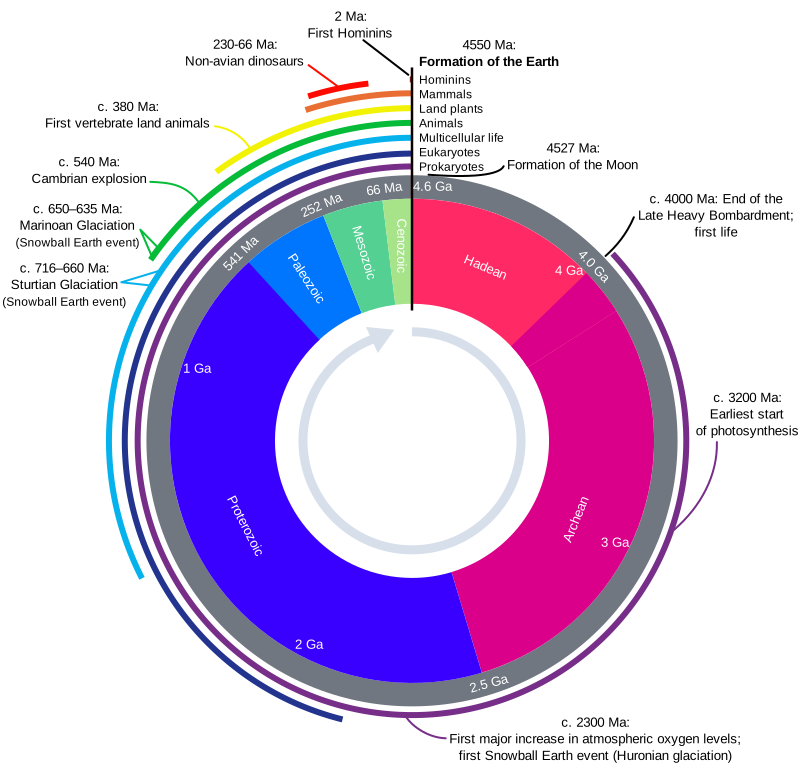
Another kinda humbling illustration:
https://upload.wikimedia.org/wikipedia/commons/7/79/Geologic...
https://upload.wikimedia.org/wikipedia/commons/7/79/Geologic...
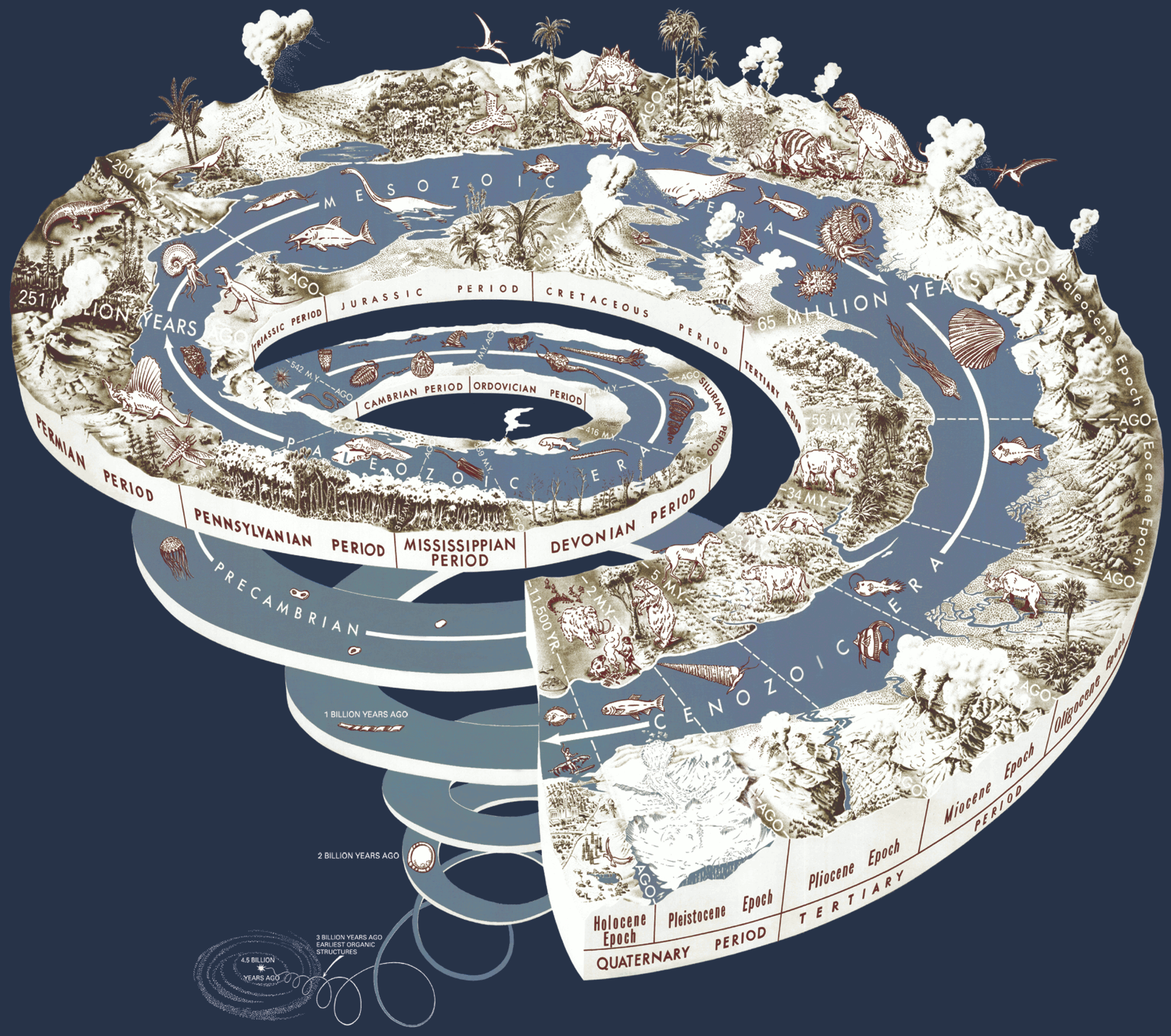
That's a really great illustration. Haven't seen it before. Thank you.
It's from here
https://en.wikipedia.org/wiki/Timeline_of_the_evolutionary_h...
which I found again via https://en.wikipedia.org/wiki/List_of_timelines
which I found again via https://en.wikipedia.org/wiki/List_of_timelines
I read somewhere we live closer in time to the t-rex than some other other dinosaurs (like the stegosaurus). Really got me thinking about how vastly longer the dinos have walked the earth.
Probably an overall better read from three months ago:
"What Caused the Dinosaur Extinction?" https://news.ycombinator.com/item?id=17738051
"What Caused the Dinosaur Extinction?" https://news.ycombinator.com/item?id=17738051
It's time to hunt space rocks.
https://www.scribd.com/document/374712301/20180227-David-L-G...
https://www.scribd.com/document/374712301/20180227-David-L-G...
[deleted]
66 mya. Never forget.
I later learned that my home town is on the edge of Europe's largest impact crater. https://en.m.wikipedia.org/wiki/Siljan_Ring
Most people seem to just... not care. :)