It’s All Greek to You and Me, So What Is It to the Greeks?(atlasobscura.com)
atlasobscura.com
It’s All Greek to You and Me, So What Is It to the Greeks?
https://www.atlasobscura.com/articles/its-all-greek-to-me
76 comments
And to step sideways and combine the two, ever hear of the Language of the Birds?
> In mythology, medieval literature and occultism, the language of the birds is postulated as a mystical, perfect divine language, green language, Adamic language, Enochian, angelic language or a mythical or magical language used by birds to communicate with the initiated.
https://en.wikipedia.org/wiki/Language_of_the_birds
> In mythology, medieval literature and occultism, the language of the birds is postulated as a mystical, perfect divine language, green language, Adamic language, Enochian, angelic language or a mythical or magical language used by birds to communicate with the initiated.
https://en.wikipedia.org/wiki/Language_of_the_birds
Yes but they speak Hebrew in heaven, so the chain continues.
EDIT: Looks like Hebrew speakers use Chinese, so we're in a loop.
EDIT: Looks like Hebrew speakers use Chinese, so we're in a loop.
https://bigthink.com/strange-maps/362-greek-to-me-mapping-mu... has a DAG that includes Chinese -> Heavenly Script.
I read that article a while ago, and until a moment ago assumed this discussion was about it. "Atlas Obscura" and "Strange Maps" are similar enough that I got them mixed up.
I read that article a while ago, and until a moment ago assumed this discussion was about it. "Atlas Obscura" and "Strange Maps" are similar enough that I got them mixed up.
This reminds me of a lighthearted paper my former CS professor wrote back in 1978, where he looks for equivalents of “it was Greek to me” and uses them to created a directed graph between languages to determine which is the hardest:
https://people.cs.umass.edu/~rsnbrg/hardest.pdf
Spoiler alert: it’s Chinese.
https://people.cs.umass.edu/~rsnbrg/hardest.pdf
Spoiler alert: it’s Chinese.
Which mentions "High Dutch" and "Double Dutch" being used in Britain. The latter being what I experienced.
I immediately see Noam Chomsky in the text. Could you give me a recommendation on which book to start reading from him? He published so many and a few got revised in 2015 so it's pretty hard to decide what is a good read.
In Hebrew we also say "It's Chinese" when we don't understand something.
Interestingly enough, I took the family to Greece just last month and explained to the children that in English, it is said that something sounds Greek if it cannot be understood. My oldest was wise enough to ask why, if Greek is the root of so many English words. I still don't have an answer for her!
Interestingly enough, I took the family to Greece just last month and explained to the children that in English, it is said that something sounds Greek if it cannot be understood. My oldest was wise enough to ask why, if Greek is the root of so many English words. I still don't have an answer for her!
Just a guess, but the Catholic Church relied on a Latin translation of the Bible. Accordingly, schools taught Latin as you needed it to understand the Bible and the Mass.
Those schools also taught Ancient Greek for advanced students to be able to read philosophy and portions of the Bible. This was useful if you wanted to be a priest, but otherwise it was just a pointlessly hard course for most students.
Those schools also taught Ancient Greek for advanced students to be able to read philosophy and portions of the Bible. This was useful if you wanted to be a priest, but otherwise it was just a pointlessly hard course for most students.
I had read that during the Roman empire there was a lot of Latin-Greek bilingualism, and that an educated person would be expected to know both, even in the western part of the empire. At some point that ceased to be the case and those places just got Vulgar Latin and the various Romance languages.
Thank you, I'm going to mention that possibility to the kids this evening. There are other oddities that they are familiar with regarding Biblical translations, such as Moses being depicted with horns.
Funnily enough, the word "barbarian" for uncivilized people comes all the way from Ancient Greek slang, proverbially meaning "people who speak in these 'bar bar bar' noises".[0] It's all bar bar bar to me. :)
[0]: https://en.wikipedia.org/wiki/Barbarian
[0]: https://en.wikipedia.org/wiki/Barbarian
"Barbarian" meant "foreigner", not "uncivilized".
Additional "fun" fact: in modern Greek, the onomatopoeia for "babbling" is "burbur".
Additional "fun" fact: in modern Greek, the onomatopoeia for "babbling" is "burbur".
I can confirm as a native Greek speaker we use Chinese for the same expression.
Based on the linked scale it is more accurate to say Japanese instead.
Based on the linked scale it is more accurate to say Japanese instead.
Am Romanian, we also use Chinese for the same expression. That is most of the times, we also use Turkish, as in: “What it is so hard to understand? Am
I speaking Turkish to you?”
Italian here, we use Arab for pretty the same sentence.
That's because we are still studying Greek and Latin on some public school.
That's because we are still studying Greek and Latin on some public school.
I wouldn't say that a language studied by a minority of students (those in liceo classico) is the reason we use "Arab" as the incomprehensible language shorthand. Especially when you consider that the Greek studied in liceo is not the Greek spoken in Greece today.
>I wouldn't say that a language studied by a minority of students (those in liceo classico) is the reason we use "Arab" as the incomprehensible language shorthand.
A minority today, but one would assume (as in the case in e.g. German and France) more (of students) in the past 50-100-200 years when the phrase was established.
A minority today, but one would assume (as in the case in e.g. German and France) more (of students) in the past 50-100-200 years when the phrase was established.
Thdre's the connotation of respect if not awe for the language, whereas this idiom is pejorative. The implication of the idiom is not "what, am I talking too educated?", quite the opposite (the connotation is not "stupid" either, just "way foreign")
Am American. We use alien.
Yes and no (meaning that we strangely use both Arabic and Turkish in different situations).
If you don't understand, you would say "Mi sembra arabo" (it seems arabic to me) but if you are talking and the other part doesn't understand it is more common "E che parlo, turco?" (what am I speaking, turkish?) than "E che parlo, arabo?" (what am I speaking, arabic?) at least in my experience.
Of course historically "turk" and "arab" were synonyms due to the fall of of Constantinople and the "contacts" with the Ottoman Empire.
And now, risking to quote myself, evidence of the sentence (by a greek) "it's English to me":
https://news.ycombinator.com/item?id=20484479#20485258
If you don't understand, you would say "Mi sembra arabo" (it seems arabic to me) but if you are talking and the other part doesn't understand it is more common "E che parlo, turco?" (what am I speaking, turkish?) than "E che parlo, arabo?" (what am I speaking, arabic?) at least in my experience.
Of course historically "turk" and "arab" were synonyms due to the fall of of Constantinople and the "contacts" with the Ottoman Empire.
And now, risking to quote myself, evidence of the sentence (by a greek) "it's English to me":
https://news.ycombinator.com/item?id=20484479#20485258
I never heard this Turkish expression, only the Arabic one. I always lived in the Milan area. Where is it used? "E che" sounds central Italy.
Sure, the "E che" form is tuscany and central Italy (as often happens considered archaic by someone), the "parlo turco" is italian alright:
http://www.treccani.it/vocabolario/ricerca/Parlare-turco/
A more "neutral" Italian would be "Parlo forse turco?".
Curiously, it is a sentence used in literature by Andrea Camilleri which should mean that the form is also in use in Sicily.
JFYI ;-) Mario Vigorone [1980]:
https://www.youtube.com/watch?v=4yANFI1bs9c
http://www.treccani.it/vocabolario/ricerca/Parlare-turco/
A more "neutral" Italian would be "Parlo forse turco?".
Curiously, it is a sentence used in literature by Andrea Camilleri which should mean that the form is also in use in Sicily.
JFYI ;-) Mario Vigorone [1980]:
https://www.youtube.com/watch?v=4yANFI1bs9c
Also the "parlo arabo?" is listed on treccani: http://www.treccani.it/vocabolario/arabo
BTW, I agree with the other comment that this is more common in the north.
BTW, I agree with the other comment that this is more common in the north.
[deleted]
In Danish, we say Volapük (well volapyk in Danish). So nice of us to give an artificial language some exposure.
https://en.wikipedia.org/wiki/Volap%C3%BCk
https://en.wikipedia.org/wiki/Volap%C3%BCk
Haha...the less successful forerunner to Esperanto (which I've been having a blast with on Duolingo).
In French we also use Chinese for the same expression.
When someone makes mistakes in English we say they speak English like a Spanish cow.
When someone makes mistakes in English we say they speak English like a Spanish cow.
You beat me to it μεγάλε (big guy), first word out of my mouth was κινέζικα (Chinese) -- in fact we use the term 'Κινέζος' (Chinese) as somewhat of an unknown unknown so to speak -- it's the same with the origin of the word for turkey (the bird) every culture seems to have a different locale in mind (https://en.wikipedia.org/wiki/Turkey_(bird)#History_and_nami...)
As for learning Japanese, believe me, it's nothing compared to Greek -- there are not as many tenses, nor genders, nor verb conjugations I'd suggest it's very similar to Hebrew which itself is rather similar to Greek in many ways
As for learning Japanese, believe me, it's nothing compared to Greek -- there are not as many tenses, nor genders, nor verb conjugations I'd suggest it's very similar to Hebrew which itself is rather similar to Greek in many ways
Phonetically (for Europeans) and from a grammar/alphabet/etc standpoint Japanese are easier than Chinese.
The awesome Argentinian move Un cuento chino is in English Chinese Take-Away or U.S. English Chinese Take-Out[0] ...because un cuento chino (literally, a Chinese story) means in Spanish a tall tale, a cock-and-bull story, a confusing mess[1], so the title (the movie features a Chinese guy and his extremely unlikely, hard-to-believe history) is rather untranslatable.
Another expression relating to a confusing mess is the wonderful Hungarian Flood-resistant mirror-drilling machine:
"Before Unicode became common in e-mail clients, e-mails containing Hungarian text often had the letters ő and ű corrupted, sometimes to the point of unrecognizability. It is common to respond to an e-mail rendered unreadable (see examples below) by character mangling (referred to as "betűszemét", meaning "garbage lettering") with the phrase "Árvíztűrő tükörfúrógép", a nonsense phrase (literally "Flood-resistant mirror-drilling machine") containing all accented characters used in Hungarian."[2]
[0] Australia here. What in the U.S. is apparently called take-out is called take-away here.
[1] https://www.wordreference.com/es/en/translation.asp?spen=un%...
https://forum.wordreference.com/threads/un-cuento-chino.7730...
[2] https://en.wikipedia.org/wiki/Mojibake#Hungarian
Another expression relating to a confusing mess is the wonderful Hungarian Flood-resistant mirror-drilling machine:
"Before Unicode became common in e-mail clients, e-mails containing Hungarian text often had the letters ő and ű corrupted, sometimes to the point of unrecognizability. It is common to respond to an e-mail rendered unreadable (see examples below) by character mangling (referred to as "betűszemét", meaning "garbage lettering") with the phrase "Árvíztűrő tükörfúrógép", a nonsense phrase (literally "Flood-resistant mirror-drilling machine") containing all accented characters used in Hungarian."[2]
[0] Australia here. What in the U.S. is apparently called take-out is called take-away here.
[1] https://www.wordreference.com/es/en/translation.asp?spen=un%...
https://forum.wordreference.com/threads/un-cuento-chino.7730...
[2] https://en.wikipedia.org/wiki/Mojibake#Hungarian
Here's a directed graph showing all of the language's versions of the idiom.
http://languagelog.ldc.upenn.edu/myl/graph2.png
from https://languagelog.ldc.upenn.edu/nll/?p=1024
http://languagelog.ldc.upenn.edu/myl/graph2.png
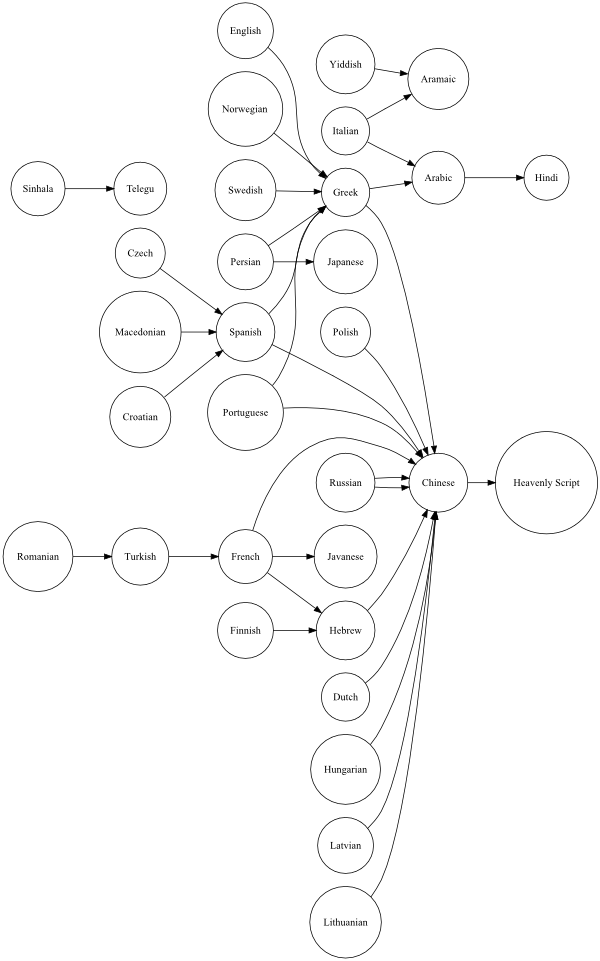
from https://languagelog.ldc.upenn.edu/nll/?p=1024
Using neato instead of dot to layout the graph is nice. I'll do that later if I get time, but I'm not in a position to do it just now.
Edit: Here:
https://www.solipsys.co.uk/images/DifficultyDiGraph.png
Edit: Here:
https://www.solipsys.co.uk/images/DifficultyDiGraph.png

The arrow from Spanish to Greek is wrong. Funnily enough, we only use "Greek" in slang as a way to refer to anal sex.
I thought the expression derived from the use of Greek alphabet characters in advanced math. With complex formulas looking like a bunch of Greek writing, this idiom fits perfectly.
Όλο το Ελληναριό του HN εδώ μαζεύτηκε :P
Greeks use Chinese as the canonical example of an incomprehensible language.
What's interesting is that although the "It's Greek to me" colloquialism mostly refers to the fact that the Greek alphabet seems incomprehensible to the (non-classical-humanities-educated) reader, Greek has actually a very complex grammar: Everything is conjugated, everything has genders, and you have to remember the correct form of every noun, preposition, article, pronoun, etc. In comparison, Chinese grammars are amazingly simple.
Most Greeks don't take notice of this fact until they see somebody struggling to learn Greek as a foreign language.
Greeks use Chinese as the canonical example of an incomprehensible language.
What's interesting is that although the "It's Greek to me" colloquialism mostly refers to the fact that the Greek alphabet seems incomprehensible to the (non-classical-humanities-educated) reader, Greek has actually a very complex grammar: Everything is conjugated, everything has genders, and you have to remember the correct form of every noun, preposition, article, pronoun, etc. In comparison, Chinese grammars are amazingly simple.
Most Greeks don't take notice of this fact until they see somebody struggling to learn Greek as a foreign language.
I am a polish native speaker and only after I have met my french-speaking girlfriend, I realized how insanelly difficult my language is, for all the reasons you have mentioned.
Πράγματι όλοι εδώ!
Not to mention the fact that ancient Greek seems like a foreign language to modern Greek speakers. Interestingly ancient Greek is more compact and comprehensive (ie uses fewer words compared to modern) as it uses a richer grammar (tenses, voices, etc)
Not to mention the fact that ancient Greek seems like a foreign language to modern Greek speakers. Interestingly ancient Greek is more compact and comprehensive (ie uses fewer words compared to modern) as it uses a richer grammar (tenses, voices, etc)
Άμα δω ελληνικά μπαίνω.
It's not as difficult as you'd expect, because word genders are derived from the suffix, with very few exceptions (e.g. η ψήφος). Compare with German, where there's no relation between the word and the gender (you just have to memorize all of them) and they still have the dative. This makes German grammar a superset (and strictly more complex) than Greek grammar.
It's not as difficult as you'd expect, because word genders are derived from the suffix, with very few exceptions (e.g. η ψήφος). Compare with German, where there's no relation between the word and the gender (you just have to memorize all of them) and they still have the dative. This makes German grammar a superset (and strictly more complex) than Greek grammar.
German here. We use Chinese, Spanish and train station.
As in: Am I talking Chinese to you?
And: That seems Spanish to me. Meaning"that doesn't seems to be right.
And if I am not able to grasp something I would say: I only understand train station.
As in: Am I talking Chinese to you?
And: That seems Spanish to me. Meaning"that doesn't seems to be right.
And if I am not able to grasp something I would say: I only understand train station.
Dutch: we use Chinese and Spanish to me as well, but it doesn't mean that something doesn't seem quite right. It typically means that you don't understand something. Looking in a dictionary, it is mentioned for Chinese, but not for Spanish, so maybe it's because I grew up close to the German border that the local dialect uses Spanish and thereby the people might also say Spanish in normal Dutch.
For the train station, we don't have something that means the same that I can think of right now, but a similar one is "my name is Haas". You can say it when you suspect someone just pretends not to know anything about it, but about yourself it can be used either way. Seems to be a purely Dutch thing, I looked up the Wikipedia and discovered that it does not have anything to do with the animal "haas" (hare). Somewhat unsurprisingly, it comes from a story about a German:
https://nl.wikipedia.org/wiki/Mijn_naam_is_haas
Paraphrased in English: The saying probably stems from an event in 1855, where a German student wanted to flee to France. To cross the border, he needed an identity card, which he got from a classmate, Victor von Hase. Von Hase then claimed he lost his ID, but it was later found in France, where the murderer had lost it. The real Von Hase had to appear in court and that is where he spoke the words millions would come to speak after him: "Mein Name ist Hase [...] ich weiß von nichts." (My name is "hare", I don't know anything about this.)
For the train station, we don't have something that means the same that I can think of right now, but a similar one is "my name is Haas". You can say it when you suspect someone just pretends not to know anything about it, but about yourself it can be used either way. Seems to be a purely Dutch thing, I looked up the Wikipedia and discovered that it does not have anything to do with the animal "haas" (hare). Somewhat unsurprisingly, it comes from a story about a German:
https://nl.wikipedia.org/wiki/Mijn_naam_is_haas
Paraphrased in English: The saying probably stems from an event in 1855, where a German student wanted to flee to France. To cross the border, he needed an identity card, which he got from a classmate, Victor von Hase. Von Hase then claimed he lost his ID, but it was later found in France, where the murderer had lost it. The real Von Hase had to appear in court and that is where he spoke the words millions would come to speak after him: "Mein Name ist Hase [...] ich weiß von nichts." (My name is "hare", I don't know anything about this.)
The same saying exists in German as well.
Oh, odd that there is no mention of it on the Wikipedia page, nor a translation.
I was never aware of the origin, but I know the use. And I was born and raised quite far from the Dutch border, so it’s not local spillover.
I’d put that down to the notoriety requirements of the German Wikipedia which are somewhat peculiar.
Edit: It’s mentioned on this Wikipedia page https://de.m.wikipedia.org/wiki/Victor_Hase and TIL: The expression was coined in the city I was born in.
I’d put that down to the notoriety requirements of the German Wikipedia which are somewhat peculiar.
Edit: It’s mentioned on this Wikipedia page https://de.m.wikipedia.org/wiki/Victor_Hase and TIL: The expression was coined in the city I was born in.
And in Spanish we use Chinese.
That last point brings to mind an idiom in Finnish. When you don't understand something, you can say "En tajua hölkäsen pöläystä". Now, the funny thing about this is that I don't think most Finns could tell you what "hölkäsen pöläys" actually means; it's just a part of the idiom, and kind of invokes the feeling of nonsensical speech. The words themselves are nonsense.
The literal translation is therefore "I don't understand hölkäsen pöläys" :P
The literal translation is therefore "I don't understand hölkäsen pöläys" :P
There’s a real background to “ich verstehe nur Bahnhof” though. It’s not nonsense, it reportedly has its origins at the end of the First World War when german soldiers wanted to travel home. All they were interested in was getting to the train station. https://german.stackexchange.com/questions/3248/meaning-and-...
Side-note but I rather disagree with placing Mandarin and Cantonese on the same level. Cantonese is definitely quite a bit harder than Mandarin...
As for Japanese being harder than Mandarin and Cantonese, I think it's true if one considers complete mastery of the language but I would say that Japanese is easier to master orally for day to day life than either Mandarin or Cantonese.
As for Japanese being harder than Mandarin and Cantonese, I think it's true if one considers complete mastery of the language but I would say that Japanese is easier to master orally for day to day life than either Mandarin or Cantonese.
A Japanese friend told me, Chinese is as easy as English. But characters are easy for him. For us Chinese is hard to speak because of the tones. The grammar seems very simple, simpler than any European language. Japanese has no tones so it's easier to speak. Reading and writing, both are a mnemonic nightmare. I remember European kids don't like multiplication tables, lol.
While it's not an equivalent phrase, many a Slavic language calls Germans "mutes" (нем/nem — mute, Germans: Немци/Nemci). "Slav/slov" comes from a "word", and then you've got these other folks nearby who can't really speak :-)
In Lebanese Arabic, the expression is: "Am I speaking Karshuni [1]?" Chinese, Turkish, and Kurdish are also used.
[1]: https://en.m.wikipedia.org/wiki/Garshuni
[1]: https://en.m.wikipedia.org/wiki/Garshuni
Hungarian: It's "full chinese" for me
Wikipedia article, with more examples: https://en.wikipedia.org/wiki/Greek_to_me
[deleted]
In Slovak, they say ‘Spanish village’ („španielska dedina“) for something beyond one's understanding.
In German: "Das sind für mich böhmische Dörfer" -> Bohemian (~Czech) villages.
But I only ever heard this one in Saxony, which borders the Czech Republic.
But I only ever heard this one in Saxony, which borders the Czech Republic.
Turkish here, we use French or Chinese
Another Turkish expression is, "Anladıysam Arap olayım" ( "Make me Arab if I understand"), again, Arabic to me, but expressed in reverse.
Jakartan (Indonesian) here, we use Hongkong (Cantonese) amusingly.
In México we say "It's in chinese".
Interesting that so many comments here talk about spanish being used as equivalent for "greek" in their culture.
Interesting that so many comments here talk about spanish being used as equivalent for "greek" in their culture.
Well growing up in England, that isn't what what we used.
We would say that something was "Double Dutch", not that it was "Greek to me".
We would say that something was "Double Dutch", not that it was "Greek to me".
Given how Dutch and Frisian and German relate to english, puzzling that double Dutch means incomprehensible,since for any sailor on the north sea coast and many Scots Dutch was a trading and neighbouring economy. Pantiles on roofs in Scotland came over as ballast trading sea coal to the Netherlands.
I also found this: https://www.phrases.org.uk/meanings/double-dutch.html
Which seems to suggest that "Double Dutch" (and "High Dutch") actually refer to the German language.
Which seems to suggest that "Double Dutch" (and "High Dutch") actually refer to the German language.
In French Hebrew is used (c’est de l'hébreu)
It might depend on the region, to me Chinese feels more natural. "c'est du chinois"
In Hebrew its Chinese.
In many Slavic languages, the word for Germans literally translates as "the mutes".
Esperanto: It's Volapük to me (estas Volapukaĵo al mi).
[deleted]
In Chinese we say it's "book from heaven"("天书"), for incomprehensible writings. That's the end of the this English...->Geek->Chinese->heaven sequence
For speakings, yes it's "bird language" ("鸟语"), but the "bird" here is used as a euphemism for male genital.
BTW Chinese is an analytic language, so the grammar is actually very easy.
See https://en.wikipedia.org/wiki/Analytic_language