Oil Companies Touted Recycling to Sell More Plastic(npr.org)
npr.org
Oil Companies Touted Recycling to Sell More Plastic
https://www.npr.org/2020/09/11/897692090/how-big-oil-misled-the-public-into-believing-plastic-would-be-recycled?t=1599932392400
164 comments
I'm in Chicago. Literally every time I see a garbage truck, it's dumping the recyclables in with the trash. This doesn't surprise me at all.
That’s a common urban myth. The trucks have several compartments.
Not where I live, at least not for glass. I can see down into them from above and it all goes into the same bin. No separation at all.
Which doesn’t make sense, since glass is relatively easy and economical to recycle. (I’m not saying what you say is untrue, there’s a lot of things in the world that doesn’t make sense.)
I know. Just wanted to say: "I can confirm this so called urban myth."
It's not that I'd been that interested in it, just read about it, and looked into it afterwards. And it happens. Again and again.
It's not that I'd been that interested in it, just read about it, and looked into it afterwards. And it happens. Again and again.
I’m sure it has happened, that like in he article, the recycling collector just puts it in the trash. But in many places, recycling is collected in garbage trucks, and sometimes in the same trucks as the trash with separate internal compartments. Whether that truck takes the contents to a recycling facility or not will depend on the local practices and economics.
Not just touted, but actively pushed legislative requirements that lied to consumers.
> Industry documents from this time show that just a couple of years earlier, starting in 1989, oil and plastics executives began a quiet campaign to lobby almost 40 states to mandate that the symbol appear on all plastic — even if there was no way to economically recycle it.
> Industry documents from this time show that just a couple of years earlier, starting in 1989, oil and plastics executives began a quiet campaign to lobby almost 40 states to mandate that the symbol appear on all plastic — even if there was no way to economically recycle it.
The blame is always shifted to the consumers, the logic being that consumers would make more sustainable decisions if they really cared about it, totally ignoring that it's either prohibitively expensive for many or almost impossible to judge the sustainability for many products.
> The blame is always shifted to the consumers, the logic being that consumers would make more sustainable decisions if they really cared about it
There is something funny in this common corporatist argument trying to get rid of responsibility by saying that "we just produce and sell what our customers demand". Namely, for some reason any proposal that would somehow increase the requirements for the corporations to disclose what, exactly, they are selling and how, exactly, that is produced, is vehemently opposed by the very same corporations.
To me, either you give full an unbiased disclosure about your products so that the customers can make their minds properly, or the ethics of your supply chain is your problem, not your customers. You just can't cherrypick here.
(sorry, no sources, just anecdotal impressions from public discussions during last decades.)
There is something funny in this common corporatist argument trying to get rid of responsibility by saying that "we just produce and sell what our customers demand". Namely, for some reason any proposal that would somehow increase the requirements for the corporations to disclose what, exactly, they are selling and how, exactly, that is produced, is vehemently opposed by the very same corporations.
To me, either you give full an unbiased disclosure about your products so that the customers can make their minds properly, or the ethics of your supply chain is your problem, not your customers. You just can't cherrypick here.
(sorry, no sources, just anecdotal impressions from public discussions during last decades.)
If consumers were compensated for recycling materials they would be much more inclined to sort properly. Recycling centers that take materials that cost too much to recycle likely have a government contract to "take care of it". They dont have a lot of incentive to be efficient. They get paid to make it disappear.
I don't know about where you live, but in California, we have a "bottle deposit" on both glass bottles and aluminum cans (~$0.10 per item), which gets returned to you if you bring it to a recycling center. The only people I see actually bothering to sort and return these are very low income people and homeless people that go through public trash cans.
NYC is the same, but the way refuse is handled makes it more convenient for people to “harvest” it. I lived on the Upper East Side for a while, and building managers would bag up recycling in clear bags. Then you’d see people out collecting the bottles and cans out of the bag but also making sure to tidy up afterwards. The collection crews would have gigantic bags, carts, etc. that they’d take to larger grocery stores to turn in for the deposit.
Any benefits of this are effectively negated by emissions from VMT's driving to the recycling center.
That seems win/win, doesn't it?
In Denmark its 1-3kr, or 15-50¢, depending on the size and material of the container.
Plenty of cans are collected by homeless / lowest income people, but it's also just about enough that average people will collect them too.
If I have a huge bag after a party, I return them. When I normally only have 0-2 bottles in a typical week, I take them outside and put them on the little shelf on the bin for someone to collect without needing to rummage: https://www.magasinetkbh.dk/sites/default/files/public/style...
New food packaging can only use recycled material collected in this way. The general household recycling is considered too dirty.
Plenty of cans are collected by homeless / lowest income people, but it's also just about enough that average people will collect them too.
If I have a huge bag after a party, I return them. When I normally only have 0-2 bottles in a typical week, I take them outside and put them on the little shelf on the bin for someone to collect without needing to rummage: https://www.magasinetkbh.dk/sites/default/files/public/style...
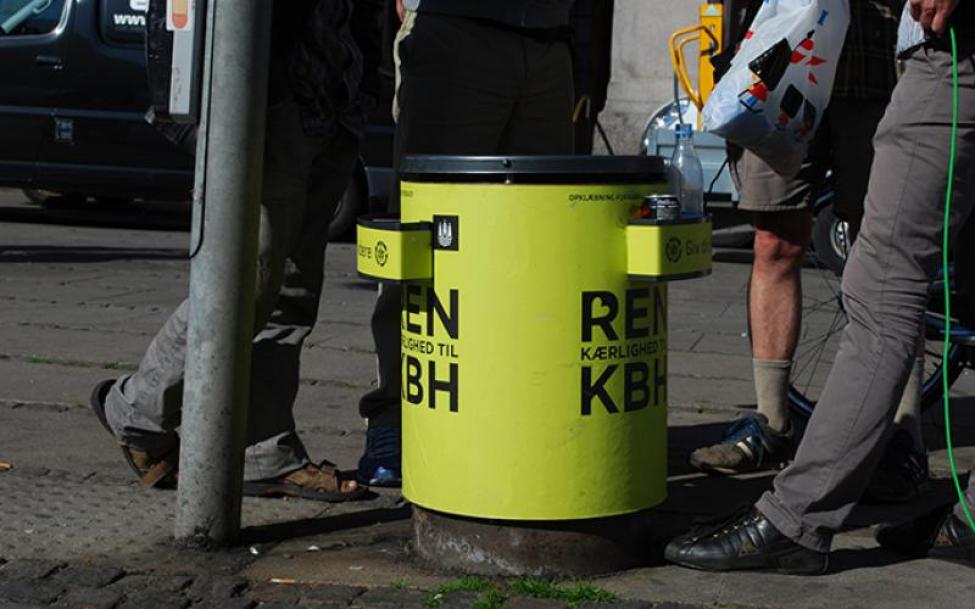
New food packaging can only use recycled material collected in this way. The general household recycling is considered too dirty.
This mirrors my experience in Germany. We would often save up a dozen or so bottles and bring them all to the grocery store where they could be returned. If we had a beer on the way to the bars we would typically just set the empty next to a garbage bin for someone to collect and return.
Reduce, reuse, recycle - meaning recycling is the last option.
It's better to not consume plastic in the first place, but if you must, find additional uses for it.
It takes more of a lifestyle change though than to simply put your cans in a different barrel. Which is probably why few people are willing to try it.
It's better to not consume plastic in the first place, but if you must, find additional uses for it.
It takes more of a lifestyle change though than to simply put your cans in a different barrel. Which is probably why few people are willing to try it.
This is not an individual choice. I can try to recycle plastic, but if there is no government programs to handle this issue, it will not work.
You can choose to reduce or reuse, though.
imagine you are a single, office worker, with long hours (no time to prepare your own lunches) and the only place you can get any food is the convenience store around the corner, you can get your lunch in a plastic container (bento box, sandwich container etc) and your drink from a pet bottle...
where is the choice to reduce there?
more than anything, the problem is the system and limited capabilities we have to reduce the usage of most plastic items
where is the choice to reduce there?
more than anything, the problem is the system and limited capabilities we have to reduce the usage of most plastic items
> Which is probably why few people are willing to try it.
This is placing a lot of the blame on individual people. I would very much like to use less plastic, and I'm willing to work for it... but my options are very limited. Nearly every product I buy is encased in multiple layers of plastic. I favor second hand stuff, and reduce my overall consumption by avoiding unnecessary purchases. Because I live in a major west-coast city, I can go out of my way to shop at a zero-waste grocery store - but they don't carry many things that I need for daily life.
Ultimately, consumer choice only works if there are options available. I can't vote with my dollars for things that are not on the ballot.
This is placing a lot of the blame on individual people. I would very much like to use less plastic, and I'm willing to work for it... but my options are very limited. Nearly every product I buy is encased in multiple layers of plastic. I favor second hand stuff, and reduce my overall consumption by avoiding unnecessary purchases. Because I live in a major west-coast city, I can go out of my way to shop at a zero-waste grocery store - but they don't carry many things that I need for daily life.
Ultimately, consumer choice only works if there are options available. I can't vote with my dollars for things that are not on the ballot.
I agree, asking 7 billion people to individually decide to change their habits is not an effective way to solve the problem. But regardless it is something you can currently do to help, even if in the end more will be needed.
I feel Americans tend to over-consume and undervalue reuse. I always get made fun of for selling my used things on ebay and also buying used instead of new.
I've heard that sentiment many decades ago too. I suspect it's because things cost the same price everywhere due to international trade but labor for repairing is cheaper in most other countries because they have lower incomes than America. So it may just be a rational economic decision, not the wrong amount of consumption and reuse.
There's a lot of friction when it comes to buying used (no warranty, no guarantees). Used doesn't necessarily mean it requires repair, but people often don't bother to re-sell things they aren't using and manufacturers have policies that try to destroy the used market (non transferrable warranties, planned obsolescence, etc).
Tons of countries want our dollars and flood us with with plastic shit to try to buy those dollars.
So don't buy plastic shit?
Many plastics can't safely be reused.
I'm not sure that judging people for not being sufficiently committed is going to save the planet. People are making money from doing this, and are going to protect their income. A pure lifestyle does make us feel better about ourselves, though.
I wonder what the world would look like now if there never was any oil. We’d have missed out on a lot of industrialising. Would we have had as many wars? I guess we could still have got into space using methane. Will all the positive stuff oil’s given us be undone by just how bad the climate gets? Interesting thought experiment!
Just realised it would probably just be a world filled with coal smoke, but at least less plastic pollution!
Have you seen before and after pictures of London buildings being power washed? The caked on coal dust is no joke, just imagine the inside of people's lungs...
https://www.manchestereveningnews.co.uk/news/nostalgia/manch...
https://www.manchestereveningnews.co.uk/news/nostalgia/manch...
A jump from coal straight to nuclear and renewables would have been possible.
That said, there are an innumerable number of side effects from cheap fossil fuels that would change present reality as we know it were they removed.
Removing cheap fossil fuel energy could have drastically slowed down emigration from cities to the burbs, so it’s also fun to imagine a different present where there’s dozens of New York Cities spread around the nation, connected by mass transport, and separated by vast swaths of mostly empty land. As EV tech and internet became widespread, it’s likely that the development of suburbia would only just begin to be happening now. Or not. Like you say though, fun thought experiment.
That said, there are an innumerable number of side effects from cheap fossil fuels that would change present reality as we know it were they removed.
Removing cheap fossil fuel energy could have drastically slowed down emigration from cities to the burbs, so it’s also fun to imagine a different present where there’s dozens of New York Cities spread around the nation, connected by mass transport, and separated by vast swaths of mostly empty land. As EV tech and internet became widespread, it’s likely that the development of suburbia would only just begin to be happening now. Or not. Like you say though, fun thought experiment.
It’s weird to think if we hadn’t had fossil fuels at all how badly it would have hampered human development. Could we have even got to modern development level without so much free power? It doesn’t seem likely. Perhaps the challenge would have forced us to come up with more imaginative solutions - I mean there’s oceans full of hydrogen for starters. And the sun would still be shining and the oceans still full of waves!
> Could we have even got to modern development level without so much free power?
It's only free if you don't consider externalities to be a cost.
It's only free if you don't consider externalities to be a cost.
Yeah of course, we know that now. I just mean could we have got to where we are now without it. How could we have done it differently?
I wonder what could have replaced all the plastic though?
And what would China be like if they never got to grow by making so much cheap plastic stuff to get them up the ladder to making so much tech stuff.
And what would China be like if they never got to grow by making so much cheap plastic stuff to get them up the ladder to making so much tech stuff.
Most of what oil provides you can get from coal and some chemistry, even liquid fuels. I think a world without coal would have been significantly different though.
Metals would be much more expensive, so most structures would have stayed would or stone. I think electric street cars would have been possible based on hydropower and minimal metal usage. That means cities would end up with mid density suburbs based on row houses like san francisco. More dramatic is the lack of cars means dramatically higher density by default without parking etc.
Wind power would have been a much bigger deal never really falling out of favor. Eventually solar would have become a major deal which probably scaled back to most of what we are used to.
Metals would be much more expensive, so most structures would have stayed would or stone. I think electric street cars would have been possible based on hydropower and minimal metal usage. That means cities would end up with mid density suburbs based on row houses like san francisco. More dramatic is the lack of cars means dramatically higher density by default without parking etc.
Wind power would have been a much bigger deal never really falling out of favor. Eventually solar would have become a major deal which probably scaled back to most of what we are used to.
What meaning of oil are you using?
Skin works a lot better with oil, for instance, and it isn't absurd to say that most cells in animals are made out of oil.
Skin works a lot better with oil, for instance, and it isn't absurd to say that most cells in animals are made out of oil.
Hah. I knew someone would take it super literally!
I’m just meaning without the in the ground stuff!
I’m just meaning without the in the ground stuff!
I didn't take it super literally though, I just pointed out that it was ambiguous.
Given the likely biological origins of petroleum, you'd have to phrase your hypothetical in terms of extraction to avoid the question.
Given the likely biological origins of petroleum, you'd have to phrase your hypothetical in terms of extraction to avoid the question.
Prior discussion: https://news.ycombinator.com/item?id=24441979
It was on the frontpage since yesterday. And the minute it drops off the frontpage, it gets spammed to the frontpage again. Unbelievable. Not only that another NPR story got spammed to the frontpage at the same time. Now that's interesting.
Edit: Looks like I touched a nerve.
Edit: Looks like I touched a nerve.
[deleted]
Important story by big news outfit is shared a lot is hardly interesting.
How can a frontpage based on user votes contain spam? Seems like you're implying something nefarious going on in order to explain a huge + impactful story's presence here?
It's perfectly normal. No one sees everything that gets posted or that appears on the front page.
Last few months this place is turned into reddit as the Reddit folks are exiled and leave in masses that site is just fake user accounts or maybe like 500 people with 5 million accounts. Real users are coming over here remembering that they can actually post stuff and it's screwing up this entire site. Because they vote brigade echo chamber stories.
I see the solution as just a better recycling symbol that a machine can easily recognize. Instead of the 7 broad categories, have 1000 highly specific categories and tag each piece in such a way that a machine can read the tag and sort it accordingly.
Number 1 plastic with water and number 1 plastic with yoghurt should have different tags because one may be contaminated and one not. The former might still be #1. The latter would be #278.
Solving the sorting problem would make recycling a lot more economical as that is where a lot of the costs are.
Number 1 plastic with water and number 1 plastic with yoghurt should have different tags because one may be contaminated and one not. The former might still be #1. The latter would be #278.
Solving the sorting problem would make recycling a lot more economical as that is where a lot of the costs are.
Digimarc have a product for exactly this. Not sure if they do the 1000 categories thing, but machine readable definitely.
With single stream everything is contaminated.
And then many of the categories simply aren't worth anything, sorted or not.
And then many of the categories simply aren't worth anything, sorted or not.
Who cares? Burn the plastic trash!
You get the plastic item use out of it, and you get almost all the energy from it as if you had burned the oil directly.
You get the plastic item use out of it, and you get almost all the energy from it as if you had burned the oil directly.
Trash can act as an energy store, to produce power during times when solar and wind production are low. If the plastics were ultimately produced from non-fossil carbon (as paper/cardboard are), what's the problem with this?
And the CO2 ends up in the atmosphere, rather than getting sequestered in the ground...
I think that will require a large number of new technologies to make such burning environmentally sustainable and cost competitive with other energy producing technologies. I don’t have enough science, engineering, or economic knowledge to even take a wild guess at the feasibility of such technology.
Maybe that would be a better challenge for Mr. Musk and various other privateers and governments than running away to Mars to escape the mess we’re making of our own planet.
Maybe that would be a better challenge for Mr. Musk and various other privateers and governments than running away to Mars to escape the mess we’re making of our own planet.
Plenty of countries have excellent trash burning plants already, all the technology exists. You only need to compete with peak oil burner plants, not the entire power producing chain. Same co2 emissions, a bit less electricity, but the trash doesn't go on horrible polluting landfills. Win-win.
Modern landfills don’t pollute.
Is there maybe an opportunity to use machine learning and vision here to perhaps create a business ? Anyone working on this ?
https://www.max-ai.com/ seem to be
Blockchain, too.
https://www.youtube.com/c/Bulkhandlingsystems/videos has demos of automatic sorting machines.
From the looks of those machines (size) it looks to be a big business already
https://en.wikipedia.org/wiki/Optical_sorting
There is an opportunity to improve this tech with better vision recognition systems. Already being worked on, but hasn't been implemented at large enough scale yet.
There is an opportunity to improve this tech with better vision recognition systems. Already being worked on, but hasn't been implemented at large enough scale yet.
If you go to Switzerland it opens your eyes a bit - there's no plastic recycling, there's only PET plastic recycling. If the bottle/whatever is not PET, it's not recycleble and you have to buy special, taxed bag that's used for "everything else" that gets burned/whatever. PET plastic can be recycled to lower grade plastic used for outdoor mats etc.
Also, you can bring back hard plastic packaging to grocery stores, they are supposed to handle it.
It looks like this has changed in the last few years.
Same in Japan.
On the other hand, packaging (and thus plastic waste) in Japan is next-level ridiculous. A fancier food present will be often wrapped in at least 3 layers, and I've counted u to 5: bag, present paper, normal box, group package, individual package.
On the other foot, Japan is next-level clean and don't think I've ever seen trash there on the streets, especially not like in South America. So more plastic in packaging but more goes into bins, wonder if it equalizes out on harm-done compared to Japan?
> So more plastic in packaging but more goes into bins, wonder if it equalizes out on harm-done compared to Japan?
in japan, most trash is incinerated... ive never looked into it, but i suspect that some amount of that turns into fine-grained soot (e.g not very healthy)
in japan, most trash is incinerated... ive never looked into it, but i suspect that some amount of that turns into fine-grained soot (e.g not very healthy)
They have these very fancy incineration towers distributed around Tokyo, I suspect they do filter a lot of the stuff being burned since I have never even seen them throw smoke nor smelled any burning:
https://www.tokyotimes.com/mysterious-tower-in-tokyo/
https://www.tokyotimes.com/mysterious-tower-in-tokyo/
thats good to know, i wonder if there are some differences between older and newer inceneration facilities...
when i lived near the ocean in kawasaki there was always some black fine-grained soot that would slowly build up over the year on a veranda, and wondered if it wasnt the nearby incinerators...
when i lived near the ocean in kawasaki there was always some black fine-grained soot that would slowly build up over the year on a veranda, and wondered if it wasnt the nearby incinerators...
Hm, harbour, ships? And in general dust from the tires and brakes of cars and trucks? In 2014 one container giant coming into the port here had a little mishap, burning heavy bunker oil which is only allowed at high seas. Turned on the fire alarms in a hospital 1 km away from the river, and several others too :-)
https://www.fotocommunity.de/photo/schwefelpilz-ms-yang-ming...
https://www.mopo.de/action/mopo/23044568/search?query=yang+m...
https://www.fotocommunity.de/photo/schwefelpilz-ms-yang-ming...
https://www.mopo.de/action/mopo/23044568/search?query=yang+m...
> Hm, harbour, ships? And in general dust from the tires and brakes of cars and trucks?
hmmm that probably makes more sense, yea
hmmm that probably makes more sense, yea
I also noticed that only PET plastic was recycled in Japan.
Is PET really more recyclable or is that just PR?
Is PET really more recyclable or is that just PR?
It is really more recyclable. It is still not infinitely recyclable so personally I'd prefer paper, glass, cloth, etc.
I remember plenty of ads, 20 or 30 years back, showing how they would be able to easily & cheaply break down & reuse plastic (they compared it to un- & re-zipping a zipper). Was that vision / promise simply abandoned, put on hold, or not true in the first place? (I'd put my money on #3, but the idea was cool).
It's #3 because there's too many molecular types of consumer plastic (so melting it isn't good enough to reuse), food contamination is a problem, and it's usually cheaper to make new plastic than move it and recycle it.
In addition, at least in North America, there is no consumer recycling - it's all landfilled unless a private contractor is paid vast sums to recycle it, or a local city council lucks into a good deal.
(I read newspapers until recently, and about once a year there's a short article on the inability to find a recycling partner, so off to the landfill it all goes. Doesn't matter what city. I have seen video of New York using a recycling barge that looks legit for at least some streams.)
The best you can do is burn plastic for electricity today, unless you redesign everything with a sane master recycling plan tomorrow.
The only benefit of consumer recycling in NA is that we've trained people on awareness and how to separate trash, kinda. There was a time when even that was unknown.
In addition, at least in North America, there is no consumer recycling - it's all landfilled unless a private contractor is paid vast sums to recycle it, or a local city council lucks into a good deal.
(I read newspapers until recently, and about once a year there's a short article on the inability to find a recycling partner, so off to the landfill it all goes. Doesn't matter what city. I have seen video of New York using a recycling barge that looks legit for at least some streams.)
The best you can do is burn plastic for electricity today, unless you redesign everything with a sane master recycling plan tomorrow.
The only benefit of consumer recycling in NA is that we've trained people on awareness and how to separate trash, kinda. There was a time when even that was unknown.
Almost all the plastic trash I see is due to food takeout.
If we simply were to require that food take out use reusable containers (special bins in public spaces, deliver people transport back to restaurant for home deliver) I think NYC could cut its waste by a huge portion.
I am sick of people saying problems are easy to fix by just enacting new laws or regulations. It is so naive.
Reusable containers are relatively heavy and take up space in delivery vehicles. It will cost the restaurants time and money to do this. People won’t spend the time to take the containers back so they will end up in the trash or people will find use for them. So all you’ve done is drive up food costs for low income folks and created more wasteful containers. How dumb is that?
While there may be some truth to this, another truth would be that as it is now we massively externalize the true costs by making it other peoples problems by shady schemes.
Yeah GP is presuming I want the regulation and I expect the restaurant business to otherwise function the same. Of course I don't. We're finally accounting for the externalities, and if this makes some restaurants unprofitable so be it.
Yeah OP is presuming I want the regulation and I expect the restaurant business to otherwise function the same. Of course I don't. We're finally accounting for the externalities, and if this makes some restaurants unprofitable so be it.
It doesn't help when progressive cities like Seattle provide giant recycling bins to houses with no charge for pickup, while charging regressive high prices for small regular garbage bins. It's a huge incentive just to throw excess plastic and foam bits into the recycling - people do not like getting charged another $5 for a one-time extra garbage bag pickup.
I think it is also just a huge incentive to simply throw anything into recycling bins. Just glancing inside the one at my complex reveals it is used as a normal trash bin by many.
I discovered this last year when our city posted on FB that you couldn't put berry and salad clamshell containers in recycling because if these were found then the entire batch would go to the landfill. After some clarification basically only water and coke bottles are eligible here.
I have called up the waste disposal departments now in three different cities I've lived in (Somerville, Boulder, Oakland) and in none of the cases did the people working there have a clue about how recycling works. They just didn't know anything about plastic.
I'd be like "can I recycle polystyrene (number 6) here" and they'd answer with "put any rigid plastic in the recycling" and I'm just like... that is not how it works...
Surprise -- none of those three cities can recycle polystyrene. That's what those clamshells are usually made of. Same material as packing peanuts, potentially my least favorite invention of the modern shipping industry.
I'd be like "can I recycle polystyrene (number 6) here" and they'd answer with "put any rigid plastic in the recycling" and I'm just like... that is not how it works...
Surprise -- none of those three cities can recycle polystyrene. That's what those clamshells are usually made of. Same material as packing peanuts, potentially my least favorite invention of the modern shipping industry.
I can't count the amount of flack I got for telling people about this years ago.
Non-aluminium recycling doesn't make a whole lot of sense in North America.
For plastics, you can make some case for PET recycling, but little else is at all practical.
Paper recycling is doable, but basically pointless when we have such high volumes of farmed pulp trees, and new pulp is more efficient than ever.
The one thing I could see working well is a subsidized glass reuse program. I know a lot of people who prefer to get things in glass anyhow, and cleaning/sanitizing glass at an industrial scale is an existing capability.
For plastics, you can make some case for PET recycling, but little else is at all practical.
Paper recycling is doable, but basically pointless when we have such high volumes of farmed pulp trees, and new pulp is more efficient than ever.
The one thing I could see working well is a subsidized glass reuse program. I know a lot of people who prefer to get things in glass anyhow, and cleaning/sanitizing glass at an industrial scale is an existing capability.
I'm pretty sure iron/steel recycling makes sense too, since that can be easily separated from the waste stream magnetically.
Glass, I don't think makes sense, except for downcycling to aggregate.
Glass, I don't think makes sense, except for downcycling to aggregate.
> I'm pretty sure iron/steel recycling makes sense too
Oh, sure, forgot that. Though steel and iron are not that common in household waste where I'm from.
I specifically point to glass reuse rather than glass recycling. As soon as you have to process glass, the energy costs are massive.
Oh, sure, forgot that. Though steel and iron are not that common in household waste where I'm from.
I specifically point to glass reuse rather than glass recycling. As soon as you have to process glass, the energy costs are massive.
The recycling rate for gold also asymptotically approaches 100%. There's plenty of money in recycling catalytic converters too. There's probably some clever economic law waiting for someone to name it after himself about recycling of metals and their market value.
Also we've all heard stories of, let's call it aggressive proactive copper recycling.
Also we've all heard stories of, let's call it aggressive proactive copper recycling.
Your measurement of "efficiency" appears to exclude the cost of the externalities associated with handling paper as waste.
What are those costs? My general understanding is that it may break down in a gassy way, but is that really so significant that it justifies the energy and opportunity cost involved in sorting and processing it for recycling? How does the cost of paper recycling compare to the cost of scaling up landfill gas recovery (something most operators are looking to do anyhow)?
Far as I can tell, some of the most popular recycled paper products, such as paperboard and molded pulp, actually require somewhere around twice as much energy to produce as virgin paperboard and molded pulp products.
Far as I can tell, some of the most popular recycled paper products, such as paperboard and molded pulp, actually require somewhere around twice as much energy to produce as virgin paperboard and molded pulp products.
Corporations lying to ensure revenue? No, I don't believe it.
When I first heard that in the US they just throw all "recycling" in the same bin it sounded insane. I'm used to sorting into colored glass, clear glass, paper, cardboard, metal, compost, batteries, plastic and "general".
I'm pretty sure the metal and plastic (if it actually is ever recycled) categories could benefit from better segmentation too.
I'm pretty sure the metal and plastic (if it actually is ever recycled) categories could benefit from better segmentation too.
Metal and plastic are super easy to separate by density or by electrical conductivity. Batteries are considered hazardous waste and have to be disposed of separately, similarly for old electronics or CFL bulbs that contain mercury.
But commingled recycling was one of the most predictably stupid moves in the area of environmentalism I've seen in a long time (well, prior to 2016 anyway), when I heard my city was moving to commingled recycling I knew they were no longer actually recycling it, I guarantee almost all of it ends up in the landfill because of contamination. It's so frustrating.
At least corn ethanol wasn't obviously quite so stupid upfront, it was always theoretically possible that it would make sense even if it was kind of obvious it wouldn't actually work.
But commingled recycling was one of the most predictably stupid moves in the area of environmentalism I've seen in a long time (well, prior to 2016 anyway), when I heard my city was moving to commingled recycling I knew they were no longer actually recycling it, I guarantee almost all of it ends up in the landfill because of contamination. It's so frustrating.
At least corn ethanol wasn't obviously quite so stupid upfront, it was always theoretically possible that it would make sense even if it was kind of obvious it wouldn't actually work.
Batteries are hazardous! You can take an empty AA-cell and drive a nail with a hammer through the middle from the side.
It makes buzzing and popping sounds, and there are blue-white arcs/tendrils all over it and the nail for maybe half a minute. Like crazy CGI in a movie! And it STINKS! That is for non-rechargables. Haven't tried that with rechargables.
It makes buzzing and popping sounds, and there are blue-white arcs/tendrils all over it and the nail for maybe half a minute. Like crazy CGI in a movie! And it STINKS! That is for non-rechargables. Haven't tried that with rechargables.
They are worse, lithium batteries tend to explode or catch fire. Cool description, I've never noticed these tendrils you describe.
I couldn't believe it either! Don't know if it were alakaline or something else anymore. I'm using rechargable Eneloops now, where possible. Honestly I can't remember anymore what has driven me to do that? Maybe frustration because empty so fast?
Awesome. They seem like a good choice, only a little lower capacity than alkaline and seem to hold capacity well. Much better than those old NiCd batteries.
The main downside is that the NiMH chemistry is 1.2V instead of 1.5V like alkaline. Same kind of issue as with the older NiCd batteries where they just didn't seem to put out as much juice. They just have a lower voltage.
Personally I'm not really sure how to do that best. Ideally you'd design electronics to run on a lower voltage to start with and always use rechargeable batteries but if they were going to do that you'd figure there'd just be a Li-Ion battery in there already. Must be primarily for cases where energy density or weight is the only consideration and waste is a very secondary concern.
My roomate used to work at A123 and one of his jobs was literally to drive nails through their lithium batteries to make sure they wouldn't explode. I think it's just a natural human drive to do things like throw batteries into a fire or drive nails through them or put them in a blender. We're a very strange species.
The main downside is that the NiMH chemistry is 1.2V instead of 1.5V like alkaline. Same kind of issue as with the older NiCd batteries where they just didn't seem to put out as much juice. They just have a lower voltage.
Personally I'm not really sure how to do that best. Ideally you'd design electronics to run on a lower voltage to start with and always use rechargeable batteries but if they were going to do that you'd figure there'd just be a Li-Ion battery in there already. Must be primarily for cases where energy density or weight is the only consideration and waste is a very secondary concern.
My roomate used to work at A123 and one of his jobs was literally to drive nails through their lithium batteries to make sure they wouldn't explode. I think it's just a natural human drive to do things like throw batteries into a fire or drive nails through them or put them in a blender. We're a very strange species.
>We're a very strange species.
Indeed :)
Btw. I have an old Canon Powershot A1200 which works flawlessly with the Eneloops. Even during cold weather under -10°C where the display begins to act weird(color shift).
Indeed :)
Btw. I have an old Canon Powershot A1200 which works flawlessly with the Eneloops. Even during cold weather under -10°C where the display begins to act weird(color shift).
Eneloop's initial voltage is low(1.2v) but its voltage drop curve is gentle than alkaline so it's usable on most devices.
> Metal and plastic are super easy to separate by density or by electrical conductivity
Yeah, what I meant by better segmentation is not to separate them from each other (we do that) but rather by type. Some plastics are easier to recycle than others and I don't know if metals can be easily and automatically sorted from each other.
Yeah, what I meant by better segmentation is not to separate them from each other (we do that) but rather by type. Some plastics are easier to recycle than others and I don't know if metals can be easily and automatically sorted from each other.
Well, some are magnetic, some are not, that's just one way to differentiate them.
Here are a couple videos I know (in French) from consignesdetri.fr:
https://youtu.be/KgW1TP909NU?t=36 (you can see the magnetic belt at that timestamp)
https://www.youtube.com/watch?v=vMJ-pDG_afk For an aluminium can. They mention doing the same with eddy currents [1] [2]
I also recall seeing a big, spiky magnetic roller in some video instead of a magnetic belt, so implementation details can vary, but this seems to be pretty standard stuff.
Less standard is the plastic-sorting equipment, though that can be achieved with hyperspectral cameras and the like (read: expensive). In some places, there are separate bins for colored and transparent glass. Some facilities use detectors instead.
[1] https://en.wikipedia.org/wiki/Eddy_current_separator
[2] https://en.wikipedia.org/wiki/Eddy_current#Repulsive_effects...
Here are a couple videos I know (in French) from consignesdetri.fr:
https://youtu.be/KgW1TP909NU?t=36 (you can see the magnetic belt at that timestamp)
https://www.youtube.com/watch?v=vMJ-pDG_afk For an aluminium can. They mention doing the same with eddy currents [1] [2]
I also recall seeing a big, spiky magnetic roller in some video instead of a magnetic belt, so implementation details can vary, but this seems to be pretty standard stuff.
Less standard is the plastic-sorting equipment, though that can be achieved with hyperspectral cameras and the like (read: expensive). In some places, there are separate bins for colored and transparent glass. Some facilities use detectors instead.
[1] https://en.wikipedia.org/wiki/Eddy_current_separator
[2] https://en.wikipedia.org/wiki/Eddy_current#Repulsive_effects...
Metals can be sorted fairly efficiently. Most types of steel can be pulled out with magnets. Nonmagnetic metals can be sorted from plastic by having a conveyor belt chuck the incoming stream over an gap with a magnetic field applied to it. The magnetic field induces a current in the flying metal, causing the metal itself to become magnetic. This causes the metal to slow down (eddy current braking), and now you have physically separate streams of plastic etc. (fast) and metal (slow).
Plastic separation is tricky, they tend to have similar physical properties so you end up relying on small density differences or optical properties or computer vision which is obviously not so great. I think most places it's still more cost effective to do it by hand.
Metals are easy to separate from one another, they tend to have substantially different densities and electrical properties. Aluminum for instance is not magnetic while steel cans are, but aluminum is conductive so if it passes through a magnetic field it will still get slowed down.
Those are the two big ones in any case. Then you could get to things like nickel (magnetic but intermediate conductivity) or tin (light but non magnetic) or maybe zinc/magnesium, but basically the densities are more different and the properties are more different so it's easier to tell them apart. And for some things that it can't figure out it makes sense to just landfill it.
Plastics though, absolutely vastly harder. You can use density but it only varies by a few percent. You can use diffraction gratings and cameras to see crystals and maybe sort a bit by that. But really it's just very hard, especially since the same polymer has different molecular weights and crystallinity. Your milk jug is milky while the same molecule processed differently is clear.
But even that's a mess -- you can't generally "depolymerize" these things very easily, you are really melting them back together and reusing the melt. When you start from monomers you can control the molecular weight (chain length) which controls things like crystallinity and stiffness, so the quality is higher. If you melt a variety of different molecular weights back together even if they're the same exact molecule the physical properties will just by worse. It's just the nature of the beast, and it sucks.
Even if you recycle by perfectly melting all the PET with perfect sorting and no food residue you'll be guaranteed to increase the variability in the physical properties of the output. It's just chemistry, unless you can convert it back to monomers it'll never be as good even in the best case.
For metals at least you can count on a fairly full recovery if you invest in it, it's not like polymers where it's just not possible. Even with alloys like steel you can at least in principle go back to the raw materials if you wanted, even if they are quite tricky.
Metals are easy to separate from one another, they tend to have substantially different densities and electrical properties. Aluminum for instance is not magnetic while steel cans are, but aluminum is conductive so if it passes through a magnetic field it will still get slowed down.
Those are the two big ones in any case. Then you could get to things like nickel (magnetic but intermediate conductivity) or tin (light but non magnetic) or maybe zinc/magnesium, but basically the densities are more different and the properties are more different so it's easier to tell them apart. And for some things that it can't figure out it makes sense to just landfill it.
Plastics though, absolutely vastly harder. You can use density but it only varies by a few percent. You can use diffraction gratings and cameras to see crystals and maybe sort a bit by that. But really it's just very hard, especially since the same polymer has different molecular weights and crystallinity. Your milk jug is milky while the same molecule processed differently is clear.
But even that's a mess -- you can't generally "depolymerize" these things very easily, you are really melting them back together and reusing the melt. When you start from monomers you can control the molecular weight (chain length) which controls things like crystallinity and stiffness, so the quality is higher. If you melt a variety of different molecular weights back together even if they're the same exact molecule the physical properties will just by worse. It's just the nature of the beast, and it sucks.
Even if you recycle by perfectly melting all the PET with perfect sorting and no food residue you'll be guaranteed to increase the variability in the physical properties of the output. It's just chemistry, unless you can convert it back to monomers it'll never be as good even in the best case.
For metals at least you can count on a fairly full recovery if you invest in it, it's not like polymers where it's just not possible. Even with alloys like steel you can at least in principle go back to the raw materials if you wanted, even if they are quite tricky.
So what you're saying is that separating glass, cardboard, paper, compost, metal (which we can separate from one another if it is just metal by the methods you described) is valuable, but the all plastic can go in the "general" type, right?
Glass, cardboard, paper and compost are either recyclable or reusable, metal is recyclable when sorted correctly, and plastics are pretty much a no-go as the parent article suggests, right?
Glass, cardboard, paper and compost are either recyclable or reusable, metal is recyclable when sorted correctly, and plastics are pretty much a no-go as the parent article suggests, right?
Except by burning it as fuel, yes, that's basically what I'm saying. I don't think this would be news to a material scientist trained since the 90s, but marketing is strong.
I think some people take the "plastic recycling is not viable" to mean that all recycling is not a thing, so I wanted to make sure I didn't misunderstand you about things like glass, cardboard, paper, metal and so on.
I think it's even harder to separate those concepts if you throw all recycling in the same bin.
I think it's even harder to separate those concepts if you throw all recycling in the same bin.
I think the point of the NPR piece is that the recycling symbols started intentionally and have continued to be for marketing.
I don't think it's viable to recycle paper products meaningfully, but they're also made from farmed trees and burn so I don't object overmuch to them. Worst case they sequester carbon...
Glass is tricky and probably cheaper to make fresh right now but it's not that big a difference to recycle it. You'd only need a marginal incentive, or for sand to somehow become more expensive.
Metal is really worth recycling economically, energetically, and technically. Glass is worth keeping separate since it can be recycled pretty easily. Paper products frankly just burn em as biofuels.
Plastics... well... I just kind of wish they didn't exist except for special applications where their unique properties were necessary. They are space age, high performance, specialty materials and we use them like they're paper cups. Use PTFE for specialty tubing, great. Use rubber tires for cars, great.
Use plastics where the properties matter. Don't use it for cups... it's just so sad...
I don't think it's viable to recycle paper products meaningfully, but they're also made from farmed trees and burn so I don't object overmuch to them. Worst case they sequester carbon...
Glass is tricky and probably cheaper to make fresh right now but it's not that big a difference to recycle it. You'd only need a marginal incentive, or for sand to somehow become more expensive.
Metal is really worth recycling economically, energetically, and technically. Glass is worth keeping separate since it can be recycled pretty easily. Paper products frankly just burn em as biofuels.
Plastics... well... I just kind of wish they didn't exist except for special applications where their unique properties were necessary. They are space age, high performance, specialty materials and we use them like they're paper cups. Use PTFE for specialty tubing, great. Use rubber tires for cars, great.
Use plastics where the properties matter. Don't use it for cups... it's just so sad...
> I'm used to sorting into colored glass, clear glass, paper, cardboard, metal, compost, batteries, plastic and "general".
I wonder how much people in your area recycle in general. With this many categories - and the unstated requirement that plastic/metal/glass containers must be cleaned/degreased, labels peeled off, etc., I'd personally give up on recycling altogether.
This work shouldn't be done by consumers because it's inefficient across the board. It wastes much more total man-hours, and a lot more water and power, compared to a centralized sorting facility.
I wonder how much people in your area recycle in general. With this many categories - and the unstated requirement that plastic/metal/glass containers must be cleaned/degreased, labels peeled off, etc., I'd personally give up on recycling altogether.
This work shouldn't be done by consumers because it's inefficient across the board. It wastes much more total man-hours, and a lot more water and power, compared to a centralized sorting facility.
Can you fill in the rest of the picture? How many different receptacles do you have to put out on the street?
Not the OP, but my apartment building has three different types of trash containers in the yard; there's one for glass; there's one for paper, plastic and aluminum cans together (I presume because those can be separated automatically somehow), and the third is for general household waste. The garbage collection fees are based on the volume of the general waste, collecting the sorted "recyclable"(it's not necessarily recycled) trash is subsidized to be free.
There's the fourth type of trash that we sort out which is things like batteries and electronics waste; these shall not be put in household waste but should be disposed in 'centralised' containers which are located at e.g. supermarkets.
There's the fourth type of trash that we sort out which is things like batteries and electronics waste; these shall not be put in household waste but should be disposed in 'centralised' containers which are located at e.g. supermarkets.
I live in an apartment complex, so we have different receptacles for each. But for single-family homes there are usually segmented so you have different subsections for each like this: https://www.rambo.se/wp-content/uploads/2016/12/fyrfackskrl-...
When I lived in my last apartment I carried the glass/plastic/paper/cardboard and so on a block over to a public recycling station, so that was a lot less convenient but I think they have dedicated receptacles now.
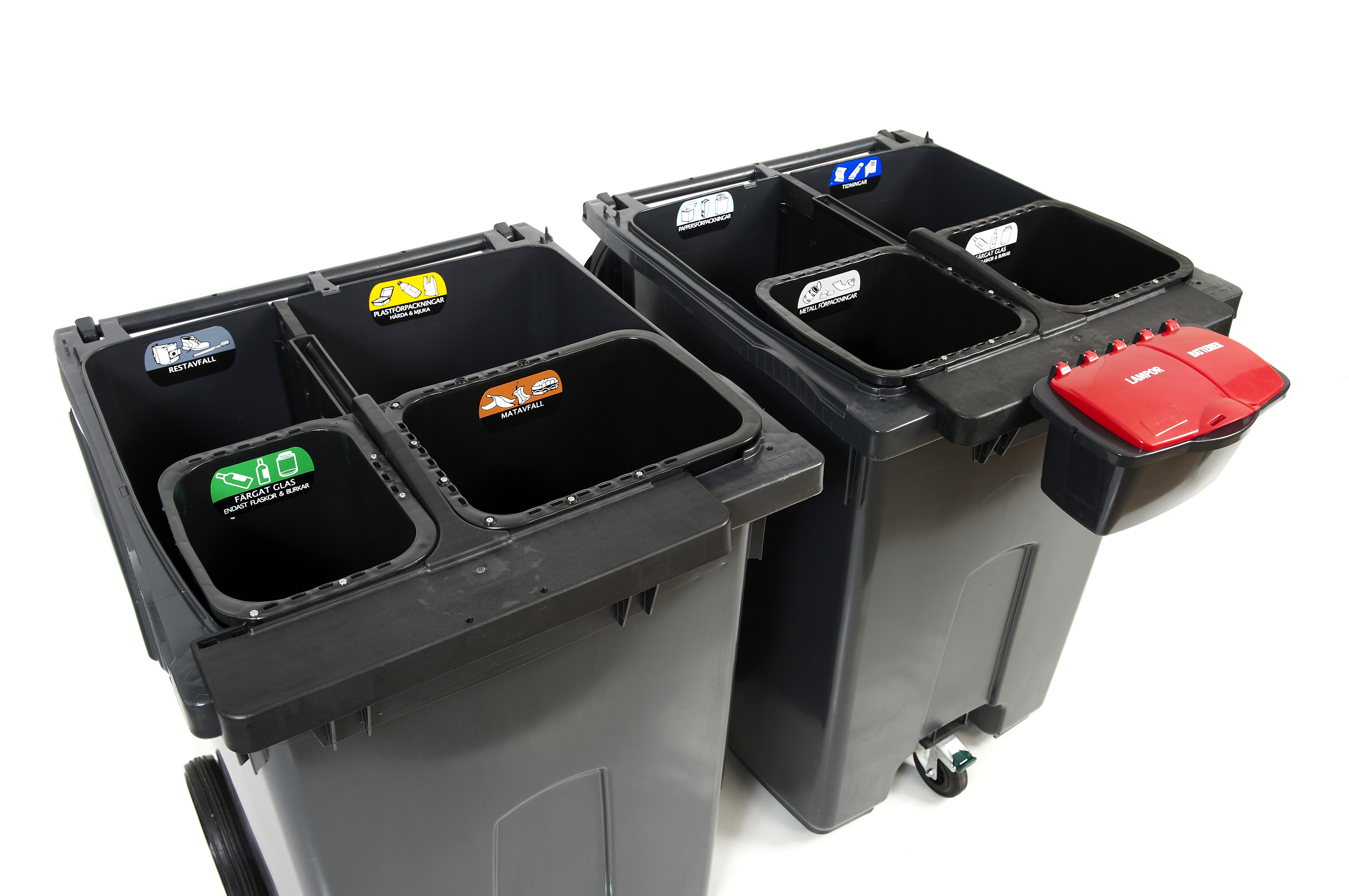
When I lived in my last apartment I carried the glass/plastic/paper/cardboard and so on a block over to a public recycling station, so that was a lot less convenient but I think they have dedicated receptacles now.
I was guessing you lived in an apartment complex but am pleasantly surprised by the sensible solution for single family homes. Thanks for sharing.
What does the emptying collection process look like for one of those barrels? I can only assume someone comes by, manually opens the lid and by hand takes out each of the smaller containers one by one, and empties them into larger segregated collection containers. Is that true?
No, it's pretty much as automated as a "normal" one, see here for a video: https://www.youtube.com/watch?v=q0WeV_9pS7I
Why? Separation actually works pretty well, I'm not sure why we need to "fix" that. What doesn't is people still leave food in things and don't do basic things like not throw in little bits of plastic like straws.
Separation is another step that needs to be taken somewhere else if not done by the consumer. The person throwing out garbage is the person responsible for the garbage and also the person that has the item in it's hand so they are both the best suited to sort it and the person that we should incentivize to do it.
I don't agree. It's more energy efficient and less environmentally destructive for you (or I) to walk everywhere we need to get to and yet here we are with bicycles, cars, airplanes, etc.
[deleted]
Same with batteries, far as I'm aware.
Can't actually be recycled. Just gathered and put in very large warehouses and nothing is done with it.
That's what our chemist teacher told us about 10 years back, anyway. So for me that remains in the "no idea what's actually true" camp.
Can't actually be recycled. Just gathered and put in very large warehouses and nothing is done with it.
That's what our chemist teacher told us about 10 years back, anyway. So for me that remains in the "no idea what's actually true" camp.
Great. Can we also discuss now how recycling paper hurts climate?
Modern landfills are airtight, so buried paper is sequestered carbon. Less buried paper - less sequestration.
Modern landfills are airtight, so buried paper is sequestered carbon. Less buried paper - less sequestration.
isn't sequestering carbon a good thing?
I think that's what he tried to say, if you recycle paper the carbon gets somehow released. But, in theory, the recycled paper will still come out as paper, thus carbon will still be there.
> in theory, the recycled paper will still come out as paper, thus carbon will still be there.
If paper never gets recycled it will continue accumulating in the landfill at a fast pace, so more carbon gets trapped over time.
If paper gets recycled the amount of captured carbon will be that trapped in the paper currently circulating. Even if some paper gets eventually trashed, it will not be at the same rate.
Recycling paper harms climate.
If paper never gets recycled it will continue accumulating in the landfill at a fast pace, so more carbon gets trapped over time.
If paper gets recycled the amount of captured carbon will be that trapped in the paper currently circulating. Even if some paper gets eventually trashed, it will not be at the same rate.
Recycling paper harms climate.
Yes. And the more paper gets recycled the less carbon gets sequestered. Recycling paper is harmful.
I'd love to see a class action lawsuit keeping the people who lied accountable for the amount of additional waste in effort, resources that are used to separate and collect these separate streams.
Stuff like this (h/t @neltnerb): >>In almost all locations, PLA, "compostable plastic" (often labeled number 7 or 0 for marketing) is not only not recyclable but actively contaminates compost and recycling plants. I see all these places using "compostable plastic" because they think it's more environmentally friendly. It's a noble goal, it makes me so sad to see.
So many groups would have standing to sue here...
Stuff like this (h/t @neltnerb): >>In almost all locations, PLA, "compostable plastic" (often labeled number 7 or 0 for marketing) is not only not recyclable but actively contaminates compost and recycling plants. I see all these places using "compostable plastic" because they think it's more environmentally friendly. It's a noble goal, it makes me so sad to see.
So many groups would have standing to sue here...
> I'd love to see a class action lawsuit keeping the people who lied accountable for the amount of additional waste in effort, resources that are used to separate and collect these separate streams.
The minuscule punishment that can be visited on the people involved in things like this won't clean up a molecule of the damage done, and won't be a deterrent for people who would do it in future (or who are doing similar things now.)
Revenge isn't a cure, executing murderers never brings people back to life. The problem is a system that gives a small number of people the power to cause such widespread damage for a relatively tiny amount of personal benefit. The amount of damage that has been done for a $10K bribe, or to keep a $150K/yr job, etc. is immeasurable. It's not scalable to track down or filter out people who will put their personal security or comfort ahead of yours, or your entire town's. We have to accept that the way that power is distributed is dangerously uneven, and consciously prevent that.
Also, let's not kid ourselves. This story will fade and be forgotten, and the practices will continue. The ability to stop powerful people from doing what they want to do isn't dependent on the consequences of what they do, but on the power that you have to stop them. Power comes from solidarity. They have it, through their command structure, and we don't. The American mind has retreated into various competing fantasies and myths; there's no chance for solidarity among the victims of these types of material harms.
The minuscule punishment that can be visited on the people involved in things like this won't clean up a molecule of the damage done, and won't be a deterrent for people who would do it in future (or who are doing similar things now.)
Revenge isn't a cure, executing murderers never brings people back to life. The problem is a system that gives a small number of people the power to cause such widespread damage for a relatively tiny amount of personal benefit. The amount of damage that has been done for a $10K bribe, or to keep a $150K/yr job, etc. is immeasurable. It's not scalable to track down or filter out people who will put their personal security or comfort ahead of yours, or your entire town's. We have to accept that the way that power is distributed is dangerously uneven, and consciously prevent that.
Also, let's not kid ourselves. This story will fade and be forgotten, and the practices will continue. The ability to stop powerful people from doing what they want to do isn't dependent on the consequences of what they do, but on the power that you have to stop them. Power comes from solidarity. They have it, through their command structure, and we don't. The American mind has retreated into various competing fantasies and myths; there's no chance for solidarity among the victims of these types of material harms.
Its (obviously) not about the renumeration of any individual, but about accountability of the source. There are several examples - Tabacco, Asbestos, Bopal, Oil, Medication, ... where billions of dollars of fines assessed against the sources, not exactly small numbers.
IIRC it's been a lie for quite a while where I live. It used to be that PNW "recyclables" were just shipped to China where I strongly suspect they were promptly landfilled after payment was collected. But China stopped taking our trash years ago, so now they are landfilled in the US. Ironically, it's likely less harmful to the environment overall, since you don't have to ship it first, and the US is likely to have more rigorous environmental standards for landfills.
aaron695(3)
I have difficulties to understand if that's US specific or also a problem in Europe and the rest of the world.
For example, I'm reading this article from 2011 that mentions that 77% of Japan's plastic is recycled: https://www.theguardian.com/environment/2011/dec/29/japan-le...
Is that complete bullshit too, or is something possible to actually achieve, just not in the US?
For example, I'm reading this article from 2011 that mentions that 77% of Japan's plastic is recycled: https://www.theguardian.com/environment/2011/dec/29/japan-le...
Is that complete bullshit too, or is something possible to actually achieve, just not in the US?
This probably depends on the country, and perhaps even municipality, but plastic is recycled properly here (.nl).
Plastic, drinking cartons and metals are collected in the same container. These three are separated using magnets[1] and infrared scanners. The plastics are melted down to little pellets that can be used to create new products. A common example are shampoo bottles. This video is in Dutch, but it has some overview of these sorting machines: https://www.youtube.com/watch?v=Gf--8o3yD6g
Based on this video about plastic recycling in Germany, I think the situation is very similar there: https://www.youtube.com/watch?v=I_fUpP-hq3A The video is in English. The plastics that are recycled there seem to be PET, PP and HDPE.
I'm absolutely in love with all the neat little tricks these machines use to sort the stuff. From simple ones like sieves and centrifuges, to fans and advanced imaging stuff. It's beautiful.
[1] Even aluminium can be sorted with magnets by doing some magic.
Plastic, drinking cartons and metals are collected in the same container. These three are separated using magnets[1] and infrared scanners. The plastics are melted down to little pellets that can be used to create new products. A common example are shampoo bottles. This video is in Dutch, but it has some overview of these sorting machines: https://www.youtube.com/watch?v=Gf--8o3yD6g
Based on this video about plastic recycling in Germany, I think the situation is very similar there: https://www.youtube.com/watch?v=I_fUpP-hq3A The video is in English. The plastics that are recycled there seem to be PET, PP and HDPE.
I'm absolutely in love with all the neat little tricks these machines use to sort the stuff. From simple ones like sieves and centrifuges, to fans and advanced imaging stuff. It's beautiful.
[1] Even aluminium can be sorted with magnets by doing some magic.
I think one of the comments in here mentions that Japan only accepts PET plastic which apparently doesn't have these issues. Regardless the main issue is that the US is not strict about how we label things or regulate things related to recycling. There is only a small subset of plastics that are recyclable.
I suspect "recycling" there means something like "separated and sent to Thailand to fuel cement kilns".
Um, what's the deal with editing the headline? The original asserts a statement. It may or may not be true. But why would it benefit HN readers to turn this assertion into a question?
no deal - the submission bookmarklet JS[1] automatically fills in the title from the html meta:
<title>Is Plastic Recycling A Lie? Oil Companies Touted Recycling To Sell More Plastic : NPR</title>
Ah thanks, that explains it. So it's partly NPR's fault for using a title tag different from the headline. I guess I was also confused because I think I had also seen the duplicate submission that used the headline, not the title tag, so I though this one was changed.
But that bookmarklet is also at fault, since at the minimum submissions are required to strip out the site's name if it occurs in the title, so leaving in the ": NPR" bit is a bug in this automated approach. So some amount of human post-processing will always be needed. And while submissions are expected to keep the original title, there is also a rule that egregious clickbait like the question in the title tag should be removed (which has now been done!).
But that bookmarklet is also at fault, since at the minimum submissions are required to strip out the site's name if it occurs in the title, so leaving in the ": NPR" bit is a bug in this automated approach. So some amount of human post-processing will always be needed. And while submissions are expected to keep the original title, there is also a rule that egregious clickbait like the question in the title tag should be removed (which has now been done!).
Just thought I would share an album I made from a trip to a Bay Area recycling facility. I shot a bunch of slow mo of recycling machinery.
It’s pretty crazy that they can’t sort black plastic because the machine relies on IR light to sense plastic type. We’ve got all these machine learning engineers in the area and probably not so many of them are working on real practical solutions to problems like trash sorting.
https://imgur.com/gallery/IK5zKkO
It’s pretty crazy that they can’t sort black plastic because the machine relies on IR light to sense plastic type. We’ve got all these machine learning engineers in the area and probably not so many of them are working on real practical solutions to problems like trash sorting.
https://imgur.com/gallery/IK5zKkO
Here's another one about paper recycling that I read in a book once. Surprisingly it's not discussed very much at all and its hard for me to judge how accurate it is.
"Recycling paper is not worth it. The paper we use is grown specifically to be harvested and used in paper. The act of growing and using this paper is a form of carbon sequestration. When we recycle paper, we lose out in an opportunity to sequester more carbon from the air. Landfills prevent the carbon in paper from re-entering the carbon cycle."
I think the most convincing argument against this is that the tree farms take up land that could be used for other purposes.
"Recycling paper is not worth it. The paper we use is grown specifically to be harvested and used in paper. The act of growing and using this paper is a form of carbon sequestration. When we recycle paper, we lose out in an opportunity to sequester more carbon from the air. Landfills prevent the carbon in paper from re-entering the carbon cycle."
I think the most convincing argument against this is that the tree farms take up land that could be used for other purposes.
I remember hearing some time ago that sorting at the facility was going to be more efficient than pre-sorting at home because we can't trust everyone to sort properly so sorting at the facility was required anyway. Is this not the case anymore? I see many other comments saying that comingled recycling is bad.
Well China did buy it for recycling, but since that is changing, the corporate narrative needs to change too.
https://slate.com/technology/2018/06/why-china-import-half-w...
https://slate.com/technology/2018/06/why-china-import-half-w...
Food waste in landfills is arguably a much bigger problem than plastics being dumped into landfills. The acid produced from the decomposing organics eats away plastics and metals, creating a toxic leachate. Landfills try to contain that, but it is not contained 100%. That stuff leaks out into soil, potentially into aquifers. Furthermore the methane gases can build up in the landfill with potentially explosive consequences. Many landfills add vertical pipes to vent it, but it isn't captured for later use, contributing to greenhouse gases.
Contrast that with being able to process food waste onsite (or at least the neighborhood level) using the carbon cycle -- vermicomposting and conventional composting. They feed the plant, and unlike oil-based fertilizers, they help build up soil fertility long-term.
There are many more actions an individual can take that contributes towards the health of the ecology. I think a lot of people latch onto recycling because it is one of the few things people know how to do that they think contributes towards a better ecology. But there are so many more impactful things individuals and communities can do, that does not depend upon forcing large megacorps to do the right thing.
Contrast that with being able to process food waste onsite (or at least the neighborhood level) using the carbon cycle -- vermicomposting and conventional composting. They feed the plant, and unlike oil-based fertilizers, they help build up soil fertility long-term.
There are many more actions an individual can take that contributes towards the health of the ecology. I think a lot of people latch onto recycling because it is one of the few things people know how to do that they think contributes towards a better ecology. But there are so many more impactful things individuals and communities can do, that does not depend upon forcing large megacorps to do the right thing.
> Rogue, like most recycling companies, had been sending plastic trash to China, but when China shut its doors two years ago, Leebrick scoured the U.S. for buyers.
So isn't a part of the article only relevant to the US, and other countries which were exporting plastic trash rather than actually recycling/using for derivative products?
> Here's the basic problem: All used plastic can be turned into new things, but picking it up, sorting it out and melting it down is expensive.
> Recycling plastic is "costly,"
By now, we should be well enough educated to say: "What do you mean by expensive or costly?"
Does it mean...
* Costs a lot of money in the current socio-economic order?
* Requires a lot of human effort?
* Requires a lot of electricity / other form of energy?
* Has a high carbon footprint (by some complex figuring)?
* Involves a process emitting pollutants?
If it's just the monetary cost, then in a sense - that doesn't matter. Just rearrange society so that either this is funded (or a non-monetary economy). If it's energy use - maybe it's worth it and it could be arranged to be done using solar collectors in the desert or whatever. And so on.
So isn't a part of the article only relevant to the US, and other countries which were exporting plastic trash rather than actually recycling/using for derivative products?
> Here's the basic problem: All used plastic can be turned into new things, but picking it up, sorting it out and melting it down is expensive.
> Recycling plastic is "costly,"
By now, we should be well enough educated to say: "What do you mean by expensive or costly?"
Does it mean...
* Costs a lot of money in the current socio-economic order?
* Requires a lot of human effort?
* Requires a lot of electricity / other form of energy?
* Has a high carbon footprint (by some complex figuring)?
* Involves a process emitting pollutants?
If it's just the monetary cost, then in a sense - that doesn't matter. Just rearrange society so that either this is funded (or a non-monetary economy). If it's energy use - maybe it's worth it and it could be arranged to be done using solar collectors in the desert or whatever. And so on.
When you recycle near me you're mostly just enriching China our local recycle facility does not usually recycle. Only when the recycle machinehas got capacity do we actually take the recycling to any type of recycle facility. Most of the time just gets thrown in the trash dump or it gets shipped overseas so that somebody else can sort through it. Along the way a lot of it mysteriously ends up in the ocean.