Healthcare in America Is Simply Extortion (2019)(gettingcanned.com)
gettingcanned.com
Healthcare in America Is Simply Extortion (2019)
https://gettingcanned.com/2019/05/01/healthcare-in-america-is-simply-extortion/
116 comments
As an European I lost you at "I called two local urgent cares". Just how? How it is not "the urgent care"? You had a crash and had to call around to see the prices. It is just mindboggling....
You can blame the politicians all you like, but they are merely a reflection of the people who vote for them. As much as we'd like to believe everyone can see how horrible this system is, it would seem that a lot of people are much more afraid of... something. Could be spending tax money on people they don't know and probably don't like, could be just letting the government run anything at all.
[deleted]
You can often retroactively activate Cobra for 60 days.
https://www.insure.com/health-insurance/cobra-tips.html#:~:t....
https://www.insure.com/health-insurance/cobra-tips.html#:~:t....
Yet…9 years ago, a similar situation and due to a layoff I decided to forgo cobra for the final two months before my wife’s insurance was available (she had a new job). In that time I fell on slick steps and broke a shoulder, bruised a hip, and sprained my ankle.
But I was able to negotiate my ER bill. Basically I told them that I would likely default on the bill anyway if it was extremely expensive. I told them what I could provide them, and they just billed me that amount. Ultimately it was cheaper than two months of cobra. Granted I would have bought cobra for the whole family and that is really expensive.
Point is, if you don’t have insurance, you should always ask your provider for their “cash price”. If they know there is no insurance and a likely default there are sometimes options.
It’s also worth inquiring about a cash price if your insurance wants a test that might be quite expensive for your out of pocket co-pay.
But I was able to negotiate my ER bill. Basically I told them that I would likely default on the bill anyway if it was extremely expensive. I told them what I could provide them, and they just billed me that amount. Ultimately it was cheaper than two months of cobra. Granted I would have bought cobra for the whole family and that is really expensive.
Point is, if you don’t have insurance, you should always ask your provider for their “cash price”. If they know there is no insurance and a likely default there are sometimes options.
It’s also worth inquiring about a cash price if your insurance wants a test that might be quite expensive for your out of pocket co-pay.
Insurance is the culprit. Insurance added a layer of abstraction between users and so users never had to know the actual cost. The folks on the product side never saw human costs as they simply dealt with a money pool. So they were able to raise prices at will, ruthlessly.
[deleted]
Literally every other developed country on Earth has universal healthcare in some degree. How do Americans accept that?
The top earning 50% of Americans with a stable w2 job (union + white collar jobs) get very "good" insurance where their job pays most of, while they pay a modest copay.
The bottom earning 25% of Americans have 0 assets and 0 money, so health care is effectively free. Go to a hospital, they must treat you, you can't pay the bill, so it gets written off.
The 26-49th percentile of people who have some money but no insurance are the people screwed by the current system.
So the reason why American's tolerate it.. is it works decently for 75% of the population. And it is hard for 25% of the population to really change anything. And of those, many are young and healthy so they don't really care. So maybe we are talking about 12.5% of the population being actively screwed by the system at any given time...
The bottom earning 25% of Americans have 0 assets and 0 money, so health care is effectively free. Go to a hospital, they must treat you, you can't pay the bill, so it gets written off.
The 26-49th percentile of people who have some money but no insurance are the people screwed by the current system.
So the reason why American's tolerate it.. is it works decently for 75% of the population. And it is hard for 25% of the population to really change anything. And of those, many are young and healthy so they don't really care. So maybe we are talking about 12.5% of the population being actively screwed by the system at any given time...
The bottom 25% of Americans don't have free health care. They won't be treated for anything that is not an emergency. There is a huge difference. Some die because diseases aren't detected until it is too late.
A large fraction of Americans in the bottom income quartile are on government Medicare and/or Medicaid plans. They can access regular treatment and preventative care, although the provider networks are limited in some areas.
it is even worse than the parent post.
28% of US population is low-income(<200% federal poverty level) and 21% are covered by Medicaid/CHIP. This leaves 6 percent who are low income and uncovered.
https://files.kff.org/attachment/fact-sheet-medicaid-state-U...
28% of US population is low-income(<200% federal poverty level) and 21% are covered by Medicaid/CHIP. This leaves 6 percent who are low income and uncovered.
https://files.kff.org/attachment/fact-sheet-medicaid-state-U...
Right. Some people would use it. Other's, typically rural Americans, have a deep distrust of the medical profession. They aren't going to go in for a yearly checkup, free or not free. It's very complicated.
Something that's a stark difference between US-style healthcare and British socialised-style healthcare is I don't get a yearly checkup in the UK - it's just not a service they offer. When I ask about this some people say it's not needed any way... not sure if that's right or not.
Routine annual checkups aren't medically justified for most healthy adults.
https://time.com/5095920/annual-physical-exam/
https://time.com/5095920/annual-physical-exam/
[deleted]
I wouldn’t say all of the 26-49 are screwed. A portion of those folks might be choosing not to pay for healthcare. They may be screwed if they get sick, but in general, if you opt out of paying intentionally and don’t get sick…you kind of “win”.
My biggest issue with the ACA was that it really didn’t fix the 26-49% and in many ways by mandating people buy insurance, especially young families making less than around $75k a year. made things worse.
My biggest issue with the ACA was that it really didn’t fix the 26-49% and in many ways by mandating people buy insurance, especially young families making less than around $75k a year. made things worse.
My understanding was the 'modest' copay can be thousands of dollars. Is that not right? Can you buy insurance to pay the copay?
Per year? I think as an employee the most I ever paid for a year of insurance for myself and my family was maybe $2k? On a salary of over 100k, it was pretty tiny.
Insurance to pay the copay makes no sense, insurance is not free money. It's a risk pool to allow you to be able to afford the million dollar surgery only 1/100 people need.
(I now own a business so am on the other side of the coin. I want nothing to do with health care. Why do I have to be involved? It's real dumb).
Insurance to pay the copay makes no sense, insurance is not free money. It's a risk pool to allow you to be able to afford the million dollar surgery only 1/100 people need.
(I now own a business so am on the other side of the coin. I want nothing to do with health care. Why do I have to be involved? It's real dumb).
> Insurance to pay the copay makes no sense
Why not I can pay a small sum to eliminate any potential copay on my car insurance?
Guaranteed to pay a small amount vs possibly going to have to pay a larger amount - that's the whole idea of insurance.
Why not I can pay a small sum to eliminate any potential copay on my car insurance?
Guaranteed to pay a small amount vs possibly going to have to pay a larger amount - that's the whole idea of insurance.
Sorry I am blending terms. Copay as your % of the insurance premium that your work buys you.
Example: Plan cost $2,000 per month. You have a $400 a month copay.
In retrospect, that is a bad term to use here, because copay means something totally different in insurance plans. There is also a copay for treatmeat, but not what I was talking about.
Example: Plan cost $2,000 per month. You have a $400 a month copay.
In retrospect, that is a bad term to use here, because copay means something totally different in insurance plans. There is also a copay for treatmeat, but not what I was talking about.
I’m not completely sure, but you seem to be confusing copay with the insurance premiums? Copay is the residual part of the cost of any given treatment that you have to pay after your insurance has (hopefully) paid for most of it.
As the sibling says, there is nothing inherently nonsensical about insuring against copay.
As the sibling says, there is nothing inherently nonsensical about insuring against copay.
Sorry I am blending terms. Copay as your % of the insurance premium that your work buys you.
Example: Plan cost $2,000 per month. You have a $400 a month copay.
In retrospect, that is a bad term to use here, because copay means something totally different in insurance plans. There is also a copay for treatmeat, but not what I was talking about.
Example: Plan cost $2,000 per month. You have a $400 a month copay.
In retrospect, that is a bad term to use here, because copay means something totally different in insurance plans. There is also a copay for treatmeat, but not what I was talking about.
You can buy a HSA, which is basically an non-taxable interest bearing savings account used to pay healthcare expenses where your contributions to it also decrease your taxable income.
So, it’s not insurance, but it’s a way to essentially decrease your out of pocket co-pays especially if it rolls over year to year and earns interest.
So, it’s not insurance, but it’s a way to essentially decrease your out of pocket co-pays especially if it rolls over year to year and earns interest.
> The top earning 50% of Americans with a stable w2 job (union + white collar jobs) get very "good" insurance where their job pays most of, while they pay a modest copay.
These folks are getting squeezed too, though. Copays keep increasing, employee contribution to premium increases, and healthcare increases have eaten compensation increases for 25 years.
These folks are getting squeezed too, though. Copays keep increasing, employee contribution to premium increases, and healthcare increases have eaten compensation increases for 25 years.
Yeah, my "good" insurance is costing me $500 per month. And I'm considered one of the lucky ones! For anyone curious that's for a family, but still!
I would expect the total costs to be $1,500 or more, meaning the employer is also paying > $1,000/mo for this plan. That's $18,000 annually that didn't go to each employee.
You are correct! And it's amazing how many Americans never take this into account when discussing single payer options. I'm not saying single payer or universal healthcare options are better, but at least when evaluating the different options and their costs we should be putting all the facts on the table.
> Go to a hospital, they must treat you
For emergency care, sure, but they don’t have to offer you expensive treatments for whatever health conditions you might have. It’s wishful thinking to think that poor Americans are getting adequate health care.
For emergency care, sure, but they don’t have to offer you expensive treatments for whatever health conditions you might have. It’s wishful thinking to think that poor Americans are getting adequate health care.
Right. It's not perfect, but it's pretty workable in a pinch.
In no means am I saying the current system is good or the right way, but simply offering reasons why there aren't enough people up in arms about the status quo.
In no means am I saying the current system is good or the right way, but simply offering reasons why there aren't enough people up in arms about the status quo.
Err, no. Using emergency care as your only source of care is not “workable in a pinch”. It represents a vastly lower standard of care than that available to poor people in most first world countries. Face it: if someone you loved had no money and no health insurance, you wouldn’t feel reassured that they’d be able to access the care that they needed.
The question isn’t “no money”. It’s “no income”. Lots of people and even some with high incomes have no money. If you have “no income” there are options available to you for government healthcare coverage.
Great. Convince more voters that this is true, and put pressure on the government to change it.
The first step to convincing more voters that it’s true is to stop repeating the untruth that poor Americans somehow receive adequate healthcare in spite of not being insured. But I’m not American, so it’s not really my job.
Not many people outside the top 5% by net worth of Americans are on hacker news, so step would be to find another venue...
there were enough people up in arms about it to elect obama, who ran on healthcare reform.
The 2008 election top issue was based on the economy and energy (gas price). Health care and education were #3 and #4, where they often tend to live (per my OP for reasons why)
https://www.pewresearch.org/politics/2008/08/21/section-3-is...
https://www.pewresearch.org/politics/2008/08/21/section-3-is...
[deleted]
Unless you lose your job or are self employed...
A major problem I read is insurance companies trying to find excuses to not pay or condition not being covered.
MisterTea(2)
Its actually a pretty popular idea in the US. Why its not done is mostly a matter of one of the parties being obstructionist to any progress that's not a political win for them.
> Among the public overall, 63% of U.S. adults say the government has the responsibility to provide health care coverage for all, up slightly from 59% last year. Roughly a third (37%) say this is not the responsibility of the federal government...
Source: https://www.pewresearch.org/fact-tank/2020/09/29/increasing-...
> Among the public overall, 63% of U.S. adults say the government has the responsibility to provide health care coverage for all, up slightly from 59% last year. Roughly a third (37%) say this is not the responsibility of the federal government...
Source: https://www.pewresearch.org/fact-tank/2020/09/29/increasing-...
the democrats have had the votes, but chose not to use them.
it isn't that the democrats are for it and the republicans are against it. both parties are against it. the democrats want to run on it though.
it isn't that the democrats are for it and the republicans are against it. both parties are against it. the democrats want to run on it though.
Because a tremendous amount of political messaging is aimed to convince Americans that universal healthcare is bad in every regard.
Because when we turn responsibilities over to the government in the U.S., they often have a tendency to do a really bad job of it. How was your last visit to the DMV? Every time I go, while I'm waiting and waiting and waiting, all I can think about is how many glaring, easy-to-fix inefficiencies I would fix "if I were in charge." I would imagine that anyone who has tried to get unemployment benefits in California over the last year might be a little less than enthusiastic about turning more responsibilities over to the government.
https://abc7news.com/california-edd-ca-unemployment-extra-30... https://abc7news.com/7-on-your-side-7oys-michael-finney-edd/...
When folks are hesitant to put those same people in charge of something as vitally important as their health care, I understand where they're coming from.
https://abc7news.com/california-edd-ca-unemployment-extra-30... https://abc7news.com/7-on-your-side-7oys-michael-finney-edd/...
When folks are hesitant to put those same people in charge of something as vitally important as their health care, I understand where they're coming from.
In my country, doctors offices and hospitals are private entities. They're reimbursed by the government based on a fixed cost per procedure/service.
The prices are absurd on the surface, but hardly anyone pays full sticker, even the uninsured. Accounting for taxes, Americans pay less for healthcare than in the UK. The NHS is free but its paid for in part by higher taxes for everyone. Canada has free healthcare but a lot is excluded too. The US is the world leader in diagnosis . world leader in benign biopsies. The fear of litigation probably leads to a lot of unnecessary tests and more costs.
> Accounting for taxes, Americans pay less for healthcare than in the UK.
Where are you getting this information from?
Taxes in the UK are not much higher than taxes in the US (although of course you can’t really compare to “the US” at all because of interstate variation).
In any case, the US has higher per capita government spending on healthcare, so even excluding health insurance payments, Americans on average are paying more in taxes towards healthcare than Brits.
https://www.statista.com/statistics/283221/per-capita-health...
Where are you getting this information from?
Taxes in the UK are not much higher than taxes in the US (although of course you can’t really compare to “the US” at all because of interstate variation).
In any case, the US has higher per capita government spending on healthcare, so even excluding health insurance payments, Americans on average are paying more in taxes towards healthcare than Brits.
https://www.statista.com/statistics/283221/per-capita-health...
[deleted]
The healthcare industry employs a lot of people due to all of the redundancies, especially on the billing/insurance side. A few of these people make a lot of money. None of these people want to lose their job, possibly get a paycut, or switch careers, even if it helps everyone else in the country.
A hot-button issue that contributed to the UK decision to leave the EU was the notion that outsiders (defined broadly) would get access to social services. Similar concerns are playing across other EU countries & Australia. Immigrants getting access to social services is a contentious issue in many countries.
In the United States, there are large ethnic groups that have not been full citizens for all that long. (The millennials are the first American generation to have all its members born as full citizens.) As a result, a very significant proportion of the US is seen (by a large minority) as not fully American, or not "real" Americans.
The US is ~27% nonwhite, with demographic trends pointing toward a much browner populace in future decades. The US basically has the same tussle over outsiders getting social services, only a large part of our citizens are considered outsiders by the political process. Much of the messaging against universal healthcare is racist and disgusting; unfortunately it is effective.
In the United States, there are large ethnic groups that have not been full citizens for all that long. (The millennials are the first American generation to have all its members born as full citizens.) As a result, a very significant proportion of the US is seen (by a large minority) as not fully American, or not "real" Americans.
The US is ~27% nonwhite, with demographic trends pointing toward a much browner populace in future decades. The US basically has the same tussle over outsiders getting social services, only a large part of our citizens are considered outsiders by the political process. Much of the messaging against universal healthcare is racist and disgusting; unfortunately it is effective.
Trust me we (some of us) hate it.
[deleted]
It's not from lack of trying:
https://pnhp.org/a-brief-history-universal-health-care-effor...
https://pnhp.org/a-brief-history-universal-health-care-effor...
What makes you think all Americans accept it? Describing those working against this new norm is not exactly describing an underground movement.
I mean, enough of us accept it that it has been historically politically suicide to do much about it. It's a pretty fair question to ask.
Political suicide? Seems more like a political platform, unless facing an opposing platform is considered suicide...? Many candidates have won, and more seemed primed to win, with a more generous approach to American health care...
Right, but that's a pretty recent change, at least in the non-rivalrous care sense. Which is to say that "I deserve free care" has been a thing in ostensibly conservative camps, for a long time, but the notion that everyone deserves free or at least affordable care has only really started catching on recently.
As recently as the nineties, a serious attempt at reform failed in a way that seriously hampered a Presidency, and the ACA is, while a significant improvement, also pretty compromised. The idea that UHC is a reasonable political platform, within the bounds of "normal" American political discourse, is pretty new.
As recently as the nineties, a serious attempt at reform failed in a way that seriously hampered a Presidency, and the ACA is, while a significant improvement, also pretty compromised. The idea that UHC is a reasonable political platform, within the bounds of "normal" American political discourse, is pretty new.
> at least in the non-rivalrous care sense
Huh?
Huh?
There are large sections of the American populace who think that access to social support is zero-sum and universal access takes something from A if B also gets it. So while we have had Medicare and Medicaid for quite some time, the discussion has been resistant to actual universal health care largely due to these factors. You're right that that's changing, but the question being "WTF, America?" about why it's still not a thing is pretty valid to me.
Put another way: it's been proven out, and to me pretty inarguably, that conservative Americans are pretty OK with socialism for themselves and for people like them--this is the genesis of the whole "keep the government out of my Medicare" meme, because it's real. And to people who adopt that workview, providing the same services to people who are unlike them codes as giving things to "undeserving" people. This remains true even as the "center" moves somewhat leftward and universal healthcare discussion becomes a tenable option in the Overton window--even many people in favor of things like UHC are in favor of UHC for themselves, not for everyone. Asking "what's wrong with you that you let this happen?" is, to me, quite fair.
Put another way: it's been proven out, and to me pretty inarguably, that conservative Americans are pretty OK with socialism for themselves and for people like them--this is the genesis of the whole "keep the government out of my Medicare" meme, because it's real. And to people who adopt that workview, providing the same services to people who are unlike them codes as giving things to "undeserving" people. This remains true even as the "center" moves somewhat leftward and universal healthcare discussion becomes a tenable option in the Overton window--even many people in favor of things like UHC are in favor of UHC for themselves, not for everyone. Asking "what's wrong with you that you let this happen?" is, to me, quite fair.
It wasn't always this way but healthcare tied to employment is a holdover from WW II. We also have this weird residual of puritanical values that says we value hard work over everything else. So tying healthcare to employment fits right in. People only get what they deserve. "If you want healthcare, just get a job." The hypocrisy is that our policies are very un-Christian given their Christian origins.
Similarly, retirement options need to stop being tied to employers as well.
I've written my representatives about this, but I also want to see the 401k separate from the employer. Reduce fees, allow anyone to have a 401k, and like an IRA, contribute however they wish, while also allowing employers to contribute to an employer bucket to keep matches for employers to provide those.
I switch jobs, my 401k can travel with me. Employers no longer need to supply one if they don't want to, they just have to support sending money to it via payroll deduction. There will be no more people who work but can't contribute to a 401k and lose that valuable option in addition to an IRA.
I've written my representatives about this, but I also want to see the 401k separate from the employer. Reduce fees, allow anyone to have a 401k, and like an IRA, contribute however they wish, while also allowing employers to contribute to an employer bucket to keep matches for employers to provide those.
I switch jobs, my 401k can travel with me. Employers no longer need to supply one if they don't want to, they just have to support sending money to it via payroll deduction. There will be no more people who work but can't contribute to a 401k and lose that valuable option in addition to an IRA.
let's say americans don't accept that. now what do they do?
they vote for democrats, because that's the party that's most open to universal healthcare. and what do democrats do? they certainly don't pass universal healthcare legislation.
it's only natural to accept what's out of your control.
they vote for democrats, because that's the party that's most open to universal healthcare. and what do democrats do? they certainly don't pass universal healthcare legislation.
it's only natural to accept what's out of your control.
This.
Neither of our political parties is _actually_ pro universal health-care. The farthest left we go is neoliberal, and let's be honest: that's not a realistic solution to anything other than expanding the wealth gap and enabling the ultra-rich.
Neither of our political parties is _actually_ pro universal health-care. The farthest left we go is neoliberal, and let's be honest: that's not a realistic solution to anything other than expanding the wealth gap and enabling the ultra-rich.
Jedi mind trick: "this is not the healthcare you are looking for". It be socialism...
[deleted]
Even without it being universal, US prices are grossly more expensive than private healthcare elsewhere, including countries with higher incomes than US.
It's not a problem of 100% coverage, but strictly a supply side problem.
It's not a problem of 100% coverage, but strictly a supply side problem.
> Literally every other developed country on Earth has universal healthcare
And pretty much every one of those countries has it's health care R&D subsidized by the US(via drug costs borne by the US market) and in most cases also has its security subsidized by the US.
Basically, innovation in medical technology is underwritten by the US
And pretty much every one of those countries has it's health care R&D subsidized by the US(via drug costs borne by the US market) and in most cases also has its security subsidized by the US.
Basically, innovation in medical technology is underwritten by the US
This is a popular narrative promoted by the US medical industry. However, it doesn’t stand up to scrutiny. Just the first debunking I find in a google search is https://www.mhaonline.com/blog/healthcare-debates-funding-me...
Then give the EU all those BionTech vaccine doses back, I guess?
Just kidding of course, we are happy too help!
Just kidding of course, we are happy too help!
Almost every country on earth outside of aberrations with atypical revenue sources are much poorer than the US. Government healthcare is not an unambiguous win; at best, it moves you around on the Pareto frontier. Americans can identify this at some level and are skeptical of adopting political changes that would make us more like other (poorer) countries.
Most of the EU has some form of universal health care. So does the UK, Canada, Japan, South Korea, Singapore. Those aren't poor countries.
EU countries except the ones I mentioned (with unusual revenue source) are generally much poorer than the US. So are Canada, Japan, South Korea. Even Singapore is slightly poorer per capita than US, and it has a lot of advantages. You can say “they’re not poor countries” - this is a meaningless subjective threshold. They are (sometimes a lot) poorer than the US.
Look at every single country richer than the US - they all have some unusual revenue source (oil, tax refuge, financial services, etc.) (and most of that money comes from the US)
Look at every single country richer than the US - they all have some unusual revenue source (oil, tax refuge, financial services, etc.) (and most of that money comes from the US)
Having lived in the UK and in Canada, I am very comfortable saying that: "they're not poor countries". We can discuss where the threshold is, but if you seriously want to class the UK or Canada as "poor" countries, you're quite disconnected from reality.
If you want some more concrete figures, there's a median income table on Wikipedia: https://en.wikipedia.org/wiki/Median_income The US has a significantly higher median income than some countries on my list, but not by the 2-5x I saw you claiming on another comment.
I'll note that there are also some that are very close to the US and do not have an unusual revenue source: Canada, Austria, Australia and Sweden.
If you want some more concrete figures, there's a median income table on Wikipedia: https://en.wikipedia.org/wiki/Median_income The US has a significantly higher median income than some countries on my list, but not by the 2-5x I saw you claiming on another comment.
I'll note that there are also some that are very close to the US and do not have an unusual revenue source: Canada, Austria, Australia and Sweden.
> We can discuss where the threshold is,
It doesn't matter what arbitrary threshold we pick. Relative to the USA, they are poor. Having half as much productivity per person is relative poverty. I'm not willing to give up half my income (probably actually more for me, given the industry I work in) for some relatively minor putative social benefits like explicitly nationalizing health insurance.
> not by the 2-5x
I was talking about dev salaries, not median income (although median income is also quite different).
> Canada, Austria, Australia and Sweden.
GDPPC: Canada: USA 38% higher Austria: USA 28% higher Australia: USA 10% higher Sweden: USA 15% higher
I'll admit that AUS and SWE are reasonably close. Canada is quite a lot poorer...
It doesn't matter what arbitrary threshold we pick. Relative to the USA, they are poor. Having half as much productivity per person is relative poverty. I'm not willing to give up half my income (probably actually more for me, given the industry I work in) for some relatively minor putative social benefits like explicitly nationalizing health insurance.
> not by the 2-5x
I was talking about dev salaries, not median income (although median income is also quite different).
> Canada, Austria, Australia and Sweden.
GDPPC: Canada: USA 38% higher Austria: USA 28% higher Australia: USA 10% higher Sweden: USA 15% higher
I'll admit that AUS and SWE are reasonably close. Canada is quite a lot poorer...
Canada has a median income that is only 6% lower than the US. Describing it as "quite a lot poorer" is plainly nonsense.
GDPPC is a mean, and can be skewed by a smaller percentage of the population earning an very high salary. (The fact that the US has a higher Gini index (41.4% vs 33.3% for Canada) suggests that this is what's going on.) It does not tell you how "poor" or otherwise a typical inhabitant of the country is.
GDPPC is a mean, and can be skewed by a smaller percentage of the population earning an very high salary. (The fact that the US has a higher Gini index (41.4% vs 33.3% for Canada) suggests that this is what's going on.) It does not tell you how "poor" or otherwise a typical inhabitant of the country is.
How much of your salary do you spend on health insurance?
Impossible to tell because it’s paid for by my employer (as with most Americans), who has a bulk contract with the insurance provider, so there’s not an easy number that you can say “I paid”. Obviously it costs me something on expectation, and I would guess that it’s probably on the order of low single digit percent. I wouldn’t be surprised if I pay more in Medicare taxes (funding medical for old people, split between me and my employer) than I do for my own insurance.
I always hear this but dont think I’ve see proof - can you link to some?
This is a very broad request. Pick any metric of wealth (GDPPC is an OK start) and google “list of countries by <wealth metric>”.
Dev salaries in different countries are something most people on HN should be familiar with - US is typically 2-5x higher than other first world countries.
Dev salaries in different countries are something most people on HN should be familiar with - US is typically 2-5x higher than other first world countries.
> So many other countries can do this. Why can’t we?
Because 70 years of good life made Americans bad businessmen.
Complete lack of entrepreneurial spirit, creativity, wits, and grit.
"Business education" (the phrase itself is an oxymoron) based on regurgitation, and rote interpolation, without much to cultivate actual ability.
A universal solution to overcoming adverse conditions I keep hearing is: "give up, and divest."
Without somebody tough to do the hard thing competing with those billion dollar hospitals, any attempt to fix the issue by legislation is meaningless.
Because 70 years of good life made Americans bad businessmen.
Complete lack of entrepreneurial spirit, creativity, wits, and grit.
"Business education" (the phrase itself is an oxymoron) based on regurgitation, and rote interpolation, without much to cultivate actual ability.
A universal solution to overcoming adverse conditions I keep hearing is: "give up, and divest."
Without somebody tough to do the hard thing competing with those billion dollar hospitals, any attempt to fix the issue by legislation is meaningless.
All this leads to question - what can common people do with corruption? Corrupt politicians have robbed my home country of 50-100 years of development. People are miserable in a country rich in natural resources and skilled workforce. The only reason EpiPen costs $650 is because of the corruption. What can be done if we exclude mass suffering?
If americans are overpaying for health insurance, where does that money go?
I heard nurses and doctors aren't paid enough. So does this money go to pay for backoffice hospital services? What happens if we reduce the cost of healthcare? will people lost their jobs? Do the "owners" of hospital or pharma equity get smaller dividends?
I heard nurses and doctors aren't paid enough. So does this money go to pay for backoffice hospital services? What happens if we reduce the cost of healthcare? will people lost their jobs? Do the "owners" of hospital or pharma equity get smaller dividends?
>"If americans are overpaying for health insurance, where does that money go?"
Owners and other shareholders
Owners and other shareholders
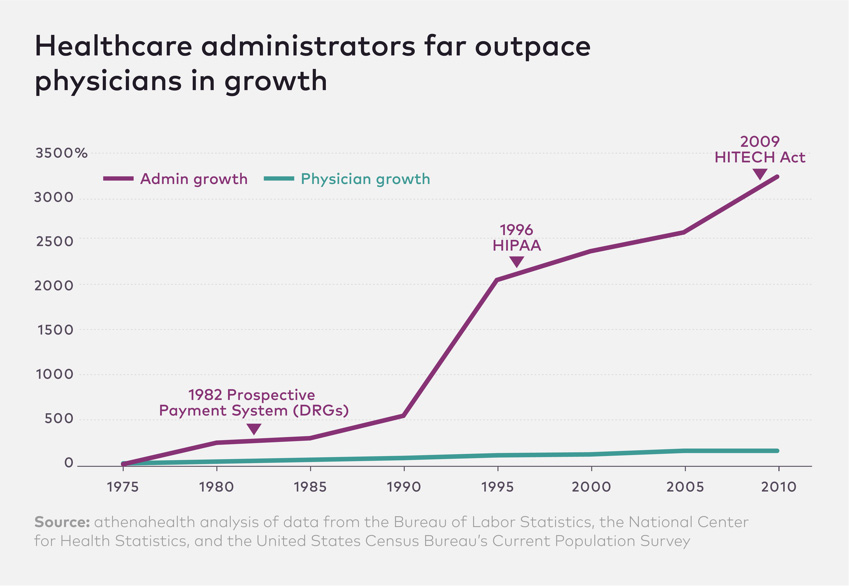
Administration? All of the paper work, negotiation and overly complicated regulatory framework must be hugely inefficient. And loss of jobs in that type of bureaucracy is exactly the thing I wouldn't lose sleep over. It's clearly non-productive work that shouldn't happen in first place.
Insurance companies and hospitals employing tens of thousands of people who play endless cat-and-mouse games of trying to avoid paying for actual healthcare and "optimizing" so that they don't end up holding the bag.
so the cost of lowering costs will be that people lose their jobs?
Yes, absolutely people will lose their jobs.
Just like if you gut the military-industrial complex people will lose their jobs.
That's what makes it so hard politically to do anything about it.
Just like if you gut the military-industrial complex people will lose their jobs.
That's what makes it so hard politically to do anything about it.
Yup and until we start taking to the streets about it. It will never change. Voting is not enough.
I've been thinking a lot about this lately. I'm reading Winners Take All [0] right now and it's explaining really well a lot of thing's that I've _felt_ or _thought_ but didn't _know_, if that makes sense.
American politics is driven by money, and at a certain point, no amount of money can push the powers-that-be to enact legislation that removes their advantage. It doesn't help that the folks who most _need_ political change are those with the least ability to affect meaningful change (because they're poor or otherwise disenfranchised).
[0] https://www.penguinrandomhouse.com/books/539747/winners-take...
American politics is driven by money, and at a certain point, no amount of money can push the powers-that-be to enact legislation that removes their advantage. It doesn't help that the folks who most _need_ political change are those with the least ability to affect meaningful change (because they're poor or otherwise disenfranchised).
[0] https://www.penguinrandomhouse.com/books/539747/winners-take...
guy doesn't know what he's talking about just spitting out numbers. An MRI doesn't pay $5000 each. More like $300-$400 from Medicare. Maintenance contract from the vendor is like $7000/month. MRI tech makes about 100k per year. Any decent MRI machine is 250k and up.
Hospitals in the US are required by law to provide stabilizing care to anyone that comes into the ER regardless of ability to pay. Prices are inflated for everyone else to subsidize this. It's like universal healthcare, but more expensive, less transparent and with worse outcomes!
This is a myth. Prices are inflated because there is no transparency and is privatized. Healthcare is not car insurance. We should stop treating it that way.
[deleted]
This is just a random rant and it doesn't need to be on HN.
When the month rolled over, I crashed my bike, and was obviously in need of stitches. Not knowing what this would cost me (thinking about all of those stories where someone got a five-figure bill for a standard outpatient visit to the ER), I called two local urgent cares, who said their billing office was not open on weekends, so they couldn't tell me. Not even an upper-bound estimate on closing a wound with centuries old technology.
Faced with the uncertainty about whether the bill would be in the hundreds or the thousands, I opted for bandages and superglue.
Even as someone who left a good job with a good health plan for another one, I was briefly exposed to the choices many Americans face when they need basic care. I can't imagine how many people choose to avoid the financial over the personal risk and end up in the red on that equation. In my case somewhat literally.
It's a crime what our lawmakers have done to preserve the costliest system in the world per capita, ensuring that administrators are guaranteed profits without any meaningful accountability to improving public outcomes over time. All they guaranteed was that more people had no choice to opt out of a terrible system and that the people who like it this way will keep getting paid.