Ask HN: Help me solve a dilemma, study in the US or take a job in the EU?
106 comments
Go get your degree. Immigrating to anywhere else in the Western world basically requires an undergraduate degree and if you don’t get permanent residence and a path to citizenship in Germany you may be locked out completely due to a tough job market. US University scholarships for undergrad are also harder to get once you’ve aged out of the standard path so it may be now or never. What happens after the degree will no doubt be a source of a lot of stress but it’ll be worth it if you use that time wisely (and some time unwisely, just to really live and experience the US).
I say this as someone who got a GC and dropped out of school to go work on my own startup before going back to do undergrad years later. The degree opens up a lot of options internationally and the US “college experience” is worth the time and money if you’ve got a scholarship.
I say this as someone who got a GC and dropped out of school to go work on my own startup before going back to do undergrad years later. The degree opens up a lot of options internationally and the US “college experience” is worth the time and money if you’ve got a scholarship.
Yes, this. Even if we assume that a degree is worthless for the sake of the argument, it's never "worthless" if you ever plan to migrate, from any country to any country really.
And degrees from Asian universities are often ranked lower or not accepted at all. I don't know what the situation is like for computer science, but my Indonesian ex had a six year university degree but that wasn't accepted in any Western countries for immigration or employment. Is there a good reason for that? I don't know – my expertise in veterinary science is basically zero, but the clinic where she worked didn't seem that different from Western clinics that I've seen, so I'm somewhat inclined to say "no".
And degrees from Asian universities are often ranked lower or not accepted at all. I don't know what the situation is like for computer science, but my Indonesian ex had a six year university degree but that wasn't accepted in any Western countries for immigration or employment. Is there a good reason for that? I don't know – my expertise in veterinary science is basically zero, but the clinic where she worked didn't seem that different from Western clinics that I've seen, so I'm somewhat inclined to say "no".
Huge number of degree mills - difficult to verify, which isn't true of like, Buffalo State University.
> I say this as someone who got a GC
Were you on an F1 visa or something else?
Were you on an F1 visa or something else?
Dependent of an H1b, so I'm not saying the "drop out to do a startup" option will be available to you, I would have stayed if my visa depended on it (I had already been in the US for over a decade as a dependent)
Developer based from Austria here - I'll counter what most are saying.
Europe has a much more stable / less volatile job market, mass layoffs are subject to union negotiations (see Google's debacle in France) and your life will generally be much more stable. Citizenship is also, comparably, easier to obtain in the long run compared to the bureaucratic mess US naturalization presents.
If you are at all willing to learn the language and are someone who prefers a calm life with a social safety net over just "more money", I'd recommend a salaried job with pension in Germany any day over an overpriced US college.
Added bonus: University is actually free as in free beer (even for non-EU citizens it is 10-20x cheaper than US based institutions)
Europe has a much more stable / less volatile job market, mass layoffs are subject to union negotiations (see Google's debacle in France) and your life will generally be much more stable. Citizenship is also, comparably, easier to obtain in the long run compared to the bureaucratic mess US naturalization presents.
If you are at all willing to learn the language and are someone who prefers a calm life with a social safety net over just "more money", I'd recommend a salaried job with pension in Germany any day over an overpriced US college.
Added bonus: University is actually free as in free beer (even for non-EU citizens it is 10-20x cheaper than US based institutions)
There will be no union in a Berlin startup.
While the thing about unions is generally true in the European Union, universally it isn't. Take Hungary (where I am from) as an example. Trade unions there are practically non-existent. Most of them got destroyed by the state during the mismanaged adaptation of capitalism after the collapse of the Soviet Union. The ones remaining are a shadow at best (in terms of power) of what's there in Austria or Germany.
The rest I wholeheartedly agree with! (Waving from Vienna, oida!) My comment here is purely just for additional context. :)
The rest I wholeheartedly agree with! (Waving from Vienna, oida!) My comment here is purely just for additional context. :)
Very true, but workers’ rights are still generally held in higher regard than in a lot of other countries… more due to begrudging compliance with EU directives than anything else, but it could be worse.
Maternity leave is very good, paternity leave recently improved, laws on overtime are relatively strict (although somewhat loosened since the “slave law”) shift allowances are decent, rules around notice periods, probation periods and termination are all relatively fair.
It’s also true in the (admittedly-no-longer-EU) UK that unions are fairly weak nowadays except in very specific industries, such as the railways, public sector, etc.
Maternity leave is very good, paternity leave recently improved, laws on overtime are relatively strict (although somewhat loosened since the “slave law”) shift allowances are decent, rules around notice periods, probation periods and termination are all relatively fair.
It’s also true in the (admittedly-no-longer-EU) UK that unions are fairly weak nowadays except in very specific industries, such as the railways, public sector, etc.
Take the scholarship. It's a much higher probability outcome.
You will have more control over your destiny. EG if you work hard in your studies and pursue side projects you will prosper.
In contrast, you can do everything "right" at the startup and still end up unemployed due to forces outside your control. In a foreign country with no qualifications.
You will have more control over your destiny. EG if you work hard in your studies and pursue side projects you will prosper.
In contrast, you can do everything "right" at the startup and still end up unemployed due to forces outside your control. In a foreign country with no qualifications.
Career aside - I’ve had the experience of being an immigrant in both North America and Europe. There’s no comparison: go to the USA.
This is about more than stats and numbers - it’s about finding a new home, being welcomed, being able to fit in, open minded locals. Even really conservative North Americans are super nice and welcoming if you stick to the rules.
Having said all that, actually getting the right to move there is easier said than done, but totally worth it.
This is about more than stats and numbers - it’s about finding a new home, being welcomed, being able to fit in, open minded locals. Even really conservative North Americans are super nice and welcoming if you stick to the rules.
Having said all that, actually getting the right to move there is easier said than done, but totally worth it.
> being welcomed, being able to fit in, open minded locals
This part differs as much across Europe as it does in the US, I'm sure. Hard to say one is "more racist" or "more bigot" than the other, without knowing exactly what locations you're comparing.
> Even really conservative North Americans are super nice and welcoming if you stick to the rules
That's the easy part! The interesting and valuable part is how they treat you when you don't fit into their "rules" and "how people should act".
This part differs as much across Europe as it does in the US, I'm sure. Hard to say one is "more racist" or "more bigot" than the other, without knowing exactly what locations you're comparing.
> Even really conservative North Americans are super nice and welcoming if you stick to the rules
That's the easy part! The interesting and valuable part is how they treat you when you don't fit into their "rules" and "how people should act".
I would argue if you move to a new country without the intention of fitting in there, you’re moving in bad faith.
Now, in NA, you can still “fit in” even while doing something new & weird, as long as your intention is to build some enterprise, contribute to society, and not do any crime. This is not the same as the social strictures of other places.
Now, in NA, you can still “fit in” even while doing something new & weird, as long as your intention is to build some enterprise, contribute to society, and not do any crime. This is not the same as the social strictures of other places.
> Now, in NA, you can still “fit in” even while doing something new & weird
And what that I understand you're also implying that you cannot do this in Europe?
I cannot say it's possible all over Europe, as I haven't been everywhere, but to the places I have been, I'm confident you'd be able to fit in while at the same time doing something new and weird.
And what that I understand you're also implying that you cannot do this in Europe?
I cannot say it's possible all over Europe, as I haven't been everywhere, but to the places I have been, I'm confident you'd be able to fit in while at the same time doing something new and weird.
My point is I wouldn't even fit no matter how conventional I might be. I'm not from there, so I don't fit into the local identity.
In Canada and the States, they care more about what you do and how you behave than where you're from.
EDIT: I want to stress that I don’t think Europeans are racist or xenophobes. They just have old idenities that are tied in with ethnicity, whereas in NA most people have an immigrant grandparent.
In Canada and the States, they care more about what you do and how you behave than where you're from.
EDIT: I want to stress that I don’t think Europeans are racist or xenophobes. They just have old idenities that are tied in with ethnicity, whereas in NA most people have an immigrant grandparent.
I've heard that NA is more welcoming of immigrants because as a country it relied more on immigrants' brain power and brain drain from other countries.
What do you think of that statement?
What do you think of that statement?
Where did you stay in Europe to have such a bad experience?
I didn’t have a bad experience per se. I just had a strong sense that I’ll never be considered a true & proper (insert country here)-man. Those cultures are so old and have an ethnic component - nobody will ever think that I’m French / English / a Swede etc. I often got the vibe of “you’re lucky to be here, now when are you going back?”
That’s not their fault by the way - they don’t owe me a good immigration experience or even the chance to immigrate.
But in the US & Canada it’s completely different. I’m just another guy here. People who were born here consider this to be my home, not the country I’m from. I’ve met exactly two Canadians who were even mildly xenophobic (one on here!).
That’s not their fault by the way - they don’t owe me a good immigration experience or even the chance to immigrate.
But in the US & Canada it’s completely different. I’m just another guy here. People who were born here consider this to be my home, not the country I’m from. I’ve met exactly two Canadians who were even mildly xenophobic (one on here!).
I get that wherever I go outside the country I was born in, including the US.
Mind you, I didn't visit all the states or stay for too long.
Mind you, I didn't visit all the states or stay for too long.
Yes, your pay in the United States would be much higher than you'd get paid in the same position in Europe. Taxes are also higher in Europe than in the US. It evens out a bit if you have dependents, or some other special circumstances. For a young person with no dependents or chronic medical conditions, financially US is going to be a much better choice.
That being said, you're not going to just automatically get a jr. dev position in the US right now. The layoffs have been brutal, and there are a lot of developers looking for jobs at the moment. I don't know how long the current conditions are going to last, but generally speaking a bad job market is the perfect time to go to school.
How confident are you about your startup employer's ability to operate? Startups are notoriously fickle. I would take a very hard look at the company, its funding, leaders and business idea before deciding to rely on them for enabling you to immigrate to Germany.
That being said, you're not going to just automatically get a jr. dev position in the US right now. The layoffs have been brutal, and there are a lot of developers looking for jobs at the moment. I don't know how long the current conditions are going to last, but generally speaking a bad job market is the perfect time to go to school.
How confident are you about your startup employer's ability to operate? Startups are notoriously fickle. I would take a very hard look at the company, its funding, leaders and business idea before deciding to rely on them for enabling you to immigrate to Germany.
Echoing on "a bad job market is the perfect time to go to school". The bad job market will rebound. Don't fall into the AI destroy jobs narative, it will create more jobs, just different. Others mentions about good US education opening doors to the US job market. That is true and definitely warrants over working in EU just by itself, but the other priceless benefit to a good US education is the network of people to start doing things on your own should you decide that is what you want later.
To compound on this, four years at a college is a perfect time to build social connections to people who will be all over the industry in various ways.
A T200 school may be a bit more limiting to a geographic region, but you'll still have contacts.
A T200 school may be a bit more limiting to a geographic region, but you'll still have contacts.
True. Forgot to mention that you don't get the network being passive. You have to actively seek it. A soso/poor geographic region will limit the network, but it's still there if you actively seek it.
East European here, a bit similar similar history to yours in that I've also got a scholarship in the US and I went the college route. In between the college years I've taken a few years of "leave of absence" to work in industry (back in Europe) - the US colleges (at least mine, but I suppose it's similar for most of them) do enable students to pause the education and return a bit later without any hassle, even my scholarship was still kept.
I'd never go back to change getting the degree - it's a great stepping stone in the professional world, opens doors and interviews, you can go back to industry any time later on. However the college is much "easier" when you are 20 - easier to fit in, make friends etc. With life, responsibilities will pile up and there can and will be much more friction to decide and get back to college later on.
College then led to masters (in ML) and that has become and still is a technical basis of all my professional career, so I have a deepest gratitude for all of these educational opportunities.
I'd never go back to change getting the degree - it's a great stepping stone in the professional world, opens doors and interviews, you can go back to industry any time later on. However the college is much "easier" when you are 20 - easier to fit in, make friends etc. With life, responsibilities will pile up and there can and will be much more friction to decide and get back to college later on.
College then led to masters (in ML) and that has become and still is a technical basis of all my professional career, so I have a deepest gratitude for all of these educational opportunities.
> Got a near full-tuition scholarship from a T200 public university to study undergrad in the US
I think this alone is an incredible opportunity that not many people get in their lives. IMO, you have the rest of your life to focus on your career. And is much better to spend these couple of recession/stagnation years in uni instead of in the professional world.
I think this alone is an incredible opportunity that not many people get in their lives. IMO, you have the rest of your life to focus on your career. And is much better to spend these couple of recession/stagnation years in uni instead of in the professional world.
Very very personal business here. Hardly an answer here will be able to asses every single aspect that matters to you. IMO, from a superficial point of view, if you are single, no kids and got yourself some sort of very disputed scholarship them I'd go for it, graduate and get a job in the EU, in your home country, whatever.
IMHO, after you graduate, you will have more experience (both technical and non-technical) and be able to find better jobs. And there will always be startups looking for good engineers....
IMHO, after you graduate, you will have more experience (both technical and non-technical) and be able to find better jobs. And there will always be startups looking for good engineers....
Indeed, I'm sure the answer would heavily rely on someone's personal values, but as barely an adult, I don't think I have developed that many personal values that I bind tightly to.
> got yourself some sort of very disputed scholarship
fwiw, it was a fairly common one that I got solely based on SAT/GPA
> got yourself some sort of very disputed scholarship
fwiw, it was a fairly common one that I got solely based on SAT/GPA
I think in the long run (which is your early 30s and that's coming sooner than you think), you'd want stability.
So main thing to watch out for US is to have a stable path forward that does not kick you out in your mid to late twenties making you start from scratch from elsewhere.
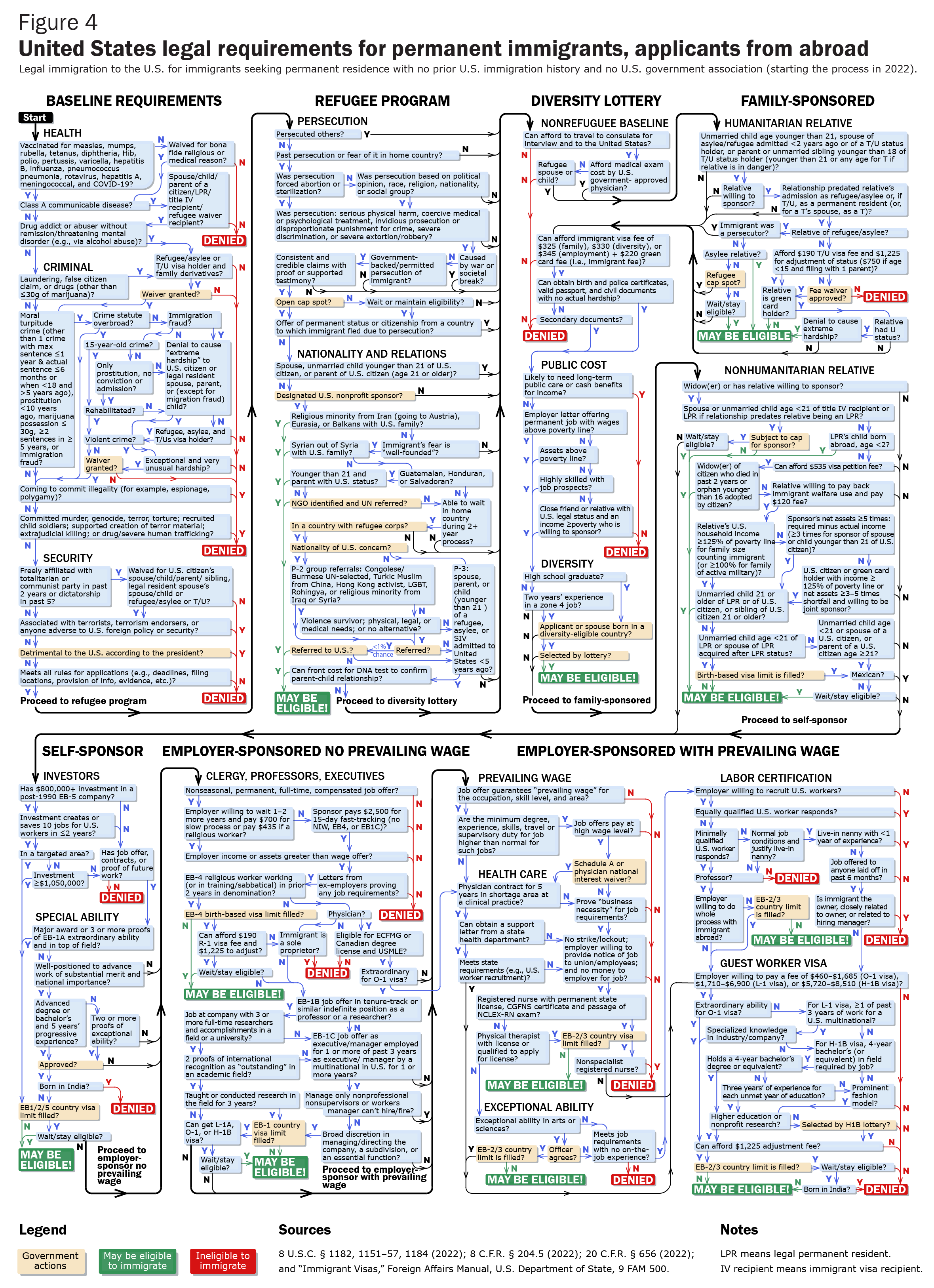
US immigration policy it seems is pretty restrictive at the moment [0]
And as for German language, it is difficult in some ways but easier in some. Learning a language certainly takes time but it is not something that has not ever done by any human.
Good luck!
[0]. https://www.cato.org/sites/cato.org/files/2023-03/2023-bier-...
So main thing to watch out for US is to have a stable path forward that does not kick you out in your mid to late twenties making you start from scratch from elsewhere.
US immigration policy it seems is pretty restrictive at the moment [0]
And as for German language, it is difficult in some ways but easier in some. Learning a language certainly takes time but it is not something that has not ever done by any human.
Good luck!
[0]. https://www.cato.org/sites/cato.org/files/2023-03/2023-bier-...
> The traditional wisdom that I'd read repeatedly until last year was job experience triumphs college and the opportunity cost is not worth it which is why I took the job
That is with the assumption have to take out a lot of student loans for tuition.
> Would you say this is still the case considering the events of last year? Does the compensation and tax differential across the pond make the investment worth it to join the US labor pool down the line?
A lot of people say yes, including Europeans.
I am an American and from what I heard American degrees are very valuable across that small pond. Get your education. A bachelor's is the basic minimum. If your college offers a masters in some tech with a similar ride, take it as well.
That is with the assumption have to take out a lot of student loans for tuition.
> Would you say this is still the case considering the events of last year? Does the compensation and tax differential across the pond make the investment worth it to join the US labor pool down the line?
A lot of people say yes, including Europeans.
I am an American and from what I heard American degrees are very valuable across that small pond. Get your education. A bachelor's is the basic minimum. If your college offers a masters in some tech with a similar ride, take it as well.
As someone that went to college in the US and lives in Berlin:
How likely is it that you can secure a high earning job in the US after you graduate? There are plenty of developers in the US not getting FAANG money/benefits.
Unless you need to speak German for your job, you can very easily get by here without it (not saying you should). The only time you will notice uni degrees is when wondering why the working students are 10 years older than you. There are plenty of people here (and the US) that get jobs after completing coding bootcamps.
As others have said, it's going to be a matter of personal preference and what kind of trade-offs you want to make.
How likely is it that you can secure a high earning job in the US after you graduate? There are plenty of developers in the US not getting FAANG money/benefits.
Unless you need to speak German for your job, you can very easily get by here without it (not saying you should). The only time you will notice uni degrees is when wondering why the working students are 10 years older than you. There are plenty of people here (and the US) that get jobs after completing coding bootcamps.
As others have said, it's going to be a matter of personal preference and what kind of trade-offs you want to make.
I'm going to say the opposite.
Look into studying in Germany (and/or while having the job).
You can get an equivalent degree there for anywhere from probably 10k-20k EUR p/y at the top schools. Going to a normal school will cost you a few hundred to maybe 3000p/y.
Look into studying in Germany (and/or while having the job).
You can get an equivalent degree there for anywhere from probably 10k-20k EUR p/y at the top schools. Going to a normal school will cost you a few hundred to maybe 3000p/y.
My perspective is limited as a US citizen who's never been to Europe, but what I would add is that international students here are under a lot of stress to find a job when they graduate so they can stay in the country. Of course choices are limited because not all companies sponsor. You can see entire lines of people disappear at the career fair when a company puts up a sign saying they aren't sponsoring visas this cycle.
The work visa system in the US seems to create this stress because there's no automatic transition between states. You get a fixed, short period of unlimited work after graduating but then you need a job to sponsor you, which will most likely be as a "nonimmigrant" that has to be renewed and updated when you change jobs. And that never converts to a green card on its own, the employer has to start over with a new process and prove that no US workers are available to do the job.
In other countries (not sure about Europe), it's more like you get a work visa the first time, you keep working for 5-7 years, then you automatically get a permanent residence and can change jobs freely (or retire, study, etc.).
You do have a valid concern about what happens if you job ends, but I think in that case a good backup plan is just to apply for schools in Europe. Not sure how the timing would work out with admission cycles or how strict they are about how long you can stay before finding a new job/switching to student though.
You could even see if the US university would be willing to defer your admission for a year to do a "gap year" of work experience? That's kinda sort of a thing in the US, so it's worth asking.
The work visa system in the US seems to create this stress because there's no automatic transition between states. You get a fixed, short period of unlimited work after graduating but then you need a job to sponsor you, which will most likely be as a "nonimmigrant" that has to be renewed and updated when you change jobs. And that never converts to a green card on its own, the employer has to start over with a new process and prove that no US workers are available to do the job.
In other countries (not sure about Europe), it's more like you get a work visa the first time, you keep working for 5-7 years, then you automatically get a permanent residence and can change jobs freely (or retire, study, etc.).
You do have a valid concern about what happens if you job ends, but I think in that case a good backup plan is just to apply for schools in Europe. Not sure how the timing would work out with admission cycles or how strict they are about how long you can stay before finding a new job/switching to student though.
You could even see if the US university would be willing to defer your admission for a year to do a "gap year" of work experience? That's kinda sort of a thing in the US, so it's worth asking.
Yes, the work visa after graduation is the main source of my worry. I've read the problem for internationals is amplified by the current state of the tech economy.
Dunno if that'll persist by the time I graduate or not. I'm considering switching my major to Electrical Engineering if the university allows in hopes of keeping more doors open.
As for the gap year, this particular university denied it, besides I'm 20 and have been out of school for more than a year already, that plus moving to another country thus loosening my ties to my home country feels like it'd seriously jeopardize my visa application as well in a year.
Dunno if that'll persist by the time I graduate or not. I'm considering switching my major to Electrical Engineering if the university allows in hopes of keeping more doors open.
As for the gap year, this particular university denied it, besides I'm 20 and have been out of school for more than a year already, that plus moving to another country thus loosening my ties to my home country feels like it'd seriously jeopardize my visa application as well in a year.
Things could change massively in four years, but I'd head into it with the "I'm going to get a degree in the USA and then return/head to the EU" - with that mentality, then the opportunity to stay on becomes not something to lose but potentially a happy bonus.
One huge advantage is being bilingual - you may be able to play that up and get something out of it, especially as more and more companies have overseas operations.
One huge advantage is being bilingual - you may be able to play that up and get something out of it, especially as more and more companies have overseas operations.
The us is the greatest country in earth for risk taking, failing and then succeeding. If you see yourself having that in you, by all means us is the only way.
If you want to just chill and not have high highs but just let the govt take care of you, go to Europe.
If you want to just chill and not have high highs but just let the govt take care of you, go to Europe.
This is honest an American centric attitude.
to flip it on it's head. If you get ill or injured in the us you could be more than the $20K in debt for hospital bills. Whereas Europe has healthcare that will not take away everything you have. Also there is the fact that America is extremely anti-immigration at the moment.
to flip it on it's head. If you get ill or injured in the us you could be more than the $20K in debt for hospital bills. Whereas Europe has healthcare that will not take away everything you have. Also there is the fact that America is extremely anti-immigration at the moment.
>If you get ill or injured in the us you could be more than the $20K in debt for hospital bills
If you're on a visa and you lose your job and thus your health insurance, you're probably going back to your home country anyways. I wouldn't worry about medical debt then, they can't pursue you across international lines. Send the hospital AP department an email saying 'hi I'm no longer in the US, I'm in HomeCountry for the foreseeable future' and they're just going to write off the debt and call it a day. Medical debts don't cross national borders
If you're on a visa and you lose your job and thus your health insurance, you're probably going back to your home country anyways. I wouldn't worry about medical debt then, they can't pursue you across international lines. Send the hospital AP department an email saying 'hi I'm no longer in the US, I'm in HomeCountry for the foreseeable future' and they're just going to write off the debt and call it a day. Medical debts don't cross national borders
> Also there is the fact that America is extremely anti-immigration at the moment.
In what way? Compared to which countries? If OP is coming to the USA for school, I don't think this is a concern esp in the short term.
In what way? Compared to which countries? If OP is coming to the USA for school, I don't think this is a concern esp in the short term.
How often does this happen? You hear about it but I don’t know anyone within 3 degrees of separation that has had this happen to them.
Many US states provides free health care if you are not able to afford it. Just go to one of those states.
You'll struggle to see a doctor in a lot of Europe. The NHS in England has wait times of years for doctors visits. The Tory government are trying to move England towards a health insurance scheme.
> You'll struggle to see a doctor in a lot of Europe.
My experience is limited to living in Spain and Sweden, but neither have had issues with having medical personal available for me when needed, even for relatively minor issues. I'm sure it differs a lot across the continent.
My experience is limited to living in Spain and Sweden, but neither have had issues with having medical personal available for me when needed, even for relatively minor issues. I'm sure it differs a lot across the continent.
I have a relatable path that I hope to help you with your choice. Don't let others influence you too much and make your own decisions yourself.
I'm a foreigner also living in Berlin, I have moved from a third-world country here almost a decade ago, but already had graduated and had worked a few years. Back then, having a recognized university diploma helped me get my visa processed. With the new German immigration reform, this shouldn't be a problem anymore. Nowadays I'm waiting on my citizenship, it feels great!
I've also tried to get into the States, but oh boy, the work visa, the lottery, and the COST suck. My wife wouldn't be able to work there. Healthcare and public services are utter garbage. There are much better immigration laws here in Germany, and you are already on your path to citizenship (in case you want to live in the EU).
You need to decide whether you want to shoot big and hopefully win big (US). I'm supposing you don't have rich parents and kind of need to do most things on your own and support yourself, so failure on those plans would be a big setback. If it isn't the case, I'd favour going to the US.
But if you are kind of just scraping by (like I was), Europe. Europe is the best.
Building a successful life in the US supposes the job market will be good when you graduate as if you can't find a job there, you'll be out. Europe will still accept you, but you'll have wasted some money and time.
In your situation, I'd continue working and attending a Berlin university while you work at night. Go to a private one that offers it in English (I'm supposing you aren't fluent in German), those that you pay some bucks and get a degree.
Take good advantage of this time while you are young(20s) and build yourself a life, it may be 4 years that you need to only work/study, but it will be worth it. It's time to "build your base", doing this is much easier while you are in your 20s, later on, you'll likely meet with people and end up with your routines etc. Take advantage of this time to develop yourself.
People like seeing you have a degree when reading your CV, trust me. And in Europe not so many care if you graduate from a top university, unless you are from Harvard.
By choosing this, I'd sincerely consider asking some help from your parents to foot the bill of living in Europe and studying.
I'm a foreigner also living in Berlin, I have moved from a third-world country here almost a decade ago, but already had graduated and had worked a few years. Back then, having a recognized university diploma helped me get my visa processed. With the new German immigration reform, this shouldn't be a problem anymore. Nowadays I'm waiting on my citizenship, it feels great!
I've also tried to get into the States, but oh boy, the work visa, the lottery, and the COST suck. My wife wouldn't be able to work there. Healthcare and public services are utter garbage. There are much better immigration laws here in Germany, and you are already on your path to citizenship (in case you want to live in the EU).
You need to decide whether you want to shoot big and hopefully win big (US). I'm supposing you don't have rich parents and kind of need to do most things on your own and support yourself, so failure on those plans would be a big setback. If it isn't the case, I'd favour going to the US.
But if you are kind of just scraping by (like I was), Europe. Europe is the best.
Building a successful life in the US supposes the job market will be good when you graduate as if you can't find a job there, you'll be out. Europe will still accept you, but you'll have wasted some money and time.
In your situation, I'd continue working and attending a Berlin university while you work at night. Go to a private one that offers it in English (I'm supposing you aren't fluent in German), those that you pay some bucks and get a degree.
Take good advantage of this time while you are young(20s) and build yourself a life, it may be 4 years that you need to only work/study, but it will be worth it. It's time to "build your base", doing this is much easier while you are in your 20s, later on, you'll likely meet with people and end up with your routines etc. Take advantage of this time to develop yourself.
People like seeing you have a degree when reading your CV, trust me. And in Europe not so many care if you graduate from a top university, unless you are from Harvard.
By choosing this, I'd sincerely consider asking some help from your parents to foot the bill of living in Europe and studying.
If money is important to you, take the US option. Do well in school and you will have a job on graduation. Total lifetime earnings in the US will be higher.
If lifestyle and proximity to South Asia is important, take the Europe option. German work culture has a good work-life balance. Flying back home will be cheaper and faster.
If lifestyle and proximity to South Asia is important, take the Europe option. German work culture has a good work-life balance. Flying back home will be cheaper and faster.
The only negative of studying in the US is that it is becoming close to impossible to stay long term after your degree to work due to the outdated work visa process.
But your other option is to move to Germany, which you can still do after getting a US degree. So you seem to belong to one of the rare categories that I think should study in the US - globally mobile and not super tied to staying in the US after getting their degree.
The only other category is if someone are genuinely brilliant i.e. companies would fight to keep you even if that involves dealing with a crazy visa process.
But your other option is to move to Germany, which you can still do after getting a US degree. So you seem to belong to one of the rare categories that I think should study in the US - globally mobile and not super tied to staying in the US after getting their degree.
The only other category is if someone are genuinely brilliant i.e. companies would fight to keep you even if that involves dealing with a crazy visa process.
I'm just a random dude on Hacker News, but I would suggest college. You can always change your mind and go back into the Industry, and you will be working your whole life. There is also more to college than education, especially for a young man like yourself. Think of it as practicing your professional Networking skills.
> The traditional wisdom that I'd read repeatedly until last year was job experience triumphs college and the opportunity cost is not worth it.
If you were taking on loans that might be the case. But in your case, you have a scholarship that tilts the opportunity cost.
To take a swipe at some conventional wisdom, yes experience does trump college eventually. But like a lot of things involving experience, people (like employers) only value it after you have it. Our profession is unique in that you can hack your way around college, but that is itself experience and you are competing with many others that are hacking that as well.
It is true that after a decade your college degree won't stand out as much, but when you don't have much experience a degree gives you a boost.
> startup
That's all you had to say. That is a large risk in these economic times even for experienced developers. I would look at this job with the same jaundiced eye as Silicon Valley equity options, and have a backup plan when things go sideways.
FWIW, I dropped out of college, worked for a while, and then went back to college. From my perspective it was worth the cost.
> The traditional wisdom that I'd read repeatedly until last year was job experience triumphs college and the opportunity cost is not worth it.
If you were taking on loans that might be the case. But in your case, you have a scholarship that tilts the opportunity cost.
To take a swipe at some conventional wisdom, yes experience does trump college eventually. But like a lot of things involving experience, people (like employers) only value it after you have it. Our profession is unique in that you can hack your way around college, but that is itself experience and you are competing with many others that are hacking that as well.
It is true that after a decade your college degree won't stand out as much, but when you don't have much experience a degree gives you a boost.
> startup
That's all you had to say. That is a large risk in these economic times even for experienced developers. I would look at this job with the same jaundiced eye as Silicon Valley equity options, and have a backup plan when things go sideways.
FWIW, I dropped out of college, worked for a while, and then went back to college. From my perspective it was worth the cost.
Study in the US JFC. You have an opportunity that most of the world would kill for.
Study in the USA. You can always go to Europe in the future, but a T200 degree for $80k is worth it imo.
Your English (from this) appears operational and you will get many contacts in the USA, and if you make money in the USA it will go further if you later decide to go to the EU or back home.
You also get four years of stability to withstand whatever winds may blow.
Your English (from this) appears operational and you will get many contacts in the USA, and if you make money in the USA it will go further if you later decide to go to the EU or back home.
You also get four years of stability to withstand whatever winds may blow.
> I've read many European developers lament how they could effectively retire and return after working for just a few years if they could work in the states
You can project this to European (or even US) remote job + your place. Just charge top European or US rates, not the "local market rate".
You can project this to European (or even US) remote job + your place. Just charge top European or US rates, not the "local market rate".
Europe is a very old hotel. North America is a new hotel.
Yes, management and other things can be terrible or acceptable in both.
But in the end of the day it comes down to your values and preferences - which kind of "hotel" do you like living the most.
There is no wrong answer.
Yes, management and other things can be terrible or acceptable in both.
But in the end of the day it comes down to your values and preferences - which kind of "hotel" do you like living the most.
There is no wrong answer.
Go study!!!!
Either you really learn a lot in your current Berlin company so that other companies will ignore your education or you will have problems.
And 20 is nothing just because it feels nice to earn money, long term it is much riskier.
Either you really learn a lot in your current Berlin company so that other companies will ignore your education or you will have problems.
And 20 is nothing just because it feels nice to earn money, long term it is much riskier.
I would absolutely get the qualification - especially under the circumstances you describe. You can get by without it, but it will close off many great opportunities if you don’t have it.
It positions you inside the US and may make it easier to work here initially. Salaries here are much higher than EU, and opportunities much better imho. You can always move to EU later, and be in a much stronger position.
Background: from Ireland, moved to US. No college degree.
It positions you inside the US and may make it easier to work here initially. Salaries here are much higher than EU, and opportunities much better imho. You can always move to EU later, and be in a much stronger position.
Background: from Ireland, moved to US. No college degree.
What was your path to moving to the US without a college degree, H1B with the 12 year experience substitution or something else?
Having a degree will make it much easier to work in different nations due to visa restrictions that sometimes require college degrees (though you might want to do some analysis on what the options are and how much they've changed since I last look into this).
There's an off chance you might learn something that you might not have otherwise if you take the college approach, however I'm not sure it's worth the cost.
There's an off chance you might learn something that you might not have otherwise if you take the college approach, however I'm not sure it's worth the cost.
Just as an option you may not have explored — would the US university allow you to defer your scholarship for a year?
If so, you could take on the German job for a year with plans to move to the US after that. Gives you the best of both worlds.
(After a year on-the-job with the German company, they might be willing to let you work remote part-time, or at least you'd have connections if you wanted to make a move back later on)
If so, you could take on the German job for a year with plans to move to the US after that. Gives you the best of both worlds.
(After a year on-the-job with the German company, they might be willing to let you work remote part-time, or at least you'd have connections if you wanted to make a move back later on)
I'd say do US.
I'm a naturalized citizen of US from Turkey, and nothing beats us when it comes to opportunities.
Not. Even. Close.
Even if you choose EU job, look for ways to come to US.
I'm a naturalized citizen of US from Turkey, and nothing beats us when it comes to opportunities.
Not. Even. Close.
Even if you choose EU job, look for ways to come to US.
Flip a coin in the air, heads is US tails is EU.
Catch it, before you look ask yourself which one you are hoping it will be.
Berlin startup sounds more fun if you ask me. But it depends on what you want I guess. Both seem like a good step forward
Moving to the US is a much better deal than moving to Europe. Much higher salaries and you'll encounter way less racism in the US. However, undergrad in the US will not give you an automatic path to residency. So you might get kicked out of the country after you graduate.
But it's still the better deal. Europe should be your plan B.
But it's still the better deal. Europe should be your plan B.
College, because, in my opinion, we headed for for a worldwide recession/depression triggered by a US depression.
Optimize for learning, not for earning. In the tech field degrees matter now (you don’t see too many AI startups founded by high school students without degrees). If a University is a ticket to a funded tech startup or a tech co, go that route. Go to the geographic hub of the industry that you pick.
Study in the EU (free) and take a job in the US ($$$).
Where would studying in the EU be free? Not only do you have to live somehow, but most universities have tuition fees, and they are higher for non-EU-residents.
I guess Germany and a bunch of countries with no or low tuition per year? Definitely not UK, universities there went crazy. Paying 1k EUR per semester is technically not free but close enough. Stipends are also often available for foreign students, especially when from desired minorities (e.g. Africa).
> Got a near full-tuition scholarship from a T200 public university to study undergrad in the US.
US public universities give scholarships to non citizens?
US public universities give scholarships to non citizens?
Not the large state schools, but some that don't get enough students do based on your academic profile. In FL or TX, your out-of-state tuition is removed if you get other merit scholarships above a certain amount, so it ends up compounding.
I think the taxpayers would be pleased to take the $20k I'm spending there relative to the $12k or so that's spent on my scholarship?
I think the taxpayers would be pleased to take the $20k I'm spending there relative to the $12k or so that's spent on my scholarship?
There's always funding available for exceptional students, regardless of where they come from.
For private schools, sure. They should be able to do whatever they want.
But public universities take tax dollars and should be accountable to taxpayers. Given how high tuition has become, I doubt most taxpayers would support academic scholarships for non citizens.
But public universities take tax dollars and should be accountable to taxpayers. Given how high tuition has become, I doubt most taxpayers would support academic scholarships for non citizens.
American students like going to school with people from different countries, and many undergraduate applicants look for a geographically diverse student body when choosing a school. Exceptionally good students also provide benefits to everyone around them if they take up teaching assistant or club leadership positions on campus. Alumni might give more money to their alma mater if advertising shows that the university has a “global perspective.”
It’s kind of like universities spending hundreds of millions of dollars on fitness or sports centers. The funding doesn’t make sense on paper, but students and alumni who donate money want schools to have them anyway.
It’s kind of like universities spending hundreds of millions of dollars on fitness or sports centers. The funding doesn’t make sense on paper, but students and alumni who donate money want schools to have them anyway.
Get the job unless you are going to a top 20 undergrad in the US, anything lower than that and you might as well go to a community college.
Full tuition scholarship is amazing, go to the US, ace school, get work experience in the summer. You will do fine.
Go study in the US.. EU will pay peanuts and there's not much going on except for a few companies.
Thinking too much about keywords. Let go of keywords.
Understand you will die one day. Not as a concept. But as the truth.
Keywords doesn't matter. Resume doesn't matter.
Do what you really want to do.
Don't think too much about future.
You are not in control of it.
Don't analyse too much. It's a scam by your egoic mind.
Just do what do you want to do.
Where will you choose to go if you don't survive 1 more year? Go there.
Understand you will die one day. Not as a concept. But as the truth.
Keywords doesn't matter. Resume doesn't matter.
Do what you really want to do.
Don't think too much about future.
You are not in control of it.
Don't analyse too much. It's a scam by your egoic mind.
Just do what do you want to do.
Where will you choose to go if you don't survive 1 more year? Go there.
"I'm deciding between X and Y, here are some of my specific concerns, anyone chime in?"
"You might die, you're not in control of the future, do what you want"
Neat list of platitudes, not really helpful here.
"You might die, you're not in control of the future, do what you want"
Neat list of platitudes, not really helpful here.
Sorry, but they are right. Fear is what limits us and fear is what drives our decision-making. If you have no fear, decisions are much easier and you don’t regret anything. Having no fear means no you’re going to die one day and all your decisions, end up to a lump of nothing.
They can be perfectly correct, and also not helpful at all in answering the question. Like right now.
Concerns are just illusions of egoic mind who believe death is not real. There are no concerns in reality. Reality is binary. Either you are alive or not alive.
Are you an AI?
Does it matter what you choose to call me?
Yes
I am conscious if that is what you want to know. But how can you trust me?
Maybe we can play a game to build trust.
Ignore this *itpost. I had the chance to study at better universities, but chose a cheap option that got me work experience as soon as possible. I graduated it whilst also doing a full time job. If I were to do it again, I'd probably take on some debt and take more care whilst studying, but at the time the lack of a steady income (hence I worked 75% of my study time) really drove me anxious. I'd say, plan your life as to not be driven by anxiety - be it due to income or imperfect life choices - it might be perfectly valid to not have a job but knowing a plan to get yourself out of debt and using the time you'd study carefully, instead of wasting it away at parties and the like, are ways to minimize regret and optimize for happiness, I think.
Your ego tells a story that you had a choice. You never did.
I didn't have a choice at the time - I didn't have the information I do now. Maybe people can gain something from the regrets of my own experience. Maybe it won't apply. Spewing platitudes that might well be true will hardly affect the decision making process of the person in question.
> Where will you choose to go if you don't survive 1 more year?
If you live every day like it’s your last you’re going to be wrong a lot.
You’re not in complete control of your future but if you ignore the effects of your decisions today, you’re doing your future self a big disservice.
If you live every day like it’s your last you’re going to be wrong a lot.
You’re not in complete control of your future but if you ignore the effects of your decisions today, you’re doing your future self a big disservice.
You should study in the US. From my perspective, it’s not even a close decision.
[deleted]
This is a no-brainer to me - get your degree.
[deleted]
Come to US and get the degree since it's almost free for you. Since u r not from India, if you can get a job after, green card will be fast enough and now you will have access to the best economy in the world. But be ready to work your ass off and you must luke capitalism because it is not as nice as Europe when it comes to social benefits.
Writing from Germany here. At your age of 20, getting a scholarship to study in the US, if your funding is solid, is a chance you should take almost no-matter-where-from IMO. If only for the college / campus life and living some years on a fundamentally culturally-and-otherwise different continent (OK granted, that's in both cases, US and EU).
Although it's unclear whether "joined a startup" means as co-founder, CxO, or some gig, might somewhat matter here.
As for "job experience triumphs college", for 90% of (even IT / dev) jobs that sounds like a ridiculous notion to me (the usually personally-interesting cutting-edge stuff is going to be both outside a job and most undergrad curriculums), regardless of how much edu quality may or may not have gone downhill in recent years. Sure, the big SV founder legends of yesteryear were mostly college drop-outs, but they weren't South Asians with a scholarship either. If their dropping-out had not paid off, they knew they could just return a few years later.
This stuff is so worth it. Even if there isn't much "college/campus life". My 3 years BSc. in the UK was pretty socially "isolated" except for a GF and her friend circle, but it was still totally worth it, slightly exotic and adventurous-feeling (20 years ago by now tho =) and had that college-town vibe I'd never known before, and with the workloads they had for students, I had a LOT of time to my own doings (whether freelancing or totally hobbyist — or in your case maybe, that startup or another, they come and go).
As for that Berlin non-tech startup? What are they even about, that might matter a bit here. There's an endless stream of rose-colored ventures cropping up and folding again all the time in Berlin (and other such "wanna-be startup capital of (insert county/country/continent)" cities), you know. I'd tell them of your unique opportunity and offer to continue remote + part-time for starters. Both are now much more culturally / business-wise acceptable, broadly, than ever before. If that's not good enough for them, split, else you can over time choose to "phase it down" or re-engage more-intensely as you like and time permits.
Also, gloom and doom (cultural-mood-and-zeitgeist-wise) once more proliferate and dominate on this old continent but especially this country currently (unlike say during most of the previous decade), but with that outlook direction Germany or east-of-it is always going to be a little extra-grim as a place-to-live on this continent IMO. I mean, for moving here.. anyone is welcome to, as far as I care, if that's their goal or need, but given the choice, I have a real hard time advertising it vs. countries / cultures like France, Italia, Spain, Portugal, even Britain.. That's a personal subjective bias tho =)
Although it's unclear whether "joined a startup" means as co-founder, CxO, or some gig, might somewhat matter here.
As for "job experience triumphs college", for 90% of (even IT / dev) jobs that sounds like a ridiculous notion to me (the usually personally-interesting cutting-edge stuff is going to be both outside a job and most undergrad curriculums), regardless of how much edu quality may or may not have gone downhill in recent years. Sure, the big SV founder legends of yesteryear were mostly college drop-outs, but they weren't South Asians with a scholarship either. If their dropping-out had not paid off, they knew they could just return a few years later.
This stuff is so worth it. Even if there isn't much "college/campus life". My 3 years BSc. in the UK was pretty socially "isolated" except for a GF and her friend circle, but it was still totally worth it, slightly exotic and adventurous-feeling (20 years ago by now tho =) and had that college-town vibe I'd never known before, and with the workloads they had for students, I had a LOT of time to my own doings (whether freelancing or totally hobbyist — or in your case maybe, that startup or another, they come and go).
As for that Berlin non-tech startup? What are they even about, that might matter a bit here. There's an endless stream of rose-colored ventures cropping up and folding again all the time in Berlin (and other such "wanna-be startup capital of (insert county/country/continent)" cities), you know. I'd tell them of your unique opportunity and offer to continue remote + part-time for starters. Both are now much more culturally / business-wise acceptable, broadly, than ever before. If that's not good enough for them, split, else you can over time choose to "phase it down" or re-engage more-intensely as you like and time permits.
Also, gloom and doom (cultural-mood-and-zeitgeist-wise) once more proliferate and dominate on this old continent but especially this country currently (unlike say during most of the previous decade), but with that outlook direction Germany or east-of-it is always going to be a little extra-grim as a place-to-live on this continent IMO. I mean, for moving here.. anyone is welcome to, as far as I care, if that's their goal or need, but given the choice, I have a real hard time advertising it vs. countries / cultures like France, Italia, Spain, Portugal, even Britain.. That's a personal subjective bias tho =)
Another european developer here. Europe is a contintent full of old boring people and the IT sector is solid, but rather unexciting. You want to be where the action and the excitement is.
Do yourself a favour and study in the States.
It comes down to preferences and priorities. The decision is personal. Here are some aids.
US: + once you finish education, and if you start employment in tech sector, you get to make more money(I’d even dare to say more than 2x, considering taxes, geography etc).
+ for the tech sector, US is where the hotness is. More opportunities, fuel for ambition.
+ while single and young, US can get you a lot of disposable income(read - less likely to get sick footing a huge medical bill, or avoid expensive child care, or school fees of children)
+ language. You don’t need to spend your time learning a new language that you may or may not use in the long term.
- (cons)
- politics (depends on personal views of course. Ask yourself if you can bear a society in which Trump wins the elections)
- the odd chance that you get in an accident or get sick with a weird/expensive disease, you’re screwed.
- personal opinion - food, lifestyle, and quality of life is comparatively poorer in the US on average than in EU. Read obesity, fatty, ultra-processed and sugary foods.
- Geography - farther to South Asia than Europe.
- Guns (depends on your views)
EU:
+ Safer, more consciously biased towards better quality of life. More public transport, walking cities, higher quality super markets, and produce etc.
+ politics (left leaning compared to the US on average)
+ traveling and cultural diversity - as in you can travel across the continent as even weekend trips and experience rich and diverse cultures - Italy, Spain, Germany, Austria, Poland, Netherlands, Scandinavia, France - so many experiences to be had.
+ in the long term, you don’t need to be anxious about falling sick, losing your job, education for your children etc. Social system has your back for all the taxes you pay.
+ Easier and probably cheaper to travel to South Asia often.
+ You get real holiday(atleast. 4 weeks or upto 6 weeks per year) to travel and live your life while young instead of bunkering to earn money.
- you definitely won’t make as much as you would have in the US.
- language. Depends on where in Europe you go, you may need to spend considerable amount of time learning the language. It could be a fun experience depending on your attitude, but it is time nevertheless.
- lowered ambition. A personal opinion. Having living equal time at both US and EU, I’ve come to conclude that EU encourages stability and playing it safe while US encourages ambitious attitudes and gets the best out of you. It depends on what you are looking for, and what you enjoy.
Hope it helped atleast a little and didn’t add more dots to your analysis paralysis.
To tip the scales, I live in the EU.
US: + once you finish education, and if you start employment in tech sector, you get to make more money(I’d even dare to say more than 2x, considering taxes, geography etc).
+ for the tech sector, US is where the hotness is. More opportunities, fuel for ambition.
+ while single and young, US can get you a lot of disposable income(read - less likely to get sick footing a huge medical bill, or avoid expensive child care, or school fees of children)
+ language. You don’t need to spend your time learning a new language that you may or may not use in the long term.
- (cons)
- politics (depends on personal views of course. Ask yourself if you can bear a society in which Trump wins the elections)
- the odd chance that you get in an accident or get sick with a weird/expensive disease, you’re screwed.
- personal opinion - food, lifestyle, and quality of life is comparatively poorer in the US on average than in EU. Read obesity, fatty, ultra-processed and sugary foods.
- Geography - farther to South Asia than Europe.
- Guns (depends on your views)
EU:
+ Safer, more consciously biased towards better quality of life. More public transport, walking cities, higher quality super markets, and produce etc.
+ politics (left leaning compared to the US on average)
+ traveling and cultural diversity - as in you can travel across the continent as even weekend trips and experience rich and diverse cultures - Italy, Spain, Germany, Austria, Poland, Netherlands, Scandinavia, France - so many experiences to be had.
+ in the long term, you don’t need to be anxious about falling sick, losing your job, education for your children etc. Social system has your back for all the taxes you pay.
+ Easier and probably cheaper to travel to South Asia often.
+ You get real holiday(atleast. 4 weeks or upto 6 weeks per year) to travel and live your life while young instead of bunkering to earn money.
- you definitely won’t make as much as you would have in the US.
- language. Depends on where in Europe you go, you may need to spend considerable amount of time learning the language. It could be a fun experience depending on your attitude, but it is time nevertheless.
- lowered ambition. A personal opinion. Having living equal time at both US and EU, I’ve come to conclude that EU encourages stability and playing it safe while US encourages ambitious attitudes and gets the best out of you. It depends on what you are looking for, and what you enjoy.
Hope it helped atleast a little and didn’t add more dots to your analysis paralysis.
To tip the scales, I live in the EU.
I think the lifestyle part depends a lot on where in the US OP would end up. Places like Boston and NYC are not car-dependent at all and most people you will meet are a normal weight and have a decent diet. There is also a ton of cultural diversity within NYC and lots of amazing food (especially if you have disposable income). Boston has many students and postdocs coming from all over, so in an academic circle you will easily have a young diverse friend group. It's definitely a different lifestyle than living in some other parts of the US, which probably are more of a negative compared to EU - though if you're into nature there are some really beautiful sights in parts of the US that make for relatively cheap vacations. There's also something to be said for the US college experience, like I wouldn't want to live in a smaller college town as an adult but some of them are super fun while you're an undergrad.
You’re right. It is impossible to put US in a box and say this is how it is. It is the land of the extremes. I tried to portray a picture from my personal experience (and hoped that it would extrapolate to the average experience of a student). NYC and Boston (both places I love are more exceptions than the norm. American society for the large part is oriented towards car ownership. Sure, one can bubble themselves the confines of downtown Boston or Manhattan area, but, if you want the “true experience” of American life, with some trips to the beautiful nature the country has to offer, bbq parties at a colleague’s place in the suburbs etc - you’re going to need a car.
Yes, I will NOT generalize to say all Americans are obese. I merely went by the stats that says more and more are.
I’ve had the American college town experience (college town South Carolina) and I cherish those times. I rode through a scholarship and had a worry free time to actually learn, and have fun while at it. But, I know many of my peers who had to pay USD tuition from their home country cash, and it was incredibly hard for them. Again, it depends…
Yes, I will NOT generalize to say all Americans are obese. I merely went by the stats that says more and more are.
I’ve had the American college town experience (college town South Carolina) and I cherish those times. I rode through a scholarship and had a worry free time to actually learn, and have fun while at it. But, I know many of my peers who had to pay USD tuition from their home country cash, and it was incredibly hard for them. Again, it depends…
In general though, accessing nature from even those cities that are relatively well-situated to nice natural areas mostly requires either leaning on friends who do have cars or belonging to college outing clubs that organize trips.
These are far too generic. The variance from state to state, or even parts of the same US state is humongous. Same for different European countries.
Traveling in Europe for a South Asian also isn't necessarily easy either. The wait times for getting a Schengen visa are pretty ridiculous right now. They are also much stricter about granting the visas these days than they used to (source: colleagues who've had months-long waiting times for visa appointments, and getting denied multiple times).
Traveling in Europe for a South Asian also isn't necessarily easy either. The wait times for getting a Schengen visa are pretty ridiculous right now. They are also much stricter about granting the visas these days than they used to (source: colleagues who've had months-long waiting times for visa appointments, and getting denied multiple times).
Great summary. One thing I would add is, tech salaries are much lower in EU, you cannot easily get multiple offers of 100K+ salary even with a decade of experience. But as mentioned in US you can get a much higher salary but you also will be tied down with medical insurance etc. and you need to build your own (and bigger) safety net.
> + politics (left leaning compared to the US on average)
- Right wing is on rise in many European countries. Dutch recently elected one such government. Germany's right wing party has plans to deport all non white, non German immigrants irrespecrtive of whether they are legal/illegal. They are polling quite high.
https://www.theguardian.com/world/2024/jan/10/politicians-fr...
- Spain/Italy both have right wing governments in power.
Few other cons about most of European countries:
- No matter what you will always be treated like a foreigner. Hence feeling of higher isolation.
- European population is getting old. OP will be working for quite a long time for a very low pension. US employers provide things like 401K and has much robust pension system.
- Right wing is on rise in many European countries. Dutch recently elected one such government. Germany's right wing party has plans to deport all non white, non German immigrants irrespecrtive of whether they are legal/illegal. They are polling quite high.
https://www.theguardian.com/world/2024/jan/10/politicians-fr...
- Spain/Italy both have right wing governments in power.
Few other cons about most of European countries:
- No matter what you will always be treated like a foreigner. Hence feeling of higher isolation.
- European population is getting old. OP will be working for quite a long time for a very low pension. US employers provide things like 401K and has much robust pension system.
Education.
The US is risky in the short run. As a foreigner, your life will get a lot more difficult very quickly if Americans re-elect Trump in 2024, and that is a non-zero risk.
The EU, in spite of having more hot wars nearby geographically, is more stable right now.
The EU, in spite of having more hot wars nearby geographically, is more stable right now.
I'm 20M from South Asia (not India). Got a near full-tuition scholarship from a T200 public university to study undergrad in the US. Total costs would come out to about $20k USD/year according to the university. (Somewhat common scholarship, and would still need help from family to cover the complete costs)
I have about a year of experience under my belt and recently joined a non-tech-focused startup in Brlin for work under the condition that I'll move there soon. And, I'm really confused on which way to go. I do not have a qualification yet, moving to a place where everyone has a Masters and I don't speak the language feels like it'd be a massive footgun in case I get laid off or if the startup has to liquidate.
The traditional wisdom that I'd read repeatedly until last year was job experience triumphs college and the opportunity cost is not worth it which is why I took the job, but I'm having second thoughts. Does that also apply to Europe?
Would you say this is still the case considering the events of last year? Does the compensation and tax differential across the pond make the investment worth it to join the US labor pool down the line?
I would like to be close to home and Europe would be more amenable to frequent travel, but I've read many European developers lament how they could effectively retire and return after working for just a few years if they could work in the states, how realistic is that?
Objectively which do you think will be the better option? The analysis paralysis is crushing me and any advice would be greatly appreciated.