This topic recently came up at the FLANN workshop [1], and seems to periodically be rediscovered [2,3,4] in different contexts. While some have speculated about the biological role it plays (e.g., Pearlmutter & Houghton [5]), we still lack a conclusive theory of sleep, but the convergent evolution of this specific phenomenon across the animal kingdom and the fact that deprivation is inevitably fatal seems like an important clue.
17k TPS is slow compared to other probabilistic models. It was possible to hit ~10-20 million TPS decades ago with n-gram and PDFA models, without custom silicon. A more informative KPI would be Pass@k on a downstream reasoning task - for many such benchmarks, increasing token throughput by several orders of magnitude does not even move the needle on sample efficiency.
There are a few approaches if you want to write a new language. One, as the author argues, is to write a library in an existing language, which may require sacrificing ergonomics to fit inside the syntax of the host language, but is safe, modular and reusable.
Many DSLs can be bolted onto an existing language with support for compiler extensions. This approach offers more flexibility, but often leads to fragmentation and poor interoperability in the language ecosystem.
There is third approach, established by a group in Minnesota [1], which is to design languages and tools which are modular and extensible from the get-go, so that extensions are more interoperable. They do research on how to make this work using attribute grammars.
If the host language has a sufficiently expressive type system, you can often get away with writing a fluent API [2] or type safe embedded DSL. But designing languages and type systems with good support for meta-programming is also an active area of research. [3, 4]
If none of these options work, the last resort is to start from tabula rasa and write your own parser, compiler, and developer tools. This offers the most flexibility, but requires an enormous amount of engineering, and generally is not recommended in 2026.
Interesting. I wonder if mqjs would make it feasible to massively parallelize JavaScript on the GPU. I’m looking for a way to run thousands of simultaneous JS interpreters, each with an isolated heap and some shared memory. There are some research projects [1, 2] in this direction, but they are fairly experimental.
You could argue that since automatic differentiation and symbolic differentiation are equivalent, [1] symbolic AI did succeed by becoming massively parallelizable, we just needed to scale up the data and hardware in kind.
> The solvers participating in this track will be executed with a wall-clock time limit of 1000 seconds. Each solver will be run an a single AWS machine of the type m6i.16xlarge, which has 64 virtual cores and 256GB of memory.
For comparison, an H100 has 14,592 CUDA cores, with GPU clusters measured in the exaflops. The scaling exponents are clearly favorable for LLM training and inference, but whether the same algorithms used for parallel SAT would benefit from compute scaling is unclear. I maintain that either (1) SAT researchers have not yet learned the bitter lesson, or (2) it is not applicable across all of AI as Sutton claims.
The difference is that SAT/SMT solvers have primarily relied on single-threaded algorithmic improvements [1] and unlike neural networks, we have not [yet] discovered a uniformly effective strategy for leveraging additional computation to accelerate wall-clock runtime. [2]
Gingsberg stole it from Yeats — “the best lack all conviction…” / “the best minds of my generation…” — many similar verses, e.g., “what rough beast…” / “what sphinx of cement…”
Depending on how comfortable you are with model theory you might also enjoy Dzhafarov and Mummert’s textbook, which first brought the subject to my attention.
This is roughly the intuition I have developed -- any computational function requires time and space to evaluate. Most computations carry with them some epistemic or aleatoric modeling uncertainty, but sometimes even a perfectly deterministic function with a worst case constant time complexity is worth approximating, as the constant factor may be prohibitive.
Given an exact decision procedure with astronomical lower bounds, and an approximate one that is identical on 99.99% of IID sampled inputs that takes a second to evaluate, which would you prefer? Given a low latency, high variance approximation, would you be willing to exchange latency for lower variance? Engineering is all about such tradeoffs.
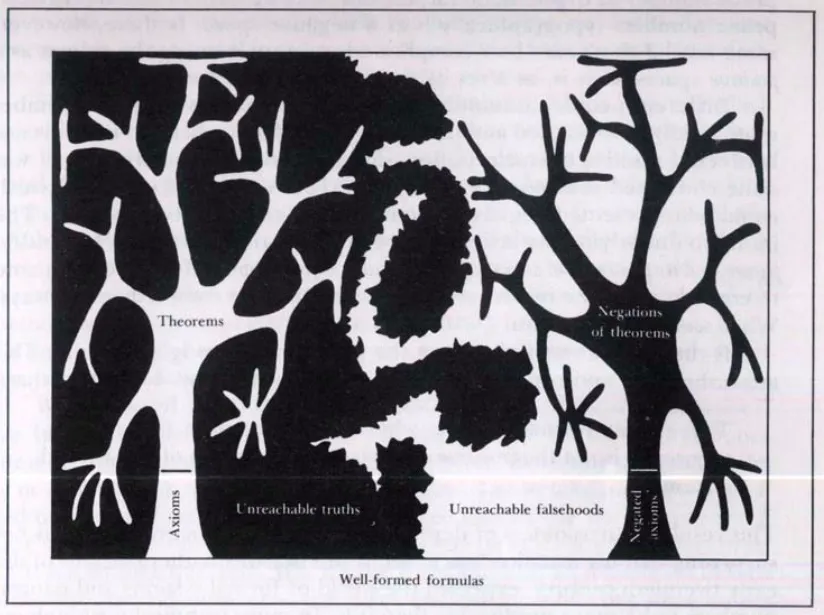
There is a neat picture [1] in GEB that captures a similar idea.
FWIW, I’ve had a very similar encounter with another famous AI influencer who started lecturing me on fake automata theory that any CS undergrad would have picked up on. 140k+ followers, featured on the all the big podcasts (Lex, MLST). I never corrected him but made a mental note not to trust the guy.
This is a handy tool, but I wish it supported edge snapping. If you inspect the generated LaTeX it doesn't actually link up the FSM states, it just anchors them to raw TikZ coordinates.
[1]: https://flann.cs.yale.edu
[2]: https://www.cs.toronto.edu/~hinton/csc2535/readings/ws.pdf
[3]: https://arxiv.org/abs/1711.02282
[4]: https://arxiv.org/abs/2006.08381
[5]: https://mural.maynoothuniversity.ie/id/eprint/1653/1/Hamilto...