Or if you would like additional commentary and extra camera views, there are independent channels such as Everyday Astronaut, NASASpaceFlight, Spaceflight Now, etc.
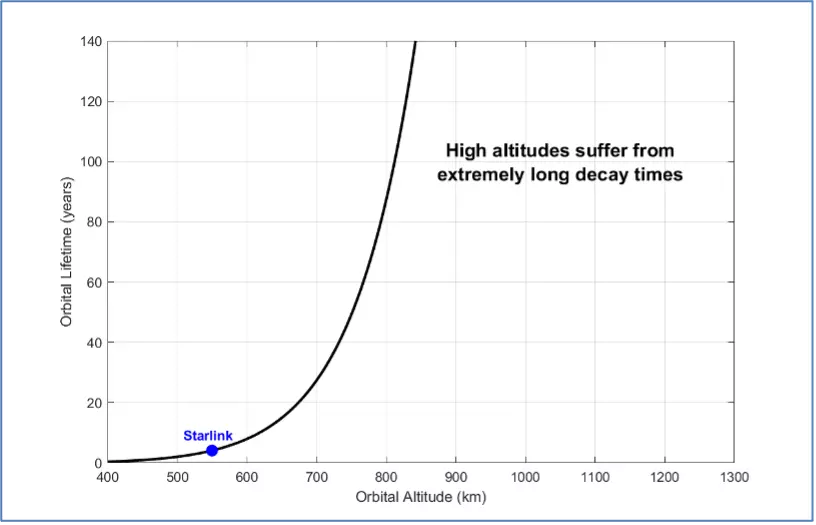
> SpaceX operates its satellites at an altitude below 600 km because of the reduced natural orbit decay time relative to those above 600 km. Starlink operates in \"self-cleaning\" orbits, meaning that non-maneuverable satellites and debris will lose altitude and deorbit due to atmospheric drag within 5 to 6 years, and often sooner, see Fig. 1. This greatly reduces the risk of persistent orbital debris, and vastly exceeds the FCC and international standard of 25 years (which we believe is outdated and should be reduced). Natural deorbit from altitudes higher than 600 km poses significantly higher orbital debris risk for many years at all lower orbital altitudes as the satellite or debris deorbits. Several other commercial satellite constellations are designed to operate above 1,000 km, where it requires hundreds of years for spacecraft to naturally deorbit if they fail prior to deorbit or are not deorbited by active debris removal, as in Fig. 1. SpaceX invested considerable effort and expense in developing satellites that would fly at these lower altitudes, including investment in sophisticated attitude and propulsion systems. SpaceX is hopeful active debris removal technology will be developed in the near term, but this technology does not currently exist.
AFAIK Starlink does not plan to put satellites in 1200 km orbits. All Starlink satellites are in orbits of 600 km or less, where any debris naturally decays in less than 5 years:
> Starlink satellites operate in a low Earth orbit below 600 km altitude. Atmospheric drag at these altitudes will deorbit a satellite naturally in 5 years or less, depending on the altitude and satellite design, should one fail on orbit. SpaceX proactively deorbits satellites that are identified to be at an elevated risk of becoming non-maneuverable. This proactive approach minimizes the number of non-maneuverable satellites in space.
People are prone to either giving Musk too much credit or too little.
Musk isn't Tony Stark, single-handedly building everything. But then again, that's not how most innovations work.
Engineers who worked directly with Musk, such as Tom Mueller, have spoken about Musk's technical acumen and involvement in managing projects.
There have been many rocket programs, both public and private, that have accomplished less with more money. Bezos's Blue Origin, for example, started earlier than SpaceX and had a much richer backer for most of its existence, but is only now hoping to launch its first orbital rocket (and I hope they succeed).
It is telling, though, that the strongest argument against SpaceX seems to be whether they followed all the correct procedures rather than whether there was actually any harm.
If the facts aren't on your side, then pound the law I guess.
Though the area does receive many orders of magnitude more water from natural rainfall than the deluge system, so anything present in that water would have been washed away anyway.
SpaceX did make changes to prevent damage to the launch pad in the future, true. I did not mean to suggest otherwise.
My point is that the "mess" the original comment complained about was not a major environmental issue, as they implied, and that it did not prevent subsequent launches from being approved.
There's a user on reddit with a bunch of alts that keeps spamming the conspiracy theory that SpaceX is a front by the military and intelligence agencies to funnel money into building a missile defense shield. They like to point to an AI chat with Twitter/X's Grok as proof.
It's true that some people connected to SpaceX were also interested in missile defense, but that's hardly unusual given that we're talking about the intersection between defense and the aerospace industry.
To the extent that SpaceX enables missile defense it's in the same way they enable any other space endeavor, as a natural consequence of lowering the cost of lifting payloads to orbit.
ESGHound has lobbed many accusations, most of which did not pan out. Some of his accusations, such as the idea that SpaceX's development was a front for their real goal to drill for fossil fuel, could be considered conspiracy theories.
Throw enough at the wall and something will stick.
I am not convinced he is correct in this case either, just that he's gotten the ear of a likeminded journalist.
I want to point out that while giving people time to comment sounds harmless, it's actually a systemic problem that's at the root of many issues.
Allowing special interest groups to delay development is a major reason why it's nearly impossible to build anything on time and on budget in the US.
If they don't cancel the project outright, or prevent it from starting in the first place via chilling effects, then the delays increase the price tag enormously.
Jerusalem Demsas at The Atlantic often writes about this:
> Development projects in the United States are subject to a process I like to call “whoever yells the loudest and longest wins.” Some refer to this as participatory democracy.
> Across the country, angry residents and neighborhood associations have the power to delay, reshape, and even halt entirely the construction of vital infrastructure. To put a fine point on it: Deference to community input is a big part of why the U.S. is suffering from a nearly 3.8-million-home shortage and has failed to build sufficient mass transit, and why renewable energy is lacking in even the most progressive states.
> . . .
> Every new development has so-called negative externalities: Construction is always annoying, trains can be loud and unsightly, wind farms may obstruct ocean views, and for some the simple knowledge that a nearby home is actually a duplex is enough to ruin the neighborhood character. Regardless of how valid you find any of these complaints, they should not by themselves be sufficient to block new projects, or else no mass transit, no new housing, no wind or solar farms could ever be installed.
> Signed into law in 1970, the National Environmental Policy Act and its state and local equivalents require federal agencies to assess the environmental effects of major projects before they sign off on them. Supporters argue that NEPA “empowers local communities to protect themselves and their environment.”
> But NEPA is more burdensome than it may sound. As the economist Eli Dourado has documented, environmental-impact statements were initially very short—just 10 pages, in some instances. But now they average more than 600 pages, include more than 1,000 pages of appendices, and take four and a half years on average to complete.
> How did this happen? Lawyers—the answer is always lawyers. Over time, the courts have embraced more and more expansive definitions of what these statements should cover. And lawyers—terrified of getting their clients caught up in lengthy court proceedings where a judge tells them they should have thought through the fourth- or fifth-order impacts of an apartment building—spend eons fleshing them out. The goal is not to mitigate environmental ill effects but to get an A+ for thoroughness.
> . . .
> Caution and deliberation are good in moderation, but waiting cannot relieve this uncertainty; it merely changes its form. Doing can cause harm, but not doing won’t preserve the world in amber. Neighborhoods in desirable communities that don’t build more housing see skyrocketing prices and demographic shifts toward high-income, white, and older residents. And nations that don’t build the necessary renewable-energy infrastructure will be subject to the very environmental degradation that 20th-century activists tried so hard to prevent.
> The unforeseen consequences of blocking change should weigh as heavily as the ones that come from allowing it. Those lost students, missing refugees, absent neighbors, and failed government projects may never intrude on our sight line or cause us frustration during our commutes, but they cost us all the same.
> Delays run up the cost of vital infrastructure and exert something like a chilling effect on new projects, as developers may not want to contend with the expensive legal battles that lie ahead. These laws have been used to stymie wind farms in Nantucket (residents dubiously claim that offshore wind kills whales), Martha’s Vineyard (the owner of the solar company that opposes the project lives near the proposed site part-time), and dozens of other purportedly progressive communities across the country.
> . . .
> Consider the way NEPA preemptively chills development or the fact that the delays themselves are costly. The economist Eli Dourado has studied NEPA’s failures for years, and he is skeptical that thoroughness and time spent should be read as a policy success: “If every review were done so thoroughly that it took 100 years to complete and the resulting lawsuit rate were zero, that would be a failure, not a success.” The problem is “the threat of litigation continuously increases the burden of NEPA review, rendering our agencies unable to make speedy decisions even in cases where it is obvious there is no significant environmental impact,” Dourado told me.
The video is of cars parked next to the launch pad area, taken by remotely operated cameras. No one was endangered.
Also, as dramatic as it looks, it is hardly an environmental disaster. I daresay paving over the land with asphalt and concrete had a larger impact.
And there have already been several launches since then. Those went more smoothly and were not delayed. The reasons for the delay this time have nothing to do with this.
Yeah, I agree it makes sense that certain apps shouldn't be easy to get rid of, though in comparison Android does let users disable apps such as the default gallery, browser, and even app store. I think the stock dialer and SMS apps are the main exceptions.
If deleted built-in apps aren't restored even after resetting an iOS 12 device, it's a good thing some apps aren't removable. I wish I'd thought to check before trading in my old iPad.
What happens if you resell an iPhone from which you've "deleted" apps such as Contacts, Maps, and Music? Does wiping and resetting the device restore it to stock condition, including those default apps?
If not, that seems potentially confusing for secondhand users. Some apps such as Phone and Photos cannot be removed in any way, but users may still be confused if other default apps are missing.
You would probably want to download the latest update rather than using the old version from the system image, but that's correct. Though IIRC the Facebook "app" the article complains is just a minimal placeholder, with the real app downloaded from the Play Store.
There are some built-in iOS apps that can't be deleted at all, such as Photos. For those that can be "deleted" Apple says users can restore them by downloading the app from the App Store.
But if a user deletes all the built-in apps that can be deleted, are they restored if the iOS device is reset? I would assume so, since wiping a phone is recommended before reselling it and a new user may be confused if default apps are missing, though I don't want to wipe my device just to confirm.
Functionally, isn't that much the same as disabling an Android system app?
I wonder if these articles would cease if Android simply changed the label "disable" to "delete" and removed the ability to view and re-enable disabled apps.
If the default apps are restored after a factory reset then "deleting" a built-in app in iOS isn't really any different from disabling an Android system app.
People don't need to be part of a secret organization to use the same arguments, sources, and terminology. A common cause or ideology will suffice.
I'm sure shill-theorists are not puppets of a secret cabal, for example, despite them all using the same unsourced anecdotes and unfalsifiable theories in their attempts to expose the truth about shilling.
It's true social media such as reddit attracts marketing, but that doesn't mean everything that could be marketing is. The obvious problem with claims of invisible marketing is that they're impossible to disprove. Also, if shilling were nearly as prevalent as the original commenter asserted it couldn't be kept such a secret.
There may be real shilling on occasion, but the damage to constructive discourse from unverifiable shilling accusations seems greater than whatever the benefits of constant vigilance are supposed to be.
If marketing were really so seamless and even valuable, it would remind me of xkcd 810: https://m.xkcd.com/810/
> And for the majority of the large subs for a specific interest, they are astroturfed to hell and back. Much of the content you see on /r/all is likely corporate shilling with sock puppets controlling the promotion of the item and the comments within.
And even more common than actual shilling is unsubstantiated accusations of shilling.
You could be right, I grant you, but anecdotally more cases of the latter stick out in my experience.
https://www.youtube.com/@VideoFromSpace/streams
Or if you would like additional commentary and extra camera views, there are independent channels such as Everyday Astronaut, NASASpaceFlight, Spaceflight Now, etc.