I suggested Ceylon as the 'modern day substitute' in the sense that it has had the opportunity to learn from mistakes made by the older FP languages. Ceylon has a very consistent type system and is therefore able to deliver more clear error messages.
I'm wondering whether Ceylon could be considered a modern day Ocaml substitute?
It has a very strong type system, focus on immutability, a strong module system and Object Oriented capability. What's missing?
Having tendon issues in my wrists, I would love a linear keyboard with gentle push down force. Or at least just gentle push down force. Any suggestions?
Ignorant here (I've never done database work):
What's wrong with asking the database to do the sorting for you? (assuming you do work that involves a database. Perhaps this assumption itself is the problem?)
The article makes a few ill considered assumptions:
That USA is a democracy (and that it thus makes sense to start influencing the election process). It isn't. Not in the sense that the opinions of the people influence the policies that are caried out.
http://talkingpointsmemo.com/livewire/princeton-experts-say-...
Third, he sort of assumes that our minds haven't already been "hijacked", by other means than addictive social media and apps. We'll, how can we explain, that those that are really good at affecting our countrys political decisions (the Saudi and the Israeli lobby) gets no scolding for this, while our chosen nemesis (Russia) gets lot's of scolding for something there's no evidence they've done? Couldn't this oddity be explained by old school "brain washing": propaganda. ?.
http://russia-insider.com/en/politics/americas-jews-are-driv...
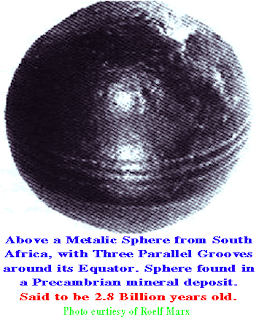
That's a bold statement. Read Forbidden Archeology, and you'll see quite a few oddities in the archeological realm. Such as metal spheres with odd, precise features, that are very very old ( http://4.bp.blogspot.com/-oiiiI75kDic/TdRv4ZsspWI/AAAAAAAAAC... )
(Yes, you can now give me the defaults:
"if this was true we would have heard of it"
"if he says something that is unconventional, he's probably a retard/arbitrarily biased"
etc. etc.
yes, go ahead)
> For example, it selectively cites a tiny corner of the
> research literature, conveniently ignoring the mountains
> of evidence that don't fit the stated thesis.
You really should provide some sort of reference on that claim.
I would say, that the consensus among psychologists in academia is the opposite of what you suggest:
A majority of those people would admit that genes have a significant influence on differences in human behaviour, interests, capabilities etc.
Ceci & Williams (2011). Understanding current causes of women’s underrepresentation in science. Proceedings of the National Academy of Sciences, 108, 3157-3162.
http://www.pnas.org/content/108/8/3157.full
Wang et al (2013). Not lack of ability but more choice: Individual and gender differences in choice in careers in science, technology, engineering and math. Psychological Science, 24, 770-775.
http://journals.sagepub.com/doi/abs/10.1177/0956797612458937
Williams & Ceci (2015). National hiring experiments reveal 2:1 faculty preference for women on STEM tenure track. Proceedings of the National Academy of Sciences, 112, 5360-5365.
http://www.pnas.org/content/112/17/5360.abstract
Actually, it's pretty easy for people in power to avoid the truth revealing effect that 'common knowledge'presents: simply label your less powerful adversary as a 'conspiracy theorist', and nobody will want to deal with that matter again. Nobody likes being labeled, or associated with, a loony.
Simple social dynamics tricks can mitigate the 'annoying' liberating effect that the internet poses.
Want an example? The content of this article by journalist Seymour Hersh will never become public knowledge. For reasons pertaining to simple social dynamics.
https://www.welt.de/politik/ausland/article165905578/Trump-s...
But how do I incorporate my level of confidence in my prior? I haven't seen any treatment of this question, even though it is a quite essential one: priors that you are not so sure about should be given less weight than priors that you are very certain about.
So. paranormality is a real thing - it is not an empty set of phenomena.
But who will believe this? Who will investigate it further?
No one! It doesn't fit with our mental schemas, so it gets ignored. Forever.
Quite a tragic outcome for such a potentially hugely disruptive area of research.
The article says:
"[in Egypt], “the deep state is not official institutions rebelling,” he said, but rather “shadowy networks within those institutions, and within business, who are conspiring together and forming parallel state institutions.”"
I don't understand how the article can make this statement. The statement clearly outlines a Conspiracy Theory. As we all know, Conspiracy Theories are false - a priori.
How can it be legitimate to concoct Conspiracy Theories for other nations, when, simultaneously, the very notion of (a national scale) conspiracy is seen as being equally as impossible as perpetual motors or faster-than-light travel?
Double standards? What's going on?
This sounds like a good suggestion.
Now my thought is to pair code files with similarly named doc files. Higher level code files will go first, and only later will I fill in the nitty gritty files.
The next question is: how do I get a good work flow? Due to a handicap, I am limited in my computer keyboard typing, but not limited in typing on my phone. Thus the optimal would be to find an Android markdown editor and an android git client. I'll check out the Play store :)