It mentions Edge is also losing MV2: is it? Any source after the 2024 Neowin article that an Edge Canary build 16 months ago disabled UBO?
No issues with UBO on Edge 149 (stable) and it's still available on the Edge Add-ons (it was featured by Microsoft, funnily enough, a few months back):
Did I miss something? Microsoft's official statement is that "The Microsoft Edge team is currently in the process of updating this MV3 migration timeline". Now, they've been working on that timeline since at least May 2025, so maybe with Chromium 150 / 151, they'll make it more concrete?
>Cortex-X4 a.k.a. Neoverse V3 has significantly lower performance per core than Zen 5.
I don't quite believe that, especially per core. In SPECint2017 from David Huang [1], Zen5 (HX 370) @ 5.1 GHz boost = 9.9 points, so Zen5 is approximately 1.94 points per GHz. But
Neoverse V3 (Cortex-X4) @ 3.2 GHz = 8.2 points, so V3 is approximately 2.56 points per GHz.
Arm 64C Neoverse V3 boosts to 3.7 GHz. AMD 64C Zen5 (9575F) boosts to 5 GHz. So this rough napkin mouth would show at maximum boost Neoverse V3 is right around maximum boost Zen5.
Zen5 fares much worse at base clocks, with Arm's 64C CPU offering +40% more SPECint perf per core than Zen5 because AMD downclocks to 3.3 GHz, but Arm is still up at 3.5 GHz + huge IPC advantage.
> The new Intel Clearwater Forest Xeon processors use Darkmont cores, which have approximately the same performance per core, the same die area per core and the same power consumption per core as the Neoverse V3
In no world will Darkmont perform like Neoverse V3 / Cortex-X4. Darkmont is much slower.
Arm's Neoverse V3 136-core CPU has a 3.2 GHz base clock, so the exact same as this Cortex-X4. Your real problem arises when a 288C Clearwater Forest CPU at the highest 500W TDP means a maximum of 1.7W per core (generous, as we're excluding uncore, fabric, cache, etc.). It's probably closer to 1.5W, but let's be generous and toss in +200mW.
Darkmont will be *nowhere* near 3.5 GHz at a mere 1.7W / core power budget. It'll be much closer to 2 GHz. Sierra Forest (6780E) is 144 cores @ 350W (2.2W / core) → a pitiful 2.2 GHz base clock. Let's go crazy and assume Darkmont magically achieves +13% higher clocks (2.2 → 2.5 GHz) at 22% less power (2.2W per core → 1.7W per core) and much higher IPC.
Darkmont @ hypothetical 2.5 GHz = ~5.09 points
Neoverse-V3 @ 3.2 GHz would be 61% faster.
>The only way how the claim of Arm can be true is if they have compared their new CPUs with antiquated CPUs like the Intel Granite Rapids Xeon CPUs, instead of comparing with state-of-the-art Intel Clearwater Forest and AMD Zen 5.
Intel had a paper announcement of Clearwater Forest this month. They have not revealed SKUs: no clocks, no model numbers, nothing exists. Nobody—including Arm—will be benchmarking against a CPU that doesn't exist on the market yet.
It is likely the hardware effiency of their chips. Apple SoCs running industry-standard benchmarks still run very cool, yet still show dominant performance. The OS efficiency helps, but even under extreme stress tests like SPEC, the Apple SoCs dominate in perf & power.
1) Apple Silicon outperforms all laptop CPUs in the same power envelope on 1T on industry-standard tests: it's not predominantly due to "optimizing their software stack". SPECint, SPECfp, Geekbench, Cinebench, etc. all show major improvements.
2) x86 also heavily relies on micro-ops to greatly improve performance. This is not a "penalty" in any sense.
3) x86 is now six-wide, eight-wide, or nine-wide (with asterisks) for decode width on all major Intel & AMD cores. The myth of x86 being stuck on four-wide has been long disproven.
4) Large buffers, L1, L2, L3, caches, etc. are not exclusive to any CPU microarchitecture. Anyone can increase them—the question is, how much does your core benefit from larger cache features?
5) Ryzen AI Max 300 (Strix Halo) gets nowhere near Apple on 1T perf / W and still loses on 1T perf. Strix Halo uses slower CPUs versus the beastly 9950X below:
Thus, it will be more than 15,000 employees for sure. :(
//
Written another way: at least 1 in 7 Intel employees will be let go. I don't know how a CPU & foundry can fire 15% in two quarters without significant negative repercussions.
Projected to be better by Intel and Intel alone. Intel has disclosed virtually no details of Intel 18A on any industry-standard metric: perf / W with an Arm core, transistor density; precise perf & density improvements over Intel 4, 3, and 20A.
TSMC is far, far more transparent than Intel—which is backwards. Intel is who needs more customers. Intel's silence on 18A's specifics is not inspiring.
Qualcomm resoundingly rejected Intel 18A, according to the Wall Street Journal, due to Intel missing multiple promised 18A milestones.
>Qualcomm, which designs chips and outsources manufacturing, wanted to work with Intel, and assigned a team of engineers to work toward making mobile-phone chips at Intel’s factories. It was particularly interested in a cutting-edge chip-making technology that Intel hopes will be the most advanced in the world by late next year.
>In early 2022, Intel’s foundry arm sent a delegation to Qualcomm’s San Diego headquarters, where they met with CEO Cristiano Amon. Then Intel missed a June performance milestone toward producing those chips commercially. It missed another in December.
>Qualcomm executives concluded Intel would struggle making the kind of cellphone chips they wanted, even if it succeeded in making high-performance processors. Qualcomm told Intel it was pausing work while it waits for Intel to show progress, according to people involved in the discussions.
Without Qualcomm, Intel has only found one real customer after a half-decade of hype: UMC's design subsidiary Faraday is an "evaluation [sever] platform" with Arm Neoverse cores, while Microsoft is making a vague "custom" chip.
Faraday won't even sell those CPUs (it's an ASIC firm primarily) and Microsoft couldn't be bothered to give a single word of detail of what they are producing.
I'm not hopeful, yet, until someone actually ships a key product on Intel 18A.
This is purely a DIY problem for six-month old systems.
Not a single OEM desktop or laptop sold in the past six months as new should have any of these issues.
UEFI is non-negotiable, TPM 2.0 is virtually universal, and you only need to be Secure Boot capable—not actually have Secure Boot on.
This tool expects the person that built the computer (Dell, HP, Lenovo, or the DIY enthusiast) to understand the terms.
But, credit to the author, it presents them in a very poor way. It should’ve noted UEFI / GPT wasn’t enabled first before any other error. But it assumes you know UEFI requires GPT which means using mbr2gpt.exe.
Thank you for the reply. Great to hear it's on Framework's radar.
While the reparability helps (as I'm used to even $800 laptops calling for $300 screens + webcam + Wi-Fi antenna), if it's profitable for Framework, it'd be an instant buy here.
Thank you so much for starting this project and hopefully long-term investment. Incredibly refreshing.
The site is down for the moment. What is the situation about warranty?
Do you plan to offer multi-year options? I’m all for repairing my own laptop, but if there is an option to pay upfront for some peace of mind on at least the parts, I’d bite.
Agreed. Zen3 would’ve been killer and cooler to boot.
I wonder if it is a supply concern? Zen2 laptops also ~seemed~ in scarce supply for quite some time last year, even after the launch.
How to tease out Intel’s anti-competitive belligerence versus actual supply issues? Zen3 on desktop seems to be regularly available, but desktop is lower volume than mobile.
This really deserves an AMD variant.
I would suspect Intel has juicy bundle discounts, especially if this is a part of the EVO program (which I don’t think it publicly is).
I think it’s down again if you click the configurations. Home page is sometimes up, but that’s also down some of the time.
“ 500 Internal Server Error
If you are the administrator of this website, then please read this web application's log file and/or the web server's log file to find out what went wrong.”
In 2005 to 2008: Intel made 2x to 6x more profit per quarter than Apple. A short example:
Q4 2005 at Intel: $24b profits
Q4 2005 at Apple: $4b profits
Not revenue. Not stock price. Profit, that can be put anywhere in the business. Intel had insanely higher profits than Apple. The iPod (which ran an ARM-derived 90MHz CPU) was already out in 2008. Apple had just acquired P.A. Semi. Intel still had vastly, vastly, vastly more free cash flow and profit.
Don't tell me Intel didn't have money for Arm or hiring CPU architects or even literally acquiring entire Arm firms.
Intel had hired these very people who later joined Apple; it absorbed Arm architects, uarches, designers, portfolios, etc.
They failed. As The Register wrote in 2006,
>Intel's failure wasn't for a lack of talent or investment - or even luck - over the years. Intel threw $1.6bn on a DSP company in 1999, and followed up with a host of smaller investments. And luck blessed Intel on several occasions. When DEC's StrongARM processor fell into Intel's hands in the fall of 1997, it was as a result of a legal settlement, and an unsought and unexpected prize. Pundits at the time thought that Intel had been handed the keys to the kingdom. But billions of dollars later, Intel could only claim two significant design wins from lower tier phone OEMs RIM and Palm. Texas Instruments, by contrast, will cash $14bn in revenue from phone chip sales this year.
>
>So how did Intel fail to capitalize? In a nutshell, it failed to live up to its name. Intel may stand for 'INTegrated ELectronics', but it failed to integrate the electronics that mattered when it mattered.
>
>A series of poor management decisions ensured that StrongARM was well positioned for a market that was on the decline, and rarely competitive in a market that boomed. Early on, Intel decided against integrating dedicated digital signal processing into the StrongARM chip, later renamed XScale. While this decision was justifiable for fixed embedded markets and for PDAs, it put the chip at a huge disadvantage for lower cost devices that needed voice capabilities. In response, Intel copied the PC strategy of adding new floating point instructions, introducing MMX for Xscale. Since phone manufacturers preferred cheaper custom chips for devices that needed a multimedia flip, this was a wasted investment.
P.A. Semi was partially responsible for the A4 and maybe A5? What about A6, A7, A8, A9, A10, A11, A12, A13, A14? You casually state "making it better and better", as if that's a regular occurrence for CPU architects over the past two decades. It's not, unfortunately.
Iterating a uarch is not a given. Ask Intel & AMD.
20% to 40% IPC gain / year is not a given. Ask Intel & AMD.
Iterating 20% to 40% IPC gain / year / nearly identical TDP is absolutely not a given. Ask Intel & AMD.
Likewise, P.A. Semi (in 2008) is a very recent addition in Apple's Arm journey.
// the history //
In the 1980s, Apple's ATG (Advanced Technology Group) pushed to move to on RISC and worked with Acorn in England to co-develop ARM III CPUs for Apple's "next-gen" devices
In 1990, Arm Ltd. is founded with the two largest shareholders as Apple (43%) and Acorn (43%).
Apple was reportedly responsible for Arm's current name: it's "Advanced", not "Acorn", because Apple didn't want to be associated with a former competitor.
Apple mainstreams Arm far earlier than the iPhone: in 2001, the first iPod launched with a 90 MHz ARM-derived CPU.
// P.A. Semi //
People always forget the history of the P.A. Semi acquisition, even as it's linked there.
The short version: Intel was literally gifted a major high-perf Arm uarch and screwed it up; that same CPU architect refuses to join Intel, founds P.A. Semi some years later, and Apple acquires P.A. Semi and that CPU architect joins Apple.
That "lot of low power chipmaking experience" was literally gifted to Intel and they couldn't do jack. Apple needed to acquire it after decades of trying to get Arm to work, far more effort than Intel.
In Q4 2005, Intel made $23b in profit. Apple made $4b in profit. Intel was a CPU IP & foundry. How did they miss Arm or other RISC designs? That's the kicker: Intel didn't miss Arm. Intel has repeatedly failed & floundered with "side technologies" that they thought inferior to x86: heterogenous dies, chiplets, Arm, XScale, etc. = Intel explicitly decried and denounced these "cheap" tactics by their competitors.
Intel in the 1990s, 2000s, and 2010s genuinely exhibited "not made here means it's crap and automatically inferior to anything we can make" philosophy.
1993: Daniel Dobberpuhl develops StrongARM, a high-performance ARM uarch.
1997: Intel is gifted StrongARM through a legal settlement and the "keys to the kingdom". Dobberpuhl doesn't agree to join Intel.
2003: Unrelenting on Arm's future, Dobberpuhl starts P.A. Semi after working at Broadcom.
2007: Intel sells off StrongARM, saying they don't know how to make money with ARM as AMD had applied unprecedented pressure with K8 & Athlon64.
2008: Apple acquires P.A. Semi.
2009: Dobberpuhl retires from Apple.
It's not like AMD, Intel, etc. were ignorant x86 had severe perf/watt limitations. They knew and they know. They tried repeatedly to overcome them and then simply lost interest as they couldn't make money.
What are these numbers based on? Just your "best estimate"? It's dismissive of Apple's uarch for what reason?
Arm has architecture licenses, unlike x86: anyone could've designed an Arm CPU from the ground up. NVIDIA tried, AMD tried, Intel tried, Qualcomm tried, Samsung tried, Huawei tried, etc. Everyone had a chance (and they still do). Arm is the most level playing field available in high-perf CPU design.
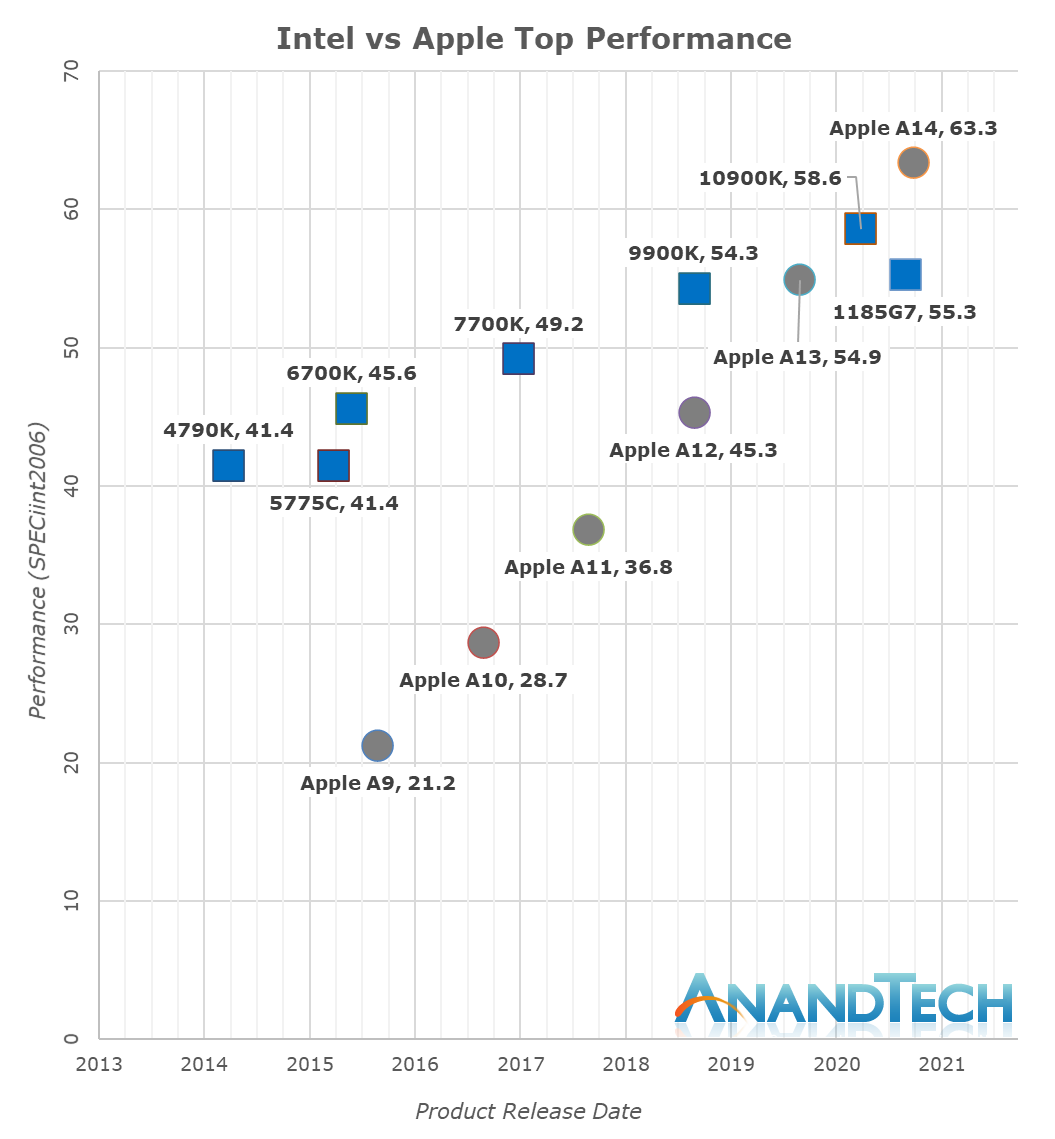
And "50% process technology" is an exaggeration even embarrassing for HN. The A13 was built on 7nm and still beat perf/watt of any x86 CPU and total 1T performance rivals Tiger Lake. A14 / M1 are a natural evolution of that same uarch.
What really breaks down your argument: Samsung has had nearly every advantage as Apple, yet its Exynos line is some of the worst-perf/watt Arm uarch today: its own OS (Tizen), its own foundry, its own phones / tablets / laptops, and a massive conglomerate for funding. What happen to Samsung? What money doesn't Samsung have? Hell, Samsung is even MORE integrated than Apple, as Apple still needs to outsource its fabrication to TSMC.
There's a reason Samsung is giving up on its uarch and moving to Arm stock cores (X-1, A78, A78C, etc.), just like Qualcomm + NVIDIA.
Don't tell me "you need trillion dollar valuation to make a top-class CPU". AMD was nearly bankrupt 6 years ago and now has the fastest general compute x86 arch in the world.
This argument reeks of "well, if Apple has the fastest CPU uarch today, then I'm going to ensure everyone else has an excuse."
Apple didn't even have an Arm architectural license, much less a custom high-perf CPU, 13 years ago. 13 years from "never designed a high-perf CPU" to "dominating x86 perf / watt while at the heels of total perf" is actually notable and actually impressive.
No issues with UBO on Edge 149 (stable) and it's still available on the Edge Add-ons (it was featured by Microsoft, funnily enough, a few months back):
https://microsoftedge.microsoft.com/addons/detail/ublock-ori...
Did I miss something? Microsoft's official statement is that "The Microsoft Edge team is currently in the process of updating this MV3 migration timeline". Now, they've been working on that timeline since at least May 2025, so maybe with Chromium 150 / 151, they'll make it more concrete?
https://learn.microsoft.com/en-us/microsoft-edge/extensions/...