Millennials Don't Care About Owning Cars, and Car Makers Can't Figure Out Why(fastcoexist.com)
fastcoexist.com
Millennials Don't Care About Owning Cars, and Car Makers Can't Figure Out Why
https://www.fastcoexist.com/3027876/millennials-dont-care-about-owning-cars-and-car-makers-cant-figure-out-why
185 comments
The funny thing is, if much fewer people are getting driver's licenses as the article claims, then ZipCar is also screwed.
I'm an example of that; since I never planned to own a car, I never got a license, and it's very hard to justify that time and expense when you can just take an Uber for a couple of bucks more.
I'm an example of that; since I never planned to own a car, I never got a license, and it's very hard to justify that time and expense when you can just take an Uber for a couple of bucks more.
I don't drive and don't have a license, but Uber is banned in my neck of the woods and taxis are ridiculously expensive. Driving would probably make my life a lot easier.
Look for a Toyota with a 22r engine (Carburated, or FI), with a manual transmission. A lot of 80's trucks, cars had them. They are easy to work on, and just last.
I would even buy one with over 175,000 miles. When you are at 250,00 to 300,000 miles you will remember this post.
There are other cars you can drive on the cheap, but I don't know the exact models. Older Hondas last. Older Volvos last. An older 60-70's VW will get you around cheaply, but are like riding in a covered wagon.
I would even buy one with over 175,000 miles. When you are at 250,00 to 300,000 miles you will remember this post.
There are other cars you can drive on the cheap, but I don't know the exact models. Older Hondas last. Older Volvos last. An older 60-70's VW will get you around cheaply, but are like riding in a covered wagon.
As long as all you are concerned about is the difficulty of moving from one point to another (presumably of a minimum distance) you are correct. You probably are not accounting for the overhead of actually owning a properly maintained and insured vehicle. The former has little cumulative effect on your life, the latter is an really complicated situation fraught with personal choices and teeming with people trying to take advantage of your naivety. Cars are a huge responsibility, 100% luxury, and generally a burden, make no mistake about it.
My car costs me a bit over $100/mo including insurance and gas, and I'm in one of the highest priced car insurance areas of the country. Amortize oil changes (a couple times a year) & tires (even less frequently), and it adds a bit more.
That's not a lot of money compared to taking a couple dozen Uber rides a month, though it is more than a monthly bus pass and a bicycle which is far less practical than a car for most American cities. Especially if you have a 24-hour lifestyle and the buses only run during the day, and take 2 hours to cross your large city vs 20 minutes on the freeway in a car.
I'm not a grease monkey by any stretch of the imagination, but as a technical person I have the curiosity to learn the basics of how things work, and when something goes wrong to try to generally understand the core failure. It doesn't take much to find a decent used car of a decently trusted brand that you can buy for cash, and drive it for years without a huge bill and without constant worries and nuisances.
It's exactly the same as dealing with the maintenance issues of anything you own, whether it's a computer or an appliance or a business or a house. You learn enough of the ins & outs of it so you can watch out for & eliminate the nuisances and focus on getting the benefits.
I will certainly agree that the cost of new cars are far outpacing average salaries, and used car prices are being pulled in the same direction. But as for right now, used cars are still quite manageable and affordable TCO-wise, and the vast majority of places in the USA still effectively require an individual means of transportation to work, shop affordably, and engage in activities.
That's not a lot of money compared to taking a couple dozen Uber rides a month, though it is more than a monthly bus pass and a bicycle which is far less practical than a car for most American cities. Especially if you have a 24-hour lifestyle and the buses only run during the day, and take 2 hours to cross your large city vs 20 minutes on the freeway in a car.
I'm not a grease monkey by any stretch of the imagination, but as a technical person I have the curiosity to learn the basics of how things work, and when something goes wrong to try to generally understand the core failure. It doesn't take much to find a decent used car of a decently trusted brand that you can buy for cash, and drive it for years without a huge bill and without constant worries and nuisances.
It's exactly the same as dealing with the maintenance issues of anything you own, whether it's a computer or an appliance or a business or a house. You learn enough of the ins & outs of it so you can watch out for & eliminate the nuisances and focus on getting the benefits.
I will certainly agree that the cost of new cars are far outpacing average salaries, and used car prices are being pulled in the same direction. But as for right now, used cars are still quite manageable and affordable TCO-wise, and the vast majority of places in the USA still effectively require an individual means of transportation to work, shop affordably, and engage in activities.
100% luxury
Actually, not owning a car is a luxury. How do you get all the stuff you need/want that you don't/can't fetch yourself from the source? You pay someone else to drive it for you! Same with people who talk about Uber, like paying for someone to drive you around isn't a luxury...
Actually, not owning a car is a luxury. How do you get all the stuff you need/want that you don't/can't fetch yourself from the source? You pay someone else to drive it for you! Same with people who talk about Uber, like paying for someone to drive you around isn't a luxury...
It entirely depends where you live whether a car is a luxury or a necessity. I grew up in a tiny village, where it was a necessity. now I live in a major European city, and it would be a luxury item. Something that sometimes saves me some time on the public transport, or the need to carry a few shopping bags a couple of hundred meters. I have a car sharing account but can rarely justify the cost of it when public transport is ubiquitous.
I think that may be the difference. Public transportation in Europe is generally much better than it is in the U.S. In most of America, you can sort of get around using busses but for the most part, you have to have some sort of personal transportation. And our bus system is not really designed/built for normal people everyday travel.
I was going to say the same thing. There are very large parts of the population that will never even have this option, no matter what they make. I live 8 miles outside of town. No uber driver is going to come pick me up. You might argue that it's a luxury to live in the country, except that 19% of the US population is rural. It doesn't make economic sense and it's not feasible for everyone to live in a city. Housing is cheaper out in the boonies, which is a necessity for some. I personally just don't mind the trade-off of convenience and like the benefits.
It may be luxurious to use Uber (?) but if its cheaper can it really be called a luxury?
>if its cheaper can it really be called a luxury
No. But for a lot of people, it is a luxury to have the freedom and flexibility to not require a car to go to your job(s), get your groceries delivered, etc.
There are situations where you can reasonably do without a car and save money vs. a minimum "clunker" car considering everything including housing prices etc. But they're in the minority, especially once people aren't urban singles.
No. But for a lot of people, it is a luxury to have the freedom and flexibility to not require a car to go to your job(s), get your groceries delivered, etc.
There are situations where you can reasonably do without a car and save money vs. a minimum "clunker" car considering everything including housing prices etc. But they're in the minority, especially once people aren't urban singles.
The Chinese must be must richer than I thought, considering that 85% have the "luxury" of not owning a car.
In many ways this statement is right. In cities the first floor of every house is a shop. If you don't want to cook breakfast walk across the street, one of those families runs a breakfast shop. The population density is high, so there is a bus stop on your street corner. Depending on the city traffic gets so bad that the brt or subway can beat driving. So, for some of that 85 percent not having a car is a luxury unavailable in most cities in the U.S.
You're being disingenuous; The GP is talking about the luxury of not needing a car.
GP is the one being disingenuous; yes, some people have even more luxurious lives than car owners, but that doesn't mean owning a car isn't a luxury.
And subsistence farmers in many areas of the world have 0% car ownership, so they clearly have luxurious lives.
You do realize you're arguing against yourself, right?
You are right that a car can make it cheaper/easier to live at a certain standard of living. However, some people can't afford to live at that standard of living at all and have to make do without the lifestyle improvements that they could have if they had a car. Hence, having a car is a luxury.
How do you get all the stuff you need/want that you don't/can't fetch yourself from the source?
We do without them.
We do without them.
Like umm groceries? How do you think they get to the store within walking distance? Or post to your letterbox?
I, like most people I know, carry groceries on the bus. You get one of these[1] and use a little arm strength (or ask for help if you can't). Yes, sometimes we spend a lot of time (possibly hours) going to and from the grocery shop.
[1] http://images.esellerpro.com/2152/I/585/38/XS0665_festival_t...
[1] http://images.esellerpro.com/2152/I/585/38/XS0665_festival_t...

Depends where you are. Where I'm at, I can either drive to the grocery store in 15 minutes, or I can walk a mile to the nearest highway where I can make a fairly dangerous crossing to try flagging down a bus that comes about once per hour, with very little regularity and often fails to stop. Then the actual trip to the store, another brief walk, and I'm limited to what I can carry, so instead of going to the store about once or twice per week with no more than an hour of transit time, I'll probably be spending a solid 4-9 hours per week travelling to get groceries. One hour per trip walking from house to bus and back, half an hour on a bus, twenty minutes walking to the store and back, multiply by 2-3 times per week. Add an extra hour every time a bus is missed or doesn't stop, which would be at least once or twice per week.
And that's not even touching trying to get to work, which takes me about 15 minutes in a different direction, and I'm not aware of any public transport that would get me from here to there without routing me in some other direction first. I could probably take on a part time job in the time I'd spend walking or riding buses.
It just wouldn't make sense for the majority of people in my area.
And that's not even touching trying to get to work, which takes me about 15 minutes in a different direction, and I'm not aware of any public transport that would get me from here to there without routing me in some other direction first. I could probably take on a part time job in the time I'd spend walking or riding buses.
It just wouldn't make sense for the majority of people in my area.
Motorcycles can be a cheaper alternative; ninja 250 gets about 70 miles per gallon and costs <15$/month for insurance.
Usefulness of a motorcycle has an all-season vehicle is very climate dependent. I know HN biases to the bay area where it might be possible. Out here, we get 14-18 feet of snow in an average winter. That motorbike is going to get you in the ditch for half the year. Especially when "plowed" after a big dump can mean single lane (for both directions) with a couple inches of slush or powder.
You are so lucky to live in a place that charges you < $15/month for insurance.
I live in Ontario and own a 150cc motorbike. Insurance: $129/month.
I live in Ontario and own a 150cc motorbike. Insurance: $129/month.
Wow, that's outrageous. 15$/mo is only for liability coverage. Since the potential damage caused by a motorbike is much less than a car so I thought it would be fairly cheap everywhere.
Good find. Ironically, I Hated ZipCar (in NYC). It was really awful, for many reasons I don't care to articulate here.
I would much rather own a car, then have to deal with ZipCar.
I would much rather own a car, then have to deal with ZipCar.
Why awful? I used it once in NYC. It was really not cheaper than a regular car rental, but other than that it was not bad. It was convenient not having to deal with lining up at a front desk when getting the car and returning it. Also the app makes extending your time easy.
I found traffic to be a huge impediment to Zipcar in NYC. I needed to really pad out reservations to ensure I did not return the car late (which was then wasteful because I was overpaying). Zipcar in SF and Chicago have been way more pleasant.
There are so many things that can go wrong with ZipCar in NYC. I never had a good experience, and it ended up being considerably more expensive than just renting a car for 24 hours. It's probably fine in other cities- but it just doesn't work in NYC.
Here's a horror story ZipCar experience for me:
Here's a horror story ZipCar experience for me:
  - I need a car for X...
  - Open ZipCar app- oh all of the cars in the area are booked for the next 4 days, except for one (inconveniently located).
  - Book the car for 3-4 hours.
  - Arrive 10mns early- find/talk to an angry parking attendant
  - Find out that the car isn't there yet, the previous person still has it.
  - Wait for 20mns for the car to arrive.
  - Car arrives, it smells like wet dog and has sand all over.
  - Hold breath, get in car. Find out it's almost out of gas.
  - Spend 30mns finding a gas station, and buying gas.
  - Find out the gas pump's credit card reader is broken, wait for another available gas pump.
  - Finally fill tank with gas. Only 1.5 hours wasted and we're on our way!
  - Preform task X
  - Drive car back to ZipCar garage, get stuck in traffic.
  - Try to extend reservation, but I can't because someone already booked the car for the next slot.
  - Return car to garage, can't find a parking attendant.
  - Pass the car along to the next annoyed ZipCar member, sorry for being late- stay away from the Brooklyn Bridge...
  - Consider for a moment this other person wasn't actually the member who reserved the car, but possibly a car thief? Nah...
- Contact ZipCar to ask for a discount because of the bad experience. Get $10 next reservation- great, thanks.Is it because cars are expensive horrendous fossil fuel powered polluting machines that are not compatible with city living?
Is it because the insurance industry, by its failure to deal with fraud, except by simply pricing it in, had made insurance premiums unreasonably expensive?
Is it because the streets are clogged and travel times are huge?
Is it because going by bike is just so nice?
I might add: From my point of view, they are more often than not unnecessary. As a single without children living in a european city, the occasions where I really 'needed' a car come down to: change of residence and buying big chunks of material -- like e.g. wood. With a supermarket, several doctors, my bank, and even a police station in about 5-10 min. walking distance, the usage of a car in everyday life routine would be definitly too cumbersome.
Also add...
Is it because many of them are having kids much later in life and don't need a car for all the reasons one would want or need one when they do have kids (school, travel, vacations, trips to grandmas, ski trips, Sunday drives, sports activities, club events, youth groups, pet vet trips, doctor trips, dentist trips, dinner night out, day hike, picnic in the park...shall I go on). Each and everyone one of us can say "I can take the bus to that", but would you or even can you load up your family of four to each and everyone one of those?
And in summary, maybe the automakers should adjust their expectations of anyone < 35 years old. Or maybe they should of all went bust in 2008 instead of being bailed out and let market forces reset the playing table resulting in better products and possibly more jobs, but that's another story.
Is it because many of them are having kids much later in life and don't need a car for all the reasons one would want or need one when they do have kids (school, travel, vacations, trips to grandmas, ski trips, Sunday drives, sports activities, club events, youth groups, pet vet trips, doctor trips, dentist trips, dinner night out, day hike, picnic in the park...shall I go on). Each and everyone one of us can say "I can take the bus to that", but would you or even can you load up your family of four to each and everyone one of those?
And in summary, maybe the automakers should adjust their expectations of anyone < 35 years old. Or maybe they should of all went bust in 2008 instead of being bailed out and let market forces reset the playing table resulting in better products and possibly more jobs, but that's another story.
I think I would add "Is it because they are money sinks, requiring substantial regular payments for insurance, maintenance, fuel, and (in some cities) parking spots?".
I'm simply going to go with - They cost money.
That is assuming the article is correct at all.
That is assuming the article is correct at all.
There are plenty of mililenials out there with cars, they just don t have NEW ones.
But for the millenials out there with old cars, and for the ones without a car at all. Nobody wants to buy a car because they're a huge financial responsibility. Duh? Millenials, who are sattled with student loans or, even worse (statistically), didn't go to school, don't want to attach themselves to a huge payment every month. If they're in a city, owning a car probably comes with huge parking fees as well.
But for the millenials out there with old cars, and for the ones without a car at all. Nobody wants to buy a car because they're a huge financial responsibility. Duh? Millenials, who are sattled with student loans or, even worse (statistically), didn't go to school, don't want to attach themselves to a huge payment every month. If they're in a city, owning a car probably comes with huge parking fees as well.
As a gen X-er, we didn't have new cars when we were young, either. My mother said it was a bit of a problem - good cars required less skill to drive, but it was older people with skill that got them. Meanwhile the young, inexperienced drivers have the crappy old cars that you really should have some experience before driving them (For example, I remember driving for half a kilometer on a dead-flat tyre because I didn't recognise the feel of that pull. Something felt wrong, but I had no idea what...)
I daresay, for recent college graduates, buying used cars and even clunkers has been common for a very long time.
There are plenty of mililenials out there with cars, they just don t have NEW ones.
The article also points out that driving licenses have dropped significantly, so it's not just a matter of buying cheaper cars.
The article also points out that driving licenses have dropped significantly, so it's not just a matter of buying cheaper cars.
As living in the city is getting more and more popular, this is very much understandable.
I can only speak for Berlin, but I got rid of my car soon after moving here. As a student public transport is basically free (it's part of the semester fee) and after finishing university, getting anywhere from anywhere at any time of the day (and at any state of consciousness) felt so natural, that I quickly got myself a BVG subscription.
You can always rent a van for cheap if you have to transport something big - that is if you have a driver's licence. Many people who were born here never bothered to get one.
I can only speak for Berlin, but I got rid of my car soon after moving here. As a student public transport is basically free (it's part of the semester fee) and after finishing university, getting anywhere from anywhere at any time of the day (and at any state of consciousness) felt so natural, that I quickly got myself a BVG subscription.
You can always rent a van for cheap if you have to transport something big - that is if you have a driver's licence. Many people who were born here never bothered to get one.
The article asserts this, but doesn't support it. It's got a statistic for the current rate, but for the past it basically says "back in MY day we were EXCITED to get our licenses."
For the boomer generation cars were socialisation: how you got to see your friends.
For the millenial generation that's smartphones.
For the millenial generation that's smartphones.
Agreed. Another possible factor: 15 years ago, most states had full licenses at 16 years old. Now, most states have restricted licenses, that "graduate" into unrestricted licenses by 17 or 18 years old (21 in the case of Maine) [1]. Even then, your unrestricted license can be delayed based on your driving record. I'd guess that the wait and the additional red-tape makes driving in general a less exciting proposition than it was "back in my day".
1. https://en.wikipedia.org/wiki/Driver%27s_license_in_the_Unit...
1. https://en.wikipedia.org/wiki/Driver%27s_license_in_the_Unit...
This should have a (2014) label. It's an old story and an old theory that was always dubious and was quickly disproven.
A better, more recent story: https://www.bloomberg.com/view/articles/2016-01-04/millennia...
Edit: The earlier version of my comment was wrong.
A better, more recent story: https://www.bloomberg.com/view/articles/2016-01-04/millennia...
Edit: The earlier version of my comment was wrong.
>But that’s not the "driving" factor, especially considering that owning a smartphone or other mobile device, with its monthly fees of network access, data plan, insurance, and app services, is almost comparable to the monthly payments required when leasing a Honda Civic.
iphone 7 plus 128GB - 41.58$
Verizon 4GB data plan - 50$
insurance - 10$
app services? - 20$
Total - 121.58$
From Honda's website, they're advertising a civic lease for $179 a month. that's with 2000$ due at signing. Oh wait! you'll also need mandatory driver's insurance on that vehicle, that'll be at least another 50$ (im told, i live in michigan which has the highest car insurance prices in the nation, my 2012 sonata costs 178 a month to insure, that's well above my monthly payment on the car itself - i have never been in an accident and i have no tickets in the last 5 years) anyways, so we are at least at $229 total with a 2000$ initial down payment. That's quite considerably more expensive...
oh wait! theres also the various fees for getting a license, getting a license plate, registering the vehicle with the state, and of course the mental cost of maintaining the various paperwork.
Total - 229$ + 2500ish$
iphone 7 plus 128GB - 41.58$
Verizon 4GB data plan - 50$
insurance - 10$
app services? - 20$
Total - 121.58$
From Honda's website, they're advertising a civic lease for $179 a month. that's with 2000$ due at signing. Oh wait! you'll also need mandatory driver's insurance on that vehicle, that'll be at least another 50$ (im told, i live in michigan which has the highest car insurance prices in the nation, my 2012 sonata costs 178 a month to insure, that's well above my monthly payment on the car itself - i have never been in an accident and i have no tickets in the last 5 years) anyways, so we are at least at $229 total with a 2000$ initial down payment. That's quite considerably more expensive...
oh wait! theres also the various fees for getting a license, getting a license plate, registering the vehicle with the state, and of course the mental cost of maintaining the various paperwork.
Total - 229$ + 2500ish$
Also, if we're including cost of a data plan for the phone, I think it's only fair to include gas and maintenance in the cost of the car.
This. The TCO of a car is ginormous, even for all the comfort it provides.
For some reason people are caught up in sticker price value versus demand value and try to play this cute game where a car is an investment, or better yet, a tool to be leveraged.
Cars are a luxury that we afford and then make excuses as to why we are justified in the expense. There are a few luxury car brands you could consider "investable" because of your ability to re-lease and do week long or similarly timeboxed rentals, but, even that is just an excuse that the people wealthy enough to afford those types of cars make to explain their luxury expense.
Cars are a luxury that we afford and then make excuses as to why we are justified in the expense. There are a few luxury car brands you could consider "investable" because of your ability to re-lease and do week long or similarly timeboxed rentals, but, even that is just an excuse that the people wealthy enough to afford those types of cars make to explain their luxury expense.
I'd be willing to argue that new cars are a luxury. A quick search[0] says that only 26% live in an urban environment. The rest are suburban or rural. The latter portion don't always have walkable areas.
I used to live a short 7 minute drive from my office. Mapping it says 15 via bike and 1 hour via foot. It would have been nearly impossible to bike there, because there are no bike lanes, areas with no sidewalk nor shoulder, intersections that are awkward even for cars, high speed limits, etc. I mean, you could get there, but it would be a very unenjoyable ride. Walking? That's pretty much out of the question.
There's another option: public transportation. It is very unreliable. The map system is so convoluted that a group of cyclists are doing their best to release a FOSS app to navigate the bus system.
Taxis and ride-share are almost non existent and very expensive. UberX is roughly $22 round trip.
Not all American metro areas are made for walking/cycling. Once you hit our downtown area, walking and cycling are pretty easy. Thus, I argue that cars are not an inherent luxury in America.
[0]:https://fivethirtyeight.com/features/how-suburban-are-big-am...
I used to live a short 7 minute drive from my office. Mapping it says 15 via bike and 1 hour via foot. It would have been nearly impossible to bike there, because there are no bike lanes, areas with no sidewalk nor shoulder, intersections that are awkward even for cars, high speed limits, etc. I mean, you could get there, but it would be a very unenjoyable ride. Walking? That's pretty much out of the question.
There's another option: public transportation. It is very unreliable. The map system is so convoluted that a group of cyclists are doing their best to release a FOSS app to navigate the bus system.
Taxis and ride-share are almost non existent and very expensive. UberX is roughly $22 round trip.
Not all American metro areas are made for walking/cycling. Once you hit our downtown area, walking and cycling are pretty easy. Thus, I argue that cars are not an inherent luxury in America.
[0]:https://fivethirtyeight.com/features/how-suburban-are-big-am...
In USA, living in an urban walkable area is just as much a luxury as owning a car, if not more, thanks to some really poor infrastructure and urban planning choices made mid 20 century.
In fact, the only city I would consider for car-free ownership would be NYC, and you all know how expensive it is.
In fact, the only city I would consider for car-free ownership would be NYC, and you all know how expensive it is.
When I sold my car a while ago I had been organized enough to keep all maintenance records and bills. On top of depreciation and licensing I could figure out how much gas I had used, and tallied up all my insurance premiums.
The cost per mile came out almost identical to what the IRS lets you expense per mile on a corporate rate that year. Right now that rate is $0.54/mile.
The cost per mile came out almost identical to what the IRS lets you expense per mile on a corporate rate that year. Right now that rate is $0.54/mile.
>that'll be at least another 50$
Maybe for the bare minimum liability. But if there's a lien on the car (because it's leased or financed) then you're required to have comprehensive insurance. Combined with the fact that a new driver will have higher rates and I think you'd be hard pressed to find a rate below $150 a month.
>oh wait! theres also the various fees
And maintenance. 4 oil changes a year, tires, brakes, belts and other things that need to be replaced regularly probably adds another $1000 per year.
Cars are definitely an excessive expense. I know because I've owned (at least) one my whole life. Then again, my car affords me the ability to live in an area where the cost of living is far below New York, San Francisco, Vancouver or Toronto.
Maybe for the bare minimum liability. But if there's a lien on the car (because it's leased or financed) then you're required to have comprehensive insurance. Combined with the fact that a new driver will have higher rates and I think you'd be hard pressed to find a rate below $150 a month.
>oh wait! theres also the various fees
And maintenance. 4 oil changes a year, tires, brakes, belts and other things that need to be replaced regularly probably adds another $1000 per year.
Cars are definitely an excessive expense. I know because I've owned (at least) one my whole life. Then again, my car affords me the ability to live in an area where the cost of living is far below New York, San Francisco, Vancouver or Toronto.
No doubt it depends on what car your driving, but those seem like pretty crazy high maintenance costs. Over the past ten years, I've spent anywhere from $60-$400/year on maintenance. I drive about 30k miles a year. "Brakes and belts" are for me something you do every 100k miles. Oil changes run about $30, with a new filter. The only other regular maintenance item is the engine air filter, which runs maybe $10. Every couple years I end up buying new tires, but I've known people that made it 8+ years on one set.
Altogether, with taxes, fuel, car payments, and insurance, it costs me about $400/month to have a car which I don't think is terrible.
It would be nice to spend less on transportation, but I really can't imagine life without a car. Even if I lived in a major city with great public transport - I can imagine using public transport to commute, but I'd still want a car. Of course, where I live now, having a car is absolutely mandatory. I've always kind of shaken my head at the HN comments that suggest I could just ride a bike or something - even if I moved right next to my job site (no thanks), for probably eight months of the year the weather is hot enough that even a slow walk will leave you absolutely drenched in sweat. And maybe I'm crazy, but I prefer going to the grocery store for an hour once every two weeks as opposed to dropping by every day...pretty tough to do without a car. And then there really is the abstract freedom aspect - I can take off and go anywhere, anytime. Coordination is never a factor.
And as you say, I can live in a much lower CoL area with my car. Which also helps in that there's much less traffic than in a big city, so driving a car is more enjoyable. I have a 30 mile commute wherein I can drive as fast as I want except for the last mile. :)
Altogether, with taxes, fuel, car payments, and insurance, it costs me about $400/month to have a car which I don't think is terrible.
It would be nice to spend less on transportation, but I really can't imagine life without a car. Even if I lived in a major city with great public transport - I can imagine using public transport to commute, but I'd still want a car. Of course, where I live now, having a car is absolutely mandatory. I've always kind of shaken my head at the HN comments that suggest I could just ride a bike or something - even if I moved right next to my job site (no thanks), for probably eight months of the year the weather is hot enough that even a slow walk will leave you absolutely drenched in sweat. And maybe I'm crazy, but I prefer going to the grocery store for an hour once every two weeks as opposed to dropping by every day...pretty tough to do without a car. And then there really is the abstract freedom aspect - I can take off and go anywhere, anytime. Coordination is never a factor.
And as you say, I can live in a much lower CoL area with my car. Which also helps in that there's much less traffic than in a big city, so driving a car is more enjoyable. I have a 30 mile commute wherein I can drive as fast as I want except for the last mile. :)
Now let's talk about how much it costs to live in a part of the country where you don't need a car at all...
The verzion $50 doesn't include line access, which is another $20 per smartphone.
Learning to drive was expensive, so I didn't do it, then I graduated and moved to a city (like many others my age) and didn't need a car because public transport is ubiquitous and parking facilities aren't. Only anecdotal, but I know a lot of people in my position.
Yep.
I grew up in the sticks, so of course I got a car the second I could to get around.
Then I moved to an actual city (i.e., 250k population) and I spent more time hunting for parking spots than actually driving, and when I moved to an even bigger city, I left my car with my parents because I was fed up with how inconvenient cars were.
I don't see how car manufacturers are going to "fix" being worse than public transit.
I grew up in the sticks, so of course I got a car the second I could to get around.
Then I moved to an actual city (i.e., 250k population) and I spent more time hunting for parking spots than actually driving, and when I moved to an even bigger city, I left my car with my parents because I was fed up with how inconvenient cars were.
I don't see how car manufacturers are going to "fix" being worse than public transit.
They could fix it by burning down public transit, https://en.wikipedia.org/wiki/General_Motors_streetcar_consp...
Austin is the modern version of that.
http://www.vocativ.com/327333/a-world-without-uber-dispatche...
http://hotair.com/archives/2016/06/22/banning-uber-and-lyft-...
http://www.vocativ.com/327333/a-world-without-uber-dispatche...
http://hotair.com/archives/2016/06/22/banning-uber-and-lyft-...
That was because Uber and Lyft threw a tantrum about having to get proper background checks for their drivers. They're not banned from the city; they could come back at any time if they agree to use real background checks.
The SSN-based background checks Uber and Lyft use are way too easy to defraud by using a fake SSN. Fingerprint background checks are much more secure. I don't get the complaints: I had to get a fingerprint background check when I legally changed my name two years ago. Big whoop. It cost me about $40 and a few weeks of waiting (and I got the actual fingerprinting done at lunch, so I didn't miss any work), and I don't care because it meant I could finally use the name I go by on official stuff.
What Uber and Lyft did is straight out of the 19th-century robber baron playbook: they responded to sensible regulation by boycotting the entire local market. That's not how a good corporate citizen behaves; it's abusive and monopolistic behavior.
The SSN-based background checks Uber and Lyft use are way too easy to defraud by using a fake SSN. Fingerprint background checks are much more secure. I don't get the complaints: I had to get a fingerprint background check when I legally changed my name two years ago. Big whoop. It cost me about $40 and a few weeks of waiting (and I got the actual fingerprinting done at lunch, so I didn't miss any work), and I don't care because it meant I could finally use the name I go by on official stuff.
What Uber and Lyft did is straight out of the 19th-century robber baron playbook: they responded to sensible regulation by boycotting the entire local market. That's not how a good corporate citizen behaves; it's abusive and monopolistic behavior.
The SSN-based background checks Uber and Lyft use are way too easy to defraud by using a fake SSN.
Do you have any evidence that criminal behavior is higher on Uber and Lift than on yellow cabs?
In any case, the fingerprint requirement is not the only thing the law requires. The law essentially required turning Uber into a yellow-cab like service which would more or less make part time driving unecomonical: http://www.austintexas.gov/edims/document.cfm%3Fid=245769
It's factually wrong that they are a monopoly. Yellow cabs still exist, and suck just as bad as they ever did. Assuming Uber and Lyft are as unsafe as proponents of Proposition 1 claim, isn't it good that they are gone?
Do you have any evidence that criminal behavior is higher on Uber and Lift than on yellow cabs?
In any case, the fingerprint requirement is not the only thing the law requires. The law essentially required turning Uber into a yellow-cab like service which would more or less make part time driving unecomonical: http://www.austintexas.gov/edims/document.cfm%3Fid=245769
It's factually wrong that they are a monopoly. Yellow cabs still exist, and suck just as bad as they ever did. Assuming Uber and Lyft are as unsafe as proponents of Proposition 1 claim, isn't it good that they are gone?
Austin once had streetcar lines, so Austin is also the historical version.
http://www.austinchronicle.com/news/2000-07-21/77996/
http://www.austinchronicle.com/news/2000-07-21/77996/
The same - lived in a small city, got a car as soon as I could. Adore driving, love it as a pursuit as well as a means to get from A-B, but having moved to London last year can hand on my heart say I'd never own a car here. Traffic, no parking, slower than public transport and Uber is but a click away.
Cars will go the way of the horse in urban areas - luxuries to be enjoyed as a passion rather than something for the everyday.
Cars will go the way of the horse in urban areas - luxuries to be enjoyed as a passion rather than something for the everyday.
Owning a car is one thing. It depends on where you live, where you work, and your preferences.
However, I literally would not have been able to have done any job I've ever had without the ability to drive. (I'm not talking about commuting although that's been the case, but driving to customer sites, driving to remote transportation with one job, etc.)
To say nothing about countless travel experiences which wouldn't have been possible without driving. Even my friends in cities like SF who don't own cars and use Uber extensively, still rent cars and use Zipcar on a regular basis.
However, I literally would not have been able to have done any job I've ever had without the ability to drive. (I'm not talking about commuting although that's been the case, but driving to customer sites, driving to remote transportation with one job, etc.)
To say nothing about countless travel experiences which wouldn't have been possible without driving. Even my friends in cities like SF who don't own cars and use Uber extensively, still rent cars and use Zipcar on a regular basis.
Driving, I gather, used to carry connotations of fun, romance, freedom, and prosperity. For me, today, it's more likely to evoke the opening scene of Office Space. The experience sucks, it's expensive, and it feels more like an obligation than an accomplishment. Taking the bus almost feels like a no-brainer in the same way that I'm apparently expected to feel that owning a car is a no-brainer.
It's part of something bigger, it's not just cars as status symbol in decline, but cars as a lifestyle enabler.
I'm a diver, and to live the dive lifestyle, i.e. diving regularly at the weekends not just a week a year on holiday, pretty much requires owning a car. You can load it up the night before, set off at 0-dark-30 to make the tide, use it as a base for the weekend, come back late and unload the next day, etc etc. Do-able with a rental but a lot more hassle given the timings. Including tanks and weights, the Mrs and I would probably take 150-200kg of gear for a weekend trip.
Diving as a sport is in long-term decline since the 1990s, so are mountaineering, basically all outdoor pursuits that require some logistics get to remote places, and possibly even all outdoor activities. People these days prefer to not go outside at all if they can avoid it. This can't be good for public health.
I'm a diver, and to live the dive lifestyle, i.e. diving regularly at the weekends not just a week a year on holiday, pretty much requires owning a car. You can load it up the night before, set off at 0-dark-30 to make the tide, use it as a base for the weekend, come back late and unload the next day, etc etc. Do-able with a rental but a lot more hassle given the timings. Including tanks and weights, the Mrs and I would probably take 150-200kg of gear for a weekend trip.
Diving as a sport is in long-term decline since the 1990s, so are mountaineering, basically all outdoor pursuits that require some logistics get to remote places, and possibly even all outdoor activities. People these days prefer to not go outside at all if they can avoid it. This can't be good for public health.
"People these days prefer to not go outside at all if they can avoid it. "
Counterpoint: I LOVE cycling. Do it all the time. I love riding anywhere I can make it my main mode of transport.
When I lived in LA, this was rarely. I rode down Lincoln Blvd. several times and still remember the sound of tires squealing from the pickup behind me. My best guess is that the driver looked up from their phone and saw me with about 0 seconds to spare, given that they came to a stop about an inch from my rear wheel.
I like cycling so much, in fact, that I moved to a European city where I can cycle to work, to the shop, to my friends' places, every day. There were other reasons too of course, but that was one of the biggest.
Living in a European city where things can be reached by cycle meant that really, I don't even need a car, so I don't own one.
Anyway, there are outdoor activities that don't require a car.
Counterpoint: I LOVE cycling. Do it all the time. I love riding anywhere I can make it my main mode of transport.
When I lived in LA, this was rarely. I rode down Lincoln Blvd. several times and still remember the sound of tires squealing from the pickup behind me. My best guess is that the driver looked up from their phone and saw me with about 0 seconds to spare, given that they came to a stop about an inch from my rear wheel.
I like cycling so much, in fact, that I moved to a European city where I can cycle to work, to the shop, to my friends' places, every day. There were other reasons too of course, but that was one of the biggest.
Living in a European city where things can be reached by cycle meant that really, I don't even need a car, so I don't own one.
Anyway, there are outdoor activities that don't require a car.
I'm in Norway. In the city I'm at, a car is definitely a luxury. We have a used one that is only used to transport heavy goods (kitty litter) and go out of town occasionally. I still walk to the grocery store and most places in town or ride the bus.
However, we would go out of town before we had a car... because public transportation is really a thing. City to city. Not all-inclusive, but enough that one can travel to the outdoors so long as you are willing to walk or cycle as well. It just takes slightly more planning is all.
I could have never had this sort of car-less freedom in the states. Living in a larger city was probably one thing, but getting from city to city - or city to the outdoors - was quite another entirely.
However, we would go out of town before we had a car... because public transportation is really a thing. City to city. Not all-inclusive, but enough that one can travel to the outdoors so long as you are willing to walk or cycle as well. It just takes slightly more planning is all.
I could have never had this sort of car-less freedom in the states. Living in a larger city was probably one thing, but getting from city to city - or city to the outdoors - was quite another entirely.
I remember visiting Seoul and being quite surprised that you can take the Metro to the surrounding hillside. It's lovely.
Of course, I still use a car now and then. I'll rent one a few times a year for a long weekend, and I use GoCar when I need to rent a van for whatever reason.
I definitely don't want to own one though. It feels about as practical as owning an airplane - another class of vehicle which is useful, but not necessary to build your civilization around.
Of course, I still use a car now and then. I'll rent one a few times a year for a long weekend, and I use GoCar when I need to rent a van for whatever reason.
I definitely don't want to own one though. It feels about as practical as owning an airplane - another class of vehicle which is useful, but not necessary to build your civilization around.
I'd imagine your life would change very little if you bought something used - that is what we did. Better than renting a few times, for us, anyway.
If I were living some other places, though, I'd have the same attitude as you. Talked to a cab driver in Amsterdam once and found out there was something like a 4-5 year wait on parking spaces. I was completely amazed - owning a car is definitely not that important to me.
If I were living some other places, though, I'd have the same attitude as you. Talked to a cab driver in Amsterdam once and found out there was something like a 4-5 year wait on parking spaces. I was completely amazed - owning a car is definitely not that important to me.
"I'd imagine your life would change very little if you bought something used - that is what we did. Better than renting a few times, for us, anyway."
The local garages charge at least €150 a month for parking. Auto insurance, just for liability, is quite expensive as well. I'd have to pay tax and get an NCT inspection every year too. Not to mention that I have spent too much of my life crawling underneath crappy old cars ('88 Volvo 760, '86 Volvo 240, '90 Nissan Sentra) when I could have just rented something new and well-maintained by someone who isn't me.
There are plenty of folks here who will say "but you're a HN reader! Clearly several hundred euro a month should be a trifling expense!" but, well, it's not. Also, the idea that everyone has a car is how employers in less hospitable places (namely, the US) justify putting their offices a zillion miles away from transit.
The local garages charge at least €150 a month for parking. Auto insurance, just for liability, is quite expensive as well. I'd have to pay tax and get an NCT inspection every year too. Not to mention that I have spent too much of my life crawling underneath crappy old cars ('88 Volvo 760, '86 Volvo 240, '90 Nissan Sentra) when I could have just rented something new and well-maintained by someone who isn't me.
There are plenty of folks here who will say "but you're a HN reader! Clearly several hundred euro a month should be a trifling expense!" but, well, it's not. Also, the idea that everyone has a car is how employers in less hospitable places (namely, the US) justify putting their offices a zillion miles away from transit.
Yeah, see, that parking fee would be about enough for me to pass on the car. Just because one is a HN reader doesn't mean they find that a trifling expense. Luckily either that isn't as common in the city I'm in or we are lucky enough to live in a small house turned apartments with parking right outside.
I'm not entirely certain about insurance rates on that one - truth be told, that is just something my spouse picks up and I never bothered to ask. I'm still not actually legal to drive here yet. I missed the short deadline, now get to take classes and re-learn. I think if we didn't have dreams of living out in the countryside where transport is much more sparse, I'd not even bother with the expense.
I'm not entirely certain about insurance rates on that one - truth be told, that is just something my spouse picks up and I never bothered to ask. I'm still not actually legal to drive here yet. I missed the short deadline, now get to take classes and re-learn. I think if we didn't have dreams of living out in the countryside where transport is much more sparse, I'd not even bother with the expense.
" we are lucky enough to live in a small house turned apartments with parking right outside."
Not as relevant in an area where land is inexpensive, but in cities free parking is usually a sign of terrible inefficiencies in land allocation. See "The High Cost of Free Parking" by Donald Shoup.
Not as relevant in an area where land is inexpensive, but in cities free parking is usually a sign of terrible inefficiencies in land allocation. See "The High Cost of Free Parking" by Donald Shoup.
I think your first part is right - and would fit the general trend of people earning less and having longer hours or less convenient schedules - but the second part seems way off. Running, jogging, hiking, and cycling seem at least as popular as ever, which would also fit the theory that sports which have a larger logistical and equipment footprint are more affected by the general decline in economic security. Something like diving or mountaineering costs a lot more in time just to acquire the skills you need to go on a trip but almost anyone can slip on some athletic shoes or ride a bike casually.
>> it's not just cars as status symbol in decline, but cars as a lifestyle enabler.
That hasn't changed one bit in the midwestern United States. People go 'up north' or 'to the lake/cabin' for the weekend, every weekend. So you need a camping trailer (huge monstrosities in their own right), or a trailer + boat, jetskis, 4-wheelers, dirt bikes, or maybe just some road bikes or canoes/kayaks.
If you have a boat/camper you need a full size truck to pull the trailer. Many people go for the 3/4 ton trucks for their hauling and payload capacity. Anything smaller and an SUV will do, and you have quite a few people who put their kayaks or bikes on the roofs of their car.
That hasn't changed one bit in the midwestern United States. People go 'up north' or 'to the lake/cabin' for the weekend, every weekend. So you need a camping trailer (huge monstrosities in their own right), or a trailer + boat, jetskis, 4-wheelers, dirt bikes, or maybe just some road bikes or canoes/kayaks.
If you have a boat/camper you need a full size truck to pull the trailer. Many people go for the 3/4 ton trucks for their hauling and payload capacity. Anything smaller and an SUV will do, and you have quite a few people who put their kayaks or bikes on the roofs of their car.
I think for many, cause and effect are reversed from your theory. Hobbies that more or less require a car are less popular with people that do not need a car otherwise, or are moved to locations & styles that are accessible without one.
Not having a car limits my outdoor locations to what I can reach by bike and public transport (and my holiday travel locations), but it's hard to justify the hassle of a car just for that. Still enough interesting locations around.
Not having a car limits my outdoor locations to what I can reach by bike and public transport (and my holiday travel locations), but it's hard to justify the hassle of a car just for that. Still enough interesting locations around.
Sports go in and out of fashion all the time. For example, in the communities that I'm involved in, open boat canoeing has been on a fairly long-term decline but paddleboarding is extremely popular, at least in the Northeast, these days--which requires big and hard-to-transport gear. Sea kayaking remains pretty popular as well, as far as I can tell.
Not sure what the overall hiking stats are. I can say that a lot of national park visitation (such as to Acadia in Maine) is up. https://irma.nps.gov/Stats/SSRSReports/Park%20Specific%20Rep... (I'm told it's way up this year. The speculation is that Americans are putting off travel to Europe for various reasons.)
Not sure what the overall hiking stats are. I can say that a lot of national park visitation (such as to Acadia in Maine) is up. https://irma.nps.gov/Stats/SSRSReports/Park%20Specific%20Rep... (I'm told it's way up this year. The speculation is that Americans are putting off travel to Europe for various reasons.)
>People these days prefer to not go outside at all if they can avoid it.
I don't know if this is true. I think I agree with you, but have no idea if the data supports it. Sports and outdoor leisure activities sometimes seem more accessible than ever.
I don't know if this is true. I think I agree with you, but have no idea if the data supports it. Sports and outdoor leisure activities sometimes seem more accessible than ever.
I can relate. I'm don't own a car, preferring to use car-sharing services instead, but I would love to go kajaking more, which requires a car. Very costly, very annoying.
For me car ownership as a millennial is about "working smarter" and saving HUGE amounts of time and hassle.
I own two cars. They're not essential (indeed one is a "fun car"...) - I live in a city and use public transport to get to and from work and get most of my groceries delivered so I could live without if I wanted, but why would I want to make my life harder and more boring?!
The time-savings of car ownership alone are through the roof, not to mention the huge convenience factor. There are several trips I do often that take under 5-10 minutes in a car, but take 30-40 on public transport/buses. I can get to the shops and buy 10 bags of groceries and be back home again and unpacked in 30 mins, but on a bus it would take 30 mins to even get there! (and then I'd realistically only be able to carry say 4 bags home with me on the bus and not have anything frozen). I estimate that car ownership saves me 45-60 minutes on this sort of trip that I do frequently - you cant put a price on that sort of convenience & time-savings.
How much more code or other fun stuff could you do with an extra 3 or 4 hours a week?
Of course there are instances where public transport is faster too (like getting into Central London) so for me it works to have the best of both worlds - use whichever makes sense. It does not need to be a polar decision.
Other millennials I work with or talk to often seem amazed that I have one let alone two cars - I dont think they realise how cheap it is to own and run a second-hand car. Get a 3 or 4 year old Honda or a Toyota that has been looked after and you'll only need to insure it, service it and put petrol/diesel in it. Up front cost will be £3-5K (and it will last many years and still be worth something when you sell it), annual running costs about £500 - fuel obviously varies, I probably spend about £300-400 a year on petrol.
So for me all in about £900 a year to run a car, or based on my average Uber fare of about £13, about 1.3 Uber trips a week if you ignore initial upfront cost.
I own two cars. They're not essential (indeed one is a "fun car"...) - I live in a city and use public transport to get to and from work and get most of my groceries delivered so I could live without if I wanted, but why would I want to make my life harder and more boring?!
The time-savings of car ownership alone are through the roof, not to mention the huge convenience factor. There are several trips I do often that take under 5-10 minutes in a car, but take 30-40 on public transport/buses. I can get to the shops and buy 10 bags of groceries and be back home again and unpacked in 30 mins, but on a bus it would take 30 mins to even get there! (and then I'd realistically only be able to carry say 4 bags home with me on the bus and not have anything frozen). I estimate that car ownership saves me 45-60 minutes on this sort of trip that I do frequently - you cant put a price on that sort of convenience & time-savings.
How much more code or other fun stuff could you do with an extra 3 or 4 hours a week?
Of course there are instances where public transport is faster too (like getting into Central London) so for me it works to have the best of both worlds - use whichever makes sense. It does not need to be a polar decision.
Other millennials I work with or talk to often seem amazed that I have one let alone two cars - I dont think they realise how cheap it is to own and run a second-hand car. Get a 3 or 4 year old Honda or a Toyota that has been looked after and you'll only need to insure it, service it and put petrol/diesel in it. Up front cost will be £3-5K (and it will last many years and still be worth something when you sell it), annual running costs about £500 - fuel obviously varies, I probably spend about £300-400 a year on petrol.
So for me all in about £900 a year to run a car, or based on my average Uber fare of about £13, about 1.3 Uber trips a week if you ignore initial upfront cost.
It looks like people like to comment on the title without reading the article - it says that young people are genuinely not interested, as demonstrated by the fact fewer take a driving licence. They do have money, but they prefer spending on IT gadgets rather than cars. The article may be wrong of course, but it's not simply a matter of them being broke.
I went from commuting for the first couple of years by car, to moving within a 10 minute bus ride from my office.
Being a major city, the bus fare alone is cheaper than parking. I live within 15 minutes of world class night life, a city who's main source of income is tourism. An uber home costs little more than a drink.
For a lot of high rises, the cost of a car park is comparable in price to an extra room. It could be the difference between a nicer place or one further out.
I used to road trip to my home town before I started working, but the last few years have been trips overseas, or to other states with the same friends. Not having a car payment, or registration, or insurance helped here...
I know my lifestyle isn't for everyone, there are a lot of pros and cons. I think putting off settling down and having a family (another millennial trend?) removes a lot of the need for a car though. By the time I stopped driving, it seemed more an inconvenience than anything. Like that bulky spare couch you don't have a room for after moving house.
Just offering my $0.02 as a millennial that relates to the story.
Being a major city, the bus fare alone is cheaper than parking. I live within 15 minutes of world class night life, a city who's main source of income is tourism. An uber home costs little more than a drink.
For a lot of high rises, the cost of a car park is comparable in price to an extra room. It could be the difference between a nicer place or one further out.
I used to road trip to my home town before I started working, but the last few years have been trips overseas, or to other states with the same friends. Not having a car payment, or registration, or insurance helped here...
I know my lifestyle isn't for everyone, there are a lot of pros and cons. I think putting off settling down and having a family (another millennial trend?) removes a lot of the need for a car though. By the time I stopped driving, it seemed more an inconvenience than anything. Like that bulky spare couch you don't have a room for after moving house.
Just offering my $0.02 as a millennial that relates to the story.
The idea that millenials are buying gadgets over cars is a pretty dumb one. Those aren't in the same realm of financial responsibility.
People disagree with the article.
People disagree with the article.
How much of the money spent on cars is spent on transportation vs spent on status? Money made from selling status has to compete with everything from craft beer to the latest iPhone and holidays that can be bragged about on social media.
Not to mention the status boost of being rich enough to not need to own a car.
Not owning a car in the current year is pretty much the "don't own a TV" of the last couple decades. Everyone competes to status signal the hardest how they support it, but when the rubber meets the road (ahem) its emperors new clothes time and almost everyone does the opposite of the signalling.
Something often not discussed is the opportunity cost of not owning a car. Not being able to have hobbies other than drinking at college bars, for example. Not being able to leave the city, not being able to travel, or visit a real park. Sorry can't take that job or promotion because I gotta live 5 minutes walk from the leased apartment. Sorry can't go out on that date, can't you just go with me to the college bar again? The cost of the parochial tunnel vision of never meeting people outside walking distance.
Not owning a car in the current year is pretty much the "don't own a TV" of the last couple decades. Everyone competes to status signal the hardest how they support it, but when the rubber meets the road (ahem) its emperors new clothes time and almost everyone does the opposite of the signalling.
Something often not discussed is the opportunity cost of not owning a car. Not being able to have hobbies other than drinking at college bars, for example. Not being able to leave the city, not being able to travel, or visit a real park. Sorry can't take that job or promotion because I gotta live 5 minutes walk from the leased apartment. Sorry can't go out on that date, can't you just go with me to the college bar again? The cost of the parochial tunnel vision of never meeting people outside walking distance.
Your straw man requires someone not have a car and not have the money that one saves from not having a car.
For the price of a car payment, I can commute on the DC metro and rent a car for a weekend. For the price of car insurance, I can take Uber for quite a few miles. For the money I made renting my parking space, I can rent a car for another weekend and subscribe to Amazon Prime. With the money saved on gas, car maintenance, and parking downtown, I can fly home to see family.
For the price of a car payment, I can commute on the DC metro and rent a car for a weekend. For the price of car insurance, I can take Uber for quite a few miles. For the money I made renting my parking space, I can rent a car for another weekend and subscribe to Amazon Prime. With the money saved on gas, car maintenance, and parking downtown, I can fly home to see family.
> Your straw man requires someone not have a car and not have the money that one saves from not having a car.
That's not the predicament that most people are in. Just because you don't have a 30k car doesn't mean you have 30k in the bank to utilize. Hell, since most people finance cars now a days, having a 30k car doesn't mean that you had anywhere near 30k in the bank before buying. Whereas, if you buy that car, whether or not you had something in the bank to cover it before buying, you now are on the hook for maintenance, gas, insurance, etc. So no that's not straw man at all.
> For the price of a car payment, I can commute on the DC metro and rent a car for a weekend.
I won't get started on this, as owning and utilizing a car in the DC/NoVa area is a beast onto its own.
That's not the predicament that most people are in. Just because you don't have a 30k car doesn't mean you have 30k in the bank to utilize. Hell, since most people finance cars now a days, having a 30k car doesn't mean that you had anywhere near 30k in the bank before buying. Whereas, if you buy that car, whether or not you had something in the bank to cover it before buying, you now are on the hook for maintenance, gas, insurance, etc. So no that's not straw man at all.
> For the price of a car payment, I can commute on the DC metro and rent a car for a weekend.
I won't get started on this, as owning and utilizing a car in the DC/NoVa area is a beast onto its own.
What did I write that requires 30k in the bank? I'm specifically talking about the same cash flows you mention.
The amount spent per month on car loan, insurance, gas, parking, amortized maintenance, etc is now free to pay for other forms of transportation: car rentals, uber, flights.
Someone with the monthly cash flow to choose not to buy a car, that complains they can't afford to go anywhere or do anything is very much a straw man.
The amount spent per month on car loan, insurance, gas, parking, amortized maintenance, etc is now free to pay for other forms of transportation: car rentals, uber, flights.
Someone with the monthly cash flow to choose not to buy a car, that complains they can't afford to go anywhere or do anything is very much a straw man.
Mercedes Benz isn't going after Millenials. Millenials are sought after in the lower market segments. 15k Kias and 20k Hondas. Outside of the ability to not have to bum rides from my friends, I can assure you my Civic is no status symbol.
I'm not saying your car is a status symbol, but there's status at every price point. Someone might not need a car, but the status of owning one could push them over the edge. Do Kia and Civic have paint and trim options that cost extra? Status. Does a new Civic loose value as soon as its purchased because no other buy will be able to say they bought it new? Status.
"demonstrated by the fact fewer take a driving licence"
That's not actually demonstrated in the article, read again.
That's not actually demonstrated in the article, read again.
This is why I think the Apple Car is doomed. Apple makes products with a luxury/status component, that people want to own. But if transportation becomes a service rather than a physical product, the market for autonomous vehicles will not be for end-consumers. Apple will need to seriously rethink its strategy and perhaps reinvent itself.
I also think that once autonomous cars are ubiquitous, transportation will become a service no matter how much big companies want to see it differently, because autonomous vehicles as a service will make parking spots totally unnecessary. Interesting times ahead for city planning.
I also think that once autonomous cars are ubiquitous, transportation will become a service no matter how much big companies want to see it differently, because autonomous vehicles as a service will make parking spots totally unnecessary. Interesting times ahead for city planning.
I'm pretty sure everyone working on autonomous cars realizes there is no future in personal ownership.
Maybe for people who only use cars for the monthly Ikea trip but there are a world of use cases where ownership makes sense, basically any time you want to use a vehicle as "mobile storage of stuff".
Of course there are always edge cases, and there are always people that will want to own instead of lease/rent/whatever.
I'm talking about the vast majority here.
I'm talking about the vast majority here.
I know people in London who question the need for anyone to own a car because public transport is so good and you can get anything you want delivered next- or even same-day.
I also know people less than an hour's drive from London for whom public transport is 1 bus per day, so people set out in the mornings with everything they need in the car and operate out of it for the rest of the day, then pick up shopping or whatever on the way home. The former group have no idea that the latter even exist despite the latter being the "vast majority".
I also know people less than an hour's drive from London for whom public transport is 1 bus per day, so people set out in the mornings with everything they need in the car and operate out of it for the rest of the day, then pick up shopping or whatever on the way home. The former group have no idea that the latter even exist despite the latter being the "vast majority".
> The former group have no idea that the latter even exist despite the latter being the "vast majority".
This is exactly the case. It's really easy to forget when living in a city that the people out in the 'burbs dominate your bubble in terms of both size and influence.
I don't see the need for a car right now because I live in a city. But whenever I go back home, I'm reminded that living in the burbs without a car is usually impossible. It's not even that the buses are inconvenient -- they just don't exist.
This is exactly the case. It's really easy to forget when living in a city that the people out in the 'burbs dominate your bubble in terms of both size and influence.
I don't see the need for a car right now because I live in a city. But whenever I go back home, I'm reminded that living in the burbs without a car is usually impossible. It's not even that the buses are inconvenient -- they just don't exist.
Yeah, we have a reasonable bus route network for the country but you cannot actually travel from one major town to the next without using a car.
One of the impacts I see the self driving car having is a massive multiplier from being able to close this gap e.g. I could order goods from the next town.
Bad news for supermarkets. I think they will be wrecked by the competition self driving cars will bring.
One of the impacts I see the self driving car having is a massive multiplier from being able to close this gap e.g. I could order goods from the next town.
Bad news for supermarkets. I think they will be wrecked by the competition self driving cars will bring.
Included in that are tons of people who have their own service business like real estate agents, doing bakery deliveries, many maintenance workers, etc.
I'm pretty sure you can argue for personal car ownership in a self-driving world. Do you want to get into a shared vehicle right after the guy who puked up his dinner? Have you ever been in a public restroom? Some people will not want to use shared transportation. Other people may see ownership and customization of a self-driving car as the ultimate status symbol. What's better than Donald Trump's gold plated throne room pulling up to the curb?
> Do you want to get into a shared vehicle right after the guy who puked up his dinner?
You simply flag the car as dirty and wait for the next car. The previous guy will get a nice cleaning bill.
Also, I'm sure there will be different classes of cars, with appropriate price tags.
You simply flag the car as dirty and wait for the next car. The previous guy will get a nice cleaning bill.
Also, I'm sure there will be different classes of cars, with appropriate price tags.
The cleanliness factor seems overrated doesn't seem to be a major issue with Zipcar, for example. However, people like to customize their cars, store things in them, etc. Sure, there's a limit to how big a premium you'll pay in many cases. But it's not strictly an economic argument.
The puke will be detected by the electronic vision & nose, which will flag the car for cleaning before the next trip.
If rental or "share" cars are anything to go by, they will be lowest spec, with maybe AC and electric windows if you are super lucky and someone wanted to splurge on extra "luxury". Electronic detectors for puke? What universe would that be in?
In the universe where they are cost-saving devices, not luxuries.
In a self-driving taxi system, the company has three options: schedule a cleaning after each trip (very expensive), have an auto-detection system or deliver a dirty car to the customer to get sent back, which will be a waste of time and gas, not to mention the bad customer experience.
Consider you can already get a portable e-nose (to detect spoiled meat, for example) for $150 on retail, the cost is definitively worth it.
In a self-driving taxi system, the company has three options: schedule a cleaning after each trip (very expensive), have an auto-detection system or deliver a dirty car to the customer to get sent back, which will be a waste of time and gas, not to mention the bad customer experience.
Consider you can already get a portable e-nose (to detect spoiled meat, for example) for $150 on retail, the cost is definitively worth it.
I'd buy a car that drives itself. Whenever I briefly consider buying any car that costs more than twice my current monthly income I eventually come to a conclusion "right, all this is probably really nice, but I'd still have to drive this thing" and that's the worst part of cars for me, driving them.
> But if transportation becomes a service rather than a physical product
"if"? In many cities that's already the case.
"if"? In many cities that's already the case.
It's also possible that cars have gotten better over time, and people are fine driving old ones. I drive a 15-year-old car. Yeah, a new car would be nice, but this one works just fine, and hasn't caused me any problems.
But when I think back to 2001, I don't think cars from 1986 would be the same way.
This is not data, of course, as it's completely anecdotal. But based on my own experience, I'd be curious if people really are holding onto cars longer, or buying more used cars.
But when I think back to 2001, I don't think cars from 1986 would be the same way.
This is not data, of course, as it's completely anecdotal. But based on my own experience, I'd be curious if people really are holding onto cars longer, or buying more used cars.
As a kid in Iowa, all the cars were rusted out. Nobody bought a new one but once or twice in their lives.
In college all the cars were new. Economy was up I guess, or cars were relatively cheaper.
Well, today the cars are getting rustier again. Lots of junkers; more used car lots than new; and even the new ones are econoboxes that won't last but a few years anyway.
Probably a study in there somewhere - plot the rust coefficient against wages or something.
In college all the cars were new. Economy was up I guess, or cars were relatively cheaper.
Well, today the cars are getting rustier again. Lots of junkers; more used car lots than new; and even the new ones are econoboxes that won't last but a few years anyway.
Probably a study in there somewhere - plot the rust coefficient against wages or something.
Depending on when you went to college, the "Cash for Clunkers" scheme might have been relevant?
Yeah, I'm way older than that.
yep! my car is 15 years old, has ~80k miles and I was hoping it would last pass 200k+ miles
Modern economy cars suck. They're less fuel efficient than they used to be, they have less power, they're not as stable and they're in need of constant repairs. They're also more expensive than they were 20 years ago. I could forgive a lot about a 10 year old Toyota Corolla when it was only $700. I'm not as forgiving now that a 10 year old Toyota Corolla is $5k.
If the cost wasn't enough, modern cars just aren't fun to drive. Compare the Honda Civic to my father's generation's idea of an economy car: The Ford Mustang. I'm told that car was a blast to drive and my father could afford one as a high school student.
If the cost wasn't enough, modern cars just aren't fun to drive. Compare the Honda Civic to my father's generation's idea of an economy car: The Ford Mustang. I'm told that car was a blast to drive and my father could afford one as a high school student.
Various sources in this article says you're wrong: http://auto.howstuffworks.com/under-the-hood/diagnosing-car-...
Plus also my anecdata. Cars were horrendously unreliable back in the 1970s. It's only because of selection bias that the few reliable cars survived while all the recalled/broken down/junked cars from that era have gone.
Plus also my anecdata. Cars were horrendously unreliable back in the 1970s. It's only because of selection bias that the few reliable cars survived while all the recalled/broken down/junked cars from that era have gone.
I'm wrong about what, exactly? My argument about reliability was about a 1986 Toyota Corolla driven in 1996 vs a 1999 Toyota Corolla driven in 2009. My argument about fun to drive was the Mustang, which came from my father. I wasn't alive in the 70's, nor did I assert 70's cars were more reliable.
The situation is almost entirely the opposite of what you stated.
Modern cars make more power while using less fuel [1][2], are way safer [3], more reliable [4], and are cheaper, relatively, than ever [5].
"Fun to drive" is subjective, but I don't think it's fair to compare a Civic to a Mustang. Personally, I think modern, performance cars handle better, feel "crisper", and accelerate better than the old muscle cars.
[1] http://www.rita.dot.gov/bts/sites/rita.dot.gov.bts/files/pub...
[2] http://www.autoblog.com/2011/02/11/every-car-is-now-a-perfor...
[3] http://www.iihs.org/iihs/sr/statusreport/article/50/1/1
[4] http://www.nola.com/business/index.ssf/2012/02/cars_have_imp...
[5] http://2.bp.blogspot.com/_DLIvw6mZGBU/SRDPkT-yq7I/AAAAAAAAAP...
Modern cars make more power while using less fuel [1][2], are way safer [3], more reliable [4], and are cheaper, relatively, than ever [5].
"Fun to drive" is subjective, but I don't think it's fair to compare a Civic to a Mustang. Personally, I think modern, performance cars handle better, feel "crisper", and accelerate better than the old muscle cars.
[1] http://www.rita.dot.gov/bts/sites/rita.dot.gov.bts/files/pub...
[2] http://www.autoblog.com/2011/02/11/every-car-is-now-a-perfor...
[3] http://www.iihs.org/iihs/sr/statusreport/article/50/1/1
[4] http://www.nola.com/business/index.ssf/2012/02/cars_have_imp...
[5] http://2.bp.blogspot.com/_DLIvw6mZGBU/SRDPkT-yq7I/AAAAAAAAAP...
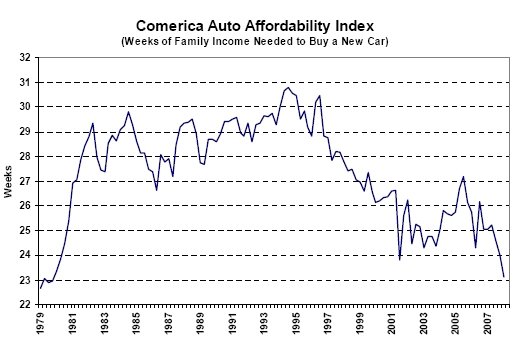
The Mustang was never any generation's idea of an economy car; it was a muscle car, which is pretty much the polar opposite of an economy car.
> The new Mustang was viewed as a "fun-to-drive economy" car, but "in reality it shared its underpinnings with the ... Pinto."[0]
The Mustang enthusiasts don't like to dwell on its economy period in the 70's. If my father hadn't owned one, I never would have known.
[0]: https://books.google.com/books?id=7NIDAAAAMBAJ&pg=PA66&lpg=P...
The Mustang enthusiasts don't like to dwell on its economy period in the 70's. If my father hadn't owned one, I never would have known.
[0]: https://books.google.com/books?id=7NIDAAAAMBAJ&pg=PA66&lpg=P...
From 2007 to 2011, the number of cars purchased by people aged 18 to 34, fell almost 30%, and according to a study from the AAA Foundation for Traffic Safety, only 44% of teens obtain a driver’s license within the first year of becoming eligible and just half, 54% are licensed before turning 18.
It would have been nice to see more data. 2007 to 2011, car purchases among that age group dropped 30%. What did other age groups look like? That was right after the crash, so I suspect other stopped buying cars as well.
And what's with quoting how many teens get licenses? What did it look like 10 years ago? Was it the same?
It would have been nice to see more data. 2007 to 2011, car purchases among that age group dropped 30%. What did other age groups look like? That was right after the crash, so I suspect other stopped buying cars as well.
And what's with quoting how many teens get licenses? What did it look like 10 years ago? Was it the same?
While the article says more technology in cars might entice millenial buyers, I feel like tech in cars is actually a disincentive for anyone interested in technology. With a few notable exceptions, most car tech seems like embarrassing garbage that's hardly enticing when it's brand new, much less at the end of a typical car's lifetime. Car development doesn't keep pace with things like smartphones, people keep cars much longer, and automakers don't seem inclined to offer much in the way of updates once they have your money.
Millennials seem to be happier moving into cities than us gen x'rs who fled the cities. Around here in the rural/suburbs you couldn't survive (ie, get to work, groceries) without a car.
I would love to have better public transportation so I didn't have the payments, but I don't see that in my lifetime.
I would love to have better public transportation so I didn't have the payments, but I don't see that in my lifetime.
The whole car pride is a thing of the past. It used to define who you were and prove your success. People are simply evolving and take the car for what it is, it's simply transportation and you shouldn't make a big deal out of it, nor you should go in massive debt for it. If the car industry wants to change, making better quality, cheaper car, less polluting and smaller or more intelligent, it might benefit them a lot.
As the article points out, a phone and data plan cost as much per month as a car payment. Perhaps, just perhaps, millennials simply don't have enough money to afford the equivalent of two car payments a month.
It's been a long time since my monthly phone bill was more than $25, and I live in a rural area. Why don't people shop harder for this service?
If we actually were living in prosperity these kinds of articles just would not exist.
It is all rationalizing.
The fact is that young people are poor, and not just poor in the conventional way people with less time on the planet less savings, but poor in the historical sense of being less wealthy in real money than their parents when they were the same age.
Somebody needs to explain to (most people outside places like Silicon Valley) why in an age supposedly advantaged by the forces of technology and globalization we are actually poorer.
We're not asking the right questions.
The government, the media and huge portions of the middle class are blithely ignoring the territory in favour of the map.
This is not going to end well.
It is all rationalizing.
The fact is that young people are poor, and not just poor in the conventional way people with less time on the planet less savings, but poor in the historical sense of being less wealthy in real money than their parents when they were the same age.
Somebody needs to explain to (most people outside places like Silicon Valley) why in an age supposedly advantaged by the forces of technology and globalization we are actually poorer.
We're not asking the right questions.
The government, the media and huge portions of the middle class are blithely ignoring the territory in favour of the map.
This is not going to end well.
Yes, I don't own a car because I don't care... It has nothing to do with my crippling student loan debt and my need to live within walking distance of public transportation.
Maybe it's too much to hope that people don't want cars because cars destroy the urban environment, cause many fatal accidents and lead to global warming?
At least in Europe, I think cheap flights are another factor. The car used to enable the fantasy that you could wake up in the morning and drive off in search of adventure.
But any adventure within driving range looks increasingly passe in the era of easy foreign travel.
At least in Europe, I think cheap flights are another factor. The car used to enable the fantasy that you could wake up in the morning and drive off in search of adventure.
But any adventure within driving range looks increasingly passe in the era of easy foreign travel.
Adventure within driving range also means "adventure within medium-distance public transport, with no worries about designated drivers etc." That said, I don't really see a decline in this lifestyle (even cheap flights are no match to 4 people to a car, pricewise), so perhaps each of us is only looking at their own precious one data point?
But any adventure within driving range looks increasingly passe in the era of easy foreign travel.
I'd say that cheap flights have had the exact opposite effect. A long weekend in London/Berlin/Paris has become increasingly passe compared to a long weekend spent a 4 hour drive off the beaten track in that place you can only reach by car.
I'd say that cheap flights have had the exact opposite effect. A long weekend in London/Berlin/Paris has become increasingly passe compared to a long weekend spent a 4 hour drive off the beaten track in that place you can only reach by car.
Cars are too expensive for people without much money. Boom, question answered.
We're talking about the same millennials that have more than one laptop and smart phone per capita, right?
I have more than one smartphone. Mostly because I've never gotten rid of some old ones that don't really work well or reliably. It isn't that out of range to have a couple of laptops, one older and the updated one. When so much of your life is on the computer, this makes sense - you are really out of sorts without it.
A car, on the other hand, costs more. I figure upfront costs for a cheapish used car being around $3,000 - $5,000. This costs more than a couple of laptops and smartphones combined - and it is all at once. At least the phones might be subsidized by the phone company (though I read that is changing there).
In addition, there are all these fees associated with cars. You have taxes and plates and insurance (which can cost as much as internet every month). These cost more with newer cars. Newer cars you have car payments, followed by some time with overlapping maintenance fees and car payments. Used cars with a loan have that as well: Without a loan, you still have maintenance costs and fuel costs to consider.
Seriously an unfair comparison.
Besides, even with a vehicle, the expectation is really that folks have a cell phone and internet service: Computer instead of television of days gone by. Heck, you need this sort of thing for job and apartment shopping. Sure, theoretically there are libraries, but not everyone actually has access to them. (there are places in Indiana without a local library, and any they can use charge to use them, for example).
A car, on the other hand, costs more. I figure upfront costs for a cheapish used car being around $3,000 - $5,000. This costs more than a couple of laptops and smartphones combined - and it is all at once. At least the phones might be subsidized by the phone company (though I read that is changing there).
In addition, there are all these fees associated with cars. You have taxes and plates and insurance (which can cost as much as internet every month). These cost more with newer cars. Newer cars you have car payments, followed by some time with overlapping maintenance fees and car payments. Used cars with a loan have that as well: Without a loan, you still have maintenance costs and fuel costs to consider.
Seriously an unfair comparison.
Besides, even with a vehicle, the expectation is really that folks have a cell phone and internet service: Computer instead of television of days gone by. Heck, you need this sort of thing for job and apartment shopping. Sure, theoretically there are libraries, but not everyone actually has access to them. (there are places in Indiana without a local library, and any they can use charge to use them, for example).
That's like saying that people must afford an iphone 7 if he owns a calculator and an alarm clock. Laptops and smartphones are orders of magnitude cheaper.
Used cars are cheaper than high-end Macbooks.
You're comparing the very best laptops on the market to the worst plausible used cars on the market without consideration for the cost of repairs that you're going to make on a car with minimum 80K miles on it. You're also not considering insurance, gas, etc.; the costs of running any car, even if you somehow luck into a used car for the price of a high end Macbook that isn't a lemon.
And for the record, I don't know any millennials buying the high-end Macbooks, either. I've always bought the Air for myself, and even though my jobs typically buy me a Macbook Pro, it's not the $5K ones with all the bells and whistles, it's a $2000-ish one with a few minor upgrades from minimum.
And for the record, I don't know any millennials buying the high-end Macbooks, either. I've always bought the Air for myself, and even though my jobs typically buy me a Macbook Pro, it's not the $5K ones with all the bells and whistles, it's a $2000-ish one with a few minor upgrades from minimum.
Macbooks running costs come down to a small amount of electricity. No services, fuel, insurance, etc.
Cars that cost less than macbooks also are going to need (relatively) expensive repairs or even replacements on a similar if not more frequent basis than the macbooks gets replaced.
Cars that cost less than macbooks also are going to need (relatively) expensive repairs or even replacements on a similar if not more frequent basis than the macbooks gets replaced.
Running a used car for a year costs much more than buying another Macbook.
Only the absolute worst ones, and you're ignoring the cost of repairs (significant on a junker), fuel and other consumables, insurance, in many cases parking and tolls, and in some cities you pay property tax or other non-trivial annual levies.
In a large city just parking alone can be a MacBook every couple of months unless your employer subsidizes it.
In a large city just parking alone can be a MacBook every couple of months unless your employer subsidizes it.
Used car + gas + insurance + repairs is certainly not cheaper than an high-end Macbook + electricity to run it.
The thing to do here would be compare used cars to used high-end MacBooks or used generic, low end PCs in general.
You don't need to pay to fill up your phone with gasoline
You do pay to fill it with a data plan, music, movies, apps, etc.
Then you probably have to buy a case, screen protector, headphones, etc.
Then you probably have to buy a case, screen protector, headphones, etc.
Case, screen protector, headphones: they are all one-time costs. If you factor them into the cost of the phone, it's still way cheaper than your car's first payment.
A data plan may perhaps equal the monthly amount of gas a car needs. But then you have insurance, maintenance, and parking. Overall, we are talking an order of magnitude of difference.
Unless you really need a car, like some of the commenters do, a car is truly a money sink. Car manufacturers seem to keep missing this point, which I honestly find surprising.
A data plan may perhaps equal the monthly amount of gas a car needs. But then you have insurance, maintenance, and parking. Overall, we are talking an order of magnitude of difference.
Unless you really need a car, like some of the commenters do, a car is truly a money sink. Car manufacturers seem to keep missing this point, which I honestly find surprising.
I'd argue that the presence of so many money sinks is why a lot of us don't own cars.
Why spend money on a car when I can spend it on a laptop, smartphone, music, movies, apps, case, screen protector, headphones... and I spend money on a whole bunch of other hobby-related things besides those.
Really, what kind of money sinks did my parents have when they were in their 20s and 30s in the '60s and '70s? Video games weren't a thing, home video wasn't a thing, personal computers weren't a thing, cell phones weren't a thing (some of these existed in the late '70s, but they were extreme niche products the general public didn't know or care about). About the only consumer electronics that were around were TV, radio, records, and consumer audio/visual technology didn't constantly evolve like it does now: if you had a color TV and a stereo system (record player, radio, speakers), you never had to upgrade, and they were built like rocks and lasted forever. The only media you could buy were records and books.
So that's it: you'd buy one TV and stereo system your whole life, you'd have a record collection and a bookshelf, and you had a pile of money left over. Why not put that into a car? See also: mortgages and expensive classy furniture, neither of which are particularly popular among Millennials either.
Why spend money on a car when I can spend it on a laptop, smartphone, music, movies, apps, case, screen protector, headphones... and I spend money on a whole bunch of other hobby-related things besides those.
Really, what kind of money sinks did my parents have when they were in their 20s and 30s in the '60s and '70s? Video games weren't a thing, home video wasn't a thing, personal computers weren't a thing, cell phones weren't a thing (some of these existed in the late '70s, but they were extreme niche products the general public didn't know or care about). About the only consumer electronics that were around were TV, radio, records, and consumer audio/visual technology didn't constantly evolve like it does now: if you had a color TV and a stereo system (record player, radio, speakers), you never had to upgrade, and they were built like rocks and lasted forever. The only media you could buy were records and books.
So that's it: you'd buy one TV and stereo system your whole life, you'd have a record collection and a bookshelf, and you had a pile of money left over. Why not put that into a car? See also: mortgages and expensive classy furniture, neither of which are particularly popular among Millennials either.
There's a magnitude difference in price owning 2 iPhones + 2 laptops versus a car, and that doesn't include maintenance.
Why don't they mention the that more and more people move to the cities?
The need for owning your own car iss very diefferent there from living in a rural area.
https://en.wikipedia.org/wiki/Urbanization_in_the_United_Sta...
The need for owning your own car iss very diefferent there from living in a rural area.
https://en.wikipedia.org/wiki/Urbanization_in_the_United_Sta...
If it was 1972, the cars on the market that were cheap and widely available were models like the Mustang, GTO, Firebird, Challenger, Charger, Camaro, Chevelle, Roadrunner, and on and on. They were beautiful, fast, and fun to drive.
Am I excited to spend 20k+ on a cookie-cutter, egg-shaped sedan? No, I'm not interested.
Am I excited to spend 20k+ on a cookie-cutter, egg-shaped sedan? No, I'm not interested.
A lot of comments about how expensive cars are. Do Americans really have to borrow money to buy cars? Where I come from, the used car market is huge. They're about the price of a laptop or a couple of smartphones. Even young people can afford them.
I can't speak for most American millenials, but my options are:
1. Buy a $5000 car up-front, which is an expensive up-front cost for me (and more than most people my age have in savings). If I've been careful in investigating the car, it will work most of the time and only cost me $500/year in repairs.
2. Buy a $20K car for $2000 up-front, taking on $18K on top of my student loans, which, frankly, I"m just not going to do. I've been shit on by banks enough for one lifetime.
3. Keep my savings, use public transit, and have enough financial stability that I could lose my job for a few months and not be homeless.
And for the record, I'm a software dev; I make almost twice as much salary as most of my peers.
My Macbook Air cost me $1200. My $2000 Macbook Pro was paid for by my job. Most of my peers buy <$1000 PCs. And laptops are cheaper to repair and don't require gas, insurance, or a license.
1. Buy a $5000 car up-front, which is an expensive up-front cost for me (and more than most people my age have in savings). If I've been careful in investigating the car, it will work most of the time and only cost me $500/year in repairs.
2. Buy a $20K car for $2000 up-front, taking on $18K on top of my student loans, which, frankly, I"m just not going to do. I've been shit on by banks enough for one lifetime.
3. Keep my savings, use public transit, and have enough financial stability that I could lose my job for a few months and not be homeless.
And for the record, I'm a software dev; I make almost twice as much salary as most of my peers.
My Macbook Air cost me $1200. My $2000 Macbook Pro was paid for by my job. Most of my peers buy <$1000 PCs. And laptops are cheaper to repair and don't require gas, insurance, or a license.
>1. Buy a $5000 car up-front, which is an expensive up-front cost for me (and more than most people my age have in savings). If I've been careful in investigating the car, it will work most of the time and only cost me $500/year in repairs.
Is this accurate for the US? I live in an expensive European country and a used car around that price would cost next to nothing in annual repairs, unless you really drove it a lot. Do you need to pay $5k up front? It's common here to take loans for used cars.
Is this accurate for the US? I live in an expensive European country and a used car around that price would cost next to nothing in annual repairs, unless you really drove it a lot. Do you need to pay $5k up front? It's common here to take loans for used cars.
> Is this accurate for the US?
I looked up my own stats on this for you. Note: I have a used car that cost me around $8k.
I spend about $500/yr for maintenance.
I don't drive very often (I bike to work and walk for groceries/to bars -- the car is left-over sunk cost from a previous life, and now only used for inclement weather and weekend get-aways). So oil changes and tire rotations are only a small fraction of that (maybe 100-200).
So repairs probably cost around 300-400/yr for me. And that's only driving very rarely.
It's worth noting that I'm probably upper tier on the used car repair spectrum. I live in a cold climate -- much harsher than everything in Europe except the Nordic countries. I also live in a poor city that can't afford to take care of its roads. This combo is pretty devastating from a maintenance/repair perspective. E.g., I need good winter tires and they take a true beating. Also, salt.
I looked up my own stats on this for you. Note: I have a used car that cost me around $8k.
I spend about $500/yr for maintenance.
I don't drive very often (I bike to work and walk for groceries/to bars -- the car is left-over sunk cost from a previous life, and now only used for inclement weather and weekend get-aways). So oil changes and tire rotations are only a small fraction of that (maybe 100-200).
So repairs probably cost around 300-400/yr for me. And that's only driving very rarely.
It's worth noting that I'm probably upper tier on the used car repair spectrum. I live in a cold climate -- much harsher than everything in Europe except the Nordic countries. I also live in a poor city that can't afford to take care of its roads. This combo is pretty devastating from a maintenance/repair perspective. E.g., I need good winter tires and they take a true beating. Also, salt.
The last car we bought was a used vehicle that cost about $8k a bit more than a year ago. Since then, including repairs, we have probably spent about $700 on maintenance. But that also includes a new set of tires, which should last longer than a year. That car is driven every weekday, with a minimum distance of 20 miles.
The US ran an incentive program a while ago called Cash for Clunkers that basically took a lot of used car inventory permanently out of circulation, as a political favor to the auto manufacturing industry. That drove the prices of the surviving used cars way up. And since many of the destroyed cars were more owner-serviceable than newer cars, that also increased the average cost of maintenance.
The cheapest new car in the US market, the Nissan Versa, retails above $14k. That's 27% of the median household income in the US. The average US household spends $3k per year for vehicle purchases, $2400 for vehicle fuel and other consumables, and up to $3k on insurance, maintenance, licensing, and other transportation-related costs. That means that the overwhelming majority of the US could not purchase a new car without a loan, even if they wanted to.
This is likely a good portion of the reason why younger folks don't own cars at the same rate as older generations. Cars got more expensive, even as education costs skyrocketed. When the economy says you can't have anything nice without taking a big dose of debt with it, it is easier to say, "Okay, well, F U then; I'll educate myself using the Internet, sleep in a cupboard under the stairs, and skate to whatever work I can find that isn't already done by robots."
The US ran an incentive program a while ago called Cash for Clunkers that basically took a lot of used car inventory permanently out of circulation, as a political favor to the auto manufacturing industry. That drove the prices of the surviving used cars way up. And since many of the destroyed cars were more owner-serviceable than newer cars, that also increased the average cost of maintenance.
The cheapest new car in the US market, the Nissan Versa, retails above $14k. That's 27% of the median household income in the US. The average US household spends $3k per year for vehicle purchases, $2400 for vehicle fuel and other consumables, and up to $3k on insurance, maintenance, licensing, and other transportation-related costs. That means that the overwhelming majority of the US could not purchase a new car without a loan, even if they wanted to.
This is likely a good portion of the reason why younger folks don't own cars at the same rate as older generations. Cars got more expensive, even as education costs skyrocketed. When the economy says you can't have anything nice without taking a big dose of debt with it, it is easier to say, "Okay, well, F U then; I'll educate myself using the Internet, sleep in a cupboard under the stairs, and skate to whatever work I can find that isn't already done by robots."
> Do you need to pay $5k up front? It's common here to take loans for used cars.
No, you don't have to pay $5K up front; you could take out a loan, but typically if you're taking out a loan you're buying from a dealership, and you aren't going to find a good $5K car at a reputable dealership. What you're looking for when you shop for a $5K car is a 10-year-old for-sale-by-owner car that the person left in their garage and didn't drive much.
No, you don't have to pay $5K up front; you could take out a loan, but typically if you're taking out a loan you're buying from a dealership, and you aren't going to find a good $5K car at a reputable dealership. What you're looking for when you shop for a $5K car is a 10-year-old for-sale-by-owner car that the person left in their garage and didn't drive much.
In Australia in the past decade it's become harder to get a license. It was 25 hours of practice, now it's 100 or something. I reckon that could be one reason.
Has that happened in other countries?
Has that happened in other countries?
Not in USA. My understanding is that driving gets safer all the time, just from vehicle safety improvements. What motivated Australia to impose this burden on new drivers?
The population average age is increasing?
They do not have any money and are not turned on by debt and maintenance costs of maintaining an automobile if they do not have to. I think the main driver is a lack of money and viewing debt apart from the the car, which is an asset. They are avoiding debt because they are cognizant of it whereas it was normal to to use debt as a means to an end. When they start making serious money they will come around.
I'm with the Millenials. I hate owning a car, and didn't miss it when I lived in the city. Now that I'm in suburbia, I only own one begrudgingly. It barely makes sense economically versus Uber and renting, and then only because we take weekend adventures. I also don't feel the need to own a horse. :-)
I look forward to price competition between fleets of driverless cars taking away the need to own a car.
I look forward to price competition between fleets of driverless cars taking away the need to own a car.
This is not only in US.
Here in Germany, thanks to the way city transports work, the majority of those that live and work in the city get by public transports and bicycles, only renting a car when going on vacations or for the weekend, for example.
Many of the young generations that buy cars, do so because they need to travel between cities for work/study.
Here in Germany, thanks to the way city transports work, the majority of those that live and work in the city get by public transports and bicycles, only renting a car when going on vacations or for the weekend, for example.
Many of the young generations that buy cars, do so because they need to travel between cities for work/study.
Personally ZipCar doesn't really solve anything. It's not necessarily owning a car that I don't like, it's driving I don't like like. Traffic sucks, parking sucks, other drivers suck.
I only drive because it's currently more convenient than not driving, and I don't even drive for my commute to work.
I only drive because it's currently more convenient than not driving, and I don't even drive for my commute to work.
They do not have any money and are not turned on by debt and maintenance costs of maintaining an automobile if they do not have to. I think the main driver is a lack of money and viewing debt apart from the the car, which is an asset. They are avoiding debt because they are cognizant of it.
The trend is exaggerated -- everyone needs transportation.
But I dislike the idea of owning a car because it requires so much work. I want a trouble free that car that "just works". I don't want to check the tire pressure, change the oil, wait in line for registration. Cars are a hassle.
But I dislike the idea of owning a car because it requires so much work. I want a trouble free that car that "just works". I don't want to check the tire pressure, change the oil, wait in line for registration. Cars are a hassle.
Eh. Relatively late model cars mostly do "just work" unless you get unlucky (or get in an accident etc.). You rarely need to check the tire pressure--and, in fact, a lot of newer cars have a tire pressure sensor. At least in my state, registration renewals are handled by mail or online. I haven't gone to the Department of Motor Vehicles for years. Assuming you have a parking space for one, cars are pretty far down the list of things that cause me work and annoyance--and one of my vehicles has almost 200K miles on it.
I'm the exact opposite - I love owning a car and doing all the maintenance. I'll check the oil level and tyre pressures every few days. Every weekend I spend 2-3 hours outside, cleaning the car, polishing it, then doing the rims, and then vacuuming the inside and cleaning all windows. I just find it super relaxing and very satisfying.
I'd agree with and extend your remark with car ownership is much like peasant agricultural labor. If a judge and jury sentenced me to do it, or culture forced me, or parents expected it of me, I'd be pretty annoyed, but of my own free will this summer I grew many green pepper plants in my elaborate container garden and find the labor involved very relaxing (and tasty!).
Elaborate economic arguments about how I should have spent those relaxing labor hours contracting and then shopping for factory farmed green peppers are going to fall on deaf ears.
Elaborate economic arguments about how I should have spent those relaxing labor hours contracting and then shopping for factory farmed green peppers are going to fall on deaf ears.
Two reasons, for me:
1) I don't trust myself to operate a machine that can kill other people.
2) I have better things to spend my money on. Why dump money into a car when I can live by myself in a big house, eat out and/or have food delivered twice a day every day, and fund several expensive hobbies?
1) I don't trust myself to operate a machine that can kill other people.
2) I have better things to spend my money on. Why dump money into a car when I can live by myself in a big house, eat out and/or have food delivered twice a day every day, and fund several expensive hobbies?
We're talking about the generation that never learned to really do anything for themselves (gross generalization) and are currently expending all their efforts to build services and apps that do everything that their parents did for them. Would Uber or Magic have been so successful without this generation? No (Yes), absolutely not (I'm sure it would have). This is the generation of "Can't someone else do it?"
Seriously though, cars are expensive, traffic and parking is crazy in many cities, infrastructure is falling apart, and the world is basically ending due to climate change... so are we really surprised that the this generation actually wants to a) be responsible and not contribute to this downward spiral or b) wants to live life to it's fullest and not be tied down to things like cars and houses. If car companies can't see that then they aren't asking them, because that is what many would say.
Seriously though, cars are expensive, traffic and parking is crazy in many cities, infrastructure is falling apart, and the world is basically ending due to climate change... so are we really surprised that the this generation actually wants to a) be responsible and not contribute to this downward spiral or b) wants to live life to it's fullest and not be tied down to things like cars and houses. If car companies can't see that then they aren't asking them, because that is what many would say.
Magic preceded the Millennials. It definitely won the hearts and minds of the Gen X gamer crowd first (the ones with the money to burn when the game first came out in the early 90s).
Uber is, fundamentally, no different than taxi services except that it allows average people to become drivers (taxis are either particularly exclusive requiring tests and certifications, or particularly bad like in most non-metropolitan towns that have them). Really, the basic use-case of Uber is what taxis should have done in the first place. GPS tracking + smartphones, they should've been connecting themselves to customers more intelligently. They didn't, Uber came in and swept up their business. That was their own fuck-up in many markets (in some markets the taxi services did do better, but not the majority, most still had traditional hailing or phoning in a taxi request).
Uber is, fundamentally, no different than taxi services except that it allows average people to become drivers (taxis are either particularly exclusive requiring tests and certifications, or particularly bad like in most non-metropolitan towns that have them). Really, the basic use-case of Uber is what taxis should have done in the first place. GPS tracking + smartphones, they should've been connecting themselves to customers more intelligently. They didn't, Uber came in and swept up their business. That was their own fuck-up in many markets (in some markets the taxi services did do better, but not the majority, most still had traditional hailing or phoning in a taxi request).
Heh, I'm 34 and I still don't have a drivers' license. I'm working on getting one but only because I moved out to a semi-rural area to follow my partner's faculty job.
Not a millenial by any means.
I hardly ever use the car now, walk most of the time and prefer public transport wherever possible.
Driving these days is a boring, stressful, tedious task that I only endure out of necessity.
I hardly ever use the car now, walk most of the time and prefer public transport wherever possible.
Driving these days is a boring, stressful, tedious task that I only endure out of necessity.
As a "millenial" in Ireland the biggest reason was cost. Cars are expensive insurance is expensive or very expensive if you're young and male.
Endless traffic jams.
Fix that and we will buy cars again (nah, not really, not anymore).
May be self driving cars where we can enjoy time instead of merely suffering it would be an option.
Fix that and we will buy cars again (nah, not really, not anymore).
May be self driving cars where we can enjoy time instead of merely suffering it would be an option.
I live in Moscow, the shortest eTaxi ride costs less than USD $2 - less than what I paid for a bus ride while living in Vancouver
Uhm... because you just want to get from X to Z and you don't really care if you're owning the method or not?
Cars was the manner to show your wealth, now it is the iphone 7. People use to be proud of their shinny car. Now, they compare cost of ownership.
BTW, I am proud of my Leaf. Maybe EV will mark a renewal for this market.
BTW, I am proud of my Leaf. Maybe EV will mark a renewal for this market.
a lot of factors going on here...
1. no jobs to pay for said car
2. must pay for student loans instead
3. cars are less reliable
4. cars cost more today, and more to maintain
5. gas prices increased but not wages
6. insurance costs
1. no jobs to pay for said car
2. must pay for student loans instead
3. cars are less reliable
4. cars cost more today, and more to maintain
5. gas prices increased but not wages
6. insurance costs
7. Millenials seem to flock to urban areas where cars are less required
Which seems to be an overstated trend according to a number of fivethiryeight pieces: http://fivethirtyeight.com/datalab/think-millennials-prefer-...
Other pieces I've read suggest the actual trend is more along the lines of college-educated millenials are somewhat trending toward a handful of particularly dense and favored urban neighborhoods in the US (SF, Manhattan/Brooklyn, Boston/Cambridge, Austin). What broader urbanization trends there are also include places like DFW, Phoenix, etc. that aren't really walkable or have good public transit.
Other pieces I've read suggest the actual trend is more along the lines of college-educated millenials are somewhat trending toward a handful of particularly dense and favored urban neighborhoods in the US (SF, Manhattan/Brooklyn, Boston/Cambridge, Austin). What broader urbanization trends there are also include places like DFW, Phoenix, etc. that aren't really walkable or have good public transit.
8. A constantly connected world via text/snapchat/instagram makes actually getting up and going to visit someone less of a necessity.
Cars as a status symbol is very old hat.
Electronic gadget addiction.
"Companies like our client ZipCar, for example".
Blink and you'll miss it: this article is not exactly flagged as sponsored content. Author bio, tucked away off-page:
"Darren Ross is executive vice president of insights and solutions at college marketing agency Fluent."
Insights and solutions, eh?
https://www.fastcoexist.com/user/darren-ross