The Fed now owns Walmart debt(cnn.com)
cnn.com
The Fed now owns Walmart debt
https://www.cnn.com/2020/06/29/investing/premarket-stocks-trading/index.html
140 comments
This is probably not the correct way to ask this, but does the ‘investment’ of the fed into a company verify its stability, or is the investment force the gov to ensure it’s solvency?
Could this be a big move towards the harvest box?
I feel we are no longer getting our money’s worth from our taxes.
We are taxed at almost an effective rate of 40%. This includes federal, state, and sales taxes.
Then, the other 40% goes to rent, or mortgages.
And you have to make due with your remaining 20% to pay for your medical expenses, food, gasoline, car, entertainment, etc. And god forbid, if you have to pay to help your aging parents, which is an added burden on your remaining 20%.
What will it take to get the attention of these Washington elites, that we, the people, are getting fleeced for our money?
Meanwhile, all this low interest rates, are going to do one thing, which is to further increase asset prices. Namely, housing prices, and stock prices.
We are taxed at almost an effective rate of 40%. This includes federal, state, and sales taxes.
Then, the other 40% goes to rent, or mortgages.
And you have to make due with your remaining 20% to pay for your medical expenses, food, gasoline, car, entertainment, etc. And god forbid, if you have to pay to help your aging parents, which is an added burden on your remaining 20%.
What will it take to get the attention of these Washington elites, that we, the people, are getting fleeced for our money?
Meanwhile, all this low interest rates, are going to do one thing, which is to further increase asset prices. Namely, housing prices, and stock prices.
Privatize the profit, socialize the debt.
This is not that.
It's the opposite of that.
Can grant you that using accounting definitions, jjoonathan is literally correct: the [accounting] profit goes to sociaty (the Fed) here and the debt liability is on the private balance sheet (Walmart).
However, GP is making a point I might take the liberty of rewording as, "privatize the profits and benefits, socialize the risks and costs."
The reworded version is certainly true in economic (not accounting) terms. The profits and benefits accrue to the private side (Walmart) through a lower cost of capital and hence a higher profit margin. The risks and costs are borne by society (the Fed) through the credit risk and the infinitesimal debasement of the currency.
However, GP is making a point I might take the liberty of rewording as, "privatize the profits and benefits, socialize the risks and costs."
The reworded version is certainly true in economic (not accounting) terms. The profits and benefits accrue to the private side (Walmart) through a lower cost of capital and hence a higher profit margin. The risks and costs are borne by society (the Fed) through the credit risk and the infinitesimal debasement of the currency.
As a nit, this isn't as clear cut and dry when you think about qui bono -- The fed's purchase itself increases the value of other outstanding Walmart debt, creating wealth for the other debt holders...
[deleted]
Supposedly the fed gets rewarded for that debt issuance (it’s not interest free?). the choice to provide credit line is to avoid thousands of job losses and domino’s bankruptcies. And agree with you that there should be a policy whereby before taking taxpayer money they should first temporarily hijack dividend payouts and stock buybacks to fix their balance sheet problems especially in moments of financial distress
> And agree with you that there should be a policy whereby before taking taxpayer money they should first temporarily hijack dividend payouts and stock buybacks to fix their balance sheet problems especially in moments of financial distress
No taxpayer money is being loaned out here ... so ... I mean it is good you are trying to be a voice of reason here - but the amount of misinformation and straight out propaganda in the water is astounding.
No taxpayer money is being loaned out here ... so ... I mean it is good you are trying to be a voice of reason here - but the amount of misinformation and straight out propaganda in the water is astounding.
These threads tend to bring out the Fed Truthers on HN. There are a lot of borderline cranks.
One has to love how "truth" has become a dismissive label. I think Orwell had something to say about that.
Judging by the constant stream of downvotes and upvotes, my conclusion is that people are living in two very different economic worlds. Likely defined by their access to the outlets of newly created money.
Judging by the constant stream of downvotes and upvotes, my conclusion is that people are living in two very different economic worlds. Likely defined by their access to the outlets of newly created money.
[deleted]
Call me old fashioned but facts are facts. Challenge claims of fact if you have something to show they are wrong but otherwise they are what they are.
I was responding specifically to harryh, who said "There are a lot of borderline cranks" after having responded to a different comment of mine with a dismissive Fed talking point.
I do agree with your previous comment that "No taxpayer money is being loaned out here". "Public money" would be an appropriate description though.
I do agree with your previous comment that "No taxpayer money is being loaned out here". "Public money" would be an appropriate description though.
Pointing out that all the inflation that people have been afraid of for maybe two decades now keeps not coming isn't a dismissive Fed talking point. It's reality.
The idea that it's just asset inflation and not inflation in the real economy is also wrong. The fact of the matter is that we now live in a world where raw capital is no longer a rare commodity, thus you can no longer get a significant return on a risk free asset like a bank account or a t-bill. In order to make a return you have to take risks with your capital and invest them in something value producing like a business.
You don't have a God given right to high interest rates. We've had a secular decline in interest rates for...maybe hundreds of years. That's just reality. Complaining that the Fed (and every other central bank in the developed world) is somehow screwing you by not creating them for you is foolish. The interest rate on your savings account is not important compared to the gainful employment by the populace that happens when we don't have too tight monetary policy.
The idea that it's just asset inflation and not inflation in the real economy is also wrong. The fact of the matter is that we now live in a world where raw capital is no longer a rare commodity, thus you can no longer get a significant return on a risk free asset like a bank account or a t-bill. In order to make a return you have to take risks with your capital and invest them in something value producing like a business.
You don't have a God given right to high interest rates. We've had a secular decline in interest rates for...maybe hundreds of years. That's just reality. Complaining that the Fed (and every other central bank in the developed world) is somehow screwing you by not creating them for you is foolish. The interest rate on your savings account is not important compared to the gainful employment by the populace that happens when we don't have too tight monetary policy.
> the inflation that people have been afraid of for maybe two decades now keeps not coming isn't a dismissive Fed talking point
It's dismissive because you're just reiterating the same paradigm the Fed has been using to get us to the state we are at. Of course the system looks consistent with the system's own rules. That is not evidence that its metrics are appropriate, nor its behavior sustainable.
> we now live in a world where raw capital is no longer a rare commodity
Also explained by the Fed continuing to print more money. Private raw capital is not in demand, because it's even easier to get newly created money. Hence the stock market continuing to go up because there is "nowhere else" for savings to go - usually private capital would slosh over to bonds during a recession.
> The interest rate on your savings account is not important compared to gainful employment by the populace that happens when we don't have too tight monetary policy.
You're significantly expanding the scope of the argument here, in an attempt to backstop with another dismissive Fed talking point. That will make any short reply look disjoint, but I will point out: 1. technological progress was supposed to make less human labor required, yet everybody is working even more. 2. women entering the workforce (good for women's self-determination, obviously), yet the labor per person has still not decreased 3. many non-productive administrative jobs have been created, especially in sectors that receive newly created money. 4. ridiculous malinvestment bets such as e-bike/scooter rental. 5. massive waste stream and unsustainable depletion of natural resources. To me, it seems like we have more than enough "gainful employment". Rather we need to stop turning the screws on the working class, especially those who still lack jobs in spite of gross overproduction.
It's dismissive because you're just reiterating the same paradigm the Fed has been using to get us to the state we are at. Of course the system looks consistent with the system's own rules. That is not evidence that its metrics are appropriate, nor its behavior sustainable.
> we now live in a world where raw capital is no longer a rare commodity
Also explained by the Fed continuing to print more money. Private raw capital is not in demand, because it's even easier to get newly created money. Hence the stock market continuing to go up because there is "nowhere else" for savings to go - usually private capital would slosh over to bonds during a recession.
> The interest rate on your savings account is not important compared to gainful employment by the populace that happens when we don't have too tight monetary policy.
You're significantly expanding the scope of the argument here, in an attempt to backstop with another dismissive Fed talking point. That will make any short reply look disjoint, but I will point out: 1. technological progress was supposed to make less human labor required, yet everybody is working even more. 2. women entering the workforce (good for women's self-determination, obviously), yet the labor per person has still not decreased 3. many non-productive administrative jobs have been created, especially in sectors that receive newly created money. 4. ridiculous malinvestment bets such as e-bike/scooter rental. 5. massive waste stream and unsustainable depletion of natural resources. To me, it seems like we have more than enough "gainful employment". Rather we need to stop turning the screws on the working class, especially those who still lack jobs in spite of gross overproduction.
[deleted]
Can you explain how it works: No money is paid from the government (according to you) but they acquire debts (on behalf of citizens) with owed amounts of $8B? How does the original creditor write it off their balance sheet if they don't receive anything?
> No money is paid from the government (according to you) but they acquire debts (on behalf of citizens) with owed amounts of $8B?
No, the government does not acquire debts, the only entity here that acquired debts is Walmart.
When walmart wants capital they have two options, issue stock, or issue bonds. When they issue bonds buyers can buy the bonds. The bond is a contract which says that the Walmart will pay the holder of the bond certain monies.
What happened here is Walmart issued bonds, those bonds were bought by some legal entities, then the Fed bought those bonds from the legal entities that held them.
So the fed paid money, which it created out of thin air, to some legal entities, in exchange for contracts which require that Walmart pays the Fed some money (probably quite a bit more than what the Fed paid for those contracts). When Walmart pays back the principle of the Bond the money basically gets deleted and the yield is added to the Federal reserves balance sheet.
(I am not an economist, so I may be wrong on some terms here).
No, the government does not acquire debts, the only entity here that acquired debts is Walmart.
When walmart wants capital they have two options, issue stock, or issue bonds. When they issue bonds buyers can buy the bonds. The bond is a contract which says that the Walmart will pay the holder of the bond certain monies.
What happened here is Walmart issued bonds, those bonds were bought by some legal entities, then the Fed bought those bonds from the legal entities that held them.
So the fed paid money, which it created out of thin air, to some legal entities, in exchange for contracts which require that Walmart pays the Fed some money (probably quite a bit more than what the Fed paid for those contracts). When Walmart pays back the principle of the Bond the money basically gets deleted and the yield is added to the Federal reserves balance sheet.
(I am not an economist, so I may be wrong on some terms here).
>So the fed paid money, which it created out of thin air //
By devaluing currency, a cost to all holders. They can make virtual numbers, they can't make value. There's a cost, the cost is just obscured.
The way you describe it is clearly wrong, otherwise the Fed could buy everyone's debt and save the economy of the entire World. Yay, just "print money" we'll all be rich!
By devaluing currency, a cost to all holders. They can make virtual numbers, they can't make value. There's a cost, the cost is just obscured.
The way you describe it is clearly wrong, otherwise the Fed could buy everyone's debt and save the economy of the entire World. Yay, just "print money" we'll all be rich!
> The way you describe it is clearly wrong
Please cite the inaccuracy.
Please cite the inaccuracy.
> No taxpayer money is being loaned out here
That doesn't mean there isn't an opportunity cost to providing liquidity through buying up bonds versus other socially productive forms of spending. Just because we have a magic money tree, why does that mean Walmart should be the beneficiary?
That doesn't mean there isn't an opportunity cost to providing liquidity through buying up bonds versus other socially productive forms of spending. Just because we have a magic money tree, why does that mean Walmart should be the beneficiary?
There isn't an opportunity cost. It's not the feds job to perform "socially productive forms of spending", it's the elected governments job to do that. The feds job is financial stability and low inflation.
And low unemployment, which, I guess, is the main reason for this bond buying program.
Buying bonds is not spending. Those bonds will either mature and the funds paid back to the Fed or the Fed will sell the bonds on the open market. Either way, this is very different from handouts to the public or "socially productive spending" in that the money will get paid back.
Finally, it's not the Federal Reserve's role to be socially helpful except as to fulfill their dual mandates to 1) minimize inflation and 2) maximize employment.
Finally, it's not the Federal Reserve's role to be socially helpful except as to fulfill their dual mandates to 1) minimize inflation and 2) maximize employment.
The feds balance sheet is imaginary who cares if it gets paid back.
So if they call in the bonds tomorrow then Walmart will cancel dividends, etc., to pay them?
Pretending there's no limit and no deleterious effect seems wrong. If that were true then the Federal Reserve could just by boobs for all debts and every citizen would be debt free and there would be nothing wrong.
If every time a company struggles the gov step in, because instead of maintaining reserves the companies pay out profit, bonuses and dividends, then large companies will engineer in the need for gov assistance and their ability to self maintain will be lost.
Pretending there's no limit and no deleterious effect seems wrong. If that were true then the Federal Reserve could just by boobs for all debts and every citizen would be debt free and there would be nothing wrong.
If every time a company struggles the gov step in, because instead of maintaining reserves the companies pay out profit, bonuses and dividends, then large companies will engineer in the need for gov assistance and their ability to self maintain will be lost.
Very few bonds are callable. And why would the Fed need to call the bond, it's not like they are short of cash. lol.
Either way, I wasn't "pretending there's no limit and no deleterious effect". As you stated, that would be wrong. There are obvious and not-so obvious problems with central banks engaging in QE (i.e. buying financial assets as a means of injecting money into the system). But this thread was about QE via corp bonds vs the Fed handing out gifts to the public so I didn't go into that.
Either way, I wasn't "pretending there's no limit and no deleterious effect". As you stated, that would be wrong. There are obvious and not-so obvious problems with central banks engaging in QE (i.e. buying financial assets as a means of injecting money into the system). But this thread was about QE via corp bonds vs the Fed handing out gifts to the public so I didn't go into that.
> So if they call in the bonds tomorrow then Walmart will cancel dividends, etc., to pay them?
They can't, not how bonds work.
> Pretending there's no limit and no deleterious effect seems wrong.
Nobody is pretending. There are many potentially deleterious effects, but amazingly the set of problems people have with this have almost no intersection with the potentially deleterious effects.
> If every time a company struggles the gov step in
This is a pandemic. The government engineered a scenario which destroyed the economy to save lives. Walmart engineered nothing here.
They can't, not how bonds work.
> Pretending there's no limit and no deleterious effect seems wrong.
Nobody is pretending. There are many potentially deleterious effects, but amazingly the set of problems people have with this have almost no intersection with the potentially deleterious effects.
> If every time a company struggles the gov step in
This is a pandemic. The government engineered a scenario which destroyed the economy to save lives. Walmart engineered nothing here.
The federal reserve is not spending money, they are buying bonds, when they buy a bond it is like adding a number in a spreadsheet, when the money is paid back (or even not) they just add the number back. The federal reserve is not allowed under law to go pay people UBI or something. What exactly do you expect them to do instead? And why should it be instead? You get the federal reserve has no inherent limit to the amount of bonds they could buy, so even if there was some other "socially productive forms of spending" they could undertake this is in no way mutually exclusive to buying bonds from Walmart.
It is astounding how little people understand of what is going on here.
It is astounding how little people understand of what is going on here.
The fed does plenty of things that are outside of the scope of it's charter. Further, we can just change the law, this isn't some immutable truth of central banks. Even within the scope of the fed's mandate we could invent ways to invest in infrastructure instead of Walmart.
> It is astounding how little people understand of what is going on here.
No, you're just a smug asshole.
> It is astounding how little people understand of what is going on here.
No, you're just a smug asshole.
> The fed does plenty of things that are outside of the scope of it's charter.
Name one.
> Further, we can just change the law, this isn't some immutable truth of central banks.
Well then go change the the law instead of saying that with the law being what it currently is the fed should instead engage in other "socially productive forms of spending".
> Even within the scope of the fed's mandate we could invent ways to invest in infrastructure instead of Walmart.
Invent them then and tell us. The fed can buy bonds, they buy bonds, they can set the interest rate, they set the interest rate. If there is a company building infrastructure that issues bonds then presumably the Fed can buy them, and I'm sure they will because the Fed is trying to flood the system with money, and for the most part indiscriminately with maybe just an eye on credit ratings.
Name one.
> Further, we can just change the law, this isn't some immutable truth of central banks.
Well then go change the the law instead of saying that with the law being what it currently is the fed should instead engage in other "socially productive forms of spending".
> Even within the scope of the fed's mandate we could invent ways to invest in infrastructure instead of Walmart.
Invent them then and tell us. The fed can buy bonds, they buy bonds, they can set the interest rate, they set the interest rate. If there is a company building infrastructure that issues bonds then presumably the Fed can buy them, and I'm sure they will because the Fed is trying to flood the system with money, and for the most part indiscriminately with maybe just an eye on credit ratings.
I hate that too, especially when it's megacorps.
however I'd like to introduce two points of discussion:
https://www.foxbusiness.com/economy/fed-bought-debt-from-wal...
first, Walmart is not the most outrageous of the list. coca cola is much worse. For all it's shortcomings, Walmart has a lot of domestic employees, around 1.5 millions. If the money from the fed directly went into welfare for these workers, it would have covered a couple months top, so it becomes a question of efficiency: if restructuring the debt buys a year or so before bankruptcy, it's still a net gain, under the assumption that being unemployed now would be much worse than being unemployed in 10 months after the current crisis is over.
second, Walmart effectively is the American version of social welfare. It's the kind of job almost anyone can get to get back on their feet. It's not too big too fail, nobody should be, but it's also not so bad a company to have around.
however I'd like to introduce two points of discussion:
https://www.foxbusiness.com/economy/fed-bought-debt-from-wal...
first, Walmart is not the most outrageous of the list. coca cola is much worse. For all it's shortcomings, Walmart has a lot of domestic employees, around 1.5 millions. If the money from the fed directly went into welfare for these workers, it would have covered a couple months top, so it becomes a question of efficiency: if restructuring the debt buys a year or so before bankruptcy, it's still a net gain, under the assumption that being unemployed now would be much worse than being unemployed in 10 months after the current crisis is over.
second, Walmart effectively is the American version of social welfare. It's the kind of job almost anyone can get to get back on their feet. It's not too big too fail, nobody should be, but it's also not so bad a company to have around.
if restructuring the debt buys a year or so before bankruptcy
Walmart is currently worth, checks notes, 336 Billion dollars. It is one of the most valuable companies in the world.
It is in no danger of going bankrupt.
Walmart is currently worth, checks notes, 336 Billion dollars. It is one of the most valuable companies in the world.
It is in no danger of going bankrupt.
yes, they should sell equity if necessary, not expect cheap debt from the government.
shareholders especially need to feel the downsides of risky decisions too, otherwise it distorts pricing mechanisms and imbalances the proper allocation of capital across the economy.
shareholders especially need to feel the downsides of risky decisions too, otherwise it distorts pricing mechanisms and imbalances the proper allocation of capital across the economy.
They haven't expected cheap debt from the government. Large corporations routinely cary debt to finance short term cashflow needs. Right now Walmart has about 60B worth. The FED, as part of a large program of corporate debt purchases, has bought a grand total of about 9 million dollars worth of this. That's .015%.
Whatever gave you the idea that Walmart had this expectation is wrong.
Whatever gave you the idea that Walmart had this expectation is wrong.
> Walmart effectively is the American version of social welfare.
Disagree; Walmart is a leech on the system, extracting the value of the labor of these employees without paying the whole cost of it. Many Walmart employees need to use real welfare programs in order to stay alive so they can keep providing discount labor to Walmart.
Disagree; Walmart is a leech on the system, extracting the value of the labor of these employees without paying the whole cost of it. Many Walmart employees need to use real welfare programs in order to stay alive so they can keep providing discount labor to Walmart.
The problem is rather what message it sends i.e. please have a lot of risk appetite, never try to be cautious because in the good times, risk takers will outperform you and get you out of the market and in the bad times, risk takers won't have any disadvantage because FED will help them out. Unfortunately this is how it works in Europe as well. However in US at least the debt is "exported" abroad to a certain point. In Europe it's normal people's savings that will melt down to save the big corps.
There's no way that buying corporate debt could ever be more efficient than direct cash payments to those employees. This is a bad argument.
walmart is a completely shit company to have around. It would be far better for society to have UBI than to prop up Walmart. Walmart can’t even pay most of the employees a living wage or any kind of insurance while simultaneously pocketing billions and billions in “profit” annually.
Walmart is the largest grocery store in the country. Just giving out UBI and collapsing Walmart, without some sort of replacement would make things even worse for people living on the edge of food deserts.
You have a point here, however:
Step 1: Use scale-derived lower WACC and an army of lawyers as cudgels to destroy independent retail and grocery in exurban and rural communities.
Step 2: "You can't get rid of us because without any other retail or grocery there'll be a food desert here!"
Step 1: Use scale-derived lower WACC and an army of lawyers as cudgels to destroy independent retail and grocery in exurban and rural communities.
Step 2: "You can't get rid of us because without any other retail or grocery there'll be a food desert here!"
Why do you think no one would buy their stores and continue the same business but with living wages and such?
> This crisis is expected to be severe but short, lowering the risk of propping up inefficient "zombie" firms that should be allowed to fail. That may not be the case next time around.
I can't tell if the author is referring to the ongoing state of the economy here, but this is claimed so nonchalantly. I wonder if this reflects a majority view of those with an economics/finance background. From my point of view it seems we're nowhere near out of the woods yet with COVID-19 and its continuing impact on the economy. How long should a large number of businesses remain closed and a large number of individuals remain unemployed before we're back in a crisis again?
I can't tell if the author is referring to the ongoing state of the economy here, but this is claimed so nonchalantly. I wonder if this reflects a majority view of those with an economics/finance background. From my point of view it seems we're nowhere near out of the woods yet with COVID-19 and its continuing impact on the economy. How long should a large number of businesses remain closed and a large number of individuals remain unemployed before we're back in a crisis again?
The unstated assumption underlying all of this intervention is that interest rates must not be allowed to go up. There is not a lack of investors willing to buy bonds - there is a lack of investors willing to buy bonds at the ridiculously low interest rates the Fed has forced over the past two decades. We should currently be experiencing a cyclic market correction where stock yields go down and bond rates go up. But the government is insisting that this shall not happen, as it would make politicians and fiscally irresponsible CEOs look bad. Savers and non-politically-connected small businesses lose out via monetary supply inflation, and are left with nowhere to go besides staying in the stock market bubble or hedging into gold in case this bubble finally pops.
Inflation? What inflation?
https://fred.stlouisfed.org/series/FPCPITOTLZGUSA
This is a yearly graph, but if you look at the month by month data you'll see that inflation has actually been negative recently.
https://fred.stlouisfed.org/series/FPCPITOTLZGUSA
This is a yearly graph, but if you look at the month by month data you'll see that inflation has actually been negative recently.
I explicitly said "monetary supply inflation" to avoid a reply with that disingenuous chart. The overt price inflation is occurring in assets, preventing the majority of people from achieving financial stability instead of assorted monthly rents to service debt. In general, we would expect consumer prices to trend downwards reflecting technological progress, increasing productivity, and offshoring. The Fed's policy is to erase that distributed progress, contributing to our growing divide between the rich and the poor.
The correct title should be "The Fed now owns Walmart debt", not "Walmart's debt". Walmart has more than $60BN long term debt outstanding. The Fed has bought exactly $8,668,097.01 of that. You can find the actual amounts the Fed has bought for different issuers at
https://www.federalreserve.gov/monetarypolicy/smccf.htm
https://www.federalreserve.gov/monetarypolicy/smccf.htm
Notwithstanding the relatively small amount purchased, the question remains still: is this something the federal reserve should be engaged in in the first place? And what are the long term consequences of even the perception of such behavior?
If the alternative is the Fed lending that money to banks who would then cut a profit on it, lending it again to private companies while assuming very little risk, I'd rather have the Fed buy the bonds directly without a middleman.
Of course, that's not the only alternative. But as far as injecting liquidity into the economy, I'd rather see the government having agency into deciding where to inject it rather than letting for-profit companies who don't have the best interests of the economy at heart do it on its behalf. Same should have happened for the covid helicopter money: letting banks allocate public funds was a mistake. Public funds, public decisions.
Of course, that's not the only alternative. But as far as injecting liquidity into the economy, I'd rather see the government having agency into deciding where to inject it rather than letting for-profit companies who don't have the best interests of the economy at heart do it on its behalf. Same should have happened for the covid helicopter money: letting banks allocate public funds was a mistake. Public funds, public decisions.
How about direct cash payments to consumers instead of involving any private enterprise.
Direct payments to consumers is a 100% loss on those funds. Buying Walmart (or other corporate debt) means the Fed gets the money back when those firms pay down that debt. So very very different.
No, that's incorrect. It's not 100% loss on those funds unless they take the money and bury it in a pit. The money will just return to the treasury, not the fed. The fed's balance sheet is imaginary anyway.
We were discussing the fed handing out money to consumers, not the US Treasury. Tax dollars (which is what I assume you meant by "the money will just return to the treasury") do not go to pay for fed operations. And the fed's balance sheet is distinct and separate from the US federal government's balance sheet. My point stands, a handout to consumers would be a 100% loss for the Fed.
A loss for whom? It is all taxpayer money. Does it matter if the Fed makes a profit or if the money is refunded back to the public? It is the equivalent of a stock dividend.
A bit of a nit. Treasury money is taxpayer money. Fed money is ... not. It's seigniorage.
But the point of this subthread remains; corporate loans are expected to be paid back (less some loss reserve, but plus some credit spread), whilst direct payments to individuals are not.
[Edit: should speak of corporate bonds, not loans, for precision. There is a big difference though for this thread it's minor.]
But the point of this subthread remains; corporate loans are expected to be paid back (less some loss reserve, but plus some credit spread), whilst direct payments to individuals are not.
[Edit: should speak of corporate bonds, not loans, for precision. There is a big difference though for this thread it's minor.]
Any profit from the Fed goes back to the Treasury and seigniorage is basically a tax on all USD holders through inflation so it is largely a distinction without a difference. It is our money. Giving it back to us isn't a "loss".
Exactly right. But I'd even take it a step further, if we use that money to create material things like infrastructure (rather than endless financial instruments) is that really a loss? The dollar could cease to hold any value and we'd still have bridges and roads afterwards.
I might not have said it in that comment, but I totally agree with you. It is one thing to talk about the efficiency of government spending, but it is almost always stupid for us to talk about government programs or projects in terms of profits and losses.
Because these loans will be (mostly) paid back. And both the Treasury and the Fed are lending a lot of money to people, through mortgages, at extremely low rates.
Yeah, but in that form, to which portions of the population are the fed and treasury indirectly lending via mortgages? Are the people in a position to benefit from that lending the most important people to assist? Is their spending going to optimize some multiplier that gets the fed the most impact for each dollar lent? Or could they have a larger effect with an intervention that injects money to some other group?
Consumers don’t subsidize the revenue of even a 30% of existing industries. If the payments were made to individuals then all of the companies that have Walmart as a customer would go down along with Walmart.
Sure, but they do subsidize Walmart. As for other sectors, we should take national ownership in the company if they want us to buy their debt.
> we should take national ownership in the company if they want us to buy their debt.
Equity is equity and debt is debt. The two things are different and serve different purposes. There is no reason to take equity in a company when all the company wants is a loan.
Equity is equity and debt is debt. The two things are different and serve different purposes. There is no reason to take equity in a company when all the company wants is a loan.
True but also not true.
In normal times with well-functioning markets and non-distressed players, that's so.
But with distressed (or small or less creditworthy) players or at distressed times, it's extremely common for lenders to demand equity as a concession for making a loan. See PIKs, warrant coverage, convertible notes, etc.
In normal times with well-functioning markets and non-distressed players, that's so.
But with distressed (or small or less creditworthy) players or at distressed times, it's extremely common for lenders to demand equity as a concession for making a loan. See PIKs, warrant coverage, convertible notes, etc.
Walmart is in no sense distressed, and the Fed owns a microscopic amount of their debt, as part of an effort to create a broad market index of corporate debt.
Clearly. But it's not as if demanding equity rights along side a debt financing is unprecedented. Certainly, it is a damn sight more precedented than the Fed buying corporate bonds!
The Fed bought the bonds on the open market. You negotiate the sticker price of a new car. You don't negotiate the price of a can of Coke.
> The Fed bought the bonds on the open market
That was facing a situation with no bids on many issuances from AAA to C rated CUSIPs.
And true, you don't negotiate the price of a can of Coke, but if people stopped buying Coke in masses, stores would be incentivized to lower their prices just so it can clear the shelves…
~46% of the IG market is rated BBB (which was the situation before the covid19 btw), where the overall market is trading over par by about 14% on average spells doom for anyone buying the IG market now and holding to maturity… unless you can sell at higher prices to the greater fool: FRBNY leveraging future tax payer money from the treasury lol
The situation is even worse with WMT senior unsecureds[0]: you have walmart paper coming due in 2040 trading at +150 that yields 5.625 from par (100), whose gonna wanna get in and hold those bags now to maturity? Nobody but FRBNY leveraging future tax payer money from the treasury lol
[0]: https://pastebin.com/raw/warjCE4M
That was facing a situation with no bids on many issuances from AAA to C rated CUSIPs.
And true, you don't negotiate the price of a can of Coke, but if people stopped buying Coke in masses, stores would be incentivized to lower their prices just so it can clear the shelves…
~46% of the IG market is rated BBB (which was the situation before the covid19 btw), where the overall market is trading over par by about 14% on average spells doom for anyone buying the IG market now and holding to maturity… unless you can sell at higher prices to the greater fool: FRBNY leveraging future tax payer money from the treasury lol
The situation is even worse with WMT senior unsecureds[0]: you have walmart paper coming due in 2040 trading at +150 that yields 5.625 from par (100), whose gonna wanna get in and hold those bags now to maturity? Nobody but FRBNY leveraging future tax payer money from the treasury lol
[0]: https://pastebin.com/raw/warjCE4M
Are you suggesting that the Fed was strictly a price-taker and so de minimus that it had no price effect? In which case, why did the Fed get involved?
Consumers are already buying as much as they can from Walmart. There are shortages on items that are not being produced. Walmart is incurring on new debt because the upstream actors failed. It is a healthy business that will come back the moment the situation stabilizes.
> It is a healthy business that will come back the moment the situation stabilizes.
Sure, then we don't need to finance their debt.
Sure, then we don't need to finance their debt.
Exactly. The disinformation campaign is staggering.
The obvious alternative is to let bond yields go up, making them an attractive investment relative to stocks - as they should be in a recession.
Letting the yields go up means that it becomes more difficult for companies to borrow money during a period of economic stress. This would mean those companies are at greater financial risk. Which is the exact opposite of the Fed's goal.
Put another way, in an information-theoretic view of markets and money: stopping the yields from going up would make it more difficult for investors reliably to gauge how safe it is to lend money during a time of economic stress.
It's also not a scaling function (reduce everyone's cost of borrowing by 10%, say). There's a floor so you get a clipping effect.
The Fed's intervention is like the CD mastering Loudness Wars.
It's also not a scaling function (reduce everyone's cost of borrowing by 10%, say). There's a floor so you get a clipping effect.
The Fed's intervention is like the CD mastering Loudness Wars.
Not more "difficult" - more expensive. A possibility that every company should have foreseen with financial modeling, and so avoided taking on more debt than they could handle during a recession.
The insulation of almost everybody from failure is somewhat of a problem.
On the other hand this is a unique situation where the economic downturn is being explicitly forced by governments.
Companies failing is important, and companies acting in ways in which they try not to fail is important, and all of this protection from failure puts companies who try to be conservative and responsible in their finances preparing to survive bad times are at a significant disadvantage.
And with all of this money being injected into the economy, we are absolutely going to get an enormous amount of inflation... eventually. You could see it as already happening with the valuation of the stock market. Markets usually lag consumer prices in inflationary periods, but it looks like this unique situation will be in reverse.
I think these are the first steps towards post-scarcity economies where money becomes vastly less important, but the road there will be extremely rocky, I wouldn't be surprised by global famines and world wars before it's all sorted out.
Short term though, many of these actions are extremely necessary to prevent a serious depression. What happens when you prevent a global depression by everybody injecting lots of new money into the various global economies is sort of an unknown, if everybody devalues their currency the same then it's not like everybody's currency can be devauled against everybody else's.
On the other hand this is a unique situation where the economic downturn is being explicitly forced by governments.
Companies failing is important, and companies acting in ways in which they try not to fail is important, and all of this protection from failure puts companies who try to be conservative and responsible in their finances preparing to survive bad times are at a significant disadvantage.
And with all of this money being injected into the economy, we are absolutely going to get an enormous amount of inflation... eventually. You could see it as already happening with the valuation of the stock market. Markets usually lag consumer prices in inflationary periods, but it looks like this unique situation will be in reverse.
I think these are the first steps towards post-scarcity economies where money becomes vastly less important, but the road there will be extremely rocky, I wouldn't be surprised by global famines and world wars before it's all sorted out.
Short term though, many of these actions are extremely necessary to prevent a serious depression. What happens when you prevent a global depression by everybody injecting lots of new money into the various global economies is sort of an unknown, if everybody devalues their currency the same then it's not like everybody's currency can be devauled against everybody else's.
> And with all of this money being injected into the economy, we are absolutely going to get an enormous amount of inflation... eventually.
But if basically none of the money is making it into the hands of the average person, will we actually see inflation of anything except stock prices (and probably also luxury goods that are being bought by people who receive most of their income from capital gains)?
There was supposed to be inflation due to QE as well, but interest rates have been low for over a decade and we've barely seen any inflation. Maybe it's because the average person isn't seeing any of it, and the small portion of people who are will only consume so much. Most of it ends up getting shoveled right back into assets.
But if basically none of the money is making it into the hands of the average person, will we actually see inflation of anything except stock prices (and probably also luxury goods that are being bought by people who receive most of their income from capital gains)?
There was supposed to be inflation due to QE as well, but interest rates have been low for over a decade and we've barely seen any inflation. Maybe it's because the average person isn't seeing any of it, and the small portion of people who are will only consume so much. Most of it ends up getting shoveled right back into assets.
The article mentions the two major consequences:
a) Zombie companies that should be dead but are propped up by taxpayer money/gov policy
> This crisis is expected to be severe but short, lowering the risk of propping up inefficient "zombie" firms that should be allowed to fail. That may not be the case next time around.
b) Moral hazards, where bad companies aren't punished for risk taking or immoral behaviour.
> Plus, there are fears that an ongoing commitment to corporate bond purchases could create a so-called "moral hazard," encouraging companies to borrow more from less-selective lenders on the expectation that Fed intervention would limit risks.
Market corrections are an opportunity to clean up a lot of cruft. But COVID isn't a typical correction, it's more of a pause button, until it can resume.
I've noticed a trend where more and more politicians act like defenders of jobs or protectors of dying companies. That sort of thing is a minefield for governments. Those resources would be far better spent helping growing/successful companies grow by getting out of the way + giving social safety nets to regular people. Not corporate welfare to politically connected franken companies.
That sort of political help to zombies is more common here in Canada (see: the SNC Lavalin fiasco) and is rampant in the even more hyper-protective countries like Japan and Germany - places where big successful companies are less common so they have deeper ties to politicians/communities, who keep them on life support.
a) Zombie companies that should be dead but are propped up by taxpayer money/gov policy
> This crisis is expected to be severe but short, lowering the risk of propping up inefficient "zombie" firms that should be allowed to fail. That may not be the case next time around.
b) Moral hazards, where bad companies aren't punished for risk taking or immoral behaviour.
> Plus, there are fears that an ongoing commitment to corporate bond purchases could create a so-called "moral hazard," encouraging companies to borrow more from less-selective lenders on the expectation that Fed intervention would limit risks.
Market corrections are an opportunity to clean up a lot of cruft. But COVID isn't a typical correction, it's more of a pause button, until it can resume.
I've noticed a trend where more and more politicians act like defenders of jobs or protectors of dying companies. That sort of thing is a minefield for governments. Those resources would be far better spent helping growing/successful companies grow by getting out of the way + giving social safety nets to regular people. Not corporate welfare to politically connected franken companies.
That sort of political help to zombies is more common here in Canada (see: the SNC Lavalin fiasco) and is rampant in the even more hyper-protective countries like Japan and Germany - places where big successful companies are less common so they have deeper ties to politicians/communities, who keep them on life support.
IMO there’s a general pattern in which the remaining independent, expert-driven institutions simply have to pick up the slack left by America’s increasingly populist and dysfunctional elected government. This isn’t necessarily a good or sustainable strategy since it only makes the populists more motivated to mess around with those institutions. But it works.
The FED’s chartered goals are “maximum employment, stable prices, and moderate long-term interest rates.” For decades, economists have been dubious about maximum employment being a useful or productive goal for monetary policy, but it remains a goal nonetheless. Even though they aren’t bailing out Wal-Mart with this deal, you could argue that even if they were, the employment clause of their charter would justify it.
The FED’s chartered goals are “maximum employment, stable prices, and moderate long-term interest rates.” For decades, economists have been dubious about maximum employment being a useful or productive goal for monetary policy, but it remains a goal nonetheless. Even though they aren’t bailing out Wal-Mart with this deal, you could argue that even if they were, the employment clause of their charter would justify it.
Small side note: I was about to make an irritated post complaining that the article is giving a misleading description of an ETF purchase.[1] That is, Fed buys $1 billion of a broad-based corporated bond ETF, 0.8% of which is Walmart bonds, and it gets reported as "Fed buys $8 million of Walmart bonds". Which articles have done before.
However, after some digging, it looks like it's not simply some indirect purchase via ETF, judging from articles like this one:
https://hardnoxandfriends.com/2020/06/29/federal-reserve-to-...
>To avoid criticism that it might favor a specific industry, the Fed said two weeks ago that it would seek to mimic a broad market index approach and purchase bonds from a wide range of companies. ...
>The Fed said Sunday that it made its first bond buys from 86 companies last week. Those companies include Nike, broadcaster Fox Corp. ...
>The central bank is also purchasing pools of bonds in exchange-traded funds, which operate similarly to mutual funds. The Fed currently owns $6.8 billion of bond ETFs.
So this is on top of the previous ETF purchases.
[1] which, for the record, is still worrying! Just not as bad as if they bought the corporate bonds directly, which they seem to be doing now.
However, after some digging, it looks like it's not simply some indirect purchase via ETF, judging from articles like this one:
https://hardnoxandfriends.com/2020/06/29/federal-reserve-to-...
>To avoid criticism that it might favor a specific industry, the Fed said two weeks ago that it would seek to mimic a broad market index approach and purchase bonds from a wide range of companies. ...
>The Fed said Sunday that it made its first bond buys from 86 companies last week. Those companies include Nike, broadcaster Fox Corp. ...
>The central bank is also purchasing pools of bonds in exchange-traded funds, which operate similarly to mutual funds. The Fed currently owns $6.8 billion of bond ETFs.
So this is on top of the previous ETF purchases.
[1] which, for the record, is still worrying! Just not as bad as if they bought the corporate bonds directly, which they seem to be doing now.
That's still a vastly different question than "should the government own all of Walmart's debt," as the previous spelling was inferring.
> And what are the long term consequences of even the perception of such behavior?
With the amount of gaslighting and misinformation being spread by people ranging from useful idiots to straight out antisemitittes and disintegrationists I think the behaviour of the federal reserve is not the biggest problem here and I would suggest you educate yourself to understand the problem before falling for some ragebate.
No debt is being forgiven, similar practices are being taken all over the world, in Germany their concern was that they could not do this fast enough to keep the economy from collapsing.
https://www.reuters.com/article/us-health-coronavirus-banks-...
> “Flooding the market with money is not enough. You need the credit demand, and you can only have credit demand if you can hand out the money,” she said.
With the amount of gaslighting and misinformation being spread by people ranging from useful idiots to straight out antisemitittes and disintegrationists I think the behaviour of the federal reserve is not the biggest problem here and I would suggest you educate yourself to understand the problem before falling for some ragebate.
No debt is being forgiven, similar practices are being taken all over the world, in Germany their concern was that they could not do this fast enough to keep the economy from collapsing.
https://www.reuters.com/article/us-health-coronavirus-banks-...
> “Flooding the market with money is not enough. You need the credit demand, and you can only have credit demand if you can hand out the money,” she said.
The page you linked to only accounts for a few hundred million dollars of direct purchases of individual bonds. It also lists several Billions of bond ETF purchases.
The largest bond etf holding is LQD, at $1.7B. 0.74% of LQD is Walmart corporate debt. 0.0074 * 1.7B is $12M. So just in one ETF I find the fed holding more Walmart debt than your "exactly" total number of walmart debt held.
Maybe you don't quite understand this data well enough to be 'correcting' people here? It's likely that your quoted total is an order of magnitude too low, but I don't have time to go through every line item. (Position-Summary ETF tab in the xls file).
https://www.ishares.com/us/products/239566/ishares-iboxx-inv...
The largest bond etf holding is LQD, at $1.7B. 0.74% of LQD is Walmart corporate debt. 0.0074 * 1.7B is $12M. So just in one ETF I find the fed holding more Walmart debt than your "exactly" total number of walmart debt held.
Maybe you don't quite understand this data well enough to be 'correcting' people here? It's likely that your quoted total is an order of magnitude too low, but I don't have time to go through every line item. (Position-Summary ETF tab in the xls file).
https://www.ishares.com/us/products/239566/ishares-iboxx-inv...
> but I don't have time to go through every line item. (Position-Summary ETF tab in the xls file).
Ok, I just did that. I got $35 MM in indirect holdings via bond ETFs. Thanks for pointing this up.
Ok, I just did that. I got $35 MM in indirect holdings via bond ETFs. Thanks for pointing this up.
“The Fed has bought a relatively small amount of Walmart’s investment-grade bonds” would be a less alarmist way of saying that.
Your point makes sense when talking about this action by the Fed when looking at it as a standalone action, but a lot of people, including myself, might think the raised state of alarm is justified given that this is a situation where the Fed is essentially investing in/bailing out individual companies. One of the huge issues with this is that it puts the Fed in a position to be choosing winners and losers, which is very much against the idea of operating in a free market economy.
I find pretty much everything the Fed does alarming.
This isn't exactly an alarmist title. There is no way to argue that it is even partially untrue or at all subjective.
The more they interfere the worse it will be one day. Kicking the can of the inevitable meltdown. The first mistake was allowing banks to be “too big to fail”. The second mistake was bailing them out.
Buying corporate debt is simply another piece of the mistake puzzle. This making the entire system more and more fragile.
At a certain point you either believe in capitalism and free markets or you admit that you like a special type of socialism.
Buying corporate debt is simply another piece of the mistake puzzle. This making the entire system more and more fragile.
At a certain point you either believe in capitalism and free markets or you admit that you like a special type of socialism.
nine_zeros(1)
This is only interesting if you are an issuer, or a corporate debt trader.
This should only become interesting if any corporate debt the Fed owns defaults, and the Fed becomes a shareholder.
For now, what this article wrote, is not the interesting part of this phenomenom.
This should only become interesting if any corporate debt the Fed owns defaults, and the Fed becomes a shareholder.
For now, what this article wrote, is not the interesting part of this phenomenom.
Asof EOD friday from about 1145 trackable CUSIPs in firna trace underlying HYG, there's 20 of them either in default or companies that have applied for bankruptcy protection. A lot more have be rolled out from HYG though.
nice, yeah thats something I find interesting too but the Fed's junk bond ETF purchasing has already been active. this article is about its investment grade primary and secondary market corporate credit facility, which was authorized with the CARES Act but took till June to get started.
Yeah, nothing in default yet from EOD friday in LQD. Of about 2272 CUSIPS in LQD then, 58 are rated BB, Baa1 392, Baa2 406, Baa3 251. I expect that it will happen soon that at least a few of these go into default.
Unless they directly issue to the fed and use the proceeds to pay off prior debt
This is very commonplace in corporate credit, aside from issuing directly to the federal reserve, which has offered verbatim to be the sole investor!
Free money!
I read the whole CARES Act and found this extra large bailout to be the biggest market distortion and thought it should have more air time than PPP or unemployment insurance boosts
This is very commonplace in corporate credit, aside from issuing directly to the federal reserve, which has offered verbatim to be the sole investor!
Free money!
I read the whole CARES Act and found this extra large bailout to be the biggest market distortion and thought it should have more air time than PPP or unemployment insurance boosts
> Unless they directly issue to the fed and use the proceeds to pay off prior debt
True, it could happen, but it would take away from the profits banks and secondary market participants get from issuing it directly them selling the debt to treasury dept leveraging fed bucks :P
True, it could happen, but it would take away from the profits banks and secondary market participants get from issuing it directly them selling the debt to treasury dept leveraging fed bucks :P
haha thats also happening, the fed is operating two new programs
Check it out
Primary Market Corporate Credit Facility
Secondary Market Corporate Credit Facility
https://www.federalreserve.gov/monetarypolicy/pmccf.htm
https://www.federalreserve.gov/monetarypolicy/smccf.htm
Check it out
Primary Market Corporate Credit Facility
Secondary Market Corporate Credit Facility
https://www.federalreserve.gov/monetarypolicy/pmccf.htm
https://www.federalreserve.gov/monetarypolicy/smccf.htm
Yup, i've been following the alphabet soup of insolvency for a while[0]
[0] https://wolfstreet.com/wp-content/uploads/2020/07/US-Fed-Bal...
[0] https://wolfstreet.com/wp-content/uploads/2020/07/US-Fed-Bal...
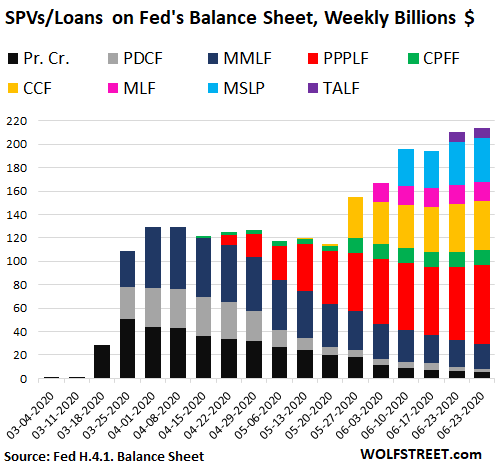
> The action by the Federal Reserve has been lauded by investors for easing conditions in credit markets after they rapidly deteriorated in March, avoiding a potentially catastrophic corporate cash crunch that could have triggered a wave of bankruptcies.
I wonder why BKR is in the list, it does seem to have a strong balance sheet and no need for a credit lifeline like say PM that does have for example negative equity.
I wonder why BKR is in the list, it does seem to have a strong balance sheet and no need for a credit lifeline like say PM that does have for example negative equity.
I assume you mean BRK. If that's the case, BRK borrows at a very cheap rate (in the case the bonds purchased, their coupon is 4%, which is kinda high for BRK).
BRK borrows for a couple of reasons, but chief among them are that sometimes it's better to write bonds (for tax reasons), than it is to use cash. At 4%, I can see that being the case.
BRK borrows for a couple of reasons, but chief among them are that sometimes it's better to write bonds (for tax reasons), than it is to use cash. At 4%, I can see that being the case.
right makes sense - noob here
The largest grift in US history is taking place while we're failing on the entire point of these programs: to prevent unnecessary deaths and suffering.
We're going to end up with a huge amount of debt, a financial crisis, and the most deaths of any industrialized country at the end of this.
We're going to end up with a huge amount of debt, a financial crisis, and the most deaths of any industrialized country at the end of this.
That’s the point isn’t it? At this point it’s hard to call it ‘mismanagement’. I have no credible evidence that the it isn’t pure malfeasance. If one wanted to unhinge the economic power of the US, destroy its international partnerships, divide its population to the point of war, and assault reality itself with the daily gaslighting chambers... I couldn’t imagine better execution than this.
> We're going to end up with a huge amount of debt, a financial crisis, and the most deaths of any industrialized country at the end of this.
What industrialized country has a higher population than US? Do you not get how proportions work or something?
EDIT: And if you think this phenomena of central banks buying debt is somehow unique to the USA ... I mean ... the media is actively trying to prevent people from having a balanced picture of the world ... so it is not a surprise ... but yes ... you should try inform yourself of the reality. Almost every industrialized nation and non industrialised nation is doing similar things.
What industrialized country has a higher population than US? Do you not get how proportions work or something?
EDIT: And if you think this phenomena of central banks buying debt is somehow unique to the USA ... I mean ... the media is actively trying to prevent people from having a balanced picture of the world ... so it is not a surprise ... but yes ... you should try inform yourself of the reality. Almost every industrialized nation and non industrialised nation is doing similar things.
The operative words you seem to be missing are "at the end of this", but fine. Lets look at right now, and put aside notions of "industrialized countries".
1. 538,000 confirmed COVID-19 deaths worldwide; 132,000 confirmed COVID-19 deaths in USA. 24.5% of worldwide deaths in USA.
2. 7.8 billion people worldwide; 328 million people in USA. 4.2% of worldwide population in USA.
Does that ratio seem like cause for concern?
1. 538,000 confirmed COVID-19 deaths worldwide; 132,000 confirmed COVID-19 deaths in USA. 24.5% of worldwide deaths in USA.
2. 7.8 billion people worldwide; 328 million people in USA. 4.2% of worldwide population in USA.
Does that ratio seem like cause for concern?
> The operative words you seem to be missing are "at the end of this", but fine.
Okay, how about I just say no, at the end of this the USA won't have the most deaths per capita of industrialized nations. Amazingly my claim has just as much, if not more, basis than the original claim. Glad we settled it.
> Does that ratio seem like cause for concern?
Belgium (2.1 more) UK (1.6 times more) Spain (1.5 times more) Italy (1.43 times more) Sweden (1.3 times more) France (1.1 times more) have more deaths per capita than USA.
Every death is concerning (I guess some people are not clear on this), but the per capita deaths of the USA is not anomalous.
Given the data we have I would say the most likely situation is that developing and least developed countries are either not being exposed to the same levels as industrialized countries or just not as good at tracking and reporting deaths as opposed to just having a lower actual mortality rate.
That being said some areas in the USA, like New York, clearly just completely botched their handling of the pandemic what with sending sick old people back into frail care facilities. I hope at the end of this whoever made that policy is brought up on murder charges.
Okay, how about I just say no, at the end of this the USA won't have the most deaths per capita of industrialized nations. Amazingly my claim has just as much, if not more, basis than the original claim. Glad we settled it.
> Does that ratio seem like cause for concern?
Belgium (2.1 more) UK (1.6 times more) Spain (1.5 times more) Italy (1.43 times more) Sweden (1.3 times more) France (1.1 times more) have more deaths per capita than USA.
Every death is concerning (I guess some people are not clear on this), but the per capita deaths of the USA is not anomalous.
Given the data we have I would say the most likely situation is that developing and least developed countries are either not being exposed to the same levels as industrialized countries or just not as good at tracking and reporting deaths as opposed to just having a lower actual mortality rate.
That being said some areas in the USA, like New York, clearly just completely botched their handling of the pandemic what with sending sick old people back into frail care facilities. I hope at the end of this whoever made that policy is brought up on murder charges.
If you want to talk about per-capita deaths, shouldn't it be controlled for density? The United States is far less dense than Europe.
> What industrialized country has a higher population than US?
I mean, the rest of your comment aside, let me just mention the answer to this IIRC: China and India both have larger populations than the US.
I mean, the rest of your comment aside, let me just mention the answer to this IIRC: China and India both have larger populations than the US.
Neither India nor China are considered industrialized countries. It could very well be that the person I replied to did not know what the phrase meant though, but it does have a very specific definition.
https://en.wikipedia.org/wiki/Developed_country
> A developed country, industrialized country (or post-industrial country), more developed country, or more economically developed country (MEDC), is a sovereign state that has a developed economy and advanced technological infrastructure relative to other less industrialized nations.
https://en.wikipedia.org/wiki/Developed_country
> A developed country, industrialized country (or post-industrial country), more developed country, or more economically developed country (MEDC), is a sovereign state that has a developed economy and advanced technological infrastructure relative to other less industrialized nations.
[deleted]
Most doesn't just have to refer to absolute quantity, it can also refer to a relative measure. Either way, it's a shit load of dead people, not sure what your point is.
[deleted]
Industrialized countries with more deaths per capita than USA: Belgium (2.1 more) UK (1.6 times more) Spain (1.5 times more) Italy (1.43 times more) Sweden (1.3 times more) France (1.1 times more).
Yes it is a shitload of deaths. Lets talk about it being more than every other industrialised nation in proportion when that actually happens.
Yes it is a shitload of deaths. Lets talk about it being more than every other industrialised nation in proportion when that actually happens.
Why does Walmart have so much debt?
It's at war with Amazon, and it's able to produce an ROI which exceeds the cost of borrowing anyway.
Because ZIRP encourages corporate debt.
The first mistake was allowing the federal reserve to exist.
Here's Jefferson on the topic [1]:
"And I sincerely believe, with you, that banking establishments are more dangerous than standing armies; and that the principle of spending money to be paid by posterity, under the name of funding, is but swindling futurity on a large scale."
[1] https://web.archive.org/web/20150711012438/http://memory.loc...)
Here's Jefferson on the topic [1]:
"And I sincerely believe, with you, that banking establishments are more dangerous than standing armies; and that the principle of spending money to be paid by posterity, under the name of funding, is but swindling futurity on a large scale."
[1] https://web.archive.org/web/20150711012438/http://memory.loc...)