U.S. adds Chinese supercomputing entities to economic blacklist(reuters.com)
reuters.com
U.S. adds Chinese supercomputing entities to economic blacklist
https://www.reuters.com/article/us-usa-china-commerce/u-s-adds-chinese-supercomputing-entities-to-economic-blacklist-idUSKBN2BV1XU
119 comments
The exact same reasoning could be applied to big American manufacturers: Boeing, Intel - all provide products to the US military and have very large business interest in China.
Why doesn't China answer back with similar sanctions?
It is honestly a bit of mystery to me. The best answer I can come up with is that the Chinese government is actually quite content with the US forcing Chinese companies to fabricate on Chinese soil.
Why doesn't China answer back with similar sanctions?
It is honestly a bit of mystery to me. The best answer I can come up with is that the Chinese government is actually quite content with the US forcing Chinese companies to fabricate on Chinese soil.
>Why doesn't China answer back with similar sanctions?
They want to, but they can't, yet. If you listen to CCP officials the long term plan is very clear: To transform China from an export driven economy to a internal market economy so they don't need others, but currently they need them.
China currently can not consume what it produces. When I was living there I could not buy the cooking tool(blender) I wanted. I went to Europe, bought the Blender(manufactured in China) and brought it to China. There was not market in China for those and they went straight from the factory to the port.
China is not the US, most people in China are very poor. The CCP is very powerful but the country is weak in many ways.
In fact China is closing down a lot recently, expats are going out the country fast.
They want to, but they can't, yet. If you listen to CCP officials the long term plan is very clear: To transform China from an export driven economy to a internal market economy so they don't need others, but currently they need them.
China currently can not consume what it produces. When I was living there I could not buy the cooking tool(blender) I wanted. I went to Europe, bought the Blender(manufactured in China) and brought it to China. There was not market in China for those and they went straight from the factory to the port.
China is not the US, most people in China are very poor. The CCP is very powerful but the country is weak in many ways.
In fact China is closing down a lot recently, expats are going out the country fast.
[deleted]
China already enjoys a massively lopsided business advantage compared to the US. It's an uphill battle for non-chinese companies to operate in China, for one China requires that part of the ownership of the chinese venture must be owned by Chinese nationals, which means that the CCP also gets to sit on the board and see and influence everything they do. I can't think of any other major power that is this xenophobic.
They did not require that for Tesla. The Shanghai is 100% American Tesla owned with no joint venture.
Yes, the way the CCP does enforcement there is the Hong Kong model: there's an entity 100% owned by Tesla called Tesla Shanghai that has a 50 year lease on a state owned factory, Tesla invests $700 mil, state invests $2 bill, when loans are paid off, Tesla can begin transferring revenue stateside
Wait so the gigafactory plant and machinery is technically owned by the Chinese? Or is it just the factory land?
From this and prior reading I'd expect: they (TSLA) own the factory and things in it, but the land it sits on is leased from the state, perhaps in some proportion to the funds invested. I don't live there, just been a couple times.
https://www.loc.gov/law/help/real-property-law/china.php
https://www.loc.gov/law/help/real-property-law/china.php
Do you have a source for that? That is different than everything I've heard about the plant.
That’s not a terrible model
I'm always thinking of companies who were making deals in Soviets almost a hundred years ago[1]. Obviously the capitalist leanings in the USSR were weaker after the 1920s and there are many differences, but I am not fully convinced it will look that different from a long term (many decades') perspective.
I suppose these companies turned out okay? The fate of locals notwithstanding. /s
[1] https://en.wikipedia.org/wiki/Industrialization_in_the_Sovie...
I suppose these companies turned out okay? The fate of locals notwithstanding. /s
[1] https://en.wikipedia.org/wiki/Industrialization_in_the_Sovie...
Foreigner running a (second) wholly owned venture in China here. While there are difficulties, the parent comment is certainly and completely wrong when it comes to ownership. I do not think China's approach to foreign economic immigration is particularly "xenophobic", and the regular people are exceptionally warm and welcoming. It's all the other issues once you get here that do you in!
Thanks for your input! Can you say in which kind of industry you are and a couple of key difficulties you faced?
Food logistics and robotics. Issues: horrific HR market, immature and ineffective court and legal system, unstable if nominally progressive regulatory environment, corrupt gatekeeping businesses and no antitrust oversight, obtuse and opaque regulatory processes, loss of foreign talent over COVID (government suspended the use of already issued foreign visas and the issuing of any new ones), general infrastructure issues, outright blackmail, etc. China is not for the feint hearted.
China's population is well over 1.4 billion. They need to create new jobs every year with the same rate that some countries do in a decade. I think it's pretty significant that they are able to run a country with that demographics most of whom were not even educated.
China still benefits from its US relationship overall. The US does benefit too, but the US also wants to slow down their growth because it's a big threat to its power. I think everything else like human rights issues are just BS. We're partner with most of Arabian countries in the Middle East and we have active arms sell to them including Saudis which are far worst than China in terms of democracy and human rights.
China still benefits from its US relationship overall. The US does benefit too, but the US also wants to slow down their growth because it's a big threat to its power. I think everything else like human rights issues are just BS. We're partner with most of Arabian countries in the Middle East and we have active arms sell to them including Saudis which are far worst than China in terms of democracy and human rights.
Layke1123(1)
> run a country with that demographics most of whom were not even educated.
PISA 2018 results
“The OECD Programme for International Student Assessment (PISA) examines what students know in reading, mathematics and science, and what they can do with what they know. It provides the most comprehensive and rigorous international assessment of student learning outcomes to date. Results from PISA indicate the quality and equity of learning outcomes attained around the world, and allow educators and policy makers to learn from the policies and practices applied in other countries. This is one of six volumes that present the results of the PISA 2018 survey, the seventh round of the triennial assessment.”
https://www.oecd.org/pisa/PISA-results_ENGLISH.png
These latest results have various parts of China‡ in #1 position, the USA in #13
‡ It is true that the sub-regions looked at are Beijing, Shanghai, Jiangsu, and Zhejiang.
The 2021 results have been postponed until 2022 for obvious reasons.
PISA 2018 results
“The OECD Programme for International Student Assessment (PISA) examines what students know in reading, mathematics and science, and what they can do with what they know. It provides the most comprehensive and rigorous international assessment of student learning outcomes to date. Results from PISA indicate the quality and equity of learning outcomes attained around the world, and allow educators and policy makers to learn from the policies and practices applied in other countries. This is one of six volumes that present the results of the PISA 2018 survey, the seventh round of the triennial assessment.”
https://www.oecd.org/pisa/PISA-results_ENGLISH.png
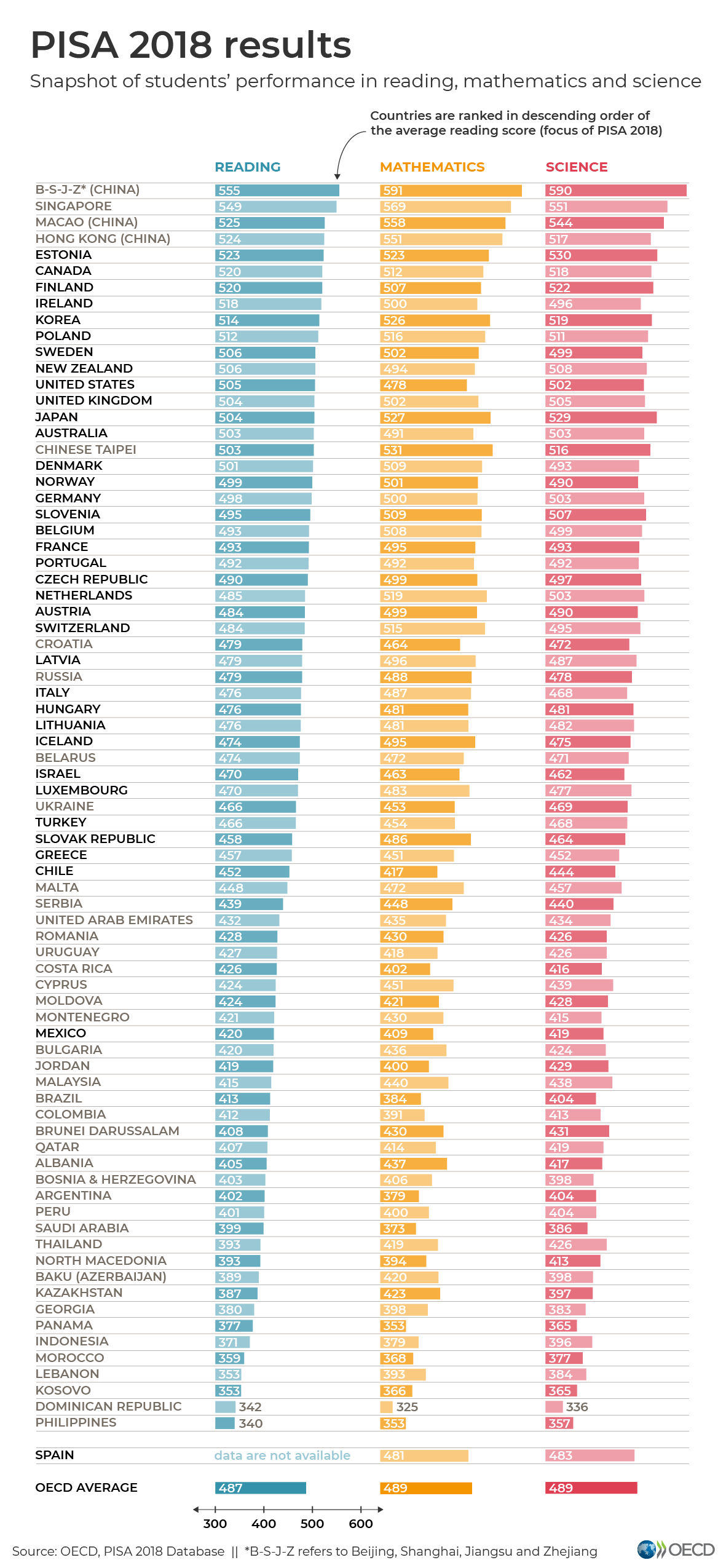
These latest results have various parts of China‡ in #1 position, the USA in #13
‡ It is true that the sub-regions looked at are Beijing, Shanghai, Jiangsu, and Zhejiang.
The 2021 results have been postponed until 2022 for obvious reasons.
They picked the two richest cities and the two richest provinces in the whole country to do the study on, and you're extrapolating those numbers across the rest?
> I think it's pretty significant that they are able to run a country with that demographics most of whom were not even educated.
Citation needed :)
As a Chinese native who has friends in almost all provinces across China, I just don't see Chinese is less educated than US. Same K-12 education for almost all (exceptions are rare).
Citation needed :)
As a Chinese native who has friends in almost all provinces across China, I just don't see Chinese is less educated than US. Same K-12 education for almost all (exceptions are rare).
Eh, you're posting on HN in fluent English. Your personal friend group is probably nothing close to what's average in China. It's a straightforward sampling bias.
Did you go to a Western university? A good one? And now work at some Western company? You can add atypical points for all of those.
Most of the Chinese people I know are fine in terms of education, around the same as any other demographic. But most of them I know from a top European university, or from highly skilled work in China. Most of China is not like that at all.
Did you go to a Western university? A good one? And now work at some Western company? You can add atypical points for all of those.
Most of the Chinese people I know are fine in terms of education, around the same as any other demographic. But most of them I know from a top European university, or from highly skilled work in China. Most of China is not like that at all.
I'm currently working in the bay area but I got my master degree in China and never attended any colleges in the west.
I was born in a city ranked 45th in China by population (from wikipedia). K-12 is 100%. My grandpa lives in a very small village with annual income just a few thousand dollars, K-12 is also 100%. My close cousins come from the same small village, now bank staffs and doctors.
I have friends who's family so poor that the roof got torn away by a typhoon. And I have friends whose parents are simply peasants.
My friend group is definitely biased since I graduated from one of the top universities, but they are selected by exams, so many families are actually not wealthy. In China money usually cannot help you directly on exams, people need to study hard.
Hmm, another thing I'm curious is that what gives the original post the impression that "Chinese people are uneducated". That's a rare heard haha.
I was born in a city ranked 45th in China by population (from wikipedia). K-12 is 100%. My grandpa lives in a very small village with annual income just a few thousand dollars, K-12 is also 100%. My close cousins come from the same small village, now bank staffs and doctors.
I have friends who's family so poor that the roof got torn away by a typhoon. And I have friends whose parents are simply peasants.
My friend group is definitely biased since I graduated from one of the top universities, but they are selected by exams, so many families are actually not wealthy. In China money usually cannot help you directly on exams, people need to study hard.
Hmm, another thing I'm curious is that what gives the original post the impression that "Chinese people are uneducated". That's a rare heard haha.
>what gives the original post the impression that "Chinese people are uneducated"
Propaganda? The stats I have seen all state that Americans are the uneducated ones in this comparison.
Propaganda? The stats I have seen all state that Americans are the uneducated ones in this comparison.
Maybe? Another possible explanation is that some people try to correlate income in USD to education levels.
It's not a direct comparison since the cost for education is also cheaper in China. Also since K-12 is almost free (at least meals are not included 20 years ago when I was a kid), parents just send kids there.
In recent years the trend is that even assembly factories require high school education, bachelor preferred... That's another interesting topic though.
It's not a direct comparison since the cost for education is also cheaper in China. Also since K-12 is almost free (at least meals are not included 20 years ago when I was a kid), parents just send kids there.
In recent years the trend is that even assembly factories require high school education, bachelor preferred... That's another interesting topic though.
The top 45 cities are what, 200 million people? So 85% of Chinese people live somewhere more rural than where you grew up, and in China that's correlated with poverty and all sorts of negative things.
This is exactly what I mean; the relatively advantaged Chinese are under the impression that they are the average. They're not at all. The average Chinese person lives no place they're likely to escape for the Bay Area. Most people can't even escape to a normal life in a tier 1 city within China.
This is exactly what I mean; the relatively advantaged Chinese are under the impression that they are the average. They're not at all. The average Chinese person lives no place they're likely to escape for the Bay Area. Most people can't even escape to a normal life in a tier 1 city within China.
Hmm, I just say from my personal experience. If you have numbers support "China is uneducated.", please paste the links.
I mentioned my grandpa, he lives in a small village (1~2k people?), I would say it is something like rural Fresno maybe.
If you can have supporting numbers, I can help explain.
I mentioned my grandpa, he lives in a small village (1~2k people?), I would say it is something like rural Fresno maybe.
If you can have supporting numbers, I can help explain.
Rural China is the opposite of many rural places in the West. In the West, there are small towns seen as desirable, where you go to live when you're richer and have kids or just want more space. In China rural is almost always poorer.
I don't think K-12 attainment is an appropriate metric. Like I said elsewhere it's like comparing hygiene standards by saying we all have access to soap. But that's the most basic standard we can achieve.
I think if you compare the % of Chinese who go to world-class universities, it's a lot more relevant. China has maybe 2 or 3 such universities, so saying it's equal and fair because you have the gaokao or whatever doesn't make much sense. The biggest intake for world class universities is rich Chinese kids going to the West, not poor kids from the village going to Tsinghua. If you managed to do that then great for you, really, but it's not an average story.
Even if we don't want to go that high-end, tertiary educational attainment at any calibre of university in China is much much lower than in the US.
I think there are good things about the Chinese approach to education, but it's kind of silly to say they've caught up to the US and others.
I don't think K-12 attainment is an appropriate metric. Like I said elsewhere it's like comparing hygiene standards by saying we all have access to soap. But that's the most basic standard we can achieve.
I think if you compare the % of Chinese who go to world-class universities, it's a lot more relevant. China has maybe 2 or 3 such universities, so saying it's equal and fair because you have the gaokao or whatever doesn't make much sense. The biggest intake for world class universities is rich Chinese kids going to the West, not poor kids from the village going to Tsinghua. If you managed to do that then great for you, really, but it's not an average story.
Even if we don't want to go that high-end, tertiary educational attainment at any calibre of university in China is much much lower than in the US.
I think there are good things about the Chinese approach to education, but it's kind of silly to say they've caught up to the US and others.
Not the OPP, but you say:
> I think it's pretty significant that they are able to run a country with that demographics most of whom were not even educated.
and then eventually switch to
> I don't think K-12 attainment is an appropriate metric. Like I said elsewhere it's like comparing hygiene standards by saying we all have access to soap. But that's the most basic standard we can achieve
> I think if you compare the % of Chinese who go to world-class universities, it's a lot more relevant
This seems like a major shift in goal-posts. If your concept of "uneducated" means not going to a world-class university, then most of the world, including most people in the US are "uneducated".
> I think it's pretty significant that they are able to run a country with that demographics most of whom were not even educated.
and then eventually switch to
> I don't think K-12 attainment is an appropriate metric. Like I said elsewhere it's like comparing hygiene standards by saying we all have access to soap. But that's the most basic standard we can achieve
> I think if you compare the % of Chinese who go to world-class universities, it's a lot more relevant
This seems like a major shift in goal-posts. If your concept of "uneducated" means not going to a world-class university, then most of the world, including most people in the US are "uneducated".
I didn’t say that; that’s not me. And I gave an intermediate option for using a ‘tertiary education if any kind’ stat.
You are basically saying you know better than someone from China and don't link any facts to back it up?
Whether they're form China seems pretty irrelevant. You could very well make the opposite case that people from China know even less about its actual KPIs.
It's trivial to pick a relevant metric and look up the median value for China. A quarter of the people there live on less than $5/day. They're not swanning off to do a Masters at MIT any time soon. They're not even able to move to the better cities within China, for the most part.
This person is a total anomaly. Taking them as representative is quite ridiculous and rather insulting to the hundreds of millions "with a K-12 education" that somehow are still living in abject poverty with no opportunities. It's an arbitrary and meaningless claim to make. It's like saying China and America have the same hygiene standards because most people in both places have access to soap.
It's trivial to pick a relevant metric and look up the median value for China. A quarter of the people there live on less than $5/day. They're not swanning off to do a Masters at MIT any time soon. They're not even able to move to the better cities within China, for the most part.
This person is a total anomaly. Taking them as representative is quite ridiculous and rather insulting to the hundreds of millions "with a K-12 education" that somehow are still living in abject poverty with no opportunities. It's an arbitrary and meaningless claim to make. It's like saying China and America have the same hygiene standards because most people in both places have access to soap.
I would say K-12 education and unemployment are different issues here, do you agree with that? For the latter that's another story and I agree it's more complicated.
Weren't we talking about education?
Weren't we talking about education?
Sure, I'm really saying that it's fine to be K-12 educated but it doesn't seem to be translating into further educational opportunities for most people. They often don't go from K-12 to university, rather they go into some not great job and never get such opportunities. Same happens in the West of course, just to a lesser degree.
That doesn't change the fact that all tests and statistics shows Chinese students are better educated than American counterparts. Since more Chinese are in poorer schools those numbers are loop sided against Chinese students which make it even worse.
But that you think you both know better than a Chinese person and didn't even bother to put in some links to facts (unlike those liked that disagree, like the Pisa test) says enough.
But that you think you both know better than a Chinese person and didn't even bother to put in some links to facts (unlike those liked that disagree, like the Pisa test) says enough.
The PISA scores are not for “China”. They’re for a tiny percentage of China’s population, living in the wealthiest districts, with the most sought after 户口.
The gathered statistics are in no way comparable to Western countries which gather scores from all districts, rich and poor alike.
The gathered statistics are in no way comparable to Western countries which gather scores from all districts, rich and poor alike.
You're conveniently circling an arbitrary part of the chart and saying 'look over here!' but it's disingenuous.
For example, Chinese tertiary attainment is half that of the US:
https://en.wikipedia.org/wiki/List_of_countries_by_tertiary_...
Again, soap and hygiene. Since when do we compare education levels only on basic literacy and numeracy?
For example, Chinese tertiary attainment is half that of the US:
https://en.wikipedia.org/wiki/List_of_countries_by_tertiary_...
Again, soap and hygiene. Since when do we compare education levels only on basic literacy and numeracy?
Since Americans started leaving schools without knowledge of basic English skills. We were talking about English skills, not how top universities fare in tests.
> We were talking about English skills
No, 'educated' was the term used. I'm not sure why you would think we're only talking about basic 'English' skills.
No, 'educated' was the term used. I'm not sure why you would think we're only talking about basic 'English' skills.
>> Why doesn't China answer back with similar sanctions?
Because it can't, yet.
Because it can't, yet.
Sure not directly maybe. But they could go after Boeing or Nike or Starbucks.
But my sense is that the ccp likes their “Sputnik moment”.
But my sense is that the ccp likes their “Sputnik moment”.
Go look at how plane orders from China are shifting to Airbus.
There are other ways to hit the US in their wallet, like allocating new sales to their EU rival. Let them fight each other. Its a more elegant way of putting diplomacy and economic heft at work.
Also COMAC should deliver their first model to (domestic?)customers this year. Then you also have a joint venture with a Russian plane company.
Also COMAC should deliver their first model to (domestic?)customers this year. Then you also have a joint venture with a Russian plane company.
China both needs these companies and has nothing to gain in attacking them.
On other hand, the US are trying to slow China's rise by hurting key industries.
This is a geopolitical struggle. The US cannot win because China is bigger than they are and so will overtake them sooner or later, but they can slow things down to maintain their dominance as long as they can.
On other hand, the US are trying to slow China's rise by hurting key industries.
This is a geopolitical struggle. The US cannot win because China is bigger than they are and so will overtake them sooner or later, but they can slow things down to maintain their dominance as long as they can.
> The US cannot win but they can slow things down to maintain their dominance as long as they can.
They (the USA) fucked up Japan pretty bad. Throughout the 70s-80s the USA was fearful of the rise of Japan, their incredible ability to usurp American businesses, and their growing trade deficit surplus, which they then rolled back into US T-bonds. From an American perspective, Japan was in the 70s what China is today.
In the early-80s, the Yen-to-dollar ratio was really high. This kicked off an inflationary asset bubble within the country that lasted for several years. Starting in 1985, the yen-to-dollar ratio collapsed, falling by half from mid ¥200s in just two years and reaching a low of ¥85 by 95.
Japan entered the Lost Decade as a result of this situation. The lost decade became two, then the GFC happened, bringing it to three decades.
It is suspected that this was the result of an intentional attack on the Japanese economy by US officials with the express intent to curb Japan's rising economic power.
They (the USA) fucked up Japan pretty bad. Throughout the 70s-80s the USA was fearful of the rise of Japan, their incredible ability to usurp American businesses, and their growing trade deficit surplus, which they then rolled back into US T-bonds. From an American perspective, Japan was in the 70s what China is today.
In the early-80s, the Yen-to-dollar ratio was really high. This kicked off an inflationary asset bubble within the country that lasted for several years. Starting in 1985, the yen-to-dollar ratio collapsed, falling by half from mid ¥200s in just two years and reaching a low of ¥85 by 95.
Japan entered the Lost Decade as a result of this situation. The lost decade became two, then the GFC happened, bringing it to three decades.
It is suspected that this was the result of an intentional attack on the Japanese economy by US officials with the express intent to curb Japan's rising economic power.
Japan doesn't have over 4x the population of US and a comparable amount of land.
China has many advantages that Japan doesn't have. It's not a given that the same thing will happen.
China has many advantages that Japan doesn't have. It's not a given that the same thing will happen.
> In the early-80s, the Yen-to-dollar ratio was really high. This kicked off an inflationary asset bubble within the country that lasted for several years.
I believe this is commonly referred to in geopolitics as the Plaza Accord.
I believe this is commonly referred to in geopolitics as the Plaza Accord.
Japan never realistically had any shot at overtaking the US economy. They have 1/3rd the population, 1/4th the land, next to no natural resources, and very little immigration. It's a testament to the nation's effort, ingenuity, and strength of character that they got as close to the US economically, as they did in the half-century after WW2. But it could never have been that close in the long term.
It's undeniable that Japan managed to overtake American businesses in key industries, such as silicon and automotive manufacturing, as well as being a world leader in technological innovation.
Japan's small population and land area means that they can never be world leaders in commodity production, such as oil, agriculture, mining, or timber - all of which are industries the USA performs really well in. Oil, specifically, is a crutch relied on by many nations to pad their GDP.
That's why Japan is so incredibly impressive. If you start removing commodities from the GDP comparisons (which are largely based on geographic luck), Japan, is and was an economic powerhouse.
Japan never needed to overtake the economy of the USA in pure GDP, since so much of USA GDP is in areas Japan could never compete in, such as agricultural output, they just needed to overtake the USA in a handful of key industrial areas. Which they did.
Japan's small population and land area means that they can never be world leaders in commodity production, such as oil, agriculture, mining, or timber - all of which are industries the USA performs really well in. Oil, specifically, is a crutch relied on by many nations to pad their GDP.
That's why Japan is so incredibly impressive. If you start removing commodities from the GDP comparisons (which are largely based on geographic luck), Japan, is and was an economic powerhouse.
Japan never needed to overtake the economy of the USA in pure GDP, since so much of USA GDP is in areas Japan could never compete in, such as agricultural output, they just needed to overtake the USA in a handful of key industrial areas. Which they did.
You realize there are several countries, like Singapore, that are in the same situation (small population, little land, no natural resources) that already exceed the US on a GDP/capita basis?
Singapore's GDP per capita isn't actually higher than the US but I get your overall point. The key differences there are "small nation" and "GDP/capita". Singapore is more comparable to a metropolitan region in the US, such as New York or Los Angeles, rather than the entire country.
There are smaller countries that have a higher GDP on average. Although some of those are suspect in reality; Ireland's is higher, but no one thinks of Ireland as especially more prosperous than say England. I wonder if it's because it's a tax haven.
Japan is not a small country at all. It's probably in the top 10 for population (off the top of my head, China > India > USA > Indonesia > Nigeria > Russia > Japan?). But there are no medium-to-large countries - population 35m+ - whose GDP per capita is within $10k of the US. The US is an outlier.
Moreover, I was talking about total GDP and not per capita. Among the current nations, only China and India have any hope of overtaking the US within our lifetimes (very slim for India). And that's only because of their gargantuan populations - per capita they'll still be far behind. For Japan to have overtaken the US in the 90s, they would have had to have a GDP per capita 3x of the US - which no country of any size has even today. Japan got really close, which is very impressive given its size.
There are smaller countries that have a higher GDP on average. Although some of those are suspect in reality; Ireland's is higher, but no one thinks of Ireland as especially more prosperous than say England. I wonder if it's because it's a tax haven.
Japan is not a small country at all. It's probably in the top 10 for population (off the top of my head, China > India > USA > Indonesia > Nigeria > Russia > Japan?). But there are no medium-to-large countries - population 35m+ - whose GDP per capita is within $10k of the US. The US is an outlier.
Moreover, I was talking about total GDP and not per capita. Among the current nations, only China and India have any hope of overtaking the US within our lifetimes (very slim for India). And that's only because of their gargantuan populations - per capita they'll still be far behind. For Japan to have overtaken the US in the 90s, they would have had to have a GDP per capita 3x of the US - which no country of any size has even today. Japan got really close, which is very impressive given its size.
Japan is a small country for the discussion at hand, which is threatening the US's dominance.
> And that's only because of their gargantuan populations
All things being equal the relative economic and industrial power of countries is proportional to their population.
Unless a catastrophe befalls the US it's the countries with comparable or larger population that are threats. These includes the EU, actually, which is why the US are always wary of further EU integration.
With the likes of the EU, China, India, Indonesia, Nigeria, the US will pretty much inevitably lose their dominance and become one of the "big guys", key words being 'one of', not 'the' and not the biggest of the big guys, either.
> And that's only because of their gargantuan populations
All things being equal the relative economic and industrial power of countries is proportional to their population.
Unless a catastrophe befalls the US it's the countries with comparable or larger population that are threats. These includes the EU, actually, which is why the US are always wary of further EU integration.
With the likes of the EU, China, India, Indonesia, Nigeria, the US will pretty much inevitably lose their dominance and become one of the "big guys", key words being 'one of', not 'the' and not the biggest of the big guys, either.
> All things being equal the relative economic and industrial power of countries is proportional to their population.
Agreed. And this is why I said the US never had to seriously fear Japan surpassing them.
Agreed. And this is why I said the US never had to seriously fear Japan surpassing them.
Singapore's main natural resource is its importance in trade, based on its location. Its natural resource is like the Panama Canal or the Suez Canal.
Japan is a small country with a much smaller population. It's not the same situation at all.
China has 4x the population of the US. The US have 4x the population of the UK.
Did the UK manage to stop the rise of the US? No. The US is much larger than any European country and thus it was inevitable that they became the dominant power (Europe helped by self-destructing, but economically the US had already overtaken European countries).
The only way the US can remain dominant is by trying to keep 'third world' countries poor. Once massive countries are on a strong development path it's just a matter of time and this is what's happening with China.
India also has the potential to overtake the US. In the future Nigeria could as well. This is actually an optimistic view as it assumes that no country is bound to be poor forever.
China has 4x the population of the US. The US have 4x the population of the UK.
Did the UK manage to stop the rise of the US? No. The US is much larger than any European country and thus it was inevitable that they became the dominant power (Europe helped by self-destructing, but economically the US had already overtaken European countries).
The only way the US can remain dominant is by trying to keep 'third world' countries poor. Once massive countries are on a strong development path it's just a matter of time and this is what's happening with China.
India also has the potential to overtake the US. In the future Nigeria could as well. This is actually an optimistic view as it assumes that no country is bound to be poor forever.
China is mostly just a buyer of their products. Not buying from them just gives power to the remaining handful of competitors in these oligopolies. It's not like they can threaten to disrupt their production--I recall that the 787 has parts mostly sourced from the US, western Europe, and Japan, not China. For any joint venture in China, there's probably also clear value in keeping Boeing and Intel facilities operating...
More importantly, China is still trying to jumpstart its own aviation juggernaut but is still using US suppliers, so it could very easily become an own goal.
CCP is sensitive to its unemployment problem and needs the jobs for stability.
Because China is trying to promote more trading -- which it benefits from. And she does need the products or connections of Boeing/Intel.
If China breaks her compeletely from all major US manufacturers, it's equivalent to a declaration of the end of post-2001 world economy and can bring ripples across the world. China is not prepared for that, yet.
If China breaks her compeletely from all major US manufacturers, it's equivalent to a declaration of the end of post-2001 world economy and can bring ripples across the world. China is not prepared for that, yet.
They're playing the long game.
Most of these sanctions don't really work either. China will get what it wants some other way. The US will get to look like it acted. Everyone will be happy...
Most of these sanctions don't really work either. China will get what it wants some other way. The US will get to look like it acted. Everyone will be happy...
>Most of these sanctions don't really work either. China will get what it wants some other way. The US will get to look like it acted. Everyone will be happy...
What are you basing this on?
What are you basing this on?
So, sanctions like these started in 2015 [0]. That was when the Chinese first topped the global super computer league (and that's for public super computers so presumably they'd been leading in private for a while?).
The US banned exports to 4 Chinese companies that made the machines.
So other companies spring up to fill the gap. This is problem 1: it takes very little time to setup a company, so sanctioning one is sort of pointless. You sanction PLA_Supplier1 LLC? Good thing PLA_Supplier1 LLC is interested in ordering the same kit!
The result was a roughly yearly round of sanctions. Every year's new list of names is a list of the companies that bypassed the last year's sanctions...
There is also problem 2: back in 2015 the computers used Intel parts but increasingly the Chinese are designing their own. They're not there yet, but they're making progress. TSMC still do most of the manufacture.
So the question is: how long till Chinese hackers steal the latest designs or Chinese engineers reverse engineer the parts they buy on the grey market? AND how long until China sets up a TSMC competitor?
I'm something of a hawk on China. I'm out on a ledge but here I am. I'd like to see real action on them for a long list of reasons. But before we can have real action, we need to drop the pretend action. Trump (what a turd) loved pretend action. Maybe Biden will be different? But this isn't that imho.
Source on the original tariffs:
[0] https://www.economist.com/business/2019/06/29/an-american-ba...
The US banned exports to 4 Chinese companies that made the machines.
So other companies spring up to fill the gap. This is problem 1: it takes very little time to setup a company, so sanctioning one is sort of pointless. You sanction PLA_Supplier1 LLC? Good thing PLA_Supplier1 LLC is interested in ordering the same kit!
The result was a roughly yearly round of sanctions. Every year's new list of names is a list of the companies that bypassed the last year's sanctions...
There is also problem 2: back in 2015 the computers used Intel parts but increasingly the Chinese are designing their own. They're not there yet, but they're making progress. TSMC still do most of the manufacture.
So the question is: how long till Chinese hackers steal the latest designs or Chinese engineers reverse engineer the parts they buy on the grey market? AND how long until China sets up a TSMC competitor?
I'm something of a hawk on China. I'm out on a ledge but here I am. I'd like to see real action on them for a long list of reasons. But before we can have real action, we need to drop the pretend action. Trump (what a turd) loved pretend action. Maybe Biden will be different? But this isn't that imho.
Source on the original tariffs:
[0] https://www.economist.com/business/2019/06/29/an-american-ba...
SMIC has been around for years and at one point it look like it would overtake TSMC but TSMC managed to stay ahead helped by a US lawsuit and US sanctions.
The problem is that on free market it is more attractive for a Chinese chip designer to go for TSMC due to their maturity and reliability.
Obviously the broadening US sanctions changes that and effectively acts as a massive boost of the domestic fab industry.
The problem is that on free market it is more attractive for a Chinese chip designer to go for TSMC due to their maturity and reliability.
Obviously the broadening US sanctions changes that and effectively acts as a massive boost of the domestic fab industry.
Thanks!
I was under the impression (mostly due to this podcast that talks about China's semiconductor history: https://chinatalkshow.libsyn.com/chinas-chip-dreams) that all of the big software companies that make chip tooling are outside of China and that a ban would be possible, but politically difficult.
> AND how long until China sets up a TSMC competitor?
From that same podcast it seems as though they've been trying for decades and have so far unable to do so and recent attempts(https://chinatalk.substack.com/p/billion-dollar-heist-how-sc...) have ended in massive fraud.
I was under the impression (mostly due to this podcast that talks about China's semiconductor history: https://chinatalkshow.libsyn.com/chinas-chip-dreams) that all of the big software companies that make chip tooling are outside of China and that a ban would be possible, but politically difficult.
> AND how long until China sets up a TSMC competitor?
From that same podcast it seems as though they've been trying for decades and have so far unable to do so and recent attempts(https://chinatalk.substack.com/p/billion-dollar-heist-how-sc...) have ended in massive fraud.
My totally armchair geopolitical opinion is that they know US companies can simply go elsewhere. Nobody manufactures in China for their "expertise".
Actually everyone does.
China is not just a source of cheap labour. But a source of cheap labour highly skilled in manufacturing which other countries all but abandoned over the previous decades.
China is not just a source of cheap labour. But a source of cheap labour highly skilled in manufacturing which other countries all but abandoned over the previous decades.
No they aren't very cheap anymore. You always can get the same manufacturing done elsewhere. It just may not all be available in the same country.
Own goal. We lost the chip lead because of outsourcing national-security-critical fab capabilities, and now we're telling China "don't make the same mistake we did -- develop your own capability".
China already knows this, and has known this for a long time, they didn't need recent US actions to remind them.
But I agree with your sentiment on the first point, what a huge strategic mistake.
But I agree with your sentiment on the first point, what a huge strategic mistake.
china is not a hive mind, it does not exert the kind of iron grip over their private sector that westerners think. external stimuli like these could potentially have the effect of aligning the government's interests and the private sector's interests more closely
Creating semiconductor fabs takes billions of dollars in investment and can only be achieved by a few very large companies, most likely with government support and coordination in any country that builds them. While it is true that China has a private sector with its own set of interests, the Chinese government is already working very closely with relevant parties in this particular circumstance.
that's a good point, though i still think there's something to be said for the motivational effects of both parties now being pushed to do or die
Why do semiconductor fabs cost so much? Billions of dollars seems kind of overkill.
Its pretty much the cutting edge of engineering I'm told.
TSMC is planning to invest like 20 billion this year alone to stay ahead of their mainland, south Korean and potential US rivals.
Still I wouldn't be surprised that TSMC will be gutted by the US and get their tech stolen just to prop up failing Intel. That pretty much what super powers do, US has planned this really well making sure key component are all made in the US. Like the needed materials and the light source ASML uses for their EUV device.
Still I wouldn't be surprised that TSMC will be gutted by the US and get their tech stolen just to prop up failing Intel. That pretty much what super powers do, US has planned this really well making sure key component are all made in the US. Like the needed materials and the light source ASML uses for their EUV device.
Didn't FinFET technology come through DARPA funding? Did TSMC steal that?
https://spectrum.ieee.org/semiconductors/devices/how-the-fat...
https://spectrum.ieee.org/semiconductors/devices/how-the-fat...
I don't know if TSMC stole it, or just bought licensed it but Wikipedia says Chenming Hu was the Chief Technology Officer at TSMC from 2001 till 2004.
The 5nm TSMC Arizona fab is projected to cost $12B between 2021 and 2029.
https://www.eenewseurope.com/news/tsmc-confirms-5nm-fab-us
https://www.eenewseurope.com/news/tsmc-confirms-5nm-fab-us
It kind of is a hive mind. Authoritarian governments can make swift, impactful decisions without much backlash or debate.
it's all relative, right? compared to us, sure. but while the government can exert direct control when necessary, they don't have the capacity and/or desire to do that 24/7. look at the public fracas with the ant ipo for example, my concept of a hive mind wouldn't allow for a conflict like that
What's the alternative, to keep providing them with the knowledge and material?
The alternative is to keep China’s supply lines integrated with the rest of the world and only using boycotts in very specific instances.
There is a strangeness in the reasoning in the article. The claim is that these supercomputers pose a threat to the US but current purchases en route to China are exempted. Normally anything that poses a real threat would not create any exemptions.
“The new rules take effect immediately but do not apply to goods from U.S. suppliers already en route.”
“The new rules take effect immediately but do not apply to goods from U.S. suppliers already en route.”
>Normally anything that poses a real threat would not create any exemptions.
Citation please? Exemptions happen all the time for all sorts of reasons. Off the top of my head: if the goods in-flight were already invoiced and paid, and on the books for a publicly traded company, halting shipment and asking them to take the stock back could have massive ramifications to that company and the stock market as a whole.
If the parts shipped so far aren't enough to actually complete the supercomputer build, why on earth would the government force that company to jump through all those hoops? In general, retroactively punishing previously legal behavior is frowned upon by most folks in all but the rarest circumstances.
Citation please? Exemptions happen all the time for all sorts of reasons. Off the top of my head: if the goods in-flight were already invoiced and paid, and on the books for a publicly traded company, halting shipment and asking them to take the stock back could have massive ramifications to that company and the stock market as a whole.
If the parts shipped so far aren't enough to actually complete the supercomputer build, why on earth would the government force that company to jump through all those hoops? In general, retroactively punishing previously legal behavior is frowned upon by most folks in all but the rarest circumstances.
I’m not the person who you’re replying to but I believe they have made a mistake. There is the US Munitions List, for which export is controlled by the US Department of State. This is a US Commerce blacklist so these items are not on the USML.
I vaguely recall a shipment being stopped midway under the USML but I’m having an early 40s moment - I’ll update this if I remember the case and find a decent citation!
I vaguely recall a shipment being stopped midway under the USML but I’m having an early 40s moment - I’ll update this if I remember the case and find a decent citation!
> Normally anything that poses a real threat would not create any exemptions.
Define "real threat". Are we talking about an imminent threat, a potential threat, a long-term strategic threat, etc?
The immediacy in which someone handles a threat depends on the details. For instance, high cholesterol and a heart attack are both a threat to someone's health. While you'd want to address both of those issues, one of them you might immediately call 911 for, and the other you might schedule an appointment for next week.
Define "real threat". Are we talking about an imminent threat, a potential threat, a long-term strategic threat, etc?
The immediacy in which someone handles a threat depends on the details. For instance, high cholesterol and a heart attack are both a threat to someone's health. While you'd want to address both of those issues, one of them you might immediately call 911 for, and the other you might schedule an appointment for next week.
I'm sympathetic to the view that China is a long term threat to Democracy. Their leadership is authoritarian and most people underestimate the monopoly that the CPC has over China's economy. China's leader is not quite, but very close to an absolute despot. He does not at this time have any credible opposition or balancing centers of power.
The only thing constraining Xi Xinping from going the route of Putin or Kim is his own self control. That's not a long term stable situation.
Having said all that, half-measures to contain China are pointless. We either should have free trade with China, or almost no trade with China. Our tech controls are highly porous. There is constant interchange in expertise and high tech goods. China is only about 5 to 10 years behind the West on any given technology that is commercially available. The only stuff they lag further behind on is stuff that is completely classified. And that stuff is a very small list of things.
Arguably, China is already exceeding America's capabilities in many next generation military technologies like drones and cyberwarfare.
The West has to make a decision ... either we go the free trade route and hope domestic competition takes down Xi Xinping ... or we withdraw completely from China and disengage as much as possible ... cold war style.
The only thing constraining Xi Xinping from going the route of Putin or Kim is his own self control. That's not a long term stable situation.
Having said all that, half-measures to contain China are pointless. We either should have free trade with China, or almost no trade with China. Our tech controls are highly porous. There is constant interchange in expertise and high tech goods. China is only about 5 to 10 years behind the West on any given technology that is commercially available. The only stuff they lag further behind on is stuff that is completely classified. And that stuff is a very small list of things.
Arguably, China is already exceeding America's capabilities in many next generation military technologies like drones and cyberwarfare.
The West has to make a decision ... either we go the free trade route and hope domestic competition takes down Xi Xinping ... or we withdraw completely from China and disengage as much as possible ... cold war style.
Hmmm and a reversal of roles vis a vis Russia and China. For it to work the EU, US, India and the RF would have to form a block to counteract China like Nixon and successors did with China and the precursor to the EU to counteract the then USSR.
>The only thing constraining Xi Xinping from going the route of Putin or Kim is his own self control.
I believe you have been brainwashed by American Media if you believe Putin is on par with Kim Jong-il.
There is hysteria in US media because Putin defends the interest of his own country against the interest of others like the US.
It seems pretty unreasonable for me to expect Putin to abandon Sevastopol and access to the black Sea,or the Mediterranean in Syria, but that is exactly what US media wanted from Putin.
They wanted a Russian leader to follow US' interest. If the Russian president were to do that, he would be loved in the US, and hated inside Russia, while the opposite happens.
BTW, China is a very complex thing, it is almost a continent in size, lots of people and it is rotten inside in many levels. The population is old and the system extremely corrupt in levels you can not understand in the West.
>China is only about 5 to 10 years behind the West on any given technology that is commercially available.
I don't think so.
I believe you have been brainwashed by American Media if you believe Putin is on par with Kim Jong-il.
There is hysteria in US media because Putin defends the interest of his own country against the interest of others like the US.
It seems pretty unreasonable for me to expect Putin to abandon Sevastopol and access to the black Sea,or the Mediterranean in Syria, but that is exactly what US media wanted from Putin.
They wanted a Russian leader to follow US' interest. If the Russian president were to do that, he would be loved in the US, and hated inside Russia, while the opposite happens.
BTW, China is a very complex thing, it is almost a continent in size, lots of people and it is rotten inside in many levels. The population is old and the system extremely corrupt in levels you can not understand in the West.
>China is only about 5 to 10 years behind the West on any given technology that is commercially available.
I don't think so.
Rather hypocritical since the best Supercomputers in the US are often used for military purposes. For example the ones at Lawrence Livermore National Laboratory
I doubt hypocrisy has ever seriously factored into a single geopolitical decision of any country.
Interactions between nation-states are always driven by self interest. There is zero benefit in acting any differently.
Interactions between nation-states are always driven by self interest. There is zero benefit in acting any differently.
The entire point of sanctions is to exert a strategic influence over a rival.
> “Supercomputing capabilities are vital for the development of many – perhaps almost all – modern weapons and national security systems, such as nuclear weapons and hypersonic weapons, Commerce Secretary Gina Raimondo said in a statement.
> “Supercomputing capabilities are vital for the development of many – perhaps almost all – modern weapons and national security systems, such as nuclear weapons and hypersonic weapons, Commerce Secretary Gina Raimondo said in a statement.
I think it'd be a lot more hypocritical if the US was actively locking millions of people up into concentration camps.
I mean there's nothing hypocritical here. What you said is like saying "in a war shooting the opposing side is hypocritical since you aren't shooting your own soldiers". Obviously you only penalize one side.
And? The US prohibited the export of all sorts of products to the Soviet Union because of their potential military applications. Why was China be exempt from these restrictions? China is still a one party, communist state. Perhaps they realized this fact again after the Hong Kong and Xinjiang crackdowns.
[deleted]
LatteLazy(1)
The Biden administration shows that America First continues beyond the Trump Age. Long-arm jurisdiction along with a broad definition of National Security means that anyone anywhere in the world can be sanctioned.
Why would America First not continue with any American president? Any nations' leader not acting first and foremost in the interest of their own country ought to be removed from office.
An obvious answer here is that "America First", as with any isolationist and protectionist policy, is explicitly bad economic policy in our globalized world.
Isolationism's probably not a great idea, sure, and there might be room to argue that protectionism is typically bad policy for the US, but the argument that protectionism is bad for all states in the modern economy, or that it's bad for every trade relationship the US maintains, is much harder to support.
"Globalized world" is bullshit - quarterly profit driven mentality has reduced our manufacturing sector to the point where it's a security concern.
Also, the globalized world (re China) was, at one point, looking like they'd liberalize and join the rest of the world - we would all rather trade goods than bullets. That has proven to be a mistake, and we're correcting it by investing in manufacturing and infrastructure here.
"But the global economy" - nope. It turns out it matters where the factories are located, and we're trying to right the ship - finally!
Also, the globalized world (re China) was, at one point, looking like they'd liberalize and join the rest of the world - we would all rather trade goods than bullets. That has proven to be a mistake, and we're correcting it by investing in manufacturing and infrastructure here.
"But the global economy" - nope. It turns out it matters where the factories are located, and we're trying to right the ship - finally!
I'm saddened to see such economically illiterate garbage on HN.
We're living in a globalized world, and everyone is better for it.
We're living in a globalized world, and everyone is better for it.
Tell that to the Uyghurs :)
American first mean we don’t waste money minding things irrelevant to us here. We need to take care of people in this country, period.
I mean it wouldn't surprise me if a European company supplying the Chinese military would get sanctions. These small sanctions have ripple effects and create a fear in companies worldwide to avoid dealing with Chinese military-associated companies. That's kind of the intention.
Just another anticipated symptom of the Long Term Debt Cycle decline for the US - https://www.principles.com/the-changing-world-order
Can you be more specific?
Hey China, what if we "give" you Siberia? Will that buy us 20 years of peace? Maybe by then you'll deflate https://www.nytimes.com/roomfordebate/2014/07/03/where-do-bo...
* https://www.washingtonpost.com/national-security/china-hyper...
* https://www.washingtonpost.com/national-security/biden-admin...
The TL;DR is that one of the sanctioned companies, Phytium, designs chips used in a Chinese supercomputer that the PLA's researchers use to simulate hypersonic weapons. The chips are designed using tools from Cadence and Synopsys (both American companies) and fabricated at TSMC.