U.S. senators propose 25% tax credit for semiconductor manufacturing(reuters.com)
reuters.com
U.S. senators propose 25% tax credit for semiconductor manufacturing
https://www.reuters.com/article/ctech-us-usa-semiconductors-congress-idCAKCN2DT29F-OCATC
270 comments
Sure, but which technology should USA reproduce. Just chips, and then be late on everything else?
No. There is a gigantic machine in China, its name is Shenzen. Its magic is that you can find any part and people who can rebuild them differently.
This is the entire “valley” that USA should bring back home. USA should bring back the construction of the Macbooks, phones, servers and routers, and the entire ecosystem of tinkering that comes with it. This is the backbone of USA’s national security.
We just have to acknowledge that having local industries means having poverty and dirty waste disposal at home instead of 9000km away. Which is not necessarily a bad thing either, so we can innovate on efforts.
No. There is a gigantic machine in China, its name is Shenzen. Its magic is that you can find any part and people who can rebuild them differently.
This is the entire “valley” that USA should bring back home. USA should bring back the construction of the Macbooks, phones, servers and routers, and the entire ecosystem of tinkering that comes with it. This is the backbone of USA’s national security.
We just have to acknowledge that having local industries means having poverty and dirty waste disposal at home instead of 9000km away. Which is not necessarily a bad thing either, so we can innovate on efforts.
Why would poverty be a necessary import? We don't need to let US companies pay as poorly as overseas to achieve a competitive price in fact we cannot because
-You cannot get skilled labor to work for less than competing unskilled work
- Welfare and benefits erase the savings.
You just make it prohibitably expensive to deal with your foreign competition, subsidize it, or some combination.
-You cannot get skilled labor to work for less than competing unskilled work
- Welfare and benefits erase the savings.
You just make it prohibitably expensive to deal with your foreign competition, subsidize it, or some combination.
Yes, and making it too expensive to import, and paying high wages results in high prices of finished products, which reduces purchasing power, and so increases poverty on the margin.
Industrial development can be promoted without creating poverty by using the tax code to eliminate any after-tax speculative super profits in real estate and finance and non-industrial sectors so that investors are forced to put their money into the real economy.
Then by using financial regulations to require loans which expand quantity of legal tender in circulation to be issued on security of the replacement cost of tangible industrial capital, structures, plant, and equipment values rather than on security of the present value of future property rents.
Then by replacing regressive sales, consumption, and payroll tax with a distributive ground rent tax on property owners.
Promoting industrial development through regressive taxes and wage suppression is only the aristocratic form of industrialization pursued by right-wing governments when they are unwilling to eliminate after tax ground rents and non-industrial super profits enjoyed by the rich.
Then by using financial regulations to require loans which expand quantity of legal tender in circulation to be issued on security of the replacement cost of tangible industrial capital, structures, plant, and equipment values rather than on security of the present value of future property rents.
Then by replacing regressive sales, consumption, and payroll tax with a distributive ground rent tax on property owners.
Promoting industrial development through regressive taxes and wage suppression is only the aristocratic form of industrialization pursued by right-wing governments when they are unwilling to eliminate after tax ground rents and non-industrial super profits enjoyed by the rich.
Hi, I have a question if you have time at some point:
When you say “ Then by using financial regulations to require loans which expand quantity of legal tender in circulation to be issued on security of the replacement cost of tangible industrial capital, structures, plant, and equipment values rather than on security of the present value of future property rents.”
This is interesting to imagine, but how? (Sorry if it’s a stupid-obvious question, but I am earnest in asking it. Perhaps I am stupid tonight.) I could certainly see regulation to kill the “future rents/superprofits industry” but not quite sure how to require loans for ... call it the future-tangible-industry-industry? Also sorry this question is formulated in such a round about way.
Gleeful aside: Me thinks the status quo elite would not like it. ;)
Finally; I am happy to do research -> how might you suggest I google my way into this viewpoint most directly?
When you say “ Then by using financial regulations to require loans which expand quantity of legal tender in circulation to be issued on security of the replacement cost of tangible industrial capital, structures, plant, and equipment values rather than on security of the present value of future property rents.”
This is interesting to imagine, but how? (Sorry if it’s a stupid-obvious question, but I am earnest in asking it. Perhaps I am stupid tonight.) I could certainly see regulation to kill the “future rents/superprofits industry” but not quite sure how to require loans for ... call it the future-tangible-industry-industry? Also sorry this question is formulated in such a round about way.
Gleeful aside: Me thinks the status quo elite would not like it. ;)
Finally; I am happy to do research -> how might you suggest I google my way into this viewpoint most directly?
> This is interesting to imagine, but how?
I ask the same question too, because when people speculate on computing:
> security of the present value of future property rents
often
> replacement cost of tangible industrial capital, structures, plant, and equipment values
Are often included included in the models because often this is the collateral that can actually have a liquid market value in the event of liquidation, but this is also subject to market conditions at the time this needs to be liquidated and the cost of actually liquidating.
Not to mention it would lower loan values since other non tangibles are often considered (IP, investor sentiment on corporate managers executing any given strategy, market conditions, etc).
I ask the same question too, because when people speculate on computing:
> security of the present value of future property rents
often
> replacement cost of tangible industrial capital, structures, plant, and equipment values
Are often included included in the models because often this is the collateral that can actually have a liquid market value in the event of liquidation, but this is also subject to market conditions at the time this needs to be liquidated and the cost of actually liquidating.
Not to mention it would lower loan values since other non tangibles are often considered (IP, investor sentiment on corporate managers executing any given strategy, market conditions, etc).
You can’t have industry and no huge salary gap between the bottom and the top. Correlation, if you mandate very uniform wages, you only have tertiary service jobs, like France which has very little income ratio (3.5x, if I remember), but doesn’t have industry anymore.
It was the simple desire of “solving it with taxes” which was the root of a despicable trend that has mechanically “exported” poverty to where it can’t be seen, because we couldn’t sustain the sight, for about 60 years now. It’s a sin and a bane.
Taxes (eg tariffs against countries that produce goods efficiently) only extract private value to put it in public hands, which politicians use to favouritize groups they like (or military projects they like, concerning US). It doesn’t make companies innovate in average - only the side that receives the taxes innovates somewhat, and based on non-market incentives, rather political ones. France is full of those non-performing startups that end up 4th on the market, if that is what you aim for, so France doesn’t have technological sovereignty.
At least if we accepted poverty in the USA in exchange for bringing industry back home, those workers would be poor but work in a safe environment.
It was the simple desire of “solving it with taxes” which was the root of a despicable trend that has mechanically “exported” poverty to where it can’t be seen, because we couldn’t sustain the sight, for about 60 years now. It’s a sin and a bane.
Taxes (eg tariffs against countries that produce goods efficiently) only extract private value to put it in public hands, which politicians use to favouritize groups they like (or military projects they like, concerning US). It doesn’t make companies innovate in average - only the side that receives the taxes innovates somewhat, and based on non-market incentives, rather political ones. France is full of those non-performing startups that end up 4th on the market, if that is what you aim for, so France doesn’t have technological sovereignty.
At least if we accepted poverty in the USA in exchange for bringing industry back home, those workers would be poor but work in a safe environment.
> At least if we accepted poverty in the USA in exchange for bringing industry back home, those workers would be poor but work in a safe environment.
Nobody's stopping anyone from opening up a factory that pays people $7/hour in the US.
Since bringing industry back home is so important, are you ready to go work in it for those kinds of wages?
It's easy to demand that other people accept poverty. It's hard to explain why market actors would be willing to work for low wages in a high-COL country.
Nobody's stopping anyone from opening up a factory that pays people $7/hour in the US.
Since bringing industry back home is so important, are you ready to go work in it for those kinds of wages?
It's easy to demand that other people accept poverty. It's hard to explain why market actors would be willing to work for low wages in a high-COL country.
You have done nothing to validate this claim and are simply regurgitating acceptable political speak.
Kids can be taught otherwise. And a minority of the rich can be told to stfu by the masses, or enjoy working in the coal shovel jobs.
We pretend there’s a meritocracy lifting these folks up, but it’s been argued well it’s nothing more than network effects and really just seeing no upside to being egalitarian while the masses sit around being apathetic political agents.
And believing you’re going to achieve perfect sovereignty is non-sense. It’s a shared planet. Nation state politics worked fine when technology and access to the world were control by monarchs.
Not enough old people are going to be around to confirm their common sense awareness of these heavily distributed “truths”.
The social narrative will be whatever the political engaged make it.
Avoiding political engagement all but insures this.
Kids can be taught otherwise. And a minority of the rich can be told to stfu by the masses, or enjoy working in the coal shovel jobs.
We pretend there’s a meritocracy lifting these folks up, but it’s been argued well it’s nothing more than network effects and really just seeing no upside to being egalitarian while the masses sit around being apathetic political agents.
And believing you’re going to achieve perfect sovereignty is non-sense. It’s a shared planet. Nation state politics worked fine when technology and access to the world were control by monarchs.
Not enough old people are going to be around to confirm their common sense awareness of these heavily distributed “truths”.
The social narrative will be whatever the political engaged make it.
Avoiding political engagement all but insures this.
Shenzen has elements which are probably not reproducible.
But 1) subsidies are what we would call a 'distortion' and those should be dealt with, possibly with anti-dumping tariffs;
2) There is such a thing as 'strategic investment' in key industries where the bar is very high and $10M from a VC won't help. This is where we need coordinated leadership.
3) There are other ways of 'building stuff'. Automation, AI etc. present opportunities for creating substitutes for those value chains.
In particular, I think what the DARPA should push for is a robotic 'pair of hands' - i.e. a very easily programable set of very nimble robotic hands with accompanying vision, that can be made to do specific tasks within parameters i.e. 'pick up that part, add this other part' and handle most of the weird things that can go wrong.
4) In germs of geopolitics ... it may be more ideal to push for more diversity in sourcing and to help develop India, Malaysia, Mexico etc. towards doing at least more of those things. That's hard though.
But 1) subsidies are what we would call a 'distortion' and those should be dealt with, possibly with anti-dumping tariffs;
2) There is such a thing as 'strategic investment' in key industries where the bar is very high and $10M from a VC won't help. This is where we need coordinated leadership.
3) There are other ways of 'building stuff'. Automation, AI etc. present opportunities for creating substitutes for those value chains.
In particular, I think what the DARPA should push for is a robotic 'pair of hands' - i.e. a very easily programable set of very nimble robotic hands with accompanying vision, that can be made to do specific tasks within parameters i.e. 'pick up that part, add this other part' and handle most of the weird things that can go wrong.
4) In germs of geopolitics ... it may be more ideal to push for more diversity in sourcing and to help develop India, Malaysia, Mexico etc. towards doing at least more of those things. That's hard though.
Personally, if the west can't build stuff it is only a matter of time before we are the customer and the prices start rising and our debt starts to crunch. There will be some part/component that during conflict becomes necessary but no ability to manufacture.
We will have lost our knowledge and it'll take decades to recover, if we can recover at all.
The billionaires will escape unscathed.
I agree with point 4. If we had distributed supply chain then things may work better longer term but I am amazed that businesses still look to offshore everything without looking at the long term prospects of their workers and communities.
We will have lost our knowledge and it'll take decades to recover, if we can recover at all.
The billionaires will escape unscathed.
I agree with point 4. If we had distributed supply chain then things may work better longer term but I am amazed that businesses still look to offshore everything without looking at the long term prospects of their workers and communities.
Short of an amazing breakthrough in automation, this is basically inevitable. If you think about it in terms of labour values (I know, but stick with it) the West basically gets to do unequal exchange, the average westerner consumes a lot more labour-hours than they actually work.
Now the reason for that is that behind every hour of work of an average westerner there's a lot more capital helping, and more educational capital too. But if developing countries do get closer, then inevitably prices will start rising.
Not all industries can benefit so much from added capital. Those that can, and the service economy, are done in developped countries. Those that can't, are done in developing countries. If the two equalize, then the inequality in labour hours will equalize and westerners will either have to work more or consume less of products that are made in developing countries.
Now the reason for that is that behind every hour of work of an average westerner there's a lot more capital helping, and more educational capital too. But if developing countries do get closer, then inevitably prices will start rising.
Not all industries can benefit so much from added capital. Those that can, and the service economy, are done in developped countries. Those that can't, are done in developing countries. If the two equalize, then the inequality in labour hours will equalize and westerners will either have to work more or consume less of products that are made in developing countries.
There's no reason to think that there will be some kind of 'equalization'.
There is no natural force driving it.
You could argue the trade imbalance in which money flows a little bit more in one direction, but that can actually go on so long as the 'Richer Nations' are growing the economic base and expanding the money supply in serviceable terms.
But what's hidden in the obvious discussion of which direction money is flowing in trade ... is the direction that surplus is flowing. The economic surplus is pretty much on the side of the more powerful countries. Everyone benefits, but the rich nations benefit more.
Almost all of the corporate value (i.e. net profits) in the iPhone is realized in the US. The consumer surpluses are also vast but they are distributed to whoever actually buys an iPhone.
As long as trade isn't too imbalanced and much of the actual cash can be returned to 'Rich Nations' by sale of services etc., and, those net consumer/industrial surpluses remain big ... the equilibrium of 'poor countries doing labour and rich countries doing services' can go on essentially forever.
The factors that will change are:
1) China is going 'up market' and will provide more advanced things.
2) The Rest of the World will start to provide competitive labour - and more importantly - be vehicles of consumption as well making rich export markets for everyone.
3) AI will probably affect production in fairly significant ways. Robots with a little bit of dexterity and AI might very well be able to do some tricky assembly ... can you imagine that they could actually lay out, fold and cut fabric? And then sew together pieces? I can see that happening.
Finally, I would say it's definitely not good to look at all of this as a 'zero sum' game, and ultimately wealth is only relative anyhow.
If we ignore the geostrategic and social issues about power, and 'liberal democracy' etc. - there's every opportunity for a lot of poor nations to move up the ladder very quickly (already happening) and for rich countries to stay rich. As those nations 'catch up' their rate of acceleration slows down somewhat as it's rather difficult to 'get ahead' let alone 'stay ahead' for long. I don't even think China will ever actually 'get ahead' - they are, per capita, still quite poor on the whole and their growth is slowing.
As cultural values start to shift, the very measures we use for 'Purchasing Power Parity' start to shift as well. For example, how do we put a price on clean air, vacation, basic freedoms? And from a less secular but still hugely relevant perspective - living among one's culture, with one's 'people', the architecture, the view from your office/home, the lovely bike path to work, the gardens, the local bier garden where you see your friends, the local football team etc. etc.. People already to value those things a lot (see: Europe) they just don't directly factor into our equations. Over the next few decades we're going to rely less heavily on GDP and more on other measures.
There is no natural force driving it.
You could argue the trade imbalance in which money flows a little bit more in one direction, but that can actually go on so long as the 'Richer Nations' are growing the economic base and expanding the money supply in serviceable terms.
But what's hidden in the obvious discussion of which direction money is flowing in trade ... is the direction that surplus is flowing. The economic surplus is pretty much on the side of the more powerful countries. Everyone benefits, but the rich nations benefit more.
Almost all of the corporate value (i.e. net profits) in the iPhone is realized in the US. The consumer surpluses are also vast but they are distributed to whoever actually buys an iPhone.
As long as trade isn't too imbalanced and much of the actual cash can be returned to 'Rich Nations' by sale of services etc., and, those net consumer/industrial surpluses remain big ... the equilibrium of 'poor countries doing labour and rich countries doing services' can go on essentially forever.
The factors that will change are:
1) China is going 'up market' and will provide more advanced things.
2) The Rest of the World will start to provide competitive labour - and more importantly - be vehicles of consumption as well making rich export markets for everyone.
3) AI will probably affect production in fairly significant ways. Robots with a little bit of dexterity and AI might very well be able to do some tricky assembly ... can you imagine that they could actually lay out, fold and cut fabric? And then sew together pieces? I can see that happening.
Finally, I would say it's definitely not good to look at all of this as a 'zero sum' game, and ultimately wealth is only relative anyhow.
If we ignore the geostrategic and social issues about power, and 'liberal democracy' etc. - there's every opportunity for a lot of poor nations to move up the ladder very quickly (already happening) and for rich countries to stay rich. As those nations 'catch up' their rate of acceleration slows down somewhat as it's rather difficult to 'get ahead' let alone 'stay ahead' for long. I don't even think China will ever actually 'get ahead' - they are, per capita, still quite poor on the whole and their growth is slowing.
As cultural values start to shift, the very measures we use for 'Purchasing Power Parity' start to shift as well. For example, how do we put a price on clean air, vacation, basic freedoms? And from a less secular but still hugely relevant perspective - living among one's culture, with one's 'people', the architecture, the view from your office/home, the lovely bike path to work, the gardens, the local bier garden where you see your friends, the local football team etc. etc.. People already to value those things a lot (see: Europe) they just don't directly factor into our equations. Over the next few decades we're going to rely less heavily on GDP and more on other measures.
Well, of course there is a reason. It's very simple. Growth rates are much lower in richer countries than the rest of the world. As an economy matures, the growth rate slows down. Therefore there is a a tendency towards equalization.
It doesn't need to become exactly equal. The gap just needs to shorten. And it does, at exponential speeds.
Already the average GDP in the West is only twice the worldwide average, this only shrinks every year.
It doesn't need to become exactly equal. The gap just needs to shorten. And it does, at exponential speeds.
Already the average GDP in the West is only twice the worldwide average, this only shrinks every year.
Exporting your deficit to the US forever can't work. It doesn't solve the paradox of saving. Eventually you have to realize that the us treasuries you were buying won't be honored and everything you exported was a free gift to the US. In short, the IOUs you spent so many real resources to acquire are an illusion if you take too long to turn them in.
Honestly, anyone who falls for a paradox of competition deserves it.
Honestly, anyone who falls for a paradox of competition deserves it.
> Shenzen has elements which are probably not reproducible.
They are reproducible if we have the political will.
They are reproducible if we have the political will.
There was a time when NYC was kinda like Shenzen. My friends and I loved to go down to Canal Street to prowl through the electronics and industrial equipment stores that looked a lot like the videos I've seen.
I think a key to Shenzen that's not reproducible in US is total disregard for patents and intelectual property. This disregard was a key to fast progress everywhere wherever fast progress happened.
Are patents and IP even a good thing? Preventing idea or bytes from spreading, what kind of silly thing to try to protect. Look at software: OSS is probably the 1st world wonder, and Debian and Postgres will last for millenia. The rest of the software world is moving to the cloud, where the source is not visible to the user anyway. Software never successfully relied on the law to be protected.
Same for the film industry. Piracy is common consumption, law has had no power in this billion dollar industry, and yet this industry is striving. I say, companies should be allowed to protect their films with the DRM they want, but once the film is in the open, the law shouldn’t try to protect it from being copied. So you’d just pay to be among the first to see the movie, in a good quality, and the rest of peer-to-peer would be legal.
IP law and patents is a weird contraption, making very little money compared to what it costs, and a major risk to any innovating company. IP law is a major drag on our industry, that’s not even respected by our real competitors.
Same for the film industry. Piracy is common consumption, law has had no power in this billion dollar industry, and yet this industry is striving. I say, companies should be allowed to protect their films with the DRM they want, but once the film is in the open, the law shouldn’t try to protect it from being copied. So you’d just pay to be among the first to see the movie, in a good quality, and the rest of peer-to-peer would be legal.
IP law and patents is a weird contraption, making very little money compared to what it costs, and a major risk to any innovating company. IP law is a major drag on our industry, that’s not even respected by our real competitors.
> Are patents and IP even a good thing? Preventing idea or bytes from spreading, what kind of silly thing to try to protect.
The theory is: Nobody will invent anything if they don't have a monopoly on the idea. As if without patents, someone would have a great idea and say "I'm not going to invent this thing and become a millionaire, because someone else might copy it cheaply and become a bigger millionaire! Nope, rather just keep stocking shelves!"
The theory is: Nobody will invent anything if they don't have a monopoly on the idea. As if without patents, someone would have a great idea and say "I'm not going to invent this thing and become a millionaire, because someone else might copy it cheaply and become a bigger millionaire! Nope, rather just keep stocking shelves!"
But would you ever invest in an idea that could be easily copied?
> Sure, but which technology should USA reproduce. Just chips, and then be late on everything else?
Whichever ones are essential to national security.
The ability to manufacture local, trusted hardware is important for military purposes, just like the ability to manufacture high-performance aircraft parts was and is important in the case that overseas suppliers are hostile or cut off.
Whichever ones are essential to national security.
The ability to manufacture local, trusted hardware is important for military purposes, just like the ability to manufacture high-performance aircraft parts was and is important in the case that overseas suppliers are hostile or cut off.
The DMEA in Sacramento basically does this.
https://federallabs.org/labs/defense-microelectronics-activi...
https://federallabs.org/labs/defense-microelectronics-activi...
There's a lot of talk about the tinkering culture of Shenzen, but is it really related to innovation?
Has Shenzen become a startup hub? What large startups have come out of it?
Has Shenzen become a startup hub? What large startups have come out of it?
Tencent, Bytedance, Huawei, DJI, SenseTime, ZTE? At least back in ~2015 when I visited, it was definitely a major startup hub.
Shenzhen is home to a lot of startups. some of them become unicorns, many of them you'll never hear about unless you're ij that specific market because they're B2B or get rebadged in Western markets. But there's a tooon of startups in every domain there. Basically most of the ebike market for example will use a lot of components from Shenzhen startups, and so do most electronics and a lot of software and e-commerce.
[deleted]
don't know any but personally since it's not in the anglosphere you're bound to miss a lot of companies doing incredible stuff. just like it's easy to miss a bunch of small tech companies in the us doing incredible stuff whether for the right reasons or not.
> Sure, but which technology should USA reproduce. Just chips, and then be late on everything else?
For ICs:
Design, Fabs and Packaging should all be looked at from a national security standpoint. IMHO it needs to be viable to compete with foreign fabs. Whether that looks like subsidies, tax breaks/credits, or guaranteed minimum volumes... Those each are different policy decisions that have pros and cons.
We also need to consider the larger electronics manufacturing supply chain:
PCB manufacturing, contract manufacturing, pick and place/automation, etc. are all extremely important and should have similar thought put into it. Today it isn't reasonable for most people to do a significant electronic manufacturing run in the US because we essentially pushed it all overseas in the 80s and 90's. There just simply aren't enough CMs and PCB houses to do large runs in the US and its the same chicken and egg problem that you have with IC fabs: You can't do it in the US because there isn't enough volume to get good pricing and there isn't a decent pricing because the PCB houses are focused on low volume runs.
Ironically, when we pushed all that stuff overseas, the major reasons were because of costs (primarily) and environmental impact. At the time, many electronics had a non-insignificant amount of hand assembly and it was stupid cheap for labor in China. Coupled with the fact that companies in China just did not give a fuck about the environment, there were literally no downsides.
Today, things have changed a ton. First, almost everything is surface mount and is well suited to automated pick and place machines. Second, PCBs have become easier to manufacture/design and there are new technologies that could make this even better. Third, with things like ROHS and all the lead free/environmental requirements, many of the advantages of going to a country that doesn't care about the environment isn't as beneficial, because the requirements are for the end products, not the process.
It really wouldn't take a massive amount of government encouragement to really bring back most of this stuff, I think though there is the big issue that there just aren't that many direct jobs created. Most of the money is going to get sunk into machines that make things and sure, there will be people who mind the machines, but you just don't need that many people for these automated processes. Lets just say that spending $50 million on roads produces a lot more jobs than spending $50m in a PCB house. The flip side is that while the $50m on a road might help transport several billion dollars worth of goods over its lifetime, a PCB house focusing on specific types of PCBs could/will enable companies generate billions of dollars worth of profits on the goods manufactured.
For ICs:
Design, Fabs and Packaging should all be looked at from a national security standpoint. IMHO it needs to be viable to compete with foreign fabs. Whether that looks like subsidies, tax breaks/credits, or guaranteed minimum volumes... Those each are different policy decisions that have pros and cons.
We also need to consider the larger electronics manufacturing supply chain:
PCB manufacturing, contract manufacturing, pick and place/automation, etc. are all extremely important and should have similar thought put into it. Today it isn't reasonable for most people to do a significant electronic manufacturing run in the US because we essentially pushed it all overseas in the 80s and 90's. There just simply aren't enough CMs and PCB houses to do large runs in the US and its the same chicken and egg problem that you have with IC fabs: You can't do it in the US because there isn't enough volume to get good pricing and there isn't a decent pricing because the PCB houses are focused on low volume runs.
Ironically, when we pushed all that stuff overseas, the major reasons were because of costs (primarily) and environmental impact. At the time, many electronics had a non-insignificant amount of hand assembly and it was stupid cheap for labor in China. Coupled with the fact that companies in China just did not give a fuck about the environment, there were literally no downsides.
Today, things have changed a ton. First, almost everything is surface mount and is well suited to automated pick and place machines. Second, PCBs have become easier to manufacture/design and there are new technologies that could make this even better. Third, with things like ROHS and all the lead free/environmental requirements, many of the advantages of going to a country that doesn't care about the environment isn't as beneficial, because the requirements are for the end products, not the process.
It really wouldn't take a massive amount of government encouragement to really bring back most of this stuff, I think though there is the big issue that there just aren't that many direct jobs created. Most of the money is going to get sunk into machines that make things and sure, there will be people who mind the machines, but you just don't need that many people for these automated processes. Lets just say that spending $50 million on roads produces a lot more jobs than spending $50m in a PCB house. The flip side is that while the $50m on a road might help transport several billion dollars worth of goods over its lifetime, a PCB house focusing on specific types of PCBs could/will enable companies generate billions of dollars worth of profits on the goods manufactured.
I understand the dirty waste but why poverty?
If your manufacturing process needs labor input, then it will happen where labor is cheap. Laborers working for cheap constitute poverty.
But if they're willing to work for cheap, wouldn't they be worse off without the manufacturing? I mean, those people are already struggling and bringing manufacturing doesn't change that.
Yes. But the question is not whether people in Shenzen are better off with those manufacturing jobs, but whether it people in _the US_ would be better off if the manufacturing came back.
So then either you have to 'force' people to take Shenzen-laborer level wages in the US, or the costs of manufacturing in the US will be higher than in Shenzen.
So then either you have to 'force' people to take Shenzen-laborer level wages in the US, or the costs of manufacturing in the US will be higher than in Shenzen.
It is poverty from our own perspective. If we stop paying them we don't have to blame ourselves. We can blame them for their own poverty.
Cleaning yourself of this "moral guilt" is selfish as hell.
Cleaning yourself of this "moral guilt" is selfish as hell.
Much of the competitive advantage that pushed manufacturing overseas was that people in poorer countries would accept lower wages for similar work compared to doing it in the US. That lowers costs a lot and makes up for other inefficiencies like prototyping time (though that has come down since so much is concentrated and can be developed locally in places like Shenzhen) and transportation.
Terrific analogy, thanks.
I support most any kind of national policy. Industrial, agricultural, transportation, education, etc.
Sure, use markets, incentives, competition.
Use some combo:
- private & public orgs
- private & public capital & finance
- top down & bottom up organizations, ranging from risk minimizing to hail mary.
Basically, whatever basket of strategies works.
But mostly I simply support directed, sustained investment in ourselves and our future.
I support most any kind of national policy. Industrial, agricultural, transportation, education, etc.
Sure, use markets, incentives, competition.
Use some combo:
- private & public orgs
- private & public capital & finance
- top down & bottom up organizations, ranging from risk minimizing to hail mary.
Basically, whatever basket of strategies works.
But mostly I simply support directed, sustained investment in ourselves and our future.
> But mostly I simply support directed, sustained investment in ourselves and our future.
But who chooses the investment? While I'm not anti-tax, I generally think the aggregated intelligence of the free market makes the best decisions, in most cases.
But who chooses the investment? While I'm not anti-tax, I generally think the aggregated intelligence of the free market makes the best decisions, in most cases.
Best for whom? Based on what evidence? Every time I see "free market" honestly I roll my eyes a little. There really aren't any truly free markets in the first place; in the second, the more free, the generally less efficient for anything except moving wealth from those that have little of it to those that have much.
I agree. As long as paradoxes of competition exist the free market is just that, an ideal.
There are a lot of scenarios where selfish behavior is rational for the individual but only permissible for a minority but if literally everyone does the selfish behavior everyone loses more than if they had done nothing.
There are a lot of scenarios where selfish behavior is rational for the individual but only permissible for a minority but if literally everyone does the selfish behavior everyone loses more than if they had done nothing.
Agreed. Markets are open, gray, black, private, or closed. "Free market" is just very successful agitprop.
Try everything. Why not? Just like science, progress requires a lot of failures.
Throwing good money after bad makes me grumpy. So we need feedback loops, post mortems, etc.
Currently, every bit of legislation requires a fiscal note. Expected costs, projected impact, ROI, etc.
We'd all benefit if society worked harder to do the obvious followup steps.
Throwing good money after bad makes me grumpy. So we need feedback loops, post mortems, etc.
Currently, every bit of legislation requires a fiscal note. Expected costs, projected impact, ROI, etc.
We'd all benefit if society worked harder to do the obvious followup steps.
> Try everything. Why not?
Because it consumes resources that are needed elsewhere, such as for healthcare, education, etc. Because it centralizes power in politicians and in large corporations. Because it's not freedom.
> we need feedback loops, post mortems, etc.
Agreed, but let's not expect people to suddenly start doing those things.
Because it consumes resources that are needed elsewhere, such as for healthcare, education, etc. Because it centralizes power in politicians and in large corporations. Because it's not freedom.
> we need feedback loops, post mortems, etc.
Agreed, but let's not expect people to suddenly start doing those things.
It seems like the free market created the problem we're trying to solve here.
What does that mean? The free market is all wrong and every alternative is correct? Much of what we have, especially in the computer industry, is due to the free market.
What garage startup will succeed if money is distributed by the fiat of powerful rather than by a merit-based market (and yes, we can improve the meritocracy).
What garage startup will succeed if money is distributed by the fiat of powerful rather than by a merit-based market (and yes, we can improve the meritocracy).
I really have no idea how this follows from my comment.
I was guessing at what you meant, as I thought my first sentence conveyed. More clearly: I don't know what you are trying to say. :)
The government should also invest its capital in the projects that it believes will benefit the country. The people should have a say in the matter, they’re technically the investors after all.
[deleted]
The free market makes the best decisions for the global economy, but not necessarily the United States.
Why do you say that?
No single approach results in the 'best' decisions, and I'm not sure what the "global economy" and the "United States' represents in this case - both are very large collections of various people and interests.
The U.S. does have a very strong emphasis on freedom, you know, and has done very well with the free market and free trade - no country, in aggregate, has gotten richer following any system in the history of the world. Truly.
I'm open to improvements that distribute benefits better, but what do you suggest would work better?
No single approach results in the 'best' decisions, and I'm not sure what the "global economy" and the "United States' represents in this case - both are very large collections of various people and interests.
The U.S. does have a very strong emphasis on freedom, you know, and has done very well with the free market and free trade - no country, in aggregate, has gotten richer following any system in the history of the world. Truly.
I'm open to improvements that distribute benefits better, but what do you suggest would work better?
It makes the best immediate decisions for immediate participants in it, which does not guarantee arrival at a global, or even local maximum.
There is no such mechanism. When nations run out of profitable investments they prefer the safety of worthless money than the insecurity of the real world. There is no force in capitalism that forces investment.
If there was we could have avoided WW2 and a lot of other wars.
If there was we could have avoided WW2 and a lot of other wars.
[deleted]
There is an interesting corollary here. Given a narrow market and the high capex of such industrial machinery, it doesn't make sense for anyone to build a second machine.
The owner of the machine can effectively charge all customers the marginal cost to build a new machine in perpetuity as a natural monopoly.
Odds are Semi is heading in the same direction where it doesn't make sense to build new fabs except for national security reasons, and whoever controls the massive fab can charge the marginal cost of building a new one to each of their customers indefinitely.
The owner of the machine can effectively charge all customers the marginal cost to build a new machine in perpetuity as a natural monopoly.
Odds are Semi is heading in the same direction where it doesn't make sense to build new fabs except for national security reasons, and whoever controls the massive fab can charge the marginal cost of building a new one to each of their customers indefinitely.
> it doesn't make sense for anyone to build a second machine.
Maybe it doesn't make sense for private parties, since it clearly makes sense for nations to not rely of adversaries for their supply chains.
I would also argue that it your ability to rely on a competitor that is critical to your supply chain depends on which laws that prevent anti-competive practices are present in the relevant jurisdictions.
Maybe it doesn't make sense for private parties, since it clearly makes sense for nations to not rely of adversaries for their supply chains.
I would also argue that it your ability to rely on a competitor that is critical to your supply chain depends on which laws that prevent anti-competive practices are present in the relevant jurisdictions.
This doesn't make rational sense.
Investments aren't financed by customers, they're financed by investors.
I reckon in today's money-printing world it's easy to get even $1bn if you can credibly say to the investors that you can charge each customer 90% of the full investment (hell, even for 10% it's still a great business!)
Investments aren't financed by customers, they're financed by investors.
I reckon in today's money-printing world it's easy to get even $1bn if you can credibly say to the investors that you can charge each customer 90% of the full investment (hell, even for 10% it's still a great business!)
[deleted]
In certain cases the requisite machine required can inherently run at a capacity larger than the market would ever require. In the case of new competition the response of the monopoly holder would be to simply discount prices by X% for N years until the new entrant goes bankrupt. In the case of presses, as the Capex was paid ~70 years ago by the incumbent they have an intrinsic financial advantage against an upstart.
It's a bad deal for investors to race to the bottom with an existing market player in a commodity business. It only makes financial sense for customers who dislike the marginal rate or feel there is a security need requiring their own supply chain.
The only way to break out of this would be a technical invention which allowed lower capacity production or technical innovation obviating the need for the monopoly. In the case of an industrial press this is a less likely outcome due to the physics of the machine and the intended application.
It's a bad deal for investors to race to the bottom with an existing market player in a commodity business. It only makes financial sense for customers who dislike the marginal rate or feel there is a security need requiring their own supply chain.
The only way to break out of this would be a technical invention which allowed lower capacity production or technical innovation obviating the need for the monopoly. In the case of an industrial press this is a less likely outcome due to the physics of the machine and the intended application.
These presses were necessitated in Germany by a shortage of materials, abundant magnesium and limitations of the Treaty of Versailles
https://www.forgemag.com/articles/84706-invisible-strength-f...
The conclusion about the inability of the market to develop alternative or similar manufacturing techniques isn't established by observing that the state did.
https://www.forgemag.com/articles/84706-invisible-strength-f...
The conclusion about the inability of the market to develop alternative or similar manufacturing techniques isn't established by observing that the state did.
[deleted]
Here's a great video essay on the program: https://www.youtube.com/watch?v=hpgK51w6uhk
Quick correction, those are 50,000 ton presses, not lbs.
Yes, thank you. I made an error, thanks for the correction. Hopefully people watch the DoD film linked in op :)
[deleted]
[deleted]
For reference, 50000lbs is 22 tons. Tesla is now using 6000 and 8000 ton casting machines to build the Model Y and Cybertruck chassis. And they come from Europe again!
The big Alcoa press is 50_000 tons, not lbs. There are slightly larger ones now, 60, 75ktons. (22 tons is, of course, force that any rail yard could produce a century ago.)
Indeed I made a couple of typos.
But this is a great opportunity to observe some of the engineering challenges with these advanced manufacturing techniques.
Tesla Model S and X were constructed with alloy control arms (Tesla calls them 'fore links') which sometimes did not meet specifications, resulting in catastrophic failures[0] termed "Wompy Wheel" in the press.
I don't know if they are extruded or forged, I think they are extrusions but I haven't had a really close look. One thing that I've noticed about the failures is that the control arms have what appear to me to be unusually large rubber bushings. I don't know what conclusions can be drawn from that observation, but there it is. I would speculate that the largeish bushings provide improved ride quality. On another note, Tesla wheels were kind of weirdly large, with uncommon tire specs.
I've had the opportunity to examine some more resent Tesla suspension components and they appear quite resilient. However, YMMV, I am not an X-Ray.
[0] https://www.motorbiscuit.com/this-is-bad-whompy-wheel-syndro...
But this is a great opportunity to observe some of the engineering challenges with these advanced manufacturing techniques.
Tesla Model S and X were constructed with alloy control arms (Tesla calls them 'fore links') which sometimes did not meet specifications, resulting in catastrophic failures[0] termed "Wompy Wheel" in the press.
I don't know if they are extruded or forged, I think they are extrusions but I haven't had a really close look. One thing that I've noticed about the failures is that the control arms have what appear to me to be unusually large rubber bushings. I don't know what conclusions can be drawn from that observation, but there it is. I would speculate that the largeish bushings provide improved ride quality. On another note, Tesla wheels were kind of weirdly large, with uncommon tire specs.
I've had the opportunity to examine some more resent Tesla suspension components and they appear quite resilient. However, YMMV, I am not an X-Ray.
[0] https://www.motorbiscuit.com/this-is-bad-whompy-wheel-syndro...
I think that is a mistyping - the Alcoa presses are 50,000 tons, not lbs.
[deleted]
Can we also offer tax credits to encourage making the next hardware innovation hub somewhere other than Phoenix, Arizona? I thought the southwest is being ravaged by the effects of climate change (120+ degree weather, massive droughts)
We might be on fire, but doing business here is excellent. I'm fine being quoted on that.
It's just about a joke anywhere else I've seen. Such as annual fees just to maintain an LLC. As if you're not already paying a high effective tax rate.
The cost of living and cost of doing business doesn't make much sense in other major metros. Unfortunately, so many people are coming here that it's raising our COL, too.
It's just about a joke anywhere else I've seen. Such as annual fees just to maintain an LLC. As if you're not already paying a high effective tax rate.
The cost of living and cost of doing business doesn't make much sense in other major metros. Unfortunately, so many people are coming here that it's raising our COL, too.
The cost of living and cost of doing business doesn't make much sense in other major metros.
Then explain all of the people living and doing business in other metros out west? Must have made sense for them...
Then explain all of the people living and doing business in other metros out west? Must have made sense for them...
Sure; I'm positive it made more sense in the past when COL of those locations wasn't as high as it is now. Depending on your line of business, there are some great market hubs out west, but now they're saturated and fully taken advantage of by incumbents looking to capitalize on those who thought the allure was worth it.
Except cost is important. Especially when you're a small business. When you see that cost of living and cost of maintaining is business is higher than you'd like, you're free to say, "No thanks," which is what plenty of businesses out here did.
Except cost is important. Especially when you're a small business. When you see that cost of living and cost of maintaining is business is higher than you'd like, you're free to say, "No thanks," which is what plenty of businesses out here did.
[deleted]
> It's just about a joke anywhere else I've seen.
Wow, you encompass a lot of very successful communities and businesses with that statement.
> Such as annual fees just to maintain an LLC.
I don't know what you mean exactly, but I've never heard a businessperson complain about such fees.
Wow, you encompass a lot of very successful communities and businesses with that statement.
> Such as annual fees just to maintain an LLC.
I don't know what you mean exactly, but I've never heard a businessperson complain about such fees.
Well, hello then. Here I am, complaining. Operating costs for a business to simply exist should be nothing. Free. Nada. It should cost 0 for some database entry to exist in a corporation directory. Oh, and if you're interested in that, welcome to Arizona.
You're already paying taxes. You're already paying insurance. You're already taking on risk. There should be absolutely no friction to take on risk and start an enterprise. Leave that friction to all the other places that make sense like taking out a loan, building your brand, establishing a network.
And yet, if you wanted to expand to other countries, you have to pay sometimes thousands of dollars annually just to exist as a foreign corporate entity. It's nonsense. It's just a money grab for certain regions. As if you paying those contractors or employees isn't directly injecting capital into those economies.
You're already paying taxes. You're already paying insurance. You're already taking on risk. There should be absolutely no friction to take on risk and start an enterprise. Leave that friction to all the other places that make sense like taking out a loan, building your brand, establishing a network.
And yet, if you wanted to expand to other countries, you have to pay sometimes thousands of dollars annually just to exist as a foreign corporate entity. It's nonsense. It's just a money grab for certain regions. As if you paying those contractors or employees isn't directly injecting capital into those economies.
If you can't scrounge up a few hundred to register an LLC ($140 in Washington from what I read), how the hell are you going to order any kind of computer hardware? Prototypes can cost thousands.
We're not just talking about hardware startups, but tiny service businesses and the like. While getting off the ground, they might have minimal startup expenses but also near zero revenue. You might say they should wait until they have more revenue, but there's no good reason to force them to register an LLC later, with all the pointless change to bank accounts and such that entails, if you don't need to. I mean, I don't hate that I paid $50 or so (IIRC) to register my VA LLC, but any more than that is getting to be a bit much.
I think you just have an incomplete picture. Most LLCs, most small businesses, are nearly indistinguishable from individual income in terms of revenue simply because a large portion of them are single-member.
So that being said, there's little to no difference between these individuals complaining about non-commercial fees, and commercial fees.
Fees are fees. And these ones don't make any sense.
So that being said, there's little to no difference between these individuals complaining about non-commercial fees, and commercial fees.
Fees are fees. And these ones don't make any sense.
This sounds like a really good point to me. If a politician wants to encourage small businesses, why not remove all fees to get up and running? Maybe provide free lawyering and business plan consulting as well?
Too often incentives are locked behind a bunch of paperwork and hoops which require up front capital to take advantage of. Which creates a market for third parties to benefit from by charging for these services, instead of founders benefiting directly.
A great example of a horrible incentives program that results in this is SR&ED in Canada. I guess you could argue it employs a bunch of service providers to assemble SR&ED claims... so jobs?
You also pay at least $600 to incorporate in Canada and most often employ a lawyer to do it for you ($1,200+). Seems pretty counter intuitive if your goal is to promote startups and small business.
Too often incentives are locked behind a bunch of paperwork and hoops which require up front capital to take advantage of. Which creates a market for third parties to benefit from by charging for these services, instead of founders benefiting directly.
A great example of a horrible incentives program that results in this is SR&ED in Canada. I guess you could argue it employs a bunch of service providers to assemble SR&ED claims... so jobs?
You also pay at least $600 to incorporate in Canada and most often employ a lawyer to do it for you ($1,200+). Seems pretty counter intuitive if your goal is to promote startups and small business.
As a recent small business starter, the most valuable thing to me would have been a complete, authoritative checklist of all the steps needed. All the licenses, registrations, etc, and dependencies between them. Sure, it will need a bit of customization for each business (need food service license?), but if it's still ambiguous after that, fix the law so it's not ambiguous.
I generally think it's a human rights violation that law is so impenetrable to the people who are supposed to follow it, but it's especially obvious in this case that murkiness helps literally no one.
I generally think it's a human rights violation that law is so impenetrable to the people who are supposed to follow it, but it's especially obvious in this case that murkiness helps literally no one.
An argument in theory, but in practice it has no bearing on starting a business. You can complain all you want, but in my entire career you are the first. If I was doing business with you and you were wasting your time on this issue (as opposed to chatting on HN) (edit: or, goodness forbid, choosing a business location based on it), I would question your business sense. Surely there are a million things you could do with greater ROI.
In theory, a business receives very many services from government, such as entire systems of infrastructure (which itself is composed of systems of transport, energy, etc.) and law. The fees are a fantastic deal.
In theory, a business receives very many services from government, such as entire systems of infrastructure (which itself is composed of systems of transport, energy, etc.) and law. The fees are a fantastic deal.
It used to be that way where I live. Zero fees to register and maintain registration. What happened was the register became a target for money laundering shell companies. Companies would be owned in complex layers by other shell companies (hundreds of layered companies to make investigating ownership too difficult).
The govt added registration fees and annual renewal to help resource the register to improve it's system and ensure that the database maintained its purpose.
Many argue for paying less taxes but we might want to look closely at where we live and consider whether our locality is truly well resourced in all walks of life. Has all infrastructure been built and maintained to perfection? If yes, then maybe it is worth arguing for reducing fees/taxes but I don't know that this utopia exists yet.
Many argue for paying less taxes but we might want to look closely at where we live and consider whether our locality is truly well resourced in all walks of life. Has all infrastructure been built and maintained to perfection? If yes, then maybe it is worth arguing for reducing fees/taxes but I don't know that this utopia exists yet.
How’s that new income tax hike in AZ treating you?
Doesn’t affect most of us.
Seismic stability is apparently a big plus for the area
That requires individual states to be tax and business friendly. The Northeast and Pacific rim no longer make any attempt at this. The rust belt tries sometimes, but flip politically too often for companies to make big investments.
There's nothing meaningful congress can do to order states to be friendly to business.
There's nothing meaningful congress can do to order states to be friendly to business.
That depends on your definition of tax and business friendly. Note that the Northeast and Pacific Rim have produced far more success and wealth in business than other places, probably more than any places in the history of the world, without exaggeration.
Taxes are the front end transaction of investment, in education, infrastructure, courts, support for workers and families, etc. Those things are very business friendly. Low tax areas, which lack this investment, don't have a great history with businesses.
Taxes are the front end transaction of investment, in education, infrastructure, courts, support for workers and families, etc. Those things are very business friendly. Low tax areas, which lack this investment, don't have a great history with businesses.
What’s wrong with 120+ degree weather? It’s fantastic in my opinion.
Public equity.
US Govt should invest (by whatever means) and then retain some reasonable ownership.
Direct action with direct results. Moot the whole taxation culture wars food fight.
Edit: aka sovereign wealth funds. Sorry, brain cramp, forgot the phrase.
US Govt should invest (by whatever means) and then retain some reasonable ownership.
Direct action with direct results. Moot the whole taxation culture wars food fight.
Edit: aka sovereign wealth funds. Sorry, brain cramp, forgot the phrase.
Maybe they should have some deal where the military gets semiconductors at cost or something. Having politicians messing around with the management decision making will just screw stuff up.
If the state wants to subsidize an industry for strategic reasons, that's the state's business. Tying it to ownership could scare away potential producers, and it's a step towards a state-run enterprise. The US already subsidizes farms for food security; no one's saying it should take partial ownership of them because of that subsidy.
All of our modern standard of living traces back to initial govt investment.
Govt routinely provides seed capital, grants, financing, patents, and other perks. Which then attracts private interests.
Often jump starting entire sectors, creating new markets.
Do you think we'd be enjoying solar boom today were it not for public investment?
Govt routinely provides seed capital, grants, financing, patents, and other perks. Which then attracts private interests.
Often jump starting entire sectors, creating new markets.
Do you think we'd be enjoying solar boom today were it not for public investment?
Doesn't mean the first instinct needs to be public ownership of it, though. The tax revenue will come on its own.
> Do you think we'd be enjoying solar boom today were it not for public investment?
This is somewhat awkward because it also wouldn't be where it's at today without cheap Chinese panels, and I doubt US tax subsidies would have been enough to make up for China's manufacturing expertise.
> Do you think we'd be enjoying solar boom today were it not for public investment?
This is somewhat awkward because it also wouldn't be where it's at today without cheap Chinese panels, and I doubt US tax subsidies would have been enough to make up for China's manufacturing expertise.
Hopefully it will happen. And, while we're properly reversing course on bad policy, let's start building some nuclear power plants, too.
It seems that the 90s free trade zealotry from the US is finally dead and buried now that there's a rival out there.
It was never alive to begin with, it was all a con. Some people fell for it, some people didn't. Either way, it was never not obvious that it was a lie. If what you're signing are trade agreements, what you have is inherently not free trade, and there is no way to dance around that fact.
There has never been a time when the US or any other major nation wanted free trade, and that includes China today (which similarly lies every time it says the words "free trade" and pretends to be in favor of it; trade with China is anything but free of heavy restrictions). All major economies want carefully restricted trade, controlled trade, and there are no exceptions. There will never be exceptions.
If you hear the US say it wants free trade, understand that it's always a lie that you are hearing. The same with any nation that claims they want free trade (while negotiating trade restricting agreements). It is that simple. What is really being said is: we think we can get one up on you through a trade agreement that favors us more than it favors you, or at the very least we think we can craft the terms in such a way that we both gain something while some other external parties lose out (which is what eg NAFTA/USMCA accomplishes, external parties lose, the parties to the agreement gain by restricting trade in a manner favorable to the people inside the trade agreement). USMCA is an aggressive trade restriction agreement, not a free trade agreement (they like to throw around phrases like "free trade agreement" to continue the con).
The purpose of allowing China into the WTO was for the big globalist corporations to go in and feast on what was believed to be an epic consumer & manufacturing opportunity, that was the sole purpose of it. And it's the sole reason Bill Clinton was tasked with making it happen by his moneyed masters, the people that de facto control him and everyone else like him in politics. It almost entirely blew up in their faces, rather hilariously. McDonald's? They don't even own their own restaurants in China today. Disney? It doesn't even own the majority of its own park in China today. The globalist parasites are getting what they deserve re China. It's one of the few times where I'll applaud China - they made something of their nation and have built up extraordinary household wealth - rather than allowing themselves to be forever fleeced by parasites and allowing the gains to all be expropriated back to some other shore. If China had allowed things to go any other way, the parasites would have abandoned China when convenient politically (eg today), and would have left China for dead economically, without a care in the world for the fleecing that went on or the wasteland left behind. Instead, China made itself self-sustainable by heavily restricting what the parasites could do, it kept plenty of the profits onshore and they used that capital to build up their nation.
There has never been a time when the US or any other major nation wanted free trade, and that includes China today (which similarly lies every time it says the words "free trade" and pretends to be in favor of it; trade with China is anything but free of heavy restrictions). All major economies want carefully restricted trade, controlled trade, and there are no exceptions. There will never be exceptions.
If you hear the US say it wants free trade, understand that it's always a lie that you are hearing. The same with any nation that claims they want free trade (while negotiating trade restricting agreements). It is that simple. What is really being said is: we think we can get one up on you through a trade agreement that favors us more than it favors you, or at the very least we think we can craft the terms in such a way that we both gain something while some other external parties lose out (which is what eg NAFTA/USMCA accomplishes, external parties lose, the parties to the agreement gain by restricting trade in a manner favorable to the people inside the trade agreement). USMCA is an aggressive trade restriction agreement, not a free trade agreement (they like to throw around phrases like "free trade agreement" to continue the con).
The purpose of allowing China into the WTO was for the big globalist corporations to go in and feast on what was believed to be an epic consumer & manufacturing opportunity, that was the sole purpose of it. And it's the sole reason Bill Clinton was tasked with making it happen by his moneyed masters, the people that de facto control him and everyone else like him in politics. It almost entirely blew up in their faces, rather hilariously. McDonald's? They don't even own their own restaurants in China today. Disney? It doesn't even own the majority of its own park in China today. The globalist parasites are getting what they deserve re China. It's one of the few times where I'll applaud China - they made something of their nation and have built up extraordinary household wealth - rather than allowing themselves to be forever fleeced by parasites and allowing the gains to all be expropriated back to some other shore. If China had allowed things to go any other way, the parasites would have abandoned China when convenient politically (eg today), and would have left China for dead economically, without a care in the world for the fleecing that went on or the wasteland left behind. Instead, China made itself self-sustainable by heavily restricting what the parasites could do, it kept plenty of the profits onshore and they used that capital to build up their nation.
Your tone is ultra-cynical-sounding, and yet you seem to take for granted that the people running China and the US (and presumably other nations) act in the interest of their countries when they restrict trade. Why?
How does one start a semiconductor manufacturing company?
First, find several dozen billion dollars.
More seriously, find a low-performance niche application and make chips on old technology for it. Differentiate yourself on the basis of being easy for your customers to work with, a natural advantage for US-based companies. Then you only need several dozen million dollars.
More seriously, find a low-performance niche application and make chips on old technology for it. Differentiate yourself on the basis of being easy for your customers to work with, a natural advantage for US-based companies. Then you only need several dozen million dollars.
> First, find several dozen billion dollars.
Some electric car companies have not had trouble tapping into capital markets. Even Transmeta, a fabless IC maker, could tap $275m in 2000.
If you were a super talented engineering firm with the ability to spend $2b on a fab, you could tap finance for it.
> More seriously, find a low-performance niche application and make chips on old technology for it.
This seems like the opposite of any winning strategy, and the opposite of what the government should subsidize. TSMC is so successfully because it relentlessly focuses on performance chips. If you are enjoying American subsidies it better be for the cutting edge, what the hell else are we paying for?
> Differentiate yourself on the basis of being easy for your customers to work with
The only customer that matters is Apple, and your only competition is Samsung and TSMC. Everyone else is using "foreign chip manufacturers" as a way to launder low Chinese labor costs, not because there is inadequate supply or poor competition in specifically semiconductor manufacturing.
Perhaps that's what people want - a manufacturing hub, i.e., assembly of chips, not the chips themselves. I don't know if that's super important.
Some electric car companies have not had trouble tapping into capital markets. Even Transmeta, a fabless IC maker, could tap $275m in 2000.
If you were a super talented engineering firm with the ability to spend $2b on a fab, you could tap finance for it.
> More seriously, find a low-performance niche application and make chips on old technology for it.
This seems like the opposite of any winning strategy, and the opposite of what the government should subsidize. TSMC is so successfully because it relentlessly focuses on performance chips. If you are enjoying American subsidies it better be for the cutting edge, what the hell else are we paying for?
> Differentiate yourself on the basis of being easy for your customers to work with
The only customer that matters is Apple, and your only competition is Samsung and TSMC. Everyone else is using "foreign chip manufacturers" as a way to launder low Chinese labor costs, not because there is inadequate supply or poor competition in specifically semiconductor manufacturing.
Perhaps that's what people want - a manufacturing hub, i.e., assembly of chips, not the chips themselves. I don't know if that's super important.
Starting from zero and competing directly with TSMC's top end processes right now is basically being at the "President Kennedy said we're going to the Moon" stage of landing on the moon. You are going to need many, many billions and billions of dollars and years of engineering and manufacturing (and failures) to get there. This is not something you just turn on the money spigot and solve the problem overnight. It is spectacular engineering at the smallest atomic level to produce in mass quantity the chips from TSMC today.
They have spend decades to fine tune the process to be just right. Just money isn't enough, and then we can also look Intel and their 10nm and that is company with experience, history and some workforce in place. Reaching that level from fresh isn't simple thing.
>What the hell else are we paying for?
Are chips for industrial equipment or cars? When you say cutting edge I think desktop / phone / servers.
Are chips for industrial equipment or cars? When you say cutting edge I think desktop / phone / servers.
Starting a semiconductor manufacturing company is 1 thing starting 1 that will be competitive will require 100s of billions of dollars.
Very carefully. And as of 2021, also with the aid of a time machine.
This question makes me think of another question: is there a difference between a rich tax credit and a poor tax?
Yes. The difference is in how it is perceived, but in an economy, perceptions actually matter. If you give a tax credit to the rich, the poor don't perceive it as a tax on them even though the strict monetary effect is the same in both cases i.e. a wealth transfer from the poor to the rich. But because the poor don't perceive rich tax credits as a tax on them they are less likely to object.
That type of thinking is political suicide in the long term. Big meddling government that doesn't attack the fact that we have far more demand than supply problems is going to get thrown out.
They aren't related at all, because the federal budget and revenues don't need to balance. They rarely ever do.
On the other hand, tax credits can be (but arent guaranteed to be). That is, if a tax credit incentivizes creating jobs that would not have existed (in the US) otherwise, those jobs end up also stimulating other economic activity. Tax incentives at the state level tend to be closer to zero sum (or a net loss) if the jobs would have been created anyway, or when thr incentives aren't strictly tied to quantifiable completion metrics like factory completion, number of positions filled, etc. (Much ado about Foxconn in Wisconsin, etc)
On the other hand, tax credits can be (but arent guaranteed to be). That is, if a tax credit incentivizes creating jobs that would not have existed (in the US) otherwise, those jobs end up also stimulating other economic activity. Tax incentives at the state level tend to be closer to zero sum (or a net loss) if the jobs would have been created anyway, or when thr incentives aren't strictly tied to quantifiable completion metrics like factory completion, number of positions filled, etc. (Much ado about Foxconn in Wisconsin, etc)
Huh? Yes federal debt doesn't matter but that's why they are similar—they are both shifting power to capital away from labor.
The fact that governments try to do Keynesian by making manufacturing jobs in 2021 kills me. We're decades past the point where those sectors were sufficiently unproductive to benefit the workers as they did in the glory days. Boost demand directly (UBI), keep an ey on imports, and let private capital fend for itself.
The fact that governments try to do Keynesian by making manufacturing jobs in 2021 kills me. We're decades past the point where those sectors were sufficiently unproductive to benefit the workers as they did in the glory days. Boost demand directly (UBI), keep an ey on imports, and let private capital fend for itself.
> they are both shifting power to capital away from labor
This doesn't make sense to me. There wouldn't be labor to empower if the tax credit was one of the factors that determined whether the plant would be opened here or not.
Zero-sum would imply that, were the tax credits not handed out, the revenue would instead go to some other program- except that in this scenario, there is no revenue without it.
Sure, we could get into a trade war with the rest of the world by taxing or banning imports, but that would definitely leave everyone worse off.
This doesn't make sense to me. There wouldn't be labor to empower if the tax credit was one of the factors that determined whether the plant would be opened here or not.
Zero-sum would imply that, were the tax credits not handed out, the revenue would instead go to some other program- except that in this scenario, there is no revenue without it.
Sure, we could get into a trade war with the rest of the world by taxing or banning imports, but that would definitely leave everyone worse off.
> There wouldn't be labor to empower if the tax credit was one of the factors that determined whether the plant would be opened here or not.
Think owners vs non-owners. The non-owners don't cease to exist if they are unemployed (or underemployed). We live in a world with massive material surplus, so the idea that we can't afford these people's basic needs without the plant is just wrong.
From that perspective, if the government is propping up businesses without propping up a weak labor market (either by more demand or fewer working hours), it's perpetuating system where employers have too much leverage.
> Zero-sum...
Right now the US federal government is uniquely capable of running deficits. I'm not worried but zero-sum in that sense.
> Sure, we could get into a trade war with the rest of the world by taxing or banning imports, but that would definitely leave everyone worse off.
Yeah I don't want trade war, I want race to the top. Higher wages, fewer working hours, etc.
Think owners vs non-owners. The non-owners don't cease to exist if they are unemployed (or underemployed). We live in a world with massive material surplus, so the idea that we can't afford these people's basic needs without the plant is just wrong.
From that perspective, if the government is propping up businesses without propping up a weak labor market (either by more demand or fewer working hours), it's perpetuating system where employers have too much leverage.
> Zero-sum...
Right now the US federal government is uniquely capable of running deficits. I'm not worried but zero-sum in that sense.
> Sure, we could get into a trade war with the rest of the world by taxing or banning imports, but that would definitely leave everyone worse off.
Yeah I don't want trade war, I want race to the top. Higher wages, fewer working hours, etc.
Really the US should pay for UBI in Germany, south Korea, etc. to boost export prices there so it's a race to the top.
Copyright and patent laws make it near impossible except for a few thousand people.
Amusing that while there's proposed legislation to punitively tax tech companies and break them up, there's also proposed legislation to have huge tax credits for tech companies.
Eh, the issues seem largely orthogonal. If anything semiconductor manufacturing subsidies propping up companies that are primarily software driven is an argument for breaking them up not an opposing idea.
It's the same thing. Breaking up large tech companies will be a golden opportunity for foreign companies to step in and take those positions. Ever wonder if the public support on social media for breaking up the tech companies isn't actually coming from the US?
What about reversing acquisitions?
I'd love if the Occulus headset didn't require me to associate a facebook account and send telemetry to Zuck's servers.
I'd love if the Occulus headset didn't require me to associate a facebook account and send telemetry to Zuck's servers.
Which 2 "it"s are being referred to in "It's the same thing"?
How about starting with a 25% tariff on imported consumer electronics? And make it for at least 5 years, so plants get built in the US.
Isn't that regressive and unfair to everyone but consumer electronics corporations? Force consumers to pay more for consumer electronics, in order to direct more money to specific corporations (and they are uncompetitive corporations).
Perhaps we should invest more in people who will create competitive businesses, such as in education.
Perhaps we should invest more in people who will create competitive businesses, such as in education.
I wouldn't automatically say 25% as that's pretty steep, but certainly there should be some level of tax on almost everything that gets imported that isn't pure raw material.
That's a lot of money. Perhaps it's good policy, but the idea of transferring large amounts of money from taxpayers to private industry seems a little sketchy if the government isn't requiring anything in return.
What could the government ask for in return? Perhaps an assurance that the fab will give priority of at least 10% of its output, including its most modern process, to foundry service with reasonable and non-discriminatory pricing for at least twenty years.
Perhaps there are other ways the government could ensure these fabs will be used in ways that are beneficial to all local electronics manufacturers and not just the one company that owns the fab?
(It's possible these details might be in the actual bill already; the article doesn't say.)
What could the government ask for in return? Perhaps an assurance that the fab will give priority of at least 10% of its output, including its most modern process, to foundry service with reasonable and non-discriminatory pricing for at least twenty years.
Perhaps there are other ways the government could ensure these fabs will be used in ways that are beneficial to all local electronics manufacturers and not just the one company that owns the fab?
(It's possible these details might be in the actual bill already; the article doesn't say.)
Is it a transfer, or just a reduction?
Presumably the plants won't exist without this subsidy, so it's a win win if it incentivizes creation of plants.
The government isn't paying anybody anything, if I understand it correctly.
Presumably the plants won't exist without this subsidy, so it's a win win if it incentivizes creation of plants.
The government isn't paying anybody anything, if I understand it correctly.
Don't we trash the Chinese for subsidizing their industries?
I'm not against it, but if this helps people, why aren't we doing it for everyone?
I'm not against it, but if this helps people, why aren't we doing it for everyone?
The US subsidizes industries pretty frequently - especially agricultural.
https://www.thebalance.com/farm-subsidies-4173885
The US got sued by Brazil for it.
https://en.wikipedia.org/wiki/Brazil%E2%80%93United_States_c...
https://www.thebalance.com/farm-subsidies-4173885
The US got sued by Brazil for it.
https://en.wikipedia.org/wiki/Brazil%E2%80%93United_States_c...
The government should not be throwing money at the world’s richest companies. Intel, Apple, Nvidia, AMD, IBM etc can all afford to do this without my assistance.
But would they choose to build in the US without the enticement
If the problem is that Asian governments subsidize the fabs, the answer is not to match their subsidies. The answer is to tax imports to even the score.
Only the first company on the list owns enough semiconductor equipment for this proposed legislation to matter.
WTF did the USA expect...give all jobs to cheap labor over in China, prop up chinese economy, take loans from china, etc... then when pandemic hits and supply chains dry up? Where do we get the stuff we need like medicine, etc?
Globalization failed.
We need a more open immigration policy so we can compete, it's a fact that Americans are having less children, this will be critical in coming decades.
25% tax credit should be for ALL manufacturing where the plant is in the USA, and employees are citizens, or legal residents of the USA. This would help with better paying jobs locally, and they should require all companies that take the credit must have either a union or meet a basic common good standard like: Pension/401k, Healthcare, Minimum Wage of $22/hour, etc.
My bestfriend's dad worked at GM in the 80s on the factory line he got a pension, he got benefits and he made like $20+ per hour.
That same job would be competing with McDonald's employees today.
Globalization failed.
We need a more open immigration policy so we can compete, it's a fact that Americans are having less children, this will be critical in coming decades.
25% tax credit should be for ALL manufacturing where the plant is in the USA, and employees are citizens, or legal residents of the USA. This would help with better paying jobs locally, and they should require all companies that take the credit must have either a union or meet a basic common good standard like: Pension/401k, Healthcare, Minimum Wage of $22/hour, etc.
My bestfriend's dad worked at GM in the 80s on the factory line he got a pension, he got benefits and he made like $20+ per hour.
That same job would be competing with McDonald's employees today.
If foreign goods are subsidized, the most obvious thing to do would be to raise a levy to the amount of the subsidy, and probably to enact other anti-dumping measures.
To the extent that business was confident those measures would remain in place, the 'free market price' (heavy quotations) may be enough to provide for material investment.
To the extent that business was confident those measures would remain in place, the 'free market price' (heavy quotations) may be enough to provide for material investment.
Too little, too late ? Asia at the moment produces almost everything we consume.
You might be astounded to learn that just prior to the pandemic, US manufacturing output in dollar terms was only about 7% smaller than China. [1]
Germany does about 35% the manufacturing output of China, with a mere 6% of China's population.
The US + Canada, as of 2018-2019, had a greater combined manufacturing output than China, with a mere 25% of the population of China.
North America + Europe still manufacture more than Asia does in terms of dollar value output. Asia produces more total widgets (of lower total value).
Germany is the per capita manufacturing king (and they also have been running the largest trade surplus). Poland has the highest percentage of its workforce employed in manufacturing globally.
The trend prior to the pandemic was for China's manufacturing position to erode due to their loss of the previously significant cost advantages they had (most everybody else had become far more competitive on manufacturing costs as incomes and operating costs in China had soared). The pandemic threw those trends into flux, we'll see how it shakes out this decade yet.
[1] https://www.brookings.edu/research/global-manufacturing-scor...
Germany does about 35% the manufacturing output of China, with a mere 6% of China's population.
The US + Canada, as of 2018-2019, had a greater combined manufacturing output than China, with a mere 25% of the population of China.
North America + Europe still manufacture more than Asia does in terms of dollar value output. Asia produces more total widgets (of lower total value).
Germany is the per capita manufacturing king (and they also have been running the largest trade surplus). Poland has the highest percentage of its workforce employed in manufacturing globally.
The trend prior to the pandemic was for China's manufacturing position to erode due to their loss of the previously significant cost advantages they had (most everybody else had become far more competitive on manufacturing costs as incomes and operating costs in China had soared). The pandemic threw those trends into flux, we'll see how it shakes out this decade yet.
[1] https://www.brookings.edu/research/global-manufacturing-scor...
This measures output in dollars, which is an absolutely useless metric since China’s manufacturing appeal lies in its ability to undercut every other country on earth in its cost to quality ratio.
If you can make, say, a screwdriver in the US for $2/unit, you can make 50 in China for the same cost. But if the US makes 1 million and one screwdrivers and China makes 50 million, then technically the US has higher manufacturing output since the dollar total is higher.
If you can make, say, a screwdriver in the US for $2/unit, you can make 50 in China for the same cost. But if the US makes 1 million and one screwdrivers and China makes 50 million, then technically the US has higher manufacturing output since the dollar total is higher.
> This measures output in dollars, which is an absolutely useless metric since China’s manufacturing appeal lies in its ability to undercut every other country on earth in its cost to quality ratio.
Of course it's in absolute dollar terms and I pointed that out in the comment repeatedly to pre-empt retort comments that would inevitably attempt to focus incorrectly on that. I also pointed out that Asia produces more units for the same reason, to pre-empt the need to waste time on someone posing that attempted retort.
It's the exact opposite of useless. You just tried to pretend that high-value manufacturing is useless by claiming that low-value high-volume manufacturing is what matters. Be sure to let Germany and Japan know that their high-value manufacturing is useless. It doesn't even warrant a serious rebuttal it's so clearly wrong. Japan is just off the coast of China and yet China has been entirely unable to take their high-value manufacturing position away from them despite the past several decades of trying.
If China were so impossible to compete with as you're claiming, their share of global manufacturing would not have stagnated for years prior to the pandemic. They have lost their ability to easily undercut everyone else on a cost + quality ratio. In fact leading up to the pandemic they were losing manufacturing on a cost + quality ratio to other regional competitors.
That's why Samsung was able to relocate half of their smartphone manufacturing to Vietnam. Vietnam was able to undercut China on a cost + quality basis. There is nothing special about what China does such that no other nations can replicate it (whether Vietnam, Indonesia, the Philippines, Mexico, India, et al.).
> If you can make, say, a screwdriver in the US for $2/unit, you can make 50 in China for the same cost. But if the US makes 1 million and one screwdrivers and China makes 50 million, then technically the US has higher manufacturing output since the dollar total is higher.
That's an entirely fake premise you're staging (and I don't mean the specific example you gave, the wider premise is fake). In instances where there's an enormous cost imbalance, the US offshores low value manufacturing, such that the US isn't going to manufacture $50 screwdrivers when they can be made at 85%-95% the same quality for $1 or $2 in China. That's what the manufacturing flight to China was all about 10-30 years in the past. You're merely providing support for my core point: the US, Europe and Japan dominate high-value manufacturing (which is where the high dollar manufacturing totals derive from), not high cost screwdriver manufacturing. Germany isn't generating its $700 billion in manufacturing output through the manufacture of $50 screwdrivers (or the equivalent) when they can outsource that to Eastern Europe or China for a dollar. Nobody does that today or can afford to do that today, given it's a hyper competitive global economy.
The US-China trade imbalance overwhelmingly consists of low-value high-volume widgets. That huge wall of imports largely consists of $1 screwdrivers. The same exact situation exists across Europe as well. Where China can undercut on cost + quality, they have; if they could take any and all manufacturing so easily, they would have (they can't).
China is rapidly losing its textile crown as another example of your premise being incorrect. Precisely because they're not always able to compete effectively on cost + quality and are susceptible to being undercut as their labor costs will persistently climb. Textiles are gradually fleeing China for better cost + quality ratios (which is exactly what happened to the US across the 20th century as textiles fled from US shores and went to Asia, due to a weakening cost + quality proposition centered on labor costs).
Via Google you'll find a large number of business stories covering China's eroding textile dominance going back across the past decade, as other competitors with superior cost + quality ratios take their market share -
2018: "China’s once-booming textile and clothing industry faces tough times"
"China’s market share by value in the global textile and clothing industry fell from 38.6 per cent in 2015 to 35.8 per cent in 2016, with a downward trend in major apparel importing regions such as the US, European Union and Japan."
"Since 2014, exports of Chinese textiles and clothing have declined sharply from about US$236 billion in 2014 to US$206 billion in 2016, according to the World Trade Organisation.
"Chinese customs data showed exports of clothes and accessories fell by 0.4 per cent last year from 2016, while textiles exports saw annual growth of 4.5 per cent last year."
"Meanwhile, labour costs in China have been rising steadily. The minimum wage in the southern boomtown of Shenzhen is now about US$336 per month – more than double the rate in some Southeast Asian countries."
https://www.scmp.com/news/china/economy/article/2143938/chin...
Of course it's in absolute dollar terms and I pointed that out in the comment repeatedly to pre-empt retort comments that would inevitably attempt to focus incorrectly on that. I also pointed out that Asia produces more units for the same reason, to pre-empt the need to waste time on someone posing that attempted retort.
It's the exact opposite of useless. You just tried to pretend that high-value manufacturing is useless by claiming that low-value high-volume manufacturing is what matters. Be sure to let Germany and Japan know that their high-value manufacturing is useless. It doesn't even warrant a serious rebuttal it's so clearly wrong. Japan is just off the coast of China and yet China has been entirely unable to take their high-value manufacturing position away from them despite the past several decades of trying.
If China were so impossible to compete with as you're claiming, their share of global manufacturing would not have stagnated for years prior to the pandemic. They have lost their ability to easily undercut everyone else on a cost + quality ratio. In fact leading up to the pandemic they were losing manufacturing on a cost + quality ratio to other regional competitors.
That's why Samsung was able to relocate half of their smartphone manufacturing to Vietnam. Vietnam was able to undercut China on a cost + quality basis. There is nothing special about what China does such that no other nations can replicate it (whether Vietnam, Indonesia, the Philippines, Mexico, India, et al.).
> If you can make, say, a screwdriver in the US for $2/unit, you can make 50 in China for the same cost. But if the US makes 1 million and one screwdrivers and China makes 50 million, then technically the US has higher manufacturing output since the dollar total is higher.
That's an entirely fake premise you're staging (and I don't mean the specific example you gave, the wider premise is fake). In instances where there's an enormous cost imbalance, the US offshores low value manufacturing, such that the US isn't going to manufacture $50 screwdrivers when they can be made at 85%-95% the same quality for $1 or $2 in China. That's what the manufacturing flight to China was all about 10-30 years in the past. You're merely providing support for my core point: the US, Europe and Japan dominate high-value manufacturing (which is where the high dollar manufacturing totals derive from), not high cost screwdriver manufacturing. Germany isn't generating its $700 billion in manufacturing output through the manufacture of $50 screwdrivers (or the equivalent) when they can outsource that to Eastern Europe or China for a dollar. Nobody does that today or can afford to do that today, given it's a hyper competitive global economy.
The US-China trade imbalance overwhelmingly consists of low-value high-volume widgets. That huge wall of imports largely consists of $1 screwdrivers. The same exact situation exists across Europe as well. Where China can undercut on cost + quality, they have; if they could take any and all manufacturing so easily, they would have (they can't).
China is rapidly losing its textile crown as another example of your premise being incorrect. Precisely because they're not always able to compete effectively on cost + quality and are susceptible to being undercut as their labor costs will persistently climb. Textiles are gradually fleeing China for better cost + quality ratios (which is exactly what happened to the US across the 20th century as textiles fled from US shores and went to Asia, due to a weakening cost + quality proposition centered on labor costs).
Via Google you'll find a large number of business stories covering China's eroding textile dominance going back across the past decade, as other competitors with superior cost + quality ratios take their market share -
2018: "China’s once-booming textile and clothing industry faces tough times"
"China’s market share by value in the global textile and clothing industry fell from 38.6 per cent in 2015 to 35.8 per cent in 2016, with a downward trend in major apparel importing regions such as the US, European Union and Japan."
"Since 2014, exports of Chinese textiles and clothing have declined sharply from about US$236 billion in 2014 to US$206 billion in 2016, according to the World Trade Organisation.
"Chinese customs data showed exports of clothes and accessories fell by 0.4 per cent last year from 2016, while textiles exports saw annual growth of 4.5 per cent last year."
"Meanwhile, labour costs in China have been rising steadily. The minimum wage in the southern boomtown of Shenzhen is now about US$336 per month – more than double the rate in some Southeast Asian countries."
https://www.scmp.com/news/china/economy/article/2143938/chin...
>Be sure to let Germany and Japan know that their high-value manufacturing is useless.
China turns high value manufacturing into cheap manufacturing. That's why virtually every high tech component is manufactured in China. Japan is currently worried that China may snag the auto market from them once they start exporting their tech.
>China is rapidly losing its textile crown as another example of your premise being incorrect.
Textiles are the lowest skilled, cheapest manufacturing in the world. No country cares when that industry goes outside of its borders because the loss of the textile industry is a sign that the country has developed into a more advanced economy. Once/if countries like Bangladesh develop ahead of other countries, they'll dump textile manufacturing as well.
As someone in the manufacturing industry, it's very easy to avoid American components or equipment. I don't even try to avoid it--there just isn't anything unless I'm actively looking for it and willing to pay extra for something that is, frankly, not any better quality. Meanwhile, it is absolutely, and I mean this with no exaggeration, impossible to avoid buying components from China. Whether it be PLCs, cables, plastics, anything--everything has China's hands in it to some extent. And from a cost perspective, it's incredibly cheap, so even trying to actively avoid it, someone is using some component because they're still undercutting Vietnam and other countries.
Vietnam is best at cheap assembly costs. When we go to factories there, they're still using significant amounts of Chinese components and equipment.
China turns high value manufacturing into cheap manufacturing. That's why virtually every high tech component is manufactured in China. Japan is currently worried that China may snag the auto market from them once they start exporting their tech.
>China is rapidly losing its textile crown as another example of your premise being incorrect.
Textiles are the lowest skilled, cheapest manufacturing in the world. No country cares when that industry goes outside of its borders because the loss of the textile industry is a sign that the country has developed into a more advanced economy. Once/if countries like Bangladesh develop ahead of other countries, they'll dump textile manufacturing as well.
As someone in the manufacturing industry, it's very easy to avoid American components or equipment. I don't even try to avoid it--there just isn't anything unless I'm actively looking for it and willing to pay extra for something that is, frankly, not any better quality. Meanwhile, it is absolutely, and I mean this with no exaggeration, impossible to avoid buying components from China. Whether it be PLCs, cables, plastics, anything--everything has China's hands in it to some extent. And from a cost perspective, it's incredibly cheap, so even trying to actively avoid it, someone is using some component because they're still undercutting Vietnam and other countries.
Vietnam is best at cheap assembly costs. When we go to factories there, they're still using significant amounts of Chinese components and equipment.
[deleted]
So the story ends like "but then there's this pandemic"?
I must just be dumb.
We can't really compete with free trade because of a high cost of living, so we subsidize (including some items that we export like crops). These subsidies require the government to borrow, usually from other countries that are our competitors. It seems like were screwed either way - pull out of free trade and trade deficit tends to increase, or subsidise and pay those competitors interest on the subsidies, or pull out of subsidies and we will become uncompetitive.
We can't really compete with free trade because of a high cost of living, so we subsidize (including some items that we export like crops). These subsidies require the government to borrow, usually from other countries that are our competitors. It seems like were screwed either way - pull out of free trade and trade deficit tends to increase, or subsidise and pay those competitors interest on the subsidies, or pull out of subsidies and we will become uncompetitive.
Now autarky is cool again?
Sucks to be emerging market countries right now, when the developed countries start building moats.
This is laughable. A temporary tax credit for super long term investments? Who on Earth would go for it?
This is in line with State tax credits on large data centers. At least a credit wouldn't favor Intel over AMD. Companies like Tesla, Deere, Ford would abuse the credit shifting as much cost as they can on their unit that manufactures and tests boards.
Do any of the big companies that could be enticed to build here actually pay enough taxes to care about a tax break? There are already plenty of ways for them to skirt paying taxes.
When America built it's wealth (until 1909) the corporate tax rate was 0% [1]. Since soon after, the country has been cruising on thus accumulated wealth, while doing various experiments, redistributing that wealth to non-productives and now increasingly to outright parasites. Not much longer is left until the dollar collapses however.
How about a 100% tax credit? That would shift some serious capital into this space.
there we go, let's build the robots
I have seen some economists say that the best corporate tax would, ironically, be 0% Corporate Tax. Why should we double-tax income with Corporate Tax and then Income Tax when it goes to individuals? Plus, the corporate tax tends to cause all sorts of shenanigans.
And this isn't a radical idea. Both right-wing and left-wing publications (such as The Washington Post) have proposed it.
And this isn't a radical idea. Both right-wing and left-wing publications (such as The Washington Post) have proposed it.
Why is "double-taxation" bad? What act do you think should be taxed where it is being taxed twice?
> The Washington Post) have proposed it.
Leaving aside the idea that a paper owned by the world's richest man (with unrealized billions in gains) is neutral on the topic of taxation can you cite this?
> The Washington Post) have proposed it.
Leaving aside the idea that a paper owned by the world's richest man (with unrealized billions in gains) is neutral on the topic of taxation can you cite this?
> Why is "double-taxation" bad?
It's not that double-taxation is bad but people are claiming that corporate profits aren't taxed or are taxed at very low rates (I've heard people use numbers like 5%) and so need to be taxed more on general fairness grounds. Pointing out that they are already taxed negates that argument.
In general, all "fairness" arguments (this tax is "bad") to taxation are quite awful, because they tend to be made by people who have no idea of what the actual incidence of taxation is. (Really most fairness arguments of any kind are awful and suffer from similar problems about people not understanding the consequences of their proposals and thus not being qualified to decide on what is fair and what is not).
For example the same people enthusiastically argue for taxes on corporations but not sales taxes, when these have the same incidendence and thus are the same tax. The difference is primarily one of shifting the burden of who fills out the paperwork and a lot of marketing.
And that tendency to view taxation on grounds of fairness (e.g. emotion) rather than economic concerns (the ultimate cost of the tax) is what opens the door to massive tweaks of the tax code by various lobbyists. A simpler tax code that treated all sources of income in the same way and did not distinguish between expenditures would be a much better system than we have now. No tax deductions for any purpose and no separate treatment of wage or capital income, or inheritance income, etc. Just put it all into one pile and apply the tax rate for that pile. Similarly consolidate all corporate and sales taxes together into a single VAT that does not distinguish by industry or product type.
Then if the government wants to give money for fab construction (a foolish policy, IMO) they can do that directly. It would be great if we had taboos against tweaking the tax code entirely.
It's not that double-taxation is bad but people are claiming that corporate profits aren't taxed or are taxed at very low rates (I've heard people use numbers like 5%) and so need to be taxed more on general fairness grounds. Pointing out that they are already taxed negates that argument.
In general, all "fairness" arguments (this tax is "bad") to taxation are quite awful, because they tend to be made by people who have no idea of what the actual incidence of taxation is. (Really most fairness arguments of any kind are awful and suffer from similar problems about people not understanding the consequences of their proposals and thus not being qualified to decide on what is fair and what is not).
For example the same people enthusiastically argue for taxes on corporations but not sales taxes, when these have the same incidendence and thus are the same tax. The difference is primarily one of shifting the burden of who fills out the paperwork and a lot of marketing.
And that tendency to view taxation on grounds of fairness (e.g. emotion) rather than economic concerns (the ultimate cost of the tax) is what opens the door to massive tweaks of the tax code by various lobbyists. A simpler tax code that treated all sources of income in the same way and did not distinguish between expenditures would be a much better system than we have now. No tax deductions for any purpose and no separate treatment of wage or capital income, or inheritance income, etc. Just put it all into one pile and apply the tax rate for that pile. Similarly consolidate all corporate and sales taxes together into a single VAT that does not distinguish by industry or product type.
Then if the government wants to give money for fab construction (a foolish policy, IMO) they can do that directly. It would be great if we had taboos against tweaking the tax code entirely.
Corporate taxes directly impact consumers and employees. Corporations just increase prices or cut costs to manage it... Or, if they are multinational, play accounting shenanigans and choose not to remit money back to the US.
If we're going to continue with the legal fiction that corporation's are 'people' and have the same rights as 'people' then they should also have the same responsibilities and we should tax them the same
I think double taxation is a fantastic thing, it allows far more granular taxation.
However, I also think we need a land tax, and part of that land tax includes the economic land of intellectual property.
IP is one of the biggest roadblocks for new entrants to the space, which greatly limits expansion of production capacity. This is also very true for things like pharmaceuticals in the developing world. There's a tradeoff to be made between allowing the creators of new economic land to charge rent for the land, and the need to reduce that rent in order to improve economic efficiency.
However, I also think we need a land tax, and part of that land tax includes the economic land of intellectual property.
IP is one of the biggest roadblocks for new entrants to the space, which greatly limits expansion of production capacity. This is also very true for things like pharmaceuticals in the developing world. There's a tradeoff to be made between allowing the creators of new economic land to charge rent for the land, and the need to reduce that rent in order to improve economic efficiency.
I would love to see a compelling, good faith argument against the revenue neutral 0% corp tax rate. I've never seen a compelling counter argument.
After years and years of pushing American manufacturing overseas, suddenly Congress wants to entice them back with a tax credit. Why not just lower the tax rate for corporations altogether, or better, close the loopholes that allow them to offshore their profits. Tax credits seem to be a a short term, ersatz panacea.
Offshore profits are why it's nearly useless to lower taxes and expect the wealthiest US companies with international holdings to pay more than they already do.
Comparing nominal corporate tax rates between the US and other companies is nearly useless. As things stand now, for every dollar in corporate tax collected the US people pay about $18.
Nominal corporate tax rates have pretty much zero to do with manufacturing moving overseas. That was always about lowering labor and other operating costs.
Comparing nominal corporate tax rates between the US and other companies is nearly useless. As things stand now, for every dollar in corporate tax collected the US people pay about $18.
Nominal corporate tax rates have pretty much zero to do with manufacturing moving overseas. That was always about lowering labor and other operating costs.
Tax rates have a lot to do with the location of manufacturing; highly automated manufacturing can really minimize the impact of labor rates, and operating costs are frequently lower in the USA. One of the best recent changes made to the tax code was to allow for 100% depreciation of some capital expenditures within one year; reducing corporate tax rates would have the impact of extending this effect.
Are costs like rent & utilities and construction of facilities really much more expensive elsewhere? I can't imagine that a lot of automobile manufacturing would move to Mexico if it cost more to operate. Unless you mean the labor savings more than offset other cost increases?
I completely agree on capex, but changes there mean literally nothing for large multinationals that already pay close to zero taxes already. For me though, running a (very small) business on the side, I took advantage of that myself to make a few big ticket purchases (relative to the scale of the business)
I completely agree on capex, but changes there mean literally nothing for large multinationals that already pay close to zero taxes already. For me though, running a (very small) business on the side, I took advantage of that myself to make a few big ticket purchases (relative to the scale of the business)
A few products, like GPUs, already have a 25% tariff added to them. Consumers bore 100% of the costs. Nothing changed. They are still being made in China for the foreseeable future.
A global would also reduce the incentive. If it's the same all over, might as well stay home.
https://www.washingtonpost.com/us-policy/2021/06/05/g7-tax-u...
https://www.washingtonpost.com/us-policy/2021/06/05/g7-tax-u...
[deleted]
while labor rates do play role, they are not the primary reason and are often over stated as the reason for off shoring
Other governmental regulations including environmental regulations are far more impactful then raw labor rates, or taxation
Even some of the manufacturing that is not directly impacted by these regulation will move as they want shorter supply chains, so if key core components move, often times the final consumer goods those components go into will move as well. The inverse is also true, if something causes finished goods to off source the manufacturing of the components in the item move with it
Other governmental regulations including environmental regulations are far more impactful then raw labor rates, or taxation
Even some of the manufacturing that is not directly impacted by these regulation will move as they want shorter supply chains, so if key core components move, often times the final consumer goods those components go into will move as well. The inverse is also true, if something causes finished goods to off source the manufacturing of the components in the item move with it
You're not wrong, but I'm guessing there's some motivation right now to accelerate this given the amount of time it might take to stand up the manufacturing capability.
I've noticed that the U.S. government usually only fixes issues in a short term mindset.. Same way they only gave stimulus checks and unemployment for a temporary time. I wish they would start working on long term solutions instead.
>U.S. government usually only fixes issues in a short term mindset
That's part of the problem - Representatives get elected every 2 years so they have a short term mindset.
But, the government isn't the only player here. U.S. Corporations hold some amount of responsibility for moving production overseas.
Corporations have even a shorter mindset - they need quarterly numbers to look good for Wall Street, so they don't think much past 3 months!
That's part of the problem - Representatives get elected every 2 years so they have a short term mindset.
But, the government isn't the only player here. U.S. Corporations hold some amount of responsibility for moving production overseas.
Corporations have even a shorter mindset - they need quarterly numbers to look good for Wall Street, so they don't think much past 3 months!
Governments and organizarions in general tend to also operate knee-jerk style as well. Its almost like there's a threshold that must be exceeded until a need for change appears necessary. That threshold could be lives lost, money lost, significant opportunities lost etc.
They only gave temporary unemployment and stimulus because the pandemic was temporary
One could argue that there could be a permanent structure (safety net) in place that sufficiently handles incidents, such as temporary mass unemployment, without the need to hastily scramble together and spin up stimulus programs like PPP and direct checks to everyone.
Sure but even then it was single checks to individuals when even Mnuchin was advocating for reoccurring payments.
Yes and:
Govt has become increasingly risk adverse. Any proactive misstep is ruthlessly pilliored. So we're left with cycles of neglect, crisis, and oversteer.
Just one example: Michael Lewis' latest book Premonition details how the CDC went from proactive to hyper risk adverse. And we've just seen how that played out.
Govt has become increasingly risk adverse. Any proactive misstep is ruthlessly pilliored. So we're left with cycles of neglect, crisis, and oversteer.
Just one example: Michael Lewis' latest book Premonition details how the CDC went from proactive to hyper risk adverse. And we've just seen how that played out.
Why not just eliminate taxes on corporations all together? Corporations are _groups_ of people cooperating. If you want to make up revenue, tax individual capital gains / dividends as ordinary income.
This removes the distortionary effects of taxation on corporations, but maintains tax revenues in a somewhat progressive structure.
This removes the distortionary effects of taxation on corporations, but maintains tax revenues in a somewhat progressive structure.
A zero corporate tax rate would highly disincentivise corporate reinvesting into things like capex for expansion or R&D. Right now if they don't plow money back into such things then they would have to book it as profit and pay taxes on it. Zero tax rates would remove that incentive. If there were no taxes on them at all then it would just sit there as people at the top find even more creative ways to give it to themselves while still avoiding a lot of personal taxes.
There's also the fact that corporations are only made possible in the first places because of the infrastructure and services provided by the government, and those must be paid for. If we moved to a model where companies were responsible to building and maintaining the proportion. Of infrastructure resources they used then indirect funding of such things via taxes would be required as much.
There's also the fact that corporations are only made possible in the first places because of the infrastructure and services provided by the government, and those must be paid for. If we moved to a model where companies were responsible to building and maintaining the proportion. Of infrastructure resources they used then indirect funding of such things via taxes would be required as much.
>A zero corporate tax rate would highly disincentivise corporate reinvesting into things like capex for expansion or R&D
This is simply not true. The investment equilibrium would change in favor of less investment in _lower_ return expenditures. Corporate managers would likely distribute more capital, which would then be reallocated efficiently in the market. The only hitch here is that the government would likely collect higher tax receipts, and thus lower total investment. But that's an argument for lowering the tax rate on investment income, not creating bad incentives for corporate managers to spend money with a lower marginal rate of return than their core business.
>There's also the fact that corporations are only made possible in the first places because of the infrastructure and services provided by the government, and those must be paid for.
Corporations pay property taxes, use taxes and payroll taxes already (e.g. truckers pay gas taxes, and that's reflected in retain prices etc). And since the proposal is for revenue neutrality, the delta revenue is still collected on the distribution end.
>Of infrastructure resources they used then indirect funding of such things via taxes would be required as much.
You can simply look at the budget. The vast majority of government spending is on income transfers, administrative expenses for social programs and jobs programs (the largest of which is bombing people in foreign countries). A very tiny sliver is infrastructure that corporations use. And as pointed out above, most of that can be paid for via use taxes they already pay.
This is simply not true. The investment equilibrium would change in favor of less investment in _lower_ return expenditures. Corporate managers would likely distribute more capital, which would then be reallocated efficiently in the market. The only hitch here is that the government would likely collect higher tax receipts, and thus lower total investment. But that's an argument for lowering the tax rate on investment income, not creating bad incentives for corporate managers to spend money with a lower marginal rate of return than their core business.
>There's also the fact that corporations are only made possible in the first places because of the infrastructure and services provided by the government, and those must be paid for.
Corporations pay property taxes, use taxes and payroll taxes already (e.g. truckers pay gas taxes, and that's reflected in retain prices etc). And since the proposal is for revenue neutrality, the delta revenue is still collected on the distribution end.
>Of infrastructure resources they used then indirect funding of such things via taxes would be required as much.
You can simply look at the budget. The vast majority of government spending is on income transfers, administrative expenses for social programs and jobs programs (the largest of which is bombing people in foreign countries). A very tiny sliver is infrastructure that corporations use. And as pointed out above, most of that can be paid for via use taxes they already pay.
Your viewpoint is fairly well contradicted by recent experience with corporate tax cuts that were not reinvested back into the company and were instead used for massive stock buy backs that gave the money to investors and upper management with their own shares to sell back into the rising prices, which is what I said happens with zero tax rates. Do you think if they went even lower that would change?
The use taxes you're referring to are mostly going to state-level entities and state infrastructure. They're not going to pay for the federal resources, and I mentioned services, not just infrastructure. Heck, the amount of resources they use in government legal services, courts etc alone are significant costs that companies pay practically nothing but miniscule filing fees to use. Further, even those state level taxes are often minimal in the race to the bottom of states giving massive tax cuts that negate much of the revenue for the sources you mention.
As for annual spending on infrastructure: yes, that is at least partially right and is exactly why we have an infrastructure crisis in the country with aging facilities, bridges, etc and no money to pay for it. Whatever companies are paying in use taxes, it's certainly not enough to keep pace with our needs. Are you an advocate for use taxes, or was that just a rhetorical device? Because if you really believe they are appropriately paying use tax, and given the infrastructure crisis, you should be all for increases to those use taxes.
The use taxes you're referring to are mostly going to state-level entities and state infrastructure. They're not going to pay for the federal resources, and I mentioned services, not just infrastructure. Heck, the amount of resources they use in government legal services, courts etc alone are significant costs that companies pay practically nothing but miniscule filing fees to use. Further, even those state level taxes are often minimal in the race to the bottom of states giving massive tax cuts that negate much of the revenue for the sources you mention.
As for annual spending on infrastructure: yes, that is at least partially right and is exactly why we have an infrastructure crisis in the country with aging facilities, bridges, etc and no money to pay for it. Whatever companies are paying in use taxes, it's certainly not enough to keep pace with our needs. Are you an advocate for use taxes, or was that just a rhetorical device? Because if you really believe they are appropriately paying use tax, and given the infrastructure crisis, you should be all for increases to those use taxes.
[deleted]
> A zero corporate tax rate would highly disincentivise corporate reinvesting into things like capex for expansion or R&D.
Valid point, but are there other ways to incentivize companies to reinvest profits without the incentive being tax avoidance?
I would be a proponent of 0% tax on small-ish corporations, perhaps with profits under $1 million (or maybe $5-10 million), so that small businesses who can’t afford an army of accountants to hide profits are brought up to a slightly more level playing field with bigger corps.
Valid point, but are there other ways to incentivize companies to reinvest profits without the incentive being tax avoidance?
I would be a proponent of 0% tax on small-ish corporations, perhaps with profits under $1 million (or maybe $5-10 million), so that small businesses who can’t afford an army of accountants to hide profits are brought up to a slightly more level playing field with bigger corps.
The problem with taxing based on profits is they can be obfuscated in too many ways. I'm not opposed to what you're saying in theory, but I think there would need to be massive changes to the tax code to make that work.
spending on RnD is equally incentivised. RnD increases share price which would tax free increase net worth.
>find even more creative ways to give it to themselves
This is not a good argument.
>find even more creative ways to give it to themselves
This is not a good argument.
>This is not a good argument.
That is not a good rebuttal, it ads nothing to the conversation except to say "I disagree" in a slightly more adversarial tone.
It need more explanation: Is it a bad argument because you think giving it to themselves is okay?
Or is it a bad argument because you don't think that would happen?
If it's the later, recent events show you're incorrect: corporate tax reductions were used in stock buybacks that significantly benefited upper management by selling their own stock back into the stock price increases.
And clearly R&D was not incentivised under those tax reductions. Also R&D is a long term investment. There's no reason to believe the short term thinking that often governs corporate decisions wouldn't also win out here. Companies that try value R&D would continue, and those using it simply to avoid taxes would reduce or stop investing in it.
That is not a good rebuttal, it ads nothing to the conversation except to say "I disagree" in a slightly more adversarial tone.
It need more explanation: Is it a bad argument because you think giving it to themselves is okay?
Or is it a bad argument because you don't think that would happen?
If it's the later, recent events show you're incorrect: corporate tax reductions were used in stock buybacks that significantly benefited upper management by selling their own stock back into the stock price increases.
And clearly R&D was not incentivised under those tax reductions. Also R&D is a long term investment. There's no reason to believe the short term thinking that often governs corporate decisions wouldn't also win out here. Companies that try value R&D would continue, and those using it simply to avoid taxes would reduce or stop investing in it.
[deleted]
Acknowledging real behavior is not a good argument?
Corporations are _groups_ of people cooperating.
That doesn't change anything about why corporations should be taxed, unless you also believe that individual people should not be taxed either. Because after all the company is only people so it should be taxed because it's people that we tax. To break it down into pieces:
1) Corporation are made up of people.
2) The money those people receive directly from the company is taxed
3) The money received by the company is also received by people because the company is, after all, only a group of people.
4) Since money held by the company is also just people's money, and people's money is taxed, the company's money should be also be taxed.
Why should money received by an individual be taxed but when it's pooled & received by a group of people it remains untaxed?
I actually know the next response in this chain: If it's taxed at the corporate level and then given to individual people who are also taxed, it has been double taxed. There's an easy solution to that: The company shouldn't hold on to the money long enough to have it taxed. Keep giving it back to people, pay higher salaries, or invest in R&D.
In that way, it's not even a tax on profits as much as it's a penalty for keeping the money stagnant. By keeping it stagnant you keep it from contributing further to the economy and from receiving enough taxes from individual taxation to pay for all of the infrastructure & other services provided by the government.
That doesn't change anything about why corporations should be taxed, unless you also believe that individual people should not be taxed either. Because after all the company is only people so it should be taxed because it's people that we tax. To break it down into pieces:
1) Corporation are made up of people.
2) The money those people receive directly from the company is taxed
3) The money received by the company is also received by people because the company is, after all, only a group of people.
4) Since money held by the company is also just people's money, and people's money is taxed, the company's money should be also be taxed.
Why should money received by an individual be taxed but when it's pooled & received by a group of people it remains untaxed?
I actually know the next response in this chain: If it's taxed at the corporate level and then given to individual people who are also taxed, it has been double taxed. There's an easy solution to that: The company shouldn't hold on to the money long enough to have it taxed. Keep giving it back to people, pay higher salaries, or invest in R&D.
In that way, it's not even a tax on profits as much as it's a penalty for keeping the money stagnant. By keeping it stagnant you keep it from contributing further to the economy and from receiving enough taxes from individual taxation to pay for all of the infrastructure & other services provided by the government.
> Corporations are _groups_ of people cooperating
With limited liability.
With limited liability.
> Why not just lower the tax rate for corporations altogether
And use market pricing mechanisms? To what end? An efficient market? You madman! How will we be able to consolidate our power and command hefty campaign contributions if we cannot pick winners and losers, rewarding our supporters while meting out punishment to those who dare oppose us?
If we go down this road, moreover, we might then have to admit that, besides taxes, our regulations and our multi-decade environmental reviews are there to cause problems, not just to solve them — that safety, pollution, justice, are all well and good themselves, but even more importantly, they are tools for us to express political favor and disfavor, to bend society to our will, and our advantage.
No. We must feed the machine. Shakedowns today, shakedowns tomorrow; shakedowns forever.
And use market pricing mechanisms? To what end? An efficient market? You madman! How will we be able to consolidate our power and command hefty campaign contributions if we cannot pick winners and losers, rewarding our supporters while meting out punishment to those who dare oppose us?
If we go down this road, moreover, we might then have to admit that, besides taxes, our regulations and our multi-decade environmental reviews are there to cause problems, not just to solve them — that safety, pollution, justice, are all well and good themselves, but even more importantly, they are tools for us to express political favor and disfavor, to bend society to our will, and our advantage.
No. We must feed the machine. Shakedowns today, shakedowns tomorrow; shakedowns forever.
Yeah but how does a society deal with negative externalities like poisoning the water table, ecosystem destruction etc
One way is making the areas damaged into property. If you own land, you generally don’t want it polluted because it would lower the value. In those examples, make the water table and ecosystems into something people can own in portions. This is done with “views” that skyscrapers would otherwise block.
Should be done with orbits to prevent space debris.
The trouble is it seems impossible to turn certain externalities into property. It would require hard thinking and innovation. And just like regulations, it would lag behind industry and miss unknowns (lead, micro plastics).
Should be done with orbits to prevent space debris.
The trouble is it seems impossible to turn certain externalities into property. It would require hard thinking and innovation. And just like regulations, it would lag behind industry and miss unknowns (lead, micro plastics).
Oh my, next people will do basic research (https://www.amazon.com/Basic-Economics-Thomas-Sowell/dp/0465... )
and start making sane decisions.
Simple, lower tax rate doesn't Guarantee industrial investment. It can lead to bunch of things like share buybacks, higher CEO pays etc. However, targeted tax breaks can help guarantee industrial investments.
How about not taxing offshore profits, and allow them to bring that cash back to the US and lower taxes overall.
Because then you end up in situations where all of your patents are held by a subsidiary in the Cayman Islands and 100% of their domestic sales happen to go to paying off the patent license fees.
We’re already in that situation, and the USA could use a re-capitalization.
Then, frankly, we should just incorporate the Cayman Islands into the USA
Tax the foreign company on their revenue within the United States then.
How does that help the US, as a country, at all?
> After years and years of pushing American manufacturing overseas, suddenly Congress
How has Congress pushed American manufacturing overseas...?
Manufacturing has moved overseas simply because labor is cheaper abroad. Congress didn't have to push anything. It's just natural economics at work.
At most you could say Congress has been part of reducing tarriffs and promoting free trade, which makes everybody involved wealthier. But that's no "push". It's just letting the free market do its job.
How has Congress pushed American manufacturing overseas...?
Manufacturing has moved overseas simply because labor is cheaper abroad. Congress didn't have to push anything. It's just natural economics at work.
At most you could say Congress has been part of reducing tarriffs and promoting free trade, which makes everybody involved wealthier. But that's no "push". It's just letting the free market do its job.
Arguably, Congress made/authorized the trade deals which were designed to move manufacturing over seas.
There was a theory that US firms would sell higher end goods and services to developing nations who did the manufacturing. Treaties were made with countries that occasionally had asymmetric tariffs in favor of the developing nations (Columbia had such a deal) based on this theory.
While debatable, the belief now is that the majority of those service jobs were actually worse than the old manufacturing jobs which provided stable 9-5 employment, benefits, and a career path. There is further concern that trading partners who took up the manufacturing side of things are now developing and exporting the supposedly advanced services and technology companies the "knowledge economy" was meant to provide (e.g. TikTok). In the case of some industries like semiconductor manufacturing it's also posing existential national security questions.
There was a theory that US firms would sell higher end goods and services to developing nations who did the manufacturing. Treaties were made with countries that occasionally had asymmetric tariffs in favor of the developing nations (Columbia had such a deal) based on this theory.
While debatable, the belief now is that the majority of those service jobs were actually worse than the old manufacturing jobs which provided stable 9-5 employment, benefits, and a career path. There is further concern that trading partners who took up the manufacturing side of things are now developing and exporting the supposedly advanced services and technology companies the "knowledge economy" was meant to provide (e.g. TikTok). In the case of some industries like semiconductor manufacturing it's also posing existential national security questions.
I haven't heard of this so I'd like to learn more.
Do you have some sources you can point me to? I've studied economics and history quite a lot and have never heard of the idea that Congress intended to migrate manufacturing jobs to service jobs, or that the US would intentionally give another country an advantage in order to achieve this. What is the name of the Columbia deal you're referring to? And is there any specific time period or administration you're describing? Or economists whose views provided the theoretical underpinning of why shifting from manufacturing to services would be desirable national policy?
Do you have some sources you can point me to? I've studied economics and history quite a lot and have never heard of the idea that Congress intended to migrate manufacturing jobs to service jobs, or that the US would intentionally give another country an advantage in order to achieve this. What is the name of the Columbia deal you're referring to? And is there any specific time period or administration you're describing? Or economists whose views provided the theoretical underpinning of why shifting from manufacturing to services would be desirable national policy?
https://en.wikipedia.org/wiki/Tariff_in_United_States_histor...
Has a good 5 paragraph summary of US Trade policy and its intentions from the 1980s to present. I've found the Perot, Bush, Clinton presidential debate of 1992 to be the most insightful as to the the state of public discourse on trade intentions at the end of the cold war. The topic of one-way trade deals featured prominently in this debate, the proposed solution that Clinton pitched was the "Knowledge Economy".
https://www.youtube.com/watch?v=eg7-QJrJZV0
For the Columbia free trade deal, this source provides useful context on the outstanding tariff levels prior to the most recent Free Trade deal.
> Before the U.S.-Colombia FTA entered into force, the U.S. average tariff on Colombian goods was 3%, while Colombia's average tariff on U.S. goods was 12.5%. Prior to the agreement, about 90% of U.S. imports from Colombia came into the country duty-free under trade preference programs or through normal trade relations.
https://www.everycrsreport.com/reports/RL34470.html#:~:text=....
Has a good 5 paragraph summary of US Trade policy and its intentions from the 1980s to present. I've found the Perot, Bush, Clinton presidential debate of 1992 to be the most insightful as to the the state of public discourse on trade intentions at the end of the cold war. The topic of one-way trade deals featured prominently in this debate, the proposed solution that Clinton pitched was the "Knowledge Economy".
https://www.youtube.com/watch?v=eg7-QJrJZV0
For the Columbia free trade deal, this source provides useful context on the outstanding tariff levels prior to the most recent Free Trade deal.
> Before the U.S.-Colombia FTA entered into force, the U.S. average tariff on Colombian goods was 3%, while Colombia's average tariff on U.S. goods was 12.5%. Prior to the agreement, about 90% of U.S. imports from Colombia came into the country duty-free under trade preference programs or through normal trade relations.
https://www.everycrsreport.com/reports/RL34470.html#:~:text=....
Thanks, that's helpful.
Across all those sources, though, I can't find anything indicating that deindustrialization was a goal.
Even the Wikipedia article which has a whole section on it seems to present it as a side effect, while Clinton's talk about the "knowledge economy" is framed as it being an area of economic opportunity.
And I found the debate transcript [1] (it was a famous one for the "giant sucking sound"!) -- and Bush is arguing for increased exports (which means greater US manufacturing), while Clinton is explicitly arguing that other countries need to be as open to trade as we are.
So if anything, Bush appears to be pro-manufacturing, and Clinton is against one-way trade deals.
And your Colombia example would show that then -- if it was a one-way trade deal, it's to benefit American manufacturers rather than consumers.
So I still don't see where a shifting employment away from manufacturing was a goal anywhere. Is there something else I'm missing?
[1] https://www.nytimes.com/1992/10/16/us/the-1992-campaign-tran...
Across all those sources, though, I can't find anything indicating that deindustrialization was a goal.
Even the Wikipedia article which has a whole section on it seems to present it as a side effect, while Clinton's talk about the "knowledge economy" is framed as it being an area of economic opportunity.
And I found the debate transcript [1] (it was a famous one for the "giant sucking sound"!) -- and Bush is arguing for increased exports (which means greater US manufacturing), while Clinton is explicitly arguing that other countries need to be as open to trade as we are.
So if anything, Bush appears to be pro-manufacturing, and Clinton is against one-way trade deals.
And your Colombia example would show that then -- if it was a one-way trade deal, it's to benefit American manufacturers rather than consumers.
So I still don't see where a shifting employment away from manufacturing was a goal anywhere. Is there something else I'm missing?
[1] https://www.nytimes.com/1992/10/16/us/the-1992-campaign-tran...
Manufacturing hasn't even moved overseas! It hasn't even really moved to Canada or Mexico either. The US manufacturing base has tripled since NAFTA.
[deleted]
Labor is only one part. The externalities are cheaper to deal with/pawn off overseas.
> Why not just lower the tax rate for corporations altogether
You're assuming it's true that manufacturing has moved overseas because of tax rates. Remember that it used to be blamed on labor costs.
All those arguments suit the arguers, who don't want to pay taxes or wages. There are many reasons, including that Americans can have better paying jobs than what they did 50 years ago.
Another issue is that Americans have to pay for things, and if the corporate tax rates are lowered (they are already pretty low), then other people have to pay a greater share. Who?
You're assuming it's true that manufacturing has moved overseas because of tax rates. Remember that it used to be blamed on labor costs.
All those arguments suit the arguers, who don't want to pay taxes or wages. There are many reasons, including that Americans can have better paying jobs than what they did 50 years ago.
Another issue is that Americans have to pay for things, and if the corporate tax rates are lowered (they are already pretty low), then other people have to pay a greater share. Who?
[deleted]
Because this is the easiest way.
It's like adding extra code as opposed to changing code within a spaghetti codebase.
Make no mistake, politics is a giant spaghetti codebase no politician really understands.
It's like adding extra code as opposed to changing code within a spaghetti codebase.
Make no mistake, politics is a giant spaghetti codebase no politician really understands.
Because politicians have realized that semiconductor manufacturing capability is especially critical to our national security and prosperity. Having the bulk of it located overseas is risky during a time of war and potentially provides unacceptable economic leverage to others during a time of peace. It’s the same reason why we have massive farm subsidies.
A lower tax rate for corporations altogether would also incentivize the relocation of noncrucial capability. Limiting the incentive to critical capability is less expensive.
A lower tax rate for corporations altogether would also incentivize the relocation of noncrucial capability. Limiting the incentive to critical capability is less expensive.
Having a more even internal tax treatment with a minimum corporate tax baseline was discussed at the G7.
Germany has more manufacturing and high taxes. It‘s not just about taxes.
> After years and years of pushing American manufacturing overseas, suddenly Congress wants to entice them back with a tax credit.
It wasn't "Congress" behind the push to outsource everything to the point where many once mighty American corporations have become little more than a veneer of supply-chain specialists, the C-level suite and their finance finaglers. This was done deliberately and systematically by corporate leadership and driven by greed. I suppose some might attribute the root-cause to the rise of neoliberalism and the globalization of the economy. Whatever it was, it took decades to unfold and it will take decades to reverse (if that's even possible).
Congress won't be able to fix this mess by giving away a few freebies to rich, powerful, and profoundly self-interested corporations. They'll take the money, of course, in whatever form it's given. What they do with that money is literally "their business" and it's not going to serve anyone's interest other than the shareholders.
It wasn't "Congress" behind the push to outsource everything to the point where many once mighty American corporations have become little more than a veneer of supply-chain specialists, the C-level suite and their finance finaglers. This was done deliberately and systematically by corporate leadership and driven by greed. I suppose some might attribute the root-cause to the rise of neoliberalism and the globalization of the economy. Whatever it was, it took decades to unfold and it will take decades to reverse (if that's even possible).
Congress won't be able to fix this mess by giving away a few freebies to rich, powerful, and profoundly self-interested corporations. They'll take the money, of course, in whatever form it's given. What they do with that money is literally "their business" and it's not going to serve anyone's interest other than the shareholders.
Because Trump did that. And as we all know anything that Trump did has to be wrong.
Right now that would be politically untenable as majority in the House and Senate have the position that Corporations are evil and do not pay their fair share™, they are actively working on rolling back Corporate tax cuts from previous administration.
Further there is a large amount of political power that is openly hostile to manufacturing believing the US should move beyond manufacturing as it is seen as "dirty" and not viable instead they put their stock in the "service" and "information" economies which have yet to prove their viability absent a strong mfg base.
In the short term given all the news about chip shortages being a national security and economic security issue many politicians will look the other way for a small concession to a critical industry but still remain openly hostile to manufacturing in general
Further there is a large amount of political power that is openly hostile to manufacturing believing the US should move beyond manufacturing as it is seen as "dirty" and not viable instead they put their stock in the "service" and "information" economies which have yet to prove their viability absent a strong mfg base.
In the short term given all the news about chip shortages being a national security and economic security issue many politicians will look the other way for a small concession to a critical industry but still remain openly hostile to manufacturing in general
Why not just do 25% corporate tax, with a reduction of 5% for every 1/4 of your workforce in the US.
The added taxes from people working in the US more than makes up for the loss in corporate tax. Further, we can then export the goods and make a buck on that.
I really don’t get what our gov is doing besides trying to do the worst job possible.
The added taxes from people working in the US more than makes up for the loss in corporate tax. Further, we can then export the goods and make a buck on that.
I really don’t get what our gov is doing besides trying to do the worst job possible.
Great. I'll just add a minimum wage whatever department to scale up the number of employees.
So create many minimum wage US jobs, and highly paid jobs elsewhere.
Nice!
So create many minimum wage US jobs, and highly paid jobs elsewhere.
Nice!
You can also just hire them part time so you don't have to pay benefits. Also change their schedules weekly so that the "employees" can't find additional work. That way, whatever taxes you do pay would just pay for EBT and Medicaid, you would have otherwise paid for with higher pay and health coverage had you hired full time.
[deleted]
Because when you are paying zero (or close to zero) corporate taxes by offshoring your revenue recognition, a 25% rate is a big increase.
This sort of thing is very easily gamed using transfer pricing. There's a worldwide effort to see whether it's possible to tax using some combination of where profits are made, where the workforce is, etc. (OECD BEPS) but you can't "just" introduce a new bit of tax law and hope that it will survive the scrutiny thousands of tax lawyers eager to get their clients to pay as little as possible.
Worst job possible? From whose perspective?
The larger corporations and associated financial elite aren't complaining about the current status quo. In fact, by most accounts, it's all working quite well for them.
Based on your observation perhaps the better question is: Who exactly is the gov working for? But perhaps just having to ask that means we already know the answer?
The larger corporations and associated financial elite aren't complaining about the current status quo. In fact, by most accounts, it's all working quite well for them.
Based on your observation perhaps the better question is: Who exactly is the gov working for? But perhaps just having to ask that means we already know the answer?
> The added taxes from people working in the US more than makes up for the loss in corporate tax. Further, we can then export the goods and make a buck on that.
The US government makes zero dollars on exports. And there's no reason to believe that the people working in the US would make up for corporate tax dollars. That logic is frequently thrown around to justify large corporate tax breaks but to the best of my knowledge, no review of the results has shown it to be true.
The US government makes zero dollars on exports. And there's no reason to believe that the people working in the US would make up for corporate tax dollars. That logic is frequently thrown around to justify large corporate tax breaks but to the best of my knowledge, no review of the results has shown it to be true.
> The US government makes zero dollars on exports.
The companies that make the exports pay taxes. Their employees pay taxes.
The companies that make the exports pay taxes. Their employees pay taxes.
> The companies that make the exports pay taxes.
Except this thread is about doing away with those taxes because somehow "exports" make up for it.
> Their employees pay taxes.
Yes, they do. And this person suggests cutting corporate taxes by 5% for every 25% of the the employees located in the US. Do those additional employee dollars pay for the corporate tax cut?
Except this thread is about doing away with those taxes because somehow "exports" make up for it.
> Their employees pay taxes.
Yes, they do. And this person suggests cutting corporate taxes by 5% for every 25% of the the employees located in the US. Do those additional employee dollars pay for the corporate tax cut?
As others have pointed out, the US has completely shot itself in the foot. Large corporations and their biggest shareholders have been systematically moving themselves out of the tax base. So now when the US tries to use the tax code to encourage certain industries and behaviours, but everyone points out that the tax code doesn't exist for the companies they're trying to have leverage over.
So what's left? Move the rich back into the tax system? You can't, the money you let them keep turns out to be a pretty effective tool for preventing that. Or the next natural step, take money from that schmuck working a 60 hour week in starbucks and hand it over to the world's most profitable companies so they fulfill some ill thought out requirements.
So what's left? Move the rich back into the tax system? You can't, the money you let them keep turns out to be a pretty effective tool for preventing that. Or the next natural step, take money from that schmuck working a 60 hour week in starbucks and hand it over to the world's most profitable companies so they fulfill some ill thought out requirements.
Wow, I always thought Intel will go bankrupt but I guess it’s clear that US is going to back them.
Gotta give Intel a lifeline because the longtime strategy of in-house design+manufacturing no longer works when you lost the manufacturing edge, when you missed the transitions to mobile and GPU, and when you are stuck with the same crappy designs for the one market you dominate: server.
Gotta give Intel a lifeline because the longtime strategy of in-house design+manufacturing no longer works when you lost the manufacturing edge, when you missed the transitions to mobile and GPU, and when you are stuck with the same crappy designs for the one market you dominate: server.
How would Intel go bankrupt when their net income is still $20 billion?
Sure they’re loosing some ground, but I see no indicators they’re at risk of a near-term bankruptcy...
Sure they’re loosing some ground, but I see no indicators they’re at risk of a near-term bankruptcy...
If Sapphire Rapids and Meteor Lake fail they might be in danger. Increasingly the threat is not AMD but Arm, since cloud hyperscalers can bring CPU design in house and undercut x86 and Arm's fixed length instruction encoding is fundamentally better for very wide decoders.
Once they stutter it’s game over. You have to research and build fabs years before you start using them. What happens when they get stuck and fall behind TSMC for a few generations?
Intel can just use TSMC to build their chips:
https://9to5mac.com/2021/01/08/bloomberg-intel-considering-o...
If second place wasn't fatal for TSMC, AMD, or ARM, perhaps it won't be for Intel either?
If second place wasn't fatal for TSMC, AMD, or ARM, perhaps it won't be for Intel either?
AMD spun off its fabs because they actually had good designs but couldn’t keep up in manufacturing. TSMC and ARM had different business models. Now, Intel never had the best designs but they had the best manufacturing. Now they are third place in both. Third place but spending as if it’s going to continue to dominate for the next decade. What’s going to happen when it writes off an entire fab?
But TSMC and ARM have very different business models.
AMD divested their manufacturing capability in order to compete.
The question I think isn't whether Intel will be around - they will - but what will their business look like in 5-10 years time.
AMD divested their manufacturing capability in order to compete.
The question I think isn't whether Intel will be around - they will - but what will their business look like in 5-10 years time.
I don't think bankruptcy is likely at all but they have more competition than for a long time (if ever) in their most profitable markets. I don't think backwards looking measures like historic earnings are that useful - if you look at the price / earnings ratio of 12 that tells you that the market is sceptical about Intel's prospects.
Even if Intel was at risk, bankruptcy doesn’t mean the company evaporates off the face of the earth.
>Intel will go bankrupt
why and how? Intel still have a good share of x86 market.
why and how? Intel still have a good share of x86 market.
I'd be surprised if x86 is still a major thing in 5 years, and very surprised if it was still a major thing in 10 years. It's had a good run, but it's 40 years old (with, granted, many extensions and improvements). Sometimes you need to start with a fresh sheet of paper.
Apple's M1 was the first shot across the bow, and I believe AMD has an ARM-like architecture in development as well.
Apple's M1 was the first shot across the bow, and I believe AMD has an ARM-like architecture in development as well.
In contrast, i'd be surprised if x86 were to disappear in 5 or 10 years from the mainstream. Personally, i think that there's too much similarly old software that's build first and foremost for x86, porting which would take bunches of time and effort.
Furthermore, ARM is only big in the consumer markets as a part of SoC designs, which are bad for a variety of reasons, notably, limited upgrade possibilities. For example, i cannot go to an Internet store within my country and purchase an ARM-compatible motherboard and buy an ARM CPU separately. As for Apple's M1 offering - i think it's a good start to demonstrate the feasibility of ARM, but i'd say that ARM will most likely remain popular mostly for phones and tablets.
I'd bet on maybe another 20-40 years as the timeframe for ARM to replace x86 and for the latter to become irrelevant.
Furthermore, ARM is only big in the consumer markets as a part of SoC designs, which are bad for a variety of reasons, notably, limited upgrade possibilities. For example, i cannot go to an Internet store within my country and purchase an ARM-compatible motherboard and buy an ARM CPU separately. As for Apple's M1 offering - i think it's a good start to demonstrate the feasibility of ARM, but i'd say that ARM will most likely remain popular mostly for phones and tablets.
I'd bet on maybe another 20-40 years as the timeframe for ARM to replace x86 and for the latter to become irrelevant.
> Personally, i think that there's too much similarly old software that's build first and foremost for x86, porting which would take bunches of time and effort.
I just got an M1 iMac this week. So far I haven't found any of my old x86 stuff that won't run. I'm positive that such software exists, but nothing I use on a regular basis.
While I haven't done any formal benchmarks, most of it feels faster under emulation than it did on my previous iMac (which, to be fair, was a few years old).
I just got an M1 iMac this week. So far I haven't found any of my old x86 stuff that won't run. I'm positive that such software exists, but nothing I use on a regular basis.
While I haven't done any formal benchmarks, most of it feels faster under emulation than it did on my previous iMac (which, to be fair, was a few years old).
Then why does Windows lag behind with its x86 emulation capabilities when running on ARM? For example: https://www.techspot.com/review/1599-windows-on-arm-performa... and https://www.windowslatest.com/2018/03/27/windows-10-on-arm-b... (disclaimer: these are from a few years back, because seemingly there isn't a lot of interest in the topic)
I feel like there's more to Apple's success, in part because of them having full control over the whole ecosystem, from the hardware, to the OS, to the languages that they'd like to support within their platform. Doing that for near-arbitrary hardware (e.g. everything for server hardware, to regular workstations, to budget off-brand laptops) would be far less likely to succeed on such a scale.
Unless everyone ditches Windows in favour for other OSes that would play nicely with ARM, or unless Windows manages to make leaps in regards to emulation technology, i don't see ARM going mainstream for the kind of personal computing that people do on their PCs (as opposed to mobile devices, where ARM clearly dominates).
Plus, there's an argument to be made that we shouldn't even need emulation in the first place, just software that's sufficiently portable to be compiled for a new target, or written in a platform-agnostic enough way that it can be easily ported over to a new architecture.
I feel like there's more to Apple's success, in part because of them having full control over the whole ecosystem, from the hardware, to the OS, to the languages that they'd like to support within their platform. Doing that for near-arbitrary hardware (e.g. everything for server hardware, to regular workstations, to budget off-brand laptops) would be far less likely to succeed on such a scale.
Unless everyone ditches Windows in favour for other OSes that would play nicely with ARM, or unless Windows manages to make leaps in regards to emulation technology, i don't see ARM going mainstream for the kind of personal computing that people do on their PCs (as opposed to mobile devices, where ARM clearly dominates).
Plus, there's an argument to be made that we shouldn't even need emulation in the first place, just software that's sufficiently portable to be compiled for a new target, or written in a platform-agnostic enough way that it can be easily ported over to a new architecture.
>I'd be surprised if x86 is still a major thing in 5 years
Then get read to be surprised. X86 ain't going nowhere in the next 5 years.
Then get read to be surprised. X86 ain't going nowhere in the next 5 years.
I've been hearing that about ARM for more than a decade. Whats different now?
A consumer company started selling laptops with ARM chips, so obviously everything will change! /s
More seriously, companies like AWS have developed ARM-based chips in-house, and they seem to be very good (cheaper, faster than x86 equivalents) for specific workloads. That will certainly help with adoption, but i sincerely doubt x86 will stop being the dominant architecture. Maybe the consumer market will see a significant shift towards ARM. But not the real money maker, datacenter.
More seriously, companies like AWS have developed ARM-based chips in-house, and they seem to be very good (cheaper, faster than x86 equivalents) for specific workloads. That will certainly help with adoption, but i sincerely doubt x86 will stop being the dominant architecture. Maybe the consumer market will see a significant shift towards ARM. But not the real money maker, datacenter.
Well said, I agree with you.
Nothing's different, this is the culmination of the last decade's work. These changes are slow, but ARM is now as fast or faster than x86 in several contexts while being vastly more efficient, and looks likely to continue improving at a better rate. ARM has started appearing in laptops, desktops, and servers. x86 is running out of bastions.
If ARM is getting vastly more efficient then why is the battery life of smartphones not getting vastly-better? Where is the benefit to the end user?
I said ARM is vastly more efficient than x86, not previous implementations of ARM. You can see this in action in the new MacBooks, which do indeed have like 4x the battery life of the x86 versions.
Ah yeah I misread that. I don't think M1 is 4x the battery life of x86 though. Any examples of specific cases? For e.g The M1 Air vs Acer swift (i7-1065G7) - 1.9 W vs 1.8 W at idle, and 30W vs 27 Watts at full load. The power consumption looks to be about on par. But maybe you're thinking of some other measure of efficiency?
Also, I'd like to say that M1 is at 5nm fabrication - which is not an advantage of ARM. I'm sure x86 will get there eventually.
https://www.notebookcheck.net/Apple-MacBook-Air-2020-M1-Entr...
Also, I'd like to say that M1 is at 5nm fabrication - which is not an advantage of ARM. I'm sure x86 will get there eventually.
https://www.notebookcheck.net/Apple-MacBook-Air-2020-M1-Entr...
I'm factoring in performance. The 1065G7 has a similar power profile to the M1 but it's much slower - both perceptually and in benchmarks. I like Passmark as a quick and dirty comparison tool, and it has the M1 at 1.7x the 1065G7, putting it in the realm of (but faster than!) the i9 Macbook Pros. 4x runtime was off the top of my head and it looks like that was an overestimate, but it's still over 2x. Also I've used those things and there's no way they get 11 hours.
You're right about the process node. AMD's new laptop chips are on 7nm and they compare more favorably than Intel's. x86 isn't dead yet, but the trend is still not in its favor:
https://images.anandtech.com/doci/16226/perf-trajectory.png
1065G7: https://www.cpubenchmark.net/cpu.php?cpu=Intel+Core+i7-1065G...
M1: https://www.cpubenchmark.net/cpu.php?cpu=Apple+M1+8+Core+320...
9880H: https://www.cpubenchmark.net/cpu.php?cpu=Intel+Core+i9-9880H...
You're right about the process node. AMD's new laptop chips are on 7nm and they compare more favorably than Intel's. x86 isn't dead yet, but the trend is still not in its favor:
https://images.anandtech.com/doci/16226/perf-trajectory.png
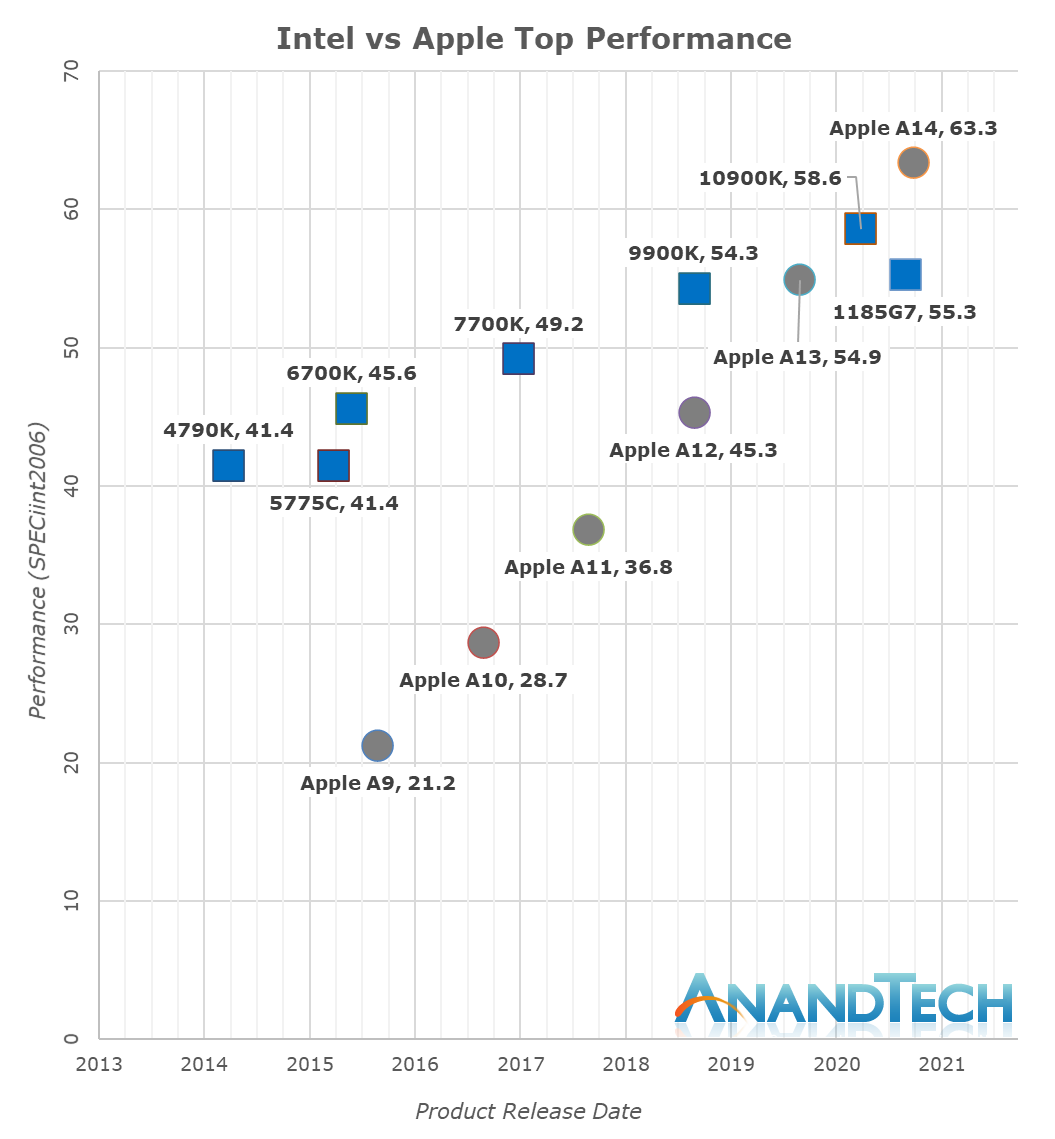
1065G7: https://www.cpubenchmark.net/cpu.php?cpu=Intel+Core+i7-1065G...
M1: https://www.cpubenchmark.net/cpu.php?cpu=Apple+M1+8+Core+320...
9880H: https://www.cpubenchmark.net/cpu.php?cpu=Intel+Core+i9-9880H...
In WW2 after examining the components from aircraft kills, german wing spars would often survive. It was discovered that Germany used unique forged alloy wing spars to achieve their excellent aircraft performance, perplexing allied engineers. These wing spars' strength and weight is critical to the structural properties of modern air frames. Without them, jet air craft like the f-15 would have been impossible.
Machining these advanced alloy parts proved difficult, expensive, error prone, and impossible to manufacture but a die forged alloy wing spar was stronger, lighter, cheaper and beyond the industrial capability of every allied nation. We did not have the metallurgical technology to create such a large forged alloy wing spar in 1945.
After the war, the US and Soviets recovered designs for the extremely large press assemblies required for advanced air frames. In the 1950s, a huge national program was geared up to create absolutely massive Heavy Press machines. The Soviets had a massive 30,000lb press for these parts, and we created a couple of monstrous 50,000lb machines[1] that are still in operation today. These things are older than we are and still out there cranking out air frame parts today for modern air frames in 2021.
Without this kind of national investment in this kind of unique manufacturing, we would be unable to fly without importing 747 parts from wherever they could be created.
[0] https://en.wikipedia.org/wiki/Heavy_Press_Program [1] https://www.youtube.com/watch?v=iZ50nZU3oG8