On the topic of algorithms helping you discover your own 'taste' (whatever that may be), some time ago when the topic came up on HN someone linked this interesting paper: "Recommender Systems for Self-Actualization" [1], which suggests some methods how filter bubbles could be avoided. I really liked it and its suggestions like having extra recommendation lists for things the user will likely hate, items that are very polarizing in the user base or things no one ever rated before.
Understandably, since that press release is devoid of any real information. Seems quite reasonable to disregard it.
That's one thing that bothers me about security in general, that it's so super political and it's a bit hard to just be interested in the technical aspects of it without being sucked into political bickering to some degree (can't follow Twitter accounts of most security people for that reason). Of course, I understand that it comes with the field since many adversaries simply have political motives. Still annoying though.
Either we make life on Earth sustainable before that or we won't have enough time to develop the technology to settle on Mars anyway, so thinking of Mars as a backup Earth does not seem like a particularly good idea.
I guess you could argue that the nodes can reject the hard fork. Decentralization doesn't preclude nodes coming to a consensus to change (or not change) the protocol.
Yeah, I also never liked that kind of advice. For me personally just doing something that roughly seems somewhat interesting was usually enough - if you get good at something, the motivation can often follow.
If I had spent more time thinking about what my passion is in life then I'd probably still sit there pondering without an idea of what to do.
I find it pretty hard to curate even interesting lists of researchers on Twitter without running into too much fluff or political tweets. I don't blame them for using the medium as it might be intended and of course they are free to share their personal opinions, but in my experience even just a handful of people who tweet a bit too often can pollute your stream enough to make it annoying to follow along.
Maybe Twitter should just let you filter posts based on content. (Maybe it's already possible, I'm not a big Twitter user.)
I suspect some people are guessing that a multipolar world will be less interventionist (since the great powers might block each other from interfering too much) and therefore adventures like the Iraq war are less likely to happen again. This might arguably make the world more peaceful, though it might allow civil wars to continue for longer.
No idea if it's true or will work out that way, but it's one hypothesis I think is out there.
Sure, the downside of China's rise is that authoritarian states have more legitimacy, but it's not like the western powers did much about those states back when they were the hegemons, so I'm not sure if the argument carries much weight either.
The problem is that reinforcement learning is far from solved and doesn't work all that well yet, so these toy problems are probably what researchers will stick with for some time to come.
There's certainly enough opportunity to work for a more peaceful world instead - scenarios where two large military powers clash should probably better be avoided anyway, so it's probably even a more productive use of one's time than optimizing for yet another variant of mutually assured destruction.
While that may be the reality of things, it surely can't be a justification in any way. If anything, I'd be afraid to revert back to those dark times where technological advancements were driven mainly by military needs.
Didn't record labels complain some time ago that Spotify had supposedly commissioned music for its instrumental playlists (presumably to save money on royalties)?
There's probably a danger that large record labels will threaten to revoke their licensing agreements if they think that Spotify may start competing with them on that front. Not sure if that will be a problem, though, I'm not familiar with the whole streaming market.
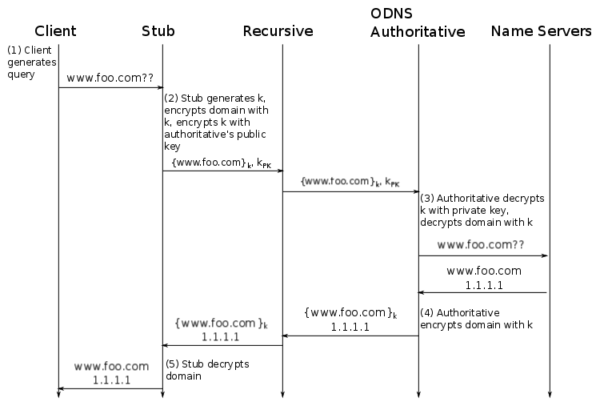
Yeah, the figure[1] on the side in the article seems to show something different, because there the response goes over the recursive resolver again. Maybe the text is wrong?
All seems to hinge on the recursive resolver acting as a proxy, so a direct response from ODNS server to the client stub doesn't seem safe.
While I like the distributed approach technically, it solves none of the social problems that social networks bring.
Filter bubbles, propaganda and competition for users' attention with clickbait and other cheap stories might even become worse, since a centralized platform could at least tweak their recommendations algorithms to break the bubbles (which Facebook doesn't seem to do, but it could).
Basically, I'm pessimistic because a distributed network only solves the (comparatively) easy technical challenge without addressing the problems of social networks.
Are encrypted DNS requests used by default? Does 1.1.1.1 somehow advertise to your client (whether it's a browser, the OS or a router) that encryption is possible? Do I have to configure my endpoint, which may expect to be able to send normal plaintext DNS requests, for it?
I guess DNS over HTTPS will surely not be supported by normal routers, but I don't know what other protocol Cloudflare refers to as "encrypted DNS", so maybe that will work.
Does someone have more information about how they implemented serializable in such a way that, as they claim, performance isn't negatively impacted? Seems pretty hard to achieve that.
As I understood it, the author didn't really claim that working at such a company makes you a god or super hacker, just that it might give you such a reputation among certain circles (not you, but others perhaps) - which many people will derive confidence from. Seems like a reasonable statement.
The article seems to be less about what some objective truth about good jobs is but more about how people perceive themselves, others and their goals in life.
Though some people might argue that the biases software reproduces will in turn reinforce biases held by the users at large. Conversely, you may reduce human bias if you algorithmically reduce the bias in the data (which is possible). Not saying whether Google should, that's a very delicate debate, but it's thinkable.
I wouldn't want to be in the place of the person at Google trying to make guidelines for that, but it's definitely doable. For instance, you could probably easily argue that the phrase "three black teenagers" (an example from the article) is pretty neutral in itself and definitely shouldn't be interpreted as a call to produce arrest pictures. In general the term "three [ethnicity] teenagers" could probably be normalized with regards to the setting the pictures show, for instance.
It's a difficult discussion because if you look at the literature regarding algorithmic fairness, there really is no measure of equality that satisfies all notions of fairness. If you force representation of seemingly underrepresented patterns in the data then you implicitly engage in social engineering.
This might be legitimate and reasonable, but you probably should be transparent about the fact that you "unbiased" your data by externally imposing a certain view of what the "fair" data should look like.
Ultimately it's a discussion for social scientists or laywers concerned with discrimination, it's not really in the realm of being fixable by engineering or computer science imho.
I probably expressed that wrong, I was more wondering if the packet sniffing had any beneficial impact on the performance in the sense of QoS or congestion control or something like that. After all, they have to do it for a reason.
But your second points mentions it's for billing and such, so I guess that's my answer.
[1] https://sci-hub.tw/https://dl.acm.org/citation.cfm?id=295918...