HackerTrans
TopNewTrendsCommentsPastAskShowJobs

Shrezzing

no profile record

comments

Shrezzing
·hace 2 años·discuss
It's less sustainable than renewables, but fills a practical requirement for peaker style powerplants (which fill sudden demand) without resorting to coal/oil/gas, which are considerably less sustainable. Drax already existed as a coal/gas facility, so transitioning it to a biomass-with-carbon-capture facility is a net benefit to the environment, even when considering the packaging and transportation of the wood, because those steps were required for its coal predecessor.
Shrezzing
·hace 2 años·discuss
Most likely it'd be burned in a bioenergy powerstation.

Drax in the UK [1] is a quite good case study for this (assuming they get it all up and running), though they're not using algae. Right now they grow trees, and burn those in pellet form. It's currently considered sustainable as it's not adding new carbon to the above-ground system (whereas coal/gas/oil is adding to the above-ground carbon). Their next phase is to attempt to capture the post-combustion emissions from their chimney stacks, at which point they have a non-biodegradable mass of carbon to bury somewhere.

[1] https://www.drax.com/sustainability/sustainable-bioenergy/
Shrezzing
·hace 2 años·discuss
Ironically, "Marxist" is also a classic motte-and-bailey word.
Shrezzing
·hace 2 años·discuss
> The world relentlessly marches forward. However, I've learned human resilience is AMAZING. You'll be surprised at what you are capable of when life asks for it.

What I'm about to say obviously pales in comparison to raising a child with autism, but entering an ultramarathon/triathalon is a quite good way to experience something like this first hand in a safe environment. The amount a human can actually "go through" when it's asked of them is entirely remarkable.
Shrezzing
·hace 2 años·discuss
'56 is too early, given how much of east Africa was under British colonial control into the 60s, and how much of S/E Asia was still looking for independence. It's likely the population of the empire was still above 100mn at the time. I'd say '56 is more like the start of the very rapid decline of the empire.

It highlighted both to the colonised and the colonisers that the empire was way over-extended.
Shrezzing
·hace 2 años·discuss
There's quite a lot of other constraints too. Lots of goods aren't allowed to sit side-by-side, for example, anything explosive goods cannot sit within n containers of hazardous chemicals. Because goods codification is so low-fidelity, lots of things which aren't actually explosive/hazardous can't be stored in close proximity, because we can't differentiate them from things which are actually hazardous/explosive.
Shrezzing
·hace 2 años·discuss
I'm not sure if this is concrete fact, or just a theory, but you can continue the line up Norway's western coast too. Then in the other direction, the line was broken, but restarts & progresses from Nova Scotia down through the Appalachians in North America.
Shrezzing
·hace 2 años·discuss
>employees are the most expensive thing a SaaS business has.

I'm pretty sure for the overwhelming majority of (successful) SaaS businesses, the most expensive part is the marketing & advertising budget. 30-50% isn't uncommon, because the returns on successful sign-ups are enormous.
Shrezzing
·hace 2 años·discuss
That's a fair summary of why the research is happening. Thanks.
Shrezzing
·hace 2 años·discuss
The paper discusses this, and the approach taken in the paper implements a number-flip stage, so numbers are formatted with their least significant figure first.
Shrezzing
·hace 2 años·discuss
Since models are very good at writing very short computer programs, and computer programs are very good at mathematical calculations, would it not be considerably more efficient to train them to recognise a "what is x + y" type problem, and respond with the answer to "write and execute a small javascript program to calculate x + y, then share the result"?
Shrezzing
·hace 2 años·discuss
>deductive reasoning is just drawing specific conclusion from general patterns. something I would argue this models can do

That the models can't see a corpus of 1-5 digit addition then generalise that out to n-digit addition is an indicator that their reasoning capacities are very poor and inefficient.

Young children take a single textbook & couple of days worth of tuition to achieve generalised understanding of addition. Models train for the equivalent of hundreds of years, across (nearly) the totality of human achievement in mathematics, and struggle with 10-digit addition.

This is not suggestive of an underlying capacity to draw conclusions from general patterns.
Shrezzing
·hace 2 años·discuss
I think these examples still loosely fits the author's argument:

> There are some cases where big data is very useful. The number of situations where it is useful is limited

Even though there are some great use-cases, the overwhelming majority organisations, institutions, and projects will never have a "let's query ten petabytes" scenario that forces them away from platforms like Postgres.

Most datasets, even at very large companies, fit comfortably into RAM on a server - which is now cost-effective, even in the dozens of terabytes.
Shrezzing
·hace 2 años·discuss
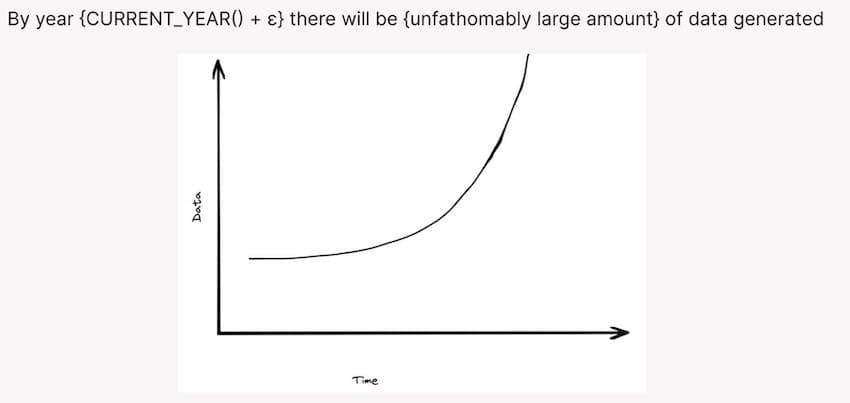
This is a quite good allegory for the way AI is currently discussed (perhaps the outcome will be different this time round). Particularly the scary slide[1] with the up-and-to-the-right graph, which is used in a near identical fashion today to show an apparently inevitable march of progress in the AI space due to scaling laws.

[2]https://motherduck.com/_next/image/?url=https%3A%2F%2Fweb-as...
Shrezzing
·hace 2 años·discuss
This was the big one for me too. The juxtaposed healthy versus unhealthy lungs resemble an uncooked chicken versus a roast chicken which was left in the oven for 30 minutes more than necessary.

https://www.scotsman.com/webimg/legacy_elm_28724349.jpg?crop...
Shrezzing
·hace 2 años·discuss
Hosting costs are £3m, but total expenditure is $160m - which obviously isn't covered by the interest on $250m.
Shrezzing
·hace 2 años·discuss
The challenge in the UK at the moment is connecting willing high net worth individuals with entrepreneurs. Even with the tax incentives, and the relatively good incubator-ish organisations like Eagle Hub, there's some enormous disconnect between viable ideas and timely capital to execute on them.
Shrezzing
·hace 2 años·discuss
The UK has an age-based advantage in this metric. Oxford & Cambridge are nearly 1,000 years old. Once you take that into account, the stat becomes "of the top 8 universities (ex. Oxbridge), 2 are in the UK and 4 are in the USA". Imperial is very high quality institution, definitely the peer of Berkley/Yale. UCL normally isn't thrown into the top 10 though - it'd usually appear in the top 25.
Shrezzing
·hace 2 años·discuss
> I don’t think it’s any longer about access to capital

The link provided as proof for this comment is Wayve receiving a $1bn injection from Microsoft and Nvidia [1].

The $1bn raise is not the concern of a budding 23 year old graduate leaving Imperial/Cambridge/Oxford. They're looking at the first £100k capital to see them through the first few months. In the UK, the scene for the first capital injection is far weaker than in the US, which has an inevitable downstream impact.

[1] https://www.bbc.co.uk/news/articles/crgypzg4edvo
Shrezzing
·hace 2 años·discuss
>Yes, there will be a need for more research in safety, for sure, but this is not something any company can do in isolation and in the shadows.

Looking through Antrhopic's publication history, their work on alignment & safety has been pretty out in the open, and collaborative with the other major AI labs.

I'm not certain your view is especially contrarian here, as it mostly aligns with research Anthropic are already doing, openly talking about, and publishing. Some of the points you've made are addressed in detail in the post you've replied to.