Dude, you're missing the point. You do not walk on the road the same way a cyclist cycles on the road. You do not walk up to T junctions, indicate with your arms and turn left. You neither come to a set of traffic lights in the same way. Cyclists have to do all these things.
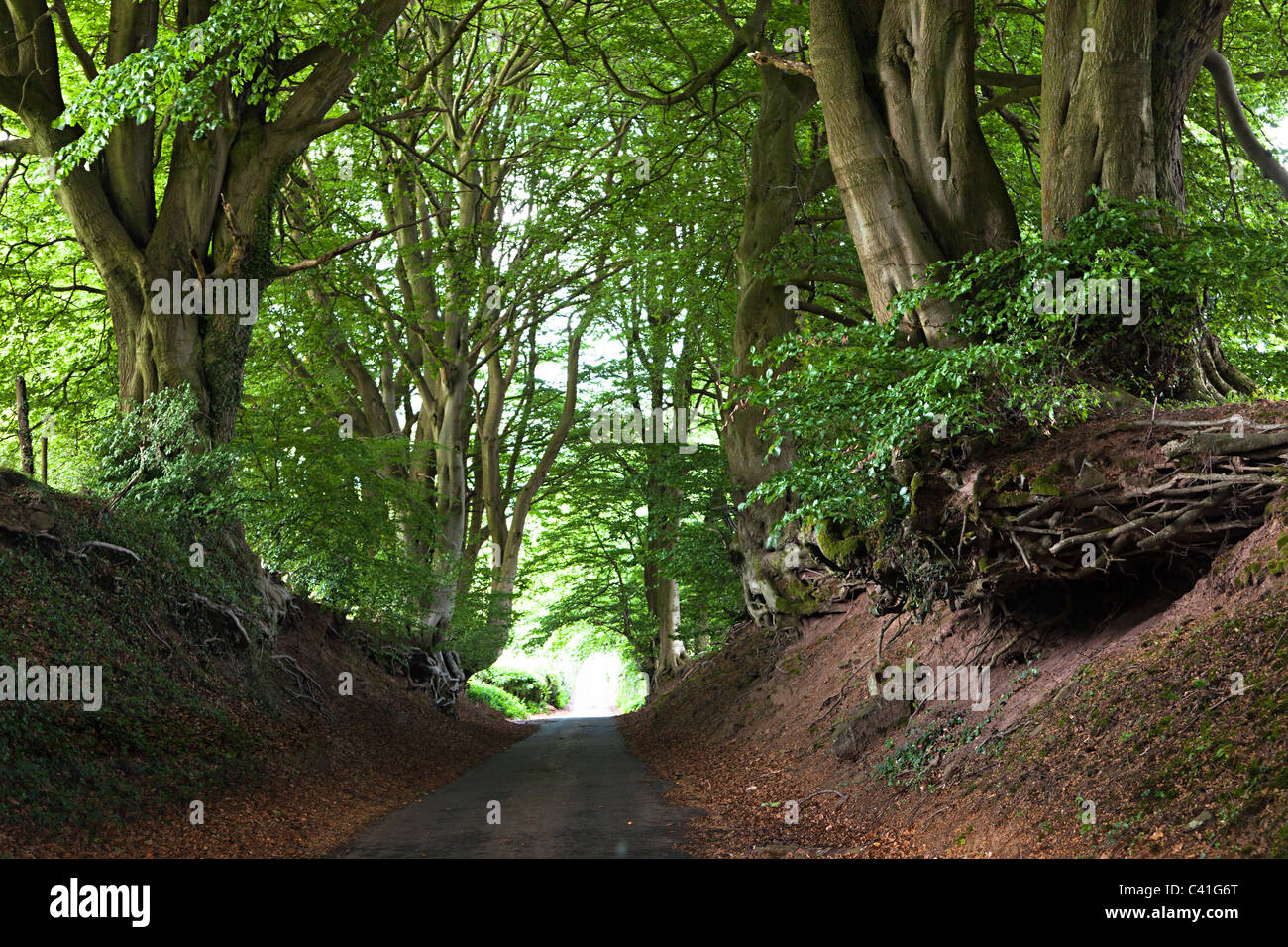
I've lived in the countryside for 14 years. I don't walk on the roads where I live. The roads are narrow and there is no place to walk as the side of the roads are raised embankments built from tree roots. Looks like this: http://c8.alamy.com/comp/C41G6T/country-lane-with-trees-form...
> I very much doubt that you would be arrested if you tried to drive a car without a license.
Without a valid driving license you will not be able to get insurance, unless you stole an insured vehicle from your parents or off the street.
Patrol cars in the UK and Europe have cameras that read number plates and check a database against all insured vehicles. If the car is not insured you will get pulled over, upon which you will be asked to present your driving license.
Well I think the issue is that unlike the pavement, the roads are much more stringently regulated with sign posts, markings and lights.
For as long as cyclists have to cycle on the roads as we know them a cyclist should be required to demonstrate that they understand the signs and rules of the road. That could be by presenting their official drivers license, or, should they not have one, be required to take a theory test. I think that would be a sensible first step.
You could then imagine a practical test for hazard perception, efficient use of gearing and safe filtering through queues of traffic.
Naturally, people don't walk on the road, and pavements don't have the same kind of mandatory control flow unless they intersect with the road, and most children are taught how to cross the road from a young age.
> What is the actual gain to society from requiring a cyclist license? Today, without licenses, police can and do hand out moving violations to cyclists.
I could, as someone who doesn't have a driving license, or has never learned to drive, go out on the road with my bicycle and more or less ride whenever and wherever I like.
I don't know what any of the road signs mean and I have no experience or training in hazard perception and collision avoidance. The law doesn't require me to. If I tried to do the same thing in a car I'd be arrested.
Since running is largely recreational most runners avoid congested areas on purpose. If this changes it will have to be revisited. Nice strawman though.
1. Pedestrians move at much slower speeds than bicycles. If two pedestrians walk into each at 5mph the damage is much lower than if two cyclists collide at 30mph.
2. Since pedestrians move much slower than bicycles they can manoeuvre much faster. The stopping distance for a walking pedestrian is less than 1m, the stopping distance for a bycicle travelling at 30mph is much greater.
3. If two pedestrians walk into each other the chance of collateral damage is quite low. It's quite easy to walk around two people that just walked into each other.
If two cyclists collide, there is a good chance that cyclists on each side of them will get caught up in the collision, crash and injure themselves too. A good example of this are the crashes seen on Tour de France.
Of course, if people started running as a mode of transport it would become increasingly dangerous, and you'd have to start separating the walkers from the runners as the damage from a potential collision would be much greater.
> Thought experiment: if you didn't have any motorised vehicles on the road, would you still want cyclists to have a licence?
Of course! In a world where there were only cyclists there would still need to be a set of rules that all cyclists are required to follow. Those might include how to behave at intersections, how and when you should overtake other cyclists, and so on. To be allowed to cycle, each cyclist should have demonstrated that they understand and follow these rules by taking some kind of test.
> In a general case though, requiring cyclists to have a licence would reduce the number of cyclists, probably significantly. This would correspondingly increase the number of motorists.
I don't think so. I expect the government to continue to penalize use of motor vehicles in cities such as London. The bicycle will remain the cheaper mode of transport.
There have been a couple. However, when it does happen it gets a lot of media attention, the most recent incident taking place on Oxford Street, a popular shopping street in London: http://www.bbc.co.uk/news/uk-england-london-41263926
The number of people on bikes running up the inside of vehicles on narrow streets is too high. I’d walk through Bank (a junction in London) 5 times a week and I’d see time and time again people riding up the inside of tipper trucks and buses indicating to turn left. It happens all the time. I’d witness 3-4 near misses a month.
Rule 73 of the Highway Code:
> Pay particular attention to long vehicles which need a lot of room to manoeuvre at corners. Be aware that drivers may not see you. They may have to move over to the right before turning left. Wait until they have completed the manoeuvre because the rear wheels come very close to the kerb while turning. Do not be tempted to ride in the space between them and the kerb.
Even so, a bike is capable of moving at speeds high enough to cause severe harm to the rider or pedestrians. What if the threshold for a test was based on the average speeds of the vehicle?
Pedestrians are, with the exception of some rural areas, provided with dedicated carriage such as a pavement or sidewalk. The rules of crossing the road are well defined and in some European countries pedestrians are even arrested for J walking.
Why shouldn’t cyclists need a license to ride on the road? Others road users must have one.
----
It's a shame I'm getting downvoted, but the current state of affairs is that in cities like London bicycles, cars and trucks will be sharing the road for the near-mid future.
I'd rather not have trucks or cars in the city, and ideally cyclists would have their own road separate from cars and pedestrians, but I think that's a pipe dream.
Until then what else can do we? At least if we require tests for cyclists, like we do for cars, buses and trucks, it might help reduce the number of cyclists doing risky things that perhaps they aren't even aware of?
Sure there are still reckless drivers, but at least they have a license that can be revoked and points that can be fined. How do we ban reckless cyclists from the road?
I have Zen Internet. It is a little bit more expensive than competitors such as BT and TalkTalk, but the customer service is so much better! It’s all in-house, run from their office in the U.K.
The Fritzbox! router is fast, reliable, has great WiFi and looks like a spaceship!
QC25s are great at reducing noise, but it’s not just noise that’s the issue! I find that older planes have more more vibration in cabin and that’s not something that noise cancelling headphones can help with.

Well, would you argue that requiring a license for motor vehicles is unnecessary? The benefits should be similar and identifiable.