That's a strange statement... It's been true for a while now that OpenAI has had much more generous limits than Anthropic on their subscription plans. And with the Fable ban/guardrails disaster, there has been a lot of frustration from people in these comment sections. And Anthropic fucked up Claude Code pretty badly for a couple of weeks during the 4.6/4.7/4.8 transition, which again was widely publicized. And they got a lot of flack over not allowing other harnesses anymore. And ChatGPT got some pretty viral wins on model intelligence when they cracked the high profile Erdos problem.
If anything the online optics have been bad for Anthropic for the last half year. OpenAI doesn't have optics issues, from my point of view they simply have the issue that they are the least trustworthy player at the frontier. The way they pivoted from their original mission is truly breathtaking, especially coming in gloatingly to take the government contract when Anthropic got kicked out for insisting the government does not use their systems for mass surveillance or autonomous weapons systems. You understand what that means, right? OpenAI models are now actively used/developed for mass surveilance and/or autonomous weapons systems.
I know there are plenty here who seem to value their own ability to use these models cheaply above all other considerations. Then OpenAI is a great choice, and much less restrictive than Anthropic. But their problem is not on the optics. It's on the substance.
You are mischaracterizing what the post is reporting entirely. Porting an open source tool used in bioscience to rust is a software engineering task. But it is somewhat understandable that it gets stuck in the overly broad safety margin.
But I do research on stuff that is entirely unrelated to bio or cybersecurity, and the model is simply not taking any of my research-level prompts. This is fairly abstract mathematical stuff. All of this, including all the examples in the posted article, are far from "trying to get the model to do what it was made not to do".
I disagree. When I got Fable to engage with research questions before they tightened the guardrails it was a genuine step up from Opus 4.8. I see no real reason that what everybody reported isn't exactly what happened.
With these guardrails it is completely useless. The only hope is that they eventually convince the US Gov to let them use a saner classifier.
My experience, too. I work on nothing in any way related to cybersecurity or biology. I asked it a few purely mathematical questions, it refused immediately.
Before the export embargo I did get it to look at some hairy problems and the output was genuinely useful...
What is your point? Sometimes it works due to other factors so we don't need regulation?
Beyond the very real closures of unprofitable rail lines that is always happening or threatening (including in state owned rail companies) your examples don't really measure up either:
Local airports are typically subsidized. So the infrastructure aspect is not market driven.
Eventually getting starlink means it was fine to not have fast internet for a couple of decades? We still don't have good mobile internet on many train lines in Germany. In Poland it's fine. The difference? Poland mandated that companies bidding for 4G meet certain coverage goals. Market forces have absolutely failed to actually get reasonable mobile internet to everyone.
Officially it's not available anymore. But there are team plans that are not enterprise, so if you are small enough and fine with the data protection included in those maybe that is what you're working with? And I do know NGOs were offered seat based plans after they were officially not available anymore.
Also: This change came in in March so if you got your contract before then this will only bite once you renew.
Individuals, sure. For enterprise you can't get monthly plans. You have to pay per token.
It's a bit like saying "nobody pays for Microsoft Office". I certainly don't know anyone personally who has. Students get a free Education License and then your employer provides one for you...
Infrastructure should not be (purely) profit driven. To improve profits for train operators, the simple option is to cut lines serving small and rural communities. The economics are much worse than serving large cities. Same for cell coverage and broadband internet. Most profitable is to just not cover a few percent of the population.
There is a point where technology becomes foundational for participating in society. And then it needs to be regulated to be available to everyone.
So requires more transmission infrastructure. The difference is that we already have that built out over decades, and now we need a different network in a much shorter timescale.
No one should pretend that the energy transition is free. The final system we will arrive at can be ver
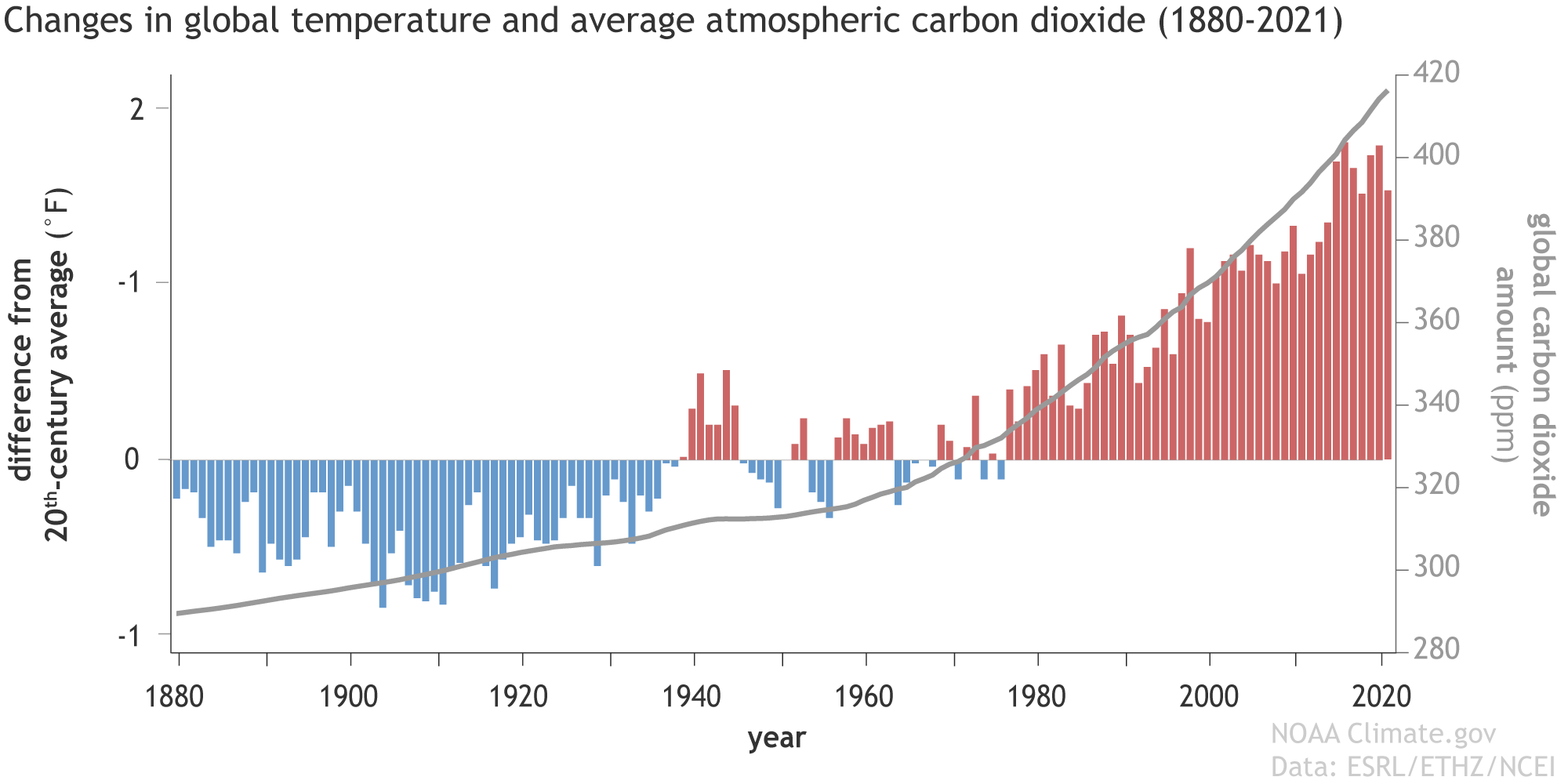
CO2 and temperature track quite well. However, climate sensitivity actually says the relationship is not linear but logarithmic. Doubling CO2 increases temperature by 2-3 degrees.
The thing is, in the last decade or two we have firmly moved into the regime where we are out of the natural variability. If you get a 30 degree summer every five years instead of every ten that might be a very clear signal for warming, but is not as notable. If every summer is 30 degree and sometimes you get 40 you really feel the new climate normal.
"Carl Benedikt Frey at Oxford has documented that the Industrial Revolution took seventy years before wages and employment recovered for the workers it displaced. In the interim, wages stagnated, the labor share of income collapsed, profits surged, inequality skyrocketed, and the political consequences included the Chartist movement and widespread social upheaval."
From half way through this (meandering) blog post:
Actually the real danger is mass labor market disruption, and a massive shift of power from labour to capital.
As was highlighted in previous discussions, the industrial revolution took 80 years to start benefiting workers. The continued impact of automation at least contributed to the rise of right wing extremism and an erosion of democracy all over the west. Now we face a development that has the potential to be faster than those that came before, in the context of political systems more fragile and worse equipped to manage the change.
So yeah, disrupting the status quo can absolutely be dangerous. It has been dangerous (and deadly) in the past and in the present.
That would convince me that the US Administration is capable of good governance and interested in a regulatory environment that furthers the public good and curtails excessive corporate power. A tough sell indeed. But that was not the question. They can be incompetent and corrupt and favouring the interests of their buddies, and also genuinely believe that the models are actually becoming dangerous (especially in the hands of other countries). It's simply impossible to tell what mix of motivations led to this mess.
I agree that this is all ridiculously arbitrary right now, but it shouldn't be surprising either.
I can't find the exact blog post (maybe on simonwillison.net ?) but I read people predicting that know your customer laws would be coming to AI if it gets more powerful several years ago already.
Powerful technology that can do immense harm in the hand of individuals/small groups is the most obvious (and legitimate!) target for regulation. Maybe Anthropics hubbub around Mythos made all of this happen earlier than it would have, but it was going to happen (if the models are going to get as capable as valuations imply they will).
(Edit: Of course this doesn't mean it can be effectively regulated in practice)
Further more, no one actually gets hurt if we start rolling these things out more slowly.
Rolling them out selectively according to the whims of an administration that disdains fair process, tears down the institutions that could potentially provide and legitimise reasonable regulation, etc... well, that's another topic.
Anthropic broke with US Gov over wanting restrictions and n how they use their model. OpenAI was more than happy to bend over backwards and hide behind a misleading press release.
The idea that OpenAI is the one who are meaningfully pushing back against the USGov is risible.
I think this is unfair to Julia. It has a strong lisp lineage, the just ahead of time compilation model is interesting and I think they were the first to make it work.
I agree that it's lacking in many ways, but it's not just Python on LLVM.
If anything the online optics have been bad for Anthropic for the last half year. OpenAI doesn't have optics issues, from my point of view they simply have the issue that they are the least trustworthy player at the frontier. The way they pivoted from their original mission is truly breathtaking, especially coming in gloatingly to take the government contract when Anthropic got kicked out for insisting the government does not use their systems for mass surveillance or autonomous weapons systems. You understand what that means, right? OpenAI models are now actively used/developed for mass surveilance and/or autonomous weapons systems.
I know there are plenty here who seem to value their own ability to use these models cheaply above all other considerations. Then OpenAI is a great choice, and much less restrictive than Anthropic. But their problem is not on the optics. It's on the substance.