They grind up your skeleton, remove the dental gold, then re-name it "ashes?" That's not very "green."
Why not add this to your will:
1. place my body on a pile of dynamite on an Oregon beach, and blow it up (first issue umbrellas to the funeral party.) Or, failing that...
2. Freeze my body in liquid nitrogen, sharpen my head in a giant pencil-sharpener, then drive me into the ground as a fertilizer-spike.
3. Do #2 above, but throw my sharpened body from a plane flying over farmland. Add fletching to my legs to guarantee pointy-end-downwards.
4. Cast my body in a block of solidified transparent polyester resin, then use it as a large tombstone. People visiting can watch the slow decay, until years later it's a me-shaped bubble. (Leave a little drain-channel to prevent explosion from gas pressure.)
5. Once I saw a button-mushroom entirely take over a live eggplant. Do that to my body, but with psilocybe species. Then dry, grind, and smoke me up.
He did say that the 3D light-effect seen in lathe-turned metal plates led him to discover human stereopsis, to draw stereo pairs, ending up as the stereo camera and stereopticon.
So, that Stereopticon-path of research, it attracted Wheatstone away, and changed the history which mighta-been. We ALMOST had Victorian steampunk holography, a century before lasers existed.
Ever heard of the Rose-engine lathe?
Ever heard of a "ruling engine?" That's how diffraction gratings were made, back in the day. A similar sort of precision machine, equipped with some Jaquard-loom punchcards, could have been turning out giant scratch-hologram masters. (Then stamp out copies, just like vinyl or lac or wax records!)
Someone discovered it all, back in 1979. Built a joystick-controlled motorized scriber-machine. Produced some 3D artwork. Then died without releasing the secret.
1979? 1838? the big question is, did The Masons know about scratch holograms? Encoding secret messages in polished metal surfaces?
Gaze into the works of centuries-old silversmiths, held out under sunlight, see if some little "sandpaper marks" produce tiny words or pictures, floating down inside the metal ...unsuspected by all non-initiates!
It needs to make a polished groove or smooth surface-divot. Definitely use colored or black plastic, to promote surface-absorption. The real key is to eliminate jaggies. Either your steppers need micron resolution or better, or the laser-sweeping needs adjustable radius (smooth curves, but stepped depth.)
I tell people, if you could play the hologram on a record turntable, the scratches must be silent. No micro-wiggles. The must behave as long, curved mirrors.
All in HTML 1.0 written by hand, from Unix shell C, using pico.
When I started, I was getting huge international traffic, from people seeing near-instant page-loading when using 2400 baud dialup. I think classrooms were using it for ESL teaching. Also, huge traffic from the deaf community (any images w/text paragraphs, and ease of speech screenreaders. Unexpectedly this put me way high on google, when it finally appeared years later.)
A kid on Youtube invented the rotating version (scratching complete circles, then turning the plate.) Then an MIT student worked out a way to eliminate the second unwanted image; the pseudoscopic inside-out one. He gave talks on the techniques, find on youtube. Eventually he had an gallery show of his black, rotating scratch-holograms, and a few years later, was hired by various rock bands (and also Disney) to provide rotating scratch-holograms for vinyl re-issues of music. (But no need to remove the second image! That way you get one image down inside the black surface, a second one flying in the air above! Very spiffy and impressive.)
Guy at MIT made huge numbers of them, using a robot-arm and sharp tool. He worked out an algorithm to interleave the short scratch-segments, so dense intersecting scratches don't ruin the image. His art is now in a mathematics museum. Also, apparently he attempted to change the name of the holograms, pushing the term "Specular Holography" everywhere he could. Deeply silly, since they're not "specular," any more than is any other hologram. They possess a transmission mode and a reflection mode. If you scribe them in clear plastic, then you can either back-paint it black, and illuminate it from the viewers' side, or you can put a light source behind it, and see the same 3D image. The invention isn't inherently "specular."
So, wtf?
Heh, but also, knowing about the history of invention-theft and fights to name new phenomena, I'd earlier listed all the possible names I could imagine. Abrasion holograms, giant-fringe holograms, single-fringe holograms. Paleo holography, caveman holography, prehistoric holograhy, car-hood holograms, Geometrical holograms (geometrical, as opposed to Physical Optics.) Brushed-metal holograms. Chatoyant holograms (same optics as cats-eye gemstones, deep highlights in polished wood and human hair.) So, if you want to take the discovery as your own, you can't use any of my names!
Credit-card security holograms ...not true holograms either. Right? They need no monochromatic illumination. And they don't employ any interference in order to produce their 3d images.
That's the whole trick, really. "Scratch holograms" employ exactly the same physics as Benton Rainbow holograms. Both store phase information, and both require coherent illumination, but neither one is based on diffraction (that's why they can still work, even with a white light source.) If you make a Benton white-light hologram, then instead make the "diffraction fringes" about 1mm apart, the hologram STILL WORKS. "Scratch holograms" are just Rainbow holograms where the fringe-spacing is enormous.
So, if credit-card Rainbow Holograms are real holograms, Benton white-light holograms are real holograms, then to be consistent, we're forced to admit that scratch-holograms are holograms. (Besides, they create unwanted pseudoscopic images, and required spatially-coherent illumination, same limits encountered with any true hologram.)
The light coming out of the scratch-hologram must be coherent. That means, the scratches must be mirrors (like smooth grooves, or bent silver wires, shiny curved spiderwebs.) Normal raster-displays emit incoherent light, and their images are entirely located on the display surface. But make your display out of billions of tiny mirrors, then you can create images which float deep inside the surface. (Or hang in the air, outside the surface.)
It was started by a famous paper from Ludwig Prandtl, in ?1920?. The math is easy, if vortex-shedding is removed, and our wing has infinite span. Nobody realizes that an infinite wing is permanently trapped in ground-effect mode, and only works by instant ground-forces, just like a venturi. Just like those snow-speeders from Star Wars.
Other Prandtl papers analyze short, non-infinite wings. But they avoid all the insoluable equations by having the wing fly at infinite velocity! This way, no air moves downwards on average. Prandtl forgets that if the tip-vortices don't move downwards, then also the vortex-shedding goes to zero, and the tip-vortices vanish! By flying at infinite velocity, then pretending that tip-vortices are still created, Prandtl is "searching for car-keys under bright streetlights, where the job is easier" when the actual explanation of lifting force is still hidden elsewhere, out in the darkness.
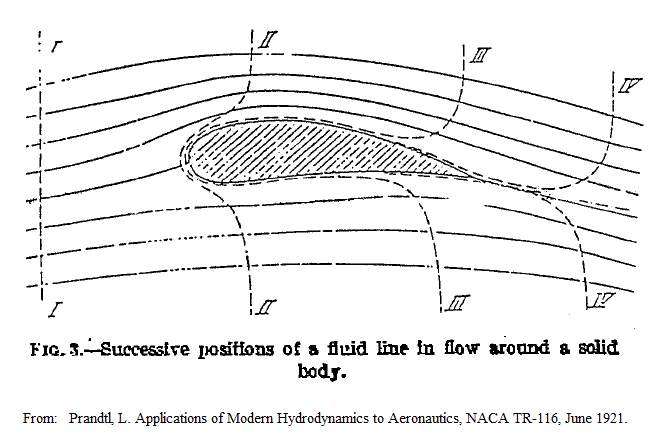
Heh, another of Prandtl's papers rigorously described the equal-transit-time theory, giving us diagrams, and including it as the explanation for lifting-force. Yet nobody could contradict the Great Prandtl, since his papers were huge walls of interlocking equations, which were all correct. Only his initial assumptions were wrong, and it took about seven decades before physics teachers started seeing the problem.
But if air is pushed down, then it must continue moving down (much like with a hovering rocket, or a helicopter.)
But this effect does not appear in typical airfoil flow-diagrams. Instead, the air approaches horizontally, and leaves horizontally. It's a symmetrical pattern, as guaranteed by "circulation theory." In these diagrams, the wing doesn't fling any air downwards. (Heh, the same thing happens with helicopters that fly inside a giant vertical pipe, where the blade-tips slide along the inside surface of the pipe.)
"There is no gravity in outer space. Gravity ends at the top of Earth's atmosphere. That's why astronauts in the ISS are weightless."
Simple and concise. Easily understood by little kids. Textbooks in the 1950s actually taught this "fact." What could be the problem?
It's not "simplified," instead IT'S WRONG...
...and it creates a massive physics-misconception, where if a student actually believed it, later they'd have enormous trouble in physics classes. (Also, if they later became a teacher, then they'd give all their students the same destructive misconception. If later they became a textbook author for K6 grades, millions of students would become infected! Heh, education is a viral effect: a meme-spreading process, and "mental diseases" like the above are common.)
It's wrong because the force on the lower airfoil surface is far smaller than the total lifting force.
The flow above the airfoil "sticks" to the airfoil. Since the upper flow is being forced downwards by the curved upper surface, it forces the airfoil to move upwards.
What happens if the upper flow doesn't curve downwards? Simple. That's called "stall," and your airplane drops out of the sky. "Stall" is when the upper flow becomes detached, and goes straight back, rather than following the curved upper surface. (The force on the bottom of the airfoil is far too small to keep the plane in the air. Most of the lift is created by the upper surface! That's why "stall" is such a huge deal.)
If it's a 3D wing with finite span, then you're well into vortex-shedding and momentum-carrying plumes of gas.
The usual way to avoid this is to make the wingspan be infinite, with no wingtips. But this is dishonest, because it transforms the problem into a "venturi effect," where the airfoil is producing an instant-force against the ground. Then, the Newtonian force-pair exists between wing and ground. (Yet real, non-infinite wings don't need any ground surface to react against. Their force-pair is between the wing and the vortices being launched downwards.)
To simplify: first explain a hovering helicopter. Wings work the same, acting as air-pumps, pulling in air from all directions, then creating a momentum-carrying plume launched downwards. (Helicopters and wings, both are examples of fluid propulsion, where Bernoulli doesn't apply.)
His statement is right, but it requires that tip-vortices and downwash-plumes exist. The air behind the wing is carrying momentum, and is left with downward motion. (In typical 2D airfoil diagrams, this cannot happen.)
Also, his statement is only true if we completely eliminate Bernoulli (since any wing which flings air downwards, is also performing net work, and injecting energy into air-parcels. If the net energy of parcels is changed, then Bernoulli concepts cannot be employed.)
"Simple" is the problem. It's simple to describe wings verbally, but the math is not simple at all. Helicopters are the same: they generate a column of downwash, but this involves performing net work, and involves vortex-shedding, so simple Bernoulli concepts are utterly forbidden.
Simplified: wings are an example of propulsion, and fluid propulsion always involves vortex-shedding, which falls under the heading of Turbulence. It's easy to verbally describe simplified elementary turbulence. It's just a vortex which moves around, and involves work performed on the air as a whole. But jeeze the math involved!
Many generations of professional pilots have been taught the "equal transit theory." It's often as an answer their licensing exams.
So, most pilots have little idea how wings actually work. (But since the rise of the internet, things have been sloooowly changing. At least the pilots have started questioning and arguing!)
Ocean waves work like this: water molecules are piled up in humps, and all the molecules slide across the ocean, while the water underneath the humps does not move. If you poured some dye into the waves, the water-humps would carry it along.
Sound works like this: vibrating objects put energy into air molecules, then the molecules zoom all the way to your ears at the speed of sound. They put the sound vibrations into your eardrum. Then they zoom all the way back to the vibrating object. Then repeat.
Uh, that's all wrong. Not oversimplified. Just wrong. (Airfoil explanations are similarly wrong. Not just oversimplified.)
He's wrong. All those explanations ARE intended to explain flight! They're given to professional pilots without qualifiers, presented as if they were complete explanations. (If they weren't, then the controversy would instantly evaporate.)
This situation is quite different than, say electrons of atoms. First we learn that atoms are like little solar systems ...but then also hear that this is oversimplified (wrong,) and that we'll have to learn QM and probability-clouds in order to have a correct explanation of atoms' electrons.
That's NOT done with lifting-force explanations. Pilots aren't being taught that the explanations are wrong, oversimplified, and only the professional fluids experts can attain the "bigger picture" which removes all the mistaken concepts.
Did your angry colleague supply a simple correct explanation, to replace the wrong ones in the article? "Feels right" is a cop-out. Pilots don't want hand-wavy fuzz, or some experts who insist "it's just too complicated for beginners."
How about this instead...
First we explain a hovering helicopter. It's an air pump. It pulls air inwards from all directions, then blasts it downwards. Next, shove the helicopter rapidly sideways. That's how wings actually work: they pull air in from all directions, then fling it downwards. (But this is hard to notice, since the downwash-plume of an airplane is all stretched out, and it even seems purely horizontal. It's not.)
Heh, wings are the same as VTOL jet aircraft! But the turbine-blades in the VTOL engine have broken loose and flown off alone. Yet each little blade is still acting as an air-pump, and pulling air inwards from all directions, and flinging it downwards, producing a downwash, a momentum-carrying "exhaust plume."
In 2D airfoil diagrams, first the parcels approach horizontally. Then they are mysteriously accelerated upwards. Then the airfoil accelerates them downwards. Then behind the airfoil, they're mysteriously accelerated upwards again, so they depart horizontally, for zero net acceleration applied to each parcel.
As a whole, air around the wing ISN'T accelerating downwards.
As long as we ignore the "mysterious" part, or try to sweep it under the rug, our explanations won't satisfy.
A complete explanation must include the ground surface ...and then we discover that we're actually explaining a kind of "venturi effect," where the ground is a part of the system, and those mysterious accelerations before and behind the airfoil are caused by interaction with the ground.
This is a "big AHA!" situation: a 2D airfoil can only explain ground-effect flight, where the Newtonian force-pair is located between ground and the airfoil, so no net downward acceleration of air exists. (In other words, if we erase the ground from our diagram, we've just violated Newton's 3rd law.)
A 2D airfoil diagram without the ground surface ...that's a sort of "inertial drive," where the upward force on the airfoil has no corresponding down-force (it does not give a net downward acceleration to the air as a whole.) Easy to fix. Just add the ground surface back in. And then confront the fact that this is a venturi, and not an explanation of flight.
"Longer path" is an incorrect explanation for why the air above the airfoil moves faster. Yet the air above the airfoil really does move faster, as that webpage correctly describes. (That webpage doesn't say why the air moves faster! Thus they avoid the "equal transit fallacy.")
- "Airplane wings are shaped to make air move faster over the top of the wing."
True. Giving the airfoil some camber will change the upper/lower velocities, making it produce lift, even at zero attack. No mention of "equal transit-time."
Why not add this to your will:
1. place my body on a pile of dynamite on an Oregon beach, and blow it up (first issue umbrellas to the funeral party.) Or, failing that...
2. Freeze my body in liquid nitrogen, sharpen my head in a giant pencil-sharpener, then drive me into the ground as a fertilizer-spike.
3. Do #2 above, but throw my sharpened body from a plane flying over farmland. Add fletching to my legs to guarantee pointy-end-downwards.
4. Cast my body in a block of solidified transparent polyester resin, then use it as a large tombstone. People visiting can watch the slow decay, until years later it's a me-shaped bubble. (Leave a little drain-channel to prevent explosion from gas pressure.)
5. Once I saw a button-mushroom entirely take over a live eggplant. Do that to my body, but with psilocybe species. Then dry, grind, and smoke me up.
6. "Resomation," but that's too too conventional.