Bringing Sous Vide to the Home Cook(nytimes.com)
nytimes.com
Bringing Sous Vide to the Home Cook
http://www.nytimes.com/2014/11/20/technology/personaltech/bringing-sous-vide-to-the-home-cook.html?_r=0
61 comments
They haven't put out any updates since May, it seems. Do we have any idea if they're still going to manage to ship in "early 2015"?
It is somewhat fascinating how much the tech community seems to strive to try to solve non-problems. In this case, poaching or hard boiling an egg is so utterly simple, done in mere minutes, that it is simply impossible that this device could make it easier. And the grotesque proposed waste of energy borders on the absurd.
And then, after you've had your perfectly cooked eggs that you presumably had to hop out of bed and rush to retrieve before they overcooked, in your busy morning you're going to vacuum pack a steak? Seriously?
Or you can turn your oven to 200F. Toss a cast iron pan on your grilltop and sear at high heat, then move the whole thing to the oven. You'll quickly have a perfect steak without blowtorches or extended water bath time.
As with the soylent thing, it's like basic skills are now lacking so people looking for a lot of menial work to replace trivial undertakings.
And then, after you've had your perfectly cooked eggs that you presumably had to hop out of bed and rush to retrieve before they overcooked, in your busy morning you're going to vacuum pack a steak? Seriously?
Or you can turn your oven to 200F. Toss a cast iron pan on your grilltop and sear at high heat, then move the whole thing to the oven. You'll quickly have a perfect steak without blowtorches or extended water bath time.
As with the soylent thing, it's like basic skills are now lacking so people looking for a lot of menial work to replace trivial undertakings.
"In this case, poaching or hard boiling an egg is so utterly simple, done in mere minutes, that it is simply impossible that this device could make it easier. And the grotesque proposed waste of energy borders on the absurd."
said like someone who has never used the sous vide cooking method. this is about precise cooking, which yeilds very specific results; it's very different than your 'toss a bunch of eggs into boiling water for 10 minutes! duhhh' method.
you cant get these results with your 'utterly simple' method(s): http://www.cookingissues.com/wp-content/uploads/2010/02/eggc...
and we're just talking eggs here. your steak wont look like this either: https://d3awvtnmmsvyot.cloudfront.net/api/file/clFhHJTkRraOg...
said like someone who has never used the sous vide cooking method. this is about precise cooking, which yeilds very specific results; it's very different than your 'toss a bunch of eggs into boiling water for 10 minutes! duhhh' method.
you cant get these results with your 'utterly simple' method(s): http://www.cookingissues.com/wp-content/uploads/2010/02/eggc...
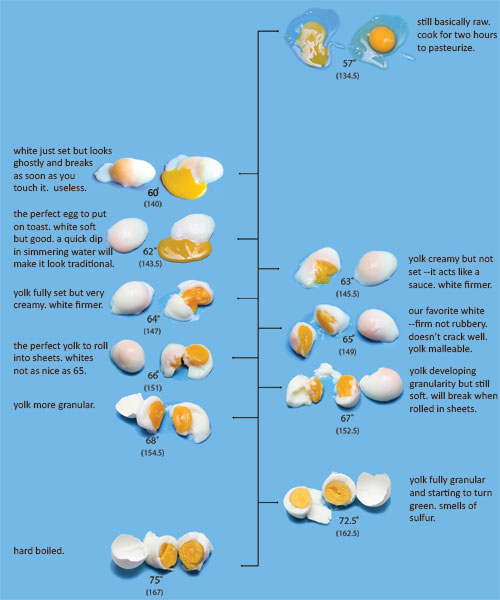
and we're just talking eggs here. your steak wont look like this either: https://d3awvtnmmsvyot.cloudfront.net/api/file/clFhHJTkRraOg...
this is about precise cooking, which yields very specific results
This is exactly what I'm talking about when I mention people intentionally making simple things difficult. Do you think someone, somewhere was sitting eating a hard (or soft, or variations thereof. Apologies if there was confusion on this) boiled egg and thought "Boy, this really is terrible. I sure wish it was..."? Do you think that was what yielded the invention of sous vide cooking? Are hard boiled eggs a current culinary problem?
No, they aren't. The argument borders on comical. Adding a "Duh!" to denigrate the notion that this is ridiculous easy doesn't prove your point. Further the steaks look absolutely vile (they look like texture monotony, which generally isn't a good result).
Sous vide came about in high volume kitchens. It wasn't because it yielded better results, but because it allowed for in-advance preparation, allowing the kitchen to toss little salmon meal baggies in hot water on spikes in orders, versus preparing it from scratch. It was a "traffic smoothing" technique, not an exercise for better results. In the classic "copy the chef" exercise, people emulated something for all the wrong reasons.
This is exactly what I'm talking about when I mention people intentionally making simple things difficult. Do you think someone, somewhere was sitting eating a hard (or soft, or variations thereof. Apologies if there was confusion on this) boiled egg and thought "Boy, this really is terrible. I sure wish it was..."? Do you think that was what yielded the invention of sous vide cooking? Are hard boiled eggs a current culinary problem?
No, they aren't. The argument borders on comical. Adding a "Duh!" to denigrate the notion that this is ridiculous easy doesn't prove your point. Further the steaks look absolutely vile (they look like texture monotony, which generally isn't a good result).
Sous vide came about in high volume kitchens. It wasn't because it yielded better results, but because it allowed for in-advance preparation, allowing the kitchen to toss little salmon meal baggies in hot water on spikes in orders, versus preparing it from scratch. It was a "traffic smoothing" technique, not an exercise for better results. In the classic "copy the chef" exercise, people emulated something for all the wrong reasons.
Yes, I do think that. Hard-boiled eggs are gross. Set egg yolks are gross. An egg white that is even slightly undercooked is also disgusting. There's a relatively narrow band of doneness in which eggs are good. You sound less like an advocate of simplicity and more like, as Dave Arnold would put it, "an enemy of quality". :)
A "six minute egg" has been a benchmark for literally centuries. Apologies if there is confusion, but when I say "hard boiled", I mean all doneness levels of boiled eggs.
Yeah, you're right about this. Honestly: I usually just fry eggs; I use the circ only when I need to serve a bunch of them.
> A "six minute egg" has been a benchmark for literally centuries.
That's just the name, it's never exactly six minutes because it depends on the cooking equipment, initial temperature of the egg, size, etc. The exact time is usually found after experimentation in one person's specific kitchen.
That's just the name, it's never exactly six minutes because it depends on the cooking equipment, initial temperature of the egg, size, etc. The exact time is usually found after experimentation in one person's specific kitchen.
Huh that steak pic can't be right? I'm pretty certain the range is 53C (rare) to 60C (medium-done). Unless my thermometer was way off, or maybe it's a sea-level thing? (I'm in NL, sea-level + first floor).
You can check it for yourself, there's a distinct difference in how it feels sticking your hand in water less than 50C and sticking it in water a few degrees hotter than that. That's because your body doesn't like it when its proteins start to denature, either :P
You can check it for yourself, there's a distinct difference in how it feels sticking your hand in water less than 50C and sticking it in water a few degrees hotter than that. That's because your body doesn't like it when its proteins start to denature, either :P
[deleted](1)
Hard-boiling an egg is trivial. Soft-boiling an egg, or making a perfect poached egg, is non-trivial; it's a finesse task. And doing it once or twice is one thing, but plating 10-20 for a bunch is another.
Also: your definition of "a perfect steak" is different from mine. You either like a little overcooked steak or a little undercooked steak (or maybe a lot of either), because you can't get uniform doneness in a cast-iron skillet and an oven.
Also: your definition of "a perfect steak" is different from mine. You either like a little overcooked steak or a little undercooked steak (or maybe a lot of either), because you can't get uniform doneness in a cast-iron skillet and an oven.
As I addressed in the other comment, yes, indeed, this is a technique built for traffic spikes. It is not a technique made for cooking breakfast.
As to steak, just to be clear (since there seems to be a lot of misinformation in here), the best New York City steakhouses grill steaks in a 1800 degree broiler. This is a heat that is difficult to obtain at home, so the sear+oven actually yields a wonderful, very uniform doneness. I suspect you've never tried it, have zero experience with it, but nonetheless pass judgment on it? Why is that?
As someone who has eaten the most expensive steaks, at the most expensive steak houses in the world, I think it's quite fantastic. I guess I defer to your judgment though?
As to steak, just to be clear (since there seems to be a lot of misinformation in here), the best New York City steakhouses grill steaks in a 1800 degree broiler. This is a heat that is difficult to obtain at home, so the sear+oven actually yields a wonderful, very uniform doneness. I suspect you've never tried it, have zero experience with it, but nonetheless pass judgment on it? Why is that?
As someone who has eaten the most expensive steaks, at the most expensive steak houses in the world, I think it's quite fantastic. I guess I defer to your judgment though?
At (steakhouse) restaurants sous vide is likely not used to cook expensive cuts perfectly. A good chef can do that in a pan+oven. The best cuts though imo aren't the expensive ones, it's the tougher ones that taste most. If you go to a restaurant and have a brisket cooked medium, that is so tender you can use a spoon, then it was likely done in a water bath over night.
That's a funny bit of message board aggression. Suggesting someone on a cooking thread about cooking steak that someone has never tried cooking a steak in a pan.
Recall that you were the one who first said that I am an "enemy of quality". Somehow on HN your smiley-disclaimed trolls -- posts that are almost always the "enemy of quality" -- get a pass. So yes, accept it as some aggression: When you dare pass judgment on my opinions in such a vapid, haughty way, expect a negative response.
I use a Sansaire, but have found that for "nice meat" I actually prefer a regular cooking in a grill pan to a perfect-all-through plus just seared. Not sure why, but it's likely something with the gradient of doneness that is a more interesting texture.
Where the sous vide shines I think is for cheap cuts such as pork belly or tougher game meat where you just can't simply sear until done but actually have to break down the meat overnight at target temp. Another perfect use is charcoal grilling for many people. Just throw a huge steak in the sous vide in the morning. Throw it on charcoal when guests arrive just for the flavor.
Where the sous vide shines I think is for cheap cuts such as pork belly or tougher game meat where you just can't simply sear until done but actually have to break down the meat overnight at target temp. Another perfect use is charcoal grilling for many people. Just throw a huge steak in the sous vide in the morning. Throw it on charcoal when guests arrive just for the flavor.
There are some secondary advantages to sous-vide prep, like being able to hold the finished steak at temperature until you're ready to serve.
I have had my Anova for just a little over a week, and I think this is missing something. Yes, the "sear then oven" technique gives you a good steak. The sous vide steak I made tonight is the best home steak I have had - more tender than the cast iron steaks I have done. It's also easier - I can make sides while the steaks cook in the water bath, and my window to get them out and still have them at the doneness I want is literally hours, whereas I have to precisely time when I I remove the steaks from the ocen to get the right internal temperature.
> And then, after you've had your perfectly cooked eggs that you presumably had to hop out of bed and rush to retrieve before they overcooked,
But they won't overcook. That's the point of sous vide. It heats the water temperature to a very specific point. The food will heat throughout until it's uniformly at that temperature. A few minutes extra won't make any difference because it's the temperature that determines the texture of the food (for most dishes), not how long it's been at that temperature[0].
Boiling water is 100 degrees Celsius and egg-white denatures at what, 40-45C? So your eggs will overcook, the sous-vide ones won't.
(edit: turns out it's more like 60-67C, before anyone runs out to try it based on my post, I'd have looked this up before trying)
> in your busy morning you're going to vacuum pack a steak? Seriously?
I never quite understood why it needs to be vacuum packed, actually. If you drop it in a plastic baggie, submerging into water will push the airbubbles out nicely.
> Or you can turn your oven to 200F. Toss a cast iron pan on your grilltop and sear at high heat, then move the whole thing to the oven. You'll quickly have a perfect steak without blowtorches or extended water bath time.
Ummmyeah... that would work. If you had gotten it right :) Steak goes into the oven first, cast iron skillet after (and then of course rest for five minutes before cutting it), and 200F is way too hot, that's like 93C, firmly beyond "well done" and into "shoe" territory. You can take it out before that happens obviously, but your steak won't be heated uniformly, in particular if you seared it before, you'll get an unnecessarily large transition layer (which the tough layer on the outside of a non-perfect steak) between the perfectly rare or medium inside (which is the part you want most of) and the brown crust outside (which you also want, but just for extra flavour and appearance).
It's just chemistry and physics.
> As with the soylent thing, it's like basic skills are now lacking so people looking for a lot of menial work to replace trivial undertakings.
I can accept the cynicism about the Soylent thing, but sous vide cooking is not just for "basic" cooking skills or to replace "trivial undertakings". Hey if you just want to cook a pretty good steak, go ahead and do that oven/skillet thing, mess it up like in your description if you like, because if you practice enough you'll get the timing just right and probably end up with a pretty damn good steak nearly all the time nonetheless. If you want a perfect steak, you want sous vide + blowtorch.
And in fairness, I do want to point out that a "pretty good" steak made from good quality meat will totally blow away a "perfect" (not) steak made from shitty meat (e.g. cheap frozen steaks). I tried and sous vide doesn't help at all. In fact overcooking it the traditional way might even help to cover up the shittyness. I do feel for the cow, whose life destiny was to end up as mere shitty frozen steak .. :-/
Anyway, in addition, the workflow of sous vide has a few benefits with regards to attention and timing. However I grant that certain traditional ways cooking can have other benefits. You may probably also take comfort in the assumption that people that invest in a sous vide machine really love cooking, and that for that reason they will probably invest in a good cast iron skillet first. Because if you love cooking you simply need one.
Finally, and I get a hunch you were thinking this but not saying it, I think the hacker / geek-factor of applying chemistry and physics concepts to the kitchen should not be dismissed either. It's a gadget with a thermostat and you even get to use a blowtorch after! You can quite easily build your own from basic electronic components (also check tropical fish aquarium supplies) and learn stuff about feedback control systems! You can experiment with crazy weird ways of preparing food! (what happens to cubes of marinated pork belly after 24 hours at ~55C for 24 hours is not just amazingly heavenly, but also impossible to achieve without sous vide) (try and find it at a restaurant if you don't care for the DIY, worth it).
[0] Now if you keep it at that temperature for more than a few hours, some "interesting" things may happen. Certain meats will become unnaturally tender (which may or may not be desirable), I dunno what happens to eggs though. This is presumably why he wants to set it to "refrigerate" for the large part of the night.
But they won't overcook. That's the point of sous vide. It heats the water temperature to a very specific point. The food will heat throughout until it's uniformly at that temperature. A few minutes extra won't make any difference because it's the temperature that determines the texture of the food (for most dishes), not how long it's been at that temperature[0].
Boiling water is 100 degrees Celsius and egg-white denatures at what, 40-45C? So your eggs will overcook, the sous-vide ones won't.
(edit: turns out it's more like 60-67C, before anyone runs out to try it based on my post, I'd have looked this up before trying)
> in your busy morning you're going to vacuum pack a steak? Seriously?
I never quite understood why it needs to be vacuum packed, actually. If you drop it in a plastic baggie, submerging into water will push the airbubbles out nicely.
> Or you can turn your oven to 200F. Toss a cast iron pan on your grilltop and sear at high heat, then move the whole thing to the oven. You'll quickly have a perfect steak without blowtorches or extended water bath time.
Ummmyeah... that would work. If you had gotten it right :) Steak goes into the oven first, cast iron skillet after (and then of course rest for five minutes before cutting it), and 200F is way too hot, that's like 93C, firmly beyond "well done" and into "shoe" territory. You can take it out before that happens obviously, but your steak won't be heated uniformly, in particular if you seared it before, you'll get an unnecessarily large transition layer (which the tough layer on the outside of a non-perfect steak) between the perfectly rare or medium inside (which is the part you want most of) and the brown crust outside (which you also want, but just for extra flavour and appearance).
It's just chemistry and physics.
> As with the soylent thing, it's like basic skills are now lacking so people looking for a lot of menial work to replace trivial undertakings.
I can accept the cynicism about the Soylent thing, but sous vide cooking is not just for "basic" cooking skills or to replace "trivial undertakings". Hey if you just want to cook a pretty good steak, go ahead and do that oven/skillet thing, mess it up like in your description if you like, because if you practice enough you'll get the timing just right and probably end up with a pretty damn good steak nearly all the time nonetheless. If you want a perfect steak, you want sous vide + blowtorch.
And in fairness, I do want to point out that a "pretty good" steak made from good quality meat will totally blow away a "perfect" (not) steak made from shitty meat (e.g. cheap frozen steaks). I tried and sous vide doesn't help at all. In fact overcooking it the traditional way might even help to cover up the shittyness. I do feel for the cow, whose life destiny was to end up as mere shitty frozen steak .. :-/
Anyway, in addition, the workflow of sous vide has a few benefits with regards to attention and timing. However I grant that certain traditional ways cooking can have other benefits. You may probably also take comfort in the assumption that people that invest in a sous vide machine really love cooking, and that for that reason they will probably invest in a good cast iron skillet first. Because if you love cooking you simply need one.
Finally, and I get a hunch you were thinking this but not saying it, I think the hacker / geek-factor of applying chemistry and physics concepts to the kitchen should not be dismissed either. It's a gadget with a thermostat and you even get to use a blowtorch after! You can quite easily build your own from basic electronic components (also check tropical fish aquarium supplies) and learn stuff about feedback control systems! You can experiment with crazy weird ways of preparing food! (what happens to cubes of marinated pork belly after 24 hours at ~55C for 24 hours is not just amazingly heavenly, but also impossible to achieve without sous vide) (try and find it at a restaurant if you don't care for the DIY, worth it).
[0] Now if you keep it at that temperature for more than a few hours, some "interesting" things may happen. Certain meats will become unnaturally tender (which may or may not be desirable), I dunno what happens to eggs though. This is presumably why he wants to set it to "refrigerate" for the large part of the night.
Boiling water is 100 degrees Celsius and egg-white denatures at what, 40-45C? So your eggs will overcook, the sous-vide ones won't.
This, along with the comments about cooking a steak (where you are simply wrong), seem to assume that when you put a cooler item in a hotter substance, boom, it's the temperature of the hotter substance. It turns out that reality doesn't quite work this way.
An egg, for instance, happens to not only have an insulative shell, it's a liquid with a very high level of heat conductivity. When you put an egg in boiling water, the inside heats at a relatively uniform rate, which is exactly how we have concepts like the 6 minute egg. It incidentally turns out that the yolk sets at a higher temperature than the whites, which is how people who want firm whites and a liquidy yolk can achieve their goals, traditionally by timing (boiling water at a given altitude is fairly consistent).
The similar concept applies to the steak. A quick sear at high heat (500F+) does almost nothing to cook the inside of the steak -- the heat differential is far too high for it to migrate far through the thick protein layers, but when put in the 200F oven the differential is so low that in that case it does have time to essentially "even out" slowly. You sear first primarily because a room temperature, salted steak sears far better and more quickly than a heated, steaming piece of meat.
No, you don't wait until the item is 200F. That is absurdity. Personally I use a remote meat thermometer but other people simply go by wisdom and time. Any notion that I have to have the external temperature match what I want the internal temperature to be is...well...it's just scientifically ignorant.
Exactly as you said, it is all science and chemistry. And you seem to be coming at this as if the steak is a piece of copper. Indeed, I think this whole "cooking better" infatuation of the tech community is an attempt to (much like with NoSQL and a desire not to bother with that old DB knowledge) essentially try to skip the whole learning the basics thing, and then to paradoxically try to pretend that one's knowledge is a step above. I've seen several comically wrong comments along this line now.
This, along with the comments about cooking a steak (where you are simply wrong), seem to assume that when you put a cooler item in a hotter substance, boom, it's the temperature of the hotter substance. It turns out that reality doesn't quite work this way.
An egg, for instance, happens to not only have an insulative shell, it's a liquid with a very high level of heat conductivity. When you put an egg in boiling water, the inside heats at a relatively uniform rate, which is exactly how we have concepts like the 6 minute egg. It incidentally turns out that the yolk sets at a higher temperature than the whites, which is how people who want firm whites and a liquidy yolk can achieve their goals, traditionally by timing (boiling water at a given altitude is fairly consistent).
The similar concept applies to the steak. A quick sear at high heat (500F+) does almost nothing to cook the inside of the steak -- the heat differential is far too high for it to migrate far through the thick protein layers, but when put in the 200F oven the differential is so low that in that case it does have time to essentially "even out" slowly. You sear first primarily because a room temperature, salted steak sears far better and more quickly than a heated, steaming piece of meat.
No, you don't wait until the item is 200F. That is absurdity. Personally I use a remote meat thermometer but other people simply go by wisdom and time. Any notion that I have to have the external temperature match what I want the internal temperature to be is...well...it's just scientifically ignorant.
Exactly as you said, it is all science and chemistry. And you seem to be coming at this as if the steak is a piece of copper. Indeed, I think this whole "cooking better" infatuation of the tech community is an attempt to (much like with NoSQL and a desire not to bother with that old DB knowledge) essentially try to skip the whole learning the basics thing, and then to paradoxically try to pretend that one's knowledge is a step above. I've seen several comically wrong comments along this line now.
Now you're just misrepresenting what I said.
You were the one who claimed that someone would have to rush out of bed before their sous-vide eggs overcook. My point is that just does not, can not happen with sous-vide because unlike hot boiling water (or an oven, with steaks) the environment of the eggs is exactly at the target temperature.
Now about your claims of uniformity and "evening out", I haven't cooked enough steaks in ovens to claim this from experience. But you can easily see on photo's of steaks the transition layer between the seared outside of a steak and the target-temperature cooked inside, it's the grey-ish part between the point and the red/pink. It's the chewy part. And it's way thinner if you look at sous-vide pics versus traditionally cooked steaks (suggesting it doesn't even out as much as you say, which to me isn't that surprising because there's no convection--same happens to pretty much every other food you put in the oven). Whether this is desirable is another question, I could agree I like that layer slightly bigger than in some of the sous-vide pics I've seen, because chewiness is yet another part of the experience. However, you can't uncook part of a steak, but you can always cook it a bit further.
With eggs, I can assure you, they are not cooked uniformly. I'm not talking about the yolk either. For the duration of soft-boiled eggs we're talking about here, I've seen big variations.
BTW I might not cook steaks sous-vide all the time (if I ate steak more often, which I don't, for reasons irrelevant here). That's in the first place because I don't have a machine and my DIY solution is kind of cumbersome. If I had one, then yes, for steaks or other cuts of meat (which are special occasion to me), I'd probably go sous-vide. Not because it's strictly better than the traditional way of cooking (from your posts I'm quite confident you can cook a delicious steak), but because I would be more confident that my steaks would come out perfectly if I did it that way. Because it's repeatable, straight-forward, not something you have to do mediocre a bunch of times before you can do it perfectly. It's not for lack of skill, either, but over the years my oven's changed, my pans changed, my gas stove, I'd have to recalibrate for all of that.
You were the one who claimed that someone would have to rush out of bed before their sous-vide eggs overcook. My point is that just does not, can not happen with sous-vide because unlike hot boiling water (or an oven, with steaks) the environment of the eggs is exactly at the target temperature.
Now about your claims of uniformity and "evening out", I haven't cooked enough steaks in ovens to claim this from experience. But you can easily see on photo's of steaks the transition layer between the seared outside of a steak and the target-temperature cooked inside, it's the grey-ish part between the point and the red/pink. It's the chewy part. And it's way thinner if you look at sous-vide pics versus traditionally cooked steaks (suggesting it doesn't even out as much as you say, which to me isn't that surprising because there's no convection--same happens to pretty much every other food you put in the oven). Whether this is desirable is another question, I could agree I like that layer slightly bigger than in some of the sous-vide pics I've seen, because chewiness is yet another part of the experience. However, you can't uncook part of a steak, but you can always cook it a bit further.
With eggs, I can assure you, they are not cooked uniformly. I'm not talking about the yolk either. For the duration of soft-boiled eggs we're talking about here, I've seen big variations.
BTW I might not cook steaks sous-vide all the time (if I ate steak more often, which I don't, for reasons irrelevant here). That's in the first place because I don't have a machine and my DIY solution is kind of cumbersome. If I had one, then yes, for steaks or other cuts of meat (which are special occasion to me), I'd probably go sous-vide. Not because it's strictly better than the traditional way of cooking (from your posts I'm quite confident you can cook a delicious steak), but because I would be more confident that my steaks would come out perfectly if I did it that way. Because it's repeatable, straight-forward, not something you have to do mediocre a bunch of times before you can do it perfectly. It's not for lack of skill, either, but over the years my oven's changed, my pans changed, my gas stove, I'd have to recalibrate for all of that.
http://www.fooducation.org/2011/02/6x-c-egg-or-opposite-boil...
Regarding the steak, the comparison made for steaks are often medium heat, pan cooked steaks. In that case the heat differential is high enough that it doesn't have time to somewhat equalize through the meat, but it is also low enough that it takes so long that you do end up with those really large layers. By quick searing at a high heat, and then cooking at a low heat, this layer is much smaller. Although personally I greatly prefer to have some of this layer (the disparity of textures is a big feature of it). Some people suggest doing the high heat searing on a frozen steak, of all things, and then moving to the over, but that's just unnecessary extra work in my opinion.
I appreciate where people want to pursue the science of food, but honestly it does very much seem like the nosql thing all over again -- skipping knowledge one doesn't have to do something perceived to be better.
Regarding the steak, the comparison made for steaks are often medium heat, pan cooked steaks. In that case the heat differential is high enough that it doesn't have time to somewhat equalize through the meat, but it is also low enough that it takes so long that you do end up with those really large layers. By quick searing at a high heat, and then cooking at a low heat, this layer is much smaller. Although personally I greatly prefer to have some of this layer (the disparity of textures is a big feature of it). Some people suggest doing the high heat searing on a frozen steak, of all things, and then moving to the over, but that's just unnecessary extra work in my opinion.
I appreciate where people want to pursue the science of food, but honestly it does very much seem like the nosql thing all over again -- skipping knowledge one doesn't have to do something perceived to be better.
Does anyone know who had this sous vide stick design first, this (Anova) or the nomiku(http://www.nomiku.com/)? It is possible that they both were designed in parallel but I would bet one came out before the other.
Could be wrong but I think the Sansaire came first. Their kickstarter finished in Sept 2013. https://www.kickstarter.com/projects/seattlefoodgeek/sansair...
The first Nomiku Kickstarter finished in July of 2012: https://www.kickstarter.com/projects/nomiku/nomiku-bring-sou...
Weren't they all evolved from the chemistry lab immersion circulators that sous-vide chefs originally used?
http://www.coleparmer.com/Product/PolyScience_Standard_Immer...
http://www.polyscienceculinary.com/sousvide-thermal-circulat...
http://www.coleparmer.com/Product/PolyScience_Standard_Immer...
http://www.polyscienceculinary.com/sousvide-thermal-circulat...
They just are what's being used in laboratories (or, at a larger scale, in industry) for keeping temperature. No need to evolve anything.
http://www.lauda.de/shop/en/temperiergerate/warme-und-kaltet...
Probably my family will complain if I bring the huge Lauda cooler/heater from the lab to the kitchen, though...
http://www.lauda.de/shop/en/temperiergerate/warme-und-kaltet...
Probably my family will complain if I bring the huge Lauda cooler/heater from the lab to the kitchen, though...
If you'd like your perfectly-cooked steak in 20 minutes, not 2 hours, try Pantelligent (note: co-founder). Video here: https://www.kickstarter.com/projects/hevans/pantelligent-int...
Unlike sous-vide cooking, Pantelligent is not limited to things you can cook in a plastic bag, doesn't take forever to get to steady-state temperature equilibrium, and most sous-vide recipes encourage you to finish in a pan anyway!
Instead, the Pantelligent app helps you control transient time & temperature profiles. The recipes adapt automatically just like a real chef would (for example, extending the cooking time a bit if the temperature is a bit too low). And the results are delicious, every time.
Unlike sous-vide cooking, Pantelligent is not limited to things you can cook in a plastic bag, doesn't take forever to get to steady-state temperature equilibrium, and most sous-vide recipes encourage you to finish in a pan anyway!
Instead, the Pantelligent app helps you control transient time & temperature profiles. The recipes adapt automatically just like a real chef would (for example, extending the cooking time a bit if the temperature is a bit too low). And the results are delicious, every time.
I saw the scallops demo[0], and it looked like a ton of fun. Obviously haven't had a chance to try it yet, but it looks like a great execution of a simple, but brilliant idea.
Looking forward to seeing where you go with this - there are some obviously cool next steps.
[0] https://www.youtube.com/watch?v=ScLOkv0ly9g
Looking forward to seeing where you go with this - there are some obviously cool next steps.
[0] https://www.youtube.com/watch?v=ScLOkv0ly9g
Oh cool, you found that! Yes, we had some messages asking for a full, un-cut cooking session, so you can see how the whole Pantelligent system works together, so we recorded the iPhone screen over Airplay and just made an 8-minute-long scallops video!
seems legit...
This looks like a PTFE pan on which you are searing ingredients, in one demo bringing the whole pan close to 400f. Isn't that dangerous? Also: counterproductive? There's a reason serious cooks tend to use non-stick pans solely for fish and eggs, right?
Also: what are the ingredients you're thinking of that are difficult to cook in a circulator?
Also: what are the ingredients you're thinking of that are difficult to cook in a circulator?
Pasta carbonara? Scrambled eggs? Mushroom risotto? Grilled cheese? Pancakes? Stir fry?
Most non-stick pans will just tell you "don't overheat the pan", but you've got to guess where that line is; Pantelligent actually knows the temperature, and the app can warn you if you're heading into dangerous territory.
Most non-stick pans will just tell you "don't overheat the pan", but you've got to guess where that line is; Pantelligent actually knows the temperature, and the app can warn you if you're heading into dangerous territory.
thanks for the self promoted informercial, but you may want to keep positioning as a companion to a sous vide machine, not as better than.
yours is a very different product that does not produce the same output as a sous vide solution.
ex: trying cooking a hard boiled egg to specific consistency, or a delicate piece of fish to the same consistency and internal temperature (with no searing) in the pantelligent. hell, even in the steak example, you cant get sear to sear pink when the high heat is coming from the searing edge.
wake me up the the pan can tell the stove to manage/adjust the heat automatically.
ex: trying cooking a hard boiled egg to specific consistency, or a delicate piece of fish to the same consistency and internal temperature (with no searing) in the pantelligent. hell, even in the steak example, you cant get sear to sear pink when the high heat is coming from the searing edge.
wake me up the the pan can tell the stove to manage/adjust the heat automatically.
Fish is absolutely great with Pantelligent; in fact, salmon is probably my #1 favorite.
Eggs (not specifically hard boiled -- huh?) are really excellent too. Low temperature scrambled eggs, omelettes, higher temperature fried eggs. It's a pan -- really versatile.
Eggs (not specifically hard boiled -- huh?) are really excellent too. Low temperature scrambled eggs, omelettes, higher temperature fried eggs. It's a pan -- really versatile.
i guess you didnt understand my point. you do not obtain the same result in a pan as you do via sous vide. one does not replace the other.
have you ever used a sous vide machine? if you had, you'd probably better understand the point im making.
have you ever used a sous vide machine? if you had, you'd probably better understand the point im making.
Yup, I have a sous vide setup. I don't use it. It's neat to do the eggs once or twice. I don't find it to be practical.
@compumike impractical... kinda like crapping up the posts comments about a completely different product.
please tell me how the product you're hocking can 'practically' cook a rack of ribs, brisket, or a roast.
or how about cooking/holding more than one serving at once? it cant.
we get it, you want your pantelligent product to take off. but saying it can do everything the sous vide does, just better/faster, is not accurate and comes off extremely biased.
you dont need to reply. you seem to like avoiding response to pertinent points and instead fall back to how great everything is re: pantelligent.
please tell me how the product you're hocking can 'practically' cook a rack of ribs, brisket, or a roast.
or how about cooking/holding more than one serving at once? it cant.
we get it, you want your pantelligent product to take off. but saying it can do everything the sous vide does, just better/faster, is not accurate and comes off extremely biased.
you dont need to reply. you seem to like avoiding response to pertinent points and instead fall back to how great everything is re: pantelligent.
You're the first person who (a) evidently cooks a lot and (b) has a water bath setup that I've ever seen call it "impractical". It is vastly more practical than a smart frying pan; among other things, it cooks unattended, the same way a crock pot does.
it also controls the temperature. The pan doesn't. You also don't have to do much to clean up after, just throw the ziplock bags away. With this pan you (should) hand wash it. The pan itself isn't even close to being similar in the same class of build quality to that of a $50-$100 non-stick pan. The pan also doesn't work with induction cooktops.
I said this in another discussion, but I think this is a $200 fish cooker. I don't see the convenience. Not being able to work above 400 means you simply can't cook some things to the quality they deserve, like with steak- you can't get an amazing crust.
There are good reviews- but there aren't any reviews that say "I've been a cooking professionally for XX years and I think this is a game changer". You do, however see that in articles for consumer sous vide devices.
I said this in another discussion, but I think this is a $200 fish cooker. I don't see the convenience. Not being able to work above 400 means you simply can't cook some things to the quality they deserve, like with steak- you can't get an amazing crust.
There are good reviews- but there aren't any reviews that say "I've been a cooking professionally for XX years and I think this is a game changer". You do, however see that in articles for consumer sous vide devices.
Do you have a patent on this? Hopefully! I can see a big brand wanting to have a stove top that auto regulates the temperature for you so it stays at the perfect temperature exactly leaving your job only to place and flip
Patent pending. Thanks!
s/big brand/consumer ftfy
the technology should be in the stovetop/hotplate burner, not the pan, IMO.
the technology should be in the stovetop/hotplate burner, not the pan, IMO.
This looks like a great idea! Ideally though, with electric hobs, I'd like to be able to set the temperature on the hob and then have the pan kept at the correct temperature automatically(with the thermometer still in the pan not the hob).
Why not simply let the factory do it for you? I foresee a market for prepared sous vide meats that are sealed well enough to store for weeks or even months on the shelf. Goodbye salmonella. From what I've read, this is how restaurants are already doing it.
There's enough evidence that plastics leak harmful chemicals into our food that I don't want to eat anything that's been sitting in a plastic bag in warm water for hours on end. No thanks.
Not eating out, in your case? I'm no industry insider but from what I hear sous vide )and therefore plastic) is rampant.
Sous-vide isn't that prevalent in the mass-market chains, but what is used is the technique of preparing the bulk ingredients in a central kitchen, vaccuum sealing in plastic and then transporting to the stores.
The stores then rewarm the food in a hot water bath before serving. This technique enabled a chain like Taco Bell to drop all cooking in-store. It also raised their average sanitation scores since the risk of undercooked food is practically nil.
Even the beloved Chipotle prepares some stuff offsite, like the barbacoa and carnitas.
The stores then rewarm the food in a hot water bath before serving. This technique enabled a chain like Taco Bell to drop all cooking in-store. It also raised their average sanitation scores since the risk of undercooked food is practically nil.
Even the beloved Chipotle prepares some stuff offsite, like the barbacoa and carnitas.
Ziploc bags are made of polyethylene and have no plasticizers. They are as safe as you can get with plastic.
[deleted]
You can also use a beer cooler or other thermo-isolated container, filled with hot water at the correct temperature (kitchen thermometer), and a bunch of plastic baggies (plus something clever with tape).
It's not quite as set-and-forget as a real sous-vide machine, you need to readjust the temperature (measure, adding more hot water, and stir a little, measure) about every 20 minutes or so (depending on the volume of water, obviously).
You need to know what you're doing, but I've gotten really great results with this DIY method :)
It's not quite as set-and-forget as a real sous-vide machine, you need to readjust the temperature (measure, adding more hot water, and stir a little, measure) about every 20 minutes or so (depending on the volume of water, obviously).
You need to know what you're doing, but I've gotten really great results with this DIY method :)
I have used this method before and it works great. It is really useful for large parties where you are not sure when everyone will want to eat. Just throw everything in the cooler (heater I guess) and when everyone says let's eat throw everything on the bbq for a couple of minutes to sear.
Agreed, but if you did it right (that is, heat the meat through and through at the correct temperature[0]), really you shouldn't sear it for more than 15-20 seconds on both sides. The meat is already done, searing is just for the Maillard reaction creating a browned crust on the outside, adding flavour. Any additional heating beyond that just increases the size of the transition between (hot) brown crust outside and (less hot) perfectly done meat inside, and it is that transition layer that makes a steak tough. Which is exactly the (somewhat) hard thing about cooking a proper steak, the very thing you're trying to solve with sous vide.
That is the reason why they sometimes attack a sous vide steak with a butane torch. It's not only because it's cool :)
[0] 53 degrees Celsius is for rare steak. Rare should not be "undercooked" (flesh proteins denature at about 50C) and with sous vide you can make sure this is indeed the case.
That is the reason why they sometimes attack a sous vide steak with a butane torch. It's not only because it's cool :)
[0] 53 degrees Celsius is for rare steak. Rare should not be "undercooked" (flesh proteins denature at about 50C) and with sous vide you can make sure this is indeed the case.
By a couple of minutes I meant ~60 seconds a side - basically just leave it on long enough to get the level of Maillard browning my guests like. This is one of those things that helps to have all the guests crowd around while you do this as they can then tell you when to take it off the grill. Yum!
If you have a rice cooker, you can make some incredible fall off the bone slow-cooked ribs.
Recipe:
1) toss in ingredients
2) hit the cook switch
3) leave it till the next evening and enjoy
It's basically a slow cooker, but you might already have it if you cook lots of rice at home
Recipe:
1) toss in ingredients
2) hit the cook switch
3) leave it till the next evening and enjoy
It's basically a slow cooker, but you might already have it if you cook lots of rice at home
Is there a mirror or anything?
ChefSteps.com has a great introductory class to sous vide for those curious to experiment, but not foolish enough to spend a bunch of money on expensive equipment. I just cooked salmon this past week following their poor man's method and it came out great.
I almost bought one, but no API makes these way less awesome.
[0] http://cookmellow.com/meet-mellow/