Yes, and I still would prefer that over Android. There are some ugly parts, especially if you're not used to writing C, but it predates Android by decades and is extremely stable.
> Java vs C++, meh, I think the main idea is that Java is a better language for most people than C++.
That doesn't make Java it a good choice for a foundation. C++ wouldn't be a good choice either. The right choice is something like C. The 99% of programmers that never touch C still rely 100% on the 1% that do.
> Low-power is kind of a bad argument and pre-mature optimization without real metrics.
There's no such thing "pre-mature optimization" when rolling out a major software platform. You can't fix fundamental performance issues after-the-fact.
The first Android devices were borderline unusable, because of too little RAM. Today, Android devices have twice as much RAM as iOS devices, and generally poorer battery life. Fast garbage collection requires twice as much RAM. RAM uses battery. All of that was entirely predictable.
There is no better term for it and rasterization is a good term.
In rasterization, the raster plays a crucial role at every step of the process. The detection of overlapping objects happens at the raster level (Z-Buffer). The shading happens at the raster level. The raster is used to for texture derivatives.
By contrast, the result of a raytraced image may be a raster image, but the raster doesn't have to play a role during image synthesis, all the sampling can be done oblivious of an image raster. You could technically store samples without a raster grid and create images from those samples at various raster resolutions.
That's not possible, because the situation we have today is that proprietary APIs (D3D, Metal, CUDA) are pretty stable, whereas open APIs (OpenGL, Vulkan, OpenCL) are buggy or unsupported.
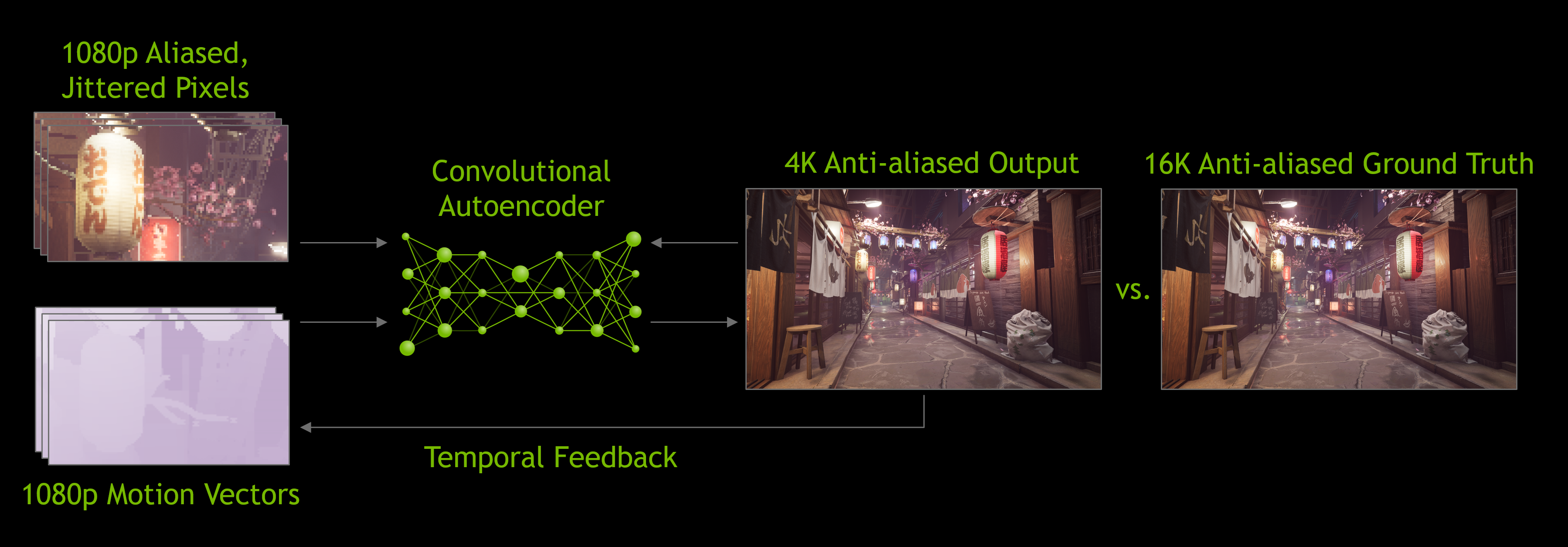
In contrast to DLSS1, the output of the NN is not color values, but sampling locations and weights, to look up the color values from the previous low-resolution frames.
A few years ago, I managed to build XRDP with RemoteFX enabled. This was the smoothest remote desktop I have ever experienced.
I couldn't replicate it a while later after an OS upgrade and I have since given up on it. Does anybody else have experience with this? Should I give it another try?
Yes, and I still would prefer that over Android. There are some ugly parts, especially if you're not used to writing C, but it predates Android by decades and is extremely stable.
> Java vs C++, meh, I think the main idea is that Java is a better language for most people than C++.
That doesn't make Java it a good choice for a foundation. C++ wouldn't be a good choice either. The right choice is something like C. The 99% of programmers that never touch C still rely 100% on the 1% that do.
> Low-power is kind of a bad argument and pre-mature optimization without real metrics.
There's no such thing "pre-mature optimization" when rolling out a major software platform. You can't fix fundamental performance issues after-the-fact.
The first Android devices were borderline unusable, because of too little RAM. Today, Android devices have twice as much RAM as iOS devices, and generally poorer battery life. Fast garbage collection requires twice as much RAM. RAM uses battery. All of that was entirely predictable.