In a marketplace model (e.g. ebay, airbnb, amazon, seamless / any food delivery), the take rate generally falls between 10%-20%.
Credit card processing fees are somewhere around 2% - 3%, so in a marketplace with all credit card transactions, impact on margin will be 6% - 30%.
If that marketplace can implement alternative payments (e.g. ACH, bitcoin, etc), impact on margin can get down below 5%. Not sure how the ebay / paypal integration influences this - would be interesting data.
One additional method to reduce margin for marketplaces is to allow transactions to occur offline and then invoice the seller based on a % of the total amount. Then your impact on margin will be exactly what your processing fees are.
There will be much different dynamics for different revenue models (e.g. as patio11 said, in SaaS, it is basically irrelevant).
So, I argue that % impact on margin is not a very useful metric unless you are comparing a specific revenue model in a narrow vertical.
Would you rather have $10B of margin with 50% going to processing fees or $1M of margin with 0% going to processing fees?
Great looking site and clear focus, but your Facebook Connect permission requirements caused me to give up before trying your product!
Getting past the home page requires connecting with facebook and providing the following info:
Your basic info
Your e-mail address
Your birthday
Your relationship status
Your photos
Friends' birthdays
Photos shared with you
This app may post on your behalf, including status updates, photos and more.
I suggest you allow me to browse more of your site while not logged in, limit the initial permission request to just my basic info + email, and/or provide alternate login method.
First, this is great. The Bootstrap Sprites definitely need some love and this is a solid forward step.
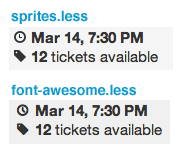
I am close to dropping in Font Awesome, but the small font sizes really need work. Here is a comparison screenshot of the standard bootstrap sprites vs font awesome sprites in Chrome on Mac: https://s3.amazonaws.com/gusta/sprites-less-vs-font-awesome-...
Again, awesome work. Font Awesome is on my short list to use once it's cleaned up a bit.
A couple of years ago, I spent Thanksgiving with a friend and the first thing he warned was, "My family does not drink alcohol!". Interesting... I am accustomed to intoxicated family parties, but on that specific Thanksgiving, 20 of us drank tea and ate turkey. It was pleasant.
After dinner, his father (a Doctor, along with 80% of the family) shared his views about alcohol, predicting that in one generation alcohol will be socially rejected the way tobacco is today because of how utterly destructive alcohol is to the human body.
Remember! Just 50 years ago, the majority of the United States had no problem with cigarettes.
I still drink, along with almost every adult I know, though I cannot help but think that my friend's dad is right.
Given a lump sum of cash and annual withdrawal of a certain percentage of that cash (3% per year is safe, 4% is pushing it, 5% is a sure way to lose your money), you would need the following amounts of money to pay yourself $50,000 per year:
$1.67 Million @ 3% (1 / .03 * 50,000)
$1.25 Million @ 4% (1 / .04 * 50,000)
$1.00 Million @ 5% (1 / .05 * 50,000)
Put another way, if you have X Million, how much could you safely withdraw each year at 3% per year?
$1M: $30k / year
$2M: $60k / year
$3M: $90k / year
$10M: $300k / year
Keep in mind you will pay tax on these figures (15% Long Term Capital Gains tax if you're lucky, or more if it's regular income). And this does not account for inflation, so assume the value of money gets cut in half every 25-30 years.
Entering the Airbnb for dogs market might face competition from entrenched players, as a whois search shows that Airbnb CEO Brian Chesky already owns dogbnb.com
From Mistake 10: "People interested in local events (that one is a perennial tarpit)". Would you please give an example or elaborate a little bit more on that?
From the first article, "Some of the highest-profile pop-ups involve established chefs relocating to summer quarters." - Agree there is a movement of DIY'ers starting these. I just acknowledge that there are two separate entrance points into the market. One, established chefs who create the highest quality food. And Two, DIY'ers where you don't know what you're going to get. From the article, "food at these instant restaurants ranges from quasi-student to haute cuisine."
There is a similar difference between Vacation Rentals & Hotels, but I expect both establishments to make money for a long time.
Thanks for the mention (I'm Chris from http://www.gusta.com and previously Airbnb). I do think a distinction should be drawn between "an Airbnb for food" (where regular people are cooking for strangers) and the established "pop-up" movement, often hosted by professional chefs. The first is a social site with a payment layer and the second is a ticketing site with a social layer.
Longer term, I think both models can coexist as they are approaching the industry from opposite ends. "Legality" is going to be an issue for any disruption in the food market - dealing with that is the cost of doing business. Personally, I hope Gusta gets to a point where people care enough to want to regulate us :)
Hey Guys - I'm the non-Carly co-founder of Gusta. Before co-founding Gusta, I was an engineer at Airbnb for ~1.5 years. I loved it there. Leaving was a tough decision, but starting my own company is so far awesome!
Any feedback about www.gusta.com is much appreciated.
Credit card processing fees are somewhere around 2% - 3%, so in a marketplace with all credit card transactions, impact on margin will be 6% - 30%.
If that marketplace can implement alternative payments (e.g. ACH, bitcoin, etc), impact on margin can get down below 5%. Not sure how the ebay / paypal integration influences this - would be interesting data.
One additional method to reduce margin for marketplaces is to allow transactions to occur offline and then invoice the seller based on a % of the total amount. Then your impact on margin will be exactly what your processing fees are.
There will be much different dynamics for different revenue models (e.g. as patio11 said, in SaaS, it is basically irrelevant).
So, I argue that % impact on margin is not a very useful metric unless you are comparing a specific revenue model in a narrow vertical.
Would you rather have $10B of margin with 50% going to processing fees or $1M of margin with 0% going to processing fees?