I agree this feature would make for an even more enlightening experience. Color/shade the highlighting as a function of its total lifetime on the screen. Words that are typed and deleted immediately after are the darkest yellow, words that live longer (like until the 2nd editing pass) are a lighter yellow, words that survive to the final remain white.
(deleted and moved here because it messed up the post order)
Ooh, ooh, and one more thing...
12. Advance your skills at all times [...] It's hard to say what will be popular in the software industry in ten years, but I can guarantee it won't be esoteric Anime.
At the risk of sounding even more juvenile than in my previous rebuttals: fuck that. I know that "anime" here is just an example of any "time-waster" that "professionals" like to hate on, as if every second of every day has to be scheduled in advance and accounted for or else... or else... chaos!
How about we don't just develop as worker bees but instead as human fucking beings? Saying "don't watch anime" is barely different from saying "don't read books" - it's the quality of the content that matters. I've gotten more out of Tengen Toppa Gurren Lagann than The Bible because the protagonists in those stories remind me to keep pushing past my limits, whereas the other work of fiction would instead as us to give in and accept our lots in life.
Whether you're Randy Pausch or Bob McBurger-flipper, our lives are ending one second at a time. Let's use that time wisely, sure. But let's also enjoy ourselves. I prefer my anime, books, wine, women, ...life to be the most interesting the most often. Whether that means reading The Little Schemer to expand your mind or lying in a field eating mushrooms to expand your mind, it's not for me to judge. So don't be hasty to write off the computer nerds who like anime.
I'd rephrase this to "know thyself". If you know you tend to show your anger/depression/lecherousness when drunk, maybe it wouldn't be such a great idea. Working for companies big and small in the past, I personally enjoyed every opportunity to go out boozing with buddies or bosses. I'd argue that several of the 33 lessons can be checked off at once this way; the idea is comical enough to me (a high-functioning alcohol aficionado), I'm going to spend the rest of the post on it:
>1. You’re not smarter than anyone
Nothing like the ancient bonding ritual of drinking until you can't stand straight to bring about the status equilibrium. But it will give you the chance to mention the stuff you have done right that might not have gotten the attention you'd hoped (10. Toot your own horn). "Well, Bob, writing that script last week was easier than walking right now."
>2. There is such a thing as a stupid question
And several of them will pour out during the bar-crawl. This is good because you have an excuse to talk frankly with one another. This ability to communicate without fear of reprisal is so important, it's a part of the lifestyle of Japanese salarymen. Afterwards, all is forgiven/forgotten because, hey, you were drunk. This means whichever you're going for (16/15. Do/Don't be a yes man), you can feel comfortable in being honest.
>3. Looks matter
This pretense falls apart when the top officers of a successful company are joyously murdering their favorite karaoke songs because their brains are too soaked to simultaneously read the words and produce the sounds they represent. It's an ugly reminder of the beautiful truth that, no, your looks and performance are independent variables.
>4. Know what you know and what you don't know
And take advantage of this opportunity to ask the important questions. Not banal, "8. Have a presence", "I'm here too, remember?" small-talk. You can learn the most fucking important information about your work (and thus, life - depending on how you look at it) by splitting a bottle with your boss. This is so important, I'm going to type "fucking" again.
At my entry-level position at my last job, I knew as much as the top managers - possibly more, if you consider that the other people "playing it straight" won't tell the executives what they don't want to hear, but will happily vent their frustrations to you (7. Listen to people, 9. Archive Everything you can, 31. Find out what you like and don't like about your job).
Bonus: when people are complaining, they're telling you how to win their hearts (11. Help others and they will help you). When they're drinking and complaining, it's more likely to be truth and not mere politicking.
>11. Help others and they will help you
Nothing builds camaraderie like holding your manager's head over the toilet and fetching him some water (or whatever the situation happens to be - searching for the house keys under a desk or the managing director, incidentally, under a desk). Improvise ways out of the adverse situations resulting from the group's drunken antics (30. Do the best you can with what you have).
I am mystified by the social ritual of drinking and continue plunging into it in hopes of better understanding it, but the strongest personal - and consequently, professional - bonds are forged in the fires of irresponsibility (24. Learn to work in a team).
If anyone has recommended reading on this phenomenon, please do share!
>18. Make Friends
>19. Have Fun
>20. Know when to put in the extra hours
>21. Don't get too comfortable
>26. Make your job enjoyable
>27. Take Breaks
>28. Be A Cool Guy
All apply directly.
I realize a lot of this will sound ludicrous, immature, illogical, terrifying and so on, but anyone who's taken part in school life and business life will have no trouble observing that these adjectives can apply to both. I don't want you to get shitfaced and stumble through the datacenter, tripping on wires and unplugging them before drowning in a puddle of vomit. I do want you to step out of your comfort zone, arrange where you can share more than a few drinks with your boss, learn about your company through his eyes, and better yourself as a result of it.
In the context of HN, I would re-title this article: "33 reasons to start your own company!" In the context of this post, I would re-title it: "32 reasons why reason 32 is bullshit."
Reading this, I was immediately reminded of why I couldn't wait any longer to start my own company. As others have mentioned in the thread, many of these 33 lessons are spot-on ...unfortunately. (I don't want to sound like I'm criticizing the author - it's well-written and concise, and he's certainly achieved the composition skills his boss had hoped.)
Some of lessons compared to working for yourself:
>1. You’re not smarter than anyone
Unfortunately, we're "smarter" than our users in that we over-estimate their comfort with our service. The majority of users are not necessarily computer-literate or used to the modern computing idioms Westerners take for granted. (My company is in a developing African nation, operates over SMS, and every day we're surprised at how many users misunderstand what we wrongly assumed to be simple instructions. Example: "SMS 'en' for English. SMS 'fr' pour le Francais." and we receive an SMS containing "[our-product name] fr". Gah, wasn't prepared for that!
>3. Looks matter
Like most things in life, "it depends." When I'm working in my underwear, no they don't. When I'm going out to recruit new users, I'll groom/dress in a way that's likely to appeal to that specific demographic du jour. I'm young, which scares some people (the kind of conservative, MegaCorp lifers who'd normally agree 100% with this article) because young == inexperienced. Ok, so I don't shave for a while before planning to meet them. +10 to age perception, "maturity" unlocked.
#4's brains are splattered on the wall, and bad_user is holding the smoking gun. Well said, amigo. The advice I've taken from HN on this matter is simply "fake it 'til you make it". HOWEVER, being a short phrase, it's prone to misinterpretation. It doesn't mean lie about what you can do. It does mean when I'm negotiating with veteran suits I should try to remain calm and collected, like I have some clue what I'm doing (I don't, but if you can't believe in yourself, how the hell is your client supposed to?).
>6. Software’s primary function is to earn profits
Nah, it's about making the users of your software happy. This way, the advice applies whether the software is FOSS or commercial.
Luckily for them, they might benefit from having a "business" Internet link as opposed to a "home" one.
Before going to China, I decided to set up a server I could securely tunnel my browsing through. There are many commercial VPN solutions, but I didn't want to pay, and the free options are the first to be blocked. (Though it is an arms-race, and those services are still often usable.)
While in China, the SSH tunnel worked well to provide access to blocked sites such as Facebook, Wikipedia, and (for some unfathomable reason at that time) Python.org. However, I began to notice that while in my apartment, the connection would periodically close. I thought it was due to high latency or some automatic timeout, but it happened consistently enough to be noteworthy.
I took my laptop into work (a building with offices, a private school, and a bank) and tried the same SSH command, and to my surprise, I couldn't reproduce the problem. Later, back at home, I re-ran the same SSH command and browsing habits and I was disconnected within 10 minutes or so.
While China wants to control people's access to information, the government also understands the need for businesses to function well. This is why I suspect that residential connections are more heavily monitored and filtered - even if it's all automatic.
After all, why would a model citizen require a persistent encrypted connection to a server in the US?
[Reminder: this is only one out of a possible billion-or-so anecdotes, so it might not be best to draw conclusions about ALL of China from it.]
These points have merit, yet I know of at least one pioneering effort that was successful: The "Higher Cracking University" or +HCU for short. It ceased functioning a long while back, but at that time it didn't just meet, but far surpassed the expectations of online learning described in these comments.
Here you had a community that
- spent years simply learning
- shared their knowledge (for free!) in essays, email, and forum discussions
- maintained a level of intelligence in incoming classes by use of strainers (reversing assignments such as http://www.woodmann.com/fravia/strain99.htm)
- never needed to meet in person to contribute these great works
It can be done, but perhaps the question is, "why haven't we seen more of these in the wild?"
From the article:
"Learning From Bad Things That Happen
Bad things happen to everyone, sometimes because of what we do and sometimes with help from us. We all have bad bosses, bad staffs, impossible and hopeless situations, impossible tasks, and unintended consequences. Aside from the trouble these bad things cause for you, the key is how can you learn from each of them.
Learning From Bad Situations
All of us will find ourselves in bad situations from time to time. Good intentions gone bad. Impossible tasks and goals. Hopeless projects. Even though you probably can’t perform well, the key is to at least take away some lessons and insights. Was there anything ironic, odd, or downright funny in all of this?"
Hmm, the Internet Explorer team wrote this? At least they've proven their "Level 1: Basic" proficiency by being able to laugh at themselves and their hopeless predicament.
I highly agree with the notion that one shouldn't deny one's weaknesses, and instead try to turn them into strengths (as raheemm and joshkaufman have written in this thread). This question, "Are you an information addict?" came at an opportune time, as I just finished reading this gem from Neil Postman, titled "Informing Ourselves to Death."
The talk looks at disruptive technologies, but points out that there are "losers" as well as "winners" when these emerge, and proceeds to explain why information has become nearly meaningless. His conclusions are in direct conflict with what I imagine many people here believe about the boon computers and information have provided to the world, but his argument is an interesting one, and hopefully it will challenge the way you think about this "Information Age."
In addition to providing the original footage, WikiLeaks appears eager to directly combat the misinformation sown by the U.S. government since the incident took place. My guess is that they wanted to refute the official reports step-by-step to maximize the impact of their leak, and so that there would be little chance of it being swept under the rug by yet another official denial.
Yes, it may come off as propaganda, but why would WikiLeaks want to do all of the hard work acquiring the video, decrypting it, and bearing legal repercussions from releasing it only to have the other major news organizations do the analysis and reap the rewards? WikiLeaks is in need of cash, so there's an incentive for them to provide the full report; and additionally, they do seem to be motivated by a sense of justice, so why entrust the same old news media who might not give it the attention it deserves?
I've noticed a certain anti-intellectualism going around this country; since about 1980, oddly enough. … I was in Nashville, Tennessee, and after the show I went to a Waffle House. I'm not proud of it, but I was hungry. And I'm sitting there eating and reading a book. I don't know anybody, I'm alone, so I'm reading a book. The waitress comes over to me like, [gum smacking] "What'chu readin' for?" I had never been asked that. Not "What am I reading?", but "What am I reading for?" Goddangit, you stumped me. Hmm, why do I read? I suppose I read for a lot of reasons, one of the main ones being so I don't end up being a fucking waffle waitress.
I'll agree with nickpp to a point: that happiness is transient, and that one cannot appreciate happiness without having suffered (however much or little - it's all relative, it's all in your head).
Having dabbled in Zen Buddhism, I don't like the thesis that life is suffering and to escape it we need to do away with want. If you want to be an emotionless zombie, sure, to each their own. But I now think that this tendency to deign "happiness = good; sadness = bad" and MINIMAX our lives is a huge disservice to our humanity. Hey, we're humans trying to make sense of a senseless world, and we're all on this crazy ride together. I'd rather collect experiences - happy AND sad - to remind myself that I'm alive, that I'm an emotional being, and so that I can appreciate others' experiences as well.
I'm much more fond of this take on happiness:
"The deeper that sorrow carves into your being, the more joy you can contain. Is not the cup that holds your wine the very cup that was burned in the potter's oven? And is not the lute that soothes your spirit, the very wood that was hollowed with knives?" -Kahlil Gibran
It's all in the mind. Framing is essential. As you've worded it, "[I need to] buckle down and start working" sounds like the beginning a painful trek that anyone would try to avoid. Instead, thinking about the exact same thing as "[I] finally have the chance to play with this interesting problem" will do wonders for self-motivation. As others have mentioned, it's not something that changes overnight, and requires daily practice.
Now, I can already hear the little voices whispering in a few of your heads "that's some optimistic bullshit, lying to yourself, etc." If you've read Self-Discipline in 10 Days, this nagging is said to come from a part of your subconscious dubbed "Hyde." Here's a brief description from the book:
=== BEGIN ===
This Jekyll/Hyde approach is one of the more important
concepts to understand in your attempts to develop self-
discipline. Time and time again, participants in my workshops, seminars, and courses have reaffirmed that this concept, understanding it and applying it, has been instrumental in their self-discipline successes. So, you will begin by learning about how your personal Hyde operates.
Hyde believes:
If I begin a structured, organized journey toward any
chosen goal:
- I'll become a slave to routine
- I'll lose my freedom
- I'll lose my sense of fun
- I'll drown in a sea of responsibilities
- I'll put too much pressure on myself
We all have a rebellious side to our personalities that resists any form of structure. We bring this rebellious seed from our childhood. One of the first words a child learns to say emphatically is "NO." The child we once were still lives inside us, and every child battles authority. Hyde, the name we will call your inner childlike rebel, battles any form of authority, even if the authority is you. Hyde subconsciously says: "Nobody can tell me what to do, not even me."
=== END ===
I find that similar to the framing-work-tasks-as-WoW-quests mentioned above, if I can tell myself that my projects are fun (and it helps if they are, which is why I code as a hobby), I'll be eager to get cracking. That childish Hyde character is still out for a good time, and mine still enjoys solving puzzles if he thinks it'll be fun. A good litmus test is to try and explain what you're doing to a non-techie. If you want to energetically share the details of your project, you're doing something right! If you'd rather not discuss it because it's "boring" or "work"... well, it's obvious where your procrastination stems from.
The blog author left out the one-stop-shop for tracing: the ISP. If your upload (comment/image/etc.) draws some heat, and your IP address is listed in that server's logs, all it takes is a subpoena to that IP's ISP to see everything you've been browsing (for days to years, depending on local laws).
Quite the opposite. The journalist idea of "Anonymous" is very different from the insider idea of Anonymous. In the simplest terms, Anonymous is anyone, really. It's not limited to 4chan users (there are other chans, and the users sometimes overlap). 4chan itself is just a convenient place to recruit people to perform an attack and later use as a scapegoat.
As an example, the anti-Scientology protests were reported under the catch-all banner of Anonymous, but the people organizing it and hitting the streets were also from rival forums such as Something Awful. Funny enough, the protest movement is completely different from (and at odds with) the original catalyst: other Anons DDoSing Scientology websites for using the DMCA to take down a video on YouTube. As someone mentioned earlier in the comments, one core motivation is trolling, or "lulz," so under this so-large-its-useless umbrella term "Anonymous," there are groups sabotaging one another just because it's funny.
The core people organizing* these DDoS attacks come and go, but they are a dedicated few who have the time and skills to design such programs to distribute to the masses. As in the Time magazine hack, it was respectably sophisticated (this article does it justice: http://musicmachinery.com/2009/04/15/inside-the-precision-ha...). And yes, this core group does have botnets, as well as excellent social engineering skills to motivate *channers to download and execute their software.
I love watching people and organizations of all varieties underestimate just how tenaciously annoying they can be.
From what the author explains in the presentation, vim violates the tried-and-true video game mechanics of starting the user with only the most basic functionality. To teach vim using the author's method, one could start by removing all but the most basic commands. Then, these missing commands could be introduced to the user one at a time, in a controlled environment where there is a clear task (eg. jump the cursor to a particular point in the text) that can be measured as success or failure.
In the linked presentation, the author draws a comparison to the game Metroid. In the game, the player falls into a deep pit and has to find a way to climb out before being able to continue on. Failure to perform the new skill (accurately timing the character's wall-jumping) is immediately clear because the player will fall back down into the pit. When the user finally times it correctly, he's free from the pit and the brain rewards him with a sense of accomplishment.
Back to vim, if you wanted to create such an environment for learning a new command to move the cursor around, you wouldn't want the user to fall back on basic navigation with h, j, k, and l. You could disable these keys temporarily, or leave them but only reward the user if they accomplish the goal using the fewest key-presses possible.
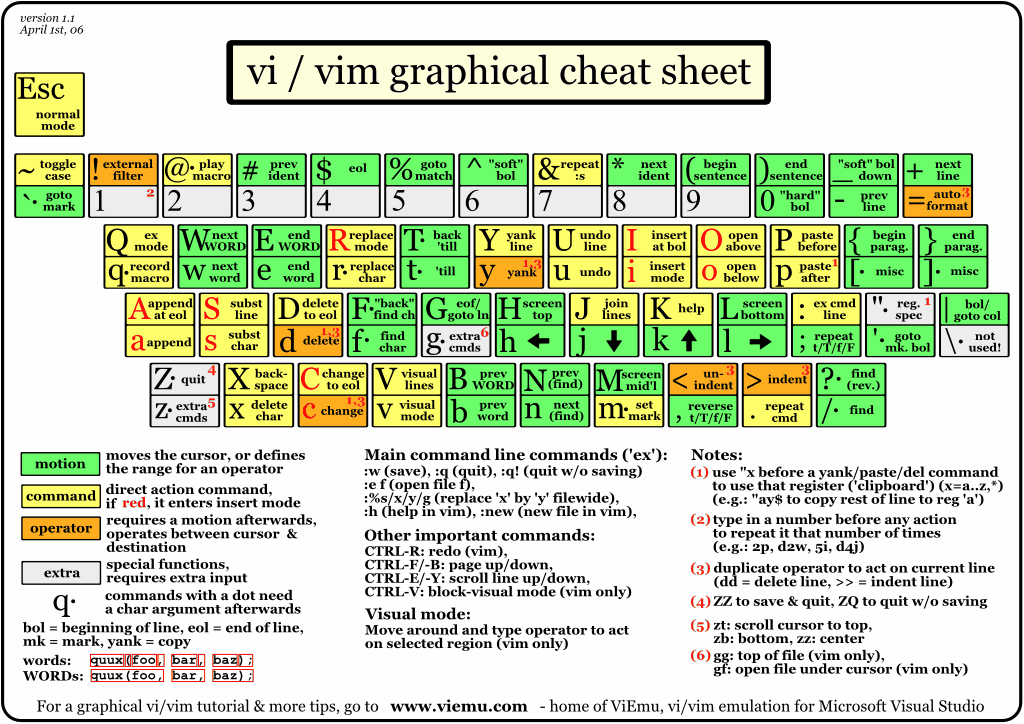
Once they "win" this "level" you've designed, those new navigation keys should be considered part of their arsenal of skills for solving future problems. Each skill mastery could be further rewarded by filling in parts of a cheat-sheet (like this one: http://www.viemu.com/vi-vim-cheat-sheet.gif). This can be seen in the section where the author talks about Link to the Past and the picture of the player's item inventory. The vim player's goal could be to "unlock" and master these keyboard skills and ultimately fill in the complete chart.
Gilder's opinion piece went from nebulous to outright flamebait upon reading these back-to-back lines:
It is ironic that liberals who once welcomed appeasement of the monstrous regime of Mao Zedong now become openly bellicose at various murky incidents of Internet hacking.
Nonetheless, with millions of Islamists on its borders and within them, China is nearly as threatened by radical Islam as we are.
His other comments aside, the answer to Gilder's question of "why antagonize China" isn't "to make another enemy." He claims that it's self-destructive for Western nations to pressure the Chinese government on issues such as human rights or pollution, but without such pressure, the results will be much more destructive for the Chinese citizens marginalized by their government.
Allowing the PRC to get away with their "but we're still a developing nation" cop-out every time the pressure is on to do the Right Thing is setting ourselves up for much bigger problems later on. If China wants to work with us, trade with us, and be regarded as a modern nation, it needs some help, yes, and some peer pressure along with it. We're a global community and we have some expectations - ones unsurprisingly not met by the "enemies" listed in Gilder's article.
We are, in fact, attempting to guide China towards a particular path so that it DOESN'T become an enemy later on. That is why we pick on them: it's tough love.
I'm in Harbin, but location has little to do with it since this pertains more to cyberspace than meatspace. The pro-Google sentiment I refer to in the beginning was coming from mostly Western blogs and social news sites. For a Chinese netizen perspective, chinaSMACK translates comments from popular BBSes here (though I don't know about authenticity/bias - my Chinese isn't that good yet). Here's an example regarding the Google announcement: http://www.chinasmack.com/stories/google-threatens-leaving-c....
It's difficult for me to gauge the Chinese reaction on my own, though. A handful of translated comments or an online poll don't amount to anything, really. Doubly so once you're aware of the "50-cent gangsters" who are paid to astroturf online (see http://en.wikipedia.org/wiki/50_Cent_Party and http://www.zonaeuropa.com/20091221_1.htm). The best resource I have are my adult students who spend the time online and can give me their impressions. So far, their responses have been to the tune of: "If Google leaves, what am I going to do!? I use GMail and many other services, and the search engine is better than Baidu for finding information in English. It's a critical part of my work!"
It should be noted that all of them (university-level and older) are aware of the censorship, they just have differing ideas on its necessity.
Do they feel like the West is unfairly criticizing China?
The Party loves playing the victim, probably because Western media affords them ample opportunity. What better way to unify the Chinese and distract them from a growing number of domestic problems than an enormous external enemy? But it's probably not always the direct work of the government - the Chinese are culturally cohesive, where the group is more important than the individual. Nationalism and its ilk pop up so often in the discussions here with students, it's frightening. (I used to live in Japan before coming here, and naturally it comes up when meeting new people. Actually having to try and reassure some people that modern Japan does not want to invade China and enslave them is unreal.)
Honestly, it's tough to say if such anti-Western reactions are genuine (thought out and justified) or just an internalized defensive mechanism.
This quote was a generalization, but aimed at ordinary users. As mentioned in this article describing Microsoft's efforts in China (http://money.cnn.com/magazines/fortune/fortune_archive/2007/...), after years of failed attempts, MS was able to turn its image around from hostile to gentle software giant and convince the government to "go genuine." In order secure those buyers, MS drastically cut prices, but given the enormous number of Chinese government users, it's probably still netting a decent fortune.
As for those ordinary users who often trawl underground software/movie markets, they are the ones who will probably never be tempted to "go genuine." They aren't under pressure from the MS/PRC back-scrubbing to do so. It's likely that most people don't need to find a Windows CD if they've already purchased a computer with it pre-installed, but anything else is open game. The vast majority of these ordinary users are purely driven by cost, and if they're buying the cheapest pirated CDs (hey, even pirates have to compete), that money isn't making it's way back to Microsoft.
As an aside, the biggest reason why I would never buy from these markets in China is that some of the software is infected with trojans. "You get what you pay for," right? ;)
I am the author of this blog post. I previously worked in IT before coming to China almost a year ago. Currently, I teach English and enjoy reading, researching, and writing with the free time this new profession affords me.
I've lurked HN for a while, but haven't given back in any way until today. My friend enjoyed this piece and encouraged me to share it to a wider audience, so here you are.