Penn Station Reborn(nytimes.com)
nytimes.com
Penn Station Reborn
http://www.nytimes.com/interactive/2016/09/30/opinion/penn-station-reborn.html
92 comments
Midtown Manhattan is a sinfully ugly tourist trap, especially around Penn. I'd argue it's the worst neighborhood by far. It's a twinkle in tourist's eyes but I avoid it like the plague.
The thing about Penn too is that it's extremely difficult to calculate your bearings. There's no significant landmarks to orient yourself by - every corridor looks the same. I use Penn regularly and I occasionally get lost if I happen to use a different entrance.
The thing about Penn too is that it's extremely difficult to calculate your bearings. There's no significant landmarks to orient yourself by - every corridor looks the same. I use Penn regularly and I occasionally get lost if I happen to use a different entrance.
The other thing about Penn is that the city dealt with the homeless by removing most of the seating. If you aren't an Acela passenger, you can go into a restaurant or you can stand. I don't really mind standing, but I find it annoying as the only real choice.
Ugh, I remember the first time I rode into Penn Station and had to find the right doors out. That was perhaps the biggest frustration during my entire stay for The Next HOPE in 2010.
>it's extremely difficult to calculate your bearings.
Yep. I take the train into Penn Station at least a couple times a year and I still invariably walk half a block in the wrong direction before figuring out what direction I'm facing.
Yep. I take the train into Penn Station at least a couple times a year and I still invariably walk half a block in the wrong direction before figuring out what direction I'm facing.
The same thing happened to me at Ueno station in Tokyo. Wandered around until I found an English speaker who could direct me where to go.
I don't care about making midtown cool - there are plenty of cool areas in New York for me to spend my time. I want midtown to be efficient - if that means turning the entire thing into a perfectly square block of concrete, so be it. Penn Station needs to be so much better at one very simple job: getting people in and out of the city.
For the people who only pass through once in a while, sure. But for the people who commute everyday or live close by, it makes a big impact.
There was a survey somewhere that said New Yorkers would rather their commute be 4 or 5 minutes longer if it meant it was less crowded or angry, or something like that. If you have to walk through some boring brutalist concrete everyday, your quality of life is going to be lower, whether you're running early or late.
Also not everyone in the city has the choice of living some place nicer in NYC. Midtown is where fresh college grads land because it's cheaper and more convenient than the rest of Manhattan, not to mention other immigrants or old people.
There was a survey somewhere that said New Yorkers would rather their commute be 4 or 5 minutes longer if it meant it was less crowded or angry, or something like that. If you have to walk through some boring brutalist concrete everyday, your quality of life is going to be lower, whether you're running early or late.
Also not everyone in the city has the choice of living some place nicer in NYC. Midtown is where fresh college grads land because it's cheaper and more convenient than the rest of Manhattan, not to mention other immigrants or old people.
Folks who haven't done their research before carelessly moving to the biggest metropolis of the Americas move to the Penn / Herald Square area. It has nothing to do with price. There are far more pleasant and cheap places to live.
I lived at 6th Ave / 27th St. for a while. I didn't dislike it, other than I don't really like living in "buildings" with 300 other people. It's a fine area, easy to get wherever you want to go by bike or train.
I like Brooklyn Heights more... though biking over a bridge-themed-tourist-attraction first thing in the morning is unenjoyable. The picture of the bike on the road does not mean "take your wedding picture here". But I digress.
I like Brooklyn Heights more... though biking over a bridge-themed-tourist-attraction first thing in the morning is unenjoyable. The picture of the bike on the road does not mean "take your wedding picture here". But I digress.
As a counterpoint, I'd recommend reading Alon Levy's blog post "Why the Focus On Penn Station?"[1]. The TL;DR is that the 650,000/day ridership number significantly overstates actual ridership, and includes subway ridership that wouldn't really benefit from most proposed improvements.
There are far better uses for transit funding in the NYC area. Even within Penn Station, the low-hanging fruit would come by improving the track level (wider platforms/fewer tracks), rather than the concourses.
If this piques your interest, Levy's "Eliminate Penn Station" proposal[2] is worth a read, although he admits it's somewhat trollish.
[1] https://pedestrianobservations.wordpress.com/2013/05/31/quic... [2] https://pedestrianobservations.wordpress.com/2015/07/15/elim...
There are far better uses for transit funding in the NYC area. Even within Penn Station, the low-hanging fruit would come by improving the track level (wider platforms/fewer tracks), rather than the concourses.
If this piques your interest, Levy's "Eliminate Penn Station" proposal[2] is worth a read, although he admits it's somewhat trollish.
[1] https://pedestrianobservations.wordpress.com/2013/05/31/quic... [2] https://pedestrianobservations.wordpress.com/2015/07/15/elim...
That's ridiculous. Excluding the subway, there's still approximately 110k riders each way on the LIRR[1] and 90k each way on NJ Transit[2]. Plus amtrak, you're talking about ~450,000 daily rail passengers. That would still make Penn Station one of the 3 busiest train stations in Europe, for context.
[1] http://transitdocs.com/files/data/lirr/2012RidershipBook.pdf [2] http://www.njtransit.com/pdf/FactsAtaGlance.pdf
[1] http://transitdocs.com/files/data/lirr/2012RidershipBook.pdf [2] http://www.njtransit.com/pdf/FactsAtaGlance.pdf
I have to agree. The destruction of the old Penn Station was a tragedy, but it is over and done with. We need to look forward to what the best use of resources is today for the people of NYC. And that's not a pretty building -- it's increased capacity, resiliency, and safety.
"We need to look forward to what the best use of resources is today for the people of NYC. And that's not a pretty building -- it's increased capacity, resiliency, and safety."
But those two things needn't be be mutually exclusive right? There are plenty of modern examples that offer both.
The Santiago Calatrava World Trade Center Station in downtown Manhattan, The Gare de Oriente in Lisbon, the Rotterdam Centraal in the Netherlands, Liège-Guillemins railway station in Belgium are all examples that combine both practicality and good aesthetics.
For those interested:
http://www.archdaily.com/783965/world-trade-center-transport...
http://inhabitat.com/santiago-calatravas-gorgeous-oriente-st...
http://www.dezeen.com/2009/12/02/liege-guillemins-station-by...
http://www.archdaily.com/588218/rotterdam-central-station-be...
But those two things needn't be be mutually exclusive right? There are plenty of modern examples that offer both.
The Santiago Calatrava World Trade Center Station in downtown Manhattan, The Gare de Oriente in Lisbon, the Rotterdam Centraal in the Netherlands, Liège-Guillemins railway station in Belgium are all examples that combine both practicality and good aesthetics.
For those interested:
http://www.archdaily.com/783965/world-trade-center-transport...
http://inhabitat.com/santiago-calatravas-gorgeous-oriente-st...
http://www.dezeen.com/2009/12/02/liege-guillemins-station-by...
http://www.archdaily.com/588218/rotterdam-central-station-be...
Call me old-fashioned, but all of those look positively hideous to me.
Perhaps, but that mindset is what led to the tragedy you mention in the first place...
I don't think MSG and associated office tower did much good for the people of NYC. They certainly didn't increase capacity, resiliency, and safety of the mass transit system.
I was in the WTC transportation hub the other day. That thing cost $3.74 billion dollars, went almost a decade over the original projected completion time, and is not particularly great as a station. It's also in my opinion somewhat ugly, but I'll concede that opinions might differ on that.
Meanwhile the subway system, and greater regional transit system has some very critical needs -- things like communications-based train control, positive train control, track maintenance, station maintenance, tunnel repairs, and additional capacity for rapidly growing neighborhoods.
I was in the WTC transportation hub the other day. That thing cost $3.74 billion dollars, went almost a decade over the original projected completion time, and is not particularly great as a station. It's also in my opinion somewhat ugly, but I'll concede that opinions might differ on that.
Meanwhile the subway system, and greater regional transit system has some very critical needs -- things like communications-based train control, positive train control, track maintenance, station maintenance, tunnel repairs, and additional capacity for rapidly growing neighborhoods.
The difference is that fixing up Penn Station is mostly just a matter of throwing money at the problem. Things like CBTC and increased capacity require sensitive negotiations with unions and local businesses.
All the mall shoppers ambling about make it a PITA to exit the place without a direct escalator out.
Also building that new tunnel under the Hudson!
True, a new tunnel would be a huge benefit for regional transit. Unfortunately, the astronomical cost estimates (recent estimates were ~$16 billion for the tunnel alone), make it pretty hard to justify on a cost-benefit basis.
NYC area construction costs are out of control relative to most of the developed world.
NYC area construction costs are out of control relative to most of the developed world.
I don't think it is for the tunnel alone. I think it is for all of the other work like a transit yard, more train carts, better train communication, more maintenance faciliities, etc, that boosted the price to $16b.
> NYC area construction costs are out of control relative to most of the developed world.
Being in NYC construction and design, the problem currently is the availability of contractors and workers. The prices follow the law of supply and demand. And a huge amount of public sector work (billions of dollars) is hitting the region and more is projected in the future. Just yesterday I learned that recent construction bid prices for projects were coming in much, much higher than the engineer's estimate throughout the City. In contractor's words, times are good, so bid high.
> NYC area construction costs are out of control relative to most of the developed world.
Being in NYC construction and design, the problem currently is the availability of contractors and workers. The prices follow the law of supply and demand. And a huge amount of public sector work (billions of dollars) is hitting the region and more is projected in the future. Just yesterday I learned that recent construction bid prices for projects were coming in much, much higher than the engineer's estimate throughout the City. In contractor's words, times are good, so bid high.
> I don't think it is for the tunnel alone. I think it is for all of the other work like a transit yard, more train carts, better train communication, more maintenance faciliities, etc, that boosted the price to $16b.
I stand corrected - the latest official word from Amtrak is $23.9 billion for the entire Gateway project, of which $7.7 is specifically for the tunnel (not including track work that's necessary to link it with Secaucus and Penn Station).
That's just the current projected cost. East Side Access was projected at $4.3 billion, but will end up costing more than $10.8 billion.
I stand corrected - the latest official word from Amtrak is $23.9 billion for the entire Gateway project, of which $7.7 is specifically for the tunnel (not including track work that's necessary to link it with Secaucus and Penn Station).
That's just the current projected cost. East Side Access was projected at $4.3 billion, but will end up costing more than $10.8 billion.
How on earth can it cost 16bn for a tunnel?
Or is it something more complicated like London crossrail which cost a similar amount.
Or is it something more complicated like London crossrail which cost a similar amount.
It's not that complicated. Manhattan is very developed which raises construction costs substantially, but ultimately construction costs here are still dramatically out of line.
The Second Avenue Subway is the most expensive metro ever constructed (on a per-mile basis), even compared to extremely dense, developed-world cities like Tokyo and Paris, both of whom have active subway construction going on for far cheaper.
There is a tremendous amount of waste and corruption in this process, and there's not a lot of political will to address it, since the governors of NY and NJ are both pretty deep in it themselves.
On the bright side, Christie's career has self-destructed over the course of this year, and Cuomo himself is under investigation for corruption. One can only hope that their successors would be a bit cleaner and more willing to tackle these issues.
The Second Avenue Subway is the most expensive metro ever constructed (on a per-mile basis), even compared to extremely dense, developed-world cities like Tokyo and Paris, both of whom have active subway construction going on for far cheaper.
There is a tremendous amount of waste and corruption in this process, and there's not a lot of political will to address it, since the governors of NY and NJ are both pretty deep in it themselves.
On the bright side, Christie's career has self-destructed over the course of this year, and Cuomo himself is under investigation for corruption. One can only hope that their successors would be a bit cleaner and more willing to tackle these issues.
I think the astronomical price tag is for the whole Gateway Project not just the tunnel, there's the expansion as well as refurbishing of the existing tunnel that was damaged by Hurricane Sandy. This article is a good insight into how convoluted the whole project is:
https://nextcity.org/features/view/gateway-tunnel-project-hu...
https://nextcity.org/features/view/gateway-tunnel-project-hu...
For comparison, the new (opened in 2006) Berlin Hauptbahnhof (main railway station) is a similar multilevel open space all the way down to the railway tracks at the bottom, all under a shell of glass walls and ceiling.
http://architektur.mapolismagazin.com/sites/default/files/be...
http://tfrisch.de/wp-content/gallery/u55-berlin/HBF%20Berlin...
http://www.e-architect.co.uk/images/jpgs/berlin/berlin_haupt...
http://awesomeberlin.net/wp-content/uploads/2016/08/hauptbah...
http://architektur.mapolismagazin.com/sites/default/files/be...

http://tfrisch.de/wp-content/gallery/u55-berlin/HBF%20Berlin...

http://www.e-architect.co.uk/images/jpgs/berlin/berlin_haupt...
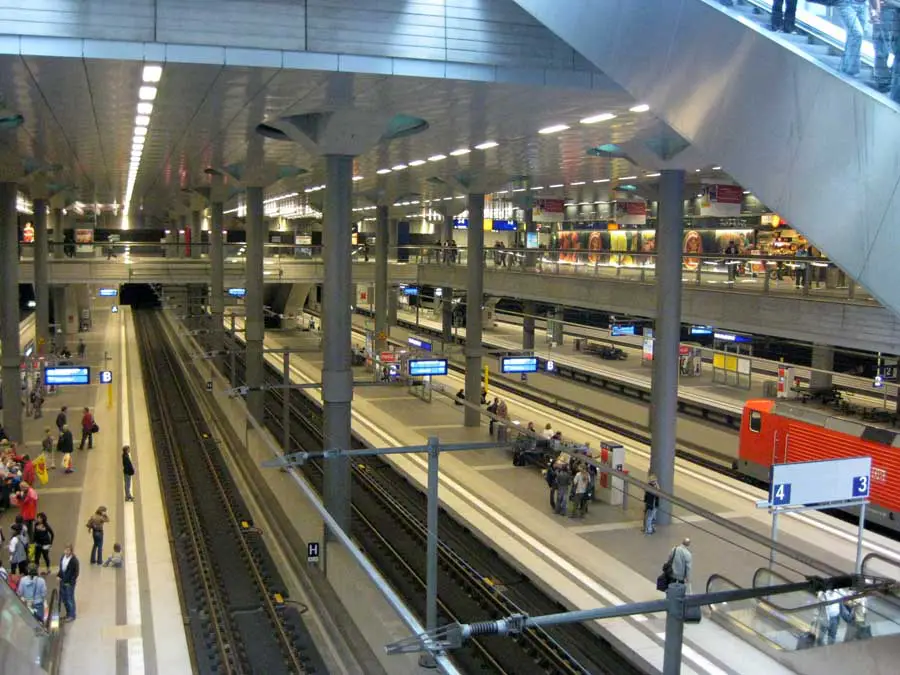
http://awesomeberlin.net/wp-content/uploads/2016/08/hauptbah...

The Berlin Hauptbahnhof is good looking with good functionality. I was there recently and it looked like there was a new phase of construction starting, its also visible in the aerial shot in on one of you links. Any idea what those plans are?
new S-Bahn S21, connecting Hauptbahnhof to Gesundbrunnen (northern "center" of the circle lines)
That the old Penn Station was destroyed in 1963, in favor of what stands today really sounds like some kind of horrible urban planning debacle no one likes to think about or talk about anymore. But New York was a different place back then, or so I'm told.
Penn Station, the way it is now is just something you sort of shrug at, given the way Midtown is, in general.
Everything on 8th Avenue from 23rd Street to 59th Street is seedy and weird, but the creeps and transients really occupy a strip between 34th Street and 42nd Street.
I've always figured it was a legacy of The Old 42nd Street, from the 1970's. That place ancient New Yorkers still talk about, from a time before Giulliani's Disnified Times Square took root in the 90's, but honestly who knows.
Somtimes I wonder, though, if that part of town would be different now, if Madison Square Garden weren't there, and the original, grander Penn Station had still remained. Throughout the 20th century many other parts of Manhattan endured similar transformations, and even Grand Central went through a period of neglect, but to compare Grand Central to Penn Station now, is like night and day.
I figure there's something to that.
Penn Station, the way it is now is just something you sort of shrug at, given the way Midtown is, in general.
Everything on 8th Avenue from 23rd Street to 59th Street is seedy and weird, but the creeps and transients really occupy a strip between 34th Street and 42nd Street.
I've always figured it was a legacy of The Old 42nd Street, from the 1970's. That place ancient New Yorkers still talk about, from a time before Giulliani's Disnified Times Square took root in the 90's, but honestly who knows.
Somtimes I wonder, though, if that part of town would be different now, if Madison Square Garden weren't there, and the original, grander Penn Station had still remained. Throughout the 20th century many other parts of Manhattan endured similar transformations, and even Grand Central went through a period of neglect, but to compare Grand Central to Penn Station now, is like night and day.
I figure there's something to that.
Though it happened years before I was born, it frankly still makes me sick to my stomach to think that this secular cathedral:
https://en.wikipedia.org/wiki/Pennsylvania_Station_(1910%E2%...
Was destroyed to make way for this rat warren:
https://en.wikipedia.org/wiki/Pennsylvania_Station_(New_York...
https://en.wikipedia.org/wiki/Pennsylvania_Station_(1910%E2%...
#/media/File:Penn_Station1.jpg)
Was destroyed to make way for this rat warren:
https://en.wikipedia.org/wiki/Pennsylvania_Station_(New_York...
#/media/File:Penn_Station_LIRR_concourse.jpg)
I always think of Penn Station as the Edith Keeler [0] of buildings. It had to die. Nationally, Penn Station is worth more as it is now than it ever would have been worth in its original state. I have even (only half-jokingly) mused that it should be landmarked as-is as a cautionary tale.
That's what I like about this plan. It takes the evil Madison Square Garden and saves it rather than just tearing it down as Penn Station was. The plan does something new rather than just trying to re-create the old Penn Station.
[0] https://en.wikipedia.org/wiki/The_City_on_the_Edge_of_Foreve...
That's what I like about this plan. It takes the evil Madison Square Garden and saves it rather than just tearing it down as Penn Station was. The plan does something new rather than just trying to re-create the old Penn Station.
[0] https://en.wikipedia.org/wiki/The_City_on_the_Edge_of_Foreve...
Agreed - the demolition of Penn Station kicked off the historic preservation movement, and has saved many thousands more buildings.
>the demolition of Penn Station kicked off the historic preservation movement
That's the retconned mythology. Based on what I've read, it's not clear how true it is.
It's probably also worth noting that Penn Station had been decaying for years and, with the bankruptcy of Penn Central because of a long-term decline in rail traffic, it's not clear what the mechanism to save Penn Station would have been at the time.
I don't disagree it's a pity--especially given how generally uninspired that whole area of Midtown is. But the NYC of fifty years ago was a very different place.
That's the retconned mythology. Based on what I've read, it's not clear how true it is.
It's probably also worth noting that Penn Station had been decaying for years and, with the bankruptcy of Penn Central because of a long-term decline in rail traffic, it's not clear what the mechanism to save Penn Station would have been at the time.
I don't disagree it's a pity--especially given how generally uninspired that whole area of Midtown is. But the NYC of fifty years ago was a very different place.
The same mechanism that saved Grand Central a decade later - legal intervention. The situation was pretty much the same. A bankrupt railroad wanted to demolish a beautiful landmark to make money.
Fair enough. I actually hadn't realized that they were both Penn Central stations. (I assume that at some point they were terminals for two different railroads--hence the lack of decent connections between them just like Boston.)
They were from two different railroads. Pennsylvania Station was from the Pennsylvania Railroad, Grand Central from the New York Central. They merged in 1968 to try and save both of railroads but it ended up not helping.
The creation of the PennCentral was probably the most ill thought out merger in US history - but the regulation climate at the time wouldnt have allowed them to seek out a more rational merger partner (like an end to end merger with the likes of the CB&Q or GN) - also mergers took forever because of ICC forbearance - which mean the merger took 6-7 years to complete, and the perennially bankrupt New Haven was shotgunned in at the last moment - In short, failure was all but a foregone conclusion - but given the nature of the market that the time, there was but little choice to proceed.
The railroads are an example of how excessive regulation can almost kill an industry - even the UP came mighty close to bankruptcy before deregulation.
The railroads are an example of how excessive regulation can almost kill an industry - even the UP came mighty close to bankruptcy before deregulation.
I knew that Penn Central was a massive bankruptcy but I never really looked into the whole history. I should read up on it when I get a chance. Any particular histories of railroads in the US you'd recommend? (I'm probably not interested enough to read one of the books specifically on the Penn Central.)
https://www.amazon.com/Wreck-Penn-Central-Joseph-Daughen/dp/...
https://www.amazon.com/Men-Who-Loved-Trains-Railroads/dp/025...
I've read the first two - I also plan on reading: https://www.amazon.com/Merging-Lines-American-Railoads-1900-... and https://www.amazon.com/gp/product/0875803164
You might also check out the 3 part history of the Union Pacific by Maury Klein.
https://www.amazon.com/Maury-Klein/e/B000APV4NC/
I've read the first two - I also plan on reading: https://www.amazon.com/Merging-Lines-American-Railoads-1900-... and https://www.amazon.com/gp/product/0875803164
You might also check out the 3 part history of the Union Pacific by Maury Klein.
https://www.amazon.com/Maury-Klein/e/B000APV4NC/
They didn't want to demolish it, they were bankrupt. They were legally obligated to liquidate everything they could to pay off their creditors.
No.. thats not right either - Penn Station was demolished in 1962-63 - well before the Pennsylvania and New York Central merged. They did want to demolish it, because of prohibitively high maintenance costs.
Including the Hotel Pennsylvania. One of my fondest memories is attending The Next HOPE in 2010, arriving in New York City at Penn Station, and making the walk across the street to the Hotel Pennsylvania. Perhaps that's sad to some people - I grew up in the country where the tallest building was the three story church steeple in the middle of Shitkick, Texas.
It was my first time in a world-class city, and I had a phenomenal time - strolled down to K-Town and got some incredibly amazing Korean food, saw Times Square up close and in person, had a great time exchanging big thoughts with big thinkers, and generally had a wonderful time.
Now if they'd consider making Newark Airport and the PATH train into Penn Station not suck...
It was my first time in a world-class city, and I had a phenomenal time - strolled down to K-Town and got some incredibly amazing Korean food, saw Times Square up close and in person, had a great time exchanging big thoughts with big thinkers, and generally had a wonderful time.
Now if they'd consider making Newark Airport and the PATH train into Penn Station not suck...
>Including the Hotel Pennsylvania
I guess parts of the facade and entrance on Seventh Avenue are somewhat distinctive. (The same architectural firm designed the hotel and Penn Station.)
I gather there's a renovation planned--which is sorely needed based on what I've seen. There was a long-running plan to just tear it down but supposedly it's going to be updated instead.
I guess parts of the facade and entrance on Seventh Avenue are somewhat distinctive. (The same architectural firm designed the hotel and Penn Station.)
I gather there's a renovation planned--which is sorely needed based on what I've seen. There was a long-running plan to just tear it down but supposedly it's going to be updated instead.
[deleted]
Midtown is a strange combination of seedy, dirty, weird, sketchy, and "cleaned up" tourist destinations. It's busy, full of massage parlors and bad souvenir stores, safe, and full of families on vacation. Probably my least favorite part of Manhattan to work in.
Midtown West is like that.
Midtown East is much less touristy and includes great restaurants, a lot of office buildings, and fairly residential parts (like Murray Hill). It also includes Penn Station's foil - Grand Central (Grand Central was actually saved because of the lessons learned from Penn Station).
Midtown East is much less touristy and includes great restaurants, a lot of office buildings, and fairly residential parts (like Murray Hill). It also includes Penn Station's foil - Grand Central (Grand Central was actually saved because of the lessons learned from Penn Station).
Midtown East is an interesting place.
I think part of the reason it remains "nicer" is the allure of Park Ave. That stretch of Park Ave from Grand Central up to 59th is actually owned by the old Penn Railroad. It was cut-and-covered long ago for a Metro-North rail yard, and all the buildings above it lease space from the now-defunct railroad's holding company.
And what buildings they are: the Lever building and the Seagram building are two of the most important modernist skyscrapers. And 432 Park Ave is probably the most important building currently under construction.
Beyond that, a lot of the neighborhood's culture comes from the elevated lines. The 3rd Ave and 2nd Ave above-ground lines were, for a long time, a boundary. It's easy to watch the neighborhood become more residential (and to see all the old tenement buildings) as you walk east. A lot of college students and young professionals live there now, as well as a growing Japanese population centered around 52nd st. It's clear that Midtown east of 3rd Ave was always residential, if not as wealthy.
Midtown west was the exact opposite: heavily industrial. The High Line, now a park, had tons of intermodals for massive, well-known businesses such as Nabisco (the ground floor of which is now Chelsea Market). The piers were used for shipping. 11th Ave was known as "Death Avenue" because of the heavy transportation use. The neighborhood's face was shaped by warehouses, industry, and transportation, resulting in both Tribeca's industrial-chic and Midtown's seeming blocks of nothingness. Hell's Kitchen was a home to the Irish mafia. Times Square was teeming with prostitutes.
My feeling is that these histories shaped the development of the neighborhoods, and you still feel it echoing today when you step off a train and onto the island.
I think part of the reason it remains "nicer" is the allure of Park Ave. That stretch of Park Ave from Grand Central up to 59th is actually owned by the old Penn Railroad. It was cut-and-covered long ago for a Metro-North rail yard, and all the buildings above it lease space from the now-defunct railroad's holding company.
And what buildings they are: the Lever building and the Seagram building are two of the most important modernist skyscrapers. And 432 Park Ave is probably the most important building currently under construction.
Beyond that, a lot of the neighborhood's culture comes from the elevated lines. The 3rd Ave and 2nd Ave above-ground lines were, for a long time, a boundary. It's easy to watch the neighborhood become more residential (and to see all the old tenement buildings) as you walk east. A lot of college students and young professionals live there now, as well as a growing Japanese population centered around 52nd st. It's clear that Midtown east of 3rd Ave was always residential, if not as wealthy.
Midtown west was the exact opposite: heavily industrial. The High Line, now a park, had tons of intermodals for massive, well-known businesses such as Nabisco (the ground floor of which is now Chelsea Market). The piers were used for shipping. 11th Ave was known as "Death Avenue" because of the heavy transportation use. The neighborhood's face was shaped by warehouses, industry, and transportation, resulting in both Tribeca's industrial-chic and Midtown's seeming blocks of nothingness. Hell's Kitchen was a home to the Irish mafia. Times Square was teeming with prostitutes.
My feeling is that these histories shaped the development of the neighborhoods, and you still feel it echoing today when you step off a train and onto the island.
You seem like you might have a good recommendation or two for further reading... I just moved to St Mark's and have been reading up on the history of the area, I'd love to know more about the island as a whole. Do you have any reading advice?
I learned most of my history from a class I took, so unfortunately I don't have any reading recommendations for history of the island. But I would strongly recommend Robert Caro's biography of Robert Moses "The Power Broker" for better understanding how New York developed throughout the 20th century.
Agree, I think that discounting Midtown entirely as a concrete bore lacks enough nuance. There are certain parts of Midtown that are quite pleasant (well, assuming you're cool with lots of people).
Each of the Avenues have their own character, it so happens that 7th Ave and 8th Ave tends to be seedy, under-utilized, deserted, and altogether unpleasant.
Compare with, say, 5th Ave or 6th Ave, which even in its most tourist-trap-laden spots are actually reasonably pleasant places to be.
Or like you said, further east. I don't really consider Murray Hill/Kips Bay part of Midtown, but even Midtown East (42nd thru 59th) is rather nice and suffers from few/none of the problems that plague 7th and 8th Ave.
I think much of the problem comes down to the under-development of the Far West Side. The east side of Manhattan is extensively developed for commercial and residential use all the way to the edge of the water. The west side on the other hand continues to be a mix of light industry, auto shops, warehouses, and general usage that discourages public traffic.
The development of Hudson Yards (the form of which I disagree with) will hopefully alleviate some of this problem. As it is the area around Penn serves no useful purpose for anyone besides commuters passing through. The introduction of mass residential and commercial use should hopefully fix some of this.
Each of the Avenues have their own character, it so happens that 7th Ave and 8th Ave tends to be seedy, under-utilized, deserted, and altogether unpleasant.
Compare with, say, 5th Ave or 6th Ave, which even in its most tourist-trap-laden spots are actually reasonably pleasant places to be.
Or like you said, further east. I don't really consider Murray Hill/Kips Bay part of Midtown, but even Midtown East (42nd thru 59th) is rather nice and suffers from few/none of the problems that plague 7th and 8th Ave.
I think much of the problem comes down to the under-development of the Far West Side. The east side of Manhattan is extensively developed for commercial and residential use all the way to the edge of the water. The west side on the other hand continues to be a mix of light industry, auto shops, warehouses, and general usage that discourages public traffic.
The development of Hudson Yards (the form of which I disagree with) will hopefully alleviate some of this problem. As it is the area around Penn serves no useful purpose for anyone besides commuters passing through. The introduction of mass residential and commercial use should hopefully fix some of this.
In addition to Hudson Yards (which I don't really have an opinion on) and the completion of the High Line's northern end, there's also been a fair bit of other building and, I guess, gentrification in Hell's Kitchen generally. New restaurants, hotels, etc. If I'm going to a show at the Javits and/or want to otherwise be in the vicinity of midtown theaters, that's where I tend to stay these days. It's convenient, has good access to reasonably priced restaurants, and is close to many of the theaters and other Midtown attractions while being outside of Times Square craziness/crush.
Yes, Hell's Kitchen is nowadays quite nice and it has an impact on the 7th/8th Ave corridor. The stretch of 7th/8th adjacent to Hell's Kitchen is noticeably nicer than the more southern stretches from 23rd thru 42nd. The lack of development west of those areas is definitely a major issue.
My main beef with Hudson Yards is that it fails to follow the Manhattan grid, and favors massive complexes with idyllic parks and public spaces between buildings, rather than streets. This is the same fatally flawed planning that has created innumerable empty concrete plazas around the country - that whole area will be defined by the desertedness of its public spaces.
Ultimately the best public space are the streets were life and commerce happens, not isolated courtyards between skyscrapers.
My main beef with Hudson Yards is that it fails to follow the Manhattan grid, and favors massive complexes with idyllic parks and public spaces between buildings, rather than streets. This is the same fatally flawed planning that has created innumerable empty concrete plazas around the country - that whole area will be defined by the desertedness of its public spaces.
Ultimately the best public space are the streets were life and commerce happens, not isolated courtyards between skyscrapers.
>This is the same fatally flawed planning that has created innumerable empty concrete plazas around the country - that whole area will be defined by the desertedness of its public spaces.
I don't disagree with your general point. Boston has one of the worst examples around City Hall (which the city is finally trying to do something about). That said, probably because of its density, much of Manhattan doesn't seem to suffer from empty pocket parks and plazas--at least in nicer weather--to the degree that other cities may. I wonder if the High Line will also help with respect to Hudson Yards specifically although I haven't really taken a close look at the plans.
I don't disagree with your general point. Boston has one of the worst examples around City Hall (which the city is finally trying to do something about). That said, probably because of its density, much of Manhattan doesn't seem to suffer from empty pocket parks and plazas--at least in nicer weather--to the degree that other cities may. I wonder if the High Line will also help with respect to Hudson Yards specifically although I haven't really taken a close look at the plans.
The area right around Grand Central suffers from too few residential units in proportion to everything else and so ends up feeling a bit sterile. It certainly isn't as bad as over by Penn, but I don't think it is anyone's favorite part of town.
And there are a lot of tall buildings which can make the area immediately uptown from Grand Central in particular feel a lot like the stereotypical concrete canyons.
What's amusing about that whole neighborhood is that it really is a tourist destination and as such is the only part of New York that many tourists see. It is very much unlike the rest of the city and yet, that is the impression that tourists will get of what New York is.
The reality is quite different.
The reality is quite different.
Tell me about it!
I grew up in the tri-state area, and thought Penn Station was The City for most of my childhood. There's a ghost of this sensation that still haunts me, when I'm in that part of town.
Most of the time, trips to Manhattan were by train. A smaller handful of outings were field trips by school bus or by driving in, and arriving at a parking garage.
It wasn't until my late teens that I began to explore the rest of the city, and find new places without the lid of parental supervision or chaperones. It wasn't until my 20's that I realized there were parts of NYC that weren't littered with tourist trap schlock shops brimming with statue of liberty figurines and empire state building miniatures.
The really funny part is that my siblings still think that way, and in their mind, when I describe hanging out in the city, I think they imagine me hobnobbing with vagrants in front of the Arby's on 8th ave.
I grew up in the tri-state area, and thought Penn Station was The City for most of my childhood. There's a ghost of this sensation that still haunts me, when I'm in that part of town.
Most of the time, trips to Manhattan were by train. A smaller handful of outings were field trips by school bus or by driving in, and arriving at a parking garage.
It wasn't until my late teens that I began to explore the rest of the city, and find new places without the lid of parental supervision or chaperones. It wasn't until my 20's that I realized there were parts of NYC that weren't littered with tourist trap schlock shops brimming with statue of liberty figurines and empire state building miniatures.
The really funny part is that my siblings still think that way, and in their mind, when I describe hanging out in the city, I think they imagine me hobnobbing with vagrants in front of the Arby's on 8th ave.
Such an interesting comment for me given the plan in the article. I grew up in the tri-state area as well, but north of the city and so my access point was always Metro North and thus arrived at Grand Central. Every time I'd show up there I'd have this unbelievable excitement to see Grand Central's soaring ceiling, the clock at the information booth, even the feeling of the heavy (are they?) bronze doors to 42nd or Lexington... There really is something magical about an epic entrance to a city and our very different experiences speak directly to it.
I see the comment about the traffic stats not necessarily justifying spending dollars on the experience of Penn Station, and I partly agree with that, but there's something you can't quantify about how important a first impression is (or maybe you can quantify it; I imagine you, pavement, and all the folks like you, who might have been turned off by that Penn Station experience flipping to Grand Central as the entryway and how many more dollars you might spend in the city over the course of your lives as a direct result of that improved first impression).
I see the comment about the traffic stats not necessarily justifying spending dollars on the experience of Penn Station, and I partly agree with that, but there's something you can't quantify about how important a first impression is (or maybe you can quantify it; I imagine you, pavement, and all the folks like you, who might have been turned off by that Penn Station experience flipping to Grand Central as the entryway and how many more dollars you might spend in the city over the course of your lives as a direct result of that improved first impression).
There is a famous and relevant quote about Penn Station (and its modern, terrible replacement):
"One entered the city like a god; one scuttles in now like a rat."
"One entered the city like a god; one scuttles in now like a rat."
There is a silver lining however in that the destruction of the station precipitated the passage of the New York City landmarks law shortly after. Fun fact - Jackie Onasis was a high profile proponent of this legislation as well as raising awareness of architectural heritage in the city.
I'm never quite convinced. The ugliness of the present station apparently hasn't stopped it serving 3x as many passengers as it was designed for. Meanwhile Madison Square Garden has provided a lot of value to a lot of people over the years. Of course a pretty building is better than an ugly one, but not if it comes at the cost of a lot of space that could be used for something else.
Just a meta note about this article: I loved the swipeable before-and-after graphics. They really helped me understand the proposed design in a way that the words alone couldn't.
(BTW, I'm typing this from an Amtrak train bound for Penn Station, which has long been my least favorite place in Manhattan!)
(BTW, I'm typing this from an Amtrak train bound for Penn Station, which has long been my least favorite place in Manhattan!)
I like this idea as much as I like some of the others I've heard over the years. I was a daily NJ Transit commuter for almost 8 years but am now down to twice a week. Upgrades to Penn Station are as needed as are upgrades to the rest of our nations infrastructure. But to me, therein lies the problem. Infrastructure. Something our country seems hellbent on destroying through neglect. I would love to see one of these big "fix Penn Station" projects be made into a reality and actually have the intended affect, but the cynical part of me (which seems to grow a bit every birthday) simply can't be brought to believe I'll see it happen anytime in the next couple decades.
To me Penn Station as it exists today is a prime example of how we've come to treat our vital infrastructure.
On an average morning it takes 5+ minutes to get off the platform because it's normal for two, or three, rush hour trains to be unloaded onto a single platform back-to-back which results in thousands of people trying to squeeze up four or five small staircases.
Looking around the platform the concrete is cracked, some of it creaks when you walk over it, there are huge chunks of concrete missing everywhere. Lights are constantly out, even when they're on its perpetually dark, everything is covered in a layer of filth.
The rest is the same. Cracked walls and ceilings. Filth, trash, stink, and overcrowding everywhere. Perpetually bad lighting. One good delay for any of the transit systems that converge under Penn and it becomes impossible to move as thousands of people stand around hoping for their train to arrive.
On the NJ Transit side track numbers aren't posted ahead of time. If you're lucky you might get ~10 minutes notice but during rush hour it's normal for tracks to be posted minutes before departure. So you get train fulls of people rushing back and forth to make it to the few stairs or escalators (which are usually going up even when trains down on the platform are boarding) to get to their train on time.
And despite all this Penn Station is vitally important to the area. NJ and NYC's economies benefit immeasurably from it. Even as far as Philadelphia, DC, and Boston. Yet, there it rots and crumbles. For decades. And the best we can do so far is hope for some more fancy computer renderings of something that maybe could make things better. And while we wait delays become more frequent, trains and stations get more crowded, things continue to fall apart, and the costs continue to rise.
To me Penn Station as it exists today is a prime example of how we've come to treat our vital infrastructure.
On an average morning it takes 5+ minutes to get off the platform because it's normal for two, or three, rush hour trains to be unloaded onto a single platform back-to-back which results in thousands of people trying to squeeze up four or five small staircases.
Looking around the platform the concrete is cracked, some of it creaks when you walk over it, there are huge chunks of concrete missing everywhere. Lights are constantly out, even when they're on its perpetually dark, everything is covered in a layer of filth.
The rest is the same. Cracked walls and ceilings. Filth, trash, stink, and overcrowding everywhere. Perpetually bad lighting. One good delay for any of the transit systems that converge under Penn and it becomes impossible to move as thousands of people stand around hoping for their train to arrive.
On the NJ Transit side track numbers aren't posted ahead of time. If you're lucky you might get ~10 minutes notice but during rush hour it's normal for tracks to be posted minutes before departure. So you get train fulls of people rushing back and forth to make it to the few stairs or escalators (which are usually going up even when trains down on the platform are boarding) to get to their train on time.
And despite all this Penn Station is vitally important to the area. NJ and NYC's economies benefit immeasurably from it. Even as far as Philadelphia, DC, and Boston. Yet, there it rots and crumbles. For decades. And the best we can do so far is hope for some more fancy computer renderings of something that maybe could make things better. And while we wait delays become more frequent, trains and stations get more crowded, things continue to fall apart, and the costs continue to rise.
Seattle just completed a much needed light rail extension north to the UW, and it's gorgeous. Construction only took three years, it works incredibly well, and it's not some ugly building meant to hide from view. It ends up adding a lot to the campus.
It's possible, but folks in NYC do seem more used to political inertia and cynical resignation.
(http://www.washington.edu/news/2016/03/25/geology-and-art-co...)
It's possible, but folks in NYC do seem more used to political inertia and cynical resignation.
(http://www.washington.edu/news/2016/03/25/geology-and-art-co...)
This proposal looks beautiful, but a minor point stuck out for me. Putting large maps on the ceiling sounds like a terrible UX that will confuse people more than orient them.
You'll end up with one axis that corresponds to actual directions in the real world, while its perpendicular axis is exactly the opposite. If the "north" and "south" ends of the map are actually to the north and south, for example, east and west will be on the wrong sides.
If you put all four compass directions in their real-world locations, then the entire map is mirrored when seen from below. Maybe this rat's-eye-view of New York would be appropriate, but it would also be deeply unfamiliar and look like an enormous mistake.
There's a really good convention for public maps that are standing up on a sign (left and right correspond to what's to your left and right in the real world, and up corresponds to what's ahead of you), and there's a completely obvious convention for maps on the floor. There's no sensible convention for ceiling maps.
You'll end up with one axis that corresponds to actual directions in the real world, while its perpendicular axis is exactly the opposite. If the "north" and "south" ends of the map are actually to the north and south, for example, east and west will be on the wrong sides.
If you put all four compass directions in their real-world locations, then the entire map is mirrored when seen from below. Maybe this rat's-eye-view of New York would be appropriate, but it would also be deeply unfamiliar and look like an enormous mistake.
There's a really good convention for public maps that are standing up on a sign (left and right correspond to what's to your left and right in the real world, and up corresponds to what's ahead of you), and there's a completely obvious convention for maps on the floor. There's no sensible convention for ceiling maps.
The Grand Central ceiling star map is reversed, maybe they should do the same in homage https://en.wikipedia.org/wiki/Grand_Central_Terminal#Ceiling
Huh. That just sounds like an unnecessary mistake, as a star map is the one kind of map that makes perfect intuitive sense on the ceiling (and its directionality is less intuitive on a piece of paper or a screen).
(I could have added that if anyone would understand why a ceiling map of NYC should be mirrored, it would be people who are familiar with star maps or people who play Kerbal Space Program.)
(I could have added that if anyone would understand why a ceiling map of NYC should be mirrored, it would be people who are familiar with star maps or people who play Kerbal Space Program.)
Sounds like a great way to get pickpocketed. Lots of disoriented travellers staring up at the ceiling. Then again, maybe it's no different from everyone staring at their phones ignoring the world around them.
I think the map is for aesthetics, not utility. But point taken.
As someone who hasn't been to New York in decades my main interaction with Penn Station has been the regular appearance of Amtrak's Kafkaesque Large Station Boarding Procedures as a whipping horse in Matt Yglesias blog posts [1, for example].Then I realized I hadn't seen one in awhile and maybe Amtrak changed to normal train boarding at major stations.
[1] http://www.vox.com/2014/3/31/5563600/everything-you-need-to-...
[1] http://www.vox.com/2014/3/31/5563600/everything-you-need-to-...
Nope. No change.
However, to Yglesias' post I'd add that, in all fairness, the underground platforms at Penn are really too narrow to have people waiting for the train on the platform and then heading into an assigned car as is common in Europe. So whether or not they checked the ticket at the top of the escalator in Penn, there would still be something of a crush as people went down to the platform from the very congested boarding area.
(What is a reasonable question is why Amtrak doesn't actually have reserved seating even on their "all reserved" trains like Acela.)
However, to Yglesias' post I'd add that, in all fairness, the underground platforms at Penn are really too narrow to have people waiting for the train on the platform and then heading into an assigned car as is common in Europe. So whether or not they checked the ticket at the top of the escalator in Penn, there would still be something of a crush as people went down to the platform from the very congested boarding area.
(What is a reasonable question is why Amtrak doesn't actually have reserved seating even on their "all reserved" trains like Acela.)
This is great. I took accela into Penn Station for 4 years from DC. I always wish they could revitalize that whole area. They can do so much with it. Today it's feels like a 3rd world train station.
I am not sure why everyone cares so much about flash infrastructure. I go to Penn Station to ride the train from time to time. It's fine. You can get a coffee down there. You buy a ticket and get on your train. It's not a work of art, it's not a beautiful space that inspires me to be excellent. But I don't expect it to be, it's a train station. I go there to get on the train.
Trump was droning on about this during the debate, how our airports make us look like a third-world country or something. I don't see why anyone cares. I've taken numerous flights in and out of Laguardia. You show up there, go through security, and get on an airplane. I am not looking for excitement or a work of art. It's an airport. I want to be in and out as quickly as possible.
I only want two transportation-related improvements -- more service so I can get a seat during the day and not wait around for 30 minutes at night, and positive train control so that I don't die when someone forgets to stop at the last station. Everything else is ego-driven money wasting. (I'm looking at you, Andrew Cuomo.)
Trump was droning on about this during the debate, how our airports make us look like a third-world country or something. I don't see why anyone cares. I've taken numerous flights in and out of Laguardia. You show up there, go through security, and get on an airplane. I am not looking for excitement or a work of art. It's an airport. I want to be in and out as quickly as possible.
I only want two transportation-related improvements -- more service so I can get a seat during the day and not wait around for 30 minutes at night, and positive train control so that I don't die when someone forgets to stop at the last station. Everything else is ego-driven money wasting. (I'm looking at you, Andrew Cuomo.)
Read icehawk's comment below regarding infrastructure. It's not the lack of works of art, architectural details, or coffee shops that's the issue. As an occasional rider you don't know, but the station hasn't scaled its ridership over the years. Coming up from the tracks or down to there, during rush hour or even a typical weekend, is a slow nightmare. Frequently commuters coming up and down colide and cause a deadlock, as there are no designated up and down areas. The layout is old. The station is large and poorly organized. I was in a very busy station with a bad rap in London a few weeks ago, called Victoria, and while the British complain about everything this station handles multiple commuter lines and several Tube lines with sophisticated aplomb. It's wide and open, like I see the new Penn design is intended to be.
It's not an issue of beauty, it's an issue of efficiency and scale. The infrastructure hasn't scaled.
It's not an issue of beauty, it's an issue of efficiency and scale. The infrastructure hasn't scaled.
I think it just proves your point: Victoria Underground Station is considered overcrowded, and is being upgraded at the moment with the construction of additional entrances.
It looks like everything new will be underground, so there's not so much room for beauty. Unlike my memories of NYC, it will at least be very well lit and kept clean.
https://tfl.gov.uk/travel-information/improvements-and-proje...
https://en.wikipedia.org/wiki/London_Victoria_station#Curren...
It looks like everything new will be underground, so there's not so much room for beauty. Unlike my memories of NYC, it will at least be very well lit and kept clean.
https://tfl.gov.uk/travel-information/improvements-and-proje...
https://en.wikipedia.org/wiki/London_Victoria_station#Curren...
You make me jealous of my time in London.
My main complaints when I lived in London (in East-Central London, in E1W): a) long east-west travel times b) no overnight Tube options c) (though less important) no A/C on the Tube, are ALL being addressed.
It's depressing and sad that a city with three times the GDP (per the last time I checked), NYC, my now-home, has a shoddy and corrupt, slow-moving infrastructure upgrade plan. Every infrastructure plan costs smaller-country-budget levels of spend, takes longer than expected, and after the ribbon is cut is still behind its competition (because let's face it, international cities compete) in Europe and Asia.
My main complaints when I lived in London (in East-Central London, in E1W): a) long east-west travel times b) no overnight Tube options c) (though less important) no A/C on the Tube, are ALL being addressed.
It's depressing and sad that a city with three times the GDP (per the last time I checked), NYC, my now-home, has a shoddy and corrupt, slow-moving infrastructure upgrade plan. Every infrastructure plan costs smaller-country-budget levels of spend, takes longer than expected, and after the ribbon is cut is still behind its competition (because let's face it, international cities compete) in Europe and Asia.
LaGuardia's issue isn't its ugliness but its lack of efficiency: not enough seating, not enough A/C outlets, long waits to get through security, not enough bathrooms, dangerous triple-parked quick-rearrange-the-luggage-so-we-can-go pickup-and-dropoff areas.
The dinginess of the terminals and dearth of food/shopping options are really bad too, but the biggest problems in my opinion have to do with objective issues that any stoic efficiency expert would balk at.
The dinginess of the terminals and dearth of food/shopping options are really bad too, but the biggest problems in my opinion have to do with objective issues that any stoic efficiency expert would balk at.
You could take a similar utilitarian view of all structures, and come the the conclusion that there's no reason for anything to be beautiful or inspiring.
But that view would be suspect, since tourists like pretty things, and tourists have pretty dollar bills. Pretty stuff is attractive to business because it attracts potential customers.
Rich people like to live near pretty things, making property expensive. Witness the expensive neighborhoods in NYC (eg. Central Park perimeter) and London (green, leafy, old, Kensington, Chelsea, St James, etc.). Utilitarian, in the dictionary definition ("designed to be useful instead of attractive") is the opposite of these places.
Utiliarianism, the greatest good for the greatest many, is a different story for these places. I feel like that's what you meant.
Your suggested conclusion might be better paired with a utilitarian approach?
Rich people like to live near pretty things, making property expensive. Witness the expensive neighborhoods in NYC (eg. Central Park perimeter) and London (green, leafy, old, Kensington, Chelsea, St James, etc.). Utilitarian, in the dictionary definition ("designed to be useful instead of attractive") is the opposite of these places.
Utiliarianism, the greatest good for the greatest many, is a different story for these places. I feel like that's what you meant.
Your suggested conclusion might be better paired with a utilitarian approach?
NYP is actually the perfect introduction to midtown and Manhattan in general. There are a ton of people moving quickly to a destination in a confusing maze of stuff that you can't find your way out of without asking somebody.
At least there's a Taco Bell.
At least there's a Taco Bell.
> a confusing maze of stuff that you can't find your way out of
Manhattan above Houston St is basically a grid with an X/Y street / ave system. It's really not that confusing nor a maze
Manhattan above Houston St is basically a grid with an X/Y street / ave system. It's really not that confusing nor a maze
I see similarities in this plan with the new Liege-Guillemins (Belgium) train station. Light, airy, modern.
https://www.theguardian.com/artanddesign/2009/sep/16/liege-g...
http://www.e-architect.co.uk/belgium/liege-guillemins-tgv-st...
https://www.theguardian.com/artanddesign/2009/sep/16/liege-g...
http://www.e-architect.co.uk/belgium/liege-guillemins-tgv-st...
Realistically, we shouldn't build anything big in NY. The costs are out of control, insanely slow, and wildly unpredictable. No one even knows where the money goes.
https://pedestrianobservations.wordpress.com/2013/06/03/comp...
https://pedestrianobservations.wordpress.com/2011/05/16/us-r...
http://www.wsj.com/article_email/mtas-costs-loom-large-14688...
What we should do is focus on a completing few small projects with time and budget constraints comparable to the rest of the world (e.g. Spain, Hong Kong or Delhi). This should be done with the goal of excluding all the current people who are robbing us blind (i.e. no MTA workers); bring in French, Japanese or Indian contractors as needed.
Once we can build and maintain a transit system at reasonable cost, then we should think about big projects. Until then, why throw good money after bad?
https://pedestrianobservations.wordpress.com/2013/06/03/comp...
https://pedestrianobservations.wordpress.com/2011/05/16/us-r...
http://www.wsj.com/article_email/mtas-costs-loom-large-14688...
What we should do is focus on a completing few small projects with time and budget constraints comparable to the rest of the world (e.g. Spain, Hong Kong or Delhi). This should be done with the goal of excluding all the current people who are robbing us blind (i.e. no MTA workers); bring in French, Japanese or Indian contractors as needed.
Once we can build and maintain a transit system at reasonable cost, then we should think about big projects. Until then, why throw good money after bad?
Every time I see more investment in Manhattan I wonder, would the money be better spent in the other boroughs?
Did anyone else notice the test string at the bottom of the article?
I love this—but is there any interactivity? Does it go beyond the short canned animation? I keep clicking everywhere but I guess that was it?
Midtown is such a barren wasteland of concreteness. Walking through the garment district feels like you're a tiny mouse in a gigantic grey maze. If you happen to be on 7th or 8th looking north or south, then you get blinded by the lights of MSG or times square. The entire environment is aggressively imposing and claustrophobic, and going underground into Penn Station is 10x worse. I've ridden the LIRR and NJ transit a few times now, and if I were to go in today I would still get lost.
One of the coolest things about Tokyo's train lines is the layers of walkways stacked vertically above roads and between other paths (e.g. shibuya), so that you're often looking into the shared space that's the big public intersection in the middle. It feels more open and there's trees.
Cool cities make you feel like you're part of something bigger, and a big factor of that is shared open public space. Penn station makes you feel like a pinball bouncing between turnstiles.