How Has San Francisco Run Out of Money for Affordable Housing?(spur.org)
spur.org
How Has San Francisco Run Out of Money for Affordable Housing?
https://www.spur.org/news/2018-11-08/how-has-san-francisco-run-out-money-affordable-housing
62 comments
Don’t know why you’re getting downvoted here because you touch on an important truth: SF is a globally important city with a massive jobs base run by people who wish it wasn’t.
I was also just in San Francisco (also from Brooklyn!) and noticed this as well. Downtown SF has all the look and feel of a global city, think Manhattan or Tokyo. Once you get into the western half of the city it seems like a nice quaint European city half it's size. I definitely understand why rich land owners want to "preserve the character of the neighborhoods" but you can't have it both ways.
The most puzzling thing was that I did see a few new residential constructions going up and they were also of the 1-3 story variety.
The most puzzling thing was that I did see a few new residential constructions going up and they were also of the 1-3 story variety.
> I definitely understand why rich land owners want to "preserve the character of the neighborhoods"
Yeah, see that's the part that confused the hell out of me actually. I actually don't know if I understand that.
I mean I'll freely admit it, some parts of SF are gorgeous and unique. Let's not bulldoze the painted ladies. In fact maybe let's save large sections of some lovely neighborhoods with Victorian houses and quaint hilly streets and so on. The parks and the coastline are a treasure.
But like the city is actually pretty big, and huge sections of it are just ugly. I went all the way through outer sunset on the way to the beach and it's just endless blocks of small unremarkable houses, all with garage doors as their primary streetside element. There's no reason to keep this stuff. Or even if you want to remember it fondly you could keep half of it and carve out a square mile or so of it and build apartment buildings and house like 200,000 more people.
I mean, I went to a meeting in SOMA and drove by a Best Buy, surrounded by a large suburban style parking lot. Like seriously WTF guys, you're keen on preserving the character a fucking big box store surrounded by surface parking? You could house tens of thousands of people on that same lot AND KEEP THE BEST BUY AND THE PARKING SPACES on the first two floors if you really felt like it.
The whole city just feels insane to me. Like you'll go by a dozen blocks of crappy postwar 3 story commercial buildings that have no aesthetic value to anyone. Street after street where the entire first floor of every building is garage doors.
I mean, guys, you don't have to DO anything to to fix a lot of the basic problem, just literally stop preventing people from building the housing that the market is desperately begging to be supplied.
It doesn't have to turn into Manhattan. Paris is one of the most dense cities in the world and it has charm for miles. Why is everyone hanging onto these lame low rise districts that have no obvious redeeming features? This is madness.
Yeah, see that's the part that confused the hell out of me actually. I actually don't know if I understand that.
I mean I'll freely admit it, some parts of SF are gorgeous and unique. Let's not bulldoze the painted ladies. In fact maybe let's save large sections of some lovely neighborhoods with Victorian houses and quaint hilly streets and so on. The parks and the coastline are a treasure.
But like the city is actually pretty big, and huge sections of it are just ugly. I went all the way through outer sunset on the way to the beach and it's just endless blocks of small unremarkable houses, all with garage doors as their primary streetside element. There's no reason to keep this stuff. Or even if you want to remember it fondly you could keep half of it and carve out a square mile or so of it and build apartment buildings and house like 200,000 more people.
I mean, I went to a meeting in SOMA and drove by a Best Buy, surrounded by a large suburban style parking lot. Like seriously WTF guys, you're keen on preserving the character a fucking big box store surrounded by surface parking? You could house tens of thousands of people on that same lot AND KEEP THE BEST BUY AND THE PARKING SPACES on the first two floors if you really felt like it.
The whole city just feels insane to me. Like you'll go by a dozen blocks of crappy postwar 3 story commercial buildings that have no aesthetic value to anyone. Street after street where the entire first floor of every building is garage doors.
I mean, guys, you don't have to DO anything to to fix a lot of the basic problem, just literally stop preventing people from building the housing that the market is desperately begging to be supplied.
It doesn't have to turn into Manhattan. Paris is one of the most dense cities in the world and it has charm for miles. Why is everyone hanging onto these lame low rise districts that have no obvious redeeming features? This is madness.
The reason those buildings are 1-3 stories is that most of the city has a zoning limit restricting building to ~4 stories at most.
Prop 13 also allows people to sit on their land because they can still afford the property tax for ridiculously expensive houses. If Prop 13 did not exist, NIMBYs would not have the resources to keep stalling development.
Many of them would be selling out and moving to less expensive areas had Prop 5 passed, but the Democrat machine opposed it.
Why fix a regressive tax with an even more regressive subsidy? Prop 13 has had such far reaching negative impacts.
I was just in SF too last week and I hear you, but I also feel for them. I would be pretty pissed off if someone built an apartment next to me. I like my views. I like my neighborhoods without apartments. This sort of thing is easier to solve earlier on, it's a bit late now. There's no free land. To build an apartment will entail buying up houses, knocking them down then building them next to houses which are already tightly packed and blocking views.
Frankly, what's playing out in SF reminds me of what's playing out in US. Who has the right to determine how things stay? Outsiders or those who currently live there? Outsiders will like a slice of the pie and will cry and moan loudly about how insane and unfair it is, but hey, if you have a home, why should you watch your home value drop because of new apartments? If you just bought a home for $1mil just to be comfortable with no speculation and hope that it will grow faster than inflation. An influx of housing dropping your house to $800k will wipe out 100% of your down payment.
As an outsider, I feel for SF. I don't really care if they build an apartment or not. If I want to move there, I'll pay the price. What I care about is that they clean up, too many homeless, crazy, folks doing drugs in the public streets, poop, and all sorts of craziness. Clean that up.
Frankly, what's playing out in SF reminds me of what's playing out in US. Who has the right to determine how things stay? Outsiders or those who currently live there? Outsiders will like a slice of the pie and will cry and moan loudly about how insane and unfair it is, but hey, if you have a home, why should you watch your home value drop because of new apartments? If you just bought a home for $1mil just to be comfortable with no speculation and hope that it will grow faster than inflation. An influx of housing dropping your house to $800k will wipe out 100% of your down payment.
As an outsider, I feel for SF. I don't really care if they build an apartment or not. If I want to move there, I'll pay the price. What I care about is that they clean up, too many homeless, crazy, folks doing drugs in the public streets, poop, and all sorts of craziness. Clean that up.
> To build an apartment will entail buying up houses, knocking them down then building them next to houses which are already tightly packed and blocking views.
Yup, you got it, that's how it works. This concept is called "a city".
Any rights San Francisco might have once had to get upset about that dynamic evaporated when they happily let companies house several million jobs in the area.
> if you have a home, why should you watch your home value drop because of new apartments? If you just bought a home for $1mil just to be comfortable with no speculation and hope that it will grow faster than inflation. An influx of housing dropping your house to $800k will wipe out 100% of your down payment.
I'm not buying this argument at all. The more dense a city gets the more valuable single family homes get.
Take a look and see how much a two story single family home goes for in the West Village or brownstone Brooklyn. The logic you're trying to advance is dubious.
Yup, you got it, that's how it works. This concept is called "a city".
Any rights San Francisco might have once had to get upset about that dynamic evaporated when they happily let companies house several million jobs in the area.
> if you have a home, why should you watch your home value drop because of new apartments? If you just bought a home for $1mil just to be comfortable with no speculation and hope that it will grow faster than inflation. An influx of housing dropping your house to $800k will wipe out 100% of your down payment.
I'm not buying this argument at all. The more dense a city gets the more valuable single family homes get.
Take a look and see how much a two story single family home goes for in the West Village or brownstone Brooklyn. The logic you're trying to advance is dubious.
CPLX, shout when you run for office back east. You've my vote.
I live in a Victorian in the Castro. There's a four (?) story housing project down the block. It's 100% fine. I understand not everyone feels that way, but we have a housing crisis, and housing people is more important than views.
Down the block. If it was built next to your Victorian would you feel the same? We don't have a housing crisis. There's tons of land and cheap home in the US. We have a capital problem, folks are going to SF because that's were the owners and controllers of capital are not because they can't find a house in other parts of the country
I wouldn't care if it was 100 feet closer.
I think it's going to be easier to build housing than to make network effects in industries not matter. You can just smear the companies across the country like they're butter.
I think it's going to be easier to build housing than to make network effects in industries not matter. You can just smear the companies across the country like they're butter.
Not gonna happen because people are happy with the status quo. There's the upper echelon of SF (those who earn $300k+) who can afford to live in luxury apartments, younger tech workers (~$200k) who don't mind paying for $4000 mission district 1 bedrooms, and the rest who are willing to commute from Antioch for their low-six figures. Oh, and scum liberal politicians protecting their own property values.
Brooklyn isn't really great about this either tbh. Sure, there is a downtown with high rises, but it gets 3 stories high pretty quickly.
NYC has plenty of problems, don't get me wrong, but I'd argue Brooklyn actually has a pretty straightforward model for this that would apply to San Francisco.
The general idea is figure out which areas have a core aesthetic that defines the area and is worth preserving, and landmark them. Then take the stuff that isn't in that category and basically let people go nuts with it and build high rise housing, and have some clear incentives for affordable housing that get it built into major projects.
Meanwhile make sure to take care of the parks and the waterfront, actually have real transit, and don't give a shit about humoring people who insist on driving.
Try it.
The general idea is figure out which areas have a core aesthetic that defines the area and is worth preserving, and landmark them. Then take the stuff that isn't in that category and basically let people go nuts with it and build high rise housing, and have some clear incentives for affordable housing that get it built into major projects.
Meanwhile make sure to take care of the parks and the waterfront, actually have real transit, and don't give a shit about humoring people who insist on driving.
Try it.
Most of that is due to history and not zoning limitations. Williamsburg, Bushwick, Greenpoint, and LIC in Queens have all sprouted up.
“Affordable housing” is just a coded way to avoid saying “subsidized housing”. So it should be no surprise that they run out of money for it, there is near-unlimited demand for subsidized housing and can sink any dollar amount into it that you could budget.
SF needs to build more dense housing. A lot more. Granting subsidized housing to a tiny minority feels good and maybe is alright as a bandaid, but isn’t ever going to solve the problem in the long run.
Build dense, everywhere you can. I sympathize with folks who worry about how it will change their neighbourhoods but not addressing the problems has produced even more negative change. Build build build.
SF needs to build more dense housing. A lot more. Granting subsidized housing to a tiny minority feels good and maybe is alright as a bandaid, but isn’t ever going to solve the problem in the long run.
Build dense, everywhere you can. I sympathize with folks who worry about how it will change their neighbourhoods but not addressing the problems has produced even more negative change. Build build build.
“Affordable housing” is just a coded way to avoid saying “subsidized housing”.
Not exactly.
"Subsidized housing" is when the renter or the landlord receive a payment from the government to supplement the rent paid by a renter.
"Affordable housing" is a broader umbrella and can also include legal requirements that the landlord set rent rates for a certain percentage of its units at a particular level (often expressed as xx% of the average wage within xx distance from the building).
Affordable housing can also include rent control, like the type in New York; and probably other methods I'm unfamiliar with.
Not exactly.
"Subsidized housing" is when the renter or the landlord receive a payment from the government to supplement the rent paid by a renter.
"Affordable housing" is a broader umbrella and can also include legal requirements that the landlord set rent rates for a certain percentage of its units at a particular level (often expressed as xx% of the average wage within xx distance from the building).
Affordable housing can also include rent control, like the type in New York; and probably other methods I'm unfamiliar with.
But specifically in the article, when they talk about a building being "30% affordable", they're talking about subsidized lottery housing. I.e. housing that is below market rate (the developer takes the hit) and is assigned via San Francisco's affordable housing lotteries to a small fraction of the people whose income is low enough to qualify.
the developer takes the hit
I think it's a difference in philosophy.
Again, I can't speak about SFO, because my experience in this space is mostly Chicago.
Your assertion seems to be that the developers "take the hit" as if the development/building is an island unto itself. The city's view is that the development/building is part of a community and should contribute to the community and integrate with it.
That's why in Chicago it is very common for a new building to fix up the neighborhood it's in, as part of the privilege of locating in Chicago.
400 North Lake Shore, for example, is required to build out DuSable Park. Most other buildings have to replace all the traffic signals and crosswalks for three or four or five blocks around.
In addition, if the developer wants extra height, that can be purchased in exchange for contributions to the Neighborhood Opportunity Fund, or a fund to preserve historic buildings.
Again, it's a difference in philosophy. "Us vs them," versus becoming a contributing part of the neighborhood community.
I think it's a difference in philosophy.
Again, I can't speak about SFO, because my experience in this space is mostly Chicago.
Your assertion seems to be that the developers "take the hit" as if the development/building is an island unto itself. The city's view is that the development/building is part of a community and should contribute to the community and integrate with it.
That's why in Chicago it is very common for a new building to fix up the neighborhood it's in, as part of the privilege of locating in Chicago.
400 North Lake Shore, for example, is required to build out DuSable Park. Most other buildings have to replace all the traffic signals and crosswalks for three or four or five blocks around.
In addition, if the developer wants extra height, that can be purchased in exchange for contributions to the Neighborhood Opportunity Fund, or a fund to preserve historic buildings.
Again, it's a difference in philosophy. "Us vs them," versus becoming a contributing part of the neighborhood community.
> 400 North Lake Shore, for example, is required to build out DuSable Park. Most other buildings have to replace all the traffic signals and crosswalks for three or four or five blocks around.
A city should set its property and income taxes such that it can (a) maintain parks and (b) maintain intersections without requiring ransom from new developers. Because what happens to the parks and intersections when no new developers want to come? Also, "I just invented a one-off tax you'll need to pay" is some corrupt (or at least corruptible) government.
A city should set its property and income taxes such that it can (a) maintain parks and (b) maintain intersections without requiring ransom from new developers. Because what happens to the parks and intersections when no new developers want to come? Also, "I just invented a one-off tax you'll need to pay" is some corrupt (or at least corruptible) government.
maintain parks
It’s not a park to be maintained. It’s a formerly radioactive wasteland.
"I just invented a one-off tax you'll need to pay"
It’s not a one-off tax. It’s codified, and every developer gets to choose if it wants to make these payments or not. If the developer doesn’t want to pay, then it is welcome to build within the zoning established a half century ago, and it won’t even be subject to Plan Commission review. If the developer wants an extra 30 stories beyond the current zoning, then it can pay for that by contributing to the community that it is going to impact with increased traffic, infrastructure, and demand for services.
It’s not a park to be maintained. It’s a formerly radioactive wasteland.
"I just invented a one-off tax you'll need to pay"
It’s not a one-off tax. It’s codified, and every developer gets to choose if it wants to make these payments or not. If the developer doesn’t want to pay, then it is welcome to build within the zoning established a half century ago, and it won’t even be subject to Plan Commission review. If the developer wants an extra 30 stories beyond the current zoning, then it can pay for that by contributing to the community that it is going to impact with increased traffic, infrastructure, and demand for services.
it's sort of the same, it's just that subsidy comes not from government but from those who pays for remaining units. Difference in price will have to be covered by some source.
Crazy how of all the recommendations put forward in the article, none of them actually say what the article admits! That is, inclusionary zoning, or any other affordability mandate put on private developers, is a failure and cannot work. If you goal is to make lots of cheap subsidized housing, mandating developers to give away 30% of their profits will certainly cause a ton of other issues.
We see IZ popping up everywhere because politicians get to claim they are helping the most needy without raising taxes or really asking anything from the normal citizen. In fact, we can see here that the side effects are numerous and quite scary.
And yet, SF tries and tries to magically create more cheap housing by telling developers they must do xyz without any care or reason to the market realities.
We see IZ popping up everywhere because politicians get to claim they are helping the most needy without raising taxes or really asking anything from the normal citizen. In fact, we can see here that the side effects are numerous and quite scary.
And yet, SF tries and tries to magically create more cheap housing by telling developers they must do xyz without any care or reason to the market realities.
Yes, they need to straight up just build more housing.
It doesn’t matter if that housing is for high-income residents or low-income residents. Every housing unit built helps make a city more affordable.
https://gizmodo.com/how-building-expensive-new-housing-actua...
It doesn’t matter if that housing is for high-income residents or low-income residents. Every housing unit built helps make a city more affordable.
https://gizmodo.com/how-building-expensive-new-housing-actua...
Yes, they need to straight up just build more housing.
Isn't it technically that they need to build massive housing that can get to the jobs in SF in a reasonable commute time? So either they need to figure out a way to get commuters into the city quickly (a mass transit solution) or they need to build a lot more housing where current single family housing is.
I guess if they want the look of the city to stay the same they really need a get-them-in-and-out plan that actually works.
Isn't it technically that they need to build massive housing that can get to the jobs in SF in a reasonable commute time? So either they need to figure out a way to get commuters into the city quickly (a mass transit solution) or they need to build a lot more housing where current single family housing is.
I guess if they want the look of the city to stay the same they really need a get-them-in-and-out plan that actually works.
People are willing to pay a premium to avoid commute times. Not to mention, commuting is bad for the environment and wastes people's time. There's demand for housing in San Fransisco. Ignoring this demand and trying to placate it by building housing out of San Fransisco probably won't do much to dent housing prices. Even if it does, we'll still pay the price in increased traffic, pollution, and urban sprawl.
I'm having technical difficulties and not readily finding a heat map. Trulia used to have one, but may have discontinued it.
However, if you look at a heat map of housing prices, the entire SF Bay Area is very expensive. This is likely in part because what you are proposing is already how SF handles things: Just fob the housing issue off onto neighboring cities, not my problem. We just do crazy high paid jobs and fuck you when it comes to housing.
It's part of why their homeless problem is so very bad that I have read articles about how much visitors to the city express horror to the hotel staff and even indicate "I don't ever want to come back here again!" So the odds are good that there is a real cost involved in acting like this is not their problem.
I left California to find more affordable housing. I was homeless in California for some years and willing to move to find affordable housing. I moved from San Diego County to Fresno, which has much more affordable housing than most of California. I've done a lot of research into housing issues for many years, starting well before I became homeless because I wanted to be an urban planner before life got in the way. I've also done a lot of research into housing options within California in specific before I threw my hands up and left the state.
California has about 25% of the nation's homeless population while having only about 12% of the nation's overall population. Surveys suggest that about 90% of the homeless were residents of California prior to ending up on the street. They have more people sleeping rough than is typical of other states and, IIRC, they have more chronic homeless.
There are lots of problems that grow out of that. There is a nationwide spike in Hepatitis, which can be deadly, and can be potentially traced to San Diego as its origin and potentially to the homeless population there. The CDC has kept that on the down low, so most people aren't aware of this spike and the death's associated with it.
I think San Francisco and California are both making big, big mistakes in acting like this is not really a thing they need to buckle down and resolve. California is importing rich people, exporting poor people and dealing with increasingly intense crises of various sorts.
I left. There probably isn't a week that goes by where I don't say (or hear from one of my sons) "Thank god, we moved to civilization. Life is so much better here." So it isn't really my problem anymore. But I think folks there who are refusing to really deal with this in some kind of effective manner are idiots, cutting their own throats.
However, if you look at a heat map of housing prices, the entire SF Bay Area is very expensive. This is likely in part because what you are proposing is already how SF handles things: Just fob the housing issue off onto neighboring cities, not my problem. We just do crazy high paid jobs and fuck you when it comes to housing.
It's part of why their homeless problem is so very bad that I have read articles about how much visitors to the city express horror to the hotel staff and even indicate "I don't ever want to come back here again!" So the odds are good that there is a real cost involved in acting like this is not their problem.
I left California to find more affordable housing. I was homeless in California for some years and willing to move to find affordable housing. I moved from San Diego County to Fresno, which has much more affordable housing than most of California. I've done a lot of research into housing issues for many years, starting well before I became homeless because I wanted to be an urban planner before life got in the way. I've also done a lot of research into housing options within California in specific before I threw my hands up and left the state.
California has about 25% of the nation's homeless population while having only about 12% of the nation's overall population. Surveys suggest that about 90% of the homeless were residents of California prior to ending up on the street. They have more people sleeping rough than is typical of other states and, IIRC, they have more chronic homeless.
There are lots of problems that grow out of that. There is a nationwide spike in Hepatitis, which can be deadly, and can be potentially traced to San Diego as its origin and potentially to the homeless population there. The CDC has kept that on the down low, so most people aren't aware of this spike and the death's associated with it.
I think San Francisco and California are both making big, big mistakes in acting like this is not really a thing they need to buckle down and resolve. California is importing rich people, exporting poor people and dealing with increasingly intense crises of various sorts.
I left. There probably isn't a week that goes by where I don't say (or hear from one of my sons) "Thank god, we moved to civilization. Life is so much better here." So it isn't really my problem anymore. But I think folks there who are refusing to really deal with this in some kind of effective manner are idiots, cutting their own throats.
If you goal is to make lots of cheap subsidized housing, mandating developers to give away 30% of their profits will certainly cause a ton of other issues.
I'm not familiar with San Francisco's "Inclusionary zoning," but in Chicago, developers are required to have 20% of their residences meet affordable housing guidelines.
If the developer doesn't want to have 20% "poors" living in the building, the developer can build those units in another building within one mile. If that doesn't work, the developer can a make payment in cash to the Chicago Housing Authority and it will build the housing. This payment must be made before the developer's building permits are issued.
For a typical 40-story residential skyscraper, the payment is about $2 million, and is what most developers seem to choose.
Chicago still has affordability issues, but these payments aren't stopping development at all. The city continues on a high-rise residential development boom.
I'm not familiar with San Francisco's "Inclusionary zoning," but in Chicago, developers are required to have 20% of their residences meet affordable housing guidelines.
If the developer doesn't want to have 20% "poors" living in the building, the developer can build those units in another building within one mile. If that doesn't work, the developer can a make payment in cash to the Chicago Housing Authority and it will build the housing. This payment must be made before the developer's building permits are issued.
For a typical 40-story residential skyscraper, the payment is about $2 million, and is what most developers seem to choose.
Chicago still has affordability issues, but these payments aren't stopping development at all. The city continues on a high-rise residential development boom.
There is 0 proof that these mandates are not curtailing development. Sure, things are still getting built, but we have no idea what could be happening absent these mandates.
This is the type of thinking that puts these failed programs into reality in the first place. "We don't immediately see anything wrong, so let's keep going".
Fundamentally, it's a huge cost for developers and that money has to come from somewhere.
This is the type of thinking that puts these failed programs into reality in the first place. "We don't immediately see anything wrong, so let's keep going".
Fundamentally, it's a huge cost for developers and that money has to come from somewhere.
There is 0 proof that these mandates are not curtailing development
And there's 0 proof that these mandates are curtailing development. Why do you presume one and not the other?
And there's 0 proof that these mandates are curtailing development. Why do you presume one and not the other?
Because it's a distorted market. There has to be tradeoffs here otherwise developers would already be doing the things these laws are making them do.
I'm not convinced that inclusionary zoning cannot work as you say. However, if it's discouraging development as much as the article suggests, I think it's clear that it's not working as it's currently implemented.
I think it would be really interesting to see more government policies that are designed to be self-correcting in a way that's more akin to how markets work (or at least how they work in econ textbooks). For example, inclusionary zoning requirements could dynamically change depending on how much new housing is being built. When less is being built, requirements would go down and when a lot is being built they could go up.
One would hope that this would also work well in another way: when more is being built, it's likely that housing costs are rising and so more affordable housing is needed.
I think it would be really interesting to see more government policies that are designed to be self-correcting in a way that's more akin to how markets work (or at least how they work in econ textbooks). For example, inclusionary zoning requirements could dynamically change depending on how much new housing is being built. When less is being built, requirements would go down and when a lot is being built they could go up.
One would hope that this would also work well in another way: when more is being built, it's likely that housing costs are rising and so more affordable housing is needed.
Maybe. But really, any mandate is going to distort supply and push the costs to other people. What used to be taxpayer-funded housing is now market-rate housing that is funding subsidized apartments.
It's really impossible to know how much housing isn't getting built or how much more expensive market-rate apartments are because of these programs. It's a hidden cost - and probably why it's so popular.
It's really impossible to know how much housing isn't getting built or how much more expensive market-rate apartments are because of these programs. It's a hidden cost - and probably why it's so popular.
> That is, inclusionary zoning, or any other affordability mandate put on private developers, is a failure and cannot work.
We've been doing it in NYC for decades, it works just fine.
Of course it only works if you understand the premise that buildings can be more than three stories tall.
We've been doing it in NYC for decades, it works just fine.
Of course it only works if you understand the premise that buildings can be more than three stories tall.
Is there any evidenced that the inclusionary rule is deterring private developers?
Because it certainly is not in New York City.
Because it certainly is not in New York City.
Because no amount of money overrides the pidgeonhole principle. If the city keeps refusing to expand the market rate housing pool, then rents (and by extension land prices) are going to keep rising. Mandating below market rate units or building public housing is putting a tiny band-aid on a larger discrepancy between supply and demand.
It seems to me (SF resident) that a lot of people have some idealized views of the city, and fear that increased density will mar that image. And thus, the tendency to try and use price controls to fight market demands.
It seems to me (SF resident) that a lot of people have some idealized views of the city, and fear that increased density will mar that image. And thus, the tendency to try and use price controls to fight market demands.
If you need an affordable car, you wouldn't look for a brand new car. You'd buy a used car. Even if the government was willing to subsidize your car, it would be much better to apply that subsidy to a used car.
The analogy isn't perfect, especially when land is a large fraction of the cost, but it sure seems like new construction is the most expensive possible housing. Why is San Francisco trying to use their limited budget to create "affordable" new construction?
The analogy isn't perfect, especially when land is a large fraction of the cost, but it sure seems like new construction is the most expensive possible housing. Why is San Francisco trying to use their limited budget to create "affordable" new construction?
If there isn't enough housing there's no way to make it affordable outside of the government buying the buildings and instituting rent control, which will never work given how much hate imminent domain gets and how inefficient the government is at managing literally anything.
1. If there aren’t enough cars to go around, someone’s going to need to make new ones.
2. Real estate doesn’t depreciate like cars do.
2. Real estate doesn’t depreciate like cars do.
to help with this analogy - consider that for every thousand of who needs a car there is only one hundred cars existing at any given minute. Some new, some used. Among those 1000 some have more money, some less. Solution here will not be just start looking for used car, there is a different problem.
There is another solution: reduce demand.
If you have certain resources that are limited like parking/sewer/etc the city would say, you can’t add that building.
In the case of S.F., the housing demand is driven by employees/new businesses. In much the same way zoning would keep you from adding a new building with no place to park, the city/county should limit new business creation when there is no place for the new employees to live.
If you have certain resources that are limited like parking/sewer/etc the city would say, you can’t add that building.
In the case of S.F., the housing demand is driven by employees/new businesses. In much the same way zoning would keep you from adding a new building with no place to park, the city/county should limit new business creation when there is no place for the new employees to live.
SF's housing market is heavily impacted by the 1 story building height limits in cities up and down the peninsula, plus in south bay.
the 1 story building height limits in cities up and down the peninsula
you know what, i meant to type 2.
2 story building height limit.
I am shamed.
2 story building height limit.
I am shamed.
Housing, like healthcare is one of the 3 pillars of a successful community.
The current "affordable housing" is the "subsidized housing" mantra that gets votes at the expense of taxpayers but does very little to solve the real issue: SUPPLY
For a successful community EVERYONE should be allowed to live happily regardless of their income. If I were to get used to paying $300/mo rent for an apartment that has a $3300/mo market rent, I would probably reconsider improving my situation - the classic case of good intentions keeping people down instead of pulling people up.
There is no easy way to improve these but a long road paved with hard and focused work.
They only kind of people willing to do that would be the actual owners of the house, so empower them. Remove and reduce power/authority from any other party that gets in their way to improving the community because of lobbying by external forces.
My suggestion is this: instead of messing around with cheap politics and vacuous social signalling, let's petition the government to let you and I build houses ourselves.
That's right - we build houses ourselves.
If that sounds crazy, maybe it is: It's just like starting a business. Requires dedication, planning and the most important glue - hard work. Literally sweat off every inch on your body.
Right now, it's REALLY hard to get good quality construction workers.
Like people who give a shit about the house they are building and even care to know if they are doing something wrong let alone going back and fixing the mess they left behind.
Learning construction takes time and finally there is no money you can pay someone to care about what they are building if they just don't care about what they are doing.
You and I building our own houses WOULD care.
Because it's in our interest to do so.
After having seen hundreds of garbage new construction where the water runs the wrong way of the drain in a bathroom, badly done framing, wiring, crooked doors and all that telltale sign of a developer trying to turnaround property as quickly as possible so that they can recoup their investment, I feel very sad when these glorified barns sell for millions of dollars because there is limited supply.
When the only two options for food are rotting potatoes grade 1 and rotting potatoes grade 2, rotting potatoes can sell for quite a lot of money.
That's SoCAL realty right now.
Very unfortunate.
I'm not saying we build everything up from the dirt and studs. I'm not saying this would even work for everyone. This would not make financial sense for the $300/hr software architect or lawyer. This would not make financial sense for the physically challenged who cant work with their hands and feet. This would not make any sense for those who think building a house is something very magical like maintaining a car or cleaning the furnace filter.
However, it would work wonders for those who are truly desperate for housing. Those who are willing to put in most of their spare time and effort into building a home for their family.
Let the government/developer do the really, really hard stuff - the foundation, the core plumbing, the sewer connections, the mainline electrical.
Maybe a studio minihouse next to a plot of land on a foundation where we can eat, sleep, commute to work from as we build the rest of the house.
Leave the rest to the owner of the house and property to build over time as time and money allows without requiring them taking out million dollars upfront in loans and hope it all works out in the end.
The current "affordable housing" is the "subsidized housing" mantra that gets votes at the expense of taxpayers but does very little to solve the real issue: SUPPLY
For a successful community EVERYONE should be allowed to live happily regardless of their income. If I were to get used to paying $300/mo rent for an apartment that has a $3300/mo market rent, I would probably reconsider improving my situation - the classic case of good intentions keeping people down instead of pulling people up.
There is no easy way to improve these but a long road paved with hard and focused work.
They only kind of people willing to do that would be the actual owners of the house, so empower them. Remove and reduce power/authority from any other party that gets in their way to improving the community because of lobbying by external forces.
My suggestion is this: instead of messing around with cheap politics and vacuous social signalling, let's petition the government to let you and I build houses ourselves.
That's right - we build houses ourselves.
If that sounds crazy, maybe it is: It's just like starting a business. Requires dedication, planning and the most important glue - hard work. Literally sweat off every inch on your body.
Right now, it's REALLY hard to get good quality construction workers.
Like people who give a shit about the house they are building and even care to know if they are doing something wrong let alone going back and fixing the mess they left behind.
Learning construction takes time and finally there is no money you can pay someone to care about what they are building if they just don't care about what they are doing.
You and I building our own houses WOULD care.
Because it's in our interest to do so.
After having seen hundreds of garbage new construction where the water runs the wrong way of the drain in a bathroom, badly done framing, wiring, crooked doors and all that telltale sign of a developer trying to turnaround property as quickly as possible so that they can recoup their investment, I feel very sad when these glorified barns sell for millions of dollars because there is limited supply.
When the only two options for food are rotting potatoes grade 1 and rotting potatoes grade 2, rotting potatoes can sell for quite a lot of money.
That's SoCAL realty right now.
Very unfortunate.
I'm not saying we build everything up from the dirt and studs. I'm not saying this would even work for everyone. This would not make financial sense for the $300/hr software architect or lawyer. This would not make financial sense for the physically challenged who cant work with their hands and feet. This would not make any sense for those who think building a house is something very magical like maintaining a car or cleaning the furnace filter.
However, it would work wonders for those who are truly desperate for housing. Those who are willing to put in most of their spare time and effort into building a home for their family.
Let the government/developer do the really, really hard stuff - the foundation, the core plumbing, the sewer connections, the mainline electrical.
Maybe a studio minihouse next to a plot of land on a foundation where we can eat, sleep, commute to work from as we build the rest of the house.
Leave the rest to the owner of the house and property to build over time as time and money allows without requiring them taking out million dollars upfront in loans and hope it all works out in the end.
This is simply not realistic in any heavily populated city.
I especially hesitate to encourage DIY house building on major earthquake faults.
I especially hesitate to encourage DIY house building on major earthquake faults.
DIY or not DIY, a house once built has to conform to building codes and those codes take earthquake, fire and hazards into account.
So my followup questions to your observation are:
1. In your experience is this false? does a separate set of building codes apply to DIY vs. a developer?
2. In your experience has DIY houses built upto code shown a higher likelihood to fail than a developer built house?
3. In your experience is a savvy developer with no ties to the property more likely to respect building codes than the owner who will be living in it for decades to come?
3. In your experience is a savvy developer more likely to use higher quality, longer lasting materials than the owner who will be living in it for decades to come?
Thank you for your observation. I am interested in your thoughts on the following:
I wrote this comment because I notice a huge lag in supply of housing. Even less when you take the quality of the building into account.
I wrote this comment because building codes are terribly onerous right now. Its very expensive and overwhelming to a DIYer.
Solving the supply side seems like a good solution to me. However, just saying "Let there be houses!" does not make houses appear.
There has to be people available who can actually build them.
So my followup questions to your observation are:
1. In your experience is this false? does a separate set of building codes apply to DIY vs. a developer?
2. In your experience has DIY houses built upto code shown a higher likelihood to fail than a developer built house?
3. In your experience is a savvy developer with no ties to the property more likely to respect building codes than the owner who will be living in it for decades to come?
3. In your experience is a savvy developer more likely to use higher quality, longer lasting materials than the owner who will be living in it for decades to come?
Thank you for your observation. I am interested in your thoughts on the following:
I wrote this comment because I notice a huge lag in supply of housing. Even less when you take the quality of the building into account.
I wrote this comment because building codes are terribly onerous right now. Its very expensive and overwhelming to a DIYer.
Solving the supply side seems like a good solution to me. However, just saying "Let there be houses!" does not make houses appear.
There has to be people available who can actually build them.
>After having seen hundreds of garbage new construction where the water runs the wrong way of the drain in a bathroom, badly done framing, wiring, crooked doors and all that telltale sign of a developer trying to turnaround property as quickly as possible so that they can recoup their investment, I feel very sad when these glorified barns sell for millions of dollars because there is limited supply.
Tons of regulation of construction didn't stop people from building crap anyway? Color me shocked. /s
Tons of regulation of construction didn't stop people from building crap anyway? Color me shocked. /s
Yup!
A savvy developer has no reason to use higher quality, longer lasting materials. The price of the house goes up and that affects how long the house will be on the market, which affects the developer's cashflow.
The owner who will be living in it for decades to come might have a higher stake in doing that
A savvy developer has no reason to use higher quality, longer lasting materials. The price of the house goes up and that affects how long the house will be on the market, which affects the developer's cashflow.
The owner who will be living in it for decades to come might have a higher stake in doing that
> Maybe a studio minihouse next to a plot of land on a foundation where we can eat, sleep, commute to work from as we build the rest of the house.
Given this, and assuming all other issues (power, water, sewer at the top of that list) are not issues... what is a realistic population density that this would support?
Given this, and assuming all other issues (power, water, sewer at the top of that list) are not issues... what is a realistic population density that this would support?
What the building is zoned for.
Based on http://default.sfplanning.org/zoning/zoning_map.pdf - how would this achieve the density of a RM2 - RM4, or RC-3 to RC-4?
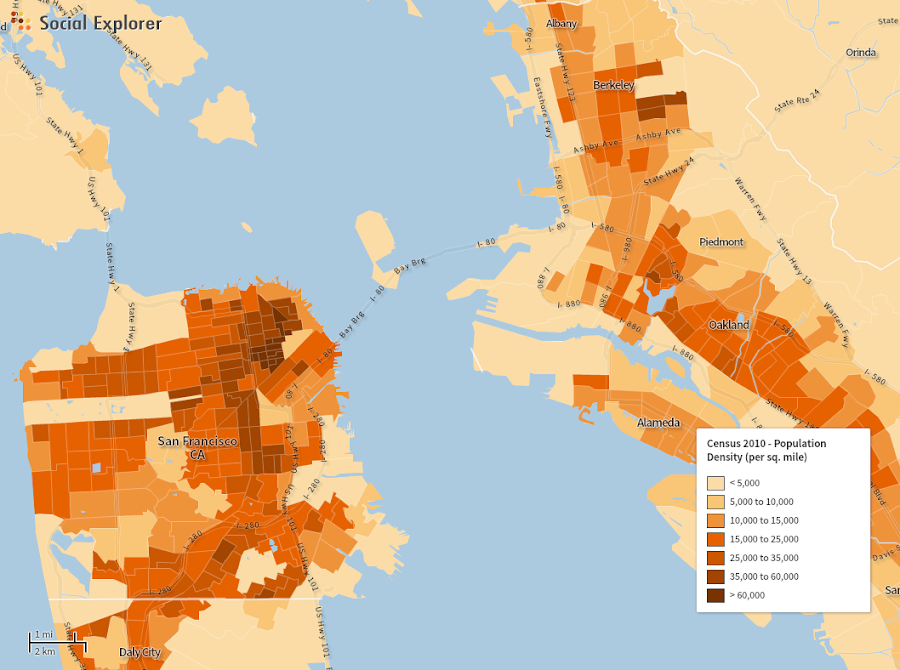
In much of this area ( https://www.nickmcummins.com/index.php/2016/08/08/population... or https://lh4.googleusercontent.com/-qmJMXOTT0B8/UrxtTiDlk4I/A... ) we're talking about densities in excess of 50,000 people per square mile. I don't see that being practical when one factors in things like sidewalks and roads without building up - which works against the mini house idea presented.
In much of this area ( https://www.nickmcummins.com/index.php/2016/08/08/population... or https://lh4.googleusercontent.com/-qmJMXOTT0B8/UrxtTiDlk4I/A... ) we're talking about densities in excess of 50,000 people per square mile. I don't see that being practical when one factors in things like sidewalks and roads without building up - which works against the mini house idea presented.
Housing, like healthcare is one of the 3 pillars of a successful community.
What’s the third? Transit?
What’s the third? Transit?
Hello David! Thank you for not only reading my comment but taking the time to think on it
I consider the 3 pillars of a successful community to be : healthcare, education and infrastructure
So the answer to your question is education.
Perhaps naively I bundle transport, roads, internet, bulidings and the like into infrastructure.
What are your thoughts on this classification?
I consider the 3 pillars of a successful community to be : healthcare, education and infrastructure
So the answer to your question is education.
Perhaps naively I bundle transport, roads, internet, bulidings and the like into infrastructure.
What are your thoughts on this classification?
What’s the third?
I'm here to tell you that I've figured out the problem you guys are having out there.
I think the reason you're having some issues is that you have a globally important city with an absolutely massive jobs base and huge skyscrapers full of people working, and the rest of the city is full of tiny wood framed 1-3 story houses that each have one car garages on the first floor.
So, maybe, like, let people build fucking apartment buildings.
Just an idea.