SpaceX, Blue Origin, Dynetics win contracts to land astronauts on moon(washingtonpost.com)
washingtonpost.com
SpaceX, Blue Origin, Dynetics win contracts to land astronauts on moon
https://www.washingtonpost.com/technology/2020/04/30/jeff-bezos-elon-musk-win-contracts-spacecraft-land-nasa-astronauts-moon/
83 comments
Probably the biggest bit of information in this article is that Boeing submitted a proposal that was rejected. You launch a defective plane, a defective crew module and then repeatedly miss deadlines and budgets for a booster. That appears to be more than the company's lobbyists can overcome!
Boeing was also a bidder for a recent cargo-to-the-lunar-gateway contract. 4 bidders, Boeing's bid was judged defective as well as having the highest cost.
... and the source selection document for this bid makes it seem like Boeing again submitted an invalid bid.
The latest Aviation Week podcast on the dumped $4B plus Boeing M&A deal for the commercial arm of a Brazilian smaller player has one industry insider analyst put positive spin on the 737MAX8. Business as usual.
The deadline for this moon landing is 2024; most space followers agree that it's a crazy deadline. It's 3 years away! It's even crazier when you consider that the lander hardware has not even been designed, let alone built, tested, certified and man-rated.
Blue Origin has made a few public statements about having ideas (and maybe even designs) for a lunar lander. However, given their current rate-of-progress, I doubt that they could finish it within the time remaining.
SpaceX has built man-rated spacecraft; also they have extensive experience of propulsive landings and re-usable launchers. Also, they have a reputation for making fast progress. They're clearly the front-runners here and I think they're the safest bet to succeed. Still unlikely for 2024 though.
Dynetics is partnered with Sierra Nevada who also have experience of building spacecraft. However their craft have never been flown manned and their speciality is in winged, aerodynamic reentry; something which is not necessary on the moon. Also, their rate of progress is glacial; I consider it very unlikely that they will be able to design, build, test and certify any kind of lunar craft before 2030 at the earliest.
Blue Origin has made a few public statements about having ideas (and maybe even designs) for a lunar lander. However, given their current rate-of-progress, I doubt that they could finish it within the time remaining.
SpaceX has built man-rated spacecraft; also they have extensive experience of propulsive landings and re-usable launchers. Also, they have a reputation for making fast progress. They're clearly the front-runners here and I think they're the safest bet to succeed. Still unlikely for 2024 though.
Dynetics is partnered with Sierra Nevada who also have experience of building spacecraft. However their craft have never been flown manned and their speciality is in winged, aerodynamic reentry; something which is not necessary on the moon. Also, their rate of progress is glacial; I consider it very unlikely that they will be able to design, build, test and certify any kind of lunar craft before 2030 at the earliest.
> It's 3 years away!
Or closer to 5 years away ( rounded up ) if you consider that 2024 also includes a december 31st as well as a january 1st.
> It's even crazier when you consider that the lander hardware has not even been designed, let alone built, tested, certified and man-rated.
You are talking about a technology that's more than 50 years old.
This isn't a time or technology issue. There's plenty of time and moon landings have been done before. It's really a business issue. It seems like the industry has come up with a business case for it ( I'm guessing space tourism initially followed up by mining perhaps ).
Or closer to 5 years away ( rounded up ) if you consider that 2024 also includes a december 31st as well as a january 1st.
> It's even crazier when you consider that the lander hardware has not even been designed, let alone built, tested, certified and man-rated.
You are talking about a technology that's more than 50 years old.
This isn't a time or technology issue. There's plenty of time and moon landings have been done before. It's really a business issue. It seems like the industry has come up with a business case for it ( I'm guessing space tourism initially followed up by mining perhaps ).
Its 4.5 years to the end of 2024. Not a crazy deadline, but not easy either.
Maybe with this, SpaceX will focus more on development of their actual Starship+SuperHeavy, rather than mostly focusing on mass production set-up.
Anyway, this it really exciting news.
Maybe with this, SpaceX will focus more on development of their actual Starship+SuperHeavy, rather than mostly focusing on mass production set-up.
Anyway, this it really exciting news.
Mass production of Starship is essential to their strategy. The way in which you build a one-off rocket is totally different from how you build an assembly line of rockets. This is more true of rockets than any other industry. I'm talking about what materials are used, how they are shaped, etc. Look at all the "weird" stuff SpaceX is doing with Starship (stainless steel tanks, the types of welds they're doing, etc.) and you wouldn't want to be doing it that way unless you were manufacturing a rocket assembly line.
So it seems smart to say, "why don't they just build and test one, then figure out how to manufacture it at scale?" But to do that would be even harder because you'd have to redesign everything from scratch the second time around, while maintaining component compatibility... much smarter to design for manufacturing from the get-go and treat the test articles as expendable.
BTW, ULA is doing something similar with Vulcan & Centaur V. The design of the rocket itself is deeply related to the assembly line they are producing.
So it seems smart to say, "why don't they just build and test one, then figure out how to manufacture it at scale?" But to do that would be even harder because you'd have to redesign everything from scratch the second time around, while maintaining component compatibility... much smarter to design for manufacturing from the get-go and treat the test articles as expendable.
BTW, ULA is doing something similar with Vulcan & Centaur V. The design of the rocket itself is deeply related to the assembly line they are producing.
> Mass production of Starship is essential to their strategy.
Yep, but if a "quickly" built Starship lander makes SpaceX a few billions, so they can invest it into the Mars program, then that may be a good option. For the same reason they are doing the Starlink network.
Yep, but if a "quickly" built Starship lander makes SpaceX a few billions, so they can invest it into the Mars program, then that may be a good option. For the same reason they are doing the Starlink network.
On the other hand if spacex gets massproduction and reusability right then they can provide any number of rides for NASA/the other participants while only paying for fuel costs and pocket the difference.
Agreed... Mass production needs to be designed-in and developed with the whole system.
Related question: Just how many Starships do you think will be necessary to fulfill all our launch demands? Given that it's designed to be reusable and it has a huge payload capacity, perhaps there is less need to mass-produce them, since fewer vehicles will be able to do the same job as many expendable vehicles...?
Related question: Just how many Starships do you think will be necessary to fulfill all our launch demands? Given that it's designed to be reusable and it has a huge payload capacity, perhaps there is less need to mass-produce them, since fewer vehicles will be able to do the same job as many expendable vehicles...?
That's a question about demand. My goal is to move all resource extraction and heavy industry off-Earth, and to open the space frontier to permanent and self-sufficient human settlements. For that many, many Starships will be required.
Note that the killer feature of Starship, IMHO, is in-space refueling. This isn't a Earth-based heavy-life vehicle... it's a re-configurable spaceship able to explore the entire solar system through fuel depot staging (with Starships themselves serving as both tankers and fuel stations).
Note that the killer feature of Starship, IMHO, is in-space refueling. This isn't a Earth-based heavy-life vehicle... it's a re-configurable spaceship able to explore the entire solar system through fuel depot staging (with Starships themselves serving as both tankers and fuel stations).
I think launch demands might expand to fit the capacity. It’s hard to predict what uses people will put a new technology to.
“I think there is a world market for maybe five computers.” -- Thomas Watson, chairman of IBM, 1943.
“I think there is a world market for maybe five computers.” -- Thomas Watson, chairman of IBM, 1943.
Plan is to get a million people to Mars within a few decades. You can only fly every other year when orbits sync up. Initially, I imagine many Starships will stay on Mars as shelter and raw material.
Then there is the idea of using Starships for very fast transport on earth. Fly from NYC to Sydney in half an hour. If that catches on, they may be replacing part of the airplane fleet.
Then there is lunar shuttle services, satellite transports and asteroid mining.
My guess is: a lot.
Then there is the idea of using Starships for very fast transport on earth. Fly from NYC to Sydney in half an hour. If that catches on, they may be replacing part of the airplane fleet.
Then there is lunar shuttle services, satellite transports and asteroid mining.
My guess is: a lot.
It's not just re-usability, but turn around time as well.
When the project management at the top level is committed to unrealistic deadlines, it makes realistic engineering hard at all lower levels. Given that nature cannot be fooled, this combination of factors tends toward failure.
Kennedy committed to reaching the moon within 8.75 years in March of 1961, when the USA had a total of 15 minutes of experience in human spaceflight, all suborbital. They hadn't even decided what architecture would get them there.
They succeeded, and this is far less ambitious.
They succeeded, and this is far less ambitious.
The Apollo program also killed people. https://en.wikipedia.org/wiki/Apollo_1
Taking risks is reasonable, but in the end this is still a vanity project. IMO, figuring out how to do self sustaining spaceships / habitats is much more useful long term than going back to the moon using giant chemical rockets, stored food and oxygen etc. Even just orbiting Mars and coming back without landing would be a new achievement.
Taking risks is reasonable, but in the end this is still a vanity project. IMO, figuring out how to do self sustaining spaceships / habitats is much more useful long term than going back to the moon using giant chemical rockets, stored food and oxygen etc. Even just orbiting Mars and coming back without landing would be a new achievement.
Chemical rocket are the right technology for the inner solar system. And big one and specially reusable have advantages and we know nothing that could potentially be cheaper.
Part of this whole moon approach is absolutely about sustaining the long term. Have you ever read the Artemis program concepts? It is very much about using commercial capability to develop moon resources.
You can't start with producing food, if you make the system depended on that it will fail. One you can actually land on the moon or mars with SIGNIFICANT payloads you can actually start to test out system for large scale food growing and things like that.
Part of this whole moon approach is absolutely about sustaining the long term. Have you ever read the Artemis program concepts? It is very much about using commercial capability to develop moon resources.
You can't start with producing food, if you make the system depended on that it will fail. One you can actually land on the moon or mars with SIGNIFICANT payloads you can actually start to test out system for large scale food growing and things like that.
Getting to Mars on chemical rockets is not that bad, especially if you can accept a launch window every 15 years. Getting people to and back from low Mars orbit with chemical rockets on a more flexible schedule takes a lot more fuel. It’s clearly viable, but for that kind of DeltaV across such a long trip, solar powered Ion thrusters have several significant advantages.
As to growing food, for on a single mission it’s not that critical, but if you’re sending several missions to Mars unused supplies from one mission can be used on the next mission. Further, the difference between survival and comfort adds up to a lot of food.
As to growing food, for on a single mission it’s not that critical, but if you’re sending several missions to Mars unused supplies from one mission can be used on the next mission. Further, the difference between survival and comfort adds up to a lot of food.
You can go every 26 month. If you can produce fuel on Mars going back is way easier then going from Earth to Mars. You don't go from Mars Orbit, you take of from the surface directly to earth where you aerobrake. No Orbit operation on Mars needed.
> It’s clearly viable, but for that kind of DeltaV across such a long trip, solar powered Ion thrusters have several significant advantages.
Not really. The only potential use for ion thrusters is for cargo transport that is not time depended. If you do that you need to figure out how to do the landing, so the complexity is just higher. The thrust is just to low compared to a few powerful chemical engines. If you can refuel in earth orbit for cheap you are gone be way better off with chemical.
If you move on from chemical, nuclear thermal is by far the best option.
Food is really not the problem. The mass of food needed for humans is pretty small. Clearly you want to produce food on Mars eventually but its not a priority for the first 5 to 10 years. Refuel on Mars is by far the biggest mass saver.
> It’s clearly viable, but for that kind of DeltaV across such a long trip, solar powered Ion thrusters have several significant advantages.
Not really. The only potential use for ion thrusters is for cargo transport that is not time depended. If you do that you need to figure out how to do the landing, so the complexity is just higher. The thrust is just to low compared to a few powerful chemical engines. If you can refuel in earth orbit for cheap you are gone be way better off with chemical.
If you move on from chemical, nuclear thermal is by far the best option.
Food is really not the problem. The mass of food needed for humans is pretty small. Clearly you want to produce food on Mars eventually but its not a priority for the first 5 to 10 years. Refuel on Mars is by far the biggest mass saver.
Individual ion engines have been built up to 1.1 lbf for 100kw. Over 2 weeks that’s 9.8m/s * 60 * 60 * 24 * 14/ mass that’s 1.2 km/s for a 10,000 lb spacecraft. And nothing says you can’t use more for a larger spacecraft.
For comparison the ISS’s solar panels are over a decade old and still generate 240kW in direct sunlight. So, you could easily reuse those panels for multiple trips, though power output is cut in half near Mars.
For comparison the ISS’s solar panels are over a decade old and still generate 240kW in direct sunlight. So, you could easily reuse those panels for multiple trips, though power output is cut in half near Mars.
Well, if you want to know whether it's worth the risk, I think the best people to ask are the astronauts, and they are chomping at the bit to go.
As far as I can see, there isn't much point to going around Mars just to go. You could just go to a high Earth orbit (or Lagrange point), and gain similar experience, with better communication. The ISS has spent 20 years in low-earth orbit; we're not going to learn much more from it or a similar station.
As far as I can see, there isn't much point to going around Mars just to go. You could just go to a high Earth orbit (or Lagrange point), and gain similar experience, with better communication. The ISS has spent 20 years in low-earth orbit; we're not going to learn much more from it or a similar station.
Apollo 8 and 10 both went to the moon without landing, doing that on a multiple year mission does seem wasteful. However, there are a host of things to test.
From an engineering perspective going to mars orbit means far less sunlight which means a host of new problems. An engine and fuel system to get there would be new and could also be used to send a lander for future missions.
IMO, the Moon might be closer, but Mars is a much better target for long term colonization due to an atmosphere, shorter day, higher gravity, etc.
From an engineering perspective going to mars orbit means far less sunlight which means a host of new problems. An engine and fuel system to get there would be new and could also be used to send a lander for future missions.
IMO, the Moon might be closer, but Mars is a much better target for long term colonization due to an atmosphere, shorter day, higher gravity, etc.
The Moon could be the starting point for Mars colonization. Also, it would make a huge difference if the new Moon missions took advantage of the ISS, which the Apollo missions couldn't count on. One thing is bringing all crew, supplies and equipment from Earth in one trip, and a whole different thing is sending everything on/around the ISS using unmanned cargo missions, then assemble the lunar mission ships up there and send the Moon astronauts when necessary.
In other words: Earth<->ISS, then ISS<->Moon<->Mars and/or ISS<->Mars.
For Mars you want people to go up last so they minimize the time spent in zero g. Docking supplies on the ISS is also pointless.
The ISS is not in a useful orbit for a Mars trip and whatever your sending there can make the trip in the same thing you send into orbit. Trying to shoehorn in the ISS just make the trip more expensive and complex.
The ISS is not in a useful orbit for a Mars trip and whatever your sending there can make the trip in the same thing you send into orbit. Trying to shoehorn in the ISS just make the trip more expensive and complex.
I agree that Mars is better, but Starship is for Mars. If NASA pays for development, that is moving much closer.
You meant lower gravity, right? Mars is smaller then Earth.
Sounded like his comparisons were for Mars vs. the moon.
The US also devoted up to 4.5% of its federal budget for the task (https://storage.googleapis.com/dbc2017/April/April%2011%20NA...) when the current budget is half of a percent. The priorities are definitely not the same
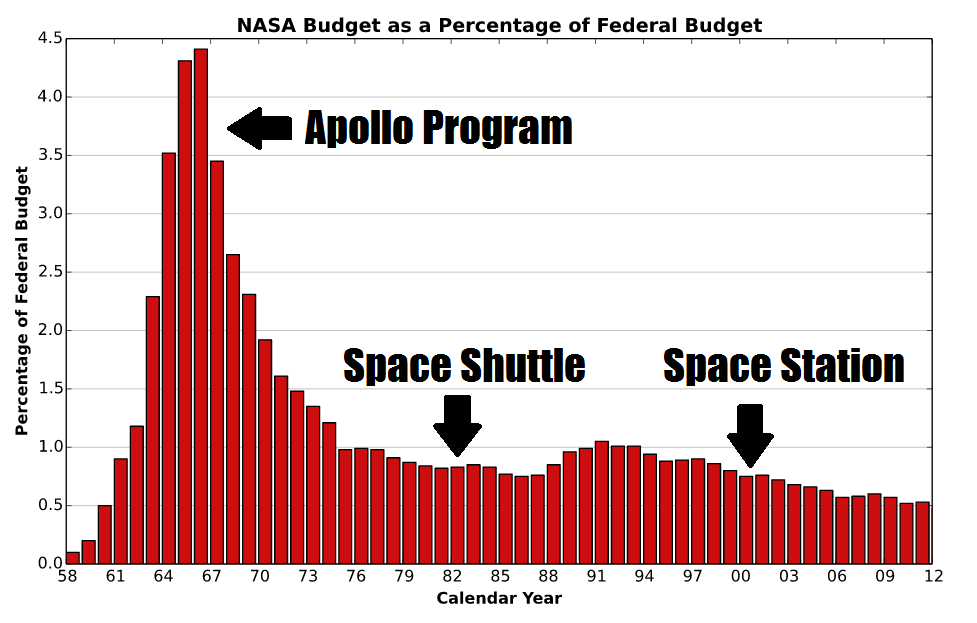
Whenever somebody uses % of budget as an argument I just shake my head.
% of budget is a good proxy to estimate intentions
You don't buy rockets with intentions.
You don't go to the moon in less 4 years if you don't really commit to it, especially if you haven't been there for 40 years
Committing to it could be done within the NASA budget. This currently is not even the majority of the NASA budget. Its only bit more then half of the human budget.
So the argument that 'you can only do this when the government gives NASA military budget' is just nonsense.
So the argument that 'you can only do this when the government gives NASA military budget' is just nonsense.
Remember that the SLS is what will be used to launch the Artemis missions. Starship & Superheavy are not in the picture at all for this work, even though they would be able to do the job and at a much lower price.
Additionally, I doubt that Starship or SuperHeavy will be ready by 2024; flying, maybe, but reliable enough for manned missions? I don't think so.
Additionally, I doubt that Starship or SuperHeavy will be ready by 2024; flying, maybe, but reliable enough for manned missions? I don't think so.
The article says that the SpaceX submission is for Starship.
I think that’s doable in 4.5 years. They expect to fly and land an unmanned prototype upper stage this year. A manned upper stage up to 4 years later doesn’t seem unreasonable. They reckon the upper stage is that hardest part, the first stage should be much simpler.
I think that’s doable in 4.5 years. They expect to fly and land an unmanned prototype upper stage this year. A manned upper stage up to 4 years later doesn’t seem unreasonable. They reckon the upper stage is that hardest part, the first stage should be much simpler.
A lot depends on the ability to refuel in orbit. To do that they’ll need multiple starships flying, and to have worked out the kinks in orbital refuelling. It might sound trivial, but it’s never been done before.
There is a reason SpaceX is not just designing one 'bespoke' rocket. Elon has said over and over again that the real challenge is producing these in large numbers and cheaply.
They will actually have to prove out refueling pretty soon under the NASA contract.
And SpaceX bid also includes flying the system many times until 2024.
So SpaceX will have to do a lot of flights and demonstrate all this stuff to have a shot at this. So it is good that they are going right into mass production that is the only way they can prove all these different things until 2024.
They will actually have to prove out refueling pretty soon under the NASA contract.
And SpaceX bid also includes flying the system many times until 2024.
So SpaceX will have to do a lot of flights and demonstrate all this stuff to have a shot at this. So it is good that they are going right into mass production that is the only way they can prove all these different things until 2024.
>* the SLS is what will be used to launch the Artemis missions*
That seems overly optimistic for a system that is now a year and a half past it's original target launch date and has a current target date of late next year.
That seems overly optimistic for a system that is now a year and a half past it's original target launch date and has a current target date of late next year.
The original launch for SLS was supposed to be 2016. But I agree, the dependency on SLS is not great.
I expect there will be more than one launch system and more than one moon landing system, provided by private companies.
Seems to work great for satellite launch and ISS supply mission. Why not for moon transport?
Seems to work great for satellite launch and ISS supply mission. Why not for moon transport?
If Spacex can get Starship flying in the next three years, I would think they could meet this deadline. Unlike Mars, there aren't the same launch window requirements.
Even if Starship isn't flying, Falcon Heavy is the best we have today. It would seem that if anyone is going to meet this deadline, it'll be Spacex.
Even if Starship isn't flying, Falcon Heavy is the best we have today. It would seem that if anyone is going to meet this deadline, it'll be Spacex.
AFAIK you could do it with multiple Falcon Heavy launches (with in orbit rendezvous) and something to put a Dragon on top of that would act like the Lunar descent stage. Then you could use Dragon as the ascent and return stage. You'd probably have an orbital module too since going to/from the Moon in just a Dragon would probably be too cramped.
Everything but the Dragon and the Falcon boosters would be expendable, but that's more reusability than Saturn V.
Everything but the Dragon and the Falcon boosters would be expendable, but that's more reusability than Saturn V.
Here's an article from NASA with more description of what they're building:
https://www.nasa.gov/feature/nasa-selects-blue-origin-dyneti...
https://www.nasa.gov/feature/nasa-selects-blue-origin-dyneti...
In this project, Blue Origin is working with Lockheed Martin and Northrop Grumman, while Dynetics is partnered with Sierra Nevada Corp. So it makes sense that Blue Origin received a much larger chunk of money than SpaceX - they're somewhat unproven in the space, but are partnered with experienced firms that have been there before and are more likely to deliver. And SpaceX is probably going to do whatever they plan to do with or without the contract money. I'm interested in seeing what Dynetics is up to... as I'm sure are a few others.
Interesting times right now.
Interesting times right now.
> they're somewhat unproven in the space, but are partnered with experienced firms that have been there before and are more likely to deliver.
I disagree with this characterization. I think SpaceX is more likely to deliver. The old dinosaurs are years behind and billions over budget on projects like SLS. SpaceX is the surest bet. They weren't five years ago but they are now.
I disagree with this characterization. I think SpaceX is more likely to deliver. The old dinosaurs are years behind and billions over budget on projects like SLS. SpaceX is the surest bet. They weren't five years ago but they are now.
It's common for specialty contracts (aerospace, nuclear, defense etc) to be awarded based on need. The government is conscious of how competitive the industry is, and tries to keep several firms alive in any one sector regardless of who is delivering more value. Sometimes it results in questionable choices.
They don't create contracts just to keep companies afloat (not without a lot of lobbying, anyway), but they will give a lot more money even if companies are losing money to wild incompetence. Westinghouse is a good example. They may be literally losing blueprints to nuclear reactors, but there aren't many other companies that can make reactors in the first place, and in the slim chance the government suddenly needs to make a lot (eg every sub sinks at once), they really don't like relying on unproven designs and manufacturers.
They don't create contracts just to keep companies afloat (not without a lot of lobbying, anyway), but they will give a lot more money even if companies are losing money to wild incompetence. Westinghouse is a good example. They may be literally losing blueprints to nuclear reactors, but there aren't many other companies that can make reactors in the first place, and in the slim chance the government suddenly needs to make a lot (eg every sub sinks at once), they really don't like relying on unproven designs and manufacturers.
Military-industrial complex, reinvented. Instead of most contracts going to Lockheed Martin and Northrop Grumman, they now go to companies such as Blue Origin who are partnered with them.
Definitely a big win for newspace, although I think it's a bit bizarre (and perhaps self-serving for Bezos) that the headline only mentions 2 of the 3 companies that got awards
First, Blue Moon is doing some really interesting things with regularizing access to the Moon. Clear adapters, clear pricing, it's as much a leap forward as what SpaceX has done with regularizing access to orbit.
From a scale standpoint, it also plays it safe. No exponential increase in tonnage over Apollo, but an exponential increase in costs and private access. That's all interesting as all hell, and props to the Blue Origin team.
Second, Starship is just insanely fucking cool. It's maybe one of the most ambitious generation on generation leaps ever attempted, by any team of human beings ever. It's aiming to skip from the Bronze Age to the Industrial Age overnight. The sheer scale of ambition is just breathtaking.
Dynetics, on the gripping hand, is... yet another government contractor. Taking a government contract. Developing a paint by numbers solution. Again. Just like SLS. And the Space Shuttle. And Constellation. And Ares. And every other slab of corporate welfare has doled out over the past 40 years.
To project my opinions onto OP, I can't imagine Dynetics' contribution here is getting anyone too hot and bothered.
From a scale standpoint, it also plays it safe. No exponential increase in tonnage over Apollo, but an exponential increase in costs and private access. That's all interesting as all hell, and props to the Blue Origin team.
Second, Starship is just insanely fucking cool. It's maybe one of the most ambitious generation on generation leaps ever attempted, by any team of human beings ever. It's aiming to skip from the Bronze Age to the Industrial Age overnight. The sheer scale of ambition is just breathtaking.
Dynetics, on the gripping hand, is... yet another government contractor. Taking a government contract. Developing a paint by numbers solution. Again. Just like SLS. And the Space Shuttle. And Constellation. And Ares. And every other slab of corporate welfare has doled out over the past 40 years.
To project my opinions onto OP, I can't imagine Dynetics' contribution here is getting anyone too hot and bothered.
> No exponential increase in tonnage over Apollo, but an exponential increase in costs and private access.
When you say "exponential" here, are you using it as a confusing synonym for "really big"? Or is there something increasing exponentially, i.e. at a rate proportional to its current value? If it's the second one, it would be incredibly interesting to see where the exponential nature of that growth is coming from.
When you say "exponential" here, are you using it as a confusing synonym for "really big"? Or is there something increasing exponentially, i.e. at a rate proportional to its current value? If it's the second one, it would be incredibly interesting to see where the exponential nature of that growth is coming from.
I couldn't find total mass for Blue Moon but could they just put it on top of Falcon Heavy and call it done? This article about using Falcon Heavy for Orion seems to imply it's at least plausible.
https://hackaday.com/2019/03/25/could-orion-ride-falcon-heav...
https://hackaday.com/2019/03/25/could-orion-ride-falcon-heav...
This also implies New Glenn won't be ready in time, or human rated in time, for 2024. New Glenn is supposed to be even more powerful than the Falcon Heavy.
That said, even if they could have New Glenn ready , it's probably super smart to tie themselves to some of the legacy aerospace companies.
It aligns a whole lot of lobbyists behind Blue Origin's bids, and brings with it a lot of expertise on the bidding process.
Blue Origin's relationship with legacy aerospace feels a lot like Microsoft and IBM.
That said, even if they could have New Glenn ready , it's probably super smart to tie themselves to some of the legacy aerospace companies.
It aligns a whole lot of lobbyists behind Blue Origin's bids, and brings with it a lot of expertise on the bidding process.
Blue Origin's relationship with legacy aerospace feels a lot like Microsoft and IBM.
Blue Origin's timelines have been even more inspirational than Musk's. Like.. Blue Origin hasn't even reached orbit yet.
But to Blue Origin's credit, they're less shy about working with others. They're developing the engine for ULA's new rocket (presumably their own competition!), and I doubt they'd have major qualms about launching Blue Moon on a ULA or even SpaceX rocket, once congress is finally able to admit that SLS isn't happening.
But to Blue Origin's credit, they're less shy about working with others. They're developing the engine for ULA's new rocket (presumably their own competition!), and I doubt they'd have major qualms about launching Blue Moon on a ULA or even SpaceX rocket, once congress is finally able to admit that SLS isn't happening.
I bet it'll be ready but par for the course is to lose 2 out of the first 10 launches on a new system. I'd guess that Blue will be flying insurable commsats at that point but not irreplaceable payloads.
This proposal doesn't involve launching humans on New Glenn.
Blue Origin's stuff is intended to optionally launch on Vulcan, which probably means it could also launch on FH.
What are you basing your judgement on Dynetics from?
15m of Googling after seeing the press on this announce - definitely not pretending to be an expert.
But - let's assume that cursory look at primary clients is correct. It appears they're all government agencies. They don't sell much to private business.
The things that make SpaceX and Blue Origin so interesting is that it utterly bucks the government procurement model, making them riskier ventures.
SpaceX and Blue Origin maintain their own product roadmaps, based on their own reading of the marketplace, what technology can do, and their long-term vision.
These other contractors, like Lockheed, General Dynamics, and apparently Dynetics, have an inherently mercenary business model. They only respond to contracts already out on the market - there's little to no incentive for them to blaze a path forward.
They win on graft, running up the bill on cost-plus contracts, and taking advantage of the procurement process that wastes trillions.
The defining question to me - why didn't Boeing or Lockheed build reusable rockets?
Blue Moon started work far before this contract awarded a dime. Same with Starship. These guys have made their money off SLS - a snakepit of corruption and waste.
I'd feel the same way about any company that's primarily a government contractor. There's a big difference in approach between the military-industrial companies, and "New Space" companies like Blue Origin and SpaceX.
But - let's assume that cursory look at primary clients is correct. It appears they're all government agencies. They don't sell much to private business.
The things that make SpaceX and Blue Origin so interesting is that it utterly bucks the government procurement model, making them riskier ventures.
SpaceX and Blue Origin maintain their own product roadmaps, based on their own reading of the marketplace, what technology can do, and their long-term vision.
These other contractors, like Lockheed, General Dynamics, and apparently Dynetics, have an inherently mercenary business model. They only respond to contracts already out on the market - there's little to no incentive for them to blaze a path forward.
They win on graft, running up the bill on cost-plus contracts, and taking advantage of the procurement process that wastes trillions.
The defining question to me - why didn't Boeing or Lockheed build reusable rockets?
Blue Moon started work far before this contract awarded a dime. Same with Starship. These guys have made their money off SLS - a snakepit of corruption and waste.
I'd feel the same way about any company that's primarily a government contractor. There's a big difference in approach between the military-industrial companies, and "New Space" companies like Blue Origin and SpaceX.
[deleted]
This question might be a bit naive, but could someone explain to me if the SpaceX illustration (https://www.nasa.gov/sites/default/files/styles/full_width/p...) is feasible at all? From the (many, oh, so many) hours of KSP I've played landing legs seem to be the way to go with an uneven and uncertain and especially slightly sloped landing surface and not a flat rocket underside. Or is there any explanation how Space Ships are supposed to land? Thanks Thanks

That’s a really early render, from back when starship was going to be made from composite materials. At that time they hadn’t figured out the landing leg system, and anyway it’s changed several times since.
So launch on Orion+SLS then transfer over to Starship for the last mile? What a crazy plan.
Unlike Crew Dragon, Starliner, Soyuz and Orion, Starship does not have a launch abort system. From what I hear, NASA now has an institutional allergy against crewed spacecraft without a launch abort system. It's been burned into the culture by the two Space Shuttle disasters.
A second Starship booster can be used to get SLS off the ground as Starship's payload.
I'm waiting for the SLS Heavy, with two starship boosters on the side instead of the SRBs.
Don't give them any ideas!
That's officially part of the plan, because otherwise it would be politically impossible -- but if those things get delayed, which seems likely, NASA could "temporarily" use some other, saner way of getting astronauts to lunar orbit. I suspect that's the real plan.
It seems a little odd that a company which has never achieved orbit was awarded a contract.
I mean that was the case when we've put men on the moon before
Wasn't spaceX's bid 1/4 the price of Blue Origin / Northrup?
[deleted]
I don't see any of these happening. People will demand large investment in biotech after this scare, instead of vanity projects.
“Vanity”. Ha.
I would figure as a member of this forum you’d have a respect for the speed of technical innovation brought about by the 1960’s space race. Why wouldn’t similar improvements occur here for intra-solar and inter-stellar space travel?
Why is it vanity to explore, but “biotech” (which recently seemed to go off the deep end of “augmented bio-humans who are part sci-fi cyborg”) is not? Did “people” “demand” “fintech” after 2007-2010?
Edit: “We choose to go to the moon...” feels just as relevant today as it did in the 1960’s. I want my children to have the opportunity to fly off this pale due dot and look back.
I would figure as a member of this forum you’d have a respect for the speed of technical innovation brought about by the 1960’s space race. Why wouldn’t similar improvements occur here for intra-solar and inter-stellar space travel?
Why is it vanity to explore, but “biotech” (which recently seemed to go off the deep end of “augmented bio-humans who are part sci-fi cyborg”) is not? Did “people” “demand” “fintech” after 2007-2010?
Edit: “We choose to go to the moon...” feels just as relevant today as it did in the 1960’s. I want my children to have the opportunity to fly off this pale due dot and look back.