Japan WWII poison gas agents still scarring people today(mainichi.jp)
mainichi.jp
Japan WWII poison gas agents still scarring people today
https://mainichi.jp/english/articles/20221002/p2g/00m/0na/026000c
70 comments
Random information: the article shows an image from Okunoshima Island. Today, this is also called Rabbit Island. It is chock full of rabbits of all colors. There is also at least one hotel on the island and a little museum that tells the dark past of this island. Rumor has it, the rabbits were used as test subjects for the chemical weapons and were freed after the war, multiplying uncontrolled. Everywhere you look, there is a group of fluffy rabbits.
I’ve been there for a day and it was a nice experience. The museum lacked English explanations for most of its exhibits though. But this was some years ago, may have changed.
The article mentions this as well:
> The tiny island in the Seto Inland Sea off Takehara, Hiroshima Prefecture, is a popular tourist destination known for being the home of hundreds of bunnies, but it was once a "poison gas island" where the Imperial Japanese Army secretly manufactured chemical weapons from around 1930 to the end of the war.
> The tiny island in the Seto Inland Sea off Takehara, Hiroshima Prefecture, is a popular tourist destination known for being the home of hundreds of bunnies, but it was once a "poison gas island" where the Imperial Japanese Army secretly manufactured chemical weapons from around 1930 to the end of the war.
My grand-father was gassed in Verdun (WW I).
All his children had pulmonary problems.
Some of his grand-children also have similar problems.
All his children had pulmonary problems.
Some of his grand-children also have similar problems.
I was doubtful of your implication of a causal relationship between poison gassing of a father and problems passed down genetically. However upon some research I came upon this study, which definitely supports such a relationship:
* https://www.ncbi.nlm.nih.gov/pmc/articles/PMC2917398/
* https://www.ncbi.nlm.nih.gov/pmc/articles/PMC2917398/
This study is a joke. 20 years after exposure. Self reporting exposure. Done by a country with a huge reason to find positive results so bias is a strong possibility. No mechanism for how exposure could result in genetic modification specific to pulmonary issues.
> 20 years after exposure.
Why is this a problem? They have medical records in Iran. It is a developed country.
> Done by a country with a huge reason to find positive results
What reason? This study was done long after the Iran Iraq war.
> No mechanism for how exposure could result in genetic modification specific to pulmonary issues.
Does every study have to explain a mechanism for cause?
Why is this a problem? They have medical records in Iran. It is a developed country.
> Done by a country with a huge reason to find positive results
What reason? This study was done long after the Iran Iraq war.
> No mechanism for how exposure could result in genetic modification specific to pulmonary issues.
Does every study have to explain a mechanism for cause?
[deleted]
How hold are you? Even if he had you in his forties, you would be more than eighty now.
I don't know much about epigenetics, but I would be highly surprised if this had anything to do with that.
I don't know much about epigenetics, but I would be highly surprised if this had anything to do with that.
not necessarily. a lot of the people in WWI were young and lied about their age. say he was 16, so born in 1900. he and this person's dad could have very well had kids at 50 or so, i.e. father born 1950 and the person born in 2000 making him young. though he is probably a bit older than this.
That reminds me of the strange little piece of trivia that the last surviving US Civil War widow died in 2020:
https://www.theguardian.com/us-news/2021/jan/08/last-civil-w...
https://www.theguardian.com/us-news/2021/jan/08/last-civil-w...
The grandson of President John Tyler died at 95 years of age in 2020.
John Tyler was President starting in 1841. It is indeed possible.
John Tyler was President starting in 1841. It is indeed possible.
This has been my go-to "that can't possibly be right" factoid for years. He had two living grandsons the last time someone made me Google it. It looks like one of them indeed passed away in 2020, but the other is still alive albeit no longer in good health[1].
I can never remember when John Tyler was President but he was born in 1790, 232 years ago, which makes it sound even more implausible. We are further in history from the Ice Bucket Challenge than this still-living guy's grandfather's birth was from the end of the American Revolutionary War.
[1]: https://en.wikipedia.org/wiki/Harrison_Ruffin_Tyler
I can never remember when John Tyler was President but he was born in 1790, 232 years ago, which makes it sound even more implausible. We are further in history from the Ice Bucket Challenge than this still-living guy's grandfather's birth was from the end of the American Revolutionary War.
[1]: https://en.wikipedia.org/wiki/Harrison_Ruffin_Tyler
This is truly incredible. The grandson of a president from the 1840's has to bear witness to ... the Tic Tok age and China's growing mind control of the world's population.
Never mind, I had a brain fart and misread gand father for father, and the sibling comment provided a link to a study showing that indeed, mustard gas has a measurable effect on spermogenesis and can increase the rate of respiratory diseases in the victims offspring.
My apologies.
My apologies.
Reminds me of:
https://en.wikipedia.org/wiki/Gruinard_Island
> The island was dangerous for all mammals after experiments with the anthrax bacterium in 1942, until it was decontaminated in the late 20th century.
https://en.wikipedia.org/wiki/Gruinard_Island
> The island was dangerous for all mammals after experiments with the anthrax bacterium in 1942, until it was decontaminated in the late 20th century.
Spooky23(1)
Agent orange has had the same affect, at least in my country
Ref: https://www.smh.com.au/world/agent-orange-caused-damage-to-d...
Ref: https://www.smh.com.au/world/agent-orange-caused-damage-to-d...
Populations living near past conflicts continue to pay the price of that conflict to this day. Mines from the world war, Vietnam, etc continue to harm people today.
It is always the common people that pay the price, there is great documentary about agent orange used in Vietnam war.
It is hard to watch, be aware.
The Vietnam War's Agent Orange legacy | Unreported World - https://www.youtube.com/watch?v=kMzJvwG2rsQ
It is hard to watch, be aware.
The Vietnam War's Agent Orange legacy | Unreported World - https://www.youtube.com/watch?v=kMzJvwG2rsQ
I clicked the link. I regret it. Don’t watch this if you want your Sunday to stay nice.
I wonder what will happen to the SS Richard Montgomery, with 1400 tons of unexploded ordinance.
https://en.wikipedia.org/wiki/SS_Richard_Montgomery
https://en.wikipedia.org/wiki/SS_Richard_Montgomery
Near where I live, there's a kindergarten, and playground where my daughter would often play in. About a year or so ago, an undetonated missile was discovered. It was one of the many bombs dropped on residential areas during firebombing of Tokyo in WWII. The place where it was discovered is right in front of the kindergarten, and very close to the playground. Luckily it was safely extracted away. But kids have been running around that place for decades.
When I went to the University of Kentucky for college I remember hearing from friends who grew up in Richmond, and the surrounding area, about the chemical weapon drills they had (similar to active shooter, fire, tornado, etc). Turns out Richmond had/has a large cache of chemical weapons waiting to be decommissioned and there was always a worry about a leak (due to age or natural disaster).
It appears that as of this year [0] they are finally nearing the completion of decommissioning the weapons but it's crazy to me to how long these just sat without any real work (or very slow work) being done to remove the threat.
[0] https://www.usnews.com/news/best-states/kentucky/articles/20...
It appears that as of this year [0] they are finally nearing the completion of decommissioning the weapons but it's crazy to me to how long these just sat without any real work (or very slow work) being done to remove the threat.
[0] https://www.usnews.com/news/best-states/kentucky/articles/20...
> crazy to me how long these just sat without any real work
You must not be very familiar with the speed of government work.
You must not be very familiar with the speed of government work.
I'm still amazed that chemical weapons weren't used in a widespread way during world war 2 (compared to, say, world war 1). Several of the nations involved in that war were fighting a war of extermination against somebody, and almost every other war crime you can imagine was commonplace.
World War 1 must have really scarred everybody.
World War 1 must have really scarred everybody.
Hitler famously refused to use the sarin gas his scientists developed based on an experience he had in WWI.
https://www.washingtonpost.com/news/retropolis/wp/2017/04/11...
https://www.washingtonpost.com/news/retropolis/wp/2017/04/11...
Turns out chemical weapons are tactically garbage and nobody actually can use them effectively, which is the true reason the ban on them is upheld.
I believe you’re referring to this article which makes the point https://acoup.blog/2020/03/20/collections-why-dont-we-use-ch..., though with a slightly different conclusion: it says that chemical weapons are useless for a top tier modern army, because top tier modern opponents can easily protect against them, and other opponents are better targeted using conventional means. But for armies that are not top-tier modern armies, they still make sense and are still in use.
My heart goes out to the Aotsuka family.
Thankfully, research, development and deployment of chemical/biological weapons are heavily restricted and regulated in most developed nations. If do we not learn from the past we're doomed to repeat it. Only through education and awareness can we prevent this type of tragedy from occurring again.
Thankfully, research, development and deployment of chemical/biological weapons are heavily restricted and regulated in most developed nations. If do we not learn from the past we're doomed to repeat it. Only through education and awareness can we prevent this type of tragedy from occurring again.
The article mentions almost offhandedly that the substance was buried no longer ago than 1993. Surely that must have been illegal? Is anyone investigating that?
This is absolutely devastating to read and truly reminds me not to be a war monger.
garmanarnar(4)
one of the clearest examples of "privatize the profits, socialize the losses."
Which profits are those? The article seems to indicate that the factory was operated by the Japanese army.
From the article (sounds very speculative though):
> Why the chemical agent was buried in Kamisu has not yet been clarified by government investigations. Some believe that during the chaotic years following the war, the substance was sold and eventually transported to the city.
> Why the chemical agent was buried in Kamisu has not yet been clarified by government investigations. Some believe that during the chaotic years following the war, the substance was sold and eventually transported to the city.
Well in that case it isn't strictly 'profit' but rather just benefit. In the same way that antisocial urban development isn't necessarily profitable per se, it just allows the people doing it to reap all the benefits while pushing the burden onto society as a whole.
Why do countries invade others? It's often portrayed as being for the greater good of the attacker, restoring their territorial integrity. But let's be honest, you don't spend billions if you're not getting anything in return other than pissed off invadees - it's for profit.
I mean, they are pretty honest about. Land is how countries make money. Its not a secret.
In the 1700s, maybe; today profit comes from fragile human and physical capital that don't like having bombs dropped on them.
Let's look at some numbers. Ukraine, a largely agriculture country, is one of the strongest possible cases for your thesis. So consider net Ukrainian raw materials exports: <https://wits.worldbank.org/CountryProfile/en/Country/UKR/Yea...>
Around $18 billion in 2019. To gain partial control of that revenue stream, Russia has largely smashed up the military it spends $50-$60 billion a year on. It's not a good trade.
You might protest that land also has factories and such on it, and that's true, but today many of those factories look like this:
<https://gdb.rferl.org/07520000-0aff-0242-a90c-08da3a5a2c06_w...>
Launching wars of aggression is a bad idea because killing people and taking things that don't belong to you is wrong. But if that fails to persuade, recall that it's also a financial catastrophe, for both sides.
(Edit: formatting)
Let's look at some numbers. Ukraine, a largely agriculture country, is one of the strongest possible cases for your thesis. So consider net Ukrainian raw materials exports: <https://wits.worldbank.org/CountryProfile/en/Country/UKR/Yea...>
Around $18 billion in 2019. To gain partial control of that revenue stream, Russia has largely smashed up the military it spends $50-$60 billion a year on. It's not a good trade.
You might protest that land also has factories and such on it, and that's true, but today many of those factories look like this:
<https://gdb.rferl.org/07520000-0aff-0242-a90c-08da3a5a2c06_w...>
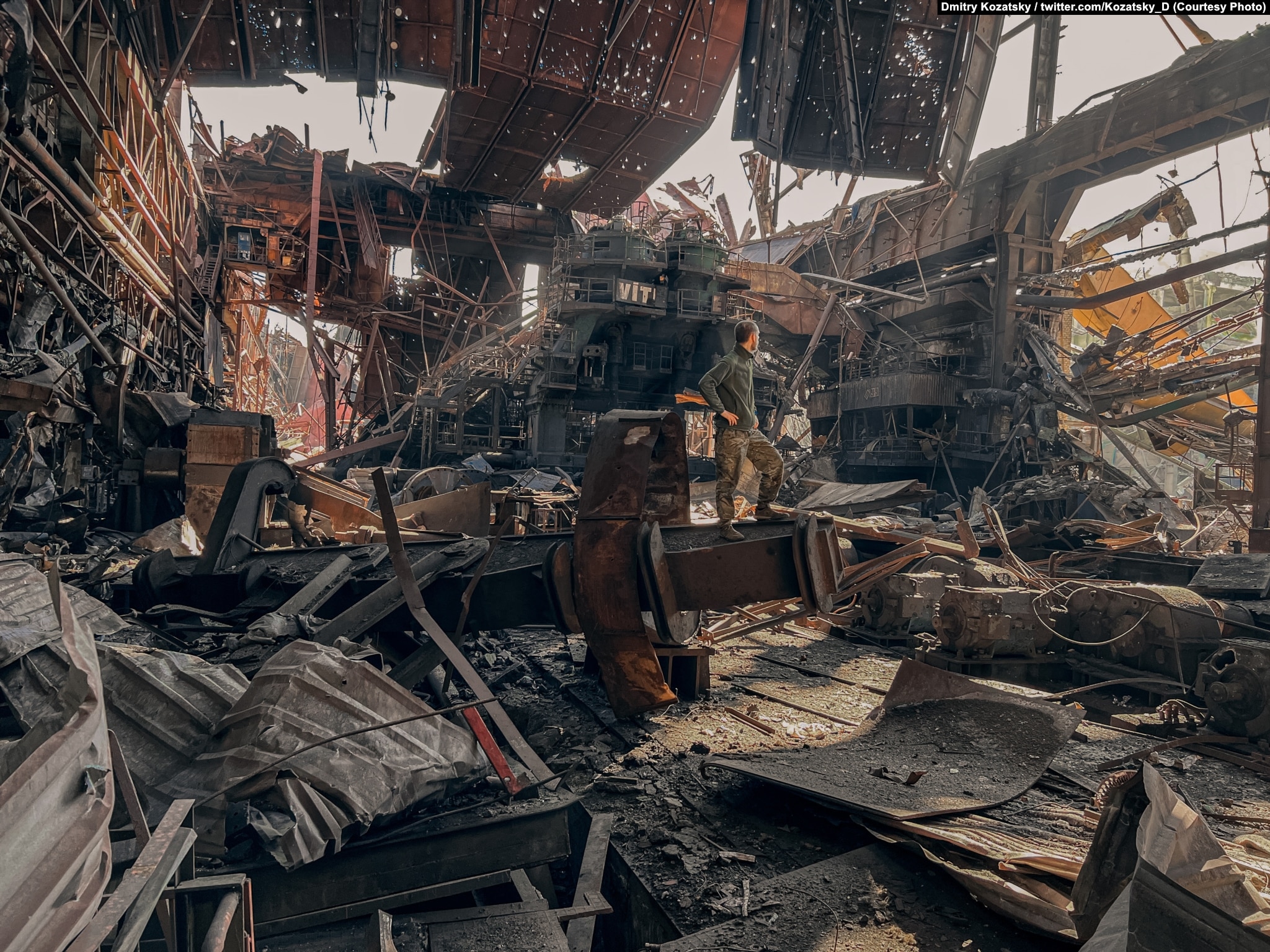
Launching wars of aggression is a bad idea because killing people and taking things that don't belong to you is wrong. But if that fails to persuade, recall that it's also a financial catastrophe, for both sides.
(Edit: formatting)
> Around $18 billion in 2019. To gain partial control of that revenue stream, Russia has largely smashed up the military it spends $50-$60 billion a year on. It's not a good trade.
With my deeply cynical hat on...
I mean, if they keep the territory (which seems unlikely at this moment), they get that revenue, so good for them?
They also got to clear out their stores of old munitions, and run a sales demo for newer munitions. Might have been a better demo if the campaign didn't go sideways, though. Either way, lots of business for domestic producers of munitions to resupply.
With my deeply cynical hat on...
I mean, if they keep the territory (which seems unlikely at this moment), they get that revenue, so good for them?
They also got to clear out their stores of old munitions, and run a sales demo for newer munitions. Might have been a better demo if the campaign didn't go sideways, though. Either way, lots of business for domestic producers of munitions to resupply.
> Ukraine, a largely agriculture country
Where a whole bunch of natural gas was recently discovered (Crimea specificly).
To be clear though, i'm not saying that its always direct. Plenty of things can be strategically valuable but not instantly translatable to $$$. Even businesses don't always do things for the short term profit exclusively - sometimes long term matters.
Where a whole bunch of natural gas was recently discovered (Crimea specificly).
To be clear though, i'm not saying that its always direct. Plenty of things can be strategically valuable but not instantly translatable to $$$. Even businesses don't always do things for the short term profit exclusively - sometimes long term matters.
Ukraine also has some of the best agricultural land in the world, which nets exports of around $18bn. Hard to argue that’s not about the land. Then there’s the big one; Putin believes that land belongs to him. Once you get into squishy questions like how much is it worth to get your thing back from someone the financial calculus becomes much harder.
[deleted]