Shouldn't distant objects appear magnified?(astronomy.stackexchange.com)
astronomy.stackexchange.com
Shouldn't distant objects appear magnified?
https://astronomy.stackexchange.com/questions/54499/shouldnt-very-very-distant-objects-appear-magnified
140 comments
Makes me think of this : https://en.m.wikipedia.org/wiki/Terrell_rotation
How when going at relativistic speeds, you start to appear to rotate to obervers even if you are going straight - you can even see behind the object!
How when going at relativistic speeds, you start to appear to rotate to obervers even if you are going straight - you can even see behind the object!
Reminds me of this video https://www.youtube.com/watch?v=ge_j31Yx_yk explaining the Terrel rotation (and other effects) in a video game engine.
I have this vague memory that Carl Sagan did similar in _Cosmos_, with motorcycles.
Took me a minute to wrap my head around it, that explanation isn't worded that clearly, but then I got it.
That happens because time is a factor in how light from different parts of the object will reach the observer. Light from its far side takes longer and in that time the object continues to move. You can see behind the object, because its rear end moves out of the way of the light coming from itself during the travel time of that light.
That happens because time is a factor in how light from different parts of the object will reach the observer. Light from its far side takes longer and in that time the object continues to move. You can see behind the object, because its rear end moves out of the way of the light coming from itself during the travel time of that light.
How does the rear end move out of the way? Wouldn't it be blocking the light? It's not like the object could move out of the way faster than the speed the light it traveling at (ftl)
> It's not like the object could move out of the way faster than the speed the light it traveling at (ftl)
It doesn't need to move as far as the light does.
It doesn't need to move as far as the light does.
(Not GP)
Thank you, that made it click for me!
Thank you, that made it click for me!
That's amazing. I've watched lots of videos about length contraction and I don't think any of them ever mentioned this (the shape of an object moving a near light speed won't change to an observer, it will just appear as if it had rotated instead of being "squeezed" as every video about this seems to imply)!
This video might change your perceptive.
https://youtu.be/watch?v=uTyAI1LbdgA
https://youtu.be/watch?v=uTyAI1LbdgA
You rather showed the opposite. While interesting, this video only explains length contraction, not the Terrell–Penrose effect. In this video, the passing spaceship would appear to be rotated to the observer, not just contracted, as, to quote Penrose via Wikipedia, the light from the trailing part reaches the observer from behind the [spaceship], which it can do since the [spaceship] is continuously moving out of its way"
This nascent series on YouTube , Hypercubist Math, sets out to make four dimensions intuitive to our three-dimensions-accustomed brains. Baseline is just basic calculus, which the inaugural video provides in context:
https://youtu.be/XfWgfZ5V2qI
https://youtu.be/XfWgfZ5V2qI
Man, the universe is weird... Whoever created it was not a fan of the KISS principle.
I actually think the opposite is true. The way I've heard it phrased and explained that makes the most sense to me is "everything moves through spacetime at the same rate" - it's basically the clock speed of the universe. It's just that if you move faster in a space dimension that your relative movement in the time dimension slows down.
It only seems weird to us because our senses and minds evolved in an environment where things we can perceive never differ by relativistic speeds.
It only seems weird to us because our senses and minds evolved in an environment where things we can perceive never differ by relativistic speeds.
While I do like that intuitive explanation, it's lacking in describing all other aspects of the universe.
Like, how the energy required for an object with mass to approximate the speed of light in spacial dimensions goes to infinity, even though it's already traveling at that speed through spacetime.
Or quantum mechanics.
Like, how the energy required for an object with mass to approximate the speed of light in spacial dimensions goes to infinity, even though it's already traveling at that speed through spacetime.
Or quantum mechanics.
Sure, one simple sentence is not going to explain the universe. But, at least from the simple relativity side of things, essentially everything falls out of (that is, it's a consequence of) that simple sentence. I.e. starting from that you can derive other consequences. E.g. "how the energy required for an object with mass to approximate the speed of light in spacial dimensions goes to infinity" is actually a direct consequence of that statement: every amount of energy you push into an object with mass causes it to accelerate, but due to the essential "clock speed of the universe", that acceleration is less and less as you approach the speed of light, and thus it takes an infinite amount of energy to reach the speed of light. Another way to think of it is that if it took anything less than an infinite amount of energy to reach the speed of light, then the speed of light couldn't be the universal speed limit, because you could add more energy that would accelerate it further.
On the other hand, my understanding is that quantum mechanics is another beast entirely, and one of the biggest problems in physics, and to developing a "theory of everything", is to unify quantum mechanics with general relativity.
On the other hand, my understanding is that quantum mechanics is another beast entirely, and one of the biggest problems in physics, and to developing a "theory of everything", is to unify quantum mechanics with general relativity.
Although nothing will explain everything, still it's fine with the first point: increasing the rotation vector of momentum in spacetime increases mass. The rest follows, since you know that the more mass, the more energy required to accelerate still more.
But if you are interested, a significant amount of the basics of quantum mechanics follow directly from Fourier transforms -- which unfortunately are harder to self-study than spacetime rotations.
But if you are interested, a significant amount of the basics of quantum mechanics follow directly from Fourier transforms -- which unfortunately are harder to self-study than spacetime rotations.
I came up with a variant of this that extends the motion vector into “matter” dimensions. Then the logical consequence is that the more matter you have, the less of the unit vector is available for movement in time == time dilation due to mass.
Similarly, only vectors with zero length in the matter direction can have unit length in the space/time direction. This is the “only massless particles move at the speed of light” rule.
Similarly, only vectors with zero length in the matter direction can have unit length in the space/time direction. This is the “only massless particles move at the speed of light” rule.
> everything moves through spacetime at the same rate
Things don't "move through spacetime": https://physics.stackexchange.com/a/133821
Things don't "move through spacetime": https://physics.stackexchange.com/a/133821
FWIW there are other answers in that Stack Exchange that, in my opinion, give a better description of the situation, and in my opinion the primary objection in that particular answer is the definition of "move". Fair enough, but I think it's still a helpful description for laypeople who are not fully versed in the math.
Or, they just set the speed of light as a #define and left the rest as undefined behaviour
Perhaps nit picky, and I know you were joking, but I think this is the wrong way to think about it. It's not that the other behavior is undefined, it's you essentially have all of these functions that use "C" in their definitions, and then you have "#define C ..." in a header file somewhere.
Nah, its real simple. SR just comes about because you want to keep chemistry working the same on a rocket doing 99% of the speed of light as it is at rest.
Working out all the implications becomes very complex.
But then you probably wouldn't have life to observe it if the simple rules didn't have complex emergent behaviors.
Working out all the implications becomes very complex.
But then you probably wouldn't have life to observe it if the simple rules didn't have complex emergent behaviors.
A limit to the speed of causality makes physics so much simpler. Without it you'd need to factor in the interaction of every particle with every other particle in the universe.
Don't you need to do that anyway, because of gravity?
Wouldn't the causality speed limit just cause those gravity interactions to arrive with a time delay rather than being instantaneous?
Which means that to simulate the universe you essentially have to keep a history of how gravity is propagating, which requires keeping more information than if interactions were instantaneous?
In a sense perhaps this applies to light too, because since it has a finite velocity now you have to keep track of how all the photons individually propagate through spacetime, whereas if light traveled instantly this would not be necessary?
EDIT: The advantage I see in a speed limit is that you should be able to compute what happens in a point of spacetime based only on the information that is around that point (which still might have come from any or all other particles in the universe, mind you). For me, this emphasizes how important locality must be and it basically converts the popular "spooky action at a distance" claims into nonsense to me.
I guess that's why I'm a fan of the Many Worlds Interpretation.
Wouldn't the causality speed limit just cause those gravity interactions to arrive with a time delay rather than being instantaneous?
Which means that to simulate the universe you essentially have to keep a history of how gravity is propagating, which requires keeping more information than if interactions were instantaneous?
In a sense perhaps this applies to light too, because since it has a finite velocity now you have to keep track of how all the photons individually propagate through spacetime, whereas if light traveled instantly this would not be necessary?
EDIT: The advantage I see in a speed limit is that you should be able to compute what happens in a point of spacetime based only on the information that is around that point (which still might have come from any or all other particles in the universe, mind you). For me, this emphasizes how important locality must be and it basically converts the popular "spooky action at a distance" claims into nonsense to me.
I guess that's why I'm a fan of the Many Worlds Interpretation.
https://spaceplace.nasa.gov/gravitational-waves/en/
Gravity waves also travel at the speed of light.
Gravity waves also travel at the speed of light.
Isn't that what I was saying?
Since they have a speed limit you have to keep track of all gravity waves associated with all particles of the universe throughout all time and space.
So all particles still interact with all other particles, all the time, it's just that they do it with a time delay.
If there wasn't a speed limit it would be much simpler because all gravity interactions would be instantaneous and you wouldn't have to keep track of gravity waves.
Since they have a speed limit you have to keep track of all gravity waves associated with all particles of the universe throughout all time and space.
So all particles still interact with all other particles, all the time, it's just that they do it with a time delay.
If there wasn't a speed limit it would be much simpler because all gravity interactions would be instantaneous and you wouldn't have to keep track of gravity waves.
If light acted instantaneously you would have to calculate the effect of it's rays everywhere all at once, which I think is quite expensive given how vast space is.
However, since the speed of light is miniscule compared to the size of the universe you can ignore all but the most local interactions, and just schedule a computation sometime in the future when you know that the light vector will interact with something.
While instant calculations would perhaps make for a simpler system conceptually, the speed limit and locality principle ensures that less processing power is needed (at the cost of a lot of memory).
However, since the speed of light is miniscule compared to the size of the universe you can ignore all but the most local interactions, and just schedule a computation sometime in the future when you know that the light vector will interact with something.
While instant calculations would perhaps make for a simpler system conceptually, the speed limit and locality principle ensures that less processing power is needed (at the cost of a lot of memory).
As someone already mentioned, you would have to account for all the interactions with light -> everywhere at once.
With a effective speed limit to space-time, you can "localize" the computation to the spaces where light has reached. And who knows, maybe light can't travel forever, it might just disappear after crossing some distance we still haven't measured (how we'd do that, who knows).
Giving yet another evidence to the "grand simulation" theory. "The universe" is just a group of simulated worlds connected by interacting photon particles (light).
With a effective speed limit to space-time, you can "localize" the computation to the spaces where light has reached. And who knows, maybe light can't travel forever, it might just disappear after crossing some distance we still haven't measured (how we'd do that, who knows).
Giving yet another evidence to the "grand simulation" theory. "The universe" is just a group of simulated worlds connected by interacting photon particles (light).
Right, that's what I meant when I said that the advantage of a speed limit is locality. It allows you to compute the next state of a point in spacetime based only on the points around it.
But my point was that this also makes the universe more complex than an alternative fictional universe where information can be accessed instantaneously across any distance (which still allows for distributed computation, if synchronization or lazy computation is possible).
But my point was that this also makes the universe more complex than an alternative fictional universe where information can be accessed instantaneously across any distance (which still allows for distributed computation, if synchronization or lazy computation is possible).
Possible alternative, but what would be a factor of locality in such an universe? And how would the universe store the infinite "light matter" in it's "memory", since light particle beam being instant means that it has no limits to where it can reach, and will grow depending on distance traveled (which is infinite)?
Some processes that are outside of scope we can sense seems like a too cheap explanation.
Some processes that are outside of scope we can sense seems like a too cheap explanation.
A universe is a computer that simulates a universe.
We actually don't know and can't really know what simulates the universe.
But we can deduce from various cues that it is being "simulated".
The Double slit experiment is one, experience of deja-vu another, dreams that partly manifest in reality after some time, the apparent speed limit of light, out of body experiences, the fact we are the only local top intelligent lifeform in this part of galaxy, etc...
All signs of processes and memory "bugging out". Except the last one, that one seems to be by design.
But we can deduce from various cues that it is being "simulated".
The Double slit experiment is one, experience of deja-vu another, dreams that partly manifest in reality after some time, the apparent speed limit of light, out of body experiences, the fact we are the only local top intelligent lifeform in this part of galaxy, etc...
All signs of processes and memory "bugging out". Except the last one, that one seems to be by design.
You're conflating a lot of things that ought not be conflated
Where are mesoscale "bugs" of cells or the like?
Or is it only on the level of quantum effects and errors of the brain, wherein you're overlaying quantum jargon onto another iconprehensibly complex function?
Where are mesoscale "bugs" of cells or the like?
Or is it only on the level of quantum effects and errors of the brain, wherein you're overlaying quantum jargon onto another iconprehensibly complex function?
What’s unique about gravity with what you’re talking about? The Coloumb force also applies between every pair of electrically charged particles, right? And with the same inverse-square function of distance?
> What’s unique about gravity with what you’re talking about?
Nothing, it was just the most obvious example (to me).
Nothing, it was just the most obvious example (to me).
Gravity is not instantaneous.
Tangential question: is the speed of causality coincidentally the same as the speed of light? Or are they the same because of some underlying principal that inherently links them?
Correct, the speed of light is actually the speed of causality, we just so named it after light because that was what we first discovered as going at c, but many other things in the universe also due because it's the same underlying principle. That is why gravitational waves also travel at c, ie if you removed the sun instantaneously from the solar system, the Earth will continue to orbit for 8 minutes, as that is how long light (and the gravitational force) takes to get from the sun to the Earth.
Not an expert, but can't resist chiming in anyways... One thing to think about it what exactly is causality? There'll be tons of different definitions, but they'll all have one thing in common, events that cause "later" events, and/or events that depend on "earlier" events.
And in a physics sense what is an event? An interaction between two things, right? And since there doesn't exist any force that can interact instantaneously across distance, the speed limit of causality is equal to the speed of our fastest forces.
If we discovered some scifi-esque Tachyon particle that traveled at 2C, we could no longer say the speed of light is the speed of causality.
And in a physics sense what is an event? An interaction between two things, right? And since there doesn't exist any force that can interact instantaneously across distance, the speed limit of causality is equal to the speed of our fastest forces.
If we discovered some scifi-esque Tachyon particle that traveled at 2C, we could no longer say the speed of light is the speed of causality.
I'm not an expert either, but I like to think that the speed of causality is the speed at which a piece of information (e.g. a particle, a gravity wave, etc) is traveling through space.
So the speed of light / gravity is essentially the maximum speed of causality, because nothing can travel faster than that.
EDIT: Or you can think in terms of how information propagates through spacetime. In this point of view, the speed of causality is always the speed of light, for everything, including particles with mass.
So the speed of light / gravity is essentially the maximum speed of causality, because nothing can travel faster than that.
EDIT: Or you can think in terms of how information propagates through spacetime. In this point of view, the speed of causality is always the speed of light, for everything, including particles with mass.
Yeah that's what I was trying to work towards. Basically that causality is an abstraction, or at least a "higher level" idea. And if we look at the components of it, we can see that interaction between two things is a central part of it. And an interaction between two things in our universe has a maximum bound of the speed of light (and gravity and so on). The speed of causality is just the speed of the fastest thing.
It's the reverse. Light and gravity travel at c because they (at least light) are mediated by particles / systems that have no mass.
Mass is what slows the speed of causality for certain particles. For example, while the photons I emit may travel at C, the massive particles that make up 'me' cannot.
Mass is what slows the speed of causality for certain particles. For example, while the photons I emit may travel at C, the massive particles that make up 'me' cannot.
I'm an expert, and an event is just a point in spacetime.
Sure, but events have a causal future light cone which can have a causal relationship with future events, and a past light cone with the inverse.
They are the same, because there’s no such thing as the “speed of light”.
Theoretically as I understand it, everything moves at exactly the same speed through space-time, whether it is light, the Earth, etc.
At non-relativistic speeds, this means moving along the time axis at approximately one second per second, with the rest of the movement in space. At relativistic speeds, higher proportions of the “speed” of an object are along the time axis.
As the energy requirements for moving massive objects through space at relativistic speeds are huge, we can only really observe this phenomenon with light, which has no mass, and therefore does not need huge amounts of energy to move through space.
As a result, we call 186k miles per second the “speed of light” when actually it is just the maximum speed anything can travel through space, and due to light being massless, it happens to be the speed that light travels through space too.
Theoretically as I understand it, everything moves at exactly the same speed through space-time, whether it is light, the Earth, etc.
At non-relativistic speeds, this means moving along the time axis at approximately one second per second, with the rest of the movement in space. At relativistic speeds, higher proportions of the “speed” of an object are along the time axis.
As the energy requirements for moving massive objects through space at relativistic speeds are huge, we can only really observe this phenomenon with light, which has no mass, and therefore does not need huge amounts of energy to move through space.
As a result, we call 186k miles per second the “speed of light” when actually it is just the maximum speed anything can travel through space, and due to light being massless, it happens to be the speed that light travels through space too.
This is my understanding as well. All massless particles must travel at the speed of light (they cannot be slowed down) and moreover, they must travel at the speed of light in all reference frames.
Whereas massive particles can remain at rest. There's no such thing as an unmoving photon.
Whereas massive particles can remain at rest. There's no such thing as an unmoving photon.
My point is subtly different, I think. The point I’m trying to make is that if you’re “at rest” in space, all of your movement is through time. If you are “at rest” in time, all of your movement is through space.
As far as I understand it, having mass is basically a result of moving more slowly through space.
As far as I understand it, having mass is basically a result of moving more slowly through space.
I'm not a physicist, but AFAIU the speed of travel/causality for light is only the maximum speed of causality because photons have a mass of literally zero.
If photons had non-zero mass they could only travel slower than the maximum speed of causality (which would probably be called speed of gravity rather than speed of light, in this alternative universe).
If photons had non-zero mass they could only travel slower than the maximum speed of causality (which would probably be called speed of gravity rather than speed of light, in this alternative universe).
Gravity effects are causality bound too?
Frankly, it may very well be KISS because the other options were so much more complex. Or they said that if we put speed of light to constant to make it simple, there were so many unforeseen edge cases because of it. The devil is in the details, perhaps?
You haven't seen this other post today
https://news.ycombinator.com/item?id=37197977
https://news.ycombinator.com/item?id=37197977
That should be "all of physics in 6 lines, two flawed overly simplistic arguments and one crackpot theory (and 18 particles and 27 constants buried in the last two items)".
https://news.ycombinator.com/item?id=30733666
https://news.ycombinator.com/item?id=30733666
Just look at near any 30+ years long programming project and then extrapolate the growth of complexity and weirdness into billions of years
Spaghetti code? Try "The Big Bang code".
I have to disagree. The fundamental laws are quite simple. All the complexity arises from their interaction like in Conway's game of life.
I think our senses are just imprecise and it undermines all our thoughts and perceptions of the universe when things approach limits.
Our senses are evolved to maximise our fitness function within our immediate reality. There's a view that our senses don't reflect truth so much as evolutionary fitness, which involves both compromises and biases.[1]
Our evolutionary environment for the most part has excluded relativistic effects.
Though that raises the interesting question of what sense perceptions of an organism evolving under such circumstances might be.
________________________________
Notes:
1. Donald Hoffman is the principle proponent of this that I'm aware of: <https://www.quantamagazine.org/the-evolutionary-argument-aga...>. I'm not entirely sold on the hard-line version of his argument; it seems to me that there's a general tendency for adherence to truth to be more parsimonious than outright fabulation, in which the nonessential inaccuracies of the sensing system incur additional costs.
Our evolutionary environment for the most part has excluded relativistic effects.
Though that raises the interesting question of what sense perceptions of an organism evolving under such circumstances might be.
________________________________
Notes:
1. Donald Hoffman is the principle proponent of this that I'm aware of: <https://www.quantamagazine.org/the-evolutionary-argument-aga...>. I'm not entirely sold on the hard-line version of his argument; it seems to me that there's a general tendency for adherence to truth to be more parsimonious than outright fabulation, in which the nonessential inaccuracies of the sensing system incur additional costs.
I believe the opposite. It seems like a standard KISS artefact when abstractions leak from lower levels to upper.
It’s very simple depending upon your context. (God’s object)
Relativity makes it simpler actually.
Is it reasonable to view the Cosmic Microwave Background Radiation as being the limit of this? The remains of the big bang, maximally scaled up and red shifted as far as things can be today?
I think there's a coherent explanation of the cmb be had there, but it's not the conventional explanation.
Under this alternative, the universe cooled to light transparency some time before the moment depicted by the cmb, and anything "further away" than that hugely magnified scene just happened outside of our light cone. That is to say, it's "elsewhere" (a technical term (https://web.phys.ksu.edu/fascination/Interlude1.pdf)).
Seems to me that in this alternative, cosmic expansion could be explained as gravitational attraction between elsewhere-matter and matter in our light cone.
Imagine there's some argument to be made for why this is not the case, but I don't know it. It would require a bit of explaining re: why that point in history and not some other?
- Is it that the maximal distance is constant and that the cmb is subtly changing in ways we havent noticed (as the point of most-distant-past moves forward in time)
- Or maybe something caused the speed of light to change at that time, pruning the rest of the universe from our view.
Under this alternative, the universe cooled to light transparency some time before the moment depicted by the cmb, and anything "further away" than that hugely magnified scene just happened outside of our light cone. That is to say, it's "elsewhere" (a technical term (https://web.phys.ksu.edu/fascination/Interlude1.pdf)).
Seems to me that in this alternative, cosmic expansion could be explained as gravitational attraction between elsewhere-matter and matter in our light cone.
Imagine there's some argument to be made for why this is not the case, but I don't know it. It would require a bit of explaining re: why that point in history and not some other?
- Is it that the maximal distance is constant and that the cmb is subtly changing in ways we havent noticed (as the point of most-distant-past moves forward in time)
- Or maybe something caused the speed of light to change at that time, pruning the rest of the universe from our view.
So essentially one giant blob of cosmic background radiation was at the time its light was emitted, the size of an atom or so?
Kinda but different scale, the CMB era universe was about 1100 times smaller than that now, so still huge.
There may be a neutrino background behind the CMB, where the universe was even smaller, and the gravitational wave background behind that with even more of a size difference.
There may be a neutrino background behind the CMB, where the universe was even smaller, and the gravitational wave background behind that with even more of a size difference.
Would the universe in those other 2 older events have been 2 orders of magnitude smaller still? Have there been any estimates made for the sizes in each "event"?
Are there even more events further back, or is the next one after gravity the big bang?
What a fascinating subject, thank you for expanding my own little universe!
Are there even more events further back, or is the next one after gravity the big bang?
What a fascinating subject, thank you for expanding my own little universe!
I'm skim-reading on mobile right now, so here's some more information, but I didn't see anything about how much the universe expanded since 1 second after the big bang, which is the relevant number for the neutrino background:
https://en.wikipedia.org/wiki/Cosmic_neutrino_background
https://en.wikipedia.org/wiki/Neutrino_decoupling
and for gravity:
https://en.wikipedia.org/wiki/Gravitational_wave_background
https://en.wikipedia.org/wiki/Cosmic_neutrino_background
https://en.wikipedia.org/wiki/Neutrino_decoupling
and for gravity:
https://en.wikipedia.org/wiki/Gravitational_wave_background
Plays right into the white hole theory, interesting
As in a white hole is the big bang? That has a kind of poetic symmetry to it, with black holes (big crunches?) being the end, and white holes being the beginning of our particular universe.
But our universe has black holes in it. Forgive the layman thinking, but does that mean we're just one of an infinite series of "nested" universes?
But our universe has black holes in it. Forgive the layman thinking, but does that mean we're just one of an infinite series of "nested" universes?
The energy in our universe is not unlimited, so perhaps each black hole spawns a new universe, and each has less and less energy in it. Think about, WHY is there a certain amount of energy in the universe? Why not more or less. Maybe it's just universes all the way down.
The cosmic microwave background radiation didn’t appear until the universe was about 380,000 years old.
https://en.m.wikipedia.org/wiki/Cosmic_microwave_background
https://en.m.wikipedia.org/wiki/Cosmic_microwave_background
So CMB is just 14B years old? Then why we see objects older than CMB? Moreover, why these older than CMB objects appearing in front of CMB?
There were no objects before the CMBR. The universe was so hot that atoms couldn't even form. Once it cooled to the point where hydrogen atoms came into existence, the CMBR became possible. I'm talking at the limits of my knowledge, so allow me to refer you to this video by Fermilab that's pretty good.
What is the Cosmic Microwave Background? -- https://youtu.be/AYFDN2DSVgc
What is the Cosmic Microwave Background? -- https://youtu.be/AYFDN2DSVgc
I think OP's question related to the observable universe vs what is beyond. We see the CMB (and thus our limit of light) only to a point, but that doesn't mean there's nothing beyond that - otherwise we'd be the literal center of the universe (I recall an old minutephysics video[0] on this).
[0] https://www.youtube.com/watch?v=W4c-gX9MT1Q
[0] https://www.youtube.com/watch?v=W4c-gX9MT1Q
We ARE the center of the universe. Just like any other point!
We dont see galaxies older than CMB.
Yep. This is the problem. Why CMB is emitted at the edge of our Universe only? Where are atoms, which produced the CMB?
Because the “edge” of our universe where we see the CMB is not a point in space we are viewing in real time that is currently emitting the CMB.
That edge is a sphere in space that was far enough away when the CMB was emitted in the past that we only see the light from it now.
That edge is a sphere in space that was far enough away when the CMB was emitted in the past that we only see the light from it now.
Yep, but this sphere must have radius up to 14Bly, to be part of BB.
The observable universe has a diameter of about 47 billion light years!
https://imagine.gsfc.nasa.gov/educators/programs/cosmictimes...
https://imagine.gsfc.nasa.gov/educators/programs/cosmictimes...
Then we need to move the time of BB to 47/2 = 23.6By. Moreover, we should do that every time when we improve our telescopes.
Correction... I meant radius of 47 billion light years. It's about 94 billion light years across!
[deleted]
> Why CMB is emitted at the edge of our Universe only?
I thought CMB was emitted everywhere.
I thought CMB was emitted everywhere.
The CMB is everywhere, but it was emitted by the initial formation of neutral hydrogen (from plasma) in the early universe. When people talk about the CMB being far away they're really talking about the last scattering surface, which is that early plasma as seen 13+ billion years later.
CMB is produced by atoms, right? We see darker/lighter regions in CMB, so we should see a transition somewhere. 300M years is very short period of time, unless everything cooled very very uniformly, which is not the case. Sometimes, somewhere there must be a galaxy past CMB.
> 300M years is very short period of time, unless everything cooled very very uniformly, which is not the case
~300M years is the time between the Big Bang singularity and the CMB, but not really relevant. The entire universe was everywhere as hot as the surface of a star at the time of the CMB, so any evidence of galaxies forming before that is surprising.
The surprisingly high uniformity of the temperature of the CMB — isotropic to roughly one part in 100,000 — is one of the reasons the Big Bang model replaced one of the older competing hypotheses (continuous creation IIRC).
So it is in fact the case that everything cooled very very uniformly and I'm not sure why you think otherwise?
I'm also not clear what you're saying with
> so we should see a transition somewhere
Given the CMB is itself the transition that we see.
> Sometimes, somewhere there must be a galaxy past CMB.
I think here you're mixing up space and time.
It's reasonable (please permit my use of conventional language rather than 4-vectors) to assume that a galaxy exists on the other side in space of the CMB as we see it now, but that happens at a point in time after the recombination epoch began and space became transparent, and light from that event hasn't reached us yet; when it does, the apparent distance of the CMB will be large enough for the galaxy to appear on this side.
Are you familiar with light cones and the convention of one space axis and one time axis? It might help you visualise it if you draw what's going on.
~300M years is the time between the Big Bang singularity and the CMB, but not really relevant. The entire universe was everywhere as hot as the surface of a star at the time of the CMB, so any evidence of galaxies forming before that is surprising.
The surprisingly high uniformity of the temperature of the CMB — isotropic to roughly one part in 100,000 — is one of the reasons the Big Bang model replaced one of the older competing hypotheses (continuous creation IIRC).
So it is in fact the case that everything cooled very very uniformly and I'm not sure why you think otherwise?
I'm also not clear what you're saying with
> so we should see a transition somewhere
Given the CMB is itself the transition that we see.
> Sometimes, somewhere there must be a galaxy past CMB.
I think here you're mixing up space and time.
It's reasonable (please permit my use of conventional language rather than 4-vectors) to assume that a galaxy exists on the other side in space of the CMB as we see it now, but that happens at a point in time after the recombination epoch began and space became transparent, and light from that event hasn't reached us yet; when it does, the apparent distance of the CMB will be large enough for the galaxy to appear on this side.
Are you familiar with light cones and the convention of one space axis and one time axis? It might help you visualise it if you draw what's going on.
https://en.wikipedia.org/wiki/GLASS-z12
GLASS-z12 is 33.2Bly away from us. It should be behind some of the CMB produced by BB, isn't?
> Given the CMB is itself the transition that we see.
In BB model, CMB emitted by hot plasma. Where it is, that plasma?
In steady universe model, CMB is light with z=1000, emitted by distant galaxies, in range of 4Tly. It explains high uniformity of temperature. It's like the temperature of a water stream from underground: it's uniform across a climate area because underground temperature averages seasonal temperature shifting.
GLASS-z12 is 33.2Bly away from us. It should be behind some of the CMB produced by BB, isn't?
> Given the CMB is itself the transition that we see.
In BB model, CMB emitted by hot plasma. Where it is, that plasma?
In steady universe model, CMB is light with z=1000, emitted by distant galaxies, in range of 4Tly. It explains high uniformity of temperature. It's like the temperature of a water stream from underground: it's uniform across a climate area because underground temperature averages seasonal temperature shifting.
> It should be behind some of the CMB produced by BB, isn't?
A reasonable mistake, but no.
If you look at the info box on your link, you'll see there are two different distances:
≈33.2 billion ly (10.2 billion pc) (present proper distance)
≈13.6 billion ly (4.2 billion pc) (light-travel distance)
The latter is what we're talking about when we say the CMB is about 13-point-whatever billion years old.
The difference with the other number is that the universe got bigger in the meantime, and that's where we recon it is now.
> Where it is, that plasma
The plasma itself?
Everywhere. The whole universe, including here.
The bit we see?
An echo made of light emitted at the last moment in time that it stopped being plasma — the light from the plasma that was here is now as far away from us as the plasma that caused the light we can see.
A reasonable mistake, but no.
If you look at the info box on your link, you'll see there are two different distances:
≈33.2 billion ly (10.2 billion pc) (present proper distance)
≈13.6 billion ly (4.2 billion pc) (light-travel distance)
The latter is what we're talking about when we say the CMB is about 13-point-whatever billion years old.
The difference with the other number is that the universe got bigger in the meantime, and that's where we recon it is now.
> Where it is, that plasma
The plasma itself?
Everywhere. The whole universe, including here.
The bit we see?
An echo made of light emitted at the last moment in time that it stopped being plasma — the light from the plasma that was here is now as far away from us as the plasma that caused the light we can see.
These numbers means that nothing can travel at FTL speed except this galaxy. It travelled 20Bly in 13By at the speed of 1.5 c. Extraordinary claim requires extraordinary evidence. Where is the source of energy for this FTL galaxy? Why this galaxy is not ripped apart into ball of gluon plasma?
Echo requires something to reflect of. Moreover, echo will be an order(s) of magnitude weaker and will have a stamp of the reflective surface on it properties.
Echo requires something to reflect of. Moreover, echo will be an order(s) of magnitude weaker and will have a stamp of the reflective surface on it properties.
GLASS-z12 is way in front of the CMB.
You have to be careful with what you mean by "distance" at cosmic scales. Space is expanding with time, and there are several different definitions of "distance" that give very different results at cosmic scales.
The best "distance" measure here is simply redshift. GLASS-z12 is at redshift z=12, as the name suggests. The CMB is at redshift z=1100, so it's father away.
In fact, for very straightforward physical reasons, no light can reach us from beyond the CMB. The universe was opaque before the time of the CMB, because it was ionized and dense. Before the CMB time, photons could not travel very far at all before they hit an electron and were scattered.
You have to be careful with what you mean by "distance" at cosmic scales. Space is expanding with time, and there are several different definitions of "distance" that give very different results at cosmic scales.
The best "distance" measure here is simply redshift. GLASS-z12 is at redshift z=12, as the name suggests. The CMB is at redshift z=1100, so it's father away.
In fact, for very straightforward physical reasons, no light can reach us from beyond the CMB. The universe was opaque before the time of the CMB, because it was ionized and dense. Before the CMB time, photons could not travel very far at all before they hit an electron and were scattered.
Nobody pointed to a source of energy for this "expansion" of "space". Usually, coordinate system doesn't expand with time. An extraordinary claim requires extraordinary evidence.
Yes, CMB emitters are much further away, at a distance of about 4Tly, while BB claimed to be just 14By ago. Your claim, that CMB is produced by BB, requires a lot of stretching.
Yes, CMB emitters are much further away, at a distance of about 4Tly, while BB claimed to be just 14By ago. Your claim, that CMB is produced by BB, requires a lot of stretching.
> ~300M years is the time between the Big Bang singularity and the CMB, but not really relevant.
Nobody else has pointed out my mistake here, the time between them is ~380ky not ~300My. My bad.
Nobody else has pointed out my mistake here, the time between them is ~380ky not ~300My. My bad.
> a transition somewhere
A transition from what to what?
> which is not the case.
Why not?
> Sometimes, somewhere there must be a galaxy past CMB.
If there is we'd have to wait for the light from it to get to us, by which time the CMB will have receded further and it would then be in front of the CMB.
A transition from what to what?
> which is not the case.
Why not?
> Sometimes, somewhere there must be a galaxy past CMB.
If there is we'd have to wait for the light from it to get to us, by which time the CMB will have receded further and it would then be in front of the CMB.
> A transition from what to what?
A transition from plasma to the cold mater in the form of galaxies we see.
> Why not?
As you see, there are big clusters everywhere. It means that some regions were cooler from the start, to form these cluster in so short period of time. It means that regions around them were hotter, thus they should emit light longer.
> If there is we'd have to wait for the light from it to get to us, by which time the CMB will have receded further and it would then be in front of the CMB.
300My is a short period of time. Why they cannot sometimes overlap?
A transition from plasma to the cold mater in the form of galaxies we see.
> Why not?
As you see, there are big clusters everywhere. It means that some regions were cooler from the start, to form these cluster in so short period of time. It means that regions around them were hotter, thus they should emit light longer.
> If there is we'd have to wait for the light from it to get to us, by which time the CMB will have receded further and it would then be in front of the CMB.
300My is a short period of time. Why they cannot sometimes overlap?
Love this, there are a few topics you hear about in class and you don't realise how mind boggling they are until someone less says hold up...
The interpretation of the Poynting vector is another.
The interpretation of the Poynting vector is another.
I've heard of "adjusting for inflation" but this is ridiculous!
Take this a further step. Assuming we had telescopes big enough and sensors sensitive enough, what does the structure of the deepest parts of space look like? Are there pre-galaxy-formation structures which are smaller than galaxies and yet take up huge swaths of sky? Are there structures from some point in the past that take up so much space on the sky that not very many of them can "fit", and, if so, do the calculations work out so that an equivalent explanation for having not very many of them is that the [region of the] universe [which is observable to us] was just that much smaller back then?
The furthest we can see is the physical limit of universe: we can literaly see thefirst photons after universe became transparent. That is the CMB (cosmic microwave background, and you can easily google a real picture). The problem is, while these are the oldest photons we will ever be able to see, they still are from when universe was cca 400 000 years old, and by that time it was 100 million lightyears wide. That picture tells us that the universe was extremely homogenous (altho not perfectly), and basically no such structures you talk about.
If we would like to see even further, we must give up on photons completely, and probably probe the ultra deep space gravitation waves. Those should give us picture even of completely opaque universe, as it was before then. So far we can only "see/hear" the brightest/loudest events in the universe with our gravitational waves observatories, but the fact we can even do that is astounding nontheless: we built a new sense for humanity, that no other known creature in the universe posses. LISA project should hear more.
If we would like to see even further, we must give up on photons completely, and probably probe the ultra deep space gravitation waves. Those should give us picture even of completely opaque universe, as it was before then. So far we can only "see/hear" the brightest/loudest events in the universe with our gravitational waves observatories, but the fact we can even do that is astounding nontheless: we built a new sense for humanity, that no other known creature in the universe posses. LISA project should hear more.
Neutrinos should also allow seeing back before the CMB, though they're nearly as hard to detect as gravitational waves.
What about between the first photons and the first galaxies? Time- or size- wise? We believe there were pre-galactic stars, right?
> What about between the first photons and the first galaxies?
~200-400 million years. There's a lot of uncertainty from early JWST observations that haven't received more detailed measurements yet.
~200-400 million years. There's a lot of uncertainty from early JWST observations that haven't received more detailed measurements yet.
Fascinating. A related question: When we look at Andromeda, which has a diameter of 220,000 light years, we are looking at it slightly edge on. Shouldn't the stars on the back edge be in a relatively different place in the sky than the stars on the front edge since the galaxy has moved relative to us over that 220K light years?
Yes. And, of course, they are.
They appear as if I am looking at the front and back edge at the same point in time -- i.e. not 220K years apart.
How would you expect it to look that is different from its current appearance?
I would expect something kind of stretched out and warped like taffy. i.e. the front edge of the galaxy would be stretch out ahead of the back edge of the galaxy since the back edge is running behind time-wise.
> stretched out ahead
You have apparently not figured out (1) by how much? and (2) in which direction? - Andromeda rotates so slowly that after 220K years the far side has made only 1/1000th of a rotation. Please draw on a picture of Andromeda how far the far side moves after 1/1000th of a rotation. That's how small the image warping is.
You have apparently not figured out (1) by how much? and (2) in which direction? - Andromeda rotates so slowly that after 220K years the far side has made only 1/1000th of a rotation. Please draw on a picture of Andromeda how far the far side moves after 1/1000th of a rotation. That's how small the image warping is.
Thank you. The "how much" is too small to stretch it out visually. Need a much larger spiral galaxy to see the effect I am thinking of.
Never forget that the universe does not have a "preferred scale" and has fractal complexity and emergent behavior from the smallest two particle interactions to the largest black holes circling each other.
Our 10 pound hunk of fat is not able to comprehend that.
Our 10 pound hunk of fat is not able to comprehend that.
A larger galaxy would rotate even slower. I don’t think this is a game you can win.
/gif head exploding meme
One thing that always bothers me is time dilation when it comes to observing distant objects like this. If it takes 4 light years for the light to travel one way (and the one way speed of light still hasn't been measured!), that is for the observer at the origin, the photons we observe, for them it is much less than 4 years, is it even in years? So if I look at alpha centauri with a telescope, it isn't really aloha centauri 4 years ago that I am observing right? It's much more recent than that?
Otherwise, if a 30yo person travels at the speed of light from alpha centauri to earth, when the person arrives will they be a 31yo(~) person who arrived 4 year later, effectively time traveling to the future? And if they return right away, will folks at alpha centauri meet a 32yo(~) person who came back 8 years later? If so, then maybe superman had the right idea about flying really fast around earth to travel in time, just not to the past.
Perhaps some billionaire will decide to spin around the solar system really fast for a few decades and skip a century or so? Haha!
Otherwise, if a 30yo person travels at the speed of light from alpha centauri to earth, when the person arrives will they be a 31yo(~) person who arrived 4 year later, effectively time traveling to the future? And if they return right away, will folks at alpha centauri meet a 32yo(~) person who came back 8 years later? If so, then maybe superman had the right idea about flying really fast around earth to travel in time, just not to the past.
Perhaps some billionaire will decide to spin around the solar system really fast for a few decades and skip a century or so? Haha!
Caveat, I'm by no means an expert.
A photon travelling between Alpha Centauri and Earth does not experience time it effectively arrives instantly. We as observers however will see that it took 4 years to make its journey. The idea of whether it's recent or not is irrelevant, it is all relative (to the photon it's recent, to us the light is 4 years old).
A photon travelling between Alpha Centauri and Earth does not experience time it effectively arrives instantly. We as observers however will see that it took 4 years to make its journey. The idea of whether it's recent or not is irrelevant, it is all relative (to the photon it's recent, to us the light is 4 years old).
Huh. That would make such objects even harder to detect, since the light is spread out over a larger area, so the amount of light hitting each pixel of the detector is less than if it wasn't magnified.
On the other hand, it means you can see details you might not be able to otherwise.
On the other hand, it means you can see details you might not be able to otherwise.
This is kind of mind blowing to me. The linked xkcd is a fantastic (if exaggerated?) illustration of this effect.
Objects in mirror may be further then they appear.
Objects in mirror may be further then they appear.
https://xkcd.com/2622
Turn up brightness, and zoom in…
Turn up brightness, and zoom in…
This would be a fantastic little toy/demo in VR.
Larger version for others who are visually challenged.
https://imgs.xkcd.com/comics/angular_diameter_turnaround_2x....
https://imgs.xkcd.com/comics/angular_diameter_turnaround_2x....
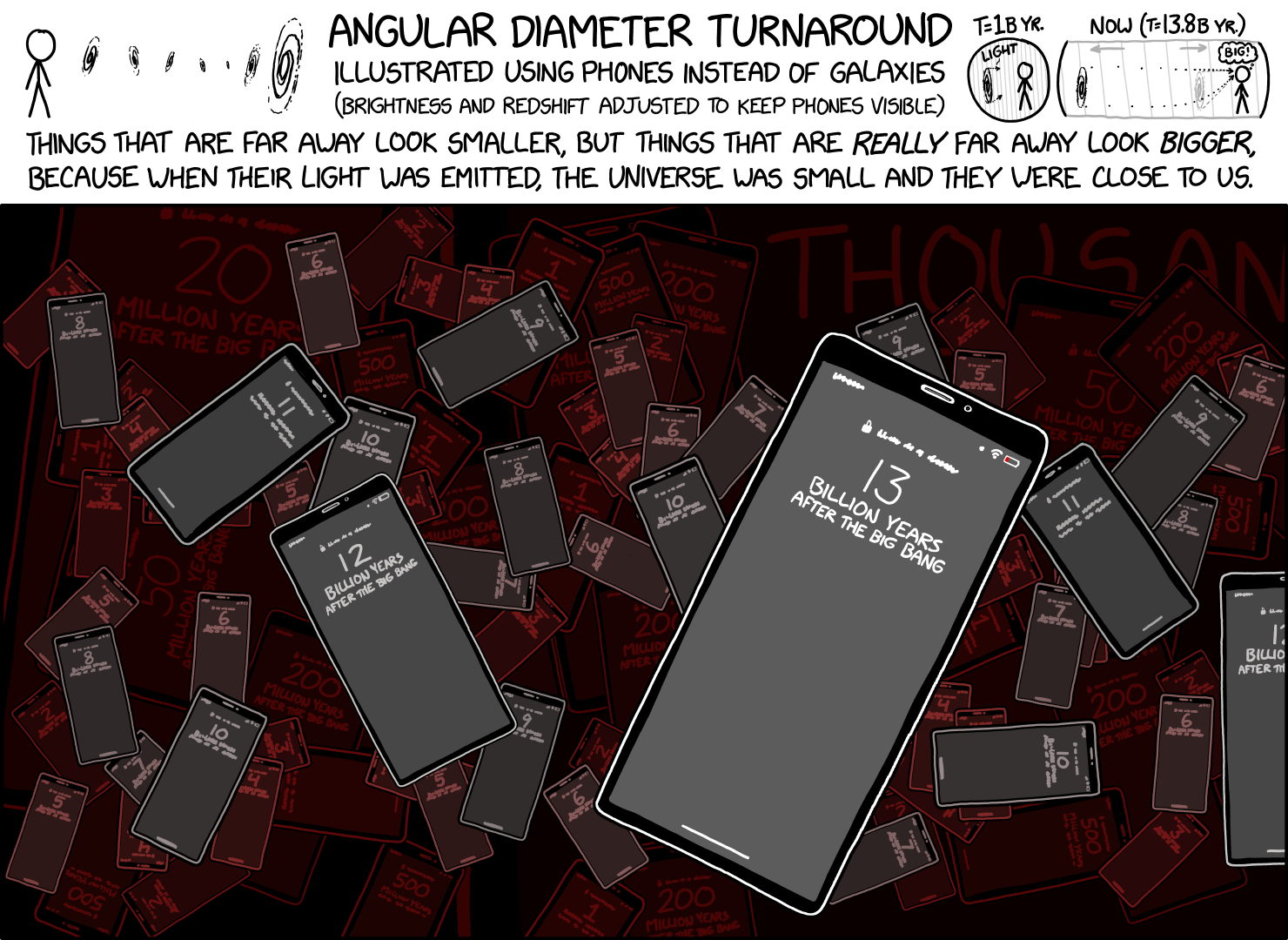
I love that the battery depletes slowly over time. Though it's a bit ominous that the most recent one shows battery in the red...
What am I looking for?
spoiler alert:
The oldest phone doesn't fit the comic strip...
The oldest phone doesn't fit the comic strip...
Clearly because Munroe hasn't adjusted for screen size inflation. If we extrapolate based on whatever Samsung or Apple are selling these days and the 8210, will we even see meaningful redshift before the Planck constant chimes in?
[deleted]
Speaking of the expansion of the universe, in a very distant future when the expansion speed is so high that most of the galaxies won't be visible from earth, their astronomers will be thinking the whole universe contains only a few galaxies. But wait, what if the universe we observe today also misses some parts that can't be observed anymore?
Neil deGrasse Tyson explained it more clearly: https://www.youtube.com/watch?t=436&v=TgA2y-Bgi3c
That's probably why it's called the observable universe.
Neil deGrasse Tyson explained it more clearly: https://www.youtube.com/watch?t=436&v=TgA2y-Bgi3c
That's probably why it's called the observable universe.
And based on the size of the magnification of the galaxies throughout time, we can tell whether the universe is expanding at a constant rate or accelerated or decelerated at certain point.
man that's fucked up. i dont want to look at the sky anymore.
This XKCD strip would be genius if he used actual different historical cell phones - for awhile they were getting smaller, and then they started to get larger again!
https://xkcd.com/2622/
https://xkcd.com/2622/
Is there an xkcd for _everything_?!?
> xkcd for _everything_
https://xkcd.com/968/
https://xkcd.com/968/
Let us make a xkcd diagonal setup? https://en.m.wikipedia.org/wiki/Cantor%27s_diagonal_argument to proof that there are xkcds not yet drawn?
Better question: If there's no XKCD of it, does it really exist?
"Give us one free miracle and we can explain anything!" - Terrance McKenna on modern science.
Holding the two concepts of an accelerated (!) (in terms of objects [1]) expanding universe and the fixed finite speed of light simultaneously in one's Euclidean head can be dizzying, so be prepare to draw and enjoy the hard earned manual labor of counterintuitive conclusions.
[0]https://arxiv.org/pdf/astro-ph/0310808.pdf
[1]https://bigthink.com/starts-with-a-bang/universe-expansion-n...