The Worst Mistake in the History of the Human Race (by Jared Diamond)(agron.iastate.edu)
agron.iastate.edu
The Worst Mistake in the History of the Human Race (by Jared Diamond)
http://www.agron.iastate.edu/courses/agron342/diamondmistake.html
45 comments
Ok, time for a bit of hand wringing. I said I'd wait a week, but this needs to be pointed out. In the space of one day, we've gone from startup news to rehashed reddit news.
http://reddit.com/info/3895/comments
Not only that, but the article itself is 20 years old, and is not an attitude I have read in Diamond's later works like 'Collapse', where he certainly underlines the dangers and problems that face the human race, but does manage to strike a good balance between gloomy and cautiously optimistic about the possibility for improvement.
Harumph.
http://reddit.com/info/3895/comments
Not only that, but the article itself is 20 years old, and is not an attitude I have read in Diamond's later works like 'Collapse', where he certainly underlines the dangers and problems that face the human race, but does manage to strike a good balance between gloomy and cautiously optimistic about the possibility for improvement.
Harumph.
If you don't allow downvoting of stories then you get this, so you have to ignore some stories. But that's much better than the alternative, which is people banding together to bury certain stories that reach the front page (or before they do, if the karma threshold is above 2).
I don't read reddit, anyway, I guess it takes time to find out what is considered appropiate for the new hacker news. I went by the definition of "is not shown on TV". It's 20 years old, but old articles have been posted before, and I only found it today... If nobody is interested, nobody will mod it up?
Besides, I thought this article also relates to startupping, because of the average work hours aspect. But granted, Jared Diamond is not exactly unknown.
Besides, I thought this article also relates to startupping, because of the average work hours aspect. But granted, Jared Diamond is not exactly unknown.
It's not that bad a link... it just seems so drastic a change:-/ It seems also to illustrate that the intersection of interesting startup links is very well defined, whereas the intersection of interesting 'hacker news' is rather less well defined, and will probably be more prone to disagreement, even if the people posting are the same ones as with the old yc.news, because our interests and beliefs are likely to be quite varied.
Add to that people who didn't see or take part in the original, and while I hope the change will go ok, it will be a lot of work.
Add to that people who didn't see or take part in the original, and while I hope the change will go ok, it will be a lot of work.
>news interesting to hackers generally.
Obviously hackers have found this interesting, but I agree it is on the border of being irrelevant. I think it is useful to use PG's rule of thumb that if it's covered on TV news then it's off topic which I think this is an exception to.
I like this new direction that yc is taking, the site was rather boring to me before which I barely frequented until I saw that it changed on reddit.
I shouldn't come here to often because each time I read something by PG I feel like quitting my job and starting a company.
Obviously hackers have found this interesting, but I agree it is on the border of being irrelevant. I think it is useful to use PG's rule of thumb that if it's covered on TV news then it's off topic which I think this is an exception to.
I like this new direction that yc is taking, the site was rather boring to me before which I barely frequented until I saw that it changed on reddit.
I shouldn't come here to often because each time I read something by PG I feel like quitting my job and starting a company.
I think part of what bugs me is that it's also somewhat sensationalist, which is why reddit keeps reposting it.
The filtering by the wise guardians probably hasn't yet kicked in, either ;-) Time will tell if the filter mechanism will help to move hacker news into a specific (desired) direction.
OTOH, people did vote it up, and I don't think it was bad... just... oh who knows, I can't figure it out. Back to hacking on Hecl.
Great point man.
"In the space of one day, we've gone from startup news to rehashed reddit news."
I love reddit, but I loved the old yc news also. I don't understand how this happens. PG says we're changing focus and all of a sudden people start linking and upvoting different stories??
How is this more interesting to hackers than startup news. I don't understand how a rather top-down decree has changed the output of a definitively democratic system.
"In the space of one day, we've gone from startup news to rehashed reddit news."
I love reddit, but I loved the old yc news also. I don't understand how this happens. PG says we're changing focus and all of a sudden people start linking and upvoting different stories??
How is this more interesting to hackers than startup news. I don't understand how a rather top-down decree has changed the output of a definitively democratic system.
Anyone who thinks hunter gatherers had pleasant lives should stop to think what happened to people who were too old to follow the tribe when it moved, or what happened when a mother who was already nursing had another baby.
Indeed. I love this comic:
http://static.flickr.com/100/267584452_4c7f35863f.jpg
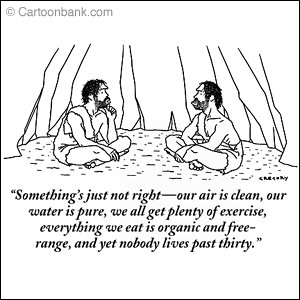
I don't think all hunter gatherers where nomads (but some agriculturalist are, or do shepherds not count), and I think I read in another book that nursing actually acts as contraceptive (Edit: I just saw that the article also mentions infanticide to keep children spaced four years apart, so true, some gruesome aspects are there).
Anyway, the point is certainly not to recommend going back to a hunter gatherer lifestyle. Although I wonder if startupping is not somewhat akin to hunting.
Anyway, the point is certainly not to recommend going back to a hunter gatherer lifestyle. Although I wonder if startupping is not somewhat akin to hunting.
The good news is that it's hard for a person to care about that once he's dead.
>Astronomy taught us that our earth isn't the center of the universe but merely one of billions of heavenly bodies. From biology we learned that we weren't specially created by God but evolved along with millions of other species.
Neither of which would have been possible if we were too busy hunting for food every waking hour.
Neither of which would have been possible if we were too busy hunting for food every waking hour.
[deleted](1)
>>It turns out that these people have plenty of leisure time, sleep a good deal, and work less hard than their farming neighbors. For instance, the average time devoted each week to obtaining food is only 12 to 19 hours for one group of Bushmen, 14 hours or less for the Hadza nomads of Tanzania.
FTA... please read it :p
You can make the argument that by increasing population size and crowding, it also made collaboration, partnership, and the growth of ideas easier but the article itself debunks the whole "they spent their entire life looking for berries" argument.
Jared Diamond is awesome.
FTA... please read it :p
You can make the argument that by increasing population size and crowding, it also made collaboration, partnership, and the growth of ideas easier but the article itself debunks the whole "they spent their entire life looking for berries" argument.
Jared Diamond is awesome.
I think it is moreso the ability to settle in one place that caused the growth of technology. The hunter-gatherers, no matter how numerous, certainly did not spend their free time building forges and experimenting with metal.
Also note that the time spent gathering food likely does not include preparing to gather food (e.g.: making weapons). Although they could spend plenty of time playing games, note that games originated to prepare children to spend time gathering food (and practice other necessary survival skills).
Also note that the time spent gathering food likely does not include preparing to gather food (e.g.: making weapons). Although they could spend plenty of time playing games, note that games originated to prepare children to spend time gathering food (and practice other necessary survival skills).
I must rescind this statement. As a result of these discussions, I began reading Guns, Germs, and Steel, which, in the chapter "To Farm or not to Farm," makes clear the disconnect between agriculture and sedentary living:
"Another misconception is that there is necesarrily a sharp divide between nomadic hunter-gatherers and sedentary food producers. In reality, although we frequently develop such a contrast, hunter-gathers in some productive areas, including North America's Pacific Northwest coast and possibly southeastern Australia, became sedentary but never became food producers. Other hunter-gatherers, in Palestine, costal Peru, and Japan, became sedentary first and adopted food production much later. Sedentary groups probably made up a much higher fraction 15,000 years ago, when all inhabited parts of the world (including the most productive areas) were still occupied by hunter-gatherers, than they do today, when the few remaining hunter-gathers survive only in unproductive areas where nomadism is the sole option.
Conversely, there are mobile groups of food producers. Some modern nomads of New Guinea's Lake Plains made clearings in the jungle, plant bananas and papayas, go off for a few months to live again as hunter-gatherers, return to check on their crops, weed the garden if they find the crops growing, set off again to hunt, return months later to check again, and settle down for a while to harvest and eat if their garden has not produced. Apache Indians of the southwestern United States settled down to farm in the summer at high elevations and toward the north, then withdrew to the south and to lower elevations to wander in search of wild foods, during the winter. Many herding peoples of Africa and Asia shift camp along regular seasonal routes to take advantage of predictable seasonal changes in pasturage. Thus, the shift from hunting-gathering to food production did not always coincide with a shift from nomadism to sedentary living."
(<i>Guns, Germs, and Steel</i> p. 106)
"Another misconception is that there is necesarrily a sharp divide between nomadic hunter-gatherers and sedentary food producers. In reality, although we frequently develop such a contrast, hunter-gathers in some productive areas, including North America's Pacific Northwest coast and possibly southeastern Australia, became sedentary but never became food producers. Other hunter-gatherers, in Palestine, costal Peru, and Japan, became sedentary first and adopted food production much later. Sedentary groups probably made up a much higher fraction 15,000 years ago, when all inhabited parts of the world (including the most productive areas) were still occupied by hunter-gatherers, than they do today, when the few remaining hunter-gathers survive only in unproductive areas where nomadism is the sole option.
Conversely, there are mobile groups of food producers. Some modern nomads of New Guinea's Lake Plains made clearings in the jungle, plant bananas and papayas, go off for a few months to live again as hunter-gatherers, return to check on their crops, weed the garden if they find the crops growing, set off again to hunt, return months later to check again, and settle down for a while to harvest and eat if their garden has not produced. Apache Indians of the southwestern United States settled down to farm in the summer at high elevations and toward the north, then withdrew to the south and to lower elevations to wander in search of wild foods, during the winter. Many herding peoples of Africa and Asia shift camp along regular seasonal routes to take advantage of predictable seasonal changes in pasturage. Thus, the shift from hunting-gathering to food production did not always coincide with a shift from nomadism to sedentary living."
(<i>Guns, Germs, and Steel</i> p. 106)
It still does not make sense. Humans were in a hunter-gathering mode for quite some time. If they were so much healthier, AND had more free time, why did the society start rapidly progressing only with the advent of agriculture? Did they just magically become smart? I'm sorry, but no. While this article is certainly interesting, and thought provoking, the thesis doesn't hold.
They didn't suddenly become smart and you certainly cannot attribute all the developments to the adoption of agriculture. Progress has been very... erratic (can't find the right word) throughout history.
To blindly attribute progress to a singular cause such as farming is short sighted. I'm sure there are many different variables (farming included) that influence progress and discovery.
To blindly attribute progress to a singular cause such as farming is short sighted. I'm sure there are many different variables (farming included) that influence progress and discovery.
Agriculture is not exactly the reason for technological advances; rather, progress became possible (but not guaranteed!) thanks to agriculture.
While a few hunter-gatherer societies lived in a place so abundant that they can settle in a single location and gather everything they needed, the vast majority of such societies were migratory, moving to wherever the food was.
In a migratory society, most technological advances are simply not useful. When you only keep the things you can carry on your back, anything that doesn't have a direct use is an active hindrance with a quantifiable opportunity cost. Civilization is only possible when people can settle in one place.
Further, even hunter-gatherer societies that are fortunate enough to settle in a single place have to remain small to survive, or they exceed their food supply. This means that the chance of a given society developing a new technology is much smaller (given a smaller supply of creative individuals). It also means that even if a society does develop a new technology, that technology spreads very slowly, leading to less cross-pollination with other individuals and ideas.
By contrast, agriculture concentrates people together. There are a variety of technologies that increased the productivity of an agricultural society as a whole, and it's very natural for those technologies to spread throughout a society. Furthermore, agricultural societies that are more productive than their neighbors can produce more soldiers (when a smaller percentage of the population can feed the whole society, there is excess labor for armies, as well as other pursuits), allowing them to conquer their neighbors and spread their advances to their newly conquered territories. Basically, in an agricultural society, technology spreads like a virus.
While a few hunter-gatherer societies lived in a place so abundant that they can settle in a single location and gather everything they needed, the vast majority of such societies were migratory, moving to wherever the food was.
In a migratory society, most technological advances are simply not useful. When you only keep the things you can carry on your back, anything that doesn't have a direct use is an active hindrance with a quantifiable opportunity cost. Civilization is only possible when people can settle in one place.
Further, even hunter-gatherer societies that are fortunate enough to settle in a single place have to remain small to survive, or they exceed their food supply. This means that the chance of a given society developing a new technology is much smaller (given a smaller supply of creative individuals). It also means that even if a society does develop a new technology, that technology spreads very slowly, leading to less cross-pollination with other individuals and ideas.
By contrast, agriculture concentrates people together. There are a variety of technologies that increased the productivity of an agricultural society as a whole, and it's very natural for those technologies to spread throughout a society. Furthermore, agricultural societies that are more productive than their neighbors can produce more soldiers (when a smaller percentage of the population can feed the whole society, there is excess labor for armies, as well as other pursuits), allowing them to conquer their neighbors and spread their advances to their newly conquered territories. Basically, in an agricultural society, technology spreads like a virus.
Obnoxious. This article manifests the worst mistake in the contemporary world -- the triumph of modern cynicism over progressive idealism.
I can't believe this article was up-voted. What does this have to do with hacking or startups???
I'm a little worried this site will go the way of reddit...
I'm a little worried this site will go the way of reddit...
Yeah I agree - this belongs on reddit not the site formerly known as startup news...
There are enough reddits and diggs in the world, if hacker news is going the way of reddit and digg I'll probably pass
There are enough reddits and diggs in the world, if hacker news is going the way of reddit and digg I'll probably pass
For me the connection with hacking is that it points out a potentially unintuitive thing, and switching from hunting to agriculture also is a kind of hack. Is a startup not also trying to hack society in a way? Also I thought it interesting that some ancient societies seemed to have less work hours.
Obviously it won't interest everybody, but didn't pg say "anything that interests hackers", not only hacking itself?
Anyway, my apologies if it was too far stretched. I hope I will refrain from further submissions in the future. Perhaps I should check out Reddit...
Obviously it won't interest everybody, but didn't pg say "anything that interests hackers", not only hacking itself?
Anyway, my apologies if it was too far stretched. I hope I will refrain from further submissions in the future. Perhaps I should check out Reddit...
Massive self-aggrandizing factual error in the third paragraph:
It's a life that philosophers have traditionally regarded as nasty, brutish, and short.
Um, Jean Jacques Rousseau? Noble Savage? Only a few decades after Hobbes?
It may not be relevant to the case being made here, but come on. I remember writing "compare and contrast" papers on Hobbes and Rousseau in high school.
It's a life that philosophers have traditionally regarded as nasty, brutish, and short.
Um, Jean Jacques Rousseau? Noble Savage? Only a few decades after Hobbes?
It may not be relevant to the case being made here, but come on. I remember writing "compare and contrast" papers on Hobbes and Rousseau in high school.
Yes, the basic idea has been re-hashed endlessly:
http://www.thecourier.com/manifest.htm
It sort of bothers me that this is getting upmodded--not because it's off-topic, but because it's so painfully banal--every high schooler has already thought these things through completely, just like this:
http://news.ycombinator.com/item?id=42398
http://www.thecourier.com/manifest.htm
It sort of bothers me that this is getting upmodded--not because it's off-topic, but because it's so painfully banal--every high schooler has already thought these things through completely, just like this:
http://news.ycombinator.com/item?id=42398
I didn't see the article as a manifesto against industrialism, despite the sensationalist title. Jared Diamond is a researcher, after all - I just found it informative to learn something about ancient societies, without jumping to conclusions from that.
This article certainly is well documented... still I don't see why agriculture is a mistake. Yes, our ancestors were intelligent enough to understand that progress usually involves a temporary loss of comfort to achieve long-term benefits. Why is it a mistake?
One of the recurring off-topic discussions on Startup News was the evolution of humanity from nomadic tribes through the Industrial Revolution and beyond. Now that the scope of the site has expanded, it would make sense that one of the most popular discussions is still the evolution of humanity. If this topic doesn't interest you, maybe you should submit a story that you find interesting.
This story is only interesting as a historical artifact in itself. It was a nice example of the current "conventional thinking" refuted by that other story yesterday about how England escaped the malthusian trap. Why is this story still here and the newer one gone already? Jared Diamond is very useful in this field, so maybe vote up some of his newer stuff?
Agriculture simply multiplied everything. Hunter-gatherers still had and have tribal wars, murder, rape, rapine, torture, high infant mortality, much lower male life expectancy (due to fighting), plus the usual disease, famine, and social inequality of women.
The average college student in a dorm room enjoys greater luxury and comfort than kings of yesteryear; they have climate control, hot and cold running water, antibiotics, corrective eyewear, and of course a far greater selection of food year-round, not to mention a better selection of healthy mates.
Whether people are happier in modern technological society or hunter-gatherer society is almost beside the point; evolution seems to have selected for worried, discontented people -- they outcompete the easily satiated. Even as we precipitate the extinction of traditional hunter-gatherer lifestyles, we can imagine them at some point in the past wiping out even less technologically-savvy people who perhaps were even more happy and contented, leading an existence akin to our bonobo relatives. A similar article written then by gatherers might blame the widespread adoption of hunting for increasing societal violence and leading to a new class division: warrior, due to the ensuing upswing in human-human "hunting".
Increased population can be thought of as a tool; it has been exploited for ill much of the time, but it can also be used for the betterment of all. When we start to live in "The Matrix" (a pleasurable one), we may well rely on aquaculture to produce high-yield algae we farm for biofuel and for nutrients for our IV drips. At that point we may instead regard agriculture, regardless of temporary blips, as the best thing to happen to humanity.