Rising Air-Conditioning Use Intensifies Global Warming(nature.com)
nature.com
Rising Air-Conditioning Use Intensifies Global Warming
https://www.nature.com/articles/s41467-026-69393-1
50 comments
This also kills a lot of people. Spain isn’t immune to it.
https://www.reuters.com/sustainability/climate-energy/heatwa...
https://www.reuters.com/sustainability/climate-energy/heatwa...
Cold is generally much more dangerous to humans, which is part of the reason why it is typically seen as more of a necessity: https://substack-post-media.s3.amazonaws.com/public/images/7...
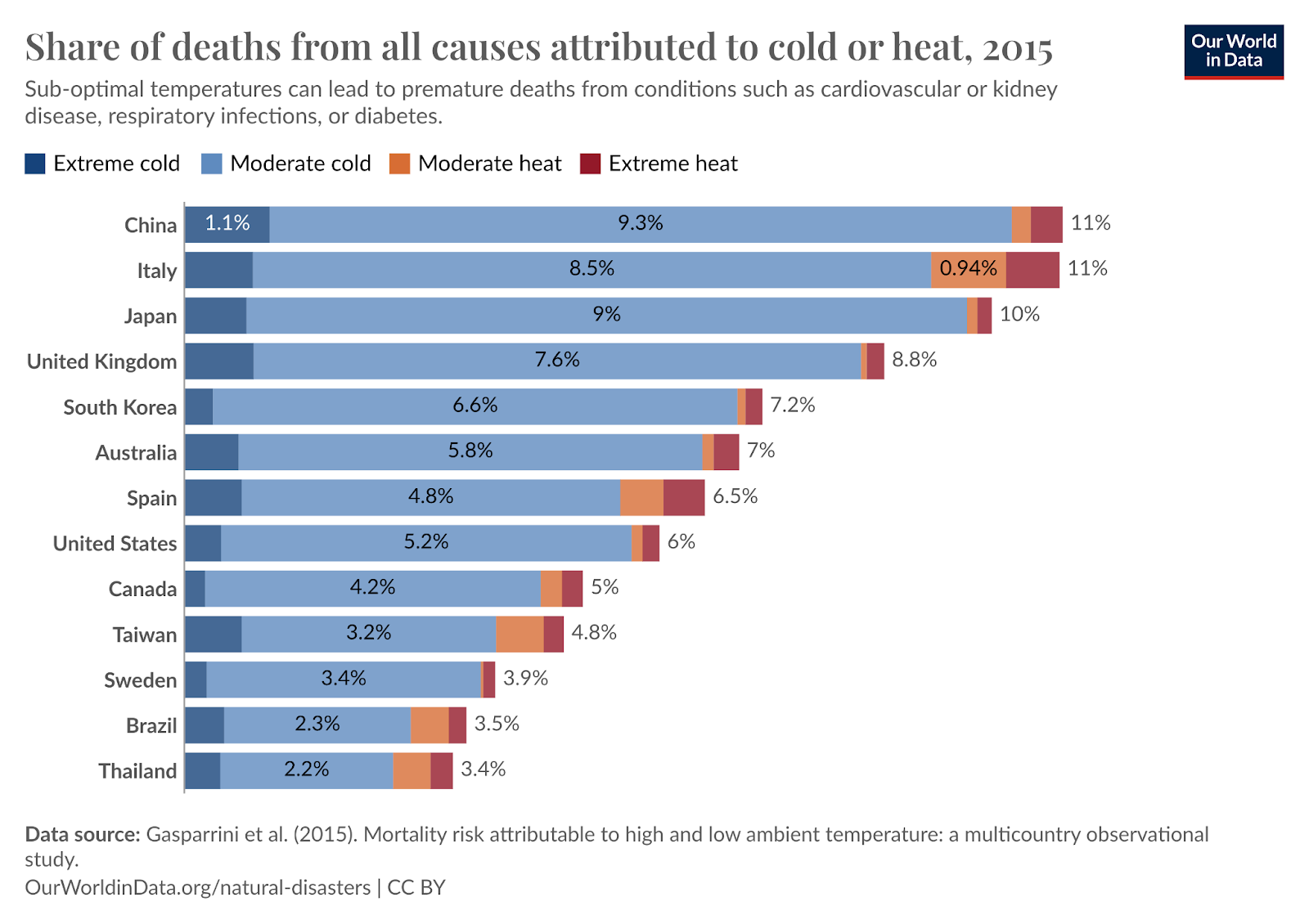
> We have ways around this heat problem
I don't consider that being uncomfortable is a solution.
There are actual solutions used by hot countries to deal with the heat: ventilation, vegetation, construction techniques, etc... But adjusting work schedules so that you have a hour or two of poor quality sleep when you can't do anything else is the kind of thing you do when you have no other choice, not a solution.
I have nothing against the Spanish schedule, but I would rather not do my siesta in an unbearably hot place. And yes, AC is a solution.
AC doesn't have to be that bad. Set a reasonable temperature, combine it with good insulation, etc... Same idea as for heating in the winter.
I don't consider that being uncomfortable is a solution.
There are actual solutions used by hot countries to deal with the heat: ventilation, vegetation, construction techniques, etc... But adjusting work schedules so that you have a hour or two of poor quality sleep when you can't do anything else is the kind of thing you do when you have no other choice, not a solution.
I have nothing against the Spanish schedule, but I would rather not do my siesta in an unbearably hot place. And yes, AC is a solution.
AC doesn't have to be that bad. Set a reasonable temperature, combine it with good insulation, etc... Same idea as for heating in the winter.
The siesta is a part of the solution to being uncomfortable. Rather it works with the nature of the earth and human biology, instead of using brute force to work against it. It is a different solution to the same problem.
I think the parent means they don't want to take a nap in the midday heat.
That said, presumably it's still cool enough to sleep indoors, because, while the outdoors is hot, the indoors has not yet fully heat soaked.
That said, presumably it's still cool enough to sleep indoors, because, while the outdoors is hot, the indoors has not yet fully heat soaked.
Right, the idea is that you go find a comfortable place and rest rather than staying in the heat and exerting yourself at whatever job you were doing.
A study from 2023 estimated a worst case blackout in Phoenix AZ could approach 1% fatality. Considering power demand would be at its highest during a heat wave, the odds of this worst case scenario are quite high.
https://pubs.acs.org/doi/10.1021/acs.est.2c09588
"In Phoenix, where the lowest daily high temperature over the 5 day heat wave is 43 °C and daily minimum temperatures average 32 °C, the rate of heat-related mortality increases by about 700% relative to the Power On scenario, reflecting the extremity of heat exposures in a desert city in the absence of mechanical AC. As reported in Figure 3, the estimated rate of heat-related mortality for the Power Off scenario in Phoenix is 917 (approximate total =13,250 deaths), which approaches 1% of the synthetic population."
https://pubs.acs.org/doi/10.1021/acs.est.2c09588
"In Phoenix, where the lowest daily high temperature over the 5 day heat wave is 43 °C and daily minimum temperatures average 32 °C, the rate of heat-related mortality increases by about 700% relative to the Power On scenario, reflecting the extremity of heat exposures in a desert city in the absence of mechanical AC. As reported in Figure 3, the estimated rate of heat-related mortality for the Power Off scenario in Phoenix is 917 (approximate total =13,250 deaths), which approaches 1% of the synthetic population."
AZ better ramp up subsidies for home-installed solar then. When conditions are worst, they receive the most relief!
https://resilient.az.gov/resiliency-programs/energy-programs...
"The Office of Resiliency received a termination notice from the U.S. Environmental Protection Agency regarding the Solar for All grant on August 7, 2025. The program is unavailable until further notice."
Or they can wait for the worst case scenario to actually happen, and THEN do something, as is tradition.
https://resilient.az.gov/resiliency-programs/energy-programs...
"The Office of Resiliency received a termination notice from the U.S. Environmental Protection Agency regarding the Solar for All grant on August 7, 2025. The program is unavailable until further notice."
Or they can wait for the worst case scenario to actually happen, and THEN do something, as is tradition.
What did people in Phoenix do before modern heat pump air conditioning existed? Plenty of people live in hot arid places on earth. Humans have figured out passive air conditioning since prehistory: https://en.wikipedia.org/wiki/Air_conditioning#History
The problem with cities like Phoenix that is people are used to high levels comfort while building traditional structures in the middle of a desert. To cope, electricity hungry industrialized HVAC systems fight the desert weather. With a daily hot/cool cycle and modern thermal management you'd think the "passive house" would be law there by now.
The problem with cities like Phoenix that is people are used to high levels comfort while building traditional structures in the middle of a desert. To cope, electricity hungry industrialized HVAC systems fight the desert weather. With a daily hot/cool cycle and modern thermal management you'd think the "passive house" would be law there by now.
Yeah; loss of utility heat in the wither has a much higher fatality risk, I'd think. The difference is, many homes have multiple heating methods available to them. If the natural gas is out, use an electric spaceheater, for example. Some homes use electric heat, others natural gas, others heating oil (which is a distributed solution.. or at least, involves a caching layer!)
Many homes have fireplaces or wood-burning stoves, again, for backup.
Many homes have fireplaces or wood-burning stoves, again, for backup.
OTOH typical heating in North America is forced air natural gas. So if either the gas or the electricity is down, you have no heat.
If you are doing it for the environment, you should forgo heat. 100F to 70F is only a 30 degree delta. If you have a heat pump, this is the same amount of energy heating your home to 70F from 40F. If you have natural gas heating, now we are talking about the same amount of energy when it is low 50's outside.
How many forests will you burn to not just wear two sweaters and blanket?
How many forests will you burn to not just wear two sweaters and blanket?
> How many forests will you burn to not just wear two sweaters and blanket?
Nice try. I wear a sweater.
Nice try. I wear a sweater.
This might work in Spain, but it won’t work in Singapore because it’s just as hot and humid at night.
My home doesn't have A/C, but the only time I wish I had it was to sleep on hot nights, which this doesn't really solve.
>Most things close at 5PM and reopen around 8PM.
Shops and stuff that require outdoor labor yeah for sure. This doesn't work for workers mandated in the 9-5 jobs like office work.
And personally, I'd rather my workday is finished at 5 PM instead of 8 PM with a long break towards the mid-end of the workday.
Shops and stuff that require outdoor labor yeah for sure. This doesn't work for workers mandated in the 9-5 jobs like office work.
And personally, I'd rather my workday is finished at 5 PM instead of 8 PM with a long break towards the mid-end of the workday.
There are cultures around the world that pull this off very broadly. It takes a different attitude towards work and human wellness than what we have in the US
I live in Europe, not the US, where 9-5 (more like 8-5) is common. Not everything revolves around the US you know, we are allowed to have and talk about our own issues too. And US is on the winning side here because residential AC use is more normalized there instead of accepting people will have to die from heat strokes just to "save the environment" like it is in some EU countries. 15K to 19K people died from heat strokes in summer of 2003 France. In 2022 about 10k died from heat strokes. Not great in my book when we're talking about a rich western country that has the technology and the money to prevent such deaths, but we choose not to out of environmental and regulatory idealist Martyrdom.
And I'm sure my current country of Austria won't adopt Spanish way of work and life anytime soon just because summers are hot an people don't have AC at home/work. Societies, especially the Austrian one, are incredibly stubborn to change for a variety of reasons even when the evidence and solution is right in front of you. How do I know this? Well, Covid proved we can do a lot of work from home. Did that stick? Of course not, we still have to go to the office for most white collar jobs, even IT ones, just because management said so. We don't live in a world run by proof and rationale, we live in a world run by the status quo, vibes and feelings of the boomer and asset owning class.
And I'm sure my current country of Austria won't adopt Spanish way of work and life anytime soon just because summers are hot an people don't have AC at home/work. Societies, especially the Austrian one, are incredibly stubborn to change for a variety of reasons even when the evidence and solution is right in front of you. How do I know this? Well, Covid proved we can do a lot of work from home. Did that stick? Of course not, we still have to go to the office for most white collar jobs, even IT ones, just because management said so. We don't live in a world run by proof and rationale, we live in a world run by the status quo, vibes and feelings of the boomer and asset owning class.
I think many of us (myself included) operate under this fundamental assumption that air conditioning is somehow sinful and wrong, against the natural order of things, but heating spaces is a good and worthwhile use of resources.
I made a slightly-snarky comment along these lines once, and a fellow commenter on HN pointed out how efficient air conditioning is. For one, it's always accomplished via heat pump; eg, moving heat, so the only byproducts are electricity consumption and waste heat. We know how to produce clean electricity. On the flip side, heating indoor spaces also produces waste heat, but a lot more of it. Much worse, the vast majority of home heating (at least in the US) is done by burning fossil fuels. If you compare the heating demands of the northeast to the cooling demands of the south, in terms of BTUs, the heat demands are way more intensive.
The most important factor in this equation is the temperature change required. The temperature differential between a winter temp of 20 or 30F to an indoor temp of 70F requires SO much more energy than cooling from a summer temp of 90F to indoor temp of 70F.
So I can remain smug about living in a mild climate in the Bay Area; my total energy consumption is much lower than the average home. But I probably shouldn't feel smug about not needing A/C when the real problem is the gas furnace I run every morning and part of the day, for months on end, from November to March.
(My house is actually currently missing several walls; the gas furnace has been thrown in the trash and it's being replaced with 3 heat pumps, which will give me both A/C _and_ more efficient heat. No thanks to PG&E, which will reward my GHG reductions by charging me out the ass for the electricity required to heat my home).
I made a slightly-snarky comment along these lines once, and a fellow commenter on HN pointed out how efficient air conditioning is. For one, it's always accomplished via heat pump; eg, moving heat, so the only byproducts are electricity consumption and waste heat. We know how to produce clean electricity. On the flip side, heating indoor spaces also produces waste heat, but a lot more of it. Much worse, the vast majority of home heating (at least in the US) is done by burning fossil fuels. If you compare the heating demands of the northeast to the cooling demands of the south, in terms of BTUs, the heat demands are way more intensive.
The most important factor in this equation is the temperature change required. The temperature differential between a winter temp of 20 or 30F to an indoor temp of 70F requires SO much more energy than cooling from a summer temp of 90F to indoor temp of 70F.
So I can remain smug about living in a mild climate in the Bay Area; my total energy consumption is much lower than the average home. But I probably shouldn't feel smug about not needing A/C when the real problem is the gas furnace I run every morning and part of the day, for months on end, from November to March.
(My house is actually currently missing several walls; the gas furnace has been thrown in the trash and it's being replaced with 3 heat pumps, which will give me both A/C _and_ more efficient heat. No thanks to PG&E, which will reward my GHG reductions by charging me out the ass for the electricity required to heat my home).
I think the other part is historical -- humans have harnessed combustion-based heat in their shelter for thousands to millions of years.
Powered air conditioning didn't really take off until the mid 20th century. Prior to that most simply used fans.
Powered air conditioning didn't really take off until the mid 20th century. Prior to that most simply used fans.
>I think many of us (myself included) operate under this fundamental assumption that air conditioning is somehow sinful and wrong, against the natural order of things, but heating spaces is a good and worthwhile use of resources.
I don't think I have ever met or heard anyone think or say that...
I don't think I have ever met or heard anyone think or say that...
I'm curious where you grew up. Heating indoor spaces in the winter has been effectively mandatory during the lifetimes of anyone who would be commenting here. On the flip side, air conditioning only became widespread during the lifetimes of many HN commenters, and the population explosion in the sun belt (desert southwest of the US) is a relatively recent phenomenon. So from a familiarity perspective alone, heat is far more popular. That's before you get into the way A/C is often treated as a luxury, from installation to utilization costs.
The Midwest. In my experience, either people have central air, or in older houses they put window units in all over the house.
All the apartments I see have mini-splits or in-wall units. I put a floor standing dual-hose unit in my bedroom where my desktop PC and server also are.
All the apartments I see have mini-splits or in-wall units. I put a floor standing dual-hose unit in my bedroom where my desktop PC and server also are.
In upstate NY we have some summers with just a few days where I'd want air conditioning, we have some when I'd want it for July-August. Usually space blankets on the windows in the day and fans to thoroughly equilibriate at night get us through.
> The temperature differential between a winter temp of 20 or 30F to an indoor temp of 70F requires SO much more energy than cooling from a summer temp of 90F to indoor temp of 70F.
Yeah but at least in the winter you have alternatives.
I spent the first month of the year in a 100 year old home in the Midwest during a record breaking snow storm.
I was fine. It was cold, but I had clothes, sock, blankets, etc. Space heaters are cheap and they work. Hell I could blast the oven out in the open if I needed to.
OTOH I’ve been in central Florida in peak summer with a dead AC for weeks. There is no refuge from <90f indoors. Evaporative coolers don’t work in humidity, fans don’t work, nothing but AC will work. When I didn’t have AC in Florida I had two options:
- soak the sheets in water so they’re cool enough for me to at least lay down and fall asleep comfortably
- pay money to go somewhere else.
Yeah but at least in the winter you have alternatives.
I spent the first month of the year in a 100 year old home in the Midwest during a record breaking snow storm.
I was fine. It was cold, but I had clothes, sock, blankets, etc. Space heaters are cheap and they work. Hell I could blast the oven out in the open if I needed to.
OTOH I’ve been in central Florida in peak summer with a dead AC for weeks. There is no refuge from <90f indoors. Evaporative coolers don’t work in humidity, fans don’t work, nothing but AC will work. When I didn’t have AC in Florida I had two options:
- soak the sheets in water so they’re cool enough for me to at least lay down and fall asleep comfortably
- pay money to go somewhere else.
If you take out the abnormally perfect climates of Hawaii and California then lowest energy users for heating and cooling are Arizona, Florida, Louisiana and Texas.
Almost all ACs Ive seen until recently are not heat pumps. Traditional refrigerant based are far more popular.
Aren't heat pumps also refrigerant-based?
As I understand it, a heat pump is an AC unit that can be driven backward. In heat mode, they are air conditioning the already-cold outside, which works as long as the compressor can chill the refrigerant lower than the ambient outside air.
They even use the same refrigerant, usually R-410A and R-454B.
As I understand it, a heat pump is an AC unit that can be driven backward. In heat mode, they are air conditioning the already-cold outside, which works as long as the compressor can chill the refrigerant lower than the ambient outside air.
They even use the same refrigerant, usually R-410A and R-454B.
Huh. You’re right. I thought the differences went beyond just heating but nope - just heating.
AC use largely corresponds with peak solar, though, so it doesn't seem like a particularly tough problem to solve? In California, there's often a surplus of solar energy on hot days.
Ice batteries https://www.youtube.com/watch?v=HSvguJ7u3VM
Also, phase change hot water 'batteries' - https://sunamp.com/blog/new-video-on-how-phase-change-materi...
I'm not sure about a surplus. 4-9pm are still peak hours and a quick skim of this CAISO page[1] indicates we're importing electricity during peak hours.
I think the solar generation from say 10am-4pm is where you'd find a surplus, if there is one.
At least at my home, there's only ~20% difference between peak and off-peak rates, but, if you have A/C, it still makes sense to pre-cool on hot days, back it off at 4pm and then turn it back up at 9pm if you still need the cooler temps to sleep.
1. https://www.caiso.com/content/summer-loads-resources-assessm...
I think the solar generation from say 10am-4pm is where you'd find a surplus, if there is one.
At least at my home, there's only ~20% difference between peak and off-peak rates, but, if you have A/C, it still makes sense to pre-cool on hot days, back it off at 4pm and then turn it back up at 9pm if you still need the cooler temps to sleep.
1. https://www.caiso.com/content/summer-loads-resources-assessm...
Peak hours after you subtract all the non utility solar.
The peak grid demand has slowly been moving later in the day (and year) because home and commerical and industrial solar is displacing grid demand.
https://www.caiso.com/documents/californiaisopeakloadhistory...
People regularly use this solar success to claim solar is useless.
The peak grid demand has slowly been moving later in the day (and year) because home and commerical and industrial solar is displacing grid demand.
https://www.caiso.com/documents/californiaisopeakloadhistory...
People regularly use this solar success to claim solar is useless.
Maybe not peak, but there is significant overlap, and batteries are cheap enough to cover the gap for the non-overlapping part (e.g. 7-9pm)
Whereas for winter heating, you would want to preheat a lot, and you would also need an oversized PV array, because there's just way less energy available from the sun.
Whereas for winter heating, you would want to preheat a lot, and you would also need an oversized PV array, because there's just way less energy available from the sun.
Pre-cooling makes sense. Also, in the evening, whole house fans are pretty great. It seems like we have a lot of options?
I’m in the SF bay area, though, so that’s playing on easy mode.
I’m in the SF bay area, though, so that’s playing on easy mode.
Would reduced heating due to warmer winters offset this? Global carbon emissions due to heating are approximately 4 times the amount of carbon emissions due to cooling [0].
(Of course, the ideal scenario is not that rising carbon emissions from increased cooling get offset by lower emissions from decreased heating, but rather that we transition to abundant carbon-free energy from solar, wind, nuclear, etc. and are able to keep our houses as cool as we want in the summer and as warm as we want in the winter without any environmental consequences.)
[0] https://ourworldindata.org/grapher/co2-heating-cooling
(Of course, the ideal scenario is not that rising carbon emissions from increased cooling get offset by lower emissions from decreased heating, but rather that we transition to abundant carbon-free energy from solar, wind, nuclear, etc. and are able to keep our houses as cool as we want in the summer and as warm as we want in the winter without any environmental consequences.)
[0] https://ourworldindata.org/grapher/co2-heating-cooling
It seems to me that with sufficient insulation a modern or futuristic home could take advantage of the seasonal energy gradient to smoothe out the domestic interior climate, essentially acting as a battery or reservoir to capture energy in summer and dispense it in winter. I suppose that's basically what photovoltaics do. I'm also somewhat aware and intrigued by non-electric solar energy systems, like convection of thermal oil through pipes?
Not futuristic: but adobe - the cheapest/oldest building material around - has this property naturally (on a 12hr cycle). Thick walls insulate from the heat during the day, and radiate that heat during the night: It's hyper efficient.
Building regulations killed it's use in America! Requiring the adding in of rebar actually makes it weaker... as well as more expensive than wood (go ahead and guess which groups lobbied for that set of regulations).
Building regulations killed it's use in America! Requiring the adding in of rebar actually makes it weaker... as well as more expensive than wood (go ahead and guess which groups lobbied for that set of regulations).
Interesting... do you know how well adobe stacks? That is, is it limited to mostly single-storey buildings?
The economics for seasonal storage are very tough. Taking advantage of the day-night cycle is a lot more doable; assuming capital costs are the same, storage pays for itself many times faster.
Heat pumps move heat, the small extra amount from the compressor does not change the game. On the other hand, things change significantly with the huge thermal mass of reinforced concrete buildings exposed to the sun, large glass facades exposed to the sun, and bare earth exposed to the sun.
Heat rises and dissipates from the atmosphere, so the point isn't the heat moved from a closed bit of atmosphere to an open one heading towards space, but rather the massive thermal mass of buildings constructed without ventilated facades, and fields and deserts without photovoltaic panels to stop the heat from massively warming the ground.
However, people don't like saying this; they don't like saying that it's the dense city that increases global warming and isn't ecological at all. They don't like it because the city serves to extract wealth from the many for the few.
Heat rises and dissipates from the atmosphere, so the point isn't the heat moved from a closed bit of atmosphere to an open one heading towards space, but rather the massive thermal mass of buildings constructed without ventilated facades, and fields and deserts without photovoltaic panels to stop the heat from massively warming the ground.
However, people don't like saying this; they don't like saying that it's the dense city that increases global warming and isn't ecological at all. They don't like it because the city serves to extract wealth from the many for the few.
[deleted]
I run my AC off solar (mostly needed in mid afternoon). Fine no?
You should open your windows and run your air conditioner to reverse global warming. Take the fight to those Philistines with their Ford F150s.
We've been talking for long of climate feedbacks, this is the climate control feedback. The global warming singularity is near.
I’m sure the nature offices are chilled nicely.
The new slogan for the global elite flying into Davos next year will be "Sweat, eat bugs, own nothing and enjoy it."
We’ve come full circle to sumptuary laws. You can’t have upwardly mobile people born to working parents going around enjoying the finer things like air travel, consuming meat, or living in a climate controlled home. It would be unseemly. Casting pearls to swine! These luxuries must only be enjoyed by the truly worthy.
Then I traveled to Spain in August and was hosted at someones house for a week. They had no AC. And their method is simple: split the day in two resulting in the siesta. During the day in the intense heat you're tired by 3 PM and nearly dead by 5. The Spaniards? They go home and go to sleep for an hour or two then wake up when the sun has gone down and it cools down. Most things close at 5PM and reopen around 8PM. People stay out late too - I saw parents chatting on benches at a playground after midnight while their children played.
We have ways around this heat problem. Though I know people so spoiled that they INSIST their home and workspace must be at 60F even in 100F heat. They'll burn forests just so they wont be inconvenienced by a bead of sweat.