HackerLangs
TopNewTrendsCommentsPastAskShowJobs

bayindirh

20,985 karmajoined 9 anni fa
HPC administrator by day, developer and researcher by night.

You can reach me via https://bayindirh.io

Submissions

Mechanism design for large language models (2025)

research.google
2 points·by bayindirh·2 mesi fa·1 comments

Spring Cleaning

blog.bayindirh.io
1 points·by bayindirh·2 mesi fa·0 comments

comments

bayindirh
·3 giorni fa·discuss
You can go far beyond that:

OpenAI GptForce FX6800TI Founders Edition, for example.
bayindirh
·3 giorni fa·discuss
Not exposing your management interface to internet and running a guest network which doesn't have access to said management interfaces can block 95%+ of the attacks, I believe.
bayindirh
·3 giorni fa·discuss
Last time when I looked OpenWRT was unable to support MIMO and beamforming capabilities of many of the devices it was running on.

This capabilities are crucial to have decent coverage, signal strength and throughput where I live (i.e.: crowded/congested wireless networks in an apartment complex).

Did OpenWRT team managed to work around them, or did the manufacturers started to play nicer with open drivers with loadable firmware?
bayindirh
·3 giorni fa·discuss
I think OpenAI can also use the naming playbooks of current Intel and AMD of 2000s.

Possibilities are endless:

    - OpenAI GPT 5.6 F5+
    - OpenAI GPT5-6000FT
    - OpenAI GPT5-6505FS
    - OpenAI GPT5-6F05UL
Sounds nice, looks cool. Why not?
bayindirh
·4 giorni fa·discuss
I know. I used to spend countless nights on older Windows versions, you know, when I was young(er).

Now I know better and don't use that thing as a daily driver for... 20 years now? :D
bayindirh
·5 giorni fa·discuss
Thank ve.ry you much
bayindirh
·6 giorni fa·discuss
Try the demo on this site: https://fingerprint.com/demo

Both in incognito and normal modes. I bet you'll get the same fingerprinting ID in both.

So yes, they can track you in incognito mode, too.
bayindirh
·6 giorni fa·discuss
I don't think so. Windows is a GUI first OS, and Linux is a CLI first (or even CLI native) OS. You can't open a command line window in Windows without loading more than half of the desktop stack.

In that sense, when a terminal (running on a desktop environment) in Linux is faster than Windows Explorer, it's a shame. When a big file explorer like Dolphin drives circles around native file explorer of Windows, that's a big ole embarrassment.
bayindirh
·6 giorni fa·discuss
A programmer had a problem, so they decided to use threads.

Now they have at least two problems.
bayindirh
·6 giorni fa·discuss
Can you share some links?

Asking for myself, some friends and HN community at large.
bayindirh
·7 giorni fa·discuss
Because the dynamics have shifted enormously inside the rack.

10 years ago, I was running 4 CPU servers with 48 cores and 128GB of RAM in 2U enclosures with a maximum power consumption of 500W or so. I was able to stick ~20 of them in a 42U rack, totaling 10kW.

A data center full of these can be cooled with CRACs and hot/cold aisles without much problem. This is still too much for a bog-standard server colocation operation, but for HPC, that was normal and manageable.

Now, a ~1U server houses 4 SOTA NVIDIA GPUs, 64 cores, magnitudes more RAM. This server alone uses ~3KW of power. This means you go anywhere between 30kW to 50kW per rack, and you have many racks.

Of course this means more power comes in, more heat comes out. This means more sophisticated infrastructure: bigger and beefier primary and secondary power systems, beefier cooling, more heat, more noise, in short "more of everything".

Of course when you cram this much energy and heat into a relatively small space, its effect on the environment will be much more pronounced.

Facebook's previous SOTA datacenter used water infused, HEPA filtered free flowing air accross the datacenter. Now, it's server level direct liquid cooling with extensive water treatment and oversight on coolant parameters.

Compare this having a hand warmer vs. coal ember in your hand. The latter needs a much more elaborate setup to prevent it burning you badly.
bayindirh
·7 giorni fa·discuss
> but the limited powersupply you can get for a datacenter.

Since many people haven't seen 10MW cabling for a data center or how a big GPU server is cabled, they naturally imagine connecting servers is akin to plugging an appliance to a wall.

When the electricity provider says "I neither have the capacity, nor the required cables in that area", thing gets real.
bayindirh
·7 giorni fa·discuss
With liquid cooling technologies (direct or rear door heat exchange), cooling efficiently is easier when compared to a decade ago, and it's pretty efficient when you compare the power consumption numbers (server total vs. cooling total).

See PUE (Power Usage Effectiveness) for its scientific form.
bayindirh
·7 giorni fa·discuss
> You’re all over this comments section with “biocides” but what the hell even is a biocide?

Biocides in terms of datacenter cooling is used to prevent moss and algae to take over your pipe systems and clog them. In inner loops, even though isolated, any small contamination creates serious clogging and flow issues (the pipes are pretty narrow to begin with).

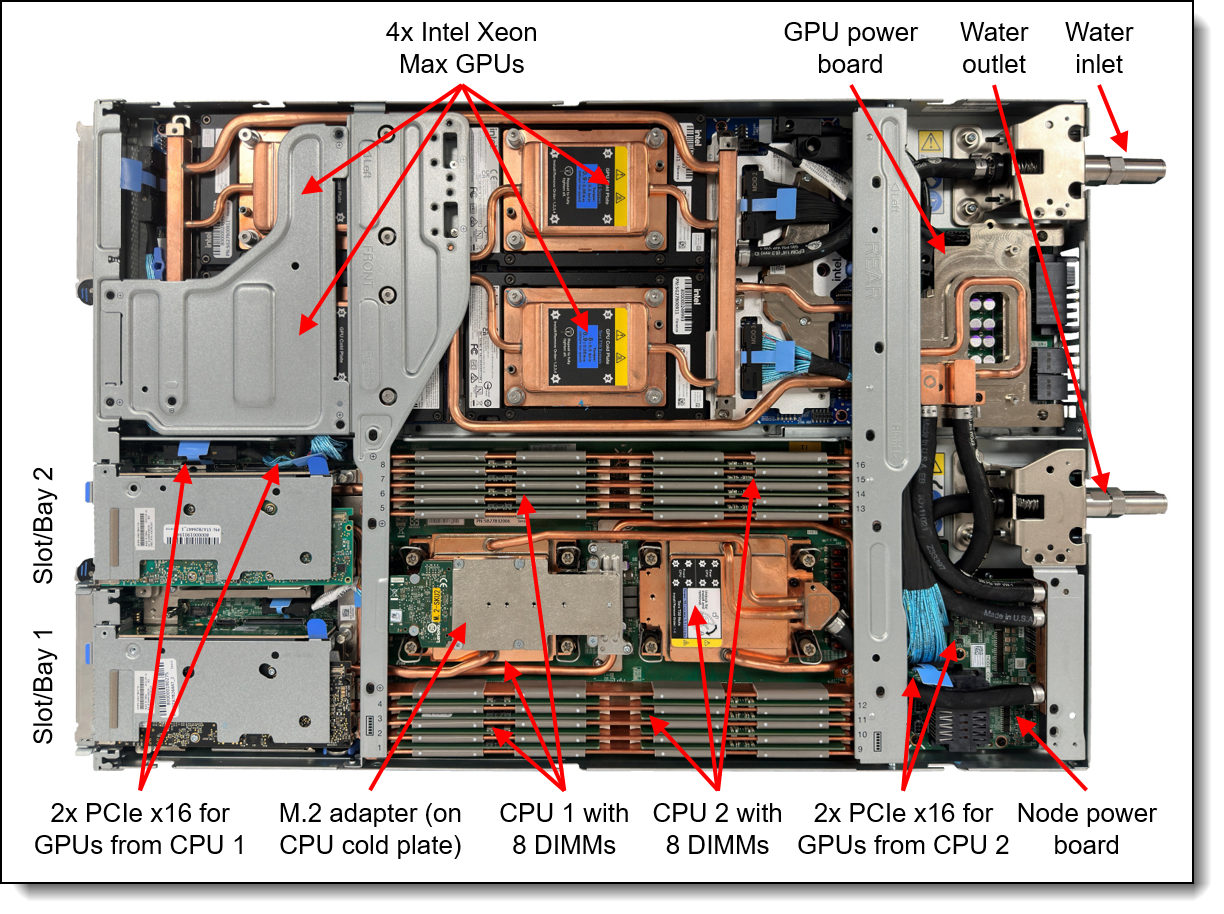
Inside a typical DLC server: https://lenovopress.lenovo.com/assets/images/LP1602/SD650-I%...

In outer loops, coolant hygiene is equally important since any layers of algae or moss creates clogs and reduces thermal conductivity in heat exchangers.

> It sounds pretty scary (“life kill! Yikes!”)

Since biocides prevent "living organisms" being present in water, it basically sterilizes it. You can't use biocide contaminated water to grow anything or to feed anything and anyone. I mean, we use similar materials to kill weeds. If you're exposed to them, after a certain dosage you'll experience nasty illnesses.

> Add to that the fact that I’ve never heard it used in the context of pollution, let alone datacenter-based pollution

See: https://h2ocooling.com/closed-loop-vs-open-loop/#How_Open-Lo...

Excerpt: Maintaining water quality demands robust chemical treatment programs. Scale inhibitors, biocides, corrosion inhibitors, and pH adjusters require careful monitoring and frequent adjustment to prevent system damage.

Biocides specialized for open-loop cooling systems: https://www.dober.com/water-treatment/cooling-tower-biocides

> I’m inclined to believe you’re not being serious.

It's your call. I work at a team for two decades which maintains a couple of Top500 systems. We still handle everything from unpacking to cabling to installation and software side (i.e. Full Stack) for most of our servers. DLC systems need their specialized installation teams on the ground, so we let them do their work, but for conventional systems we still do everything.

> Also, what processing plants are supposed to be separating water from “biocides and other chemicals”?

Your water treatment plant removes many harmful things to create potable water, but not all chemicals can be removed by them. US tap water frequently tests positive for antidepressant and other drugs' traces. Also treatment plants generally use bacteria (i.e. bugs) to remove harmful stuff, not chemicals (except gases like ozone) to treat water IIRC.

> Are you saying that in an open loop system, none of the water makes it back into the water cycle?

What I say is, in an open loop system, you use much more water and poison your environment during the process. Closed loop systems doesn't waste much water and certainly doesn't leak nasty chemicals around. You forcefully remove heat from the water with drycoolers and/or chillers and you can use the heat for secondary purposes if you want/can, too.
bayindirh
·8 giorni fa·discuss
It’s infused with biocide and other chemicals which can’t be separated by processing plants. It’s not evaporated, but dumped if the system is open loop.

It becomes unusable for consumption and farming. It becomes waste.

Closed loop systems and ordinary humidifying doesn’t and can’t “use” that amount of water.
bayindirh
·8 giorni fa·discuss
> It’s by far not the biggest problem!

Yeah, you're right. Some parts of the world is running out of fresh/clean water. We can drink coke instead.
bayindirh
·8 giorni fa·discuss
I'm not sure, because of two reasons.

First, I don't see the banks of dry coolers or chillers required to cool that amount of water in many of the data center photos.

Second, our closed loop data center is not losing that amount of water, so losing 10 billion gallons of water to evaporation across that many data centers seems unrealistic, even with evaporation for humidity balancing and dry-cooler boosting reasons.

Sitting on top of a data center and directly working on it has its perks, apparently.
bayindirh
·8 giorni fa·discuss
That's a great fallacies of our times:

    - I don't like crypto, so it's bad,
    - I like AI, so it's good, even if it's destroying our world.
We're all grown up children at the end of the day. We like our toys and are in denial of its harms. Scale doesn't matter.

BTW, I believe that AI is a good thing in its ideal case, but we need to sort its energy use and data ethics issues.
bayindirh
·8 giorni fa·discuss
> I imagine every side jumping on the water issue is exactly trying to distract from this.

With the planet heating up at an enormous pace and we have a new hip word called "Water Scarcity" with a cool map (https://en.wikipedia.org/wiki/Water_scarcity#/media/File:Wat...),

I don't think this is a distraction.
bayindirh
·8 giorni fa·discuss
The water you infuse with biocides is not "immediately renewable". You can't send it to your water management center and just pump back to people.