@striking, the comments you mention appear to be from one side.
@bucaran's alleged censoring of the discussion [0] makes it difficult to know what was actually discussed, but it's telling at the same time, especially in the context of everything else that appears to have happened:
- @bucaran appears to have usurped an open source repo from two other owners
- @bucaran appears to have deleted comments posted by people who objected to his alleged usurpation
- @bucaran filed a DMCA takedown when omf community members tried to reboot their project without him
i've heard of hostile takeovers in the corporate world, but never for a github repo. i thought transparency was guard enough against machiavellian behavior like this. i mean, who would want to work with someone who has a history of hijacking repos, censoring comments, and filing DMCA takedowns on open source repos?
"refers" got their start in chicago, when george h. hammond patented a refrigerated rail car design in 1868 [0].
although the technology was initially used to transport meat via rails, hammond's company (and the rest of the meat trust) quickly adapted the technology for transatlantic shipping (circa 1875) [1].
> Is anyone using a pedal in addition of a keyboard on a daily basis?
i've been using foot pedals with a kinesis advantage for a couple of months. note: i don't always use the pedals.
> Do you really think this could be a significant help when typing code?
no. i'm slower with the pedals, but my immediate goal was to reduce RSI-related pain, not to increase typing speed. to that effect they've been effective.
> “The real problem is that the car is too safe...”
no. this statement is fallacious, and i believe it is dangerously misleading. it sounds like something out of the mouth of a corporate attorney, and not someone who cares about being actually safe. out here in the real world driving laws are more like guidelines.
my take on the situation is the car knows and follows all of the written rules of the road, but not the unwritten ones. kind of like a 16-year-old kid who's just aced his driving exam, but doesn't yet have a feel for driving. every so often he encounters a situation not covered by the law or the driver's handbook, and he's forced to choose the safest course of action on his own.
i live near google in mountain view, and (usually) encounter the self-driving SUVs many times a day, either biking around town or as they drive past my residence. in hundreds of encounters i've only witnessed one potentially dangerous incident (many months ago) involving a self-driving SUV. it wasn't clear to me who/what was at fault.
whilst making a protected left turn onto west el camino real from el monte ave [0], a self-driving SUV came to a complete stop in the middle of the intersection, causing the vehicles behind it to halt and lay on their horns. since the incident occurred a few yards behind me (over my left shoulder) i don't know exactly what precipitated the incident, but reflecting on the experience has caused me to recognize some potential flaws in this generation of self-driving vehicles.
that intersection's turning lanes are delineated by dotted lines. this isn't unique, but it's interesting to me because dotted lines can sometimes be more difficult to see than solid lines (especially in certain lighting or weather conditions, or when there are debris on the road). for example, i remember lanes on stretches of 101-N marked with faded dotted lines and no reflector dots. these lanes were impossible to see under wet conditions and the sun's reflection. drivers were forced to either guess where the lanes might be, or to follow other vehicles, but we could still proceed safely. how would a driverless vehicle respond?
further, some human drivers completely ignore lane markers even when they are perfectly visible. in india and some central american countries, for example, driving conditions are like the polar opposite of suburban SV: lawless. yet in my experience, driving there is not without rules; it's just that the rules are unwritten. and though this is an extreme analogy, it led me to an interesting question: if self-driving vehicles can't safely navigate the crowded streets of mumbai, how comfortable are we giving them free reign in the US? or perhaps should we exclude them from certain roads until they can?
the main point i'm trying to make is this: the current generation of self-driving vehicles has not developed (whether by feature or flaw) the level of intuition of an experienced and safe driver. they are quite literally like student drivers whose instructors have a foot above the brake and a hand on the steering wheel. and while it's conceptually possible to create safer roads by eliminating human error, i'm not confident replacing humans with a bunch of robotic student drivers is the best solution. i'd feel much safer as a passenger in a vehicle driven by someone or something that's A) primarily concerned with my safety (and not corporate liability), and B) knows what to do in unexpected or unpredictable circumstances.
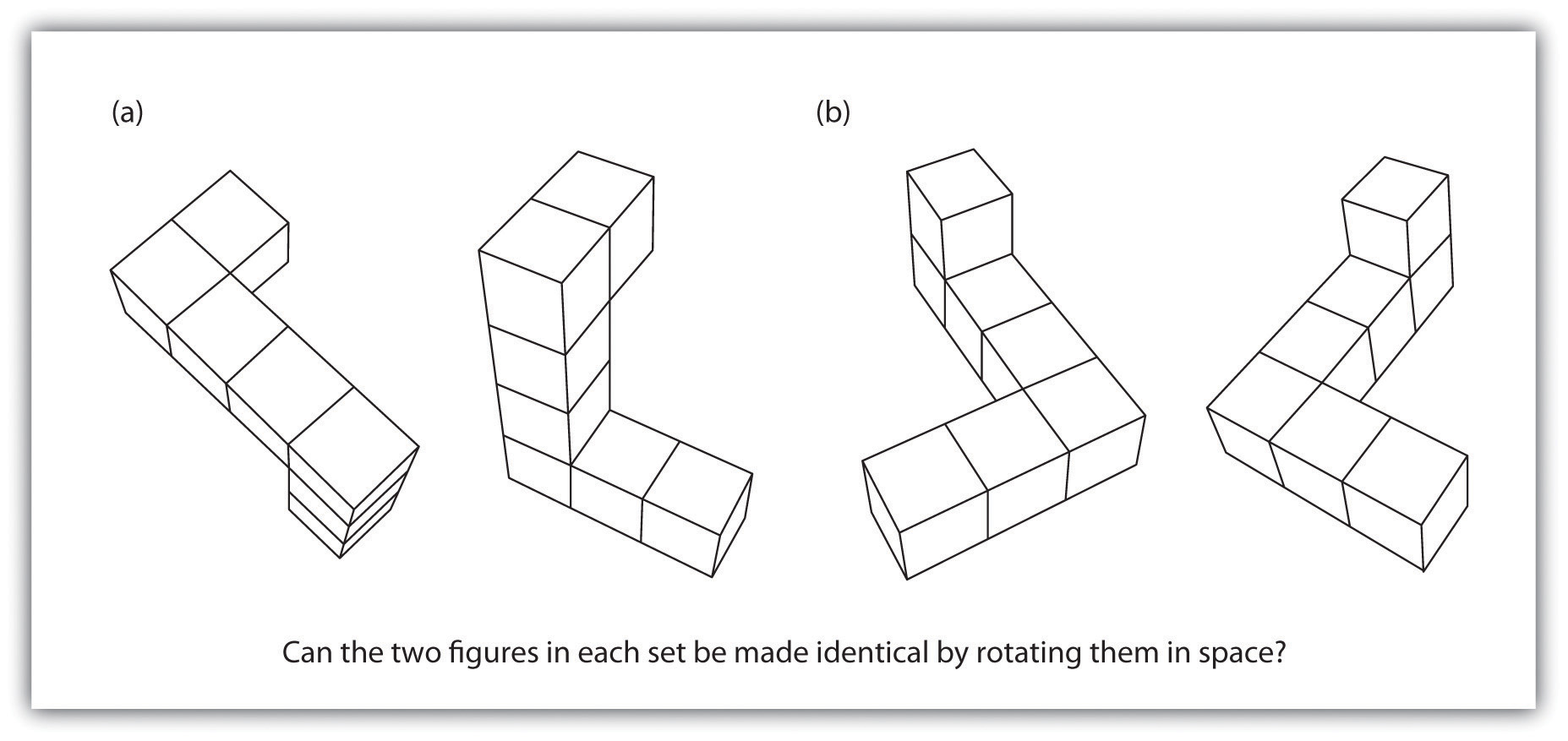
some questions on IQ tests depict rotated images of figures, and ask things like:
> can the two figures in each set be made identical by rotating them in space? [0]
this isn't my domain, so without knowing any better i would kind of expect the Vividness of Visual Imagery Questionnaire and its abridged version to ask similar questions. but if they didn't, and you wanted to create another test, here's where i'd start:
1. devise a test with a bunch of similar questions (to the one in the above example) of varying difficulty. use these hypotheses:
H_{0}: there will be no difference in performance for people with aphantasia
H_{1}: people with aphantasia will perform worse.
2. find some people with aphantasia and test them to get a baseline.
> The browser should be ... for viewing and retrieving data, not executing that data.
i'm genuinely interested in what a modern version of that would look like.
recently i watched a 1992 interview [0] with brewster kahle in which he described WAIS (wide area information server) [1].
aside: i've not used WAIS, nor do i feel it is the way forward.
my understanding is that WAIS provided a client-side interface to a directory of servers. it also seems the presentation of content was simple: mostly text, but some images and video, too. this appeals to me because after more than 20 years on the web i struggle to remember what it was like when (or even if) the majority of pages i visited were focused on delivering pure content.
don't get me wrong -- i'm fortunate to have access to the web and a way to search for information -- but i'm becoming increasingly frustrated with the quality of today's content.
i'll concede SERP SPAM is a hard nut to crack, but that doesn't stop me from cringing every time i click on a dodgy question/answer aggregation site or some wholesale ripoff of another site [2].
and less dodgy but arguably more frustrating are legitimate publishers who modify their content presentation strategy based on google algorithm updates. for example, i can't tell you how many times i've searched for a simple recipe but the top SERP was a slideshow instead of a simple recipe i could print out and place on my counter top.
lastly, over the past 20 years it seems like primary content has become a secondary citizen on the web. when i visit SERPs today it feels like i'm less likely to be presented with what i actually searched for. instead, i'm increasingly bombarded with "SIGN UP NOW!" mortars .. erm modals .. and the presentation of the content i searched for feels more like Dahala Khagrabari [3] than the main reason for my page visit.
one might read the above and conclude i'm a bitter luddite. quite the contrary, i feel blessed to be alive and am optimistic (mostly ;) WRT the future of IT. however, i am concerned with (what seems like) this generation's tendency to favor presentation over information. the older i get the less patience i have for popups/modals, slideshows, and pictures-because-google-likes-pictures; just gimme my goddamned information already.
so. i'd really like to see a dumb client-side app that gives me only what i want to see. i've tried lynx/w3m-emacs/etc. but JavaScript ruined that effort. keen for alternative suggestions :)
[2] http://stuccy.com/ is a wholesale ripoff of stackoverflow. (note: i don't recommend visiting this site; who knows what they're up to.) i've emailed SO, whose response was essentially this:
> Please note, bringing these sites into compliance (or getting them to no longer serve our content) is often a long and arduous process. You may not see immediate results. However, rest assured that we're working on it.
the proliferation of driverless cars could make the debate about losing access to public roads (i.e. losing one's drivers license) much more interesting.
agreed. interesting read, yet far from complete, and certainly questionable.
a couple that jumped out to me as questionable:
the "discounting" section reminds me of the stanford marshmallow experiment (itself questionable iirc). i'm not convinced a marshmallow is worth an additional 5 minutes of delayed gratification, and i'm even less convinced an additional 0.07ml of juice (or a whole 0.002oz) is worth waiting at all.
the "Relative and Absolute Utility" section, and particularly the quoted section of Glimcher's example, fail to acknowledge a fundamental component of human motivation: context.
for example, strand someone on a remote, uninhabited, desert island (with no way to escape, etc.), and offer her a choice of $1,000,000 worth of goods or $1,000 worth of goods. her choice at this point is uninteresting because currency is arguably worthless in the absence of trade; she assigns value based on what these goods can do for her rather than what they would fetch at auction back home.
for example, let's say the $1,000,000 worth of goods is a lifetime supply of jello, and the $1,000 is a safe ride home on a fishing vessel. the safe ride home is arguably the better choice despite its lower monetary value. this is why i believe it's silly to blindly apply the transitive property of inequality (in terms of monetary value) as a predictor of human motivation while ignoring context.
datatau [0] might be worth checking out, if you're not familiar.
since bioscience isn't on my radar i'm not sure if you'd find anything useful there, however, it feels like a more concentrated version of HN which specializes in some of the other stuff that interests you (e.g. learning algos, data analysis, etc.).
> But you are making an assumption that just because someone enjoys living in a trailer house, they must also be ok with living in an apartment. That may not be the case, at lease that's not the case for me.
good point. a home with a private yard for the kids to play, no shared walls, a porch to sit on while you wave to neighbors on their evening stroll -- these things aren't possible in high-rise apartment buildings, which by comparison might feel like confinement.
also, many people who've never lived in a trailer park, or don't know any manufactured homeowners, might not understand the sense of community that a lot of trailer park residents feel.
i'm not saying that a sense of community is not possible in a high-rise apartment building, but in my experience, high-rise apartment buildings have a much different atmosphere than gated communities.
> Also, I am not familiar with the area in question, but isn't it quite susceptible to earthquakes? I am not saying don't build a multistory building, but 40 stories?
SF and san jose have lots of high-rises, as do other big cities near fault lines :)
if i've written something that's factually wrong or misleading, offensive, or otherwise violates the comment guidelines, i would appreciate the opportunity to update my comment or delete it. and for that to happen i would need some feedback.
like OP, online ads (partially) put food on my table. but that's where the similarities stop: whereas OP mentions he's "never been tempted to run ad-blocking software before," i've blocked ads for years. and i don't just block ads myself, i advise my friends and family to block them, too.
what most of my friends and family don't know is web ads represent, arguably, one of the most dangerous aspects of modern web UX. ad servers exploited with 0-day vulns are one thing, but what worry me (and what i despise) most are dodgy ads that try to mimic/replicate some aspect of the publisher's web UI, and ads that fraudulently misrepresent other websites (e.g. fake facebook notification ads). many of these ads run on the biggest networks.
so instead of repeatedly telling my grandma that the buttons on certain sites aren't actually buttons for those sites, or that the banner with the facebook friend request isn't actually from facebook, i just install adblock on her browser.
i'm well aware of the irony and the double-standard. but safety first, right?
a few years ago i had to pare down my wardrobe for extended travel. sadly (at the time), my startup tees were the first to go. i replaced them with patagonia's silkweight tees (2/3 merino, 1/3 synthetic).
as a lazy hacker i won't go back to cotton. i can comfortably wear a 2/3 merino + 1/3 synthetic base layer in virtually any climate. unlike cotton or pure merino, my pits don't remain wet after sweating. and unlike 100% synthetic tees, i don't smell like a locker room by lunchtime. (lazy bonus: this means fewer washes in cooler weather.)
there are a couple of downsides though:
- they're more expensive (~$40 on sale)
- they're delicate (delicate wash, and tumble dry with no heat or lie flat to dry is recommended)
there may be other companies with similar-quality products, but i'm comfortable recommending patagonia based on my experience. with proper care their stuff should last a long time, but they have a great warranty just in case.
i get that this is a tongue-in-cheek comment, and appreciate your sense of humor, but it also saddens/frightens me to think this could become the prevailing sentiment in the years to come.
i grew up believing the internet was a great equalizer, capable of providing opportunity to people from across the globe, irrespective of nationality, race, creed, etc.
but now i fear the actions of certain nation states could produce -- for lack of a better term -- a fervent "digital xenophobia" that causes people to delineate and enforce boundaries on the net mirroring real world geopolitical borders maintained by a powerful minority.
that's not the kind of future i'd like to see.
for example, might people one day need a digital passport to send and receive data internationally? and might those data be subject to customs inspection before/after receipt?
today these may seem like parts of a cyberpunk b-movie plot, but it's not inconceivable that legislators would push for similar measures in the future if, for example, "national security interests" hung in the balance and they had the power to push such measures through.
whilst reading your above comment i wondered why you chose not to use environment variables instead. e.g.:
  $ export cdc_stuff='/Users/me/src/project_stuff'
  $ cd $cdc_stuff
however, now it's clear.
in the event you're looking for alternatives, perhaps porting your code to (e.g.) ruby could work.
just in case, here's the isbn number of a book called, 'Build Awesome Command-Line Applications in Ruby 2,' from the pragmatic bookshelf: 978-1-93778-575-8