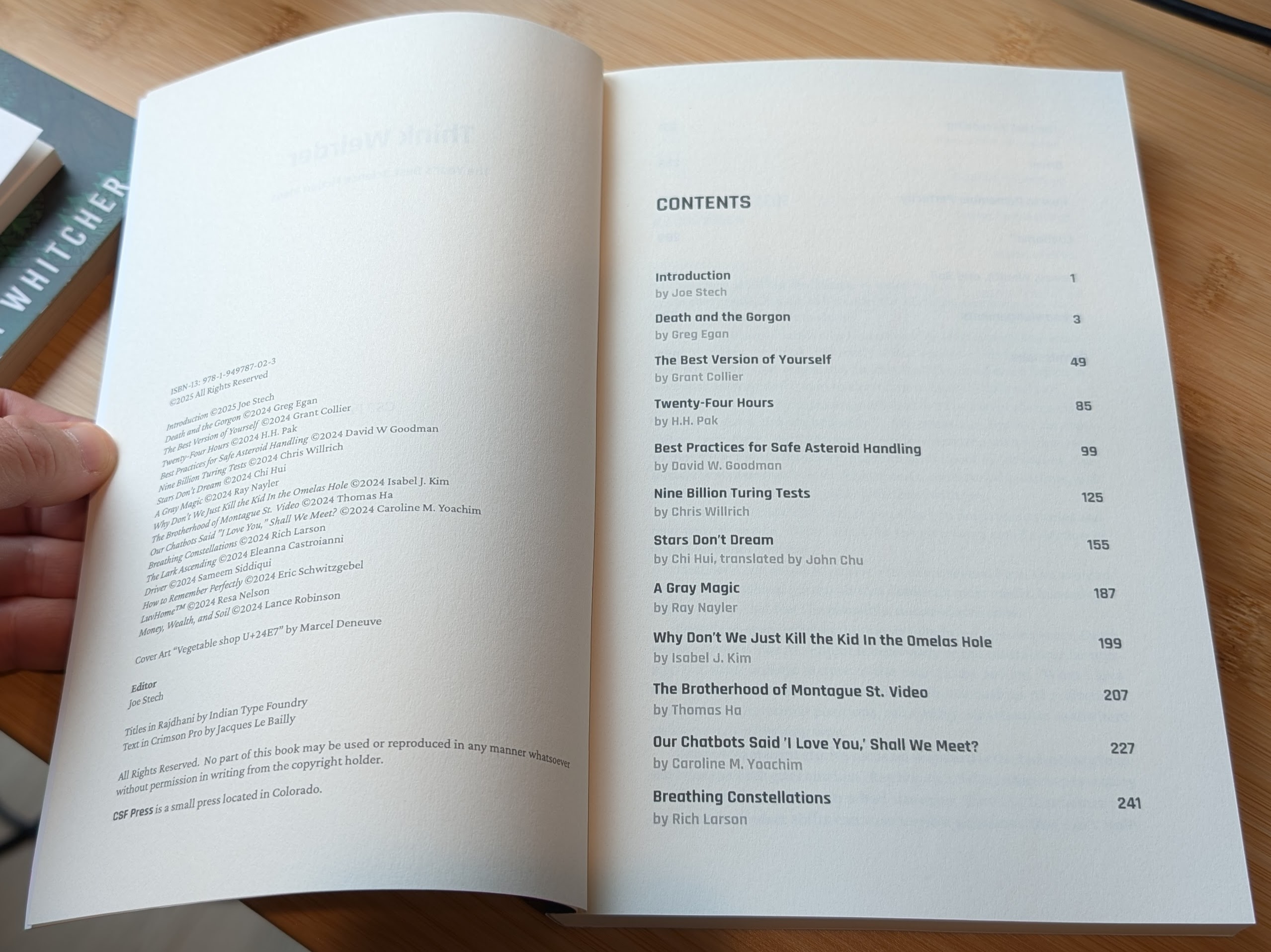
I see this pattern a lot -- folks start a publication, publish for a handful of years, and then shutter. I did it myself with Compelling Science Fiction magazine. This is why I settled on releasing only one book per year, it's sustainable while working full-time on other projects.
My reading is that OpenAI is paying lip service. Altman is basically saying "OF COURSE we don't want to spy on Americans or murderdrone randos, but OF COURSE the government would never do that, they just told me so (except for the fact that they just cut ties with Anthropic because Anthropic wouldn't let them do that)"
nicely said. I've been thinking a lot about how the bottleneck in the limit is getting your intent into the machine. Over time as AI improves it'll get better and better at extracting your intent just from situational context, but this only helps if you're willing to abdicate more and more judgement to the machine.
Eventually you may get to the point where the machine has all the context about the scenario and all the knowledge about how you think, and so will always perfectly be aligned with your intent, but when that day comes the thing will have far surpassed your decision-making capability and you won't be in the loop anymore anyway.
That's really cool! Yes, it's always been amazing to me how many people will respond helpfully to a random cold email.
And well-known authors are similar to other artists in the fact that they have steep rates for commissions. For instance, https://clarkesworldmagazine.com pays a flat reasonable rate of 14 cents per word ($840 for a 6k word story). I've talked to well-known authors who would charge $5/word for that same story on commission ($30k)
My favorite collection recently was "The Collected Stories of Vernor Vinge". It spans his short fiction from 1965-2001.
I've considered commissions many times, I go back and forth on it. I wouldn't want to put a commissioned story into a "Year's Best" anthology, just because I truly want it to be a "Year's Best" -- i.e. I need to evaluate ALL the stories published to the best of my ability and choose the best regardless of name recognition.
I could commission some and create a new themed book separate from the "Year's Best", but that's hit and miss. The main issue with commissions for me is that you never really know if the thing you're commissioning is going to turn out how you want. If the authors are well-known it will probably be good, but I've had many editor friends commission stuff that was just phoned in.
Yes, I plan on releasing one annually, based on the best concept-driven science fiction stories from the previous year. Any more than that and it would take too much time, but one per year is sustainable for me.
I agree that there are many forgotten gems in old science fiction short stories. I just counted on my bookshelf, I own 19 of those old collections in physical form and I'm sure many more in ebook form.
Thanks for pointing that out, I need to remove that submissions page altogether, the magazine has been shut down for five years and you found your way to a vestigial part of the site that almost nobody visits anymore.
First I just want to say that it's an honor that you took a look, I've read and enjoyed many of your articles in the past.
This anthology is actually a "Year's Best" -- they're reprints selected from a pool of 391 stories printed in the big science fiction magazines last year. So I'm not opening for submissions, or anything like that (I have done that before, back when I published a magazine). For this anthology I reached out to the authors about the best concept-driven stories I read last year, and fortunately they all agreed to let me publish their stories.
Happy to talk about it, the TL;DR is that this is a hobby where I as the editor don't expect to make back the money I spent creating the book, but the authors get paid a fixed amount up-front. Here's a more detailed answer: https://news.ycombinator.com/item?id=45785154#45879003
The only addendum to that answer is that after being featured on HN last week I'm now over halfway toward break-even.
Thanks for your support! I believe I understand where you're coming from, some of the stories have more novel concepts than others -- Twenty-Four Hours is hard to discuss without spoilers, but I selected it because the characters and setting felt very real, while at the same time it would completely fall apart without the technological concept.
As I wrote in that blog you linked, I tried to interleave the stories so that you get alternating vibes as you go through the book. I know not every story will be for everyone, but I hope you find most of them interesting!
I plan on pursuing as close to the same process as I can next year, I want to put out the most consistently concept-focused Year's Best out there.
The reprint rights agreements were all extremely manual, I did everything through email and SignNow. Mostly payments went through PayPal, although there was one author who wanted a physical check mailed.
Thanks, you're completely correct, rights acquisition was the most difficult part!
The absolute hardest story in the anthology to get rights for was "Stars Don't Dream" by Chi Hui. It's a translation of a story that won an award in China, but Chi Hui doesn't speak English, and her contact info was extremely hard to obtain (I had to get help from the editor of Clarkesworld Magazine). We did the entire contract discussion via a combination of Google Translate and my very weak Mandarin I learned in college.