Missouri disaster: Duck boat’s designer had no engineering training(latimes.com)
latimes.com
Missouri disaster: Duck boat’s designer had no engineering training
http://www.latimes.com/nation/la-na-duck-boat-20180724-story.html
137 コメント
You're right, but I suspect that one couldn't find a modern naval engineer who would approve any design based on a boat with insufficient flotation. If you cut a modern factory-built boat in half, both halves will float. If one of these duck coffins springs a leak, it's going to the bottom. So, the focus on the engineering degree isn't totally off-base, because a qualified engineer would just "nope" the whole thing.
The NTSB really should have put an end to this industry in 1999. It's tough to imagine that they won't fix their mistake this time around.
The NTSB really should have put an end to this industry in 1999. It's tough to imagine that they won't fix their mistake this time around.
The one in Seattle suffered an axle break on a bridge, slamming into a charter bus.
These things are insanely heavy, put through daily stress, and are basically maintained by carnies.
Whether they're sinking like brick or eviscerating the sides of buses, it's clear that they don't belong on the road.
Can't they just sunset these stupid things for the sake of the businesses, let wealthy collectors buy the old boats for their own purposes (and at their own risk), and force "Ride the Ducks" (who constantly insists that is not a single entity, despite having the same brand and business model), to purchase modern amphibious tour buses that pass safety regulations.
Surely there would become an immediate demand for a safe, comfortable, maneuverable amphibious vehicle in the wake of a crackdown on these deathtraps.
These things are insanely heavy, put through daily stress, and are basically maintained by carnies.
Whether they're sinking like brick or eviscerating the sides of buses, it's clear that they don't belong on the road.
Can't they just sunset these stupid things for the sake of the businesses, let wealthy collectors buy the old boats for their own purposes (and at their own risk), and force "Ride the Ducks" (who constantly insists that is not a single entity, despite having the same brand and business model), to purchase modern amphibious tour buses that pass safety regulations.
Surely there would become an immediate demand for a safe, comfortable, maneuverable amphibious vehicle in the wake of a crackdown on these deathtraps.
My wife recently rode one in the lower Wisconsin Dells and the outboard motor blew while they were breaching the water. The tour guide said this was the first it's ever happend. :rolleyes:
[deleted]
Hmmmmm. And here I was thinking Ride the Ducks could be fun, and a friend recommended it to me some while ago...
You're probably thinking of boats like Boston Whalers that have flotation foam built into the hull and will float when cut in half. But there are many other types of modern factory-built boats which will sink immediately if they take on enough water.
Anything 20' or less has to have that flotation by law. Lots of brands install it in all boats regardless of length. There's a video of the back half of a 35' Carolina Skiff motoring around. [0] Obviously ducks are longer than 20', but no engineer would sign off on "sinks immediately". Larger vessels have various methods of buoyancy control. Nothing modern is built like a duck.
[0] https://youtu.be/6Tv1EBb-MqE?t=425
[0] https://youtu.be/6Tv1EBb-MqE?t=425
Err... pretty much every monohull sailboat ever manufactured will "sink immediately" if the hull is punctured. Keels are heavy.
Most monohull sailboats don't even have keels let alone weights. Certainly any sailboat designed to handle a capsize, which is all but the very largest, will not sink from a puncture, with keel-weight or without. Remember that interminable Robert Redford movie? That boat had a puncture the size of a shipping container...
> Most monohull sailboats don't even have keels let alone weights.
That's factually incorrect. Smaller monohulls that focus on racing performance often do not have weights, though they will certainly have a keel to reduce drift when sailing upwind. The exceptions are certain classes of tiny sports vessels.
Larger monohulls that are designed to be lived on are generally categorised under "class A" according to Europe's CE certification, but are probably sold with equal safety standards around the world. Class A means that they are impossible to fully capsize and will not sink with even a reasonable amount of water in them (well, de facto at least, de jure they only need to survive certain wind and sea conditions). For example, a class A yacht may roll over 90° onto its side and fill up with water, but will not sink. To pull this off, these yachts have heavy weights on the end of their keels to counterbalance the force of the wind pushing them into the water.
However, given enough water in them, even class A yachts will begin to sink.
That's factually incorrect. Smaller monohulls that focus on racing performance often do not have weights, though they will certainly have a keel to reduce drift when sailing upwind. The exceptions are certain classes of tiny sports vessels.
Larger monohulls that are designed to be lived on are generally categorised under "class A" according to Europe's CE certification, but are probably sold with equal safety standards around the world. Class A means that they are impossible to fully capsize and will not sink with even a reasonable amount of water in them (well, de facto at least, de jure they only need to survive certain wind and sea conditions). For example, a class A yacht may roll over 90° onto its side and fill up with water, but will not sink. To pull this off, these yachts have heavy weights on the end of their keels to counterbalance the force of the wind pushing them into the water.
However, given enough water in them, even class A yachts will begin to sink.
Centerboards are not keels. You may not care about dinghies such as e.g. Lasers, but there are a whole hell of lot more of them around than there are keeled yachts. Neither of which have a damn thing to do with this discussion, since as I already noted and you repeated they're both much safer than ducks. This thread is like a parody: a stream of idiotic "well, actually"'s.
This thread is like a parody
You started this subthread by comparing 30+ passenger commercial amphibious vessels with sub-20' dinghies. Nonsense begets nonsense.
You started this subthread by comparing 30+ passenger commercial amphibious vessels with sub-20' dinghies. Nonsense begets nonsense.
The comparison is between boats designed by engineers in the last fifty years, and boats not so designed. You're the one who wanted to talk about sailboats, which in support of my point are also safer than ducks. Please educate yourself before promulgating falsehoods: "Pretty much every monohull sailboat ever manufactured will sink immediately if the hull is punctured." Hilarious!
The NTSB really should have put an end to this industry in 1999.
They did everything they could legally do, which is to say that they issued many strongly worded recommendations. Unfortunately they don’t have the legal authority to actually force anyone to do anything.
They did everything they could legally do, which is to say that they issued many strongly worded recommendations. Unfortunately they don’t have the legal authority to actually force anyone to do anything.
Who has the authority to ban these boats?
I could be wrong, but I believe both the federal Department of Transportation and their state equivalents have this authority. So far, they haven’t done it though.
As with most of these issues, it’s quite likely that a private market solution would be most effective. If insurance companies refused to cover these boats, or they at least forced clients to implement all NTSB recommendations, the problems associated with this industry would largely disappear overnight. According to the NTSB, the reason the death rate is so high when these things sink is because the canopy doesn’t come off. They had specific recommendations that would address this problem, and the industry seems to have entirely ignored them.
As with most of these issues, it’s quite likely that a private market solution would be most effective. If insurance companies refused to cover these boats, or they at least forced clients to implement all NTSB recommendations, the problems associated with this industry would largely disappear overnight. According to the NTSB, the reason the death rate is so high when these things sink is because the canopy doesn’t come off. They had specific recommendations that would address this problem, and the industry seems to have entirely ignored them.
Isn't the Coast Guard also involved, it being a water craft used for hire?
It's a bit harsh to want to end the whole industry, no?
By all means let's get some proper safety standards for these things, but banning them outright seems excessive.
By all means let's get some proper safety standards for these things, but banning them outright seems excessive.
Ban the use of anything designed and constructed during WWII for amphibious transport of the public. There's no way you'll ever get enough flotation in there. If someone wants to invest enough to develop a new amphibious vehicle to replace the existing stock, that's fine, but I doubt the market would support such an undertaking. Thus the industry would disappear without any excessive action.
I don't think the original purpose was to be able to behave like a boat, more for fording deeper rivers in combat situations.
My Dad used them to transport cargo from ship to shore when they were constructing an air base in Thule Greenland. They are for getting stuff ashore in places where there isn’t a harbor.
You don't really deserve the downvotes you're getting. This is a widespread tourist attraction and I'd have to see some statistics to conclude that it's an especially unsafe one. That said, they deserve a serious look at what could be practically done to retrofit for greater safety (flotation, sorry but you get wet if it rains, wear PFDs) and otherwise set stricter operating guidelines.
From a 2016 news article:
If you search Google news (use a date range prior to this month's accident) you'll see regular deadly incidents going back years.
The NTSB did a huge review after a 1999 incident with 13 deaths. Conclusion? They're death traps. Duck boats swamp easily and sink like a stone. If there's a canopy people get dragged straight to the bottom.
The industry is huge and economically important. So perhaps just grandfather existing duck boats as long as they don't have a canopy. If you want a fancy duck boat with windows and a canopy, then buy a properly designed boat that isn't a death trap.
EDIT: Reading through the Google News results it seems these things are more deadly on land than in water.
  Philadelphia's fleet of 20 to 25 duck boats have been
  involved in three fatalities in five years, he said.  "If
  you compare those rates to the number of fatalities per mile
  driven in a passenger car, you are talking about rates of
  fatalities literally thousands of times higher."
If you search Google news (use a date range prior to this month's accident) you'll see regular deadly incidents going back years.
The NTSB did a huge review after a 1999 incident with 13 deaths. Conclusion? They're death traps. Duck boats swamp easily and sink like a stone. If there's a canopy people get dragged straight to the bottom.
The industry is huge and economically important. So perhaps just grandfather existing duck boats as long as they don't have a canopy. If you want a fancy duck boat with windows and a canopy, then buy a properly designed boat that isn't a death trap.
EDIT: Reading through the Google News results it seems these things are more deadly on land than in water.
Yes, they are hard to drive in urban areas, which is a shocker considering they were designed to drive on the ocean/beach. In Seattle we have them and they have a pretty bad record about hitting people in crosswalks, even running over a guy on a harly. They are so far above traffic that you just can't see that shit. Not to mention a couple of years ago when the axil popped off and ripped a tour bus in half killing a few kids and sending a good number to the hospital.
Amphibious tours in amphibious cities would be great, but I doubt you could even get those things approved now, and no one actually has the money to make a new fleet and profit.
It is also probably note worthy that the original design was made for a situation where loss of human life was already expected.
Amphibious tours in amphibious cities would be great, but I doubt you could even get those things approved now, and no one actually has the money to make a new fleet and profit.
It is also probably note worthy that the original design was made for a situation where loss of human life was already expected.
Growing up in a family of commercial fishermen/sailors I have often heard complaints that the drivers of these things possess limited boating experience and routinely cause interruptions or annoyance for other waterborne vessels. I've never ridden one, though, or captained a boat in my life, so feel free to file this wherever you keep your unsourced anecdotes.
The article says there are versions that don’t have the top, that would fix most of the issue. Wearing lifevest you’d be able to get out safely instead of being trapped inside.
I suspect that would help a lot. Literal capsizing would still be an issue but filling up with water and sinking would be much less of one.
That would address most of the concern about the boats sinking, because every passenger could safely wear a floatation device.
However, they're unsafe in other ways. The 2015 crash in Seattle, which killed 4, was caused by a snapped axle. When I read that the duck design was "stretched" by someone with zero engineering training, that sounds awfully suspicious.
An additional concern is the the safety & maintenance records themselves. As part of the settlement in Seattle, the company admitted to 463 separate violations:
https://www.seattletimes.com/seattle-news/transportation/duc...
However, they're unsafe in other ways. The 2015 crash in Seattle, which killed 4, was caused by a snapped axle. When I read that the duck design was "stretched" by someone with zero engineering training, that sounds awfully suspicious.
An additional concern is the the safety & maintenance records themselves. As part of the settlement in Seattle, the company admitted to 463 separate violations:
https://www.seattletimes.com/seattle-news/transportation/duc...
We certainly can't let a little death get in the way of profit now can we?
By that logic, we should just ban rollercoasters; they're inherently unsafe, obviously, and it's a lost cause to try to make them more safe. Never mind that we've spent more than a century doing just that. No reason why duckboats can't get the same treatment.
> Yes, someone with more experience and even professionally licensed should probably have signed off on the mods. But no one OKing this service required it and it's not clear the modifications were responsible for what happened or it was just something that can happen when duck boats generally are operated in the way that they're operated.
From the article:
"In the water, duck boats are like a “sinking coffin” when they start to flood, said McCaskill, who plans to draft legislation proposing stronger safety standards for duck boats."
Forgive the dead horse beating, but this is why it's frequently said on HN (and in general) that safety laws and regulations are written in blood. People die, gaps are identified, gaps are closed, time passes, people complain about regulation.
From the article:
"In the water, duck boats are like a “sinking coffin” when they start to flood, said McCaskill, who plans to draft legislation proposing stronger safety standards for duck boats."
Forgive the dead horse beating, but this is why it's frequently said on HN (and in general) that safety laws and regulations are written in blood. People die, gaps are identified, gaps are closed, time passes, people complain about regulation.
I feel like every law should include the reason why it came to exist.
People stop dying from it (because the regulation) therefore it’s not needed.
People stop dying from it (because the regulation) therefore it’s not needed.
I feel the same. It's a similar problem to code comments / commit messages. You look at a line of code and wonder, why on Earth is it there? You hope there's an explanatory comment nearby, or that you can git-blame your way into a commit message.
Law is similar, except on much longer timescales. I wish the laws would carry both inline explanation (comments), and explanations of reasoning and causes when changed (commit messages).
Law is similar, except on much longer timescales. I wish the laws would carry both inline explanation (comments), and explanations of reasoning and causes when changed (commit messages).
This is part of the reason I hate the mentality that all code is self-documenting, so to speak. I've seen corporate environments that frown on any code commenting besides standard headers and such...
[deleted]
I think it's very naive to think, especially in the political climate of the last few decades, that people who call for repeal of regulation are first of all reading the text and second would be averted from repeal if it simply contained a rationale or they had it explained to them.
De-regulators know there is a reason, in many cases they understand it well. They don't care.
De-regulators know there is a reason, in many cases they understand it well. They don't care.
I didn't claim there would be less deregulation. However, it would be harder to misrepresent the original intent and easier to trace recurrence back to repeal.
[deleted]
If only Claire (or one of her "unaffiliated" super-PACs) could somehow blame this on something Josh did during his 1.5 years as AG...
These are not great on the road either. There was a massive accident a couple years ago in Seattle which killed 4 students.
https://www.cnn.com/2015/09/24/us/seattle-tour-bus-duck-tour...
https://www.cnn.com/2015/09/24/us/seattle-tour-bus-duck-tour...
It has been mentioned (but not corroborated) that the engines are prone to stalling in rough waters... something you do not want to happen, aside from capsizing.
I think after the NTSB is done, it's likely these get taken off waterways --at which point, there is no reason to keep them as land only vehicles since they get such poor mileage and offer a poor bumpy ride.
I think after the NTSB is done, it's likely these get taken off waterways --at which point, there is no reason to keep them as land only vehicles since they get such poor mileage and offer a poor bumpy ride.
Maybe. These are a big tourist attraction in a lot of places. The NTSB made a number of recommendations in the past (which were mostly not followed). And I don't see a lot of appetite for the feds coming in and shutting down a popular tourist attraction in many cities around the country once the current news cycle ends.
I would hope that some (known) relatively simple and inexpensive quick fixes would at least be made though.
I would hope that some (known) relatively simple and inexpensive quick fixes would at least be made though.
> And I don't see a lot of appetite for the feds coming in and shutting down a popular tourist attraction in many cities around the country.
If this isn’t a good time for a regulator to intervene, when is?
If this isn’t a good time for a regulator to intervene, when is?
Also depends on how you use them. Should they have been that far out in the water? etc.
Yeah the canopies seem like death traps :(
Yeah the canopies seem like death traps :(
Like most lakes in Missouri, it's impossible to get very far from shore on Table Rock Lake. Our lakes are built by flooding the narrow valleys that streams cut into the limestone and dolomite of the Ozark Plateau. This really just compounds the tragedy, as a boat driver with an ounce of common sense would have just driven up on any available shore when the storm got bad, rather than trying to make it back to the home ramp. I thought that public tour boat operators had to be Coast Guard-approved, but this guy failed pretty hard.
Awesome geography knowledge here! This was fundamentally a weather and engineering issue though. There’s just no way to get to safety when you realize the storm is too much for you in a slow and clumsy craft like this. You have to make the decision not to go out at all if the forecast is potentially dangerous. I’ve never seen weather swells on these small lakes large enough to swamp anything (big speedboat wakes are another story) so I would imagine the wind caught the awning and tipped it enough to take on water. Then the awning drowned everyone when they couldn’t overpower the bouyancy of their jackets to get out from under it. Bad decision by the driver to make the trip caused the accident, and the life-jacket policy combined with the awning design made it fatal.
At its very widest the channel is less than a mile across, so there is less than half a mile to go. Holy crap these things are slow, but apparently that would take less than ten minutes, less if aided by gale-force winds. Did ten minutes pass between "I can't handle this storm" and "oh shit I've killed us all"? Probably!
https://www.google.com/maps/place/Table+Rock+Lake/
https://www.google.com/maps/place/Table+Rock+Lake/
"Then the awning drowned everyone when they couldn’t overpower the bouyancy of their jackets to get out from under it."
Unfortunately, I heard reports that, no one had life jackets on.
Unfortunately, I heard reports that, no one had life jackets on.
So many bad choices.
I heard from reports that the tour employees pointed to them and said they wouldn't be needed.
Then when water started coming on board, reports said, some people stood up (possibly to get the life jackets) but the employees told everyone to stay sitting.
Then when water started coming on board, reports said, some people stood up (possibly to get the life jackets) but the employees told everyone to stay sitting.
I'm going go all internet badass here and say I hope that I'd be strong enough to have have some harsh words and it would take some physical interaction for me not to get to those jackets.... I've been on the water enough to know how quick stuff can go bad and there's no time to get flotation devices out (not enough) to save most folks after it goes bad.
It's fine to imagine being badass, but remember that families with children and elderly people rode these things. At my most badass I could cut my way through the deathcanopy with my trusty pocketknife and maybe pull one small child to safety before the whole thing went to the bottom. What if there were three children and two old folks sitting near me? What a nightmare! Tour boats operated for the amusement of the general public must not sink quickly, even in choppy water.
Internet badass here again... if I'm there with my kids, that's why I'm being a badass. I'm not sitting in an unstable boat in a storm and not having a jacket on my family...
I understand your experience, but there's plenty of cliff-like terrain that the lake(s) (Table Rock and Lake of the Ozarks) have. In a lot of parts of the lake, there's not a shore to beach on. The speed of these things in the water wouldn't outrun their ability to take on water, either.
Sure there are bluffs. They don't tend to be vertical at water level for a very long distance. Anyway the tragedy occurred within non-motorized-rescue distance of the dock for "The Showboat Branson Belle", which is an area with more gently sloping shores. Here's a view of that area from the north:
https://www.google.com/maps/@36.6044492,-93.3119691,3a,75y,2...
If they had started out right next to the dam, they couldn't have driven up onto that, but in that case they would have passed about half a mile of shoreline before sinking.
If this sort of thing happened at Lake of the Ozarks, the main obstacle would be all the lake-home seawalls... CoE regs prevent installation of those amenities at Table Rock. Of course, given the Lake's wealthier/more prestigious clientele, duck rides would never prosper there...
https://www.google.com/maps/@36.6044492,-93.3119691,3a,75y,2...
If they had started out right next to the dam, they couldn't have driven up onto that, but in that case they would have passed about half a mile of shoreline before sinking.
If this sort of thing happened at Lake of the Ozarks, the main obstacle would be all the lake-home seawalls... CoE regs prevent installation of those amenities at Table Rock. Of course, given the Lake's wealthier/more prestigious clientele, duck rides would never prosper there...
Oh man they didn't just head to shore? :( ... even a sand bar or something would have helped, getting stuck even fine!
From the article:
'U.S. Coast Guard spokesman Chad Saylor confirmed that the Missouri duck boat was a “stretch duck.” He said the boat was last inspected on Nov. 29, 2017, and was found “fit for route and service.”'
'U.S. Coast Guard spokesman Chad Saylor confirmed that the Missouri duck boat was a “stretch duck.” He said the boat was last inspected on Nov. 29, 2017, and was found “fit for route and service.”'
[deleted]
It is not evident that the [lack of] credentials of the person who designed the vessel contributed to its capsizing. This CNN article goes on to discuss the conditions during the day of the incident[0]
The town was under a severe thunderstorm warning issued about half an hour before the boat capsized.
There were numerous reports of damage throughout the county, including trees down and structural damage, said CNN meteorologist Taylor Ward.
The highest wind gust reported in the area was 63 mph.
"I believe it was caused by weather, yes," said Stone County Sheriff Doug Rader.
Any time you are traveling in a motorized vehicle there is a chance that things turn deadly. Let's allow the investigation to continue before rushing to judgement.
[0]: https://www.cnn.com/2018/07/24/us/missouri-duck-boat-investi...
The town was under a severe thunderstorm warning issued about half an hour before the boat capsized.
There were numerous reports of damage throughout the county, including trees down and structural damage, said CNN meteorologist Taylor Ward.
The highest wind gust reported in the area was 63 mph.
"I believe it was caused by weather, yes," said Stone County Sheriff Doug Rader.
Any time you are traveling in a motorized vehicle there is a chance that things turn deadly. Let's allow the investigation to continue before rushing to judgement.
[0]: https://www.cnn.com/2018/07/24/us/missouri-duck-boat-investi...
The NTSB investigation for the 1999 sinking of a duck boat has concluded [0]:
> Until reserve buoyancy retrofits are completed the Board recommended immediate actions to mitigate the danger for vessels without adequate reserve buoyancy including the removal of canopies during water operations or installation of a Coast Guard approved canopy that would not restrict the horizontal or vertical escape of passengers; closing unnecessary access plugs; reduction of through-hull penetrations to the minimum size needed for operation; and installation of independently powered electric bilge pumps.
I don't have all the information, but it certainly doesn't look like those recommendations were enacted here.
[0]: https://www.ntsb.gov/news/press-releases/Pages/NTSB_Determin...
> Until reserve buoyancy retrofits are completed the Board recommended immediate actions to mitigate the danger for vessels without adequate reserve buoyancy including the removal of canopies during water operations or installation of a Coast Guard approved canopy that would not restrict the horizontal or vertical escape of passengers; closing unnecessary access plugs; reduction of through-hull penetrations to the minimum size needed for operation; and installation of independently powered electric bilge pumps.
I don't have all the information, but it certainly doesn't look like those recommendations were enacted here.
[0]: https://www.ntsb.gov/news/press-releases/Pages/NTSB_Determin...
For clarification, these recommendations were for Duck Boats in general; The entrepreneur in the headline designed a "stretch" duck boat, which was an extended version of a regular one.
> Let's allow the investigation to continue
This is a strawman - no one is calling for ending the investigation prematurely.
> before rushing to judgement.
How soon is too soon to "rush" to judgement that these boats are unsafe?
The NTSB report regarding the 1999 Arkansas sinking [0] noted problems with their lack of reserve buoyancy. Certainly weather played a factor in the Missouri sinking, but so did the design flaw that causes it to sink or capsize much more easily than a modern boat of equivalent size. That design flaw has been known publicly for almost 20 years.
The passengers who drowned in the Missouri sinking weren't wearing life jackets. [1] The 1999 NTSB report recommended removing the canopies of these boats, but if the canopies couldn't be removed, then they recommended not using life jackets.
And the main subject of the article is the crash from 3 years ago in Seattle. That happened on land, caused by a broken axle. [2] It turns out the person who designed the "stretch" duck boats didn't have any formal engineering training, and it's not a huge step to imagine that stretching a vehicle in that way could lead to increased stress on the axle.
This isn't rushing to judgement. This is understanding the context of decades of previous incidents for better insight into the most recent one.
0: https://www.ntsb.gov/news/press-releases/Pages/NTSB_Determin...
1: https://www.cnn.com/2018/07/22/us/missouri-duck-boat-tragedy...
2: https://www.seattletimes.com/seattle-news/ntsb-ruling-expect...
This is a strawman - no one is calling for ending the investigation prematurely.
> before rushing to judgement.
How soon is too soon to "rush" to judgement that these boats are unsafe?
The NTSB report regarding the 1999 Arkansas sinking [0] noted problems with their lack of reserve buoyancy. Certainly weather played a factor in the Missouri sinking, but so did the design flaw that causes it to sink or capsize much more easily than a modern boat of equivalent size. That design flaw has been known publicly for almost 20 years.
The passengers who drowned in the Missouri sinking weren't wearing life jackets. [1] The 1999 NTSB report recommended removing the canopies of these boats, but if the canopies couldn't be removed, then they recommended not using life jackets.
And the main subject of the article is the crash from 3 years ago in Seattle. That happened on land, caused by a broken axle. [2] It turns out the person who designed the "stretch" duck boats didn't have any formal engineering training, and it's not a huge step to imagine that stretching a vehicle in that way could lead to increased stress on the axle.
This isn't rushing to judgement. This is understanding the context of decades of previous incidents for better insight into the most recent one.
0: https://www.ntsb.gov/news/press-releases/Pages/NTSB_Determin...
1: https://www.cnn.com/2018/07/22/us/missouri-duck-boat-tragedy...
2: https://www.seattletimes.com/seattle-news/ntsb-ruling-expect...
There are US flotation standards for small boats.[1] That requires big blocks of foam that floats. But amphibious vehicles are excepted. This is a problem.
Amphibious buses [2] are scary. They have flotation, but how stable are they in rough water?
[1] https://www.uscgboating.org/regulations/assets/builders-hand...
[2] https://newatlas.com/stagecoach-amphibious-bus-amfibus/14130...
Amphibious buses [2] are scary. They have flotation, but how stable are they in rough water?
[1] https://www.uscgboating.org/regulations/assets/builders-hand...
[2] https://newatlas.com/stagecoach-amphibious-bus-amfibus/14130...
They seem equally unsafe on land.
Reminds me of the recent story [1] about that kid who was killed on an amusement park ride designed by some guy with zero credentials. You'd think at some point, someone would have signed off on the engineering design and then on the actual workmanship of the final product, but where do you draw the line?
Too much regulation and certification, and you have the aviation industry, where you can't so much as run a USB charger out to the front panel of your Cessna without the FAA coming down on you like a ton of bricks. Too little and you have people drowning and kids getting their heads accidentally ripped off. Maybe the line should be drawn at the point where you hang your shingle out there and try to make a business out of your invention?
1: https://www.washingtonpost.com/news/post-nation/wp/2018/04/0...
Too much regulation and certification, and you have the aviation industry, where you can't so much as run a USB charger out to the front panel of your Cessna without the FAA coming down on you like a ton of bricks. Too little and you have people drowning and kids getting their heads accidentally ripped off. Maybe the line should be drawn at the point where you hang your shingle out there and try to make a business out of your invention?
1: https://www.washingtonpost.com/news/post-nation/wp/2018/04/0...
If your cheap Chinese USB charger shorts out and starts a fire in the dash of your Cessna, that is a major issue, and given the rate that Chinese USB chargers do short out, a reasonably significant risk.
The last thing we need is flaming Cessna's dropping out of the sky into heavily populated areas.
The last thing we need is flaming Cessna's dropping out of the sky into heavily populated areas.
> Too much regulation and certification, and you have the aviation industry
Where it's amazingly safe considering it's literally aluminum tubes carrying humans through the air at almost 700 mph? I'm a big fan of what the FAA does.
Where it's amazingly safe considering it's literally aluminum tubes carrying humans through the air at almost 700 mph? I'm a big fan of what the FAA does.
I feel like this article is a real railroad of the mechanic that "designed" this version of the boat instead of the entire industry that is using military surplus vehicles that shouldn't be used for this purpose. They point out that he got information from other mechanics... in my experience, those guys are some of the best practical engineers out there.
This article is worded like somehow an ivy league education would have fixed that duck boats are a shitty deal. I think that's pointing the finger in the wrong direction.
This article is worded like somehow an ivy league education would have fixed that duck boats are a shitty deal. I think that's pointing the finger in the wrong direction.
I would not want to ride in a vehicle designed by someone who has an engineering degree from the Ivy League. It's well known that Ivy League engineering is pretty shitty. I'd trust a room full of Germans... or maybe some people from a engineering powerhouse state school like U of M.
> It's well known that Ivy League engineering is pretty shitty
Citation needed.
Citation needed.
Yeah, I don't agree with that statement either. I also don't think anyone from the ivy league would get into this business based on it's own merits. My original point however wasn't to disparage a classical education in engineering, but just to point out that framing the story as that this man "only" talked to other mechanics about his designs frames his role in the accident as some sort of classist bullshit.
This whole thing is not ideal and needs to maybe be regulated. In my opinion it should be regulated because Duck Tours are a stupid eyesore and anyone who would pile on them doesn't value an actual good time, but that's just me... While the article makes sure to spend several paragraphs railing on the design by a mechanic 30 years back, it doesn't actually put together a graph to quantify duck tour accidents in relation to say accidents on greyhound or megabus. It just says these things have killed people. Great, so do rented party boats.
The conclusion it draws from the first sentence onward is that because this guy didn't go to college that he designed a death trap. He didn't even design the thing. He modified something that the US military built for storming the beaches at Normandy. It's ludicrous.
Anyone who is lucky and driven enough to get a real study in engineering should. They should also build amazing things after! And if they unfortunately kill people, then that should be evaluated on it's merits, but it's just silly to say that this guy didn't take a lot into account and worked with what he had based around safety expectations of the time. His education isn't even nearly the most important thing happening here.
This whole thing is not ideal and needs to maybe be regulated. In my opinion it should be regulated because Duck Tours are a stupid eyesore and anyone who would pile on them doesn't value an actual good time, but that's just me... While the article makes sure to spend several paragraphs railing on the design by a mechanic 30 years back, it doesn't actually put together a graph to quantify duck tour accidents in relation to say accidents on greyhound or megabus. It just says these things have killed people. Great, so do rented party boats.
The conclusion it draws from the first sentence onward is that because this guy didn't go to college that he designed a death trap. He didn't even design the thing. He modified something that the US military built for storming the beaches at Normandy. It's ludicrous.
Anyone who is lucky and driven enough to get a real study in engineering should. They should also build amazing things after! And if they unfortunately kill people, then that should be evaluated on it's merits, but it's just silly to say that this guy didn't take a lot into account and worked with what he had based around safety expectations of the time. His education isn't even nearly the most important thing happening here.
Coming home from work yesterday I observed what is supposedly an identically designed boat on the Charles River in Boston. On flat water, the bow is maybe 2 feet from the water. I know nothing about maritime design but as a recreational boater I can tell these things aren’t safe. At the same time, I’m seeing local officials and news outlets in Boston saying that it’s different here, for some reason.
Money.
Pretty much. Anyone who thinks these will be banned relatively casually is... misguided. Boston's not exactly the anti-regulation capital of the universe but there would be a huge backlash against any attempt to ban this incredibly popular tourist attraction.
The exhaust location is really troubling, they are quite low and on the front of the boat. If you watch video from the storm, I can't imagine the exhaust is venting correctly. I also read If the engine goes, the bilge pump doesn't have a backup, so it wouldn't be functioning, and the front was already under water.... Interestingly the DOT says the exhaust should be at the back or above the passenger compartment but The U.S. Coast Guard regulations do not have this rule, so it's not enforced. Looks like this: http://john.je/tCXb // http://john.je/tCU4 // http://john.je/tBdi
So I went and looked up "Duck boat" on wikipedia, and that inevitably led to "Duck Tour":
https://en.wikipedia.org/wiki/Duck_tour
If they took away the canopy and made customers wear life jackets, I might actually consider riding in one.
What's the procedure for regulating a national industry like this? The eco-tour companies out here in my state are constantly in fear of being regulated, but that's regulation on the state level, by state agencies. Duck-tours, and duck-tour disasters seem to be all over.
https://en.wikipedia.org/wiki/Duck_tour
If they took away the canopy and made customers wear life jackets, I might actually consider riding in one.
What's the procedure for regulating a national industry like this? The eco-tour companies out here in my state are constantly in fear of being regulated, but that's regulation on the state level, by state agencies. Duck-tours, and duck-tour disasters seem to be all over.
Department of Transportation, Coast Guard, American Bureau of Shipping...
I suspect though that these probably fall into some crack where it's unclear who, if any, has federal regulatory authority.
I suspect though that these probably fall into some crack where it's unclear who, if any, has federal regulatory authority.
I hesitate to blame it on lack of credentials. Much of engineering history has been made on piles if dead bodies resulting from mistakes made by fully credentialed engineers, even with advanced degrees.
Engineering school does not confer at least two things: common sense and experience. These qualities are independent from academic learning.
If the designer/modifier is found to be at fault it is far more likely to be due to a lack of research and common sense than a lack of schooling.
I mean, building a boat like that that can sink if swamped and traps passengers inside is just plain stupid, degree or not.
Engineering school does not confer at least two things: common sense and experience. These qualities are independent from academic learning.
If the designer/modifier is found to be at fault it is far more likely to be due to a lack of research and common sense than a lack of schooling.
I mean, building a boat like that that can sink if swamped and traps passengers inside is just plain stupid, degree or not.
Are there any statistics about the fatality rate adjusted for ridership for Duck boats vs cars? There was a fatal crash in Seattle last year[0] involving a Duck boat, but it seems like their fatalities always garner more news than more standard vehicles'.
[0] https://www.seattletimes.com/seattle-news/ntsb-ruling-expect...
[0] https://www.seattletimes.com/seattle-news/ntsb-ruling-expect...
So is there not, like, some kind of government agency that certifies whether a given boat design is safe to put passengers on? I know it says
> He said the boat was last inspected on Nov. 29, 2017, and was found “fit for route and service.”
But I assume that's more like when I get my car inspected. This is one of those things I assume exist in society, but I guess I really have no idea.
> He said the boat was last inspected on Nov. 29, 2017, and was found “fit for route and service.”
But I assume that's more like when I get my car inspected. This is one of those things I assume exist in society, but I guess I really have no idea.
edit: never mind, deleted the comparison to the misuse of “engineer” (can’t delete post anymore).
The "Professional Engineer" designation is super limited and grants some statutory privileges for signing off on public projects, but not much else. The vast majority of engineers behind airplanes and cars are not PEs.
It may be limited but it's not just public projects. When I worked in the offshore drilling business, senior engineers had PEs so they could sign off on drawings submitted to the ABS (American Bureau of Shipping) and perhaps others.
Why do we keep supporting the LA Times which is UNREADABLE in the EU, with that stupid GDPR wall?
I guess this news story wasn't reported anywhere else huh..
I guess this news story wasn't reported anywhere else huh..
Why should the LA Times keep supporting the EU after GDPR when their financial base is entirely in the US - and the paper's online presence mostly is based on serving ads and retrieving data?
The parent comment was not about the LATimes. Rather that HN would better serve its global audience by linking to stories from other sources that all HN readers can access.
Exactly, it's not like only Americans read this website. You're cutting out a lot of nations.
> Unfortunately, our website is currently unavailable in most European countries. We are engaged on the issue and committed to looking at options that support our full range of digital offerings to the EU market. We continue to identify technical compliance solutions that will provide all readers with our award-winning journalism.
Copyright © 2018, Los Angeles Times
"We are now longer allowed to spy on you and violate your privacy. F* EU!"
> We're too lazy to read a page of regulations / not track users by default
Yeah, that whole GDPR thing really came out of nowhere, eh? :)
People also died riding them in philly
http://www.philly.com/philly/columnists/ronnie_polaneczky/du...
http://www.philly.com/philly/columnists/ronnie_polaneczky/du...
This article is perhaps not news to many, but on its own is damning.
These “boats” (they are not) do not meet basic standards for road nor sea, are furthermore hacked together from scrap, maintained shoddily, and yet receive certifications from all government authorities from which they require inspection in order to operate.
Keep straws. Ban this.
These “boats” (they are not) do not meet basic standards for road nor sea, are furthermore hacked together from scrap, maintained shoddily, and yet receive certifications from all government authorities from which they require inspection in order to operate.
Keep straws. Ban this.
A recurring pattern in media now a days is to give absolutely no context to anecdotal accounts. The article highlights a few anecdotal incidents of accidents. However, it also mentions, implicitly, that these vehicles have been operating for decades and are hugely popular in some areas. So what is the incidence rate? Not mentioned. What is the fatality rate? Not mentioned. How do these rates compare to other vehicles? Of course, not mentioned.
People are rushing to judgement based on a lack of familiarity with an industry and so are extrapolating anecdotal evidence to be more widespread than it likely is given that this article seems to have been searching far and wide to dig up any incidents it could, including even regular roadway crashes in the reporting.
People are rushing to judgement based on a lack of familiarity with an industry and so are extrapolating anecdotal evidence to be more widespread than it likely is given that this article seems to have been searching far and wide to dig up any incidents it could, including even regular roadway crashes in the reporting.
There used to be 2 operators of these things in Britain.
After a series of incidents(fires at sea, sinking) due to shoddy maintainence by poorly resourced bus mechanics and questionable modifications made in a desperate attempt to make them, technically, seaworthy according to modern regulations, they have both shut down. I'm kinda surprised the US still has them in such numbers.
After a series of incidents(fires at sea, sinking) due to shoddy maintainence by poorly resourced bus mechanics and questionable modifications made in a desperate attempt to make them, technically, seaworthy according to modern regulations, they have both shut down. I'm kinda surprised the US still has them in such numbers.
I did some further research here. We've had these commercial duck trip services since 1946 (that company is still in business!). According to the NTSB [1] more than go on tours with more than a million passengers per year as well. That number is probably up since that report was from 1999.
And the only two major incidents at sea have been caused by extreme human error. The 1999 issue was a mechanic leaving a 4.5" access hole to the hull unplugged. And the most recent involved the captain taking the passengers out into a serious storm with 70+ mph winds and 4-6 foot waves. Like most things in the media today this just seems like absurd sensationalism over an event that people can be emotionally exploited to click on lots of stuff about.
[1] - https://www.ntsb.gov/investigations/AccidentReports/Pages/MA...
And the only two major incidents at sea have been caused by extreme human error. The 1999 issue was a mechanic leaving a 4.5" access hole to the hull unplugged. And the most recent involved the captain taking the passengers out into a serious storm with 70+ mph winds and 4-6 foot waves. Like most things in the media today this just seems like absurd sensationalism over an event that people can be emotionally exploited to click on lots of stuff about.
[1] - https://www.ntsb.gov/investigations/AccidentReports/Pages/MA...
Duck boats are generally considered a bad idea. They actually didn't work all that well during WW2 in the first place.
They worked well for the very limited purpose for which they were designed: to shuttle troops and supplies to shore. They weren’t designed as a primary transportation mode but as somewhat of a ferry pretty much designed to go one way: from ship to beach. They certainly weren’t designed as tourist attractions to transport children and the infirm — but to transport trained soldiers and marines into battle. They were designed to last long enough to supply beach landing troops in combat.
It’s like using Spitfires to transport school children.
It’s like using Spitfires to transport school children.
Wow, imagine arriving at school in a Spitfire, king!
DUKWs performed well enough to stay in US inventory into the Korean war, and France didn't retire theirs until the 80's. Gen Eisenhower called them "one of the most valuable pieces of equipment produced by the United States during the war."
And after the DUKW the US Army continued with the LARC series of amphibians, widely used in Vietnam.
Many tour vessels called 'ducks' are actually LARC-5s, like this one:
https://www.flickr.com/photos/55378459@N07/5894827819/
Many tour vessels called 'ducks' are actually LARC-5s, like this one:
https://www.flickr.com/photos/55378459@N07/5894827819/
[deleted]
Would anyone accustomed to boating get in one of those things? They don’t create a first impression of seaworthiness.
Since they're typically boarded on land, it's kind of a bait and switch, isn't it? On land, one wouldn't notice the insufficient freeboard. One might be less likely to notice how enclosed the passenger compartment is, because at that point it feels more like a bus than a boat. Once the thing plunges down the ramp, one might start getting some bad feelings, but at that point it's pretty much too late. Demanding a return to shore would make one appear wimpy, and would inconvenience one's fellow passengers. The same impulse might have prevented passengers from demanding, once the storm got bad, an immediate shore landing rather than a long cruise to the home ramp. The thing is on wheels, so that would have saved all lives.
This firm does seem to target tourists, who would be less likely than locals to have boating experience.
This firm does seem to target tourists, who would be less likely than locals to have boating experience.
I wouldn't, first thought when I've learned about them. And then wondered why millions would.
I can swim, so I'm not overly concerned. I've floated on some questionable conveyances that needed quite a lot of duck tape to make them hold water chasing trout.
Then again, I usually don't bother fishing when there are near hurricane winds forecast. Although I have gone trawling across a pond with two anchors down on multiple occasions...
Then again, I usually don't bother fishing when there are near hurricane winds forecast. Although I have gone trawling across a pond with two anchors down on multiple occasions...
Whether you can swim or not isn't really the issue. The issue is that they are retrofitted with enclosures that make it difficult to escape, and once they start taking on water they can sink in seconds.
Can you provide an image? Every image I've been able to find has enormous and open windows that seem specifically enabled to allow people to escape outside them in an emergency. I've attached a few random images below.
http://cdn1.bostonmagazine.com/wp-content/uploads/2016/05/du...
http://www.completingmybucketlist.co.uk/wp-content/uploads/2...
https://assets.atlasobscura.com/article_images/17877/image.j...
https://upload.wikimedia.org/wikipedia/commons/b/bc/LondonDu...
https://www.massvacation.com/blog/wp-content/uploads/2012/11...
https://cdn.vox-cdn.com/uploads/chorus_image/image/50295385/...
http://cdn1.bostonmagazine.com/wp-content/uploads/2016/05/du...

http://www.completingmybucketlist.co.uk/wp-content/uploads/2...

https://assets.atlasobscura.com/article_images/17877/image.j...
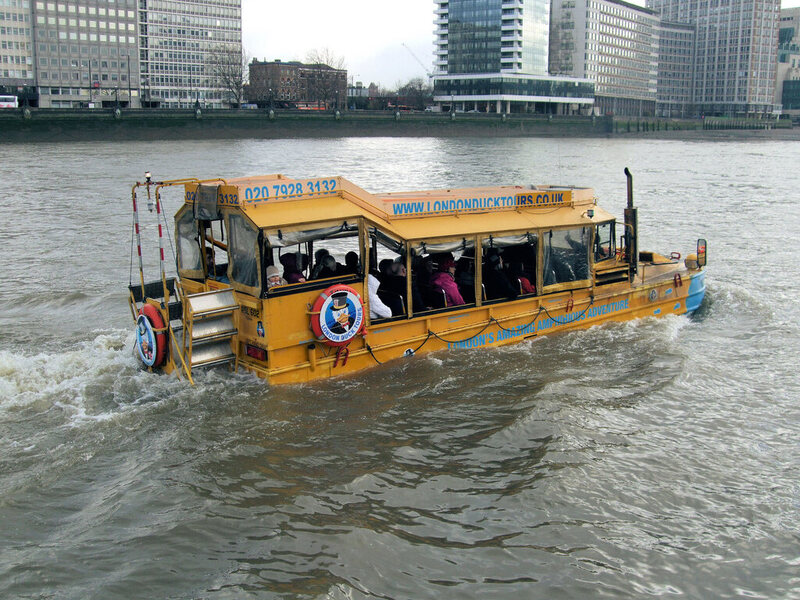
https://upload.wikimedia.org/wikipedia/commons/b/bc/LondonDu...

https://www.massvacation.com/blog/wp-content/uploads/2012/11...

https://cdn.vox-cdn.com/uploads/chorus_image/image/50295385/...

In the video still of the duck that sank (not one from some other place), you can see that there is at least some obstruction (it may just be plastic sheet though):
https://www.cnn.com/2018/07/23/us/missouri-duck-boat-investi...
https://www.cnn.com/2018/07/23/us/missouri-duck-boat-investi...
I think it's a bit much to ask a group of tourists that includes children, the elderly, possibly the disabled, all not wearing life jackets, to evacuate out the windows into open water as the ceiling comes down on them. That's not something you can reasonably expect to happen in a matter of seconds.
Sure, but that's not the issue right? These things have apparently been running for decades and are hugely popular in some areas. This article seems to have tried to drag up every single incident it could that involved them, even including random normal traffic collisions. But relative to length and frequency of usage, there weren't many incidents.
Put another way these things seem to be incredibly safe on average, but certainly when something goes wrong it's going to be make for good headlines because it's so awful. But beyond that, it seems like even when something does go wrong you certainly have good chances if you're a decent swimmer. Though perhaps this incident would be an exception, it looks like they were out in the water during a serious storm - which is completely idiotic in any sort of small water boat.
Put another way these things seem to be incredibly safe on average, but certainly when something goes wrong it's going to be make for good headlines because it's so awful. But beyond that, it seems like even when something does go wrong you certainly have good chances if you're a decent swimmer. Though perhaps this incident would be an exception, it looks like they were out in the water during a serious storm - which is completely idiotic in any sort of small water boat.
Read the NTSB report from 1999. They recommend the canopies be removed because the boats can sink in as little as 15 seconds. They ride very low in the water and there are multiple reports of canopies pulling people under.
Most of them have windows or plastic sheeting that can (and was in the Missouri case) be closed in the case of rain or cold weather.
The coast guard also recommends not wearing life jackets while inside because in one documented inncident people wearing life jackets floated to the top and got stuck under the canopy.
Most of them have windows or plastic sheeting that can (and was in the Missouri case) be closed in the case of rain or cold weather.
The coast guard also recommends not wearing life jackets while inside because in one documented inncident people wearing life jackets floated to the top and got stuck under the canopy.
You need to consider rates for things. "Multiple reports" means absolutely nothing when you're talking about something that's been running for decades for one can only imagine how many total millions of hours or whatever other metric you want to use.
For instance you can find that thousands of people have been killed because of seat belts or air bags. But these things don't really matter because the rate of incidence is extremely low. Perhaps also a bad example on my part as they also save lives when they work, but you can pick practically anything -- given a large enough sample, you'll find people manage to die to just about everything. My favorite is Isadora Duncan - a celebrity, no less! So the key question is what is the incident rate here? Given the most condemning data we have is "multiple reports" over 2 decades, that sounds like a pretty good baseline for 'extremely safe.'
----
Also, can you please provide evidence of even just a single duck boat with windows? I just tried pretty hard to find even a single one, and failed. But yeah, velcro or drop sheets are of course part of the system. And again those are designed to be able to be rapidly removed.
For instance you can find that thousands of people have been killed because of seat belts or air bags. But these things don't really matter because the rate of incidence is extremely low. Perhaps also a bad example on my part as they also save lives when they work, but you can pick practically anything -- given a large enough sample, you'll find people manage to die to just about everything. My favorite is Isadora Duncan - a celebrity, no less! So the key question is what is the incident rate here? Given the most condemning data we have is "multiple reports" over 2 decades, that sounds like a pretty good baseline for 'extremely safe.'
----
Also, can you please provide evidence of even just a single duck boat with windows? I just tried pretty hard to find even a single one, and failed. But yeah, velcro or drop sheets are of course part of the system. And again those are designed to be able to be rapidly removed.
>Given the most condemning data we have is "multiple reports" over 2 decades, that sounds like a pretty good baseline for 'extremely safe.'
The most condemning data we as armchair sleuths have is that the NTSB who did have all the data on incident rates opened an investigation in 1999. They concluded that the boats weren't safe. They recommended that they be retrofitted with reserve buoyancy, that electric bill pumps be installed (so that bilge pumps keep working when the engine is swamped), and that the canopies be removed or replaced with coast guard approved canopies that allow for easy escape.
>Also, can you please provide evidence of even just a single duck boat with windows? I just tried pretty hard to find even a single one, and failed. But yeah, velcro or drop sheets are of course part of the system. And again those are designed to be able to be rapidly removed.
https://www.gannett-cdn.com/presto/2018/07/22/PSPR/90431ecf-...
Those were on the Missouri boat that sank. They can be electronically raised and lowered by the captain [1]. They don't look like they are easy to remove without the captain raising them. From watching video taken inside, they don't appear to be held on by something easy to remove like velcro.
According to eye witness reports they weren't able to easily escape through the windows.
"Keller said her daughter made it clear that the canopy was on and the windows were sealed." "They were all closed," Keller said her daughter told her. "The windows were closed and the top was on." "It was so hard to get out of the boat, Mom. It was so hard to get out of the boat."[2]
You also have designs like this: https://media4.s-nbcnews.com/j/newscms/2018_29/2504521/18072...
Where the window openings are too narrow to allow for quick escape. Especially considering how low in the water they ride and how quickly they sink.
1. https://www.kansascity.com/news/local/article215235950.html 2. https://www.kansascity.com/news/state/missouri/article215257...
The most condemning data we as armchair sleuths have is that the NTSB who did have all the data on incident rates opened an investigation in 1999. They concluded that the boats weren't safe. They recommended that they be retrofitted with reserve buoyancy, that electric bill pumps be installed (so that bilge pumps keep working when the engine is swamped), and that the canopies be removed or replaced with coast guard approved canopies that allow for easy escape.
>Also, can you please provide evidence of even just a single duck boat with windows? I just tried pretty hard to find even a single one, and failed. But yeah, velcro or drop sheets are of course part of the system. And again those are designed to be able to be rapidly removed.
https://www.gannett-cdn.com/presto/2018/07/22/PSPR/90431ecf-...

Those were on the Missouri boat that sank. They can be electronically raised and lowered by the captain [1]. They don't look like they are easy to remove without the captain raising them. From watching video taken inside, they don't appear to be held on by something easy to remove like velcro.
According to eye witness reports they weren't able to easily escape through the windows.
"Keller said her daughter made it clear that the canopy was on and the windows were sealed." "They were all closed," Keller said her daughter told her. "The windows were closed and the top was on." "It was so hard to get out of the boat, Mom. It was so hard to get out of the boat."[2]
You also have designs like this: https://media4.s-nbcnews.com/j/newscms/2018_29/2504521/18072...

Where the window openings are too narrow to allow for quick escape. Especially considering how low in the water they ride and how quickly they sink.
1. https://www.kansascity.com/news/local/article215235950.html 2. https://www.kansascity.com/news/state/missouri/article215257...
I increasingly feel like I'm playing Where's Waldo when it comes to digging out facts in between appeals to emotion in media articles. Your articles confirm that the "windows" are plastic curtains which one individual described as being difficult for children or elderly to open. The canopy was also detachable, and was detached, during the incident. And before diverging too much, the point I was getting at here is that these incidents seem to be extremely rare relative to the usage of these vehicles.
And (at risk of hijacking my own point, again) in this case the major problem was not the boat itself, but a captain bringing his passengers out into a very severe storm - with possible wind speeds in excess of 60 mph in the exact lake they were going into. And the warning was released before they even entered the water. That's enough to wreck any small water vehicle. And the captain also did not tell the passengers to put on their life vests even when telling them this was the worst storm he'd ever seen. He probably did not want to start a panic but, at least in hindsight, that was another bad judgement call on his part. It'll be up to the courts to decide if that judgement entered into the realm of negligence.
And (at risk of hijacking my own point, again) in this case the major problem was not the boat itself, but a captain bringing his passengers out into a very severe storm - with possible wind speeds in excess of 60 mph in the exact lake they were going into. And the warning was released before they even entered the water. That's enough to wreck any small water vehicle. And the captain also did not tell the passengers to put on their life vests even when telling them this was the worst storm he'd ever seen. He probably did not want to start a panic but, at least in hindsight, that was another bad judgement call on his part. It'll be up to the courts to decide if that judgement entered into the realm of negligence.
>Described as being difficult for children or elderly to open.
That part was a paraphrase of what he said. You ignored the next part which was a direct quote: the windows would "prevent you from even trying to get out. You need to swim toward the back of the boat. But there being 30-plus people in there, I could just ... just all the chaos happening in there I think it would be difficult to calmly line up and go out the back."
He's not talking about just children and elderly when he mentions people calmly lining up and going out the back.
Look at the plastic sheeting. They are raised and lowered electronically and the sheets take up an entire side of the boat. Nothing about them looks well designed to allow quick escape in an emergency.
>These incidents seem to be extremely rare relative to the usage of these vehicles.
You don't know that at all. You have no idea how often they are are used or how many of them are operating. You don't have the information say whether they are more or less dangerous than other tour boats.
You know who does have this information, the NTSB. Their conclusion is that they are unsafe and should be heavily modified.
>And the captain also did not tell the passengers to put on their life vests
The coast guard doesn't recommend wearing life vest while under a canopy because if the boat goes down the vest can pin you under the canopy. In the 1999 sinking they found 4 people with life vests stuck under the canopy.
> The canopy was also detachable, and was detached,
This article and pictures I've seen of the recovered boat indicates that it wasn't actually detached, "The boat appeared largely intact with holes in its canvas top.." It looks like it either ripped or a few flaps were opened in it.
https://www.wsj.com/articles/coast-guard-preparing-to-raise-...
A private inspector who inspected the boats for the company that owns them last year even warned the company about how dangerous they were. He inspected 20 of them and thought they were too dangerous. He said: "The biggest problem with a duck when it sinks is that canopy, Paul said. “That canopy becomes what I’ll call a people catcher, and people can’t get out from under that canopy."
That part was a paraphrase of what he said. You ignored the next part which was a direct quote: the windows would "prevent you from even trying to get out. You need to swim toward the back of the boat. But there being 30-plus people in there, I could just ... just all the chaos happening in there I think it would be difficult to calmly line up and go out the back."
He's not talking about just children and elderly when he mentions people calmly lining up and going out the back.
Look at the plastic sheeting. They are raised and lowered electronically and the sheets take up an entire side of the boat. Nothing about them looks well designed to allow quick escape in an emergency.
>These incidents seem to be extremely rare relative to the usage of these vehicles.
You don't know that at all. You have no idea how often they are are used or how many of them are operating. You don't have the information say whether they are more or less dangerous than other tour boats.
You know who does have this information, the NTSB. Their conclusion is that they are unsafe and should be heavily modified.
>And the captain also did not tell the passengers to put on their life vests
The coast guard doesn't recommend wearing life vest while under a canopy because if the boat goes down the vest can pin you under the canopy. In the 1999 sinking they found 4 people with life vests stuck under the canopy.
> The canopy was also detachable, and was detached,
This article and pictures I've seen of the recovered boat indicates that it wasn't actually detached, "The boat appeared largely intact with holes in its canvas top.." It looks like it either ripped or a few flaps were opened in it.
https://www.wsj.com/articles/coast-guard-preparing-to-raise-...
A private inspector who inspected the boats for the company that owns them last year even warned the company about how dangerous they were. He inspected 20 of them and thought they were too dangerous. He said: "The biggest problem with a duck when it sinks is that canopy, Paul said. “That canopy becomes what I’ll call a people catcher, and people can’t get out from under that canopy."
You can estimate the usage of these duckboats (and thus their relative safely) pretty easily. These boats have been running for decades and they're described as hugely popular with numerous companies offering duckboat rides throughout the country in various areas with individual boats giving 6+ hours of tours each day. Even at the absolute rock bottom, you're easily way into the millions of hours of operation. And this LATimes piece seemed to try to dig up every single incident they could given they were even reporting random traffic collisions, and there just weren't many relative to this bottom end of the scale.
I understand it can be difficult to find facts between all the emotional drivel, but your own article (second one) states, "the captain had a moment of clarity and was able to release the canopy." Of course they could just be writing whatever they feel like, which is another increasingly common trend in media, but this is a rather specific fact.
I understand it can be difficult to find facts between all the emotional drivel, but your own article (second one) states, "the captain had a moment of clarity and was able to release the canopy." Of course they could just be writing whatever they feel like, which is another increasingly common trend in media, but this is a rather specific fact.
> I increasingly feel like I'm playing Where's Waldo
Perhaps that is because you are playing armchair accident investigator...
Perhaps that is because you are playing armchair accident investigator...
> "A U.S. Coast Guard investigation concurred, warning that enclosed duck boats presented a basic safety problem involving life preservers: If passengers put on life preservers while inside a sinking duck boat, they might float upward and drown after getting trapped beneath the canopy; but if passengers escape the duck boat without life preservers, they might drown in open water."
https://www.macleans.ca/sinking-of-leviathan-ii/
> "In the days after the accident, Jamie Bray and other operators tried to defend the practice of not requiring passengers to wear lifejackets by explaining they make escape harder in an enclosed boat. That’s nonsense, says Giesbrecht. He’s conducted a study where people wearing flotation coats are plunged into water: “The assumption is this will hinder their ability to escape the sinking car.” It “really doesn’t.” "
https://www.macleans.ca/sinking-of-leviathan-ii/
> "In the days after the accident, Jamie Bray and other operators tried to defend the practice of not requiring passengers to wear lifejackets by explaining they make escape harder in an enclosed boat. That’s nonsense, says Giesbrecht. He’s conducted a study where people wearing flotation coats are plunged into water: “The assumption is this will hinder their ability to escape the sinking car.” It “really doesn’t.” "
dogruck(1)
In this case, the near hurricane force winds are likely the largest contributing factor to the capsizing of the boat. A perfectly engineered boat, if not engineered for hurricane force winds, would also likely capsize. Weather can be hard to predict, but there were warnings issued and someone obviously 1) wasn't aware of the warning 2) ignored the warning or 3) thought the boat would be back in time before the winds kicked up. Breaking t-cells can make a calm day turn really quickly.
And presumably someone in government (in a lot of places) signed off on transporting people in these.
Yes, someone with more experience and even professionally licensed should probably have signed off on the mods. But no one OKing this service required it and it's not clear the modifications were responsible for what happened or it was just something that can happen when duck boats generally are operated in the way that they're operated.