CO₂ and Other Greenhouse Gas Emissions(ourworldindata.org)
ourworldindata.org
CO₂ and Other Greenhouse Gas Emissions
https://ourworldindata.org/co2-and-other-greenhouse-gas-emissions
85 コメント
It is always interesting to see graphs like this, I am curious how much something like a new green deal would move the 2100 temperature line. A common argument against it is that everything depends on China and India. I don't suspect this is true. The USA is one of the highest per capita emitters, it doesn't seem right that we would get to live like that while we take away resources from these other countries who are not as capable of switching over.
At least we should get to a point where we all have equal per capita emitters, preferably we should be investing in the technology that would allow them to never have to use carbon-emitting technologies and even potentially profit off them.
I think Otherlab's analyses talk about this a little:
The Green New Deal: The enormous opportunity in shooting for the moon. https://medium.com/otherlab-news/decarbonization-and-gnd-b8d... (electrifying everything with clean generation will reduce energy needs by half even without any changes in lifestyle)
How do we decarbonize? https://medium.com/otherlab-news/how-do-we-decarbonize-7fc2f... (A fairly balanced take on how realistic various solutions are, from engineering, policy, and economic perspectives)
The Green New Deal: The enormous opportunity in shooting for the moon. https://medium.com/otherlab-news/decarbonization-and-gnd-b8d... (electrifying everything with clean generation will reduce energy needs by half even without any changes in lifestyle)
How do we decarbonize? https://medium.com/otherlab-news/how-do-we-decarbonize-7fc2f... (A fairly balanced take on how realistic various solutions are, from engineering, policy, and economic perspectives)
I'm really a fan of the new green deal, I am afraid that them trying to couple it with a jobs guarantee and universal healthcare will make it easy for the Republicans to make it look like a power grab.
I am a fan of both a jobs guarantee and universal healthcare, but those items are not nearly as important as decarbonizing as quickly as possible.
Seems like if part of the political resistance is people losing jobs in dirty indstries (and since healthcare and employment are bizarrely conjoined) then addressing all three together makes perfect sense.
> electrifying everything with clean generation will reduce energy needs by half even without any changes in lifestyle
This is pretty cool
This is pretty cool
And since we outsourced our industry to China, a fair share of China's emissions are also our emissions.
According to the data, consumer electrical demand is a larger and faster growing source of emissions.
[deleted]
black6(1)
> A common argument against it is that everything depends on China and India.
This is true though. If you're concerned about absolute fairness, then yes, it makes sense that China should be able to emit as much as the US and Europe does per capita.
But if you care about the environment, then this is a disastrous idea.
The US needs to continue to reduce its carbon output, and China needs to dramatically slow it's increase in carbon output.
Remember, when the US and Europe industrialized, renewables were nonexistent (other than hydro) -- so I think it's fair to expect China and India to leapfrog fossil fuels as much as possible. They've leapfrogged the west on many other technologies -- like telecom and transportation -- so why not energy?
This is true though. If you're concerned about absolute fairness, then yes, it makes sense that China should be able to emit as much as the US and Europe does per capita.
But if you care about the environment, then this is a disastrous idea.
The US needs to continue to reduce its carbon output, and China needs to dramatically slow it's increase in carbon output.
Remember, when the US and Europe industrialized, renewables were nonexistent (other than hydro) -- so I think it's fair to expect China and India to leapfrog fossil fuels as much as possible. They've leapfrogged the west on many other technologies -- like telecom and transportation -- so why not energy?
If this is the case we should be investing heavily in research cheap renewables that would allow them to leap the carbon emitting phase. This seems like something even a Republican Congress could get on board with.
However, correlate per capita emissions with per capita economic output and the calculus changes. The US also has one of the highest per capita economic outputs of the world. Suggesting that a million people in Yemen (producing very little) should have the same CO2 allowance as the US is just strange. The question isn’t about per capita output of CO2, but of per capita economic value created from that output. If a Yemeni farmer outputs x and an American farmer outputs 10x, but the American farmer is producing 15x the amount of food, we that means that 10x CO2 is a net gain, because we are getting significantly more food per x output. That would mean the Yemeni farmer should produce less CO2 since they are using it so inefficiently compared to an American farmer. In other words, fossil fuel buses produce more pollutants than a car, but they move move dramatically more people per unit of pollution. Suggesting per capita CO2 should be equal across the world is saying that a bus should emit the same as a car, despite a bus being more efficient per passenger than a car.
These are fantastic charts.
The problem is that most people will look at them, quickly find "another" large source of CO2 emissions (be it another country, another industry), point fingers and say "it's them!" without doing anything else. Which in the long term (as in, our children and grandchildren will suffer) will destroy our planet.
The problem is that most people will look at them, quickly find "another" large source of CO2 emissions (be it another country, another industry), point fingers and say "it's them!" without doing anything else. Which in the long term (as in, our children and grandchildren will suffer) will destroy our planet.
A thought I had the other day, that sort of fits in the context of what you're saying, but probably not completely:
It's interesting to step back and consider how the current Climate Change narrative is similar to the universal theme of "We offended God, so now he is punishing us."
Not really sure what the implications of that are, but seems like something that could be harnessed either for good or ill.
It's interesting to step back and consider how the current Climate Change narrative is similar to the universal theme of "We offended God, so now he is punishing us."
Not really sure what the implications of that are, but seems like something that could be harnessed either for good or ill.
It's super depressing to see the acceleration of coal energy in 2000. Despite the rise of renewables, they haven't even been able to keep up with the rise of coal!
And the vast majority of it comes from energy production! Electric cars don't solve the problem if we are switching from high-efficiency gas engines to coal-fired electric.
And the vast majority of it comes from energy production! Electric cars don't solve the problem if we are switching from high-efficiency gas engines to coal-fired electric.
It's even worse. Fossil investments are still growing in 2018 https://www.reuters.com/article/uk-iea-energy-investment-idU...
"Molecules of freedom"! https://edition.cnn.com/2019/05/29/politics/doe-freedom-gas-...
Beyond parody.
Beyond parody.
While renewables are awesome and we should do everything we can to support their growth, they have a major problem (which is why they currently can't replace fossil fuels). Renewables are not constant energy providers and they cannot scale to demand (either up or down). The best bet with them is batteries. But that means that you have to produce at minimum enough to fulfill a full day's worth of energy demands within the time period they operate (solar: day, wind: windy parts of day, etc). Worse, tomorrow might be rainy, so you have to provide more than a few days. Unfortunately this problem is frequently left out. (And yes, we should also majorly be funding research into new batteries)
This is actually why people argue for nuclear. Not because they (we) want to replace renewables, but we want to replace fossil fuels. They compete in different areas. The more renewables you have (and battery tech) the less nuclear you need. But there still has to be something in the system to load balance and scale to demand. Because renewables currently can't tackle this problem we end up building more coal and natural gas plants (which are cheap! But they get much more expensive than something like nuclear once you price in emissions and health effects).
This is actually why people argue for nuclear. Not because they (we) want to replace renewables, but we want to replace fossil fuels. They compete in different areas. The more renewables you have (and battery tech) the less nuclear you need. But there still has to be something in the system to load balance and scale to demand. Because renewables currently can't tackle this problem we end up building more coal and natural gas plants (which are cheap! But they get much more expensive than something like nuclear once you price in emissions and health effects).
Don't perpetuate the myth that intermittency of renewables is a dealbreaker. While intermittency of power supply with inflexible demand is a problem when renewables hit 80% penetration, the reality is we're going to see utilities buy up demand and then flexibly shift that demand to when renewables are producing electrons.
This makes economic sense because renewables are FAR FAR cheaper than new-build nuclear, and the big businesses who supply electricity to EVs, heating, cooling, and industry are going to continue to encourage flexibility of demand.
For all the software and tech we have, you think we can't shift our electricity demand? It's laughable in the USA to imagine new-build nuclear coming online anywhere near as fast as the scenario I outlined above. It's simply far easier to shift demand than to build new nuclear.
This makes economic sense because renewables are FAR FAR cheaper than new-build nuclear, and the big businesses who supply electricity to EVs, heating, cooling, and industry are going to continue to encourage flexibility of demand.
For all the software and tech we have, you think we can't shift our electricity demand? It's laughable in the USA to imagine new-build nuclear coming online anywhere near as fast as the scenario I outlined above. It's simply far easier to shift demand than to build new nuclear.
> Don't perpetuate the myth that intermittency of renewables is a dealbreaker.
I was trying really hard NOT to do this. How can I better rephrase it?
I tried mentioning that we should continue to support battery research. I tried using qualifiers like "yet" and "currently". I tried very hard to stress that the issue is with CURRENT technology. Every time I try to talk about this problem it seems to either be dismissed or pushed off as "we'll get there". Which I do believe we'll get there, but it is an unknown time frame and we need to act 2 decades ago.
How can I better rephrase my message? Because I don't think my message and yours are at odds.
I was trying really hard NOT to do this. How can I better rephrase it?
I tried mentioning that we should continue to support battery research. I tried using qualifiers like "yet" and "currently". I tried very hard to stress that the issue is with CURRENT technology. Every time I try to talk about this problem it seems to either be dismissed or pushed off as "we'll get there". Which I do believe we'll get there, but it is an unknown time frame and we need to act 2 decades ago.
How can I better rephrase my message? Because I don't think my message and yours are at odds.
Not to mention the new HVDC tech that allows for very long transmission lines. That means that demand can be shifted by 2 hours in each direction in case of solar, depending on geography.
You mentioned electric cars, but Bitcoin deserves much of the blame:
https://www.theguardian.com/technology/2018/jan/17/bitcoin-e...
>Bitcoin’s electricity usage is enormous. In November, the power consumed by the entire bitcoin network was estimated to be higher than that of the Republic of Ireland. Since then, its demands have only grown. It’s now on pace to use just over 42TWh of electricity in a year, placing it ahead of New Zealand and Hungary and just behind Peru, according to estimates from Digiconomist. That’s commensurate with CO2 emissions of 20 megatonnes – or roughly 1m transatlantic flights.
https://www.theguardian.com/technology/2018/jan/17/bitcoin-e...
>Bitcoin’s electricity usage is enormous. In November, the power consumed by the entire bitcoin network was estimated to be higher than that of the Republic of Ireland. Since then, its demands have only grown. It’s now on pace to use just over 42TWh of electricity in a year, placing it ahead of New Zealand and Hungary and just behind Peru, according to estimates from Digiconomist. That’s commensurate with CO2 emissions of 20 megatonnes – or roughly 1m transatlantic flights.
Currencies based on "hard cpu work" should be forbidden for that alone...
I'd rather see a global tax on carbon. Suddenly Bitcoins mined with coal are no longer profitable.
Isn't that kind of what agreements like the Paris accord are supposed to accomplish? Individual nations retain sovereignty and can set their own precise laws, but as long as everyone's above some baseline you can't arbitrage by moving the polluting part of your business to Asia or Africa.
"Supposed to" are the important words. Currently literally no country is taking the Paris agreement seriously.
What happened in 1600 that made CO2 levels drop? Natural reforestation after European germs wiped out agricultural civilizations in the Americas?
Carbon dioxide and temperature are linked. 1650 was the height of the Little Ice Age [0]. Lots of interesting theories and research, e.g. [1], for the specific carbon dioxide drop.
[0] https://en.wikipedia.org/wiki/Little_Ice_Age
[1] https://www.nature.com/articles/ngeo2769
[0] https://en.wikipedia.org/wiki/Little_Ice_Age
[1] https://www.nature.com/articles/ngeo2769
The link from CO2 to temperature is well discussed. But carbon does not randomly disappear from the atmosphere, so either the trigger must have been something on the ground/at sea or there's also a reverse causal link from temperature to CO2 (so it could be triggered by something sun activity), which would imply a terribly unstable system. A very interesting topic indeed. Could variations in the amount of living biomass (which temporarily binds carbon to be released after death unless buried into isolation) make that much of a dent in atmospheric carbon concentration? My gut feeling says atmospheric carbon far outweighs biologically bound (and is in turn dwarfed by geologically bound, until we have dug it all up), but that's really just a guess.
OurWorldInData is one of my favorite resources now for finding out about the world ️
Utterly depressing to see how much damage we can cause in 30-40 years, basically only since older “millennials” were born.
> 1.5°C consistent: there are a range of emissions pathways that would be compatible with limiting average warming to 1.5°C by 2100. However, all would require a very urgent and rapid reduction in global greenhouse gas emissions.
Is this polite data analyst-speak for "We're fucked"?
Is this polite data analyst-speak for "We're fucked"?
It's polite data analyst speak for, "We need immediate and globally-coordinated _radical_ action" (action being the key term) Edit: We're not fucked yet. Apotheosis of hope.
I'd say at this point, "radical" is the key term here.
Pragmatically its more a return to old-style living in many ways but will seem radical to groups addicted to modern lifestyles.
No, return to old style living won't save us, because the planet can't sustain our current population levels with old-style living. Unless you want to trigger civil unrest and kill many people, the solution has to be technological. Renewable energy and improved energy efficiency can do it, it just needs a few trillion dollars of investment.
Triggering civil unrest and such is not really required to reduce population sizes: as we seem to be tracking ca. +3.5 C increase in average temperatures by 2100, the reduction in population levels will happen automatically by extinctions of animals, disease, extreme weather, flooding of coastal areas, loss in crop productivity, droughts, melting ice cover, societal unrest, and so on.
Renewable energy will have a hard time winning globally unless cheap dirty stuff like coal and oil is made much more expensive through taxes or other means. There is also active resistance from the fossil fuel industry too.
Renewable energy will have a hard time winning globally unless cheap dirty stuff like coal and oil is made much more expensive through taxes or other means. There is also active resistance from the fossil fuel industry too.
Indeed, the major issue that is always conveniently forgotten is population growth.
Stopping it should at the top of our priorities along with renewable energies.
Stopping it should at the top of our priorities along with renewable energies.
The parent didn't say population growth, they said population. There's way more people currently alive on Earth than the planet's carrying capacity under 1600-level tech, to which we'd had to backtrack globally if we wanted to fix the climate crisis through reducing consumption alone. This is unacceptable for pretty much every reason.
We either find technological solutions to this problem - both on the emission end and on the sequestration end - or climate change starts killing people (and making more people kill even more people). It's that simple.
We either find technological solutions to this problem - both on the emission end and on the sequestration end - or climate change starts killing people (and making more people kill even more people). It's that simple.
Population is the result of population growth.
The best solution for the planet and our quality of life is to make population growth stop, and ideally see population decrease.
The best solution for the planet and our quality of life is to make population growth stop, and ideally see population decrease.
Population growth is slowing itself. So we have that covered. And now what? Turns out, it's not enough, not even before considering that 2/3 of this population is still in developing countries, which are going to increase their emission levels in the pursuit of decent quality of life.
And thus population control is critical... QED. We don't have that covered at all at the moment: We are already 7 billions and will possibly be 11+ billions by the end of the century. That's insane.
Let's not forget that emissions are only a tiny part of the pressure we put on the environment.
Let's not forget that emissions are only a tiny part of the pressure we put on the environment.
Unless you plan on killing the top 90% GHG emitters over the next fifteen years or so, reducing population levels is not an option. Slowing population growth is important, but it's not a solution.
One of the problems we have is people not being able to take a long term view. Everything has always to work within 5 years... Result: nothing is done.
What I wrote should have started at least 30 years ago. As the saying goes, the next best time to start is now.
What I wrote should have started at least 30 years ago. As the saying goes, the next best time to start is now.
Luckily, we don't have to go back to 1600-level tech, even if our energy output falls to 1/2 of what it currently is.
Vaccines, and reducing child-mortality (and other health care), for example, are not inherently energy-intensive. Neither is massive computing power and storage (data centers are ripe for being carbon-neutral).
What might happen is that we'll have 1 farmer supporting 100 people, instead of 1000, so we'll end up having a larger agricultural population, but not as large as at the end of 19th century. Consumption WILL go down whether you like it or not, even though you might find it politically unpalatable at this point in time.
This might have the additional benefit of slowing down population growth even more, resulting in sustainable levels. It might also result in a healthier population as we embrace reduced consumption and maybe slightly more physical labor.
Vaccines, and reducing child-mortality (and other health care), for example, are not inherently energy-intensive. Neither is massive computing power and storage (data centers are ripe for being carbon-neutral).
What might happen is that we'll have 1 farmer supporting 100 people, instead of 1000, so we'll end up having a larger agricultural population, but not as large as at the end of 19th century. Consumption WILL go down whether you like it or not, even though you might find it politically unpalatable at this point in time.
This might have the additional benefit of slowing down population growth even more, resulting in sustainable levels. It might also result in a healthier population as we embrace reduced consumption and maybe slightly more physical labor.
> Vaccines, and reducing child-mortality (and other health care), for example, are not inherently energy-intensive. Neither is massive computing power and storage (data centers are ripe for being carbon-neutral).
They may not be that emission-dependent in principle, but their supply chains might. Remember that for any technology we want to keep through changes, we also need to keep its entire supply chain in some form - from raw material through all specialized processing steps, plus populations and transportation required. These may not be so easy to decarbonize, though I do have high hopes, especially if and when electric vehicles finally take over.
> This might have the additional benefit of slowing down population growth even more, resulting in sustainable levels.
Or it may have the exactly opposite effect - accelerating population growth. So far the only thing that seems to solidly correlate with population growth is the development level, and that correlation is negative. I.e. as countries become wealthier and consume more, their population growth rates decrease.
They may not be that emission-dependent in principle, but their supply chains might. Remember that for any technology we want to keep through changes, we also need to keep its entire supply chain in some form - from raw material through all specialized processing steps, plus populations and transportation required. These may not be so easy to decarbonize, though I do have high hopes, especially if and when electric vehicles finally take over.
> This might have the additional benefit of slowing down population growth even more, resulting in sustainable levels.
Or it may have the exactly opposite effect - accelerating population growth. So far the only thing that seems to solidly correlate with population growth is the development level, and that correlation is negative. I.e. as countries become wealthier and consume more, their population growth rates decrease.
No, those growing countries are not the ones producing the most emissions. Top priority is getting the first world to cut down it's emissions and make green technology accessible for developing countries so they don't follow the same path
Population growth is not conveniently forgotten, it's brought up constantly in any discussion. It just isn't the cause of our current situation and won't be significantly adding to it in the time frame that the west needs to adjust
Population growth is not conveniently forgotten, it's brought up constantly in any discussion. It just isn't the cause of our current situation and won't be significantly adding to it in the time frame that the west needs to adjust
> No, those growing countries are not the ones producing the most emissions.
For now.
Developing countries like China and India are the ones adding the most because that's what happens when a huge population is brought out of poverty.
Emissions are far from being the only environmental problem.
Population is obviously the main cause of the pressure we put on the environment and of our current situation.
As I said top priorities are both cutting emissions and putting the brakes on population growth and aim at reducing population.
For now.
Developing countries like China and India are the ones adding the most because that's what happens when a huge population is brought out of poverty.
Emissions are far from being the only environmental problem.
Population is obviously the main cause of the pressure we put on the environment and of our current situation.
As I said top priorities are both cutting emissions and putting the brakes on population growth and aim at reducing population.
Increasing population will be a contributor in the future if we do not change our technology, but that does not matter because even if everyone but the west (who has a stable population level) stopped emitting carbon we'd still be screwed
Focusing on reducing population is literally preemptive optimization on something that may or may not be a problem depending on the trajectory of energy/production over the next 10 years. It is also just a polite way of saying eugenics
Focusing on reducing population is literally preemptive optimization on something that may or may not be a problem depending on the trajectory of energy/production over the next 10 years. It is also just a polite way of saying eugenics
It is already a massive problem and it will only get worse.
Again, emissions are only a small part of the pressure we put on the environment. Deforestation, loss of natural habitat, dwindling fish stocks, pollution at large, and indeed emissions: These are all caused by ever more people needing ever more resources.
This has nothing to do with eugenics, which has a completely different meaning.
Again, emissions are only a small part of the pressure we put on the environment. Deforestation, loss of natural habitat, dwindling fish stocks, pollution at large, and indeed emissions: These are all caused by ever more people needing ever more resources.
This has nothing to do with eugenics, which has a completely different meaning.
Seeing as how the 1.5C pathways require global emissions to go zero of negative within our lifetimes, yes: https://ourworldindata.org/uploads/2018/04/Greenhouse-gas-em....
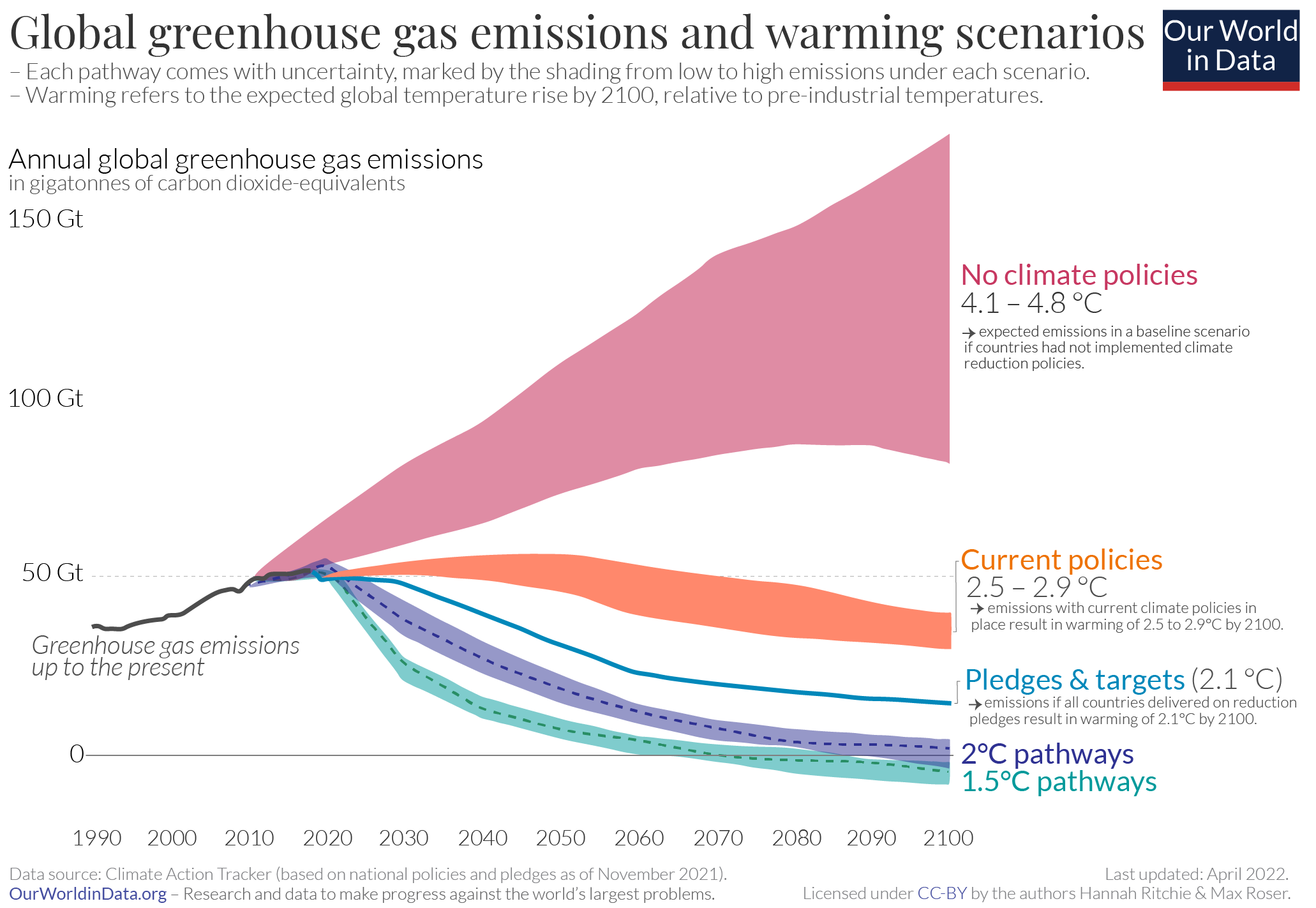
What I don't understand about this is, that we were flat for about three years, and then we went up a little bit. This to me signals that we are close to if not at peak emissions and we should be able to start seeing the downturn at any time. But the chart you are showing has emissions increasing for the next 20 years. Am I oversimplifying or being naive?
We are nowhere near peak emissions. There may be dips here and there (e.g. due to recession). But look what happened to China starting in 2000: https://images.app.goo.gl/F4m9zThoK7Yr9jC66. It added more CO2 than the total output of the US. That’s going to happen to India and Africa over the next few decades as those places develop into middle class economies.
In other words authorities in China, India and Africa pay lip service to what one might call the 'Greta Prediction' while their actions show they simply do not believe it.
Two years old at this point: https://www.vox.com/2016/10/4/13118594/2-degrees-no-more-fos...
> This image should terrify you. It should be on billboards.
> As you can see, in either scenario, global emissions must peak and begin declining immediately. For a medium chance to avoid 1.5 degrees, the world has to zero out net carbon emissions by 2050 or so — for a good chance of avoiding 2 degrees, by around 2065.
> This image should terrify you. It should be on billboards.
> As you can see, in either scenario, global emissions must peak and begin declining immediately. For a medium chance to avoid 1.5 degrees, the world has to zero out net carbon emissions by 2050 or so — for a good chance of avoiding 2 degrees, by around 2065.
Climate aside, doesn't the increase of CO2 from 280PPM to 400PPM not have a substantial impact on the respiration of trees and animals? 42% increase of poison to animals has no meaningful impact?
I'm not sure about other animals, but 400ppm is a long way away from toxic for humanity. Poorly ventilated indoor environments can easily hit 1200-1500ppm. You've got to hit 70,000 to 100,000 ppm before you start running the risk of coma and death.
Interestingly some studies indicate that 1200ppm and higher might confer some mild cognitive impairment, even if it's a long way away from fatal. This has been used glibly to explain the poor decisions made in office rooms, but one does wonder what happens to humanity if global emissions make us slightly dumber.
Interestingly some studies indicate that 1200ppm and higher might confer some mild cognitive impairment, even if it's a long way away from fatal. This has been used glibly to explain the poor decisions made in office rooms, but one does wonder what happens to humanity if global emissions make us slightly dumber.
That's why they are called "poorly ventilated" and you are not supposed to stay in them 24/7. Indeed, adverse effects begin before coma and death.
Phrasing it that way is a little misleading.
At 400 ppm CO2 is only 0.04% of the total atmosphere. Increasing from 0.028% to 0.04% is a 42% increase, but 0.04% is too low to directly poison plants.
The climate change effects will be a problem long before plants and animals start getting poisoned by it.
At 400 ppm CO2 is only 0.04% of the total atmosphere. Increasing from 0.028% to 0.04% is a 42% increase, but 0.04% is too low to directly poison plants.
The climate change effects will be a problem long before plants and animals start getting poisoned by it.
It doesn't poison plants, they rely on CO2 in much the same way that animals rely on O2. I know that it's a negligible part of the atmosphere, but a 42% increase on the primary mechanism for plant respiration, which is also a poison for animals, seems like it would have a meaningful impact.
CO2 is not 'poison' and the concentration increase actually makes plants grow bigger. Let's not go over the top and let's stick to facts.
Overall it's good for plants though this is more than offset by the downsides.
Overall it's good for plants though this is more than offset by the downsides.
fearai(6)