72% of Americans say social media companies have too much political influence(pewresearch.org)
pewresearch.org
72% of Americans say social media companies have too much political influence
https://www.pewresearch.org/fact-tank/2020/07/22/most-americans-say-social-media-companies-have-too-much-power-influence-in-politics/
139 コメント
I don't get why people are so quick to replace private authoritarianism with government authoritarianism. At least with the first version you have the theoretical option of escaping.
> I don't get why people are so quick to replace private authoritarianism with government authoritarianism. At least with the first version you have the theoretical option of escaping.
I’d like to run the numbers on how long fugitives escape justice when they’re targeted by bounty hunters, placed on most wanted lists or other red notices, or both. It’s not always good innocent guys getting caught by good innocent law enforcement, either. Entrapment and parallel construction exist. Ideally the crimes or criminal intent to justify all this apparatus actually exist too, right? Some people may not care about justifications; feels over reals, basically.
The people involved may believe they are correct to work for private authoritarian companies, or public ones; I guess that’s hypercapitalism for you.
I’d like to run the numbers on how long fugitives escape justice when they’re targeted by bounty hunters, placed on most wanted lists or other red notices, or both. It’s not always good innocent guys getting caught by good innocent law enforcement, either. Entrapment and parallel construction exist. Ideally the crimes or criminal intent to justify all this apparatus actually exist too, right? Some people may not care about justifications; feels over reals, basically.
The people involved may believe they are correct to work for private authoritarian companies, or public ones; I guess that’s hypercapitalism for you.
> Twitter is a private public square
So ABC, NBC, CBS are all private companies and they are much older than Twitter. How is it that they can be regulated by the FCC?
So ABC, NBC, CBS are all private companies and they are much older than Twitter. How is it that they can be regulated by the FCC?
FCC only regulates broadcasts that go over the public airways; cable TV isn't regulated by the FCC.
> The problem is that Twitter is a private public square.
What were the public public squares and the private public squares before Twitter was developed?
Understanding the historic context of these forums is pretty important.
I would argue there have only been remarkably few public public squares since property became privatized.
What were the public public squares and the private public squares before Twitter was developed?
Understanding the historic context of these forums is pretty important.
I would argue there have only been remarkably few public public squares since property became privatized.
so... jericho?
Does this point to a social media platform which is publicly funded, publicly funded internet infrastructure, and publicly funded web access?
Do we not want a public square?
Do we not want a public square?
I don't trust governments not to coopt such a system and make it political in one way or another.
I'd prefer we go a federated route, like Mastodon. That way the servers are private, but the system as a whole is not controlled by a central authority. Can't find a server that will let you express what you want to express? Roll your own. Don't want to hear about Emacs ever again, join a vi-only server, or a never-emacs server.
I'd prefer we go a federated route, like Mastodon. That way the servers are private, but the system as a whole is not controlled by a central authority. Can't find a server that will let you express what you want to express? Roll your own. Don't want to hear about Emacs ever again, join a vi-only server, or a never-emacs server.
> fell off the edge of the disc
What in the flat world... ? /s
What in the flat world... ? /s
I don't fully understand what you're trying to argue here.
> Meanwhile, we really need to consider the economics of companies like twitter & facebook. Does FB really need 50k employees and a $70bn budget to provide the world with facebook?
Are you saying that if FB had a smaller headcount or budget, they'd be less influential? A company's headcount and budget are largely a function of the market, and the market highly values FB. If you have a problem with the economics of FB, you have a problem with the market forces that created it. But you end with:
> I hope we're not heading for a regulatory shitshow
If you're not happy that the market created conditions for companies like FB to grow to the size that they are, and you're also not happy that regulation is possibly in the future of these companies, then how would you like to see this scenario play out?
> Meanwhile, we really need to consider the economics of companies like twitter & facebook. Does FB really need 50k employees and a $70bn budget to provide the world with facebook?
Are you saying that if FB had a smaller headcount or budget, they'd be less influential? A company's headcount and budget are largely a function of the market, and the market highly values FB. If you have a problem with the economics of FB, you have a problem with the market forces that created it. But you end with:
> I hope we're not heading for a regulatory shitshow
If you're not happy that the market created conditions for companies like FB to grow to the size that they are, and you're also not happy that regulation is possibly in the future of these companies, then how would you like to see this scenario play out?
Imo the party which makes the values of FB high is the problem. It isn't just some companies that want to put advertisements for their products. The companies want to dominate the market and shut down their competitions, even to the point that our privacy start to be intrused.
The best scenario is for FB to stay at early 2000 version, where our feeds full of friend's stories, games and some ads. Now it's full of media, arguably some pushes political agenda, intrusive advertising (tracking ads), and a few of friend's feed.
Then imo, not all regulations are good. Because fb is a political platform, the regulation for sosmed is more likely full with political agenda too.
The best scenario is for FB to stay at early 2000 version, where our feeds full of friend's stories, games and some ads. Now it's full of media, arguably some pushes political agenda, intrusive advertising (tracking ads), and a few of friend's feed.
Then imo, not all regulations are good. Because fb is a political platform, the regulation for sosmed is more likely full with political agenda too.
To the first part, I meant that the range of possible worlds is very broad. Resources aren't a limiting factor. Facebook could continue to do facebook regardless of financial burdens placed on them. If not, someone else can. This wasn't the case for most monopolies of the past. In the past, there was a real concern of "oops. We killed smelting. No more steel."
To the second part... I don't have full answers. I would like this scenario play out to a free media outcome. Decentralisation, and ideally, a lot of commercialisation too. More wikipedias, WWWs. Fewer FBs. Disintermediation. Commodification of bottlenecks like youtube has... owning the relationship between video maker and video watcher. The ideals that made the internet work in the first place.
That's not something a politician can give us though. No one decided that wikipedia or WWW would win. It happened. What I want from politicians is a laundry list:
(1) Trustbusting. The Facebook's acquisitions of whatsapp & IG should never have happened, for example. Youtube should be split from Google (and adwords from search... off topic).
Also, modern antitrust needs to recognize the economic realities of these businesses. This isn't a railroad monopoly or Bell. There are no capital costs and there is no major danger of harming the public interest by sinking the industry. Social media will exist whether or not FB is worth $1trn. That money does not represent "capital" in the productive capacity sense, it just represents earning potential.
(2) Different rules for giant companies. Rules should apply only to designated giant companies. The biggest problems are size related. Be explicitly skeptical of size. Data laws. Copyright enforcement. User content liability. Fairness requirements. etc. A normal regulator will enforce the monopolies which create the underlying problems. We need an explicitly "large company" set of rules, including tax rules.
(3) Much stronger fair use and public domain rules. A complete rethinking. Eg, if a politician gives an interview... this should be public domain or under extremely strong fair use protection.
This is another area where we need to consider modern economic realities. For said political interview, you could preserve most of the financial value (and incentive) with a copyright limited to one week.
(4) Non-consumer rights in regards to monopolies. If facebook, youtube or amazon ban you, this is a public matter. It's more akin to blackballing than "please leave this bar." Everyone needs protections from monopolies, especially non consumers. Once companies are in that size range, they need to
(5) Data use transparency laws. FB political advertising is an extreme example. Half the shit they do wouldn't stand the light of day. Some of it is borderline treason. Shine that light. Full data dumps of ads, targeting criteria, etc. Publish ad matching algorithms. Give the public access to everything the advertiser has access to...
... the list gets long.
To the second part... I don't have full answers. I would like this scenario play out to a free media outcome. Decentralisation, and ideally, a lot of commercialisation too. More wikipedias, WWWs. Fewer FBs. Disintermediation. Commodification of bottlenecks like youtube has... owning the relationship between video maker and video watcher. The ideals that made the internet work in the first place.
That's not something a politician can give us though. No one decided that wikipedia or WWW would win. It happened. What I want from politicians is a laundry list:
(1) Trustbusting. The Facebook's acquisitions of whatsapp & IG should never have happened, for example. Youtube should be split from Google (and adwords from search... off topic).
Also, modern antitrust needs to recognize the economic realities of these businesses. This isn't a railroad monopoly or Bell. There are no capital costs and there is no major danger of harming the public interest by sinking the industry. Social media will exist whether or not FB is worth $1trn. That money does not represent "capital" in the productive capacity sense, it just represents earning potential.
(2) Different rules for giant companies. Rules should apply only to designated giant companies. The biggest problems are size related. Be explicitly skeptical of size. Data laws. Copyright enforcement. User content liability. Fairness requirements. etc. A normal regulator will enforce the monopolies which create the underlying problems. We need an explicitly "large company" set of rules, including tax rules.
(3) Much stronger fair use and public domain rules. A complete rethinking. Eg, if a politician gives an interview... this should be public domain or under extremely strong fair use protection.
This is another area where we need to consider modern economic realities. For said political interview, you could preserve most of the financial value (and incentive) with a copyright limited to one week.
(4) Non-consumer rights in regards to monopolies. If facebook, youtube or amazon ban you, this is a public matter. It's more akin to blackballing than "please leave this bar." Everyone needs protections from monopolies, especially non consumers. Once companies are in that size range, they need to
(5) Data use transparency laws. FB political advertising is an extreme example. Half the shit they do wouldn't stand the light of day. Some of it is borderline treason. Shine that light. Full data dumps of ads, targeting criteria, etc. Publish ad matching algorithms. Give the public access to everything the advertiser has access to...
... the list gets long.
Excellent post, one nitpick:
>Wikipedia is another example [of the public square]
Quite the opposite; Wikipedia is explicitly based on published reliable sources. They have a specific rule[1] excluding information that was not published in such way.
There are certain advantages to this rule, and its utility has been validated through Wikipedia's long, and ongoing, run. Nonetheless this cathedral mindset cannot be compared to a public square in any way other than being a very opposite.
In particular the published reliable sources rule excludes general blogs and public forums and the likes, thus excluding the majority of discourse & voices on the internet. Even expert sources, if self-published, can only be used in limited way and with caution.
--
[1] "If no reliable sources can be found on a topic, Wikipedia should not have an article on it", https://en.wikipedia.org/wiki/Wikipedia:Reliable_sources
>Wikipedia is another example [of the public square]
Quite the opposite; Wikipedia is explicitly based on published reliable sources. They have a specific rule[1] excluding information that was not published in such way.
There are certain advantages to this rule, and its utility has been validated through Wikipedia's long, and ongoing, run. Nonetheless this cathedral mindset cannot be compared to a public square in any way other than being a very opposite.
In particular the published reliable sources rule excludes general blogs and public forums and the likes, thus excluding the majority of discourse & voices on the internet. Even expert sources, if self-published, can only be used in limited way and with caution.
--
[1] "If no reliable sources can be found on a topic, Wikipedia should not have an article on it", https://en.wikipedia.org/wiki/Wikipedia:Reliable_sources
You're not wrong, but I think you're missing his key point, which is that a forum for free thought simply isn't if it's policed by content moderators around a set of culture rules, no matter how high-minded the intentions. Now for sure, WP has moderators, and they are human, but they're pretty tightly bound to enforce only the rules of admission. They're not vested with the power and mission to censor opinions deemed odious or disharmonious. I'm sure abuses happen and the slope is slippery, but moderators tend to respond to conflict there. Not predefine and block it's alleged precursors.
The key point was wrong wrt Wikipedia :-)
>a forum for free thought >if it [isn't] policed by content moderators around a set of culture rules
The rules are mostly invisible to us because we are surrounded with, and submersed in, this very culture 24/7.
To get written up in Wikipedia one must first get published in a reliable source. This mostly means a journal or "books published by respected publishing houses" (full list: [1]). The publishing is the gatekeeper here; the wikipedia moderators are a secondary consideration.
This does indeed silence out a priori (i.e., censors) ideas that are culturally unpopular or frowned upon or just held by small number of individuals. To avoid muddling the argument with hot button issues, here's a very mild and barely objectionable example: picoLisp, a modern interpreted programming language with dynamic scoping. Having it written up, and then kept, in Wikipedia is an uphill struggle spanning years, and with sad reversals & losses. And that's with ideas that are only mildly unpopular.
Again, Wikipedia's utility is clear and recognized. Let's just not mix it up with a public square.
--
[1] https://en.wikipedia.org/wiki/Wikipedia:Verifiability#What_c...
>a forum for free thought >if it [isn't] policed by content moderators around a set of culture rules
The rules are mostly invisible to us because we are surrounded with, and submersed in, this very culture 24/7.
To get written up in Wikipedia one must first get published in a reliable source. This mostly means a journal or "books published by respected publishing houses" (full list: [1]). The publishing is the gatekeeper here; the wikipedia moderators are a secondary consideration.
This does indeed silence out a priori (i.e., censors) ideas that are culturally unpopular or frowned upon or just held by small number of individuals. To avoid muddling the argument with hot button issues, here's a very mild and barely objectionable example: picoLisp, a modern interpreted programming language with dynamic scoping. Having it written up, and then kept, in Wikipedia is an uphill struggle spanning years, and with sad reversals & losses. And that's with ideas that are only mildly unpopular.
Again, Wikipedia's utility is clear and recognized. Let's just not mix it up with a public square.
--
[1] https://en.wikipedia.org/wiki/Wikipedia:Verifiability#What_c...
https://larrysanger.org/2020/05/wikipedia-is-badly-biased/
This is wikipedia co-founder writing this.
This is wikipedia co-founder writing this.
It's true. Sadly it takes strong familiarity with wide range of subjects to be able to point out the biases of omission, and a big name to point it out without attracting too much of dismissive shrugs.
In my opinion, the bias is primarily derived from the bias of the sources Wikipedia uses, with influence by the WP editors being only a secondary influence.
In my opinion, the bias is primarily derived from the bias of the sources Wikipedia uses, with influence by the WP editors being only a secondary influence.
Larry Sanger is an idiot. There's a reason he was kicked out early in Wikipedia's history.
Wikipedia is certainly biased, but in what topics are covered, not the content itself. I think they had an example that the article for the Falklands war was longer than the Congo civil war, the deadliest conflict since WW2.
Wikipedia is certainly biased, but in what topics are covered, not the content itself. I think they had an example that the article for the Falklands war was longer than the Congo civil war, the deadliest conflict since WW2.
I'm not saying that wikipedia is equivalent in every way to twitter, vis-a-vis the public square concept. It is a very important media though, and faces a lot of the same issues.
Whatever issues social media has encountered around politics, covid, etc. are arguably more acute for wikipedia... because of its authority and role as a source of objective information. Meanwhile, it has handled everything much better by default. That's why we don't think of it as part of the social media problem.
Whatever issues social media has encountered around politics, covid, etc. are arguably more acute for wikipedia... because of its authority and role as a source of objective information. Meanwhile, it has handled everything much better by default. That's why we don't think of it as part of the social media problem.
Naturally, there's a relevant XKCD:
https://xkcd.com/978/
https://xkcd.com/978/
Does Wikipedia not have rules against using sources that were published later than the 'fact' on Wikipedia was asserted?
If only the stakes were as low as the scroll lock key...
The citogenesis xkcd is right, but could & should take one more step and say openly:
Wikipedia has became part of the media ecosystem, not much different from any other part of the media ecosystem.
Journalists at typical outlets are also engaged in re-publishing -edited or verbatim- content from other outlets. Among those practices, churnalism [1].
--
[1] https://en.wikipedia.org/wiki/Churnalism
Wikipedia has became part of the media ecosystem, not much different from any other part of the media ecosystem.
Journalists at typical outlets are also engaged in re-publishing -edited or verbatim- content from other outlets. Among those practices, churnalism [1].
--
[1] https://en.wikipedia.org/wiki/Churnalism
Why do you say that? Wikipedia is vastly different from anything I’d normally recognise as news media(I guess that’s what you mean?). It puts content up front (except when asking for donations). It shows how the sausage is made (you can look at talk pages if you really want to). It sources claims. I guess at some point it’ll take a turn for the worse, but it’s nowhere close to there yet from what I can see. Am I missing something? I guess you could say that it’s part of the ecosystem in that it trusts it and news sources are an integral part of its fact-checking process, but I don’t see that that makes it resemble too closely the sources it uses for fact-checking. And companies use it for PR\allow-washing, which isn’t great. And subject-experts express frustration in getting their edits reverted by idiots. But, it’s still recognisably wikipedia from the old days. I don’t see how you get to “not much different from any other part of the media ecosystem”.
>Wikipedia is vastly different from anything I’d normally recognise as news media
Agreed - Wikipedia is not news media.
Instead it's media fact & opinion aggregator and editor. It does function as media platform, with content provided by the media and only by the media. The editors' opinions are a secondary consideration; they are obliged by the rules to only ever derive content from the published reliable sources.
My "not much different from any other part of the media ecosystem" statement is connected with how the ideas & opinions flowing back and forth between Wikipedia and other medias (as shown in the citogenesis xkcd) - a process that's typical, even characteristic, of media.
Agreed - Wikipedia is not news media.
Instead it's media fact & opinion aggregator and editor. It does function as media platform, with content provided by the media and only by the media. The editors' opinions are a secondary consideration; they are obliged by the rules to only ever derive content from the published reliable sources.
My "not much different from any other part of the media ecosystem" statement is connected with how the ideas & opinions flowing back and forth between Wikipedia and other medias (as shown in the citogenesis xkcd) - a process that's typical, even characteristic, of media.
If someone else is always confused by the use of acronyms, "JD" here is for "Jack Dorsey" (twitter co-founder and CEO).
Twitter and FB could be replaced quickly, because their technology is not their primary asset. Their primary asset is their hundreds of millions of users who are there mainly because of the other hundreds of millions of users.
Not surprisingly, network effects are pervasive on the network, and with everything moving to the network, network effects will dominate almost everything unless something is done to deal explicitly with network-effect-based monopolies. Just imagine email if you couldn't email anyone who didn't have an email address at the same company you have yours. Almost all email would begin to consolidate in the winning company, which would then begin telling people what could and couldn't be said in email. They could cut you off from email and destroy businesses for violating whatever "terms of service" they felt like imposing or even accidentally. Too bad for you.
I think the answer to network-effects monopolies is to force them to switch to an open protocol once they crossed a threshold of a certain number of users. They could then continue to offer services, but other companies and agencies could also put you on "the network". Companies could stay small and retain full control or grow and be forced to open so their competitors and users couldn't be locked out (or in).
Not surprisingly, network effects are pervasive on the network, and with everything moving to the network, network effects will dominate almost everything unless something is done to deal explicitly with network-effect-based monopolies. Just imagine email if you couldn't email anyone who didn't have an email address at the same company you have yours. Almost all email would begin to consolidate in the winning company, which would then begin telling people what could and couldn't be said in email. They could cut you off from email and destroy businesses for violating whatever "terms of service" they felt like imposing or even accidentally. Too bad for you.
I think the answer to network-effects monopolies is to force them to switch to an open protocol once they crossed a threshold of a certain number of users. They could then continue to offer services, but other companies and agencies could also put you on "the network". Companies could stay small and retain full control or grow and be forced to open so their competitors and users couldn't be locked out (or in).
[deleted]
It is not easy to run the infrastructure for a Facebook clone, even with 10M users. Technology is absolutely part of their entrenchment.
Part, yes. But not a majority.
I worked at a large social media company (not large by modern tier 1 social media network standards). We handled well over 10M users, but the company is dying / died. The technology still works, but the mindshare was lost and users jump ship faster when the network effect stops being an asset.
I worked at a large social media company (not large by modern tier 1 social media network standards). We handled well over 10M users, but the company is dying / died. The technology still works, but the mindshare was lost and users jump ship faster when the network effect stops being an asset.
It blows my mind. The US has an international reputation for being pro-corporate so from the outside, it makes sense that social networks get away with the lack of accountability they have.
However, a large portion of humanity use social networking tools so US legislation has a direct affect on everyone and potentially (inadvertently) it has an effect on the democratic processes of other nations.
At what point does it become an international issue?
However, a large portion of humanity use social networking tools so US legislation has a direct affect on everyone and potentially (inadvertently) it has an effect on the democratic processes of other nations.
At what point does it become an international issue?
Cold war CIA wouldn't have dreamt with the power that social networks, streaming sites and tech companies have over electoral processes in other countries.
I live in a small city in the ass end of the world, but my local politicians, who live a few miles from my home, fork money (a lot of money) over to FB and Google so I can see their ads. They have a huge impact on who gets elected.
I live in a small city in the ass end of the world, but my local politicians, who live a few miles from my home, fork money (a lot of money) over to FB and Google so I can see their ads. They have a huge impact on who gets elected.
As someone not from the US, I am so glad that the networks are located there.
The US also has a pro-freedom reputation and that is currently really valuable. I never held back with criticism towards the US and won't do so in the future, but on this issue I would staunchly run with the worst hillbilly rednecks you can imagine firing freedom bullets in every direction without an ounce of shame.
Democracy has nothing to do with content restrictions.
The US also has a pro-freedom reputation and that is currently really valuable. I never held back with criticism towards the US and won't do so in the future, but on this issue I would staunchly run with the worst hillbilly rednecks you can imagine firing freedom bullets in every direction without an ounce of shame.
Democracy has nothing to do with content restrictions.
I kind of agree. If these social media sites were located in Europe I expect it would be much worse.
I live in the UK and here we have thought police units who will knock on your door to "check your thinking" if you post jokes that are too controversial. While it's obviously a problem that billion dollar foreign internet companies are regulating what we can say online they are at least, for the time being, more aligned to the values of free-speech than many European governments.
I live in the UK and here we have thought police units who will knock on your door to "check your thinking" if you post jokes that are too controversial. While it's obviously a problem that billion dollar foreign internet companies are regulating what we can say online they are at least, for the time being, more aligned to the values of free-speech than many European governments.
Thanks for posting this. Every time I hear of someone saying that there should me more Internet services based in Europe, I cringe. And I say this as a European.
I can sympathize with this point, but let's not pretend that this "freedom" represents democracy any better. What we've seen in the past decade regarding the impact modern advertisement has on elections and public privacy to me is a testament to social media in the current state being anything but benefitial to democracy.
That said, I don't have a solution.
That said, I don't have a solution.
I guess I’m one of the 28%. Politicians, the government, megacorporations other than social media, and the police as well as entire associated bureaucratic law enforcement organizations have too much influence, period. The protests on all sides are a reaction to and expression of that rejection of unwanted, nonconsensual influence over free people. Social media is the megaphone of this protest movement. This is the establishment trying to chop the heads off the hydra, while counterprotesting heads stir up trouble and confuse the narrative on all sides. Will it work? For whom?
Pfizer and Exxon don’t get to decide which hashtags are allowed to be on trending or what stories people should see in their feed.
You think that Pfizer doesn’t have a whole team dedicated to managing what gets reported on them by TV news and major papers?
Marketing/PR isn't power. The ability to market isn't concentrated in the hands of a few companies.
Meanwhile Twitter can block a trend on a whim. That's very different. That is direct, intentional manipulation of the conversation in the new (private) public square.
Meanwhile Twitter can block a trend on a whim. That's very different. That is direct, intentional manipulation of the conversation in the new (private) public square.
Do you think PR teams don't have the ability to block topics on a whim?
Do you think they do? That's quite a novel conspiracy theory to me. But even if it's true, they obviously don't have as much direct influence as Twitter, Reddit, or newspapers themselves.
Another good point. Just because a social media megacorp is useful to you doesn’t mean it needs you, or your followers, even if you’re verified. Maybe especially not if you’re verified. They can always verify someone else, and people will follow them instead. Especially if you’re banned from the service. Wait, is deplatformed the PC way to say it now? I’m trying here, folks.
Anyone have a coat? I’m catching a cold from all these http://chillingeffects.com
Anyone have a coat? I’m catching a cold from all these http://chillingeffects.com
However, their lobbyists in DC will threaten to give the other guy or gal more money than they’ll give their regular congresscritters if they don’t play ball. This is not Schoolhouse Rock. Laws don’t exist. They’re memes that have force of law, and like all memes, laws are subject to mutation and deep frying, as well as appropriation and recontextualization.
>However, their lobbyists in DC will threaten to give the other guy or gal more money than they’ll give their regular congresscritters if they don’t play ball
The difference between being able to censor whatever unilaterally and having to get a legislator to do it for you could not be more massive.
Having to play the lobbying game adds a huge amount of time, expense and outside scrutiny making it much harder to do bad things.
Sure the fact that regulatory capture is possible and doable at a certain scale is bad but it's infinitly better than bigCos being able to act unilaterally.
It's like the difference between the cops being able to kick down your door on a whim and them having to get a warrant and at least look like idiots on the official record and make other people who share no upside condone their stupidity.
The difference between being able to censor whatever unilaterally and having to get a legislator to do it for you could not be more massive.
Having to play the lobbying game adds a huge amount of time, expense and outside scrutiny making it much harder to do bad things.
Sure the fact that regulatory capture is possible and doable at a certain scale is bad but it's infinitly better than bigCos being able to act unilaterally.
It's like the difference between the cops being able to kick down your door on a whim and them having to get a warrant and at least look like idiots on the official record and make other people who share no upside condone their stupidity.
fit2rule(2)
Social media companies are megacorporations. Not just that even among the megacorps they are 2nd to big pharma in terms of lobbying budgets.
You call social media the megaphone of the protests, but when Trump went to threaten the protesters “when the looting starts, the shooting starts” he did it on social media.
You call social media the megaphone of the protests, but when Trump went to threaten the protesters “when the looting starts, the shooting starts” he did it on social media.
It isn't exclusive but it is deeply disingenuous to say it isn't their megaphone. That it can be used Trump to post doesn't subtract from it being the medium depend upon it. But unlike Trump who can give press releases, speeches to the nation, and press conferences essentially any time he wants the people lack that reach.
> It isn't exclusive but it is deeply disingenuous to say it isn't their megaphone.
That’s your opinion, obviously people took to the streets because social media can be ignored And minimized but people in the streets can’t be ignored.
I’ll return the favor to say social media is the protestors megaphone over the streets is deeply disingenuous...see how easy it is to speak past each other online, good luck with that in the street
That’s your opinion, obviously people took to the streets because social media can be ignored And minimized but people in the streets can’t be ignored.
I’ll return the favor to say social media is the protestors megaphone over the streets is deeply disingenuous...see how easy it is to speak past each other online, good luck with that in the street
The people don't really have that reach. Social media companies decide what messages are allowed, so only people the companies agree with have any reach on the platforms.
In effect, social media users are just acting as speechwriters for the companies' political views. They submit comments, and mods chosen by the company decide which comments are published. Or sometimes the company simply bans particular viewpoints.
What gets published on social media is increasingly company approved just like any other company's public messaging.
In effect, social media users are just acting as speechwriters for the companies' political views. They submit comments, and mods chosen by the company decide which comments are published. Or sometimes the company simply bans particular viewpoints.
What gets published on social media is increasingly company approved just like any other company's public messaging.
> In effect, social media users are just acting as speechwriters for the companies' political views.
Well, since you brought it up, which speeches of yours did you take this comment from, and who are you writing those speeches for? Whose agenda do your words subtly lend support to?
Well, since you brought it up, which speeches of yours did you take this comment from, and who are you writing those speeches for? Whose agenda do your words subtly lend support to?
You're taking the metaphor too literally, but to answer the second part: in this thread I'm lending support to the 72% of Americans who think social media companies have too much political influence. My agenda is simply that they should take a more hands off approach.
The number of anti-cancel-culture posts on HN, as well as a post about "aggressive conformity" on HN right now by the founder of HN, suggest that HN has a similar agenda, so I suppose I am simply adding content that supports the company's position.
The number of anti-cancel-culture posts on HN, as well as a post about "aggressive conformity" on HN right now by the founder of HN, suggest that HN has a similar agenda, so I suppose I am simply adding content that supports the company's position.
fit2rule(3)
While social media seem to be the problem, I find myself internally conflicted. On the one hand I see myself as a supporter of democracy, freedom of speech and liberty of expression, but I'm dismayed by the self harm these ideals are causing at the moment. It's the feeling of being unable to defend against painfully obvious (to me) propaganda but also the worry that I don't close doors to the freedom these platforms allow.
Why do information campaigns seem to be failing against the propoganda mills?
Living in underdeveloped part of the world I believed for the most of my life that it was lack of education but having in the US for the past few years I had to firmly discard that notion. I currently believe that it is the inherited values that society imparts on us, and that serves as a lens to view facts that is being manipulated.
The last company I worked for our executives, all highly educated and good natured, for most parts, held political opinions that I thought were only held by the 'idiots' captured by someone on cell phone videos. They had built a successful company on highly educated immigrant workforce, with major workforce still outside the US, headquarter located in a deep 'blue' state with the founder and chairman of the company an immigrant and PhD holder a first generation immigrant but everyone still a vehement, vocal supporter of current anti-immigrants, anti-science, anti-obama/hillary, anti-medicine propaganda.
I don't think it's simply dismissable as biased by financial profit. Is it because everyone near them believes in such and these opinions are manifestation of values they grew up with? Is social media just giving it a loud-speaker. We need to address that somehow I feel.
Why do information campaigns seem to be failing against the propoganda mills?
Living in underdeveloped part of the world I believed for the most of my life that it was lack of education but having in the US for the past few years I had to firmly discard that notion. I currently believe that it is the inherited values that society imparts on us, and that serves as a lens to view facts that is being manipulated.
The last company I worked for our executives, all highly educated and good natured, for most parts, held political opinions that I thought were only held by the 'idiots' captured by someone on cell phone videos. They had built a successful company on highly educated immigrant workforce, with major workforce still outside the US, headquarter located in a deep 'blue' state with the founder and chairman of the company an immigrant and PhD holder a first generation immigrant but everyone still a vehement, vocal supporter of current anti-immigrants, anti-science, anti-obama/hillary, anti-medicine propaganda.
I don't think it's simply dismissable as biased by financial profit. Is it because everyone near them believes in such and these opinions are manifestation of values they grew up with? Is social media just giving it a loud-speaker. We need to address that somehow I feel.
Think of Democracy as a system that embodies the wishes & will of the average voter (not the average citizen).
Now imagine that you invented a system that would get tens of millions more people emotionally engaged to vote, but they happened to also be the least educated, least nuanced, least mature voters - people who seldom voted before.
Then imagine your surprise when intelligent debate disappears, and politics devolves into reality television.
That is what we've done.
Imagine if we allowed the average person dictact Climate Change policy, rather than the scientists? ...oh wait, we've done that as well...
Now imagine that you invented a system that would get tens of millions more people emotionally engaged to vote, but they happened to also be the least educated, least nuanced, least mature voters - people who seldom voted before.
Then imagine your surprise when intelligent debate disappears, and politics devolves into reality television.
That is what we've done.
Imagine if we allowed the average person dictact Climate Change policy, rather than the scientists? ...oh wait, we've done that as well...
Since the effects of regulations put in place around climate change are enjoyed/suffered by all citizens, and not only scientists, it's appropriate that everybody gets to dictate what those regulations are.
The problem is when the masses completely disregard what the scientists recommend.
It's like having a random group of people do your heart surgery.
Expert opinions matter - more. ...and we need a mechanism to ensure that specialists in a field have more say than the uneducated rabble.
It's like having a random group of people do your heart surgery.
Expert opinions matter - more. ...and we need a mechanism to ensure that specialists in a field have more say than the uneducated rabble.
[deleted]
it still is lack of education. it's the moral education that is lacking.
education in justice (part of that is social justice if you like, but don't mistake that with social justice warriors, those are not about actual social justice, but rather they are political correctness gangsters)
education in equality. education against racism. education to help people out of poverty. education about diversity. education about critical analysis and discourse. education about religions. (even atheists should have a better understanding about the various religions and vice versa)
people claim a right not to be subjected to ideas that they don't agree with. they want to live in a bubble. this is part of the problem.
these are just some of the points that current education is missing. i am sure we can find a few more.
education in equality. education against racism. education to help people out of poverty. education about diversity. education about critical analysis and discourse. education about religions. (even atheists should have a better understanding about the various religions and vice versa)
people claim a right not to be subjected to ideas that they don't agree with. they want to live in a bubble. this is part of the problem.
these are just some of the points that current education is missing. i am sure we can find a few more.
Who determines what is moral as the baseline? That's the problem. You could argue your morals are right, the opposite side could argue theirs are right. People do have a right to not be subjected to ideas they don't like. I think part of the problem is hard line stances against ideas, then yelling at people that they're not "moral" ends up pushing people further away.
The 2A arguments are a good example of this. By default you would think many of the 2A advocates would be against federal forces policing (ignoring any context, not taking sides, just using an example). In fact many of the left that aren't pro 2A are calling them out for just that. But from their perspective, for years they've been told they are foolish, uneducated, or just simple people that are wrong. After all of that treatment for their stance on 2A, why would they be open to discussions from the same individuals on other topics?
So the problem is two fold. Both sides are ignorant, both sides get hyper focused on their causes, and don't care about the other sides perspective, or the collateral damage the hardline stances have.
In order for anything to work or be peaceful, we have to stop trying to change each others positions on everything, but instead realize, that for a functioning society, we have to accept, not everyone is going to get what they want.
It's tough. It requires calm discussions on both sides and notably hyperawareness about how one projects themselves. Online media makes it infinitely worse when you don't have the human behavioral cues as part of the narrative. It's why you can read the same line two or three ways and get two or three things out of it based upon the state of mind you enter the conversation at.
The 2A arguments are a good example of this. By default you would think many of the 2A advocates would be against federal forces policing (ignoring any context, not taking sides, just using an example). In fact many of the left that aren't pro 2A are calling them out for just that. But from their perspective, for years they've been told they are foolish, uneducated, or just simple people that are wrong. After all of that treatment for their stance on 2A, why would they be open to discussions from the same individuals on other topics?
So the problem is two fold. Both sides are ignorant, both sides get hyper focused on their causes, and don't care about the other sides perspective, or the collateral damage the hardline stances have.
In order for anything to work or be peaceful, we have to stop trying to change each others positions on everything, but instead realize, that for a functioning society, we have to accept, not everyone is going to get what they want.
It's tough. It requires calm discussions on both sides and notably hyperawareness about how one projects themselves. Online media makes it infinitely worse when you don't have the human behavioral cues as part of the narrative. It's why you can read the same line two or three ways and get two or three things out of it based upon the state of mind you enter the conversation at.
great points.
we can start with the things that we agree on. racism for example is a rather obvious one (although there will still be differences about what that means).
and with the tools, how to have a calm discussion and the related aspects that you mention. those things are learnable. learning how to communicate, how to listen to others, all that should be part of education
we can start with the things that we agree on. racism for example is a rather obvious one (although there will still be differences about what that means).
and with the tools, how to have a calm discussion and the related aspects that you mention. those things are learnable. learning how to communicate, how to listen to others, all that should be part of education
Yep!
It's not the social media, it's mainstream mass media who decide to report on "hashtags", memes and viral videos and bring them to the wider public. Lazy journalists who don't investigate facts anymore and only care about trends and outrages and whose "ultimate editor" is now Twitter, as Bari Weiss alleged.
This is closer to the truth. The internet’s main currency is attention. It is a sea of information and the only places that get noticed are the ones given attention to.
Mainstream media is in a feedback loop with the internet.
Mainstream media is in a feedback loop with the internet.
There's more money and opportunity for journalists to use tools like Twitter because that's where the public's attention is.
With media outlets incentivizing things like CTR, journalists are going to use whatever gets more eyeballs. And since people aren't directly paying for their news anymore, reporting using tools like Twitter is what makes them the most money.
If you're going to criticize "lazy journalists", you also have to acknowledge the system that makes it impossible to generate serious revenue without sites like Twitter and FB, because that's effectively what those companies have done.
With media outlets incentivizing things like CTR, journalists are going to use whatever gets more eyeballs. And since people aren't directly paying for their news anymore, reporting using tools like Twitter is what makes them the most money.
If you're going to criticize "lazy journalists", you also have to acknowledge the system that makes it impossible to generate serious revenue without sites like Twitter and FB, because that's effectively what those companies have done.
Exactly. Like Bari Weiss said, "Twitter has become the editor". US journalists now write articles to satisfy their twitter following.
Gluttony cannot be solved by making a better dish, only way to solve it is to moderate eating.
What does a world without social networks look like? I don't think we want that anymore. Because social networks do serve a required function.
For Twitter, I love the fact that I can follow some people that I look upto and get their real time musings.
For Facebook, it's about connecting to friends and people I know and being able to reach out without phone numbers etc.
We are trying to solve this problem the wrong way. So again, gluttony cannot be solved by making a better dish, only way to solve it is to moderate eating
What does a world without social networks look like? I don't think we want that anymore. Because social networks do serve a required function.
For Twitter, I love the fact that I can follow some people that I look upto and get their real time musings.
For Facebook, it's about connecting to friends and people I know and being able to reach out without phone numbers etc.
We are trying to solve this problem the wrong way. So again, gluttony cannot be solved by making a better dish, only way to solve it is to moderate eating
Food can be (and there are those that are) designed to optimize for the desire to eat more. Slot machines payouts are designed to encourage people to play one more time. There are games that are famous for eliciting "one more turn... oh my god it's 5 a.m. already".
When a stimulus reliably elicits a particular response on a large enough population, you can reasonably say that it's the stimulus and not the individual's failure to apply moderation/critical thinking/what-have-you.
When a stimulus reliably elicits a particular response on a large enough population, you can reasonably say that it's the stimulus and not the individual's failure to apply moderation/critical thinking/what-have-you.
No it's definitely individual failure. If I get fat by eating burgers and sweets everyday. It's my fault.
What required function do social networks fill? Your wording implies objective requirements exist in the general sense which can only be fulfilled by social networks.
The two things you've said are access to "real time musings" which is absolutely not a requirement in the objective sense, and connecting to friends and people, which is a requirement that can be easily fulfilled by other applications.
Phones and email are still completely viable methods for communicating with anyone. Chat programs such as Signal or Apple Messenger or WhatsApp really only add the additional functionality of group SMS. Otherwise standard SMS is fine.
I think your point about moderating your eating is a good and valid point though.
Let's take the metaphor further. Let's say social networks as they exist today are like restaurants that serve 3500 calorie meals. Sure, a person could choose to pay $30 for a 3500 meal and then moderate their consumption and take the rest home in a doggy bag, but that clearly is not what is happening. Instead what is happening is people are eating the whole dish. And on top of that, the restaurant is adding a ton of stuff that makes the food taste more addictive, and other stuff that makes you not feel full so that you'll want to order that dessert too.
And to beat the metaphor to death, I just don't go to restaurants anymore, I make my meals at home.
The two things you've said are access to "real time musings" which is absolutely not a requirement in the objective sense, and connecting to friends and people, which is a requirement that can be easily fulfilled by other applications.
Phones and email are still completely viable methods for communicating with anyone. Chat programs such as Signal or Apple Messenger or WhatsApp really only add the additional functionality of group SMS. Otherwise standard SMS is fine.
I think your point about moderating your eating is a good and valid point though.
Let's take the metaphor further. Let's say social networks as they exist today are like restaurants that serve 3500 calorie meals. Sure, a person could choose to pay $30 for a 3500 meal and then moderate their consumption and take the rest home in a doggy bag, but that clearly is not what is happening. Instead what is happening is people are eating the whole dish. And on top of that, the restaurant is adding a ton of stuff that makes the food taste more addictive, and other stuff that makes you not feel full so that you'll want to order that dessert too.
And to beat the metaphor to death, I just don't go to restaurants anymore, I make my meals at home.
Your analogy assumes the problem is overconsumption of social media. But what about concentration? 3-4 companies control ~90% of global social media. I don't think people would be as worried if that control was spread more evenly across hundreds of smaller companies.
Control is a misleading phrase in that context - it isn't the same sort of control as Murdoch over his empire or the infamous Sinclair Media scripted message.
They aren't the same type of control at all, implying it is deeply disingenuous like claiming beating your kids with a baseball bat and scolding them doesn't make a difference because it is just punishing them either way.
They aren't the same type of control at all, implying it is deeply disingenuous like claiming beating your kids with a baseball bat and scolding them doesn't make a difference because it is just punishing them either way.
> They aren't the same type of control at all, implying it is deeply disingenuous
I implied no such thing. I nor the parent post didn't even mention traditional media. And I freely admit, it's not the same type of control. But it is control. They control what type of speech is allowed, what gets amplified, what gets suppressed, and what gets banned.
To go with your analogy, they don't beat their kids, but they do ground them, take away their allowance, or make them go to bed without supper, until they learn to behave. And the owners of social media get to define what 'behave' means.
I implied no such thing. I nor the parent post didn't even mention traditional media. And I freely admit, it's not the same type of control. But it is control. They control what type of speech is allowed, what gets amplified, what gets suppressed, and what gets banned.
To go with your analogy, they don't beat their kids, but they do ground them, take away their allowance, or make them go to bed without supper, until they learn to behave. And the owners of social media get to define what 'behave' means.
A private Discord channel is the best social media.
You invite certain people, people can share things, text or even voice chat. You can curate, you have more control of what comes down stream.
You invite certain people, people can share things, text or even voice chat. You can curate, you have more control of what comes down stream.
I have thought about this before. I believe internet lacks enough echo chambers. In real world, people automatically segregate based on their income bracket, community, values, lifestyle, job, family (kids or not?), healthcare, accessibility to various things, etc. People have all sorts of stereotypes and things they expect other people to conform to based on visible factors. This isn't possible online. There is too little information and our stereotypes will never be correct (too big number). It shocks people. In real life, oh that's a catholic person. Of course I would expect them to say this. Too much difference in opinions leads to defensiveness rather than acceptance. You cannot accept 180 degrees but you can accept 10 degrees slightly left.
The whole question is frankly deeply stupid on so many levels. First off it is push pollingly worded to get directly contradictory groups (those conplaining about too much and too moderation) while pushing a clear agenda. Second the very concept is meaningless. What is a proper level of influence for social media? It can't even be defined. It only leads to intellectual abominations like obscenity and know it when I see it which leads to "Whatever the fuck the person in power wants narcicistically imposed upon all."
Kind of interesting that the intro for the wikipedia on Conservatism in the United States [1] says "Conservative philosophy is also derived in part from ... laissez-faire economics (i.e. economic freedom and deregulation)" but that in this circumstance [2] the self-identified "conservative" group members were the most likely to support more regulation.
[1] https://en.wikipedia.org/wiki/Conservatism_in_the_United_Sta...
[2] https://www.pewresearch.org/wp-content/uploads/2020/07/ft_20...
[1] https://en.wikipedia.org/wiki/Conservatism_in_the_United_Sta...
[2] https://www.pewresearch.org/wp-content/uploads/2020/07/ft_20...
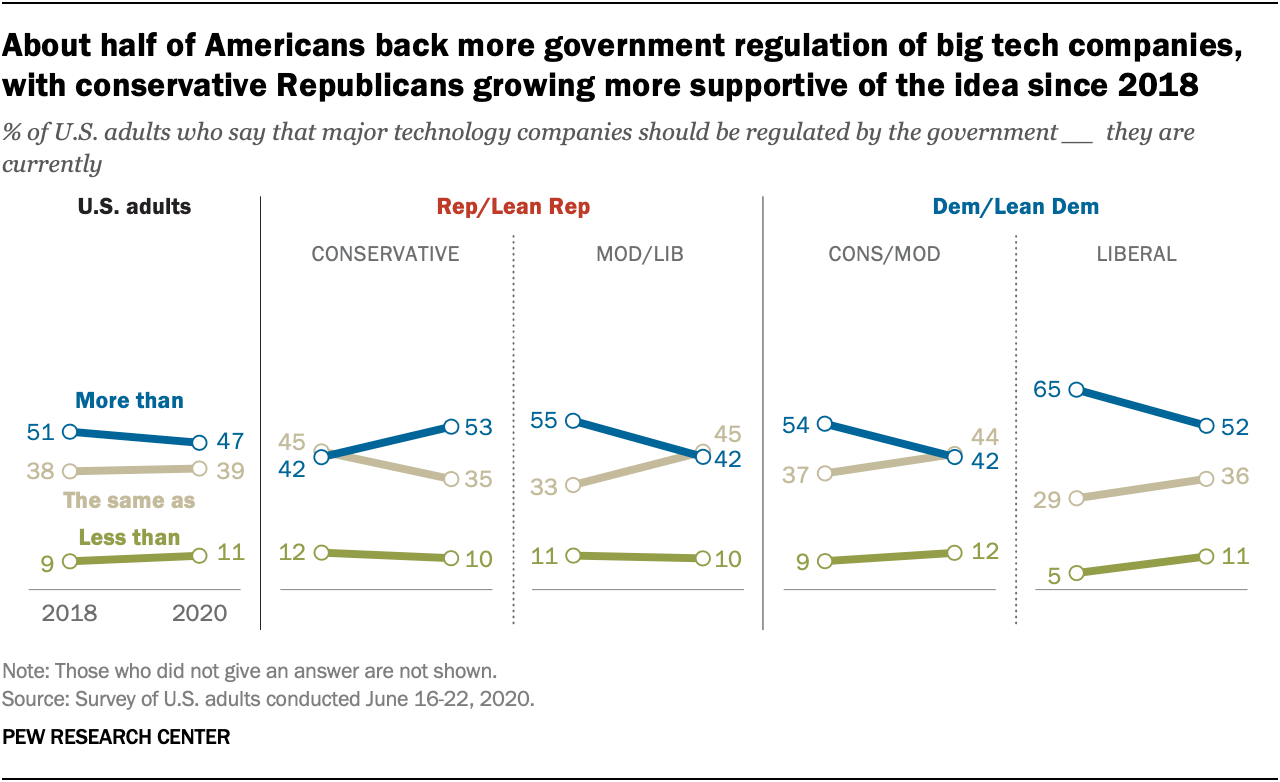
This is a rather lazy strawman. Monopolies and cartels have always been the primary threat to efficiency in all free market models. All serious proponents of free market economics have always identified the importance of regulating monopolistic and cartel-like behaviour (aside from the anarchists, which is mostly an extremist form of libertarianism).
All these terms are too wide to describe one person's position on certain topic.
They could be anti-regulation in terms of "government influences who, how, when, where operates in some economy sector" as it leads to market capture and control of the regulatory organizations by the companies they were supposed to regulate, but pro-regulation in terms of trust-busting companies having above-government power, like it happened to Rockefeller's "Standard Oil".
It's interesting though. The networks really were created to increase connection/communication between people, and it did in many ways.
What was unexpected is the effect. One had expected that people would feel less concerned by the state of the world, cause they would talk to their friends and family rather than bingeing on the global news.
But instead, this increase in connections created a sort of phase transition in society. It's kind of similar to the article that was posted here the other day, where scientists realized that atoms in a solid glass were more connected to each other than in liquid glass. In a way, social media literally "cristallized" polarization.
What was unexpected is the effect. One had expected that people would feel less concerned by the state of the world, cause they would talk to their friends and family rather than bingeing on the global news.
But instead, this increase in connections created a sort of phase transition in society. It's kind of similar to the article that was posted here the other day, where scientists realized that atoms in a solid glass were more connected to each other than in liquid glass. In a way, social media literally "cristallized" polarization.
Meanwhile, the major social networks (if not all of them) are still very good at creating echo-chambers and filter bubbles. So nothing has changed since 2016.
To be honest, I like some of those bubbles. I have much more trouble of finding value in engaging in some sanitized, corporate, mainstream, pop culture that looks like the abused child of advertisers, special interest and propaganda.
Yes, some are insular and don't really develop if that is your thing, but you can always have multiple bubbles.
Yes, some are insular and don't really develop if that is your thing, but you can always have multiple bubbles.
I tried logged out youtube without initalization and the value just plain wasn't there. Even a bad day for it was far superior to the generic mass market lowest common denominator schlock. Which I suppose demonstrates why old media lost.
Their approach was rather one size fits most with many lowest common denominator. Discovery is a damn useful service which is kind of obvious in retrospect with reviewers and guides being something people pay for.
Their approach was rather one size fits most with many lowest common denominator. Discovery is a damn useful service which is kind of obvious in retrospect with reviewers and guides being something people pay for.
I can't stand algorithmic timelines, obsessively keep Twitter on latest mode even when it automatically tries to trick you back with the "You're back home" nonsense.
Never thought I'd be one of those people but I'm ashamed to say YouTube had got me now, think it's a combination that it just seems to really know what you'd enjoy watching and the fact the default logged out versions content is so painfully bad that I'd never want to engage with that version of YouTube anyway.
Never thought I'd be one of those people but I'm ashamed to say YouTube had got me now, think it's a combination that it just seems to really know what you'd enjoy watching and the fact the default logged out versions content is so painfully bad that I'd never want to engage with that version of YouTube anyway.
> Filter bubbles are seen as critical enablers of Brexit, Trump, Bolsonaro, and other populist political phenomena, and search and social media companies have been criticised for failing to prevent their development. Yet, there is scant empirical evidence for their existence, or for the related concept of ‘echo chambers’: indeed, search and social media users generally appear to encounter a highly centrist media diet that is, if anything, more diverse than that of non-users.
https://www.doi.org/10.14763/2019.4.1426
https://www.doi.org/10.14763/2019.4.1426
I've recently written a pair of explanatory articles regarding the Fediverse, the decentralised social media network.
https://torresjrjr.com/archive/2020-07-19-guide-to-the-fediv...
https://torresjrjr.com/archive/2020-07-20-what-is-the-fedive...
The solution to centralised power and control already exists and is thriving, with approximately 2 million users strong. Take a moment to learn about the Fediverse and you'll be asking yourself why you didn't know about this before. Don't complain, act for Internet freedom.
https://torresjrjr.com/archive/2020-07-19-guide-to-the-fediv...
https://torresjrjr.com/archive/2020-07-20-what-is-the-fedive...
The solution to centralised power and control already exists and is thriving, with approximately 2 million users strong. Take a moment to learn about the Fediverse and you'll be asking yourself why you didn't know about this before. Don't complain, act for Internet freedom.
I just realized how social can fix this issue.
Every account has a default setting that is ultra-curated content, works nicely, politically correct, etc.
Deep in the options, you can ‘unlock’ all (requires 18+ notification, verification, or whatever depending on laws), then it will be an absolutely uncurated FILO sort of absolutely everything going a mile a minute.
The unlocked settings would let you upload code-snippets to do curating, so people could share things and invent new ways to curate.
This solves the issue with the risk of censorship.
Every account has a default setting that is ultra-curated content, works nicely, politically correct, etc.
Deep in the options, you can ‘unlock’ all (requires 18+ notification, verification, or whatever depending on laws), then it will be an absolutely uncurated FILO sort of absolutely everything going a mile a minute.
The unlocked settings would let you upload code-snippets to do curating, so people could share things and invent new ways to curate.
This solves the issue with the risk of censorship.
The issue is the speed and magnification of ideas, not necessarily the "adult" content.
Then in the uncurated version, they could disable the like button, which is what makes things go viral...
Only if they had the will power to stop contributing to it.
I recently finished playing Watch Dogs 2, and the missions go over this very problem. Social media’s impact on politics and how data is used to influence the masses.
Quite scary actually, that the real thing is happening.
Quite scary actually, that the real thing is happening.
Funny that this didn't pop up on my Google News feed
What about NGOs?
Yes, they do because they can get away with everything that the other non-"social" companies cannot.
Articles whining about ProblemX are tedious in a capitalist system.
Convert all of that whining energy into improving the situation, so as to do more than perpetuate it.
Now, if there is substantial ReasonY that ProblemX cannot be addressed, there is genuine basis for complaint.
Convert all of that whining energy into improving the situation, so as to do more than perpetuate it.
Now, if there is substantial ReasonY that ProblemX cannot be addressed, there is genuine basis for complaint.
> you should spend time fixing the problems
also
> don't talk about the problems
How does that work ? No one is going to solve these multi faceted issues alone in their garage. Creating a discussion around them is part of the solution
also
> don't talk about the problems
How does that work ? No one is going to solve these multi faceted issues alone in their garage. Creating a discussion around them is part of the solution
And what to do thet do when solving it? Talk about possible solutions. Instead whining is constantly "someone else should do it"! Which is neither helpful nor wise.
What if someone who never thought about the issue and doesn't talk about it in his circles find this article, start thinking about it and end up finding your "solutions" ?
If you don't want to read it you don't have to, I really don't see the issue here. Doing something, even as small as that, is still better than doing nothing or actively trying to shut down people talking about it...
If you don't want to read it you don't have to, I really don't see the issue here. Doing something, even as small as that, is still better than doing nothing or actively trying to shut down people talking about it...
My point here is that:
word != deed
If we hate Twitter, but aren't using, for example, Mastadon, then what are we doing to inject competition?
word != deed
If we hate Twitter, but aren't using, for example, Mastadon, then what are we doing to inject competition?
Sure, whining is tedious, but polling a populace to get an overview of public opinion seems to be a different thing.
Ok, so we should have no articles about Covid19, climate change, Boeing crash or 2008. May i ask how does the public even realise a problen exists?
Secondly, if you are going to make that argument, you should highlight our system is democratic. Slaves in enjoyed capitalist system too, you know.
Secondly, if you are going to make that argument, you should highlight our system is democratic. Slaves in enjoyed capitalist system too, you know.
Slavery still exists. Illegally, in places many don’t go, for various reasons, all of which are wrong, because slavery. And also legally, in American prisons as forced servitude, which is also wrong, because slavery.
I am not clear what point you are making
Even after reading the article, I’m not sure how to understand the question. Is it: "Social media companies are censoring me and must be regulated" or are they perhaps mixing the platform with the content? Because if Trump writes on Twitter, that’s not Twitter. It’s Trump.
IMHO, social media companies don’t have a lot of political influence. It’s the reach they create for platform users that’s "the problem".
IMHO, social media companies don’t have a lot of political influence. It’s the reach they create for platform users that’s "the problem".
Social media do actually have a lot of political influence - at least those which curate and promote certain content. They are the ones who control what kind of information gets consumed by more eyeballs and what kind of information gets suppressed, or at least displayed less prominently.
It's not about "social media companies are censoring me", but rather "social media companies are censoring what I see".
It's not about "social media companies are censoring me", but rather "social media companies are censoring what I see".
Yeh is it "I don't agree with president Trump" or more conservative twitter users objecting to companies tweeting about BLM or Pride.
I actually suspect the latter.
I actually suspect the latter.
Given the evidence of blacklisting and censoring trending Twitter users and hashtags via screenshots of the leaked admin tool, they have a lot of political influence and have access to that tool which can be used to crush anyone or any tweets they don't like. President or protestor.
The moment they censored anyone re-posting that admin tool on Twitter, it tells you that not only it exists but that they also still actively use it.
The moment they censored anyone re-posting that admin tool on Twitter, it tells you that not only it exists but that they also still actively use it.
They really should've added the question "Which social media accounts do you have" and then just summed that up.
Do you think those companies would have that much power without its users?
Do you think those companies would have that much power without its users?
When, I don't know, +90% of public discourse is flowing through a handful of platforms, and they are cutting out what they don't like, teasing out what they do like a gardener sculpting shrubbery to present some customized, skewed version of the public consciousness...yah, it's a problem.
I think the publisher vs platform provisions do need to be revisited. I think small niche sites and forums could be allowed more latitude in how they curate, but at a certain scale a higher expectation of neutrality should be enforced. Really, just limited to taking down obscenity, porn, gore, etc. If any more grey curating is applied (i.e. these platforms attempting to deem for themselves what is "hate speech") there should significant penalties for not applying it generally; for instance, taking down a Trump tweet addressing BLM for being deemed racist in some way, and yet giving a pass to others saying "white loves don't matter" or the like.
A few giant platforms can't be allowed to be the grand arbiters of what is acceptable public speech and what isn't. The influence they have is scary.
I think the publisher vs platform provisions do need to be revisited. I think small niche sites and forums could be allowed more latitude in how they curate, but at a certain scale a higher expectation of neutrality should be enforced. Really, just limited to taking down obscenity, porn, gore, etc. If any more grey curating is applied (i.e. these platforms attempting to deem for themselves what is "hate speech") there should significant penalties for not applying it generally; for instance, taking down a Trump tweet addressing BLM for being deemed racist in some way, and yet giving a pass to others saying "white loves don't matter" or the like.
A few giant platforms can't be allowed to be the grand arbiters of what is acceptable public speech and what isn't. The influence they have is scary.
and you can define obscenity? or is it "I know it when i see it" again. There is no neutral.
Fine, porn or gore or profanity, list of slurs. If you want to begin curating other nebulous concepts like "hate speech" at scale, it should be explicitly defined and you should held to being clear when you are acting upon violations for it, and responsible for applying your policy broadly and not cherry picking. "There is no neutral" so we'll just make it up as we go is just a ridiculous pass that big platforms are exploiting to the ill of society.
that's what we've always done, make it up as we go along, since societies and language change.
I doubt you'll find it easy to really split what's porn and what is art. or even what gore vs art is.
I doubt you'll find it easy to really split what's porn and what is art. or even what gore vs art is.
The problem is that Twitter is a private public square. That contradiction is not something JD can accept, because "his salary depends on his not understanding it.” It isn't reconcilable.
We don't have many examples, in modern times, of of non-companies filling roles like Twitter of FB fill. But, that doesn't mean they can't exist.
The WWW itself is a platform for speech and is a "public square." Wikipedia is another example. A really good example, if you think about it. If wikipedia was a commercial company, imagine the issues they'd be facing... all that authority as an information source.
Meanwhile, we really need to consider the economics of companies like twitter & facebook. Does FB really need 50k employees and a $70bn budget to provide the world with facebook? This isn't a question you could ask about Toyota.
If Facebook fell off the edge of the disc, we would very quickly have a replacement. People wouldn't lack for social media. If Toyota fell off the disc, we would have fewer cars. Rebuilding that capacity would require real resources.. Until then, we'd lack for cars.
This last part is key. Commercial viability is nearly a non-issue. Social media can be viable on a tiny fraction of its current revenue. This explodes the number of possible actions.
I really hope we're not heading for a regulatory shitshow... I hope, but I can't say I'm optimistic.