I like this approach. Something related I've been tinkering with are "protected bookmarks" - you declare what bookmarks (main, etc) are protected in your config.toml and the normal `jj bookmark` commands that change the bookmark pointer will fail, unless you pass a flag. So in your local "CI" script you can do `jj bookmark set main -r@ --allow-protected` iff the tests/lints pass. Pairs well with workspaces and something that runs a local CI (like a watcher/other automated process).
I haven't yet submitted it to upstream for design discussion, but I pushed up my branch[1]. You can also declare a revset that the target revision must match, for extra belts and suspenders (eg., '~conflicts()')
I'm glad you shared this because, in my head this Dr. Nick quote is so canonical it must be from the original golden 8 seasons, so it's nice to be reminded there are occasionally good things after! ;^)
For example, health care plans in the US are county-specific with regard to premiums, co-pays, etc. (based on demographics). Allowing someone to type in their ZIP Code to get started can be a better user experience than having them pick their county.
One thing I just recalled is that if you maintain a small exceptions lookup table (i.e. the ones that span state boundaries), you can use ZIP Codes as a way to uniquely look up a county name.
This is a fact of ZIP Codes that a lot of people stumble one. I've worked on GIS/mapping projects in the past where stakeholders wanted or assumed ZIP Codes to be polygons.
Another complexity that surprises folks is you can't guarantee a one-to-many state-to-ZIP Code relationship. There are several (I forgot offhand how many, I used to have them memorized) that span across state boundaries.
Similar timing, I had a high school internship at the National Cancer Institute at Ft. Detrick, MD in 1994-95, and the lab down the hall had some SGI iron and a glove (I don't remember what the glove hardware was, if it was SGI or 3rd-party or custom) for manipulating 3D renders of folded proteins. Incredible stuff, same "in the future" feeling.
Another good rule of thumb to remember is that a 50mm lens on a 35mm sensor ("full-frame") is roughly the equivalent FOV of the human eye, i.e., what you see naturally.
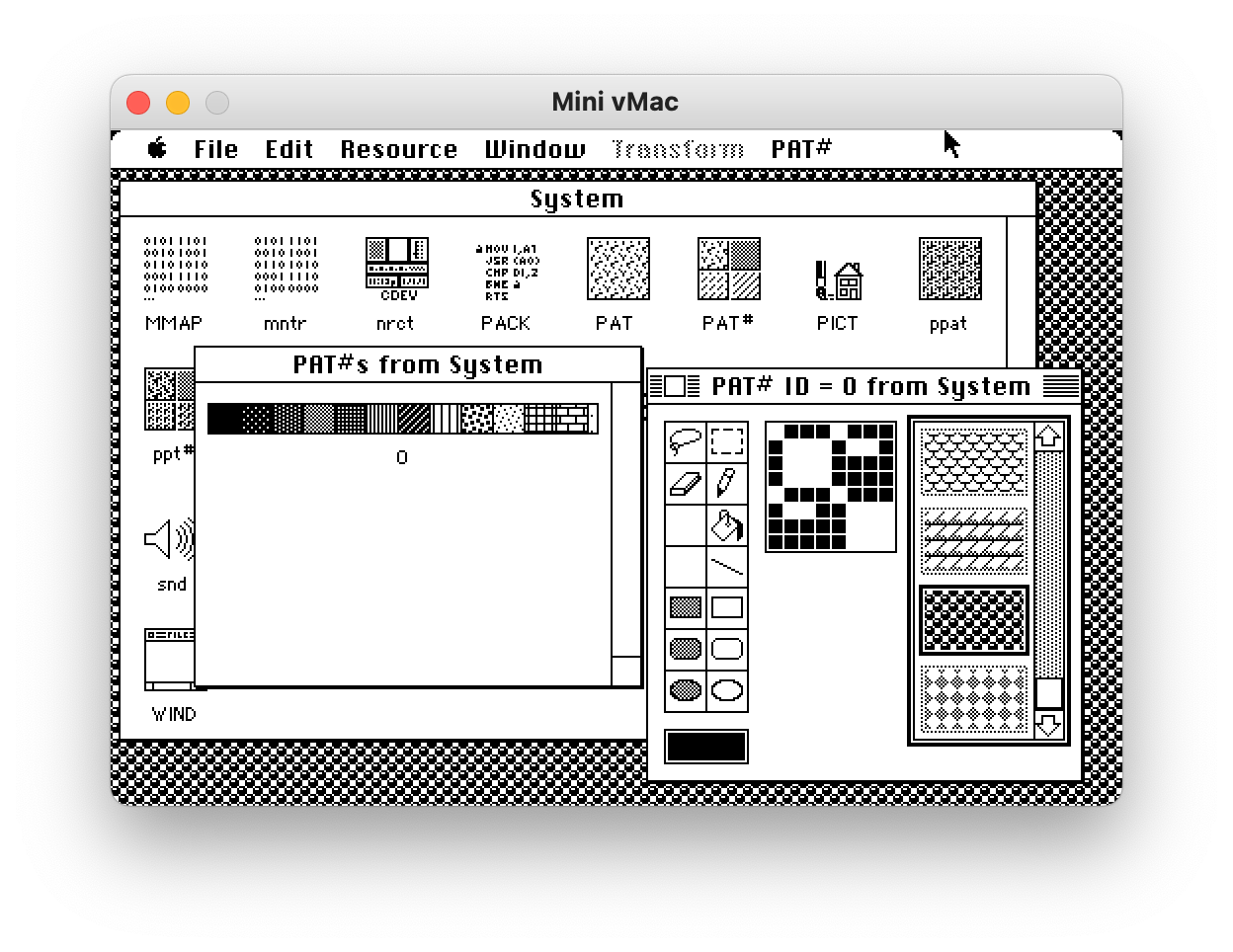
It's a great point, and I did consider it, the trouble is, how do you get the pattern resource data out of ResEdit running in the emulator and onto the modern machine? And ResEdit doesn't seem to run in any kind of compatibility mode on modern Macs anymore either.
It's too bad because ResEdit is an amazing program, and even has a surprisingly full-featured graphical editor, including for those patterns, with a live preview mode:
Exactly. One of the cool things about doing this the hard way was discovering that Apple still hosts old system and programmers manuals like the one for QuickDraw on its website.