The SELinux coloring book [pdf](people.redhat.com)
people.redhat.com
The SELinux coloring book [pdf]
https://people.redhat.com/duffy/selinux/selinux-coloring-book_A4-Stapled.pdf
56 comments
It's a long running tradition, especially in medical education.
Here's an edition from 17 years ago: https://www.amazon.co.uk/Human-Brain-Coloring-Book-Concepts/...
Here's an edition from 17 years ago: https://www.amazon.co.uk/Human-Brain-Coloring-Book-Concepts/...
Excellent example. I love the visual kinesthetic combination of these books and wonder if there has been studies on it's effect on learning.
When Google Chrome first came out in 2008, they used a series of cartoons to explain their innovations (multi-process browsing, JIT compilation for JS, etc).
https://www.google.com/googlebooks/chrome/
https://www.google.com/googlebooks/chrome/
>I personally believe that women have a better sense for simplifying complex ideas
SELinux is not a "complex idea", SELinux is a tool with subpar documentation.
A coloring book does nothing to fix that.
SELinux is not a "complex idea", SELinux is a tool with subpar documentation.
A coloring book does nothing to fix that.
Comments like this, while factually correct, are the reason why we need these books.
My comment was in reference to topics covered beyond SELinux.
It is a question of personal taste. I personally don't like it, there's too much distraction and too little substance. It might be interesting to illustrate some concept, but not everything imo.
I wonder if it's because a colouring book is not a Serious Adult thing, and women have - or allow themselves - a bit more wiggle room to not be Serious Adults all the time.
The discussion is about selinux, and not gender.
Maybe men don't feel comfortable publishing book in styles that others perceive as women's territory.
From @lattera on Twitter:
here's a couple lost pages found by the grsecurity folks:
https://grsecurity.net/~spender/pics/lost_selinux_coloring_b...
https://grsecurity.net/~spender/pics/lost_selinux_coloring_b...
:)
here's a couple lost pages found by the grsecurity folks:
https://grsecurity.net/~spender/pics/lost_selinux_coloring_b...
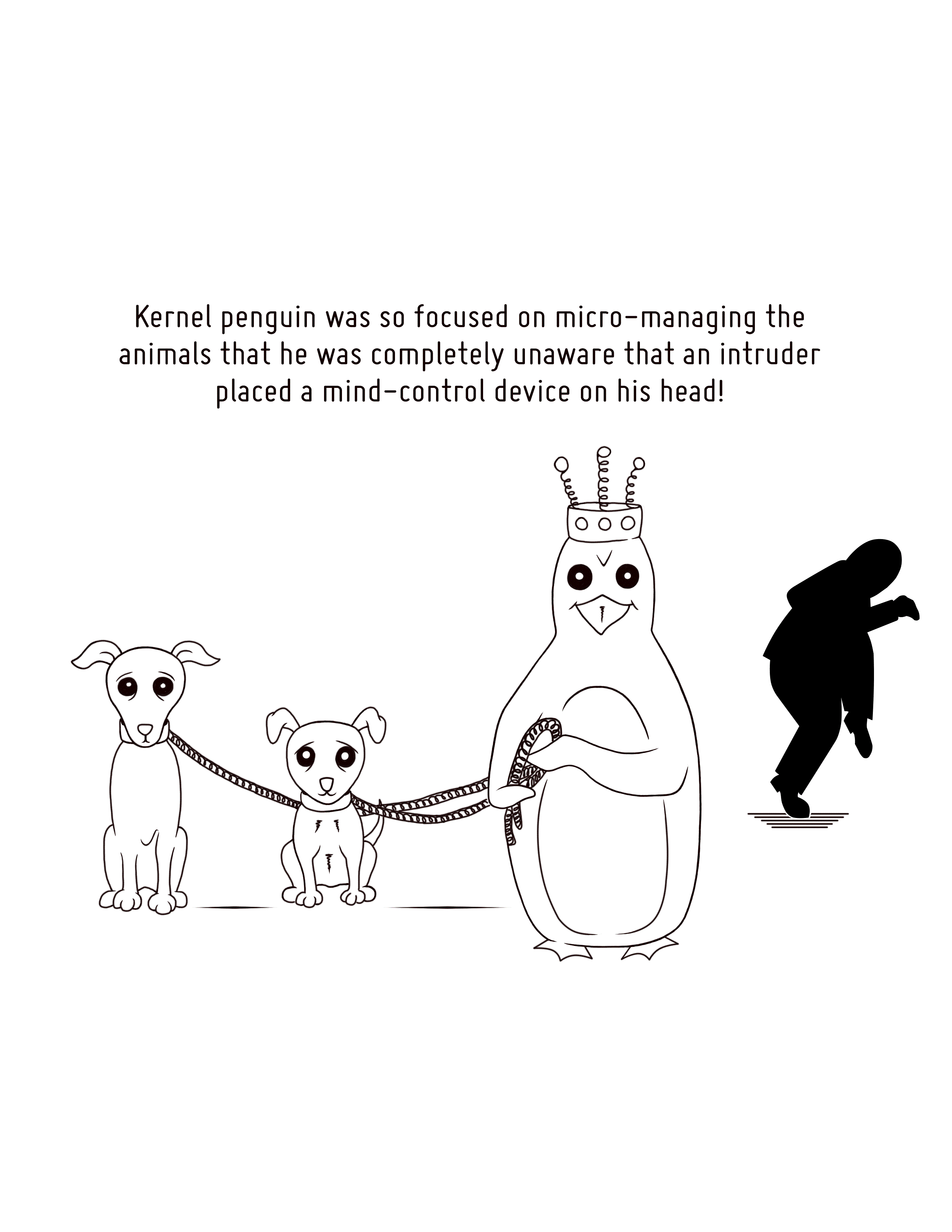
https://grsecurity.net/~spender/pics/lost_selinux_coloring_b...

:)
The problem with SELinux is not really in the beginner documentation, but in the documentation of the policy macro packages eg. in Fedora -- which are what you in the end should/need to use for actually writing or modifying policies.
Answers to questions on eg. finding the difference between "userdom_user_application_domain" and "application_domain", or learning that "~/.local/share" has the symbolic name "data_home_t" are very difficult to find. Everything in SElinux has a symbolic name, so there's also at least one more layer of indirection as compared to apparmor.
Answers to questions on eg. finding the difference between "userdom_user_application_domain" and "application_domain", or learning that "~/.local/share" has the symbolic name "data_home_t" are very difficult to find. Everything in SElinux has a symbolic name, so there's also at least one more layer of indirection as compared to apparmor.
I don't necessarily think that the illustrations are what makes this great. They're cute, but the simple and explicit examples with uncontrived situations are what really makes this worthwhile.
It may be that getting into "writing for a coloring book" mode makes people think simpler and "cuter," which lends itself well to quick illustration of complex ideas.
I'd like to see more of this kind of explanation in guides and manuals in general, with the "normal" manuals being for reference when people need to drill down into something specific.
It may be that getting into "writing for a coloring book" mode makes people think simpler and "cuter," which lends itself well to quick illustration of complex ideas.
I'd like to see more of this kind of explanation in guides and manuals in general, with the "normal" manuals being for reference when people need to drill down into something specific.
I think the version in this link may be an old one. In the version on Github (https://github.com/mairin/selinux-coloring-book/blob/4ac589b...), I see at least one typo that's fixed and I believe there are other differences as well.
As a colouring book, it's not great.
The writing is all messed up too. :(
Very first sentence:
> The SELinux primary model or enforcement is called type enforcement.
"or" should be "of" or "for". I'm not sure which, because it doesn't even tell you what enforcement means.
First page:
> Imagine a system where we define types on objects like cats and dogs.
"On" isn't a preposition you usually use with "type". You can say things have a type, or are a type, but "define a type on" is a unfamiliar construction.
> A cat and dog are process types.
I'm confused. Do they have types defined on them, or are they the types? Earlier, it said they are objects, now they are process types?
> We have a class of objects that they want to interact with which we call food. And I want to add types to the food, cat_chow and dog_chow.
Using "they" to refer to a noun from the previous page is a little confusing. "food" should be quoted. You can start a sentence with "And", but it feels gratuitous here since the previous sentence is short.
> As a policy writer, I would say that a dog has permission to eat dog_chow write this rule in policy, as shown below.
What happened between "dog_chow" and "write" here? The latter half looks like a random fragment of text. What is a "policy writer"?
> food and a cat has permission to eat cat_chow food. In SELinux we would
We would what?
Very first sentence:
> The SELinux primary model or enforcement is called type enforcement.
"or" should be "of" or "for". I'm not sure which, because it doesn't even tell you what enforcement means.
First page:
> Imagine a system where we define types on objects like cats and dogs.
"On" isn't a preposition you usually use with "type". You can say things have a type, or are a type, but "define a type on" is a unfamiliar construction.
> A cat and dog are process types.
I'm confused. Do they have types defined on them, or are they the types? Earlier, it said they are objects, now they are process types?
> We have a class of objects that they want to interact with which we call food. And I want to add types to the food, cat_chow and dog_chow.
Using "they" to refer to a noun from the previous page is a little confusing. "food" should be quoted. You can start a sentence with "And", but it feels gratuitous here since the previous sentence is short.
> As a policy writer, I would say that a dog has permission to eat dog_chow write this rule in policy, as shown below.
What happened between "dog_chow" and "write" here? The latter half looks like a random fragment of text. What is a "policy writer"?
> food and a cat has permission to eat cat_chow food. In SELinux we would
We would what?
The last two sentences that you complain about are on a two-page spread: "As a policy writer, I would say that a dog has permission to eat dog_chow food and a cat has permission to eat cat_chow food. In SELinux we would write this rule in policy, as shown below."
Graphics are far from professional level, unfortunately. I would throw away coloring idea. Instead, I'd put a decent graphics. It could be even made into some simple story.
That kernel though. Damn awesome work, made me smile.
I thought the kernel looked a bit menacing.
This is one of the weirder artifacts I've come across lately. One of those things for which I like to imagine how a far-future archaeologist would react to it.
That is, if we still made documents that will be around for far-future archaeologists to puzzle over.
This is one of the weirder artifacts I've come across lately. One of those things for which I like to imagine how a far-future archaeologist would react to it.
That is, if we still made documents that will be around for far-future archaeologists to puzzle over.
"This is a bit too beefy for you." - Kernel
SELinux always makes me feel like I'm a complete idiot (the worst thing about that is that I could be an idiot and not know it or refuse to acknowledge it).
So, maybe this introduction will make it a little more accessible.
So, maybe this introduction will make it a little more accessible.
You're not an idiot and you're not alone. In fact even those who you might expect to know it get it wrong and struggle to figure out what's gone on. For example recently I decide I didn't know systemd very well so picked a random service to setup and play with (tor) and a distro that uses systemd (Fedora 25).
I set up a hidden ssh service which was initially fine but after a reboot it failed with some weird permissions issue I couldn't figure out. Turns out this was some weird misconfiguration in SELinux for the Fedora tor package which afaik is still unresolved.
https://bugzilla.redhat.com/show_bug.cgi?id=1279222
https://bugzilla.redhat.com/show_bug.cgi?id=1250893
https://bugzilla.redhat.com/show_bug.cgi?id=1375369
There's more of these floating around if you search for the right terms. If SELinux was widely well-understood then this would be a pretty simple issue to identify and resolve (note: I'm not well versed enough in it - I've applied a workaround and have resolved to return and fix it properly "later") but it doesn't appear that this is the case
I set up a hidden ssh service which was initially fine but after a reboot it failed with some weird permissions issue I couldn't figure out. Turns out this was some weird misconfiguration in SELinux for the Fedora tor package which afaik is still unresolved.
https://bugzilla.redhat.com/show_bug.cgi?id=1279222
https://bugzilla.redhat.com/show_bug.cgi?id=1250893
https://bugzilla.redhat.com/show_bug.cgi?id=1375369
There's more of these floating around if you search for the right terms. If SELinux was widely well-understood then this would be a pretty simple issue to identify and resolve (note: I'm not well versed enough in it - I've applied a workaround and have resolved to return and fix it properly "later") but it doesn't appear that this is the case
If you're having issues with selinux run:
[1] https://www.youtube.com/watch?v=MxjenQ31b70&t=1s
sealert -a /var/log/audit/audit.log
[1] https://www.youtube.com/watch?v=MxjenQ31b70&t=1s
It's nice... but the suggestions are often terrible when they could be fixed properly with a bool or changing the context of a directory.
I sat the RHCE course/exam recently and the Red Hat trainer dealt with this in... amusing... ways.
Unfortunately, fixing things properly requires knowledge, if only of where to find the information. Thinking solely about file contexts, it's not easy to for example search them. e.g. "show me all contexts related to samba" so you can find the share rw label. (One of the RHEL 7.0 man pages suggests the nfs rw label which doesn't work, had to make a point of remembering that for the exam!) Everything's spread across selinux's man pages, service's man pages... ugh.
I sat the RHCE course/exam recently and the Red Hat trainer dealt with this in... amusing... ways.
Unfortunately, fixing things properly requires knowledge, if only of where to find the information. Thinking solely about file contexts, it's not easy to for example search them. e.g. "show me all contexts related to samba" so you can find the share rw label. (One of the RHEL 7.0 man pages suggests the nfs rw label which doesn't work, had to make a point of remembering that for the exam!) Everything's spread across selinux's man pages, service's man pages... ugh.
I personally feel like the included man pages on RH distros for selinux discussion on specific topics are quite good. You can see the full list of these by searching your man database with: man -k _selinux
In this specific case, you're looking for samba_selinux. It's not perfectly written, but it should at least cover all the relevant information: (https://linux.die.net/man/8/samba_selinux). You mentioned looking for the read/write share label, and that's specifically discussed, and described with examples.
You can also use sesearch to query your selinux policy for more information about anything mentioned in that man page. For example, to understand the implications of setting samba_enable_home_dirs you can run `sesearch -A -b samba_enable_home_dirs`. You can run similar queries for file types, process types, port types, etc. If you really want a list of every type relevant to samba, you can run: `sesearch -A -s smbd_t`. If you wanted to use sesearch to find everything smbd_t can write to, as an alternate method of discovering public_content_rw_t, you can filter that, like: `sesearch -A -s smbd_t -p write -d -c file -C`. This will also show you that the public_content_rw_t rule is conditional on the smbd_anon_write boolean.
I used to teach RHCE courses and exams; I'm curious about the amusing ways of dealing with selinux you encountered.
In this specific case, you're looking for samba_selinux. It's not perfectly written, but it should at least cover all the relevant information: (https://linux.die.net/man/8/samba_selinux). You mentioned looking for the read/write share label, and that's specifically discussed, and described with examples.
You can also use sesearch to query your selinux policy for more information about anything mentioned in that man page. For example, to understand the implications of setting samba_enable_home_dirs you can run `sesearch -A -b samba_enable_home_dirs`. You can run similar queries for file types, process types, port types, etc. If you really want a list of every type relevant to samba, you can run: `sesearch -A -s smbd_t`. If you wanted to use sesearch to find everything smbd_t can write to, as an alternate method of discovering public_content_rw_t, you can filter that, like: `sesearch -A -s smbd_t -p write -d -c file -C`. This will also show you that the public_content_rw_t rule is conditional on the smbd_anon_write boolean.
I used to teach RHCE courses and exams; I'm curious about the amusing ways of dealing with selinux you encountered.
That "show me all contexts related to samba" is something I'm really missing. I worked one weekend on getting NextCloud to play nicely with SELinux and Apache on Fedora 25 without any dirty tricks, and one thing that would really have come in handy was an accurate list of all the labels related to Apache. The only comprehensive lists I could find online were out-of-date, and the only things that were up to date were single examples.
sesearch is one way of doing it, for example:
  $ sesearch -A -s some_app_t -c file -p read -p write
  allow some_app_t some_type_t:file { read write };
  allow some_app_t some_other_type_t:file { read write };
  allow some_attribute_of_some_app_t yet_another_type_t:file { read write };
  $ sesearch -A -t some_type_t -c file -p read -p write
  allow some_app_t some_type_t:file { read write };
  allow some_other_app_t some_type_t:file { read write };
I had no idea this existed. Thank you.
I found it to be extremely helpful to check out the Fedora SELinux repositories. They're an excellent reference and full of good examples.
https://github.com/fedora-selinux/selinux-policy
https://github.com/fedora-selinux/selinux-policy
AppArmor took some time to understand, but it wasn't too bad. I've written AppArmor profiles for in-house apps. I realize AppArmor isn't as powerful as SELinux, but I do find it easier to understand.
I feel like having to worry about complex SELinux configuration isn't going to matter as much for people who start to use containers. Most distributions have SELinux profiles for docker that work, and containers provide a decent level of isolation.
They're not as good as full VMs, and a kernel exploit can still break out of a container, but if you're running all your own in house/trusted code on your container system, it seems like a pretty good trade-off for isolation/security.
I feel like having to worry about complex SELinux configuration isn't going to matter as much for people who start to use containers. Most distributions have SELinux profiles for docker that work, and containers provide a decent level of isolation.
They're not as good as full VMs, and a kernel exploit can still break out of a container, but if you're running all your own in house/trusted code on your container system, it seems like a pretty good trade-off for isolation/security.
Such comments made me do a new submission on the original motivation and architecture for it so things might make a bit more sense. At least explain why it's so complex.
https://news.ycombinator.com/item?id=13783975
https://news.ycombinator.com/item?id=13783975
Cute.
At the point you have to make a "cute" coloring book (for adults) to make your OS seem more friendly, maybe it's time to reflect on the reality that there's something fundamentally wrong with the reasoning used to justify the logic required to use it.
> At the point you have to make a "cute" coloring book (for adults)
... is right about the point where you've lost completely. what is this nonsense? This infantilization of adults is insane.
... is right about the point where you've lost completely. what is this nonsense? This infantilization of adults is insane.
You may not like the approach, but, please, stop using "infantilization" argument. Not all comic books and animated movies are for kids, even though they look like it might be the case.
Here, it may open the subject for broader audience. It is easier to comprehend even for a layman. And even if you're not the one, you could dig in - just for fun.
A picture is worth a thousand words, they say.
Here, it may open the subject for broader audience. It is easier to comprehend even for a layman. And even if you're not the one, you could dig in - just for fun.
A picture is worth a thousand words, they say.
While I do enjoy some comic book and/or tv shows I did find this book a bit infantilizing. This looks more like Teletubbies than Rick and Morty if you see what I mean.
"Hey, I've heard you're too much of a dumb-dumb to get SELinux to work? Maybe if we turn it into an episode of Dora the Explorer you'll get it this time! Don't forget to renew your RHEL subscription by the way."
"Hey, I've heard you're too much of a dumb-dumb to get SELinux to work? Maybe if we turn it into an episode of Dora the Explorer you'll get it this time! Don't forget to renew your RHEL subscription by the way."
rimantas(1)
I think you might be taking this too seriously.
[deleted]
coloring books for adults is a mindfulness thing.
the selinux one is just a cute marketing move for red-hat to sell courses
the selinux one is just a cute marketing move for red-hat to sell courses
Wow I feel like I understand SELinux. Guess I can stop turning it off now...
So the lesson is (just looking at the pictures) if I don't disable SELinux a puppy will starve?
Just curious, anyone here not working on government systems ever enabled MLS mode and used it successfully?
Yes, mostly just to learn more about it.
Finally managed to get it working and get all my sensitivities and categories set up the way I wanted them. Wasn't fun at all.
Before I started I had this idea I was going to use it all the time for all my data. That didn't last long.
Finally managed to get it working and get all my sensitivities and categories set up the way I wanted them. Wasn't fun at all.
Before I started I had this idea I was going to use it all the time for all my data. That didn't last long.
Explaining weird solutions with cute explanations is cute.
I just wish I had some example commands to color in.
The thing that made SELinux click for me was this talk - it's really a great talk for SELinux: https://www.youtube.com/watch?v=MxjenQ31b70
(I also have a video explaining some specific/common things: https://serversforhackers.com/video/battling-selinux-cast)
(I also have a video explaining some specific/common things: https://serversforhackers.com/video/battling-selinux-cast)
For those who liked this, the authors have another one on containers:
https://raw.githubusercontent.com/fedoradesign/coloringbook-...
popobobo(1)
[deleted]
I love this idea. It's not meant to teach people everything, but it shows the basic SELinux concepts in a fun manner, that is different from the typical dry written documentation.
The best utility that this has is that it gets people asking questions. I could put this on my wall at work, and then when my colleagues ask about it, I could use it to segue into actually teaching them about SELinux. Putting the SELinux text documentation on my wall would not have the same effect.
The best utility that this has is that it gets people asking questions. I could put this on my wall at work, and then when my colleagues ask about it, I could use it to segue into actually teaching them about SELinux. Putting the SELinux text documentation on my wall would not have the same effect.
The illustrations that I've found most amazing and well done are created by people like:
Lin Clark (https://code-cartoons.com/)
Julia Evans (http://jvns.ca/zines/)
Linda Liukas (http://www.helloruby.com/)
Amy Wibowo (https://shop.bubblesort.io/)
You may notice a trend with the gender of the authors above. I personally believe that women have a better sense for simplifying complex ideas, and greater empathy and patience for teaching those ideas once they've been made simple.