Stephen Hawking: I'm Worried about the Future of the NHS(bbc.co.uk)
bbc.co.uk
Stephen Hawking: I'm Worried about the Future of the NHS
http://www.bbc.co.uk/news/health-40967309
36 comments
I wouldn't call outcomes similar in terms of disease survival rates, British medical journals have spent quite a few words on this very topic. For example, cancer survival rates are 50% higher in the US than NHS, as reported in Lancet. That is worse than much of Europe. You see similar deltas for cardiovascular disease treatment outcomes.
Metrics like average lifespan are not that correlated with survival rates from medical diseases. Switzerland or France are where you want to be in Europe if the goal is to survive serious medical conditions.
Metrics like average lifespan are not that correlated with survival rates from medical diseases. Switzerland or France are where you want to be in Europe if the goal is to survive serious medical conditions.
This 50% figure is debunked here: http://scienceblog.cancerresearchuk.org/2009/08/17/we-need-t...
In the end largely detection in the US is quite a bit better but the actual cancer care is similar.
In the end largely detection in the US is quite a bit better but the actual cancer care is similar.
Precisely. Survival rates are strongly correlated with early detection and the US is pretty obsessive about that. If you read the various papers on the subject, UK has poor survival rates because they have poor early detection rates. And in fairness, it is expensive to do the amount of screening that causes the US to have good survival rates.
Either way, the difference in survival rates is stark.
Either way, the difference in survival rates is stark.
No, that’s not what the article says in totality, have you read it? Your statement that in all cancer you’re 50% more likely to die in the UK requires at least a link. It’s just not supported. With prostate cancer the linked article explains the difference.
That statistic does not sound accurate.
Unfortunately it is. Trivially google-able to find Lancet Oncology papers comparing cancer survival rates across Europe. UK looked quite poor comparatively.
The US has the best cancer survival rates in the world by a fair margin, though It is closer in women than men. (Edit: misremembered which European countries had relatively high survival rates)
The US has the best cancer survival rates in the world by a fair margin, though It is closer in women than men. (Edit: misremembered which European countries had relatively high survival rates)
In aware that outcomes are better in the US, but very skeptical of that amount.
Any numbers I tried to find on UK and NHS spending show them going up steadily since the 90s, and ignoring some 5-year fluctuations spending seems to never have been higher: http://election2015.ifs.org.uk/uploads/images/election_graph...
When did the defunding you're talking about happen?
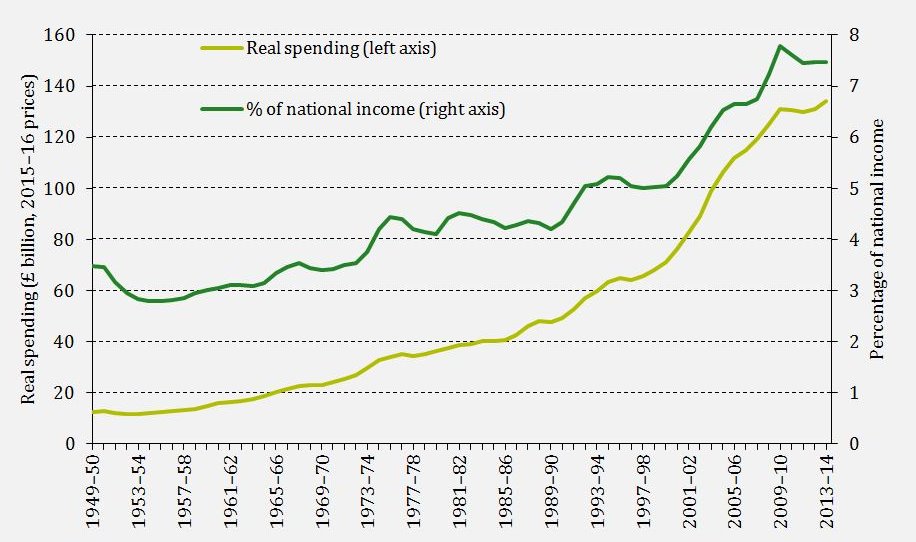
When did the defunding you're talking about happen?
The population is aging and amount of money per person is going down. Inflation is higher for the NHS than for the general economy.
https://fullfact.org/health/spending-english-nhs/
£30bn shortfall by 2020 and the NHS is being asked to save £22bn which seems impossible.
You can add vanity projects that aren’t supported by data to this list; “7 day NHS” it’s a complete myth more people die on a weekend, defunding Public sector pay, not paying student nurses anymore even though a large part of what they do is learned while working. Then add in the EU migrants leaving at an alarming rate...
https://fullfact.org/health/spending-english-nhs/
£30bn shortfall by 2020 and the NHS is being asked to save £22bn which seems impossible.
You can add vanity projects that aren’t supported by data to this list; “7 day NHS” it’s a complete myth more people die on a weekend, defunding Public sector pay, not paying student nurses anymore even though a large part of what they do is learned while working. Then add in the EU migrants leaving at an alarming rate...
I don't get it, looking at these per-capita numbers:
https://en.wikipedia.org/wiki/List_of_countries_by_total_hea...
The NHS spending levels look pretty reasonable, and have been rising. What's missing here? Is there a better resource for per-capita spending?
https://en.wikipedia.org/wiki/List_of_countries_by_total_hea...
The NHS spending levels look pretty reasonable, and have been rising. What's missing here? Is there a better resource for per-capita spending?
“Total expenditure includes both public and private expenditures.” So those statistics are meaningless in this context right?
Do you have a better reference for per-capita numbers?
Private healthcare spending in the UK is a fraction of public spending (because even if you have private insurance in the UK, most healthcare is still provided publicly (you still go to public-funded GP/emergency and only go private if referred)).
In addition to this, it's a relatively fixed fraction (~20%):
https://www.nuffieldtrust.org.uk/chart/uk-spending-on-public...
Private healthcare spending in the UK is a fraction of public spending (because even if you have private insurance in the UK, most healthcare is still provided publicly (you still go to public-funded GP/emergency and only go private if referred)).
In addition to this, it's a relatively fixed fraction (~20%):
https://www.nuffieldtrust.org.uk/chart/uk-spending-on-public...
"being underfunded at and amazing rate", a citation on this would be useful to me. From the charts I can find [1] NHS funding has increased by >2% every year since 1990.
Another small point. It really doesn't make sense to compare the U.K. and American health service. The American health service is a global outlier. It spends more than any other country on health for very poor outcomes, when compared against almost any other country. It would make more sense to compare the U.K. to other countries with similar demographics...
[1] http://www.health.org.uk/chart-how-funding-nhs-uk-has-change...
Another small point. It really doesn't make sense to compare the U.K. and American health service. The American health service is a global outlier. It spends more than any other country on health for very poor outcomes, when compared against almost any other country. It would make more sense to compare the U.K. to other countries with similar demographics...
[1] http://www.health.org.uk/chart-how-funding-nhs-uk-has-change...
Some information on the declining level of funding here: https://fullfact.org/health/spending-english-nhs/
On your small point, I suppose one way in which you could compare the UK and American systems in high-level terms is by money paid for service provided. In the UK, people pay for their health care through their taxes (and some direct costs like prescriptions). In the US it is largely through direct cost for health insurance and/or employment deductions. That cost is clearly far lower in the UK than the US.
On your small point, I suppose one way in which you could compare the UK and American systems in high-level terms is by money paid for service provided. In the UK, people pay for their health care through their taxes (and some direct costs like prescriptions). In the US it is largely through direct cost for health insurance and/or employment deductions. That cost is clearly far lower in the UK than the US.
I can't see how the site you quote shows that the NHS is being defunded at an alarming rate... In fact:
"Looking at the wider UK, the amount spent on health has been rising over the long-term. That’s true whether it’s expressed in cash, cash adjusted for inflation, per person, or as a proportion of the size of the economy."
Regarding the UK/US comparison. The question is why would you want to compare yourself to a global outlier unless you're trying to setup a straw man?
The UK health care system is obviously better than the US, almost every developed country has a healthcare system than is better than the US, it's not even hard.
It's hard to be better than other European countries, or for example... Japan.
For some strange reason British politics tends to frame arguments as "we're better than the US at X"... doesn't matter... there are many things the US is poor at.
"Looking at the wider UK, the amount spent on health has been rising over the long-term. That’s true whether it’s expressed in cash, cash adjusted for inflation, per person, or as a proportion of the size of the economy."
Regarding the UK/US comparison. The question is why would you want to compare yourself to a global outlier unless you're trying to setup a straw man?
The UK health care system is obviously better than the US, almost every developed country has a healthcare system than is better than the US, it's not even hard.
It's hard to be better than other European countries, or for example... Japan.
For some strange reason British politics tends to frame arguments as "we're better than the US at X"... doesn't matter... there are many things the US is poor at.
"the amount spent on health has been rising over the long-term"
The point is that the amount being spent IS NOT ENOUGH to offset the growth in demand for services. That is why the NHS faces a £30 billion funding gap by 2020 - as the article explains in full.
As to the US comparison, that will continue as long as the US approach to health care is the one that's favoured by right-wing politicians in the UK. They are not (yet) touting the Japanese or Finnish models. So we don't care about those comparisons.
The point is that the amount being spent IS NOT ENOUGH to offset the growth in demand for services. That is why the NHS faces a £30 billion funding gap by 2020 - as the article explains in full.
As to the US comparison, that will continue as long as the US approach to health care is the one that's favoured by right-wing politicians in the UK. They are not (yet) touting the Japanese or Finnish models. So we don't care about those comparisons.
Do you have a citation that suggests a completely US style system is being proposed?
This might be the case, but I feel like if this is the discussion being had, there should be an explicit reference, and justification that the US is the closest implementation of what is being suggested.
This might be the case, but I feel like if this is the discussion being had, there should be an explicit reference, and justification that the US is the closest implementation of what is being suggested.
No UK politician would openly say that they wanted to privatise the NHS. But what they are doing is solidly along the lines of the US modal. That is, to turn the rump of the NHS into a Medicaid/Medicare provider with the bulk of healthcare borne by private insurance.
I may be wrong of course - what is your interpretation of what is happening with the NHS? Perhaps you think it's being run well, and that tax payers need not fear the threat of having to buy private health insurance or rely on employer support?
I may be wrong of course - what is your interpretation of what is happening with the NHS? Perhaps you think it's being run well, and that tax payers need not fear the threat of having to buy private health insurance or rely on employer support?
Comparisons with rail are probably poor. While rail was nationalized, usage fell, as soon as rail was privatised again in the 90s usage has increased back up at a trend almost perpendicular to that seen when nationalised.
https://en.wikipedia.org/wiki/Rail_transport_in_Great_Britai...
https://en.wikipedia.org/wiki/Rail_transport_in_Great_Britai...

> NHS costs less than half the cost of the American system for similar outcomes and it worked really really well when funded at the level of other European countries under the last Labour government.
[Citation needed (for "similar outcomes")]. The NHS has always been cost efficient but fairly bad when it comes to outcome.
[Citation needed (for "similar outcomes")]. The NHS has always been cost efficient but fairly bad when it comes to outcome.
I'm always relieved to see when prominent voices in technology stand up for our social services because sadly these voices are all too rare, and especially today under permanent onslaught from the kind of privatization that Mr. Chomsky and Hawking point toward.
Other aspect would be outsourcing departments under TUPE (originated in UK Goverment circa 1980 and adopted https://en.wikipedia.org/wiki/Transfer_of_Undertakings_(Prot... ) and not only transitions whole area's into the private sector, but is often overlooked. Under Blair whole area's got TUPED, one being IT, which got outsourced to ICL who then went on to be brought up by Fujitsu, as well as splitting up the NHS into trusts, opening up new private tendering. But many of these aspects only open up the NHS to added costs in the end and captive to quality. As any switching risks a whole new learning curve and it is an area of business that has more than it's fair share of quirks.
So short term you end up making the balance sheet look good thru initial savings, but over time the costs unfold and you end up pumping in more money than before and get worse results.
But lets focus upon the issues and solutions over which party is more to blame than others as all messed it up and then blames the others, achieving nothing.
How to fix it, supporting home grown talent and that means via education to become doctors and nurses, pay them a fair wage that reflects the mental aspect of the work and stress.
But one aspect is the lack of home knowledge upon medical needs and we find people these days taking up medical professionals time for minor aliments that easily dealt with. So some form of health/first aid education being mandatory, would go a long way. Be you target at school, or even those with time, like unemployed. You could also offer incentives to staff and I'm sure a goverment could negotiate a countrywide dicount card that many a global chain will want to get behind to show there support for emotional PR with consumers. That saves staff money, ie 10% at Tesco's. Cost to run would be low and monetary value to employee's would add up nicely for them. Another way towards a rewarding wage.
Then planning for the future and with that, DNA sampling (bit big brother) but as and when aliments are adentified the daily check of the register would allow proactive medicine for so many and overall - save more than costs.
So many ways to address the issues, education to reduce the floods of patients and proactive investment for reduction and equally more manageable customer interactions.
I would also say that video consultation with doctors is something technology wise that needs some exploring as a way to reduce doctor appointments and it is those front lines that impact and have a knock on effect.
Only way to compare the NHS with other systems would be other countries with comparable health systems -Spain being closest of the few European countries operating non private healthcare.
But one whole avenue that bugs me about health care is that well of countries litery stripping lesser of countries of doctors and nurses to fulfill there needs and exacerbating the issues in such countries. That is so wrong on the scale it currently operates and only crates problems in the country with a shortage on so many levels that they become reduced to charity begging, and we pay and assist and feel all warm and fuzzy for all the good we do and yet, the asset stripping of resources that could of prevented such disasters always gets overlooked.
Health care is a human right, we should have a World health service, would solve more problems than just health. But that's me just being all StarTrek.
So short term you end up making the balance sheet look good thru initial savings, but over time the costs unfold and you end up pumping in more money than before and get worse results.
But lets focus upon the issues and solutions over which party is more to blame than others as all messed it up and then blames the others, achieving nothing.
How to fix it, supporting home grown talent and that means via education to become doctors and nurses, pay them a fair wage that reflects the mental aspect of the work and stress.
But one aspect is the lack of home knowledge upon medical needs and we find people these days taking up medical professionals time for minor aliments that easily dealt with. So some form of health/first aid education being mandatory, would go a long way. Be you target at school, or even those with time, like unemployed. You could also offer incentives to staff and I'm sure a goverment could negotiate a countrywide dicount card that many a global chain will want to get behind to show there support for emotional PR with consumers. That saves staff money, ie 10% at Tesco's. Cost to run would be low and monetary value to employee's would add up nicely for them. Another way towards a rewarding wage.
Then planning for the future and with that, DNA sampling (bit big brother) but as and when aliments are adentified the daily check of the register would allow proactive medicine for so many and overall - save more than costs.
So many ways to address the issues, education to reduce the floods of patients and proactive investment for reduction and equally more manageable customer interactions.
I would also say that video consultation with doctors is something technology wise that needs some exploring as a way to reduce doctor appointments and it is those front lines that impact and have a knock on effect.
Only way to compare the NHS with other systems would be other countries with comparable health systems -Spain being closest of the few European countries operating non private healthcare.
But one whole avenue that bugs me about health care is that well of countries litery stripping lesser of countries of doctors and nurses to fulfill there needs and exacerbating the issues in such countries. That is so wrong on the scale it currently operates and only crates problems in the country with a shortage on so many levels that they become reduced to charity begging, and we pay and assist and feel all warm and fuzzy for all the good we do and yet, the asset stripping of resources that could of prevented such disasters always gets overlooked.
Health care is a human right, we should have a World health service, would solve more problems than just health. But that's me just being all StarTrek.
Privatization has always been an incredibly overloaded term when it comes to the NHS. No party is proposing getting rid of state healthcare. The left wing argument against markets in general even interacting with the NHS is usually along the lines of [I don't want those fat cats profiting off peoples health]. This makes me wonder: As long as the care is universal and free, who cares how it's delivered.
I feel the best pro-"privatisation" argument is found in the Liberal Democrat Orange Book.
I feel the best pro-"privatisation" argument is found in the Liberal Democrat Orange Book.
"As long as the care is universal and free"
The left-wing argument is that businesses exist to maximise profit, so once you have the profit motive involved it'll eventually have to be paid for at point of use or not have it at all (assuming public funding is denuded).
This is a much of an article of faith as the right-wing argument that the profit motive means costs will go down and governments won't have to pay very much.
Both ends of the spectrum are ideological fantasies of course, but the NHS is caught in the middle.
The left-wing argument is that businesses exist to maximise profit, so once you have the profit motive involved it'll eventually have to be paid for at point of use or not have it at all (assuming public funding is denuded).
This is a much of an article of faith as the right-wing argument that the profit motive means costs will go down and governments won't have to pay very much.
Both ends of the spectrum are ideological fantasies of course, but the NHS is caught in the middle.
We keep hearing that Hawking makes his concerning comments about subjects like AI, aliens and now national health insurance. He is a theoretical physicist.
Yes, this article while reasonable and indicating actual concerns is another reason why the right feels like science and academia in general is against them.
Hawking is using his position of authority in physics to push for progressive political change. I'm not saying I'm against this but I'm of the view people should take a more realist approach to articles such as this.
Hawking is using his position of authority in physics to push for progressive political change. I'm not saying I'm against this but I'm of the view people should take a more realist approach to articles such as this.
With a lot of experience using of the health system he talks of.
?? As do literally tens of millions of people in the UK.
Whatever, dude. Do you agree with what he says or not?
BTW Jeremy Hunt's only qualification to be in charge of the NHS was to be the MD of Hot Courses before he became an MP. Who cares?
BTW Jeremy Hunt's only qualification to be in charge of the NHS was to be the MD of Hot Courses before he became an MP. Who cares?
[deleted]
yeh he's "only" a theoretical physicist, with highly advanced mathematical skills and exceptional topological visualization capabilities, who's dedicated his life to studying cosmology while suffering one of the world's most nightmarish diseases
Evidently you are under the impression that argument by authority has some merit. It does not. His qualification to comment remains as with anybody else, the quality of the actual arguments and the nature of any supporting evidence that he puts forward on a particular subject.
Well yes, but I take it you also understand he has motor neurone disease and has therefore been contact with the NHS a great deal during his life.
tell me, who do you trust on this issue more: Hawking or Hunt ?
Met some NHS technical staff back in 2009 or so at a Linux meetup: they were grizzled, hardcore knowledgeable, hard working and underpaid.
This is 100% the case with the UKs rail system, and our national health service is being underfunded at and amazing rate. I always think Jeremy Hunt looks like he’s just received a particularly distressing colonoscopy which I suppose is why he hates doctors and nurses so much.
NHS costs less than half the cost of the American system for similar outcomes and it worked really really well when funded at the level of other European countries under the last Labour government.