BMW did have the _iconic_ "halo angel eye" headlights in the mid-2000s - the most iconic headlight signature at least in my memory. So your point would make sense.
Those were often copied by enthusiasts and "ported" to other cars via aftermarket headlights.
Afair, e.g. Land Rover stopped producing the classic Defender due to more stringent pedestrian protection regulations in the EU. They introduced strict front-end safety requirements for cars and SUVs whereas the US does not. So vehicles designed and sold in European (in numbers) are probably safer for pedestrians because it is tested for and required - but there are exceptions for some US trucks somehow.
> You just made that up. Pedestrians are mostly killed by head onto solid object.
Not to be combative, but I'd also like to see stats on that - that sounds just as made up. I'd expect a lot of pedestrians to strike the hood (about just as likely as windshield) as most pedestrian accidents happen in parking lots, drive-ways, traffic lights and vehicles exiting across a sidewalk (under 25mph).
Hard to find reliable data, but could only find (shared) data for 2022 for large SUVs - whatabout doesn't quite cut it imo, feel free to look into midsize SUVs but imo the really large ones are more problematic:
Ford Expedetion: 81,988 in 2021, 71,648 in 2022
Mercedes GLS: 24,482 in 2021, 12,395 in 2022
Chevy Tahoe: 106,030 2021, 109,032 2022
Chevy Suburban: 48,214 2021, 52,459 2022
Dodge Durango: 65,935 2021, 58,627 2022
GMC Yukon: 84,242 2021, 80,731 2022
Nissan Armada: 22,814 2021, 17,551 2022
Toyota Sequoia: 8,070 2021, 7,066 2022 (but about 25,000 after refresh in 2023)
* Ford F-150 [2] *: 726,004 2021, 683,633 in 2022.
I'm sure the mix is different and skews a lot more Japanese for mid-size (which are probably also dangerous), but these large SUVs and trucks with huge hoods and no rear visibility are getting quite problematic [1]. The front blind zones are pretty ridiculous, to the point that people advocate for front cameras: https://youtu.be/NDH3FDfVQl0?si=o0uvSEmKZrn2gHSN&t=205 (with timestamp).
There's Will Whang's boards - IMX585 [1] (16:9 1"-ish) and even IMX283 [2] (1") and even IMX294 [3] (Micro 4/3). But just those camera boards run $199 to $399, and released in "artisanal quantities" (I think their hand-assembled!)... so you have to pounce when restocked. Soho Enterprise has some IMX585 boards as well and I've seen some IMX585 MIPI CSI boards on aliexpress afair but never tried them
I'm experimenting with and have built a rangefinder-style camera [4], built around the IMX585 or IMX283 (the only boards I got my hands on) but using a CM5, this thing gets hot. It works though! Not too much bigger than my Leica Q. Haven't released anything yet but I tend to work on it and the model is in OnShape. Currently planning a complete screen-less redesign in FreeCAD... so that's _really_ different and slow, but I'm so over proprietary software :/
There's also the CinePi project using those sensors on a full-size Pi with a pretty active discord server.
I don't think this is solely tied to car manufacturing automation. Even though Hyundai Motor Group is acquiring them, I would imagine they'd be well-positioned to commercialize general-purpose robotics and not just for car manufacturing, if Tesla is anything to go by.
I do think this might be tied to South Korea's demographics, by 2040 the working-age population is projected to decline 25% from 2020 and keep declining almost linearly until leveling out around 17M around 2065, a 50% drop total in < 50 years. I would think HMG / Hyundai sees a huge business opportunity or this might be a national-level political priority but I don't know the specifics.
I've sort of been thinking about this as well. Personally, I'd like to re-capture the era of personal blogs and niche knowledge discovery of the earlier web I experienced - crossed with something easy to host/publish and not requiring a browser.
I don't really have any coherent picture but I would like to see these ideas I think:
- Anti-commercial/anti-tracking: maybe requiring some sort of open-source license for all published content that makes it harder to commercially exploit the information, ideally this would be by and for the community, especially in light of recent aggressive LLM-training crawling. I would also like to exclude advertisement and tracking.
- Browser-less: The idea would be to do away with the complexity of the modern web (as people say, browsers are basically operating systems), back to more of its hyper-text roots. Simple documents, mostly textual information. I could imagine a mix of basic markdown and some pre-wired complex/interactive views like "forum" or "blog" and so on (differences in how data is loaded, presented, ...) - the idea would be to implement the "app" part in the browser-replacement and not in the web-page itself if that makes sense. This would lead to more uniformity but that might be a good thing. I'm not even sure if/how images would fit in or videos.
- Peer-to-peer?: Hosting should be as simple as hitting a "publish" button on an article. I like the idea of decentralization, so maybe there could be some sort of peer-to-peer federation where users could "host" content that they've read, liked or general content that's part of a certain (sub-) community. This might require some ranking like HN or a similar mechanism to (unfortunately) censor certain content if the community would not believe it to match their values - so not ultimate freedom. P2P would be more about decentralization, and maybe anti-tracking than pure censorship-resistance.
A session might look like opening the "non-browser" app - it would be fast and require very little memory. Then you'd select or type a community/site and you view of all the content with filters and sorts, depending on the community/site's "template" (again, this is not JS/HTML - basically a native form rendered directly if you will). When you feel like it, you click the "create" button, a text-area + preview pops up and you write your post or article in markdown. When happy, you "publish" and it gets slowly disseminated through all the P2P nodes of your community. This could encompass communities like HN or reddit even if the voting mechanics are worked out, personal blogs, ... but would probably exclude e-commerce stores or video sites because the engine would be potentially too simplistic - and that's fine by me.
But these AIs need energy and GPUs data-centers ... who pays for those? I could imagine a circular mini-economy between a few companies making the bare essentials to keep AI running and not catering to 99.9% of the population because they don't have the funds to buy anything those companies could produce so they don't.
In that scenario AI and robots produce everything, the owners of those AI companies can trade their AI's output with other AI/robot companies, robot and chip manufacturers and commodity owners? So 10000 people world-wide are fine, everyone else is not?
Exactly. But I did find an article ([1]) and spend doesn't seem that high per engineer ($150 to $250 per eng) - at least on average, I assume the costs were skyrocketing towards the end.
> Adoption climbed from 32 percent of engineers in February to 84 percent classified as agentic coding users by March. By spring, 95 percent of Uber engineers used artificial intelligence tools monthly, and roughly 70 percent of committed code originated from those tools. About 11 percent of live backend updates were written by agents with no human in the loop, according to Uber's own disclosures.
> The numbers behind the spend are what make the story instructive rather than anecdotal. Monthly cost per engineer ranged from $150 to $250 on average, with power users running between $500 and $2,000.
My guess is that the reason to rethink AI-spend was probably the exponential growth in cost over time, and tokenmaxxing payoff not being immediately obvious as mentioned in the article.
But on a more serious note, do we know how much Uber spent per technical employee/month? I assume it is far more than even any of those $200 "max ai" plans.
And the other question is how much the public would be willing to spend, in my estimation this is as "cheap" as it will ever get (main-stream at least).
Otoh, you can buy contact lenses OTC in other European countries... not saying Europe isn't over-regulated (try legally building a bike-trail on your own forest-land in Germany!! ...insanity) but it's a bad example.
Once you have a reliable printer, the workflow is mostly to slice -> send to printer -> wait and check on it every couple of hours until it's done ime. Imo it no longer super matters how much better the on-screen ui or webcam are.
Mutli-color though is where Bambu has a good leg up.
(Diluted) Vision Miner Nano Polymer Adhesive and a good bed leveling probe has done a lot to make my printer set and forget, no matter which print sheets I use.
My thing with bambu was always that they polished whatever the industry (and hobbyists) had invented and closed it all off, then also innovating on top of that but never giving back unless they _had_ to. Polish and mechanical design are great but corexy kinematics, input-shaping are imo what made the X1 stand out as the fast+good-qual printer when it launched. A lot of what they added on top was then to build a moat.
This may be a controversial take, but imo it would be Bambu to set the industry back by a decade if they "win" and lock up the market. That's clearly their strategy afaict.
Does anyone remember Bambu patenting existing open inventions as their own? I can't seem to find good links anymore (?!) but there's some details here https://www.mdpi.com/2411-5134/8/6/141
I would have said Prusa a year or two ago but they've reneged a little on their open-ness. That was probably in response to Bambu being fully closed and gaining so much market share.
The Core line of printers seems promising and a big leap towards closing the gap towards Bambu's corexy printers but haven't used one yet and I've been out of the game a little. Bambu though is probably more of a high-end appliance type than Prusas more utilitarian feel.
I really like the look of the car, but from the title it sounds like a Mustang has been converted into an FSD Tesla ("teslafied" Mustang) - but Tesla suspension, Tesla interior... this smells like a Mustang body fitted onto a Tesla chassis ("mustangified" Tesla).
I suspect that this might be more of a "Mustang body kit" on a Tesla chassis and not retrofitting the Tesla tech into a Mustang chassis + body. Still cool, but maybe misleading.
One reason I used it was that I wasn't locked into a single provider and switching them was as easy as changing a drop-down. Small feature? Sonnet or GPT5.4/mini? Large changes? Opus. And why not see how good Raptor Mini does this one refactor?
It also helped build an intuition of what wach model could do and which parts it was weaker at because you could try them almost side by side, especially if one model's output wasn't great.
That said, these were all side projects so nothing truly consequential. Otoh, you might leave some extra perf on the table but I found the models worked quite with the Copilot harness.
Interestingly, Espressif nowadays does something similar on the ESP32-P4 which is RiscV but doesn't have builtin Wifi/BT. So they tend to pair it with an ESP32-C6 which runs the WiFi stack and firmware that communicates with the P4 using SDIO. Not bare metal though, but similar dual-mcu setup for wifi/bt.
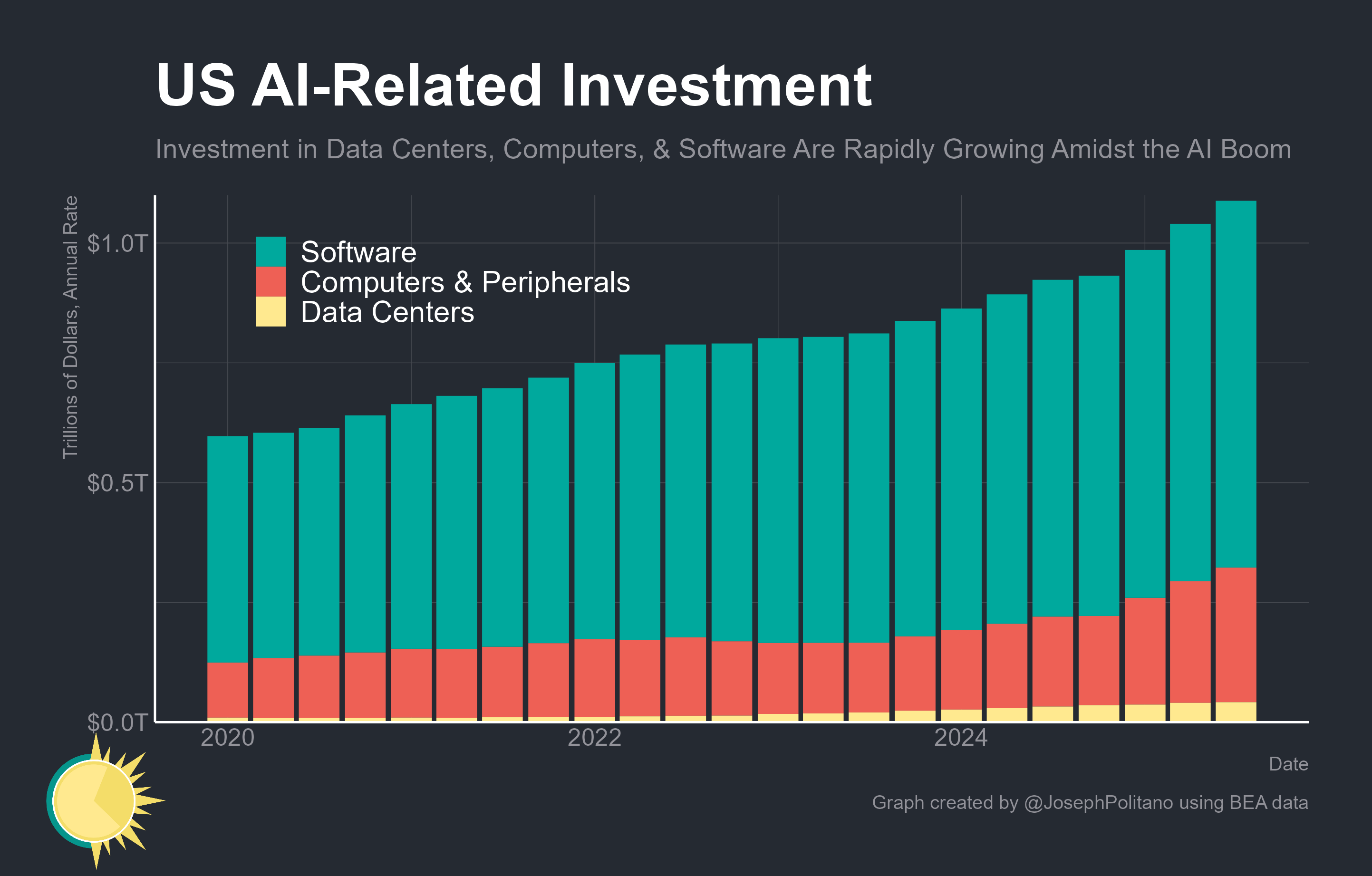
If I'm mistaken, then the article states that the investment is $1T annualized when taking software development costs into account [1] if the labs don't all suddenly decide to stop development.
That would mean earnings of ~ $1.1T would be required on that investment annually, so maybe on $2T of revenue, capturing 2% of the global GDP - so I'd estimate that GDP would need to go up more like 5-10% to justify this.
Thanks, I'll have to try that. I've only had mediocre success with Jules using it for a couple weeks after launch but I always felt like it may have been running one of the smaller models.
you can bring your google api key to try it out, and google used to give $300 free when signing up for billing and creating a key.
when i signed up for billing via cloud console and entered my credit card, i got $300 "free credits".
i haven't thrown a difficult problem at gemini 3 pro it yet, but i'm sure i got to see it in some of the A/B tests in aistudio for a while. i could not tell which model was clearly better, one was always more succinct and i liked its "style" but they usually offered about the same solution.
Those were often copied by enthusiasts and "ported" to other cars via aftermarket headlights.