For all it's outdatedness, Bitcoin is actually used as a currency, but typically for high value items such as real estate or private jets, as the fiat mechanisms to transfer large amounts of money, especially across borders can be terribly unreliable and costly. Bitcoin, even used in its largely original form, can be (and is) used to transfer arbitrarily large amounts of money anywhere in the world, conclusively and trustlessly, without intermediaries, within an hour, or more typically ten minutes.
There has never existed a currency that has had such properties previously.
Warren Buffet has lost his fortune many times over by failing to invest a small high-risk portion of it in Bitcoin since he first heard of it and passed judgement on it. [0]
Most people claiming to understand the technology clearly have little grasp of its wider implications.
Its honestly a bit tiresome to reply to people who say, after 12 years consistent value increase, and a trillion-dollar market cap that its somehow a useless ponzi.
If it is, it's the most successful and self-sustaining ever, and for that alone could well deserve merit even ignoring anything else...
Edit to add:
[0] - Warren Buffet first expressed negative sentiment on Bitcoin in March 2014 (https://coindesk.com/warren-buffet-bitcoin-currency ). The price in March 2014 was ~$550. Assuming a 5% portfolio position in Bitcoin held until now, equates to a 4x overwhelm of the entire portfolio at the time of entry (an 80x increase in value of the Bitcoin portion).
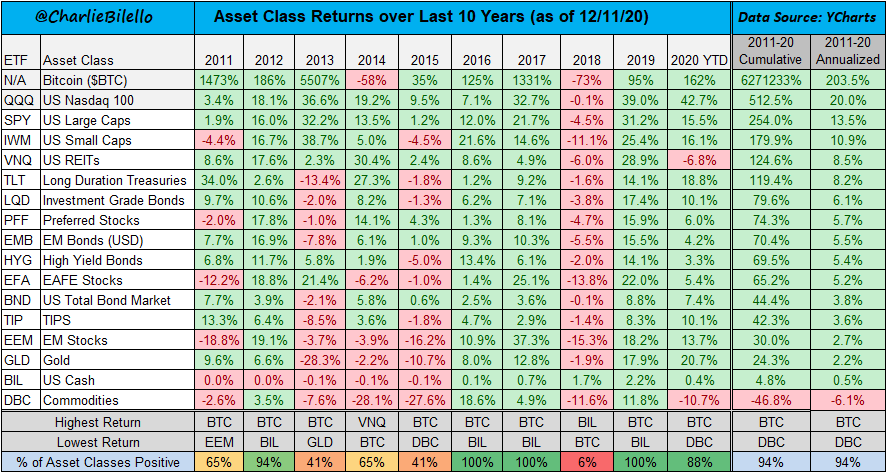
Another way to look at Bitcoins meteoric rise over the past ten years is as a catastrophic crash in value of the assets it (and currencies like it) may be in the process of replacing.
Many central banks and governments are experimenting with cryptocurrency/blockchain. I believe some have gone live with various projects around voting, currency-issuing and accounting.
Notably also, the US government is using USD-pegged crypto currency "USDC" to circumvent governmental corruption in Venezuela, in order to deliver economic aid directly (to intended recipients who weren't receiving it through government-controlled Venezuelan banks):
I'm not that familiar with SC but assuming there isn't a native way, you could sign up with an exchange that has SC (the major ones like Binance, Kraken & Bittrex do). Then convert it to fiat there and withdraw. Most exchanges have API's so this could be automated.
There are also various decentralised exchanges that handle pegged-fiat crypto currencies for price-exposure.
But after a while you may regret doing that, as much of this tech is in very early stages, and as such the value of the coins are low versus their longterm potential. If you believed in Sia/SC longterm, it might be better to hold the SC and convert to dollars later.
For an example of why this may be the case, look up bitcoin pizza guy.
(And obviously none of this is intended as investment advice, always do your own research, etc.)
It's like using the term "COBOL" when you mean "programming languages", and then criticising COBOL's modern utility in that context. The parent comment was about crypto (short for "cryptocurrencies") in general, not Bitcoin, which is 12-year old technology, and broadly not fairly comparable to current cryptocurrencies or their applications.
You are as correct that you can't do much with a Bitcoin as you are that you can't do much with COBOL. This doesn't however mean that programming sucks.
If you're interested to learn about the space and what's going on in it, visit https://coingecko.com, select "developer", and sort the list by "Commits past 4 weeks".
This is a list of currently actively developed projects. Click a few and visit their websites. For example, SC, 4th in the list, is a incentivised and decentralised cloud, which is up and working right now. You can earn money from spare storage.
There are many such projects pushing various different boundaries of technology. I too find it baffling how uneducated and "luddite" many on HN are regarding blockchain and cryptocurrencies. There's a whole world of activity going on, and many here are missing out.
While many of these are forks of Bitcoin and use similarly wasteful proof mechanisms, many are also completely new and different. Several different consensus mechanisms are broadly used across these, most of which improve drastically on Bitcoins wasteful Proof of Work (PoW). Some even solve the problem with only very negligible energy footprint, such as the variations on Byzantine Fault Tolerance (BFT). It's been long-debated whether those alternatives trade safety for energy-savings, but after many years it would appear the reverse is true. The majority of projects that have succumbed to some kind of system-inherent weakness have been PoW protocols being "51% attacked", which is generally not a concern for the alternatives.
Facebook itself is effectively a spam bot that uses people and their invasively-assessed psychological proclivities to proliferate. To hold it up as somehow distinct from other unethical and invasive mechanisms used to "drive traffic" is hopelessly naive.
Should probably destroy all technology that uses energy for the same reason, using the same methodology. Ie, ignore every conceivable benefit and focus only on energy usage as the singular and all-pervasive critical factor.
I guess humans even without technology might use energy too, simply by existing, so we should probably attack and end us as well.
This is surely humanity's only sensible path to a sustainable future, and one that everyone can and must get on board with. Right?
Organised efforts to sway public opinion using technology is not a conspiracy theory, it's present reality and if we don't watch for it and err on the side of caution, it will only get worse.
The stance that this is not worthwhile and that no measures should be employed to mitigate it is negligent at best.
In general: long-form, balanced, well-researched essay comments are exactly what's exhibited on HN, and precisely the reason many frequent the site.
It is starkly obvious to frequent visitors when comment threads deviate from this norm into highly-polarised, emotional and often baseless and yet miraculously-synchronised agenda. That this only occurs pertaining to particular topics, and reliably so, reveals to incumbent readership that those engaging in this activity, whilst possibly attempting to blend in, are actually standing naked in full view.
Indeed, in some cases this ineptitude suggests a low level of social awareness possibly consistent with that of a language model.
Regardless, tools to assist genuine readers in filtering such content and reversing its own filtering is a suitable mitigation, largely without negative side-effects.
It depends when you ask. Most times checking this thread it's been dire. The current top 3 commenters, comprising the first page of comments:
"The problem is that it's not totally clear whether Giuliani believed any of his crazy-talk. It may actually be the case that Giuliani is just off his rocker."
"I think it's nuts for a modern democracy to allow for anything but open source software being used to count paper ballots with chain-of-custody records, voter ID validation, biometric markings, and redacted ballots being published on the web for all to view and count independently."
"I hope whatever happens with these lawsuits it chills the baseless accusations of voter fraud used to undermine voter confidence in our democracy"
It's the definition of polarisation, entirely one-sided views, and each side demonstrably not thinking impartially. The first and third threads are largely echo-chambers with heavily-downvoted opposing views (which are often reasonable). All threads have some useful discussion, but its divisive opposite comes in seemingly combative/reactive waves that are stark in their coordination.
A community rooted in computer security (and AI) shouldn't be reliant on the naive idea that each anonymous online forum account represents one real person.
The suggestions made initially might go some way toward mitigating harm resultant from this reality of our current internet, which - thus far, almost exclusively for some specific political matters - HN seems to pointedly ignore.
Agree such threads presently have limited value, hence suggestions granting readers greater dominion over them. Sans, excessive polarisation remains a risk for any topic.
> At their core, social networks are primarily about one thing: Building social capital through signaling.
Maybe for the author.
People also use social networks without expecting or requiring any net social "capital" benefit through "signalling".
Examples:
- keeping in touch with people (privately or publicly)
- inform others about something they may be interested in (without needing or requiring acknowledgement)
- lessening loneliness
- gathering or dispensing intel on a topic
- filling in time / looking for entertainment
I can readily think of many more reasons than the singlular one of signalling to heighten social status. I'm sure that occurs, but listing it as a primary reason cast the article immediately in disfavour for this reader.
They can solve this issue by adequately providing for self-moderation. Avoiding this approach reveals an intention to impose. Users leave once they realise the violation.
There has never existed a currency that has had such properties previously.