What's Wrong With E=MC^2?(scientificblogging.com)
scientificblogging.com
What's Wrong With E=MC^2?
http://www.scientificblogging.com/hammock_physicist/whats_wrong_emc2
24 comments
As someone with a Ph.D. in physics, I found the whole article wrongheaded and partly wrong. Sure, Einstein's original paper (I did read it in its original German) did not have E=mc^2 in the short form, but don't worry, since it is still true. If you compress a spring, it weighs more. If you add a photon to a box, it weighs more. The net momentum of both does not matter here.
Not to detract from what you're saying, but just a note: The author has a PhD in physics as well.
I don't quite know what he's arguing against. The E that's mc^2 has always been the rest-mass energy. Hence what Doug wrote for the total energy
E^2 = m^2 c^4 + p^2 c^2
I'm not saying the article is wrong, but he sure could have explained more clearly what wrongheaded thing he's trying to debunk because I didn't get it. It sounded kind of like railing that E=mgh is "wrong" because it should be E=mgh+mv^2.
E^2 = m^2 c^4 + p^2 c^2
I'm not saying the article is wrong, but he sure could have explained more clearly what wrongheaded thing he's trying to debunk because I didn't get it. It sounded kind of like railing that E=mgh is "wrong" because it should be E=mgh+mv^2.
So basically to be uber geeky you should start espousing e=mc2 + mv2/2?
That's only when the speed is much smaller than the speed of light (v << c). The one you are after is:
http://en.wikipedia.org/wiki/Energy–momentum_relation
E^2 = m^2 c^4 + p^2 c^2
http://en.wikipedia.org/wiki/Energy–momentum_relation
Or something like this, even http://www2.wolframalpha.com/Calculate/MSP/MSP20811972138108...
(From http://www.wolframalpha.com/input/?i=Series[%28m0*c^2%29%2FS...] )
(From http://www.wolframalpha.com/input/?i=Series[%28m0*c^2%29%2FS...] )
It's so smart! http://www.wolframalpha.com/input/?i=are+you+stupid%3F
though i will say, i find this hilarious..
http://www.wolframalpha.com/input/?i=population+of+japan+/+(...)
http://www.wolframalpha.com/input/?i=population+of+japan+/+(...)
holy expletive! Wolfram alpha can solve equations, show steps, and graph it? Wow I knew it could tell me the population of the world and stuff but didn't know it could do my math homework too. Screw maxima.
[deleted]
I like how it uses Google to test an opinion: I do this for things like spell checking and phrase verification.
It's one character longer than necessary. Try E=MCC
I am no physicist and would appreciate if somebody can explain why the speed of light is used everywhere in physics, specially in that E=mc2 formula.
What is the meaning of using light when calculating energy or mass?
And what if light is not the fastest thing in the universe, would we need to rewrite all formulas?
Excuse my ignorance, but this topic really picks my interest.
What is the meaning of using light when calculating energy or mass?
And what if light is not the fastest thing in the universe, would we need to rewrite all formulas?
Excuse my ignorance, but this topic really picks my interest.
It's actually the opposite. The universe has a speed limit. And light moves as fast as it is possible to go.
As opposed to light itself being the decider of the speed limit.
Light is not the only thing that moves at the speed limit. Gravity does too. Magnetic and electric forces do as well (which makes sense since light is made out of a combination of both, but the point is that the individual elements also move at the speed limit).
Now, why did the universe pick that specific speed as the limit? No one knows.
As opposed to light itself being the decider of the speed limit.
Light is not the only thing that moves at the speed limit. Gravity does too. Magnetic and electric forces do as well (which makes sense since light is made out of a combination of both, but the point is that the individual elements also move at the speed limit).
Now, why did the universe pick that specific speed as the limit? No one knows.
"The universe has a speed limit. And light moves as fast as it is possible to go."
My question has always been, how sure are we? Any room for error?
My question has always been, how sure are we? Any room for error?
Not more than there's room for error in Newton's laws: Newton's laws are still an excellent framework for physic in most `normal' situations. Anything that dethrones General Relativity will incorporate it as a special case.
We are actually sure, I'll tell you how.
Start with e=mc2. This has been accurately measured as true.
First of all notice the c (speed of light [speed of the universe]) in there.
People always talk about how things get heavier when they go faster, so why is that? It's not a magical property of the universe, it's simply e=mc2
As you go faster, you have more energy. Since you have more energy you are heavier. Now if you want to go even faster you also have to accelerate that extra mass (energy) as well, so you need even more energy.
Do that over and over and you get the famous relativity equations. You find that as you get closer to c your mass goes to infinity.
This is probably not enough to convince you, but I'm not done.
This formula was not discovered first, and then relativity from it. It was the reverse.
It started from noticing that no matter how fast a distant star was moving (two binary stars orbiting each other), the light always moved at the same speed.
Start with that assumption, and create rational formulas to explain how that could work. They are called the Lorenz transform.
Calculate what happens to mass as it undergoes the Lorenz transform and e=mc2 falls out of the equations.
If there was a faster speed possible the Lorenz transforms would work differently, and e=mc2 would be different - but we know e=mc2 is correct. And we've also measured parts of the Lorenz transform as correct.
Look for the book: Relativity, the special and the general theory: a popular exposition by Albert Einstein. Sunheading: A clear explanation that anyone can understand.
The whole set of formulas is very self consistent, if any one part was wrong (and we tested many parts) the rest would be wrong too.
The final question is, ok you can't send matter faster than light, but how do we know you can send a message faster than light? It's because information has an energy content. Each bit of information is equal to a small amount of energy. So if you send information, you are sending energy.
As a side note, tricks might be possible, i.e. don't take the long route through space, but take a short cut. This could work if the universe is curved (curved in 4d), but current thinking is that the universe is flat. In the book I recommended Einstein talks about how to measure if the universe is curved or flat. (For a 3d example it's going through the earth, instead of on the surface.)
Start with e=mc2. This has been accurately measured as true.
First of all notice the c (speed of light [speed of the universe]) in there.
People always talk about how things get heavier when they go faster, so why is that? It's not a magical property of the universe, it's simply e=mc2
As you go faster, you have more energy. Since you have more energy you are heavier. Now if you want to go even faster you also have to accelerate that extra mass (energy) as well, so you need even more energy.
Do that over and over and you get the famous relativity equations. You find that as you get closer to c your mass goes to infinity.
This is probably not enough to convince you, but I'm not done.
This formula was not discovered first, and then relativity from it. It was the reverse.
It started from noticing that no matter how fast a distant star was moving (two binary stars orbiting each other), the light always moved at the same speed.
Start with that assumption, and create rational formulas to explain how that could work. They are called the Lorenz transform.
Calculate what happens to mass as it undergoes the Lorenz transform and e=mc2 falls out of the equations.
If there was a faster speed possible the Lorenz transforms would work differently, and e=mc2 would be different - but we know e=mc2 is correct. And we've also measured parts of the Lorenz transform as correct.
Look for the book: Relativity, the special and the general theory: a popular exposition by Albert Einstein. Sunheading: A clear explanation that anyone can understand.
The whole set of formulas is very self consistent, if any one part was wrong (and we tested many parts) the rest would be wrong too.
The final question is, ok you can't send matter faster than light, but how do we know you can send a message faster than light? It's because information has an energy content. Each bit of information is equal to a small amount of energy. So if you send information, you are sending energy.
As a side note, tricks might be possible, i.e. don't take the long route through space, but take a short cut. This could work if the universe is curved (curved in 4d), but current thinking is that the universe is flat. In the book I recommended Einstein talks about how to measure if the universe is curved or flat. (For a 3d example it's going through the earth, instead of on the surface.)
"Start with e=mc2. This has been accurately measured as true."
By whom? If tachyons were the new measure for fastest thing in the universe I guarantee you that the minimum difference between the old equation and the new one would make no noticeable difference.
"People always talk about how things get heavier when they go faster"
Who says so and who has proved that? You may get heavier by adding gravitron collisions to your particles, and that doesn't mean it is a law.
"As you go faster, you have more energy. Since you have more energy you are heavier."
I didn´t know energy had weight, but again, it may be explainable.
"You find that as you get closer to c your mass goes to infinity."
Unproven. Photons travel at the speed of light and they don't have mass.
"This is probably not enough to convince you"
Nop.
"The light always moved at the same speed."
Who say so? What if light has different speeds based on huge gravitational forces? Nothing to do with the curvature of spacetime (which I call bullshit) but with the perception of the observer.
"Start with that assumption, and create rational formulas to explain how that could work."
If your assumptions are wrong your formulas will also be wrong.
"A clear explanation that anyone can understand."
It is not that I don't understand it, it is just that I don't accept it as truth.
"The final question is, ok you can't send matter faster than light"
I am not talking about matter, it may well be a limit for matter, but how about other forms of known and unknown energy or radiation?
Relativism is ok regarding the observer and using light as a measurement unit. But just throwing a huge number c2 in a formula doesn't make it right, just the same as throwing another t2 (speed of tachyons squared) would make it right either.
Here is my formula: E=mt2
My question stands: why the speed of light squared?
By whom? If tachyons were the new measure for fastest thing in the universe I guarantee you that the minimum difference between the old equation and the new one would make no noticeable difference.
"People always talk about how things get heavier when they go faster"
Who says so and who has proved that? You may get heavier by adding gravitron collisions to your particles, and that doesn't mean it is a law.
"As you go faster, you have more energy. Since you have more energy you are heavier."
I didn´t know energy had weight, but again, it may be explainable.
"You find that as you get closer to c your mass goes to infinity."
Unproven. Photons travel at the speed of light and they don't have mass.
"This is probably not enough to convince you"
Nop.
"The light always moved at the same speed."
Who say so? What if light has different speeds based on huge gravitational forces? Nothing to do with the curvature of spacetime (which I call bullshit) but with the perception of the observer.
"Start with that assumption, and create rational formulas to explain how that could work."
If your assumptions are wrong your formulas will also be wrong.
"A clear explanation that anyone can understand."
It is not that I don't understand it, it is just that I don't accept it as truth.
"The final question is, ok you can't send matter faster than light"
I am not talking about matter, it may well be a limit for matter, but how about other forms of known and unknown energy or radiation?
Relativism is ok regarding the observer and using light as a measurement unit. But just throwing a huge number c2 in a formula doesn't make it right, just the same as throwing another t2 (speed of tachyons squared) would make it right either.
Here is my formula: E=mt2
My question stands: why the speed of light squared?
"I didn´t know energy had weight, but again, it may be explainable."
If you didn't know that energy had weight, then how could you possibly understand anything whatsoever about relativity?
You talk about "adding graviton collisions". Go way way simpler. Energy has weight. Speed things up, they are heavier. Want to speed it even more? You need to add even more energy than the first time because now you are also speeding up the energy [weight] from before.
Run the math. Solve. Final result c=speed_limit. The math is easy, don't take my word for it. Do you know any calculus? That's all you need for the math.
You are talking about advanced topics like gravitons and tachyons, without even understanding the simple topics like energy having weight [mass].
How do we know that the weight of energy is equal to the energy times c_squared?
You can measure it, that's how. The earliest particle accelerators can do it. Actually you don't even need a particle accelerator.
Take a gamma ray (a photon), cause it to split into an electron and an anti-electron (using a magnet). Measure the energy of the photon that is left over. The difference is the energy that was consumed in making the electron and anti-electron.
Measure the mass [weight] of a single electron.
Do math. Result: e=mc2 (i.e. mass of an electron * 2 * c_squared + energy of leftover photon = energy of starting photon).
If you didn't know that energy had weight, then how could you possibly understand anything whatsoever about relativity?
You talk about "adding graviton collisions". Go way way simpler. Energy has weight. Speed things up, they are heavier. Want to speed it even more? You need to add even more energy than the first time because now you are also speeding up the energy [weight] from before.
Run the math. Solve. Final result c=speed_limit. The math is easy, don't take my word for it. Do you know any calculus? That's all you need for the math.
You are talking about advanced topics like gravitons and tachyons, without even understanding the simple topics like energy having weight [mass].
How do we know that the weight of energy is equal to the energy times c_squared?
You can measure it, that's how. The earliest particle accelerators can do it. Actually you don't even need a particle accelerator.
Take a gamma ray (a photon), cause it to split into an electron and an anti-electron (using a magnet). Measure the energy of the photon that is left over. The difference is the energy that was consumed in making the electron and anti-electron.
Measure the mass [weight] of a single electron.
Do math. Result: e=mc2 (i.e. mass of an electron * 2 * c_squared + energy of leftover photon = energy of starting photon).
I am no physicist and would appreciate if somebody can explain why the speed of light is used everywhere in physics, specially in that E=mc2 formula.
This is a consequence of the invariance of the speed of light. You can pretty much derive Lorentz transformations (and a large chunk of special relativity) by simply forcing the speed of light to always be the same regardless of how fast you are moving with respect to the light source. (For a sketch see http://astro1.panet.utoledo.edu/~ljc/voigt02.jpg and http://en.wikipedia.org/wiki/Lorentz_transformation#From_phy... for a more detailed example).
A direct consequence of the form of the transformation factor \beta=1/(sqrt(1-(v/c)^2) is that you can't go over the speed of light without getting all sorts of imaginary (as in non physical) quantities.
This is a consequence of the invariance of the speed of light. You can pretty much derive Lorentz transformations (and a large chunk of special relativity) by simply forcing the speed of light to always be the same regardless of how fast you are moving with respect to the light source. (For a sketch see http://astro1.panet.utoledo.edu/~ljc/voigt02.jpg and http://en.wikipedia.org/wiki/Lorentz_transformation#From_phy... for a more detailed example).
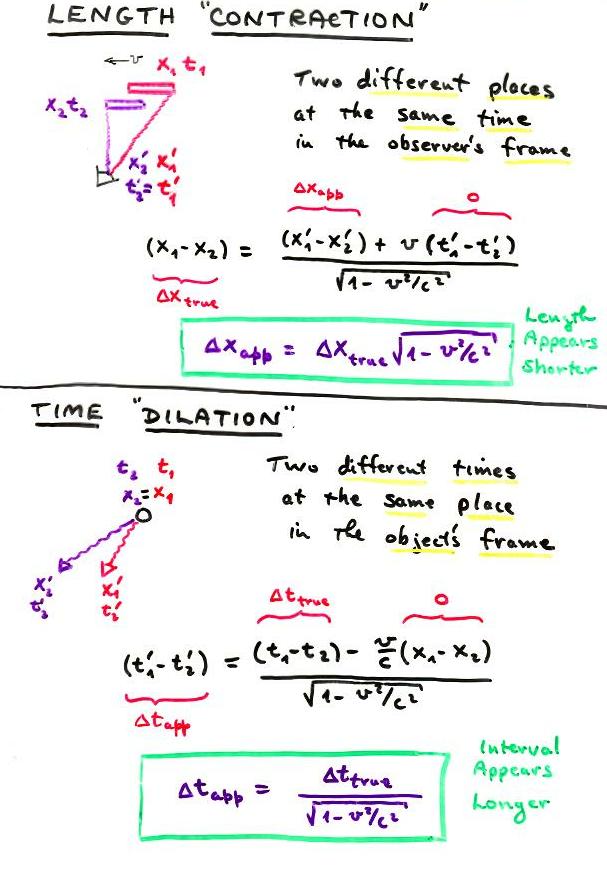
A direct consequence of the form of the transformation factor \beta=1/(sqrt(1-(v/c)^2) is that you can't go over the speed of light without getting all sorts of imaginary (as in non physical) quantities.
I also am no physicist, but I've read a bunch of books!
Picking 'the speed of light in a vacuum' does seem to be fairly arbitrary, almost as if physicists had decided to write equations in terms of 'the top speed of a stock 1972 Dodge Viper', but as I understand it, light really does have a special place in the scheme of the universe. Newton's laws are an excellent description of the way the universe works at the scales humans work with, but with extremes of mass, energy or velocity Newton's laws break down.
Einstein's theories have a number of consequences that seem strange to our limited human experience; things like time running slower for things moving at an appreciable proportion of c, the mass of fast-moving objects approaching inifinity as their velocity approaches c, and time running lower in the vicinity of very large masses. Despite how strange these predictions sound, they seem to match our observations of the world around us - for example, one of Einstein's early triumphs was that he was able to accurately predict the orbit of Mercury (deep within the Sun's enormous gravitational field) when Newton's laws could never get it quite right.
As for 'why light specifically', well, it isn't exactly - it's the speed of all electromagnetic radiation. Of the four fundamental forces in the universe, half (strong and weak nuclear forces) only work on atomic scales, and gravity works by its own special rules, leaving electromagnetism as pretty fundamentally important.
Picking 'the speed of light in a vacuum' does seem to be fairly arbitrary, almost as if physicists had decided to write equations in terms of 'the top speed of a stock 1972 Dodge Viper', but as I understand it, light really does have a special place in the scheme of the universe. Newton's laws are an excellent description of the way the universe works at the scales humans work with, but with extremes of mass, energy or velocity Newton's laws break down.
Einstein's theories have a number of consequences that seem strange to our limited human experience; things like time running slower for things moving at an appreciable proportion of c, the mass of fast-moving objects approaching inifinity as their velocity approaches c, and time running lower in the vicinity of very large masses. Despite how strange these predictions sound, they seem to match our observations of the world around us - for example, one of Einstein's early triumphs was that he was able to accurately predict the orbit of Mercury (deep within the Sun's enormous gravitational field) when Newton's laws could never get it quite right.
As for 'why light specifically', well, it isn't exactly - it's the speed of all electromagnetic radiation. Of the four fundamental forces in the universe, half (strong and weak nuclear forces) only work on atomic scales, and gravity works by its own special rules, leaving electromagnetism as pretty fundamentally important.
Thanks for your response, but many things don't compute.
"time running slower for things moving at an appreciable proportion of c" - Time doesn't slow down, perception of time changes from the observers point of view.
Mercury's orbit is easily predicted with newtonian laws, again, perception of it changes due to the strong gravitational effect of the sun on it and its light we use to measure it.
In other words, I really don't accept things like time travel, infinite mass, getting younger if traveling at the speed of light and bullshit like that.
I don't know if they use that stuff to make it interesting to the unwashed masses but it is an insult to our intellect.
Going back to the speed of light as a measure of energy, I take as you say, it is the speed of all electromagnetic radiation, but why related to energy and mass?
And what if there is something faster? say like hypothetical tachyons?
"time running slower for things moving at an appreciable proportion of c" - Time doesn't slow down, perception of time changes from the observers point of view.
Mercury's orbit is easily predicted with newtonian laws, again, perception of it changes due to the strong gravitational effect of the sun on it and its light we use to measure it.
In other words, I really don't accept things like time travel, infinite mass, getting younger if traveling at the speed of light and bullshit like that.
I don't know if they use that stuff to make it interesting to the unwashed masses but it is an insult to our intellect.
Going back to the speed of light as a measure of energy, I take as you say, it is the speed of all electromagnetic radiation, but why related to energy and mass?
And what if there is something faster? say like hypothetical tachyons?
Mercury's orbit is easily predicted from Newton's laws, but the prediction is -- just a tiny little bit -- Wrong.
http://en.wikipedia.org/wiki/Tests_of_general_relativity#Per...
No one gets younger by traveling faster, but one of the ideas of the twin paradox is to set up a real situation where the changing perception of time by different observers adds up to a real effect that can be clearly seen to persist once the twins are back together, and are once again agreeing on their perception of time.
http://en.wikipedia.org/wiki/Tests_of_general_relativity#Per...
No one gets younger by traveling faster, but one of the ideas of the twin paradox is to set up a real situation where the changing perception of time by different observers adds up to a real effect that can be clearly seen to persist once the twins are back together, and are once again agreeing on their perception of time.
[deleted]