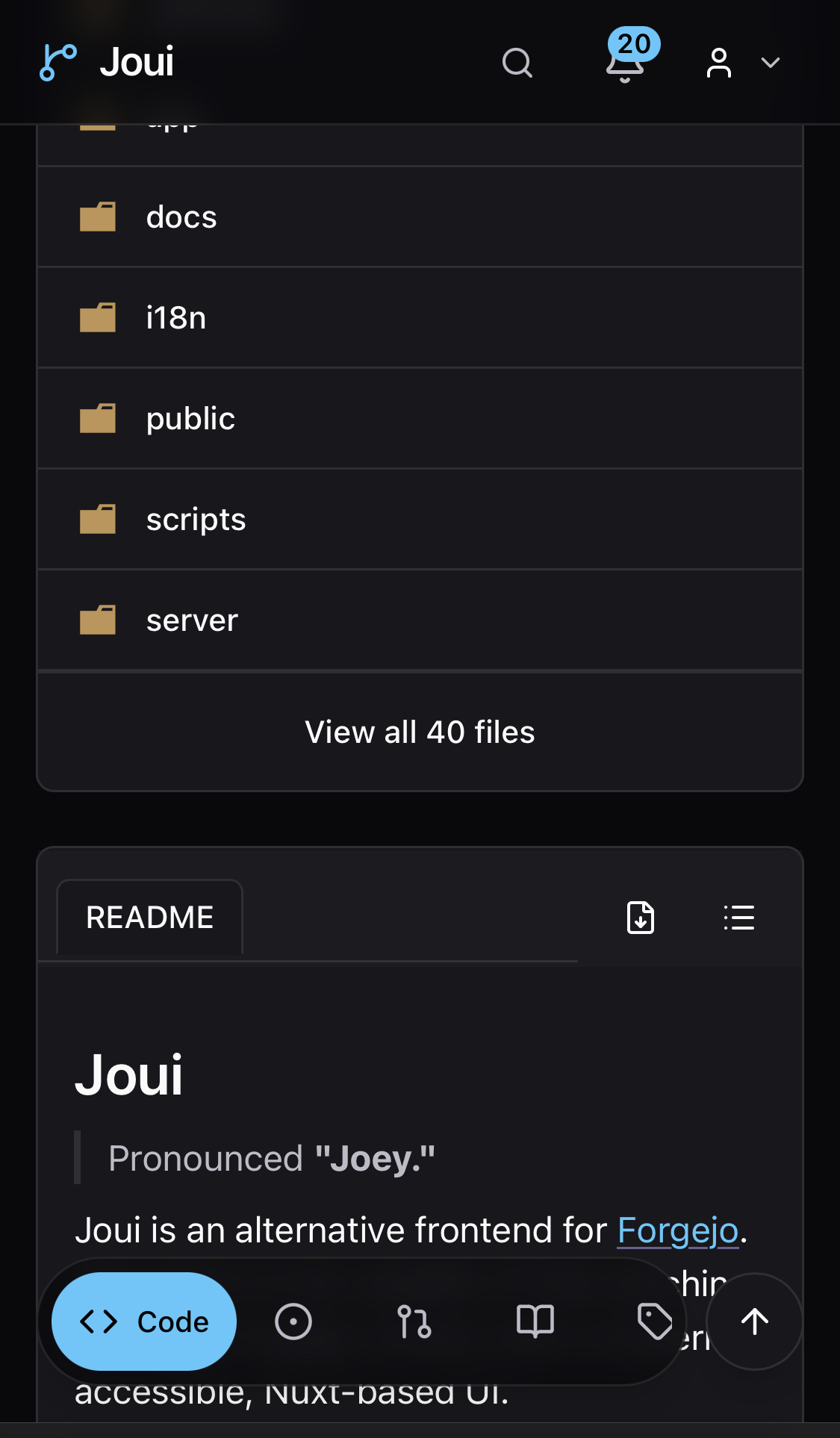
I’m working on an open source Forgejo Frontend that exposes additional features like this, and offers a better user experience, faster large diffs, and basically fixes every little thing I don’t like about Forgejo. Would be interested in hearing more of your complaints so I can continue to improve.
No doubt in my mind, a future Apple model will be the best to use for this purpose. They likely have more swift to train on than anyone else, and would benefit directly from more quality apps, rather than the slop flowing into the App Store (>1k app submissions per hour; they claim)
Well said. In creative spaces they talk about “Dirty” vs “Clean”. Dirty they say lets you move fast. Clean is slow.
Happen to be a startup that isn’t mission critical to someone’s health and well being? Great, now you can use AI and be as dirty as you would like.
Are you working with dangerous chemicals that are ingested by others, or systems that control hunks of metal flying through the sky with hundreds on board? Maybe we should stay clean in those environments until we make AI itself clean.
I’ve always felt this automation shouldn’t exist at all, but should rather be selectively controlled via a hook. The hooks yarn offers out of the box for example can be used to run any code you need to after install. Putting the project owner in control instead of the dependency.
One funny thing I see it doing is deleting seemingly random comments lines, for example if a file has a comment that spans multiple lines but doesn’t use a multi line comment syntax. It just chooses one at random transforming the once useful comment into slop.
The problem is that we have an ever growing and large number of constraints, and not following even a single one means the result is sloppy.
I don’t see them fixing this any time soon, and thus human in the loop is a requirement to use these tools effectively. That is unless you love your slot machine dopamine rush enough to ignore quality gates and respect for your peers time.
I moved most of my projects off GitHub to Forgejo and will be using Tangled too for public repositories. I don’t think people realize that if you self host Forgejo, you get 99% of the functionality of GitHub with zero of the limitations. Especially if you have the hardware to spare for CI runners. And if self hosting isn’t your thing you can always just use Codeberg and Tangled directly.
I’m working on an open source Forgejo browser called Joui. It’s coming along nicely, and is so much snappier than GitHub in every single way.
I left a similar comment elsewhere in this thread. I still remember when so many people hallucinated that we would suddenly have flying cars by 2002 at the latest. If we achieve several more major improvements on current technology, these thoughts are interesting to consider. But not before that occurs.
I appreciate your insights in a sea of psychosis comments. I find it strange how many people think we have achieved the likes of Y2K flying cars 20 years ago, or the dream of having every car on the road be an electric fully self driving car by now (a promise made at least over a decade ago by several of these types).
The point I’m making is that we give the spotlight to people who are making absurd claims. We have not achieved the ability to remove the human from the loop and continually produce value-able outputs. Until we do, I don’t see how any of the claims made in this article are even close to anything more than simply gate-keeping slop.
Not to mention how trigger happy LLMs can be when it comes to being overly verbose and adding unnecessary bits even with explicit direction not to do so.
When doing this remove write permissions on the test file, it will do a much better job of staying the course over long periods. I've been doing this for over a year now.