HackerTrans
TopNewTrendsCommentsPastAskShowJobs

zedr

401 karmajoined 14 lat temu
https://www.zedr.com

Submissions

Show HN: A jewel matching game for the terminal

github.com
1 points·by zedr·2 lata temu·0 comments

EciAdsl, story of a driver unlike any other (2004)

flashtux.org
1 points·by zedr·5 lat temu·0 comments

Dieter Rams' design principles applied to software engineering

github.com
161 points·by zedr·5 lat temu·60 comments

comments

zedr
·22 godziny temu·discuss
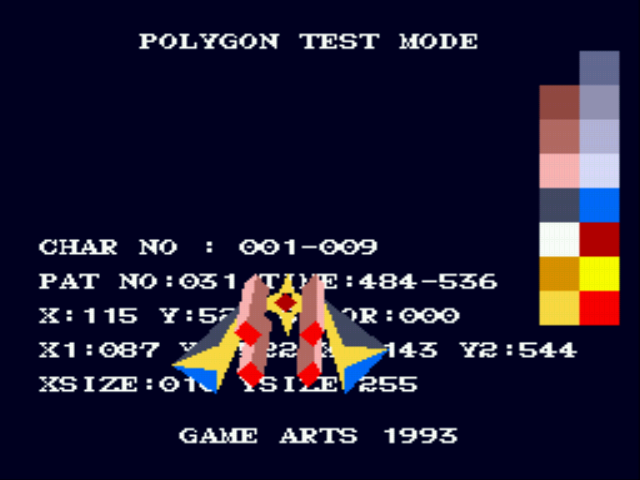
I'm sure they are 3d models and are rendered using the CPU. You can check by entering the secret Options Mode and selecting the Polygon Test, which will allow you to freely rotate your ship and the enemies, including the end of level bosses (except the final one). Screenshot: https://www.vizzed.com/vizzedboard/retro/user_screenshots/sa...

Fabien seems to be unaware of this, by the way.

This is also why the game play is so bland. The number of 3d objects and their complexity was severely constrained and did not allow for varied or more sophisticated game elements.
zedr
·przedwczoraj·discuss
I think there is realtime 3D used for the player and enemy "sprites" (really 3D objects), including the end of stage bosses. They are small and extremely simple, as this was the maximum the Genesis/Megadrive's 68k CPU could handle. The final boss fight is the exception.

Silpheed was amazing back in the day. It was one of the first titles that really showcased what CD drives could add to games in terms of cinematic experience. The live orchestral music gave it an epic feel and the mecha-design of the SA-77 is beautiful and modern even by today's standards.
zedr
·2 miesiące temu·discuss
Another: Thunderforce 4. IMHO the finest horizontal shoot 'em up ever made on any system.
zedr
·5 lat temu·discuss
> think I could come up with a python example that maps 1:1

My take on it:

    class Stuff:
        def __init__(self):
            self._list = [1, 2, 3, 4]
        
        @property
        def each(self):
            for el in self._list:
                yield el
    
    for item in Stuff().each:
        print(item)
It's even less verbose than the Ruby equivalent in the original article, thanks to the indentation-defined blocks.
zedr
·5 lat temu·discuss
Archive.org copy: http://web.archive.org/web/20211021141127/https://www.calver...

My favourite brutalist building is in Belgrade: the Western City Gate https://en.wikipedia.org/wiki/Western_City_Gate
zedr
·5 lat temu·discuss
I had this for years a my default ring tone.
zedr
·5 lat temu·discuss
He could also donate it to the Internet Archive's collection of documents.
zedr
·5 lat temu·discuss
I agree with your preference. I too lean towards a pragmatic approach to REST, which I've seen referred to as "RESTful", as in the popular book "RESTful Web APIs" by Richardson.
zedr
·5 lat temu·discuss
> Easily discoverable data, e.g. user ID 3 would be at /users/3. All of the CRUD (Create Read Update Delete) operations below can be applied to this path

Strictly speaking, that's not what REST considers "easily discoverable data". That endpoint would need to have been discovered by navigating the resource tree, starting from the root resource.

Roy Fielding (author of the original REST dissertation): "A REST API must not define fixed resource names or hierarchies (an obvious coupling of client and server). (...) Instead, allow servers to instruct clients on how to construct appropriate URIs, such as is done in HTML forms and URI templates, by defining those instructions within media types and link relations. [Failure here implies that clients are assuming a resource structure due to out-of band information, such as a domain-specific standard, which is the data-oriented equivalent to RPC’s functional coupling].

A REST API should be entered with no prior knowledge beyond the initial URI (bookmark) and set of standardized media types that are appropriate for the intended audience (i.e., expected to be understood by any client that might use the API). "[1]

1. https://roy.gbiv.com/untangled/2008/rest-apis-must-be-hypert...