We've Just Had the Best Decade in Human History(spectator.co.uk)
spectator.co.uk
We've Just Had the Best Decade in Human History
https://www.spectator.co.uk/2019/12/weve-just-had-the-best-decade-in-human-history-seriously/
233 comments
Is that why this article is flagged? Because of who wrote it?
Do you have any specific disagreement with anything he wrote? Because it seemed to be an interesting article with many things in it I didn't know, written in an engaging style.
From glancing through the comments below it seems people are angry because this guy isn't angry, and doesn't believe the world is doomed.
Why climate change is good for the world - "Don't panic! The scientific consensus is that warmer temperatures do more good than harm"
You don't explicitly pass judgement on this, apparently believing climate sensitivity and impact of small temperature changes is so obvious as to be beyond doubt. But there's a lot of doubt about how sensitive the climate really is. Climatology is very far from being a precise and well understood science, and that's before you get into some of the questionable scientific practices found inside.
The article is, again, well written and makes good arguments. It starts by citing a scientific meta-study into the economic impacts and goes from there. It also acknowledges the possible counter-arguments.
For those who are interested in the question of climate sensitivity Nic Lewis (a published climate scientist and skeptic), has some good talks on the matter, like this one:
https://www.nicholaslewis.org/wp-content/uploads/2019/09/Lew...
https://www.youtube.com/watch?v=cYZW-6jw98U
Do you have any specific disagreement with anything he wrote? Because it seemed to be an interesting article with many things in it I didn't know, written in an engaging style.
From glancing through the comments below it seems people are angry because this guy isn't angry, and doesn't believe the world is doomed.
Why climate change is good for the world - "Don't panic! The scientific consensus is that warmer temperatures do more good than harm"
You don't explicitly pass judgement on this, apparently believing climate sensitivity and impact of small temperature changes is so obvious as to be beyond doubt. But there's a lot of doubt about how sensitive the climate really is. Climatology is very far from being a precise and well understood science, and that's before you get into some of the questionable scientific practices found inside.
The article is, again, well written and makes good arguments. It starts by citing a scientific meta-study into the economic impacts and goes from there. It also acknowledges the possible counter-arguments.
For those who are interested in the question of climate sensitivity Nic Lewis (a published climate scientist and skeptic), has some good talks on the matter, like this one:
https://www.nicholaslewis.org/wp-content/uploads/2019/09/Lew...
https://www.youtube.com/watch?v=cYZW-6jw98U
Matt Ridley and James Delingpole are regulars in the Spectator and Telegraph since their capture by the extreme. They regularly mangle facts, cherry pick and misquote to give highly misleading pieces. So much so they have become notorious for it. Nic Lewis, retired financier, physicist and mathematician, is not a climate scientist, despite his interest and Lawson thinktank funded paper. Calling himself an independent climate scientist doesn't make him one.
Let't take a look. Here's a report when it was published[1]. Even one of the people Mr Lewis cites disputes his claims.
The "good news" the IPCC apparently tried to hide is that the world's climate system is less sensitive to a doubling of carbon dioxide in the atmosphere than some scientists think it is.
The bad news for the GWPF – a secretly funded organisation founded by UK climate science sceptic Lord Nigel Lawson - is that before the ink has even dried on their new report, the organisation has been accused of cherry-picking facts to make their argument stick.
And in more bad news, one of the researchers cited by the GWPF report has told me that even if Lawson's think tank is right, then we're heading for 3C of global heating by the end of the century (which is actually very bad news).
Good prose does not make a good scientific or factual argument. It is as you say, just "good talks", or hot air. Lawson was so bad at denial that his appearances on the BBC were more a black comedy five minutes than actual contrarianism.
https://www.theguardian.com/environment/planet-oz/2014/mar/0...
Let't take a look. Here's a report when it was published[1]. Even one of the people Mr Lewis cites disputes his claims.
The "good news" the IPCC apparently tried to hide is that the world's climate system is less sensitive to a doubling of carbon dioxide in the atmosphere than some scientists think it is.
The bad news for the GWPF – a secretly funded organisation founded by UK climate science sceptic Lord Nigel Lawson - is that before the ink has even dried on their new report, the organisation has been accused of cherry-picking facts to make their argument stick.
And in more bad news, one of the researchers cited by the GWPF report has told me that even if Lawson's think tank is right, then we're heading for 3C of global heating by the end of the century (which is actually very bad news).
Good prose does not make a good scientific or factual argument. It is as you say, just "good talks", or hot air. Lawson was so bad at denial that his appearances on the BBC were more a black comedy five minutes than actual contrarianism.
https://www.theguardian.com/environment/planet-oz/2014/mar/0...
I thought I recognized the name:
http://www.mattridley.co.uk/books/
I read his book Genome years ago and thought it was a moderately interesting primer on the revolution in genetic research starting to unfold in the wake of the Human Genome Project.
I'm sorry to discover Viscount Ridley turned out to be such a hack:
https://hansard.parliament.uk/search/MemberContributions?mem...
http://www.mattridley.co.uk/books/
I read his book Genome years ago and thought it was a moderately interesting primer on the revolution in genetic research starting to unfold in the wake of the Human Genome Project.
I'm sorry to discover Viscount Ridley turned out to be such a hack:
https://hansard.parliament.uk/search/MemberContributions?mem...
This is the worst paragraph of the whole article:
> Perhaps one of the least fashionable predictions I made nine years ago was that ‘the ecological footprint of human activity is probably shrinking’ and ‘we are getting more sustainable, not less, in the way we use the planet’. That is to say: our population and economy would grow, but we’d learn how to reduce what we take from the planet. And so it has proved. An MIT scientist, Andrew McAfee, recently documented this in a book called More from Less, showing how some nations are beginning to use less stuff: less metal, less water, less land. Not just in proportion to productivity: less stuff overall.
...and what you're leaving out here is that this is far too little, far too late. This is like noting a decrease in the number of iceburg collisions in the last hours before the Titanic sank.
This is NOT a cause for optimism. We're destroying the environment at a slower rate, but that doesn't mean we're not destroying the environment.
> Perhaps one of the least fashionable predictions I made nine years ago was that ‘the ecological footprint of human activity is probably shrinking’ and ‘we are getting more sustainable, not less, in the way we use the planet’. That is to say: our population and economy would grow, but we’d learn how to reduce what we take from the planet. And so it has proved. An MIT scientist, Andrew McAfee, recently documented this in a book called More from Less, showing how some nations are beginning to use less stuff: less metal, less water, less land. Not just in proportion to productivity: less stuff overall.
...and what you're leaving out here is that this is far too little, far too late. This is like noting a decrease in the number of iceburg collisions in the last hours before the Titanic sank.
This is NOT a cause for optimism. We're destroying the environment at a slower rate, but that doesn't mean we're not destroying the environment.
Even that is wrong - we aren’t slowing the rate we are damaging the environment- that is fated to go up.
What we are doing is reducing the rate at which our damage grows.
Reduction in acceleration is not reduction in velocity or reversal.
What we are doing is reducing the rate at which our damage grows.
Reduction in acceleration is not reduction in velocity or reversal.
But the least fashionable prediction is just completely false. No one is using less stuff. The book he cites just notes that that less stuff is being consumed by manufacturing within the borders of the continental United States of America, while ignoring the fact that all the manufacturing for Americans has moved to other countries. It's a completely bogus argument in the book, being repurposed as a completely bogus argument on this webpage. Just pure fiction.
We are using natural resources at a rate which is constantly increasing, and the rate of increase is increasing as well.
We are using natural resources at a rate which is constantly increasing, and the rate of increase is increasing as well.
tucaz(6)
For an invective against environmental politics, this Spectator article somehow managed to avoid even alluding to carbon.
If you're going to say that all green types are nuts because everything is hunky dory, you have to at least put in some claim that the Earth isn't even really warming, or isn't warming as much as we thought, or that rapid warming is good. Any of them would be false, but you've at least got to try.
If you're going to say that all green types are nuts because everything is hunky dory, you have to at least put in some claim that the Earth isn't even really warming, or isn't warming as much as we thought, or that rapid warming is good. Any of them would be false, but you've at least got to try.
It is important for us to celebrate good news and talk about positive things. It's part of positive reinforcement and giving us a more holistic view of things.
Always focusing on the negative and problems has many thinking there has not been positive movement, has left people with more anxiety and depressions, and causes hordes of other problems.
Celebrating and talking about positives is important. It doesn't mean all things are hunky dory. But, it's healthy to do.
Always focusing on the negative and problems has many thinking there has not been positive movement, has left people with more anxiety and depressions, and causes hordes of other problems.
Celebrating and talking about positives is important. It doesn't mean all things are hunky dory. But, it's healthy to do.
I agree in general, but this article in particular is mostly a rant against environmentalists.
How so? The article I read is mostly a list of interesting factoids about resource and commodity consumption. It doesn't attack environmentalists, if anything it starts with a jibe at journalists, but only insomuch as it notes "good news is no news".
In particular, what parts were ranty? I didn't see anything that would rise to the level of a rant. It's remarkably good natured given the invectives routinely dished out by those who would disagree.
In particular, what parts were ranty? I didn't see anything that would rise to the level of a rant. It's remarkably good natured given the invectives routinely dished out by those who would disagree.
Or its warming but the warming isn't so terrible to outweigh the other advances.
I can even buy that! I have the apparently rare perspective that economic growth is good; climate change is likely to be both deadly and a consistent drag on economic growth; and well-designed policies to decrease carbon emissions (like a carbon tax with rebate) are likely to more than pay for themselves. Climate change denialists seem to have zero interest in that debate, though, while at least green politics seems interested in that dialog.
> deadly and a consistent drag on economic growth
It seems to depend very much on where you are:
https://web.stanford.edu/~mburke/climate/map.php
It seems to depend very much on where you are:
https://web.stanford.edu/~mburke/climate/map.php
Yes, people who are highly invested in beach resorts in Siberia will benefit by climate change.
Countries with an aggregate population today of roughly six billion will suffer for it, though.
Countries with an aggregate population today of roughly six billion will suffer for it, though.
Yes it is. Global warming is an existential threat to human existence on earth in a way that few other environmental issues are.
> in a way that few other environmental issues are.
I often wonder about that. It could also be that our collective attention can only handle one big emergency at the time, and we make that our sole focus.
I would not be surprised if in some years another emergency will dominate the news. Maybe its about ecocide then, large-scale collapse of ecosystems due to a combination of overfishing, poaching, natural habitat destruction and pollution. And man-made climate change only an additional factor in that.
I often wonder about that. It could also be that our collective attention can only handle one big emergency at the time, and we make that our sole focus.
I would not be surprised if in some years another emergency will dominate the news. Maybe its about ecocide then, large-scale collapse of ecosystems due to a combination of overfishing, poaching, natural habitat destruction and pollution. And man-made climate change only an additional factor in that.
I really don't understand people who believe this kind of thing. Existential means existence, yet not a single scientist believes global warming threatens human existence.
Where exactly are you getting this from? It's certainly not from the science.
Where exactly are you getting this from? It's certainly not from the science.
> Existential means existence, yet not a single scientist believes global warming threatens human existence.
If you're going to argue this pedantically, perhaps don't start by claiming you know the opinions of every scientist, because if we're being pedantic, that's obviously not true.
Less pedantically, I think we agree that probably humans will survive global warming. But I think that we can agree that there's a temperature that's not survivable, even if we don't know what temperature that is. There's no long-term upper bound on how hot earth can get, and we're modeling uncharted territory: earth has never been as hot as it's going to get, while life has been on earth. So we really don't know how bad it will get. There is some chance that global warming will literally wipe out humanity, and given the stakes, I think that's a significant risk we need to be addressing.
If you're going to argue this pedantically, perhaps don't start by claiming you know the opinions of every scientist, because if we're being pedantic, that's obviously not true.
Less pedantically, I think we agree that probably humans will survive global warming. But I think that we can agree that there's a temperature that's not survivable, even if we don't know what temperature that is. There's no long-term upper bound on how hot earth can get, and we're modeling uncharted territory: earth has never been as hot as it's going to get, while life has been on earth. So we really don't know how bad it will get. There is some chance that global warming will literally wipe out humanity, and given the stakes, I think that's a significant risk we need to be addressing.
> There's no long-term upper bound on how hot earth can get, and we're modeling uncharted territory: earth has never been as hot as it's going to get, while life has been on earth. So we really don't know how bad it will get.
Paleocene–Eocene Thermal Maximum [0]
The associated period of massive carbon release into the atmosphere has been estimated to have lasted from 20,000 to 50,000 years. The entire warm period lasted for about 200,000 years. Global temperatures increased by 5–8 °C. Paired δ13C, δ11B, and δ18O data suggest that ~12000 Gt of carbon (at least 44000 Gt CO 2e) were released over 50,000 years, averaging 0.24 Gt per year.
Since at least 1997, the Paleocene–Eocene Thermal Maximum has been investigated in geoscience as an analog to understand the effects of global warming and of massive carbon inputs to the ocean and atmosphere, including ocean acidification. Humans today emit about 10 Gt of carbon per year, and will have released a comparable amount in about 1,000 years at that rate.
Take a look also at "Abrupt climate change" article [1]:
Timescales of events described as 'abrupt' may vary dramatically. Changes recorded in the climate of Greenland at the end of the Younger Dryas, as measured by ice-cores, imply a sudden warming of +10 °C (+18 °F) within a timescale of a few years. Other abrupt changes are the +4 °C (+7.2 °F) on Greenland 11,270 years ago or the abrupt +6 °C (11 °F) warming 22,000 years ago on Antarctica.
[0] https://en.wikipedia.org/wiki/Paleocene%E2%80%93Eocene_Therm... [1] https://en.wikipedia.org/wiki/Abrupt_climate_change
Paleocene–Eocene Thermal Maximum [0]
The associated period of massive carbon release into the atmosphere has been estimated to have lasted from 20,000 to 50,000 years. The entire warm period lasted for about 200,000 years. Global temperatures increased by 5–8 °C. Paired δ13C, δ11B, and δ18O data suggest that ~12000 Gt of carbon (at least 44000 Gt CO 2e) were released over 50,000 years, averaging 0.24 Gt per year.
Since at least 1997, the Paleocene–Eocene Thermal Maximum has been investigated in geoscience as an analog to understand the effects of global warming and of massive carbon inputs to the ocean and atmosphere, including ocean acidification. Humans today emit about 10 Gt of carbon per year, and will have released a comparable amount in about 1,000 years at that rate.
Take a look also at "Abrupt climate change" article [1]:
Timescales of events described as 'abrupt' may vary dramatically. Changes recorded in the climate of Greenland at the end of the Younger Dryas, as measured by ice-cores, imply a sudden warming of +10 °C (+18 °F) within a timescale of a few years. Other abrupt changes are the +4 °C (+7.2 °F) on Greenland 11,270 years ago or the abrupt +6 °C (11 °F) warming 22,000 years ago on Antarctica.
[0] https://en.wikipedia.org/wiki/Paleocene%E2%80%93Eocene_Therm... [1] https://en.wikipedia.org/wiki/Abrupt_climate_change
Is this some kind of satire modeled after climate deniers?
I mean that's even less scientific than what climate deniers say.
Is this what the world has come to? You have two camps: climate deniers, and climate alarmists, neither party caring in the slightest about science?
I mean that's even less scientific than what climate deniers say.
Is this what the world has come to? You have two camps: climate deniers, and climate alarmists, neither party caring in the slightest about science?
Is there any science to back that up?
By that reasoning, literally everything is an existential threat to humanity.
By that reasoning, literally everything is an existential threat to humanity.
> this Spectator article somehow managed to avoid even alluding to carbon.
It was alluded to in this section (ctrl-f "emissions"):
>> A wind farm requires far more concrete and steel than an equivalent system based on gas. Environmental opposition to nuclear power has hindered the generating system that needs the least land, least fuel and least steel or concrete per megawatt. Burning wood instead of coal in power stations means the exploitation of more land, the eviction of more woodpeckers — and even higher emissions.
It was alluded to in this section (ctrl-f "emissions"):
>> A wind farm requires far more concrete and steel than an equivalent system based on gas. Environmental opposition to nuclear power has hindered the generating system that needs the least land, least fuel and least steel or concrete per megawatt. Burning wood instead of coal in power stations means the exploitation of more land, the eviction of more woodpeckers — and even higher emissions.
Emissions here can't refer to carbon, because burning wood doesn't inject any new carbon into the carbon cycle. So he's only referring to particulate matter. Which, sure, coal beats wood on. But my main concern is about carbon, not anything else.
Is someone suggesting burning wood?
One of the ways the UK has reduced emissions is by burning wood pellets.
https://en.m.wikipedia.org/wiki/Drax_Power_Station
https://en.m.wikipedia.org/wiki/Drax_Power_Station
"Wood pellets are the most common type of pellet fuel and are generally made from compacted sawdust and related industrial wastes from the milling of lumber, manufacture of wood products and furniture, and construction. Other industrial waste sources include empty fruit bunches, palm kernel shells, coconut shells, and tree tops and branches discarded during logging operations."
https://en.wikipedia.org/wiki/Pellet_fuel?wprov=sfla1
Interesting. I wonder how much power is available from that.
https://en.wikipedia.org/wiki/Pellet_fuel?wprov=sfla1
Interesting. I wonder how much power is available from that.
Right now 7.1% of our power generation is coming from biomass.
http://www.gridwatch.templar.co.uk
I'm not convinced it's all waste product.
http://www.gridwatch.templar.co.uk
I'm not convinced it's all waste product.
This was from 2015:
> Europe imported more than 4 million tons of wood pellets from US forests last year and wrote it all off as renewable energy.
https://www.businessinsider.com/europe-imports-wood-biomass-...
> Europe imported more than 4 million tons of wood pellets from US forests last year and wrote it all off as renewable energy.
https://www.businessinsider.com/europe-imports-wood-biomass-...
I think this is partly why he believes wood burning can be worse than coal. Yes in theory growing trees and burning them is closed-loop ... if you assume the trees are grown right next to the power station and requires no energy input to grow or move them, which isn't the case.
Coal is very energy dense. Imports and other automated machinery like wood-cutting machines, planes for seed planting all burn oil. If you import coal and import wood, you could end up burning a lot more fuel with the wood option.
Now, that's kind of a tricky form of accounting because it would make wood burning worse from the perspective of the importing country only. But the carbon was still pulled out of the atmosphere in the exporting country.
The real reason wood burning/planting doesn't make much sense for reducing emissions is just one of scale. You end up needing to plant billions of trees to balance even just airline travel, let alone everything else. There isn't enough space short of terraforming deserts and other very energy intensive activities that probably wouldn't balance.
Coal is very energy dense. Imports and other automated machinery like wood-cutting machines, planes for seed planting all burn oil. If you import coal and import wood, you could end up burning a lot more fuel with the wood option.
Now, that's kind of a tricky form of accounting because it would make wood burning worse from the perspective of the importing country only. But the carbon was still pulled out of the atmosphere in the exporting country.
The real reason wood burning/planting doesn't make much sense for reducing emissions is just one of scale. You end up needing to plant billions of trees to balance even just airline travel, let alone everything else. There isn't enough space short of terraforming deserts and other very energy intensive activities that probably wouldn't balance.
This is true, but where I live, leftover plant matter, typically from logging, is routinely just burned. Capturing that energy is a win up to the point it takes more to capture than it produces.
Wouldn't it be better to return that organic matter to the soil?
I read the implicit claim to be that technological innovation has fairly rapidly mitigated it’s own problems.
What I think the author misses is the interplay between pessimists identifying problems and innovators creating solutions. A voice identifying a severe problem is important, but do is the own saying “we got this, let’s fix it.”
What I think the author misses is the interplay between pessimists identifying problems and innovators creating solutions. A voice identifying a severe problem is important, but do is the own saying “we got this, let’s fix it.”
tucaz(3)
I broadly agree with Ridley, Pinker, et al, that material conditions, education, crime reduction, and various other aspects of life have been improving lately.
I would also agree that economic growth and energy usage aren't inherently bad; these are only problematic at our current level of technology. And we're going to need a lot more of both in order to tackle future existential problems among other things.
However one aspect of well-being which isn't always included in these treatments is that of 'mental health' or the state of our 'souls' as it used to be thought of. Both concepts are vague but they do point to something real and profoundly important. So here's an unrhetorical question: are we getting better or worse in this respect, on average? Or is it simply impossible to measure at our present inadequate level of understanding?
I would also agree that economic growth and energy usage aren't inherently bad; these are only problematic at our current level of technology. And we're going to need a lot more of both in order to tackle future existential problems among other things.
However one aspect of well-being which isn't always included in these treatments is that of 'mental health' or the state of our 'souls' as it used to be thought of. Both concepts are vague but they do point to something real and profoundly important. So here's an unrhetorical question: are we getting better or worse in this respect, on average? Or is it simply impossible to measure at our present inadequate level of understanding?
Although it would be silly to expect much better from The Spectator, this is an shockingly bad article which does little more than say “some metrics are better therefore green policies are shit”.
I like positivism. And I think given what we see in the news all the time it's important to promote good things.
But stating "best decade in human" history is really tongue in cheek. You could has well hand pick other indicators and state "end of the world signs were clear starting from 2010":
- The biggest economical power in the world, China, is now turning into 1984
- 60 % of the insect species considered extinct, and because of us
- Micro plastics everywhere
- USA general opioid addiction
- For the first time literacy, IQ and lifespan decrease in some occidental countries
- Obesity and diabetes epidemics
- Highest difference between rich and poor in centuries, while the former never paid such low taxes.
- Mass surveillance and black torture sites are now considered standard practice
- Extremism rising
- Mega corporations now have more economical power than some small countries
- Ads, ads everywhere. Comments are ads. Articles are ads. The entire internet has been sold to PR companies.
- Huge revealed scandals (panama papers, PRISM, Epstein, snowden, equifax...) ended up with no consequences for the criminals, screaming to the world that the powerful can actually do whatever they want
- Health care and justice systems in rich countries are saturated
- Jails are businesses, filled mostly with males from a few minorities.
- The population is violently divided on major political issues: Trump in the US, Brexit in the UK, Gilets Jaunes in France, Hong Kong in China...
- Privacy is at a all time low with the rise of IoT and smart speakers/cameras to complement the already omnipresent internet trackers and ubiquitous phones
- Star Wars 9
But stating "best decade in human" history is really tongue in cheek. You could has well hand pick other indicators and state "end of the world signs were clear starting from 2010":
- The biggest economical power in the world, China, is now turning into 1984
- 60 % of the insect species considered extinct, and because of us
- Micro plastics everywhere
- USA general opioid addiction
- For the first time literacy, IQ and lifespan decrease in some occidental countries
- Obesity and diabetes epidemics
- Highest difference between rich and poor in centuries, while the former never paid such low taxes.
- Mass surveillance and black torture sites are now considered standard practice
- Extremism rising
- Mega corporations now have more economical power than some small countries
- Ads, ads everywhere. Comments are ads. Articles are ads. The entire internet has been sold to PR companies.
- Huge revealed scandals (panama papers, PRISM, Epstein, snowden, equifax...) ended up with no consequences for the criminals, screaming to the world that the powerful can actually do whatever they want
- Health care and justice systems in rich countries are saturated
- Jails are businesses, filled mostly with males from a few minorities.
- The population is violently divided on major political issues: Trump in the US, Brexit in the UK, Gilets Jaunes in France, Hong Kong in China...
- Privacy is at a all time low with the rise of IoT and smart speakers/cameras to complement the already omnipresent internet trackers and ubiquitous phones
- Star Wars 9
I would add to that, complete collapse in civilized political discourse, fueled by social media. Post-shame, post-fact world.
Isn't people calling the other side names like "post fact" and "post shame" the very collapse of civilized discourse you're lamenting?
No side was specified. There's typically no shortage of untrue words on either side of any divide.
> I like positivism.
Not disagreeing with your main point, but positivism doesn't mean what you think it does (you wanted "positivity" instead.)
noun: positivism
1. a philosophical system that holds that every rationally justifiable assertion can be scientifically verified or is capable of logical or mathematical proof, and that therefore rejects metaphysics and theism. a humanistic religious system founded on positivism. another term for logical positivism.
2. the theory that laws are to be understood as social rules, valid because they are enacted by authority or derive logically from existing decisions, and that ideal or moral considerations (e.g., that a rule is unjust) should not limit the scope or operation of the law.
Not disagreeing with your main point, but positivism doesn't mean what you think it does (you wanted "positivity" instead.)
noun: positivism
1. a philosophical system that holds that every rationally justifiable assertion can be scientifically verified or is capable of logical or mathematical proof, and that therefore rejects metaphysics and theism. a humanistic religious system founded on positivism. another term for logical positivism.
2. the theory that laws are to be understood as social rules, valid because they are enacted by authority or derive logically from existing decisions, and that ideal or moral considerations (e.g., that a rule is unjust) should not limit the scope or operation of the law.
Thanks. French here, I need this.
tucaz(5)
The article starts out by addressing the very point you're making here: what about bad things that happened in the last decade? His answer is that things can get better in big ways, such that things that get worse in small ways don't counterbalance them.
I guess also the problem here is that many statements about things getting worse are very subjective, whereas the article tries to focus on objective metrics like absolute poverty, metals usage, etc. And it takes a global view.
Your list is pretty large but, for instance, you say "ads everywhere". The internet has been funded by ads for decades. Did it objectively get moreso in the past decade? And if so, isn't the worseness of this purely subjective given that many services we enjoy may not exist without ads or, possibly, would be charged for and thus available only to the rich, in rich countries? This is highly debatable. Whereas "child mortality is at record lows" is metric-based and objectively good.
Also many of these are very USA specific, but the worst places to live are really outside the USA. If your child died of TB "too many ads" and "the rise of smart speakers" is going to seem really trivial in comparison. No quantity of ads will counterbalance even a small rise in child mortality as a problem.
I guess also the problem here is that many statements about things getting worse are very subjective, whereas the article tries to focus on objective metrics like absolute poverty, metals usage, etc. And it takes a global view.
Your list is pretty large but, for instance, you say "ads everywhere". The internet has been funded by ads for decades. Did it objectively get moreso in the past decade? And if so, isn't the worseness of this purely subjective given that many services we enjoy may not exist without ads or, possibly, would be charged for and thus available only to the rich, in rich countries? This is highly debatable. Whereas "child mortality is at record lows" is metric-based and objectively good.
Also many of these are very USA specific, but the worst places to live are really outside the USA. If your child died of TB "too many ads" and "the rise of smart speakers" is going to seem really trivial in comparison. No quantity of ads will counterbalance even a small rise in child mortality as a problem.
The article makes pretty much the same arguments he made in his 2010 book "The Rational Optimist"[1]. Although I mostly agree with the overall message, I have the same qualms with this article as I did with the book, namely the almost total lack of references, and often uselessly manipulative language.
[1]: https://en.wikipedia.org/wiki/The_Rational_Optimist
[1]: https://en.wikipedia.org/wiki/The_Rational_Optimist
Yeah, I very much agree. I just didn’t want to jump in with the point that this stuff is basically righteous reassurance porn for the centre-right.
There are certainly many major issues to address.
Still, it's good for our collective mental health to acknowledge that many really important elements of the human experience are really improving in meaningful ways.
If nothing else, openly acknowledging the successes of the past decades gives humanity confidence to address the considerable challenges of the present.
Strictly focusing on either the negative or the positive is out of balance. Balance is healthy.
Still, it's good for our collective mental health to acknowledge that many really important elements of the human experience are really improving in meaningful ways.
If nothing else, openly acknowledging the successes of the past decades gives humanity confidence to address the considerable challenges of the present.
Strictly focusing on either the negative or the positive is out of balance. Balance is healthy.
All of this is great but it doesn't change the fact that our emissions are ridiculously high and we are entering the most perilous time for humanity.
The sea level rising by two centimeters is not more perilous than nuclear annihilation.
The wars caused by crop failures precipitated by climate inaction increase the risks of nuclear annihilation exponentially.
Yeah, but they said "most perilous time". It's hard to argue that nuclear annihilation is more likely now than in 1950~1990.
Humans didn't launch any global nuclear offensive but they have "launched" climate change.
Even if a miracle happened and we reached zero emissions today there are still 40 years of warming from current emissions in the atmosphere plus unstoppable feedbacks that have already been triggered (Arctic ice, methane in the permafrost, etc). Nobody really knows how much warming these feedbacks will add or for how long.
And even in the best case scenario we won't get to zero emissions in at least a couple of decades.
Even if a miracle happened and we reached zero emissions today there are still 40 years of warming from current emissions in the atmosphere plus unstoppable feedbacks that have already been triggered (Arctic ice, methane in the permafrost, etc). Nobody really knows how much warming these feedbacks will add or for how long.
And even in the best case scenario we won't get to zero emissions in at least a couple of decades.
Last I checked crop yields and global food production is going up, not down.
For now, but changes in weather will change the places where we can grow crops. This change will happen fast, the question is if our adaptation can keep up with the change.
Don't forget that the high yields are caused by the crops being highly optimized for current conditions..
Don't forget that the high yields are caused by the crops being highly optimized for current conditions..
Sea level rise is the least of our problems.
I know, people are stupid. There is no way to give our children their childhoods back, in this era of Trump, and when a child from Sweden asks him how he can do that for her he starts a cyber bullying war with her. The world is literally dying right now.
And by “we” I presume you mean Asia and South America [1]. By blaming the US and European countries, Greta & co are barking the wrong tree. What we really need is to get China off coal to make a dent. The EU and US have been doing some decent progress already.
[1] https://cdn.zmescience.com/wp-content/uploads/2017/10/Global...
[1] https://cdn.zmescience.com/wp-content/uploads/2017/10/Global...
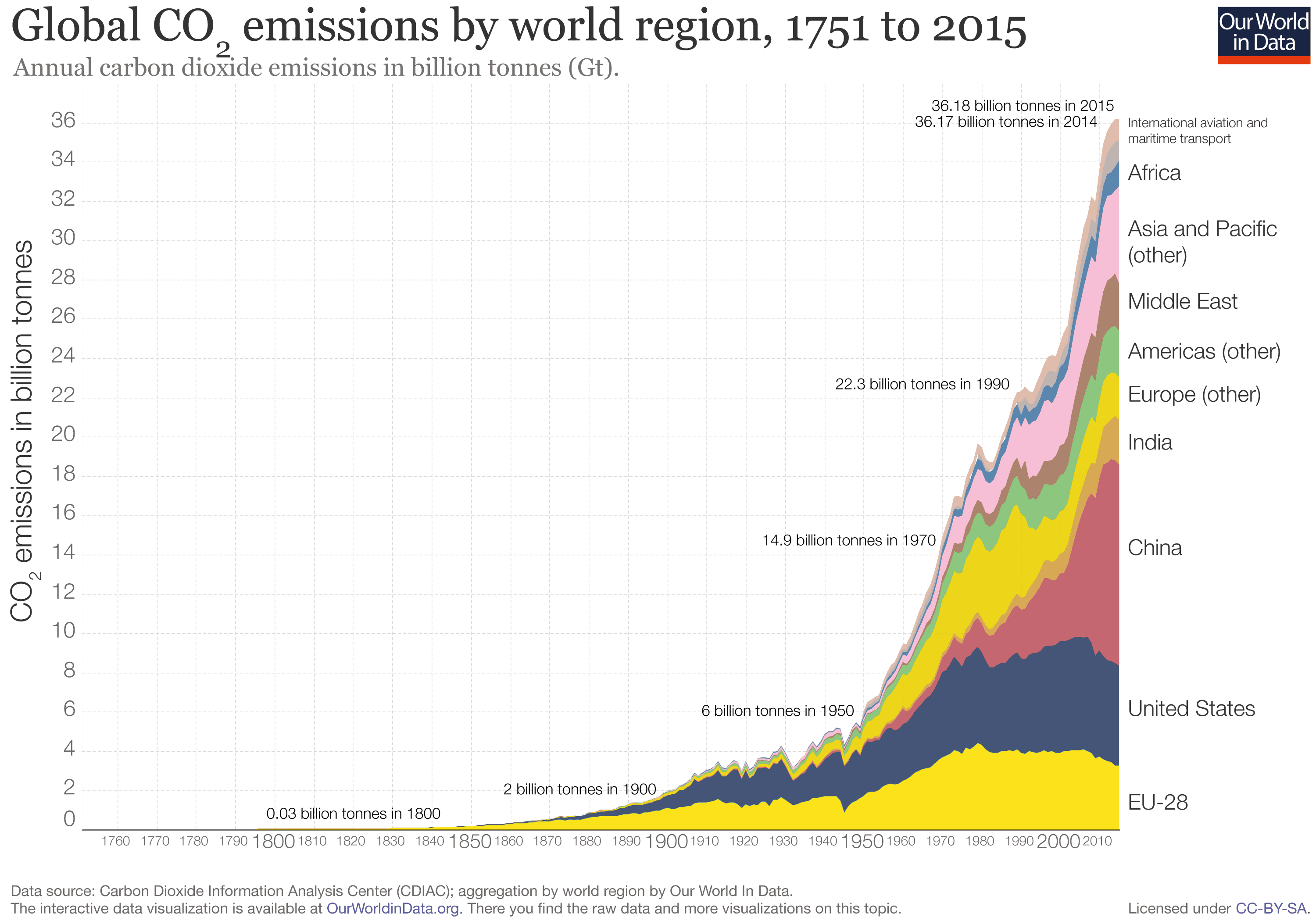
No, by "we" I mean humanity.
Edit: Also that graph doesn't show emissions per capita which is the metric that really matters.
https://external-content.duckduckgo.com/iu/?u=https%3A%2F%2F...
Also see this about cumulative emissions:
https://wriorg.s3.amazonaws.com/s3fs-public/uploads/cumulati...
The US is still the country that has emitted more CO2.
Edit: Also that graph doesn't show emissions per capita which is the metric that really matters.
https://external-content.duckduckgo.com/iu/?u=https%3A%2F%2F...

Also see this about cumulative emissions:
https://wriorg.s3.amazonaws.com/s3fs-public/uploads/cumulati...

The US is still the country that has emitted more CO2.
The EU and the US have not made decent progress if you measure it by likelihood of staying under 2° of warming. Both have goals that are incompatible with the Paris agreement, and they're not even meeting those weak ambitions.
Americans consume way more than the average person in S. America or China and produce way more CO2 per capita.
Just one click to the author's name reveals these titles:
https://www.spectator.co.uk/author/matt-ridley/
>The most dangerous thing about the Amazon fires is the apocalyptic rhetoric
>Ignore the global warming hysteria: hurricanes are not getting worse
>The eradication of South Georgia’s rats proves we can do anything
>Wind turbines are neither clean nor green and they provide zero global energy
>The world is getting greener. Why does no one want to know?
And my personal favorite:
>How hunting and shooting help wildlife – and not just in Africa
Bloody brilliant, let me tell you.
https://www.spectator.co.uk/author/matt-ridley/
>The most dangerous thing about the Amazon fires is the apocalyptic rhetoric
>Ignore the global warming hysteria: hurricanes are not getting worse
>The eradication of South Georgia’s rats proves we can do anything
>Wind turbines are neither clean nor green and they provide zero global energy
>The world is getting greener. Why does no one want to know?
And my personal favorite:
>How hunting and shooting help wildlife – and not just in Africa
Bloody brilliant, let me tell you.
I haven’t read those articles but I can think of a few good points behind many of those titles. It appeared the Amazon fires weren’t worse than any other year, wind turbines have lots of challenges that make them pretty much unsuitable as a primary source of energy at scale, as for hunting, it seems counter intuitive but it is often what supports financially many natural reserves, which happen to also require population control.
They do reveal a pattern that is equivalent to ignoring the canaries in a coalmine. The Amazon's fires are crucial this year not because there was not burning previously, but because once the ecosystems collapse, there is no regaining the rainforest. And of course it will happen, anyone who thinks otherwise is either ignorant, stupid, or plainly paid to ignore it. Wind? There is a difference between it being not good enough to be a primary source vs "providing zero energy", and the list goes on.
The hunting of endangered species is a gross practice that is a natural extension of the colonialist history of the West. When rich whites go to shoot animals who are not capable of defending themselves, no one should kid itself that yeah, there are alternatives to that horrid practice - and meanwhile, illegal hunting continues to eat up entire species, so the whole talk about hunting conserving the population is simply not true when taken in its actual context.
And we completely ignored the times when the ruling class goes to countries, shoots animals unlawfully, and gets away with it. Examples:
https://www.theguardian.com/us-news/2019/dec/11/donald-trump... https://dailynewshungary.com/deputy-pm-semjens-swedish-hunt-...
And we could continue with more historic examples, like this piece of art right here: https://en.wikipedia.org/wiki/Smithsonian%E2%80%93Roosevelt_...
Makes my skin crawl.
The hunting of endangered species is a gross practice that is a natural extension of the colonialist history of the West. When rich whites go to shoot animals who are not capable of defending themselves, no one should kid itself that yeah, there are alternatives to that horrid practice - and meanwhile, illegal hunting continues to eat up entire species, so the whole talk about hunting conserving the population is simply not true when taken in its actual context.
And we completely ignored the times when the ruling class goes to countries, shoots animals unlawfully, and gets away with it. Examples:
https://www.theguardian.com/us-news/2019/dec/11/donald-trump... https://dailynewshungary.com/deputy-pm-semjens-swedish-hunt-...
And we could continue with more historic examples, like this piece of art right here: https://en.wikipedia.org/wiki/Smithsonian%E2%80%93Roosevelt_...
Makes my skin crawl.
Those titles are not damning at all. You can’t think of a single way that hunting and shooting wildlife helps wildlife? Of course he’s not referring to the actual animals shot and killed but the population of wildlife holistically.
Appropriate hunting and other wildlife management are helping wildlife, given that the only other alternative is extinction.
But it's still a weird definition of "help". And I would argue that, if you look at it holistically, in many cases it is little more than a temporary holding action.
But it's still a weird definition of "help". And I would argue that, if you look at it holistically, in many cases it is little more than a temporary holding action.
He should do a suggestion box for new pieces... ‘The plucky resilience of poor children who still drink tap water in Flint, Michigan’, ‘Why we are better off without polar bears’, ‘Are snow capped mountains really all that?’...
The number of homeless is increasing, but so is the number of humans in general.
"Productivity is up and wages might stagnate - but here's why its actually a good thing"
[deleted]
I appreciate the positivity until it comes at the snarky expense of environmentalists and ecologists.
Does this guy think we were born yesterday?
> predictions I made ... that ‘the ecological footprint of human activity is probably shrinking’ and ‘we are getting more sustainable, not less...’... our population and economy would grow, but we’d learn how to reduce what we take from the planet. And so it has proved. An MIT scientist, Andrew McAfee, recently documented this in a book called More from Less, showing how some nations are beginning to use less stuff: less metal, less water, less land. Not just in proportion to productivity: less stuff overall.
That's the kind of evidence he gives?
* "Some" nations, not all nor most, nor the largest ones.
* "Beginning" to use less stuff, not "using" less stuff.
* "less stuff: [one kind], [another kind], [a third kind]" - not using less generally, but using less of certain kinds of things, albeit important ones.
and so on. This is Junk commentary. I wouldn't be surprised if even his sources are also painting an overly rosy picture.
> predictions I made ... that ‘the ecological footprint of human activity is probably shrinking’ and ‘we are getting more sustainable, not less...’... our population and economy would grow, but we’d learn how to reduce what we take from the planet. And so it has proved. An MIT scientist, Andrew McAfee, recently documented this in a book called More from Less, showing how some nations are beginning to use less stuff: less metal, less water, less land. Not just in proportion to productivity: less stuff overall.
That's the kind of evidence he gives?
* "Some" nations, not all nor most, nor the largest ones.
* "Beginning" to use less stuff, not "using" less stuff.
* "less stuff: [one kind], [another kind], [a third kind]" - not using less generally, but using less of certain kinds of things, albeit important ones.
and so on. This is Junk commentary. I wouldn't be surprised if even his sources are also painting an overly rosy picture.
>> For example, a normal drink can today contains 13 grams of aluminium, much of it recycled. In 1959, it contained 85 grams. Substituting the former for the latter is a contribution to economic growth, but it reduces the resources consumed per drink.
Interesting. But before I hip-hip-hurray, I'd like to know how many 13g drink cans were made in 2019, and how many 85g cans were made in 1959.
Interesting. But before I hip-hip-hurray, I'd like to know how many 13g drink cans were made in 2019, and how many 85g cans were made in 1959.
I don't know about cans but overall aluminium production has rocketed, see https://en.wikipedia.org/wiki/History_of_aluminium#/media/Fi...

Yes, that bit about the cans was a very suspect statistic to quote so out of context.
The google shall set you free --> http://www.cancentral.com/can-stats/statistics
At a quick glance I'd say, umm, more...
At a quick glance I'd say, umm, more...
Yep, thanks, you're absolutely right.
Though the numbers are only for the US, total number of empty beverage cans produced and shipped in the US and US-controlled territories in 1960 was 9.700 (billions or tonnes, I'm not sure, the unit is not in the table) and in 2010 it was 96.457. So there's been a ten-fold increase of production for an eight-fold decrease in aluminum used. Note the numbers are for total cans, which I think includes steel, but there's only aggregate data up to 1979.
Data from this table from the page you linked:
http://www.cancentral.com/sites/cancentral.com/files/public-...
Fortunately, it seems that for other types of cans production went down. For example, total number of food cans was 34.600 in 1970 and 28.432 in 2010.
This table:
http://www.cancentral.com/sites/cancentral.com/files/public-...
Again thanks, I should have looked it up myself :)
Though the numbers are only for the US, total number of empty beverage cans produced and shipped in the US and US-controlled territories in 1960 was 9.700 (billions or tonnes, I'm not sure, the unit is not in the table) and in 2010 it was 96.457. So there's been a ten-fold increase of production for an eight-fold decrease in aluminum used. Note the numbers are for total cans, which I think includes steel, but there's only aggregate data up to 1979.
Data from this table from the page you linked:
http://www.cancentral.com/sites/cancentral.com/files/public-...
Fortunately, it seems that for other types of cans production went down. For example, total number of food cans was 34.600 in 1970 and 28.432 in 2010.
This table:
http://www.cancentral.com/sites/cancentral.com/files/public-...
Again thanks, I should have looked it up myself :)
This commentator is appealing to the idea that existential threats basically aren't real because they aren't measurable.
Look: measurement a,b,c,d all show things are improving. So this is the truth.
It's one point of view. There are plenty of other ways to look at the world seriously. It doesn't have to be reduced to 5 or 6 numbers.
Look: measurement a,b,c,d all show things are improving. So this is the truth.
It's one point of view. There are plenty of other ways to look at the world seriously. It doesn't have to be reduced to 5 or 6 numbers.
We also passed 400 ppm CO2 in the atmosphere. Best decade ever for sealing peoplekind's fate.
Seems like they should mention how the global debt crisis is going to be resolved, if everything is really so great.
The "roaring 20s" preceded the great depression. And then a world war.
The "roaring 20s" preceded the great depression. And then a world war.
Strangely enough, I was just compiling a list of "good things that happened this decade" in an adjoining window for a different purpose. Here's what I got so far:
Cheap solar energy
Electric cars
CRISPR gene editing
Real world machine learning applications
Commercial space vehicles
Ebola vaccine
Heightened public awareness of: plastics, climate change, inequality, sexual harrassment
We fixed the Ozone hole
Extreme poverty down by half
Higgs boson and gravitational waves discovered
Cheap solar energy
Electric cars
CRISPR gene editing
Real world machine learning applications
Commercial space vehicles
Ebola vaccine
Heightened public awareness of: plastics, climate change, inequality, sexual harrassment
We fixed the Ozone hole
Extreme poverty down by half
Higgs boson and gravitational waves discovered
[deleted]
Everything has to do with science and innovation.
What about mass surveilance, rising suicides and homelessness, or never-ending wars, among other things?
What about mass surveilance, rising suicides and homelessness, or never-ending wars, among other things?
to be fair to gp, i probably wouldn't include those in a list of the best parts of the last decade either
Suicide rates have been falling around the world:
https://ourworldindata.org/grapher/suicide-death-rates-by-se...
https://ourworldindata.org/grapher/suicide-death-rates-by-se...
I was just compiling a list of "good things that happened this decade"...
Since they aren't good things they don't belong on the list.
[deleted]
[deleted]
No mention of any cultural or individual progress. Of course technology will get better because we can build on the past. Individual and cultural progress should be the measure of a society.
Tell that to all the people oppressed by the right wing shitheads that are in power in so many countries.
That can't possibly be true, not while Trump is president.
Honestly the world is awesome and there is no time I’d rather live than the present. The endless complaining and “sky is falling” stories made me unplug from the media, when I do read the news I skim over anything like that (which is usually most of it).
My wife has a coworker who has to go to therapy to deal with her generalized anxiety about the world’s issue, which went into overdrive after the Trump election. She is constantly on top of the latest NYT disaster article. Her hair has started to fall out and she’s only in her mid-30s. It’s really, really sad.
My wife has a coworker who has to go to therapy to deal with her generalized anxiety about the world’s issue, which went into overdrive after the Trump election. She is constantly on top of the latest NYT disaster article. Her hair has started to fall out and she’s only in her mid-30s. It’s really, really sad.
Or my two unemployed Facebook friends that spend every waking hour on their endless political crusade. I want to shake them and tell them: maybe your world view is tainted by your local environment. It's convenient to attack political leaders for your problems, but maybe you need to spend all that time and energy focusing on finding an income instead of adding another useless voice to the chorus.
Propoganda.
The best decade technologically and economically? Yes, no question.
But the best decade politically? Not even close. Nobody saw the resurgence of right-wing populism coming, of anti-immigrant vitriol, of rejecting the international institutions safeguarding peace, or breakdown of constitutional norms.
And with climate change on its way, I wouldn't count our chickens before they're hatched.
But the best decade politically? Not even close. Nobody saw the resurgence of right-wing populism coming, of anti-immigrant vitriol, of rejecting the international institutions safeguarding peace, or breakdown of constitutional norms.
And with climate change on its way, I wouldn't count our chickens before they're hatched.
Name a better decade. Seriously. Starting from 1900, every one up to the '40s is out because two world wars, then all of the ones until the '90s is out because we were literally a paranoid mid-ranking officer away from global thermonuclear destruction, giving us the '90s, the '00s, and the '10s to work with. So we seem quite unarguably in the top 25% of the past 12 decades, so "not even close" is rather unfair. I will not argue the relative rankings of the past three decades except to state that it is not obvious what they should be.
I am not disputing that our world is on a knife edge. I am saying that it has always been like this, or worse.
I am not disputing that our world is on a knife edge. I am saying that it has always been like this, or worse.
Politically, 1990s were a big bunch of positive (or at least positive-seeming) political changes, the world had moved away from totalitarianism and it seemed that there was a momentum for improvement - while this decade has shown lots and lots of regression. IMHO there is an obvious difference between these past three decades, and the political climate was obviously better in 2000 than in 2019. Currently there's so much tension and public support for authoritarian leadership and us-vs-them policies that it reminds me very much of the global mindset during late 1920s or 1930s, and we all know the outcome of that - even without a particular mustachioed guy or two, that world situation would have resulted in some horrible violence.
Consider though, much of this sentiment has been present but unseen, or new, often as a result of being "left behind" by globalism. I don't think it's safe to assume that visible racist sentiments are as simple as they seem, but rather, people are mad, for a wide variety of reasons, and taking it out on out-groups is how this manifests.
Intellectuals and progressives are very guilty of similar behavior, it's just that their out-groups are not delineated by skin color, so no one notices it.
Intellectuals and progressives are very guilty of similar behavior, it's just that their out-groups are not delineated by skin color, so no one notices it.
You literally just answered your own question -- the other decades since the cold war, meaning the 90's and 00's were obviously far, far better politically.
But I'd argue that what's particularly scary is the fact that things have gotten worse politically. It's not that the 10's were improving less fast -- it's that long-trusted political institutions are falling apart, and nobody knows how much further they have to go, or if they'll be able to be put back together.
But I'd argue that what's particularly scary is the fact that things have gotten worse politically. It's not that the 10's were improving less fast -- it's that long-trusted political institutions are falling apart, and nobody knows how much further they have to go, or if they'll be able to be put back together.
> it's that long-trusted political institutions are falling apart, and nobody knows how much further they have to go, or if they'll be able to be put back together.
Or... we're witnessing a rebalancing of power where an executive branch will no longer have carte blanche and there will once again be a balance of power between the three branches of government (in the US at least, can't speak to how other countries do their politics).
One can hope at least.
Or... we're witnessing a rebalancing of power where an executive branch will no longer have carte blanche and there will once again be a balance of power between the three branches of government (in the US at least, can't speak to how other countries do their politics).
One can hope at least.
Except we're not witnessing that rebalancing of power. I don't know where you would even get that hope from. There are literally zero signs of any rebalancing currently. The Senate claiming to conduct a sham trial is a new low, not a pendulum swinging back.
> it's that long-trusted political institutions are falling apart
This isn't the first time that's happened, you know. And the institutions that replace them will also fall apart and be replaced. And those as well.
You should stop worrying about governing body A or B and start hoping that the next group who seizes power respects inalienable rights as much as the ones who created your current situation.
This isn't the first time that's happened, you know. And the institutions that replace them will also fall apart and be replaced. And those as well.
You should stop worrying about governing body A or B and start hoping that the next group who seizes power respects inalienable rights as much as the ones who created your current situation.
I'm well aware of history. But constitutional checks and balances falling apart, or NATO losing credibility, or Britain retreating, are not things to "stop worrying about". To the contrary, they're everything to worry about.
You're implying that it's more important who rules ("the next group") rather than which institutions constrain them. I would suggest that this is deeply misguided. Institutions are what we have to protect us. Worrying about them is incredibly important, because they're what determines who the next group will be.
You're implying that it's more important who rules ("the next group") rather than which institutions constrain them. I would suggest that this is deeply misguided. Institutions are what we have to protect us. Worrying about them is incredibly important, because they're what determines who the next group will be.
Wasn’t that long ago that the American south elected open, blatant racists to positions of high political power, and South Africa had Apartheid as official government policy. I think we need to appreciate how far the world has come in such a short time.
You could say most of those things about the previous decade. The anti-Muslim vitriol fueled by 9/11 and other events, the "Hague Invasion Act", etc
How many miles of rightwing, anti-immigrant wall have been actually constructed, though? Seems to me that a lot of people are conflating rhetoric with actual reality.
> But the best decade politically? Not even close.
That's very much a matter of perspective, almost by definition. "Right-wing populism" is just grassroots politics that some people don't like. We're also seeing a resurgence of left-wing grassroots movements; and again, plenty of people might dislike these political stances, but one can also see where they're coming from.
That's very much a matter of perspective, almost by definition. "Right-wing populism" is just grassroots politics that some people don't like. We're also seeing a resurgence of left-wing grassroots movements; and again, plenty of people might dislike these political stances, but one can also see where they're coming from.
Sadly, it hasn’t really been a great decade for human dignity.
Compared to which one?
Your definition of what is great for humanity doesn’t necessarily need to be relative. You can have absolute criteria for what you consider a great decade for human dignity. Perhaps there has not yet been a great decade for human dignity.
Sure, but then you're playing semantics to grandstand and detract from real achievements.
I didn't make it past the first paragraph because I really can't stand the worst logic flaw in web performance being turned into a worldview. Hiding glaring flaws behind averages by just trying to overwhelm the average with a much higher volume of "good" traffic.
If poverty is an error, then a 60% error rate on 1 billion requests and a 10% error rate on 6 billion requests is the exact same thing for those people.
If poverty is an error, then a 60% error rate on 1 billion requests and a 10% error rate on 6 billion requests is the exact same thing for those people.
You should look at the data and not invent some silly comparisons to error rates. Poverty is declining both in absolute and relative terms.
There is less poor people now than there was 10 years ago.
https://ourworldindata.org/extreme-poverty
There is less poor people now than there was 10 years ago.
https://ourworldindata.org/extreme-poverty
Those data on poverty are a joke! Read for example: https://www.jasonhickel.org/blog/2019/4/27/200-years-to-end-...
It's basically the World Bank covering its ass for its own spectacular failure.
It's basically the World Bank covering its ass for its own spectacular failure.
> If poverty is an error, then a 60% error rate on 1 billion requests and a 10% error rate on 6 billion requests is the exact same thing.
I can't conceive of the mental contortions you must have forced yourself into to conclude that a world of 600 million people, all in abject poverty, is just as good the world we live in now.
I can't conceive of the mental contortions you must have forced yourself into to conclude that a world of 600 million people, all in abject poverty, is just as good the world we live in now.
> If poverty is an error, then a 60% error rate on 1 billion requests and a 10% error rate on 6 billion requests is the exact same thing.
No. They are not the same thing. Error rate does not automatically drop when requests grow. The number of errors remains the same, but the number of "good" increases, how is that "the exact same thing"?
Also, 1 billion world population was in 1800s, at that time poverty rate was 80%.
No. They are not the same thing. Error rate does not automatically drop when requests grow. The number of errors remains the same, but the number of "good" increases, how is that "the exact same thing"?
Also, 1 billion world population was in 1800s, at that time poverty rate was 80%.
There is an interesting phenomenon happening here on hacker news.
Optimistic comments are being voted down by the moderators (who have a high enough ranking to do so). Yet, this article has been pushed to the top by regular members.
The messages within the down-voted comments aren't breaking any of the community rules. So the down-voting is happening because of a political disagreement. The moderators are intolerant of an opposing view and rather than engage in open debate; they instead wink the things they disagree with, out of the conversation entirely.
Optimistic comments are being voted down by the moderators (who have a high enough ranking to do so). Yet, this article has been pushed to the top by regular members.
The messages within the down-voted comments aren't breaking any of the community rules. So the down-voting is happening because of a political disagreement. The moderators are intolerant of an opposing view and rather than engage in open debate; they instead wink the things they disagree with, out of the conversation entirely.
By 'moderators' it seems that you mean users with enough karma to downvote and/or flag. Those are the users who've been affecting this thread. What you're seeing here is that the article is a divisive one, which is unsurprising, no?
It's always been ok for downvoting to express disagreement on HN: https://news.ycombinator.com/item?id=16131314.
It's always been ok for downvoting to express disagreement on HN: https://news.ycombinator.com/item?id=16131314.
Why climate change is good for the world - "Don't panic! The scientific consensus is that warmer temperatures do more good than harm" https://www.spectator.co.uk/2013/10/carry-on-warming/
His tenure at Northern Rock does not inspire confidence:
The man who crocked Northern Rock - and how the scandal will cost £55 BILLION https://www.dailymail.co.uk/news/article-1026384/The-man-cro...
Lessons of the fall - "How a financial darling fell from grace, and why regulators didn't catch it" https://www.economist.com/briefing/2007/10/18/lessons-of-the...
Northern Rock chairman quits after crisis https://www.euronews.com/2007/10/19/northern-rock-chairman-q...
Matt Ridley would turn planet into Northern Rock https://theecologist.org/2018/nov/05/matt-ridley-would-turn-...