Manufacturing the Librem 5 USA Phone in the US(puri.sm)
puri.sm
Manufacturing the Librem 5 USA Phone in the US
https://puri.sm/posts/manufacturing-the-librem-5-usa-phone-in-the-united-states-of-america/
92 comments
What's the basis for your impression that this "seems" a significant premium over the actual cost differential? I have zero idea of what it costs a company to manufacture a phone in China versus the USA, so I'm genuinely curious.
I've priced out PCBA (of a handful of boards substantially less complex than the Librem, of course) in the US and overseas. In volumes of 1K, the US suppliers were closer to 2.5-3.5x overseas rather than 5x.
In writing this, I just realized that I can't do math. I was thinking it was a 5x multiplier rather than a 2.5x multiplier, which seems pretty reasonable.
In writing this, I just realized that I can't do math. I was thinking it was a 5x multiplier rather than a 2.5x multiplier, which seems pretty reasonable.
The amount of overhead to spin up a US based manufacturing process for an already niche item is going to be expensive. If someone has that type of hard requirement, they must not have many alternatives and should pay the premium for it. I'm sure if there was enough demand the cost would come down.
They need a lot of customers to make it worthwhile to bring US costs down. Right now US production is mostly used for prototypes where high production costs don't matter as much as flexibility to make changes. If you need 10 made in the US that is good enough. If you need millions made in the US then it would be worth investing in all the things needed to manufacture something cheaply. With enough investment per-unit costs in the US can be lowest in the world - but few things are worth putting that much investment in when China already has most of what you need and the supply chain is shorter.
Everything I said about the US applies in some form to every other country to some extent.
Everything I said about the US applies in some form to every other country to some extent.
Another way to look at it is
"this is what it costs to ALSO make something in the US"
you aren't just paying to the difference in labor, you are paying for the difference in requirement, documentation, redundancy, small market segment, etc.
It's like bolts for aircraft. I can buy the bolt for a couple cents at my local Ace. But to buy the certified one costs 10x+ because of the work involved in getting it certified.
"this is what it costs to ALSO make something in the US"
you aren't just paying to the difference in labor, you are paying for the difference in requirement, documentation, redundancy, small market segment, etc.
It's like bolts for aircraft. I can buy the bolt for a couple cents at my local Ace. But to buy the certified one costs 10x+ because of the work involved in getting it certified.
I find binning fascinating when this topic comes up. You start with a pile of 1 cent parts with a 10% tolerance, go through it and measure each and every one, and you magically end up with bins of 1% tolerance parts that now cost a dollar. The parts didn't change at all! And yet merely the fact that they are sorted gives them so much more value.
Another interesting story is that in the 50s and 60s, light aircraft shared a lot of accessory parts with cars of the era.
Cessna used the same voltage regulator as Ford. Ford accepted statistical process inspection for their parts. Cessna required 100% parts inspection for the exact same part.
Solution: run the assembly line for the voltage regulators normally, do the greater of the number of inspections required by Ford or the volume required by Cessna. Ink all the inspected parts with an inspection stamp. Now, Ford can use any of the voltage regulators. Cessna can use any of the stamped regulators. Both companies get parts more cheaply than if the lines were separated.
Cessna used the same voltage regulator as Ford. Ford accepted statistical process inspection for their parts. Cessna required 100% parts inspection for the exact same part.
Solution: run the assembly line for the voltage regulators normally, do the greater of the number of inspections required by Ford or the volume required by Cessna. Ink all the inspected parts with an inspection stamp. Now, Ford can use any of the voltage regulators. Cessna can use any of the stamped regulators. Both companies get parts more cheaply than if the lines were separated.
It's still a great way to do it. Instead of 3D printing a custom pulley for your hobby build robot, you could just use a standard VW part that costs much less and will last a lifetime.
Indeed, and when you buy the 10% tolerance part you will get one thats close to 10% out because the ones that were better have all been picked out.
Seems like this is priced for military & contractors.
Genuinely hope they can find success in that niche. Even if their products never compete with the iPhone in ubiquity, having a domestic company with full stack hardware manufacturing experience is a tremendous asset both to the country and to other companies who aspire to bring their own manufacturing stateside.
Genuinely hope they can find success in that niche. Even if their products never compete with the iPhone in ubiquity, having a domestic company with full stack hardware manufacturing experience is a tremendous asset both to the country and to other companies who aspire to bring their own manufacturing stateside.
>Seems like this is priced for military & contractors.
You would normally expect to see the magic words "Berry Compliant" if the target market includes that. Not super-clear how mobile phones would fall into that particular regulatory tranche.
EDIT: no, my bad, that only applies to (broadly defined) fabric products.
You would normally expect to see the magic words "Berry Compliant" if the target market includes that. Not super-clear how mobile phones would fall into that particular regulatory tranche.
EDIT: no, my bad, that only applies to (broadly defined) fabric products.
> Seems like this is priced for military & contractors.
there are already a series of south korean manufactured, Samsung DoD approved android devices for that market. And similar from General Dynamics, as I recall.
https://www.samsung.com/us/business/solutions/industries/gov...
there are already a series of south korean manufactured, Samsung DoD approved android devices for that market. And similar from General Dynamics, as I recall.
https://www.samsung.com/us/business/solutions/industries/gov...
Could it be possible they would run a specific batch for the military or intelligence industry?
This multiplier (800x2.5) seems much lower than I'd expect.
For prototype quantities (<100), I have consistently seen a multiplier of 8 or so, for the exact same spec (and verified within-spec after receiving the parts).
For prototype quantities (<100), I have consistently seen a multiplier of 8 or so, for the exact same spec (and verified within-spec after receiving the parts).
That actually seems about right to me, at least for the type of mfg I'm used to. Compare low-run CNC quotes from Hubs (China) and Xometry (USA) - Xometry is usually ~2-3x the price. I've seen similar for IM prices although I have less experience there. One caveat is that in China it's relatively cheap to move stuff between factories (Say the part is made in factory 1, then painted in factory 2, then laser-etched in factory 3), whereas in the US as soon as you try to do that setup and freight gets really expensive really fast.
I don't know anything about PCBs or components, so I can't really comment there - maybe the multiplier is worse in that case.
One additional thing to consider is there are often grants or tax breaks for US or in-state manufacturing that can be VERY appealing depending on where you are and what you need done.
I don't know anything about PCBs or components, so I can't really comment there - maybe the multiplier is worse in that case.
One additional thing to consider is there are often grants or tax breaks for US or in-state manufacturing that can be VERY appealing depending on where you are and what you need done.
Can you recommend some other Xometry/Hubs competitors for hobby use?
It’s so cheap it angers me.
Given the ultra-integrated supply chain over in China for high-tech parts & the comparatively low economies of scale here, this is almost a worst-case scenario - and the multiplier is 2.5? Surely that isn’t worth all of the deleterious consequences outsourcing has wrought.
Given the ultra-integrated supply chain over in China for high-tech parts & the comparatively low economies of scale here, this is almost a worst-case scenario - and the multiplier is 2.5? Surely that isn’t worth all of the deleterious consequences outsourcing has wrought.
I am not surprised at all by the price considering the need to manufacture something that's a totally bespoke design in very low quantities. The economy of scale factor that a giant manufacturer in east asia has access to is not available for this sort of project.
I purchased the LibreM phone when it was being crowdfunded. I waited years for the thing to be released, and what they came out with at the end was beyond disappointing. It's nearly three times heavier and 2.5x thicker than a normal phone- by today's standards, the thing is a brick.
If I had been told that I was going to get a developer device, that would have been one thing, but I (and many others) were sold the LibreM as a consumer device, and it's just not.
Along with that, there are reports of how working within the company was, such as this one:
https://jaylittle.com/post/view/2019/10/the-sad-saga-of-puri...
... which paints an extremely negative picture of the internal working of the company.
Between feeling ripped off for my purchase and hearing how terrible working with them was, I'd have a hard time buying any new products from Purism.
If I had been told that I was going to get a developer device, that would have been one thing, but I (and many others) were sold the LibreM as a consumer device, and it's just not.
Along with that, there are reports of how working within the company was, such as this one:
https://jaylittle.com/post/view/2019/10/the-sad-saga-of-puri...
... which paints an extremely negative picture of the internal working of the company.
Between feeling ripped off for my purchase and hearing how terrible working with them was, I'd have a hard time buying any new products from Purism.
Not sure why you are disappointed exactly. Because of the size? It's the only phone with usable kill switches, running fully free software, recommended by the FSF, with good working convergence mode and so on.
> Because of the size?
It's huge and because of that, it's not in the same category as a normal phone. If it had been sold as that, that would be one thing, but it wasn't.
I bought an MNT Reform laptop knowing it won't look like a normal laptop- that's fine. But if they had shown something that looked like a Dell XPS 13 and then shipped something that looks like the MNT Reform does, I'd be just as upset.
> usable kill switches
Physical kill switches, not usable. I believe the Pinephone also has software kill switches which function much the same way.
> running fully free software
Yes, no binary blobs is good, but that doesn't change the issue of the form factor making it unusable.
It's huge and because of that, it's not in the same category as a normal phone. If it had been sold as that, that would be one thing, but it wasn't.
I bought an MNT Reform laptop knowing it won't look like a normal laptop- that's fine. But if they had shown something that looked like a Dell XPS 13 and then shipped something that looks like the MNT Reform does, I'd be just as upset.
> usable kill switches
Physical kill switches, not usable. I believe the Pinephone also has software kill switches which function much the same way.
> running fully free software
Yes, no binary blobs is good, but that doesn't change the issue of the form factor making it unusable.
> I believe the Pinephone also has software kill switches which function much the same way.
Pinephone has hardware kill switches which are not usable/convenient. You have to open the back cover to access them and they are very tiny. You won't be able to switch the microphone on when you receive a call, unlike with Librem 5.
Pinephone has hardware kill switches which are not usable/convenient. You have to open the back cover to access them and they are very tiny. You won't be able to switch the microphone on when you receive a call, unlike with Librem 5.
I'm personally waiting for the next revision. Hardware specs are not for me at the moment.
Yeah it’s 2021 and Chinese manufactured are more reliable and higher quality than anything American made. As an anecdote I build PCBs for a hobby and I’ve purchased PCBs and chips from both cheap Chinese fabs and suppliers as well as Americans ones. The only issues I’ve ever had were with American ones (which were many times more expensive) and I’ve stopped using them completely.
I would be curious if librem will ever release data regarding failure rates of their American made phones versus non-American made ones. But considering how they’re branding this and the kind of person who will spend the premium to buy it, I doubt they will ever say anything.
Also after the Snowden revelations, I laugh at the idea that American made products are somehow more “secure”. Sure we (as in US intelligence community) think China puts back doors in things but from the Snowden revelations we KNOW that American companies like Cisco puts backdoor into things.
I would be curious if librem will ever release data regarding failure rates of their American made phones versus non-American made ones. But considering how they’re branding this and the kind of person who will spend the premium to buy it, I doubt they will ever say anything.
Also after the Snowden revelations, I laugh at the idea that American made products are somehow more “secure”. Sure we (as in US intelligence community) think China puts back doors in things but from the Snowden revelations we KNOW that American companies like Cisco puts backdoor into things.
It crushed me last year when we ordered extrusion/machine work samples (a lot of 10 pieces) from a major American brand and some from "Ricky" a Chinese machine shop connect one of the guys here heard of through doing other parts sourcing in China.
The Chinese ones were better machined, had no issues, and were 1/3 the price. I weep for American manufacturing.
The Chinese ones were better machined, had no issues, and were 1/3 the price. I weep for American manufacturing.
Even assuming that all hardware is backdoored, it can still make sense to use hardware from your own country, since your own government probably doesn’t want to harm its own economic interests.
On the other hand, your own state has more of an incentive to control your behaviour.
As with everything else, think through the threat model.
As with everything else, think through the threat model.
I’m more worried about the other state understanding the topology of my state in higher resolution than my own state does. The ramifications are endless, and I believe that to be the more grave threat (aka undermine society at its cultural fabric while stealing/undermining the economy and crippling the military).
Sure, arrive at your own conclusions :)
Has it ever been proven that China backdoored circuits?
> Also after the Snowden revelations, I laugh at the idea that American made products are somehow more “secure”.
Be that may, but as a US person I’d rather have US intelligence snooping on me than a foreign hostile entity. There are no ifs and buts about it. For folks in other countries, I leave it to them if they are more comfortable with a democracy, with relatively good relations with most countries in the world, snooping on them or a communist regime, which has issues with each and every one of its neighbors.
Be that may, but as a US person I’d rather have US intelligence snooping on me than a foreign hostile entity. There are no ifs and buts about it. For folks in other countries, I leave it to them if they are more comfortable with a democracy, with relatively good relations with most countries in the world, snooping on them or a communist regime, which has issues with each and every one of its neighbors.
The error here is the assumption that only foreign entities are hostile. A "foreign hostile entity" may have lots of information and malicious intent, but they lack legal jurisdiction and the ability to take open, direct action where I live. The most worrisome threat is that they manage to uncover a common interest with some domestic entity and share what they learned—and from that perspective domestic snooping just cuts out the middleman. I'd rather keep the entities doing the snooping and the ones with influence over me as widely separated as possible.
Is it your hobby/part time job to defend China and dump on the USA? Just curious, looking back through your comment history and all.
If you had actually looked back through my comment history you would have seen that I never defended China or claimed that the USA was worse. I am not a fan of governments in general but I will freely acknowledge that the US government is far from the worst example. My comment was purely about domestic snooping vs. foreign from the perspective of the one being spied upon—if one lives in China the roles will obviously be reversed, and in that case one should prefer a foreign entity like the USA gathering intel over the domestic Chinese equivalents. Either could wish you ill but the domestic power will almost always be the more immediate threat. (Not being spied upon at all would be ideal, of course.)
Not good advice if you're American as your own government can always hurt you most.
Which of the two countries has more invasions, coups and occupations in its history? Which one is still occupying several countries and has military bases in many others?
It’s the US the rest of us fear, with good reason.
It’s the US the rest of us fear, with good reason.
The foreign entity isn't interested in you. They're interested in you to get to your state.
Your state is only interested in you. If they snoop on you they're after you personally.
Your state is only interested in you. If they snoop on you they're after you personally.
Foreign entities seek to use info on civilians for malicious targeting ops. This is an example of why the OPM hack[1] was so devastating.
[1] https://en.m.wikipedia.org/wiki/Office_of_Personnel_Manageme...
[1] https://en.m.wikipedia.org/wiki/Office_of_Personnel_Manageme...
China is not communist, nor do I trust the US more than them. Both countries are countries I have no respect for.
As a small US contract manufacturer working largely in Opensource Hardware I applaud their efforts. It is a step forward...even if it costs more.
There are many people in the US who would pay more for a phone made in the US. It isn't just military/govt. Although, they are not the majority.
I got into electronics in the mid/late 90s when there was still a lot of development and production in my area. I watched it largely move out of country and quite a few mid/high paying jobs largely disappear.
It still costs quite a bit more to have boards made in the US (unless you get your own equipment) but with the tariffs, shipping and possibility of further issues between our governments it starts to become fairly close to being worth the effort, at least for some things. It would just take one or two lot rejections or a batch lost in shipping to make it not worthwhile for a mid sized producer. Large companies can absorb and plan in advance...small companies the loss may not be sizable...but the mid size company very well may have most of their eggs in the same basket so to speak.
I have had fairly good results with our Chinese manufacturer over the last 8 years or so but doing our own in house QA/Test is absolutely required. There has been very few batches where we could have got away with not doing so.
In our case we are doing small batch production in house while doing larger batches from China but since we have the machines in house and we can order parts from anywhere there is very little reason to not do our own in house production entirely. This allows for much tighter control over the process as well as defect mitigation on the fly during production. The next few years are going to be very interesting for manufacturing worldwide. I expect it won't just be the US who is looking to bring at least a portion back to their country...or to countries which are cheaper/easier to work with.
There are many people in the US who would pay more for a phone made in the US. It isn't just military/govt. Although, they are not the majority.
I got into electronics in the mid/late 90s when there was still a lot of development and production in my area. I watched it largely move out of country and quite a few mid/high paying jobs largely disappear.
It still costs quite a bit more to have boards made in the US (unless you get your own equipment) but with the tariffs, shipping and possibility of further issues between our governments it starts to become fairly close to being worth the effort, at least for some things. It would just take one or two lot rejections or a batch lost in shipping to make it not worthwhile for a mid sized producer. Large companies can absorb and plan in advance...small companies the loss may not be sizable...but the mid size company very well may have most of their eggs in the same basket so to speak.
I have had fairly good results with our Chinese manufacturer over the last 8 years or so but doing our own in house QA/Test is absolutely required. There has been very few batches where we could have got away with not doing so.
In our case we are doing small batch production in house while doing larger batches from China but since we have the machines in house and we can order parts from anywhere there is very little reason to not do our own in house production entirely. This allows for much tighter control over the process as well as defect mitigation on the fly during production. The next few years are going to be very interesting for manufacturing worldwide. I expect it won't just be the US who is looking to bring at least a portion back to their country...or to countries which are cheaper/easier to work with.
This is really inspiring to see consumer electronics made in America. So many people say that “we lost the capability” to do such.
$2000 isn’t a bad price in the grand scheme of things. But I will be waiting until the software / UI is snappier.
$2000 isn’t a bad price in the grand scheme of things. But I will be waiting until the software / UI is snappier.
Maybe I'm missing it, but it doesn't seem obvious if the parts they're using were also manufactured in the US? Which, if they're not, makes sourcing them still an issue if global supply chains were to break down for example.
https://puri.sm/products/librem-5-usa/
Scroll a little bit down and you'll see the country of origin for the parts. Most are of US origin.
Scroll a little bit down and you'll see the country of origin for the parts. Most are of US origin.
Am I missing something or does that not say where the SoC/processor is made? TFA does not seem to say where the NXP CPU is made either. Or is that categorized under the "Electronics" category?
Maybe you don't know, but Purism tends to publish misleading information.
Most of the stuff in that product listing is trivial stuff to produce. The PCB/PCBA entries can basically all be ignored, and all the ICs on those PCBs can basically be assumed to be made in China, except for the NXP i.MX8M which is made in Korea
Most of the stuff in that product listing is trivial stuff to produce. The PCB/PCBA entries can basically all be ignored, and all the ICs on those PCBs can basically be assumed to be made in China, except for the NXP i.MX8M which is made in Korea
Do you have a source for where the i.MX8s are made? I tried to figure that out a while back and didn't find a clear answer, although Korea seems likely. (Samsung process which is done at fabs in the US and Korea, but origin documents I found list China for packaging/testing, which is more likely for a Korean fab - but not 100% certain, since chips get flown stupid distances sometimes for packaging, and not 100% if there aren't US-made ones too)
The NXP i.MX 8M Quad processor in the Librem 5 has "Made in Korea" stamped on them and there have been news articles published about how NXP was switching its foundry work from TSMC to Samsung. By the way, the i.MX 8M is designed in Austin, Texas (by the old Motorola division, which turned into Freescale and then was bought by NXP).
For more info, see: https://source.puri.sm/Librem5/community-wiki/-/wikis/Freque...
For more info, see: https://source.puri.sm/Librem5/community-wiki/-/wikis/Freque...
This page has a table of components and their corresponding country of origin
https://puri.sm/products/librem-5-usa/
https://puri.sm/products/librem-5-usa/
Ah, what is a "bad" price for an massively underwhelming piece of hardware, in your book, then?
Come on, the Purism people have put up a huge effort. You can't just casually the product "massively underwhelming" without stating your reasons for doing so.
Well.. The CPU is multiple generations behind anything else on the market. Power management is basically non existent. They've only recently managed to get cameras working sorta, but not really. It was sold as a customer device, not a damn development platform. They started crowd funding in 2017, and so far have only delivered less than two months worth of devices to customers. Purism is violating the law on a daily basis.
Yes, the CPU is weak, suspend-to-RAM hasn't yet been added to the mainline Linux driver for the i.MX 8M, camera auto-focus doesn't yet work, and lot of work is needed for full functionality of the Megapixels camera app and use of an OpenPGP smartcard, but you are ignoring all the progress that has been made. Purism started with a new chip that didn't yet have good mainline Linux support and had to make several hundred commits to mainline Linux to support half a dozen new chips. Purism created a new mobile environment for Linux, which 65% of PinePhone users say in a poll is their favorite interface. Purism created the first free/open hardware phone since the Golden Delicious GTA04 in 2014 and manufactured the first phone in the US since the Motorola Moto X in 2013. The Librem 5 contains 6 innovations in the mobile phone industry, which is more innovations than any phone since the Samsung Galaxy S5 released in 2014. This is the first phone ever produced where the manufacturer promises lifetime software updates and the processor will be produced by the manufacturer (NXP) until at least Jan. 2033.
All of this info is on the FAQ: https://source.puri.sm/Librem5/community-wiki/-/wikis/Freque...
All of this info is on the FAQ: https://source.puri.sm/Librem5/community-wiki/-/wikis/Freque...
> Let’s say hypothetically that a Texas-based Instrument and parts maker has a part, let’s say that part is something like a TPS65892 (revision AB), and like all parts that Electronics Engineers (EEs) select, needs to be kitted exactly to part number (TPS65892) and package (NFBGA 96). Normally parts vary by part number (I am pretty sure it’s why they’re called part numbers), but in rare instances (I can think of only one) that part is a completely different part if it is appended by what you normally would read as a revision number: TPS65892BB. In this example these are pin-matching parts that do completely different things and where all things work fine with the exception of charging the battery and providing USB connectivity. After a number of hours tracing schematics to board read values, this hunting manifested itself into a data sheet comparison where we learned these are unrelated parts.
Holy moly. I'm glad that I don't have to deal with that.
What is going on with that instrument maker?
Holy moly. I'm glad that I don't have to deal with that.
What is going on with that instrument maker?
I don’t know why they won’t just come out and say who the manufacturer was, to give the hypothetical some real-world context. I wouldn’t want to assume that they are referring to Texas Instruments.
Sarcasm aside, I appreciated the humor they put into that paragraph.
Sarcasm aside, I appreciated the humor they put into that paragraph.
For reference, the Librem 5 USA cost $2000 and comes with 32GB of eMMc on device storage, a SoC that can be generously called "slow", and 3GB of RAM.
It's easy to see why phones are not entirely sourced from the US when it makes the iPhone look like impossibly good value for your money.
It's easy to see why phones are not entirely sourced from the US when it makes the iPhone look like impossibly good value for your money.
This is not just about the specs: https://source.puri.sm/Librem5/community-wiki/-/wikis/Freque....
By the way, there is also China-made version for $800.
By the way, there is also China-made version for $800.
The point is the device is clearly not competitive on specs. You have to put a lot of value in it being an open platform to find it attractive.
It is the kind of specs you typically find on $30 phones.
https://www.amazon.com/Simple-Mobile-Prepaid-Smartphone-Lock...
It is the kind of specs you typically find on $30 phones.
https://www.amazon.com/Simple-Mobile-Prepaid-Smartphone-Lock...
That's subsidized via the sim-lock. The "real" prize is probably more like 80$.
Correct me if I am wrong but the choice of SoC was due to the open nature of it and not the origin. All of the other limitations stem from the choice of SoC it seems.
Is it actually more open than a typical SoC? Also asking for the PinePhone. Also, will it ever get firmware updates? Also, I’m not even sure we have source code for the existing firmwares.
> Another misconception is that a machine placed part is in some way superior to the same connected part placed by hand. It’s not. It’s faster and more efficient, but hand (re)placement is equally stable. Electronics off a line are hand repaired more often than people understand. This only increases cost (labor and time), it doesn’t reduce reliability.
I had no idea! Worth the price of admission. Whole article fascinated me tbh
I had no idea! Worth the price of admission. Whole article fascinated me tbh
This hack is remarkable.
https://puri.sm/wp-content/uploads/2021/05/purism-librem-5-u... [.jpeg]
"Fun side story, one brand of 32GB eMMC has test pins on the underside that confuses the optical scanner for SMT parts placement, while another brand does not have the test pins. Since there is no easy way to mask the optical scanner of those test pins, a black permanent marker is a quick fix to blot them out so as not to confuse the scanner."
https://puri.sm/wp-content/uploads/2021/05/purism-librem-5-u... [.jpeg]
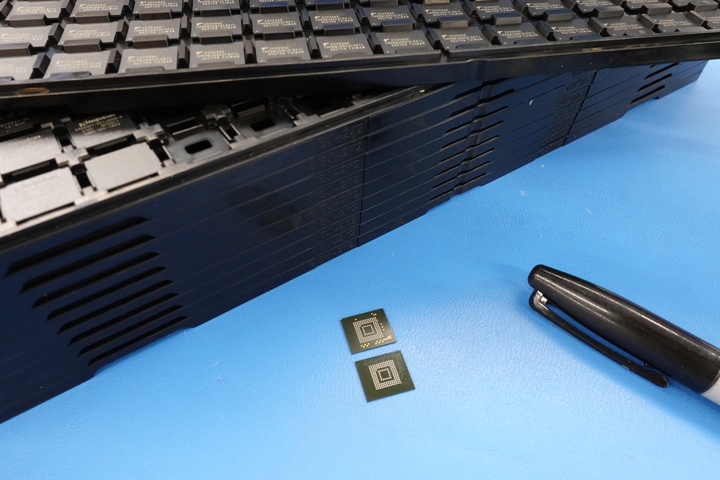
"Fun side story, one brand of 32GB eMMC has test pins on the underside that confuses the optical scanner for SMT parts placement, while another brand does not have the test pins. Since there is no easy way to mask the optical scanner of those test pins, a black permanent marker is a quick fix to blot them out so as not to confuse the scanner."
How many ICs are actually made in the US? They're pretty mum about it. My guess is that none of them are made in the US. So the phone was assembled in the US from all kinds of parts.
Google/Motorola tried this before, but it didn't work out:
https://www.bbc.co.uk/news/business-27643474
I don't know what went wrong there, or what lessons could have been learned.
https://www.bbc.co.uk/news/business-27643474
I don't know what went wrong there, or what lessons could have been learned.
Actually, that's interesting in that 1. they imply that it wasn't a "made in USA" issue and that the problem was just that they were only making the Moto X there and it didn't do well in the market, and 2. "Motorola says that the Moto X smartphone will still continue to be manufactured at plants in China and Brazil." -> if they're still making stuff in Brazil, that implies that it's really not as simple as "can't make anything outside of China".
Tariffs on some electronics can be insane in Brazil - for example "At a time when the [Playstation 4] was selling for $399 in the U.S., an equivalent system was heading to Brazil for $1,899".
source: https://tedium.co/2015/07/16/sega-master-system-brazil/
source: https://tedium.co/2015/07/16/sega-master-system-brazil/
Interesting to note that they started US manufacturing with the Librem Key[1] in 2019 which I imagine has a much lower total labor component than a full phone. Paying double the price for an under specced product is a lot easier to justify at $59 than $2000, especially for something so security essential. I would be happy to pay the premium just for the cool factor and to support supply chain diversity. I just wish they would release a USB-C NFC version of it.
[1] https://puri.sm/posts/made-in-usa-librem-key/
[1] https://puri.sm/posts/made-in-usa-librem-key/
What if pricing was listed in two parts: first, the price at current market rates, relative to its alternatives; second, a share of early adopter stock. The price paid less market rates for a comparable phone treated as an investment, perhaps as much as several hundred dollars per device. The stock pool being a percentage of the company commensurate with network-effects of its adoption. Sometimes crowd-sourced purchases like this are more easily justified, and even rewarded later, if accounted for as investments.
It is an interesting idea to have a USA model. However, I do not understand why do they have two models of the same phone? It is like saying "We have this made-in-China phone which is secure and open source but we also have this other made-in-USA phone which is more secure and more open". Oversimplistic but that is the idea.
It seems nice but I don't think it matters at this point to wave the nationalist flag when it's only a half-measure forgetting the 500 kg gorilla in the room. Where are nearly all the closed-source designs, manufacturing, and firmwares for the chips made? And, absolutely no chances of backdoors there, right?
The 362.874 kg gorilla.
I will wait for the European edition. I can imagine its a unique selling point for people in North America
Hope having production on the same floor as inovative hw designers will bring new features for hackers like:
- ability to extract all memory component to reflash them
- pinctrl connectors for i2c/spi
- reboot of grey bus
- sdr components
Please make something incomparable!
- ability to extract all memory component to reflash them
- pinctrl connectors for i2c/spi
- reboot of grey bus
- sdr components
Please make something incomparable!
> Making a convergent operating system that is not Android nor iO
"convergent"?
"convergent"?
In this case, that means that it converges with desktop software. From what I can tell, GTK and QT have both been shifting their focus to touch-based, scalable UIs. The result is native code that feels just as good with a mouse as it does on a touchscreen.
Other than US govmt, and other highly regulated US institution, I wonder about the size and social characteristics of the group that both can/doesn't mind paying 2000USD for a understating (and in many ways underpowered) and rejects the non-USA model.
My only gripe with bringing desktop Linux to phones is that desktop Linux is a security nightmare. Someone with more experience please chime in, but the whole thing is C, no usable sandbox (a bug in firejail will make the untrusted code run root..) and the old xkcd comic is still true: the only thing a malicious actor can’t do is install a video driver. That is, your user account with all the important data is basically left completely open. Compared to the iphone, and android (especially graphene os) it is laughable.
And while basically noone uses pinephone/librem 5, there are plenty of people running desktop linux (myself included), but I don’t sleep well knowing how unsecure the whole thing is, and seemingly it is not a priority to anyone. Is my paranoia based on facts?
And while basically noone uses pinephone/librem 5, there are plenty of people running desktop linux (myself included), but I don’t sleep well knowing how unsecure the whole thing is, and seemingly it is not a priority to anyone. Is my paranoia based on facts?
Thanks for the link!
Some nitpicks (not directed at you at all):
> When we develop security solutions, we develop them without looking down on the user or thinking of them as som[e]body that we have to protect almost like a parent-child relationship. We try to build a solution that gives them control over their own security.
That's many words for saying we don't have any sort of security measures.
> Because all the code in the root file system of the Librem 5 is free/open source, all of it can be reviewed to verify that it doesn't contain backdoors and doesn't do anything that the user doesn't want it to do
At most it answers privacy but not security. Also, non-existent security can so easily add a "backdoor", especially on top of an all-memory-unsafe environment where memory bugs are everywhere.
But I will give them that they do list basically all my gripes with it:
> It lacks a secure boot process to verify that none of the boot files have been changed. > It lacks a hardware-backed key store. > The apps are not run in a secure sandbox. > PureOS doesn't have shim kernel drivers that do most of their execution in userspace libraries like Android and iOS. > PureOS doesn't have low-level protections such as Control Flow Integrity and ShadowCallStack in Android and Pointer Authentication Codes in iOS. > Most of the operating system and applications are written in memory unsafe languages like C and C++. > The Librem 5 lacks a permission system where each app is required to ask the user for permission to access parts of the phone like Android has.
And unfortunately the answer to these is that there are some distant plans for some of these. Hopefully both desktop and mobile Linux will improve heavily in this area in the coming years.
Some nitpicks (not directed at you at all):
> When we develop security solutions, we develop them without looking down on the user or thinking of them as som[e]body that we have to protect almost like a parent-child relationship. We try to build a solution that gives them control over their own security.
That's many words for saying we don't have any sort of security measures.
> Because all the code in the root file system of the Librem 5 is free/open source, all of it can be reviewed to verify that it doesn't contain backdoors and doesn't do anything that the user doesn't want it to do
At most it answers privacy but not security. Also, non-existent security can so easily add a "backdoor", especially on top of an all-memory-unsafe environment where memory bugs are everywhere.
But I will give them that they do list basically all my gripes with it:
> It lacks a secure boot process to verify that none of the boot files have been changed. > It lacks a hardware-backed key store. > The apps are not run in a secure sandbox. > PureOS doesn't have shim kernel drivers that do most of their execution in userspace libraries like Android and iOS. > PureOS doesn't have low-level protections such as Control Flow Integrity and ShadowCallStack in Android and Pointer Authentication Codes in iOS. > Most of the operating system and applications are written in memory unsafe languages like C and C++. > The Librem 5 lacks a permission system where each app is required to ask the user for permission to access parts of the phone like Android has.
And unfortunately the answer to these is that there are some distant plans for some of these. Hopefully both desktop and mobile Linux will improve heavily in this area in the coming years.
Off topic I guess, but the font that article uses is throwing my eyes for a loop. The lower-case 't' in particular, but I am also not fond of the number '3' either.
The US is the biggest surveillance state of all, why is this a step forward?
This is really cool, but it's $2,000. The problem is the specs don't quite justify a $2,000 price tag. The iPhone 12 Pro Max is $1,099 for 256Gb model. The Librem 5 has 32Gb built in. Granted you can expand storage on the Librem 5, but that's added cost on top of the $2,000. There are other specs to compare, but storage is an easy target.
I think the project is awesome, and I'd be very inclined to purchase one, but I can't justify $2,000 for a comparatively subpar device.
I think the project is awesome, and I'd be very inclined to purchase one, but I can't justify $2,000 for a comparatively subpar device.
For perspective a name-brand 256gb microsd card currently retails for roughly $30.
The value here isn't in raw specs, it's in privacy and respect for the user, which is a total blow out in favor of the librem.
The value here isn't in raw specs, it's in privacy and respect for the user, which is a total blow out in favor of the librem.
Yeah I definitely see the value in privacy and respect for the user, and Librem is king there, but that still doesn't justify a $2,000 price tag to me. I wouldn't pay $15,000 for a Ford Pinto because it has bulletproof windows.
(Edit: I'm leaving this paragraph here as it attracted comments that would no longer make sense if I edited/removed, but it was a result of a flawed premise [bad math in my head]) That seems a significant premium over the actual cost differential, but they self-admit "this is for customers who have hard requirements on sourcing" rather than "this is what it costs to make something in the US".