I was the project engineer for the Air Force Space Command / NORAD DSP satellite ground network back in the 80's. The system used the 10MB 8" Bernoulli drive and cartridges to store the early warning message traffic. The system was installed in 1988 and was decommissioned around 2005.
I'm not sure if they used the 8" cartridges all the way to 2005, but I can find out. I'm still friends with the original system maintainer. I pivoted to video compression in 1993 and lost track of the program, but we found each other on Facebook in 2010.
Advanced Television Systems Committee. It's the US standards organization for terrestrial digital television. ATSC 3.0 is a new standard that's very similar to DVB-T2 (used in the UK for HDTV) at the PHY layer.
The article kind of disses the Intel 8085. For those of us with 8080 code bases that were never going to be rewritten for the Z80, it was a welcome upgrade. On the paper dryer process control systems I was working on in 1979, the 8085 based Intel 80/30 Multibus SBC could be dropped in for the older 8080 based 80/20 SBC with no changes and provide a significant 2.5X performance upgrade.
In the United States in 1935, the Radio Corporation of America demonstrated a 343-line television system. In 1936, two committees of the Radio Manufacturers Association (RMA), which is now known as the Consumer Electronics Association, proposed that U.S. television channels be standardized at a bandwidth of 6 MHz, and recommended a 441-line, interlaced, 30 frame-per-second television system. The RF modulation system proposed in this recommendation used double-sideband, amplitude-modulated transmission, limiting the video bandwidth it was capable of carrying to 2.5 MHz. In 1938, this RMA proposal was amended to employ vestigial-sideband (VSB) transmission instead of double sideband. In the vestigial-sideband approach, only the upper sidebands-those above the carrier frequency-plus a small segment or vestige of the lower sidebands, are transmitted. VSB raised the transmitted video bandwidth capability to 4.2 MHz. Subsequently, in 1941, the first National Television Systems Committee adopted the vestigial sideband system using a total line rate of 525 lines that is used in the United States today.
Although everyone is interested in visible aurora, the proton flux is also really impressive. It peaked at 37,000 pfu at 1910Z. The highest ever recorded was 43,500 pfu in March 1991.
Here's the Emmy that C-Cube Microsystems won back in 1995 for the MPEG-2 (actually unconstrained MPEG-1) encoder chip set used in the roll-out of DirecTV.
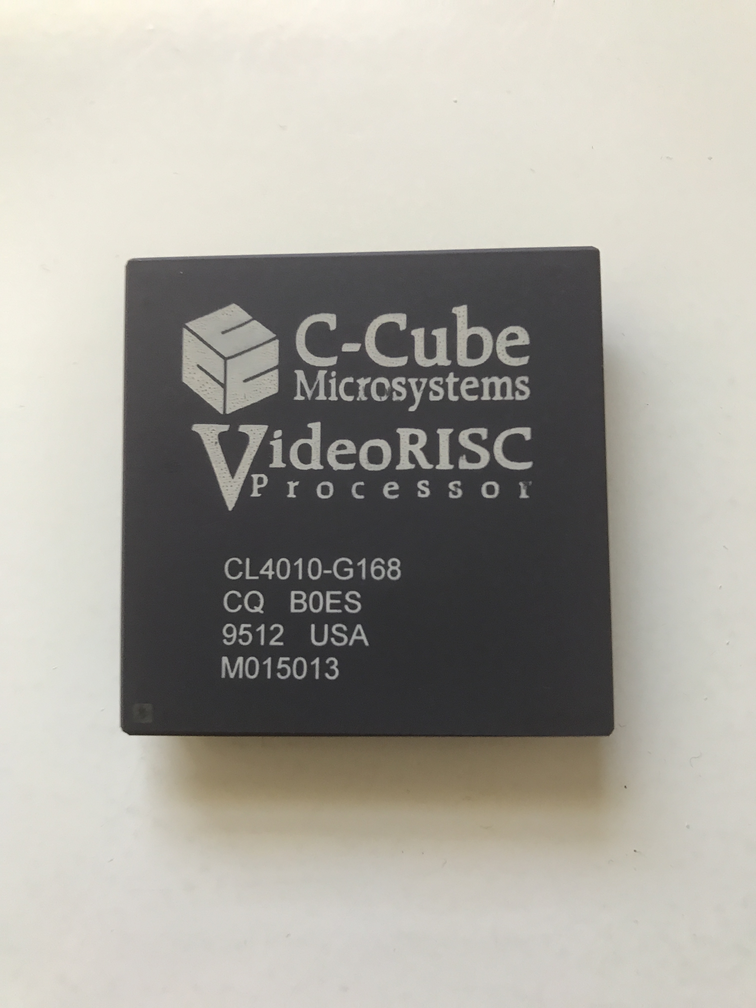
The original DirecTV encoder was MPEG-1 at 704x480 using eight CL4000 chips. Then in 1995 when the MPEG-2 capable CL4010 was finished, the encoders were upgraded to MPEG-2 (frame only encoding). Then upgraded again to a 12 chip AFF (Adaptive Field/Frame) encoder when the firmware was completed.
The first 16:9 content I ever saw was the trailer to "Batman Forever" (with Val Kilmer) in 1995 when I was working at C-Cube Microsystems. The studios use to send them test content all the time for video compression testing. It was on D1 tape, and looked beautiful for SD resolution. The professional Sony CRT 4:3 monitors back then had a 16:9 button to letterbox the image.
However, predicting the effects of solar flares is very difficult. Not only does the particle stream have to hit the Earth, it has to couple with the magnetic field.
Large flares can cause small events on Earth and vice versa.


I'm not sure if they used the 8" cartridges all the way to 2005, but I can find out. I'm still friends with the original system maintainer. I pivoted to video compression in 1993 and lost track of the program, but we found each other on Facebook in 2010.