Unfortunately, we live in a world where public opinion (skewed by fossil fuel companies or otherwise) is a huge driving force. We can lament what the world would be like if only people were more knowledgeable, but at the end of the day it's the ecosystem we have to operate in.
Fusion power has indeed had high R&D costs, but so has any significant project before the ROI starts to kick in. Fusion power (especially the types that don't generate a neutron flux) is safer and more productive in principle compared to fission, and I have high confidence I will live to see a commercial fusion reactor come online in my lifetime.
I don't work as a physicist (but I got my degree in Engineering Physics @ CU-Boulder, 2009) and I went to see Interstellar in IMAX on opening night. I really enjoyed it overall, and the scenes involving the realistically-rendered black hole were worth it alone.
I'm relatively easy to please when it comes to movies, but to each their own of course.
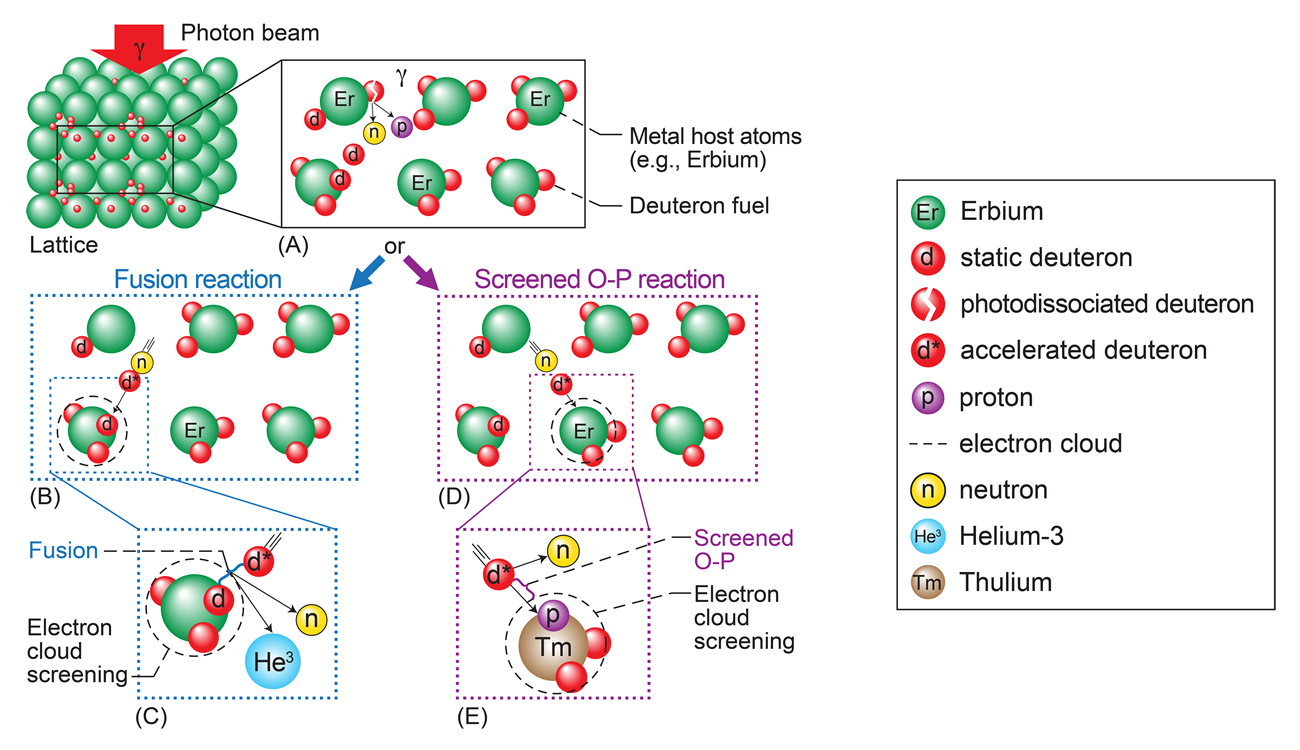
It appears to be the same mechanism as neutronic high-energy fusion. An energetic neutron gets kicked out, which collides with some material in the cell (probably the erbium lattice), and generates heat. Which then needs to be hooked up to a water boiler to create steam, which powers a turbine, etc.
I'm much more hopeful for someone creating a Dense Plasma Focus device with aneutronic hydrogen-boron (pB11) fuel because the reaction energy can be directly captured as electricity, instead of having to capture hot neutrons to boil water.
Theoretical LENR device would be comparable to an RTG [1] because at high heat the device would melt itself. It's more about a trickle of stable power, rather than being used as a cell of a power plant. So, ignoring support infrastructure and focusing on the size of the power generator, we have:
Using the power source for the voyager probe as an example:
RTG size: 0.5m x 0.5m x 1m == 0.25 cubic meters.
RTG power: 2400 watts (thermal)
RTG power density: 9600 watts per cubic meter
Using ITER as an example for the scale of fusion power plant:
Reactor size: 800 cubic meters
Reactor power: 500,000,000 watts (thermal)
Reactor power density: 625,000 watts per cubic meter
So yeah, theoretically it would be compact, but low power density. Enough to power a space probe, but not our civilization.
I got my undergrad in Engineering Physics from CU-Boulder and talked with many professors about fusion research (plus keeping up with developments since then).
Putting aside all the controversy of LENR (low-energy nuclear reactions, the official name for cold fusion) and assuming that the theory actually results in usable tech (for once), the first line of the NASA article hints at where a device's power density would be competitive:
> "A team of NASA researchers seeking a new energy source for deep-space exploration missions"
which tells me that a theoretical device would be a replacement for current RTGs [1]. Low but consistent power for niche applications.
But in general I wouldn't get your hopes up. The higher-energy types of fusion power are far more promising for world-wide civilization-powering clean energy.
“That which can be asserted without evidence, can be dismissed without evidence.” - Hitchens's razor.
The burden of proof is always on the person making an assertion or proposition. When they do not provide proof of their claim, and another person calls it "full of shit", it is not valid to shift the burden of proof onto them to disprove the original claim.
And there's a great reason for this - the bullshit asymmetry principle: the amount of energy needed to refute bullshit is an order of magnitude bigger than to produce it.
My family visited here in 1998/99 when my dad (USA Air Force) was stationed at "Peace Vector 3" in Ismailia, Egypt. The Siwa Oasis was a fascinating place - people still lived in the ancient mudbrick houses that have been around for hundreds of years (so we were told). The whole neighborhood looked like Dr. Suess buildings because torrential rains that came once a decade warped everything and then re-dried. Just like everywhere we visited, the people were welcoming and generous, the street food was amazing, and there was more to experience than we had time for. I'd love to go back some day.
Also, we went on a tour of the dunes and salt flats and the guide started his jeep with a flathead screwdriver. That was a culture shock for my 12yo american kid self.
"Dense Plasma Focus device with aneutronic hydrogen-boron (pB11) fuel"