Is that really the case? Let me think about the apps I use most often. Could they be replaced by an LLM?
* Email/text/chat/social network? nope, people actually like communicating with other people
* Google Maps/subway time app? nope, I don't want a generative model plotting me a "route" - that's what graph algorithms are for!
* Video games? sure, levels may be generated, but I don't think games will just be "AI'd" into existence
* e-reader, weather, camera apps, drawing apps? nope, nope, nope
I think there will be plenty of apps in our future.
Not only do I disagree with the premise, but I think the article is poorly argued.
Was working on the Manhattan project unethical because it furnished the ability for us to kill humans on an even more vast industrial scale than we previously could have imagined? Perhaps, but it's hard to square this with the reality that the capability of mutually assured destruction has ushered in the longest period of relative peace and global stability in recorded history, during a period of time we might otherwise expect dramatically increased conflict and strife (because we are sharing our limited planet with an additional order of magnitude of humans). Had everyone at Los Alamos boycotted the effort, would we be in a better place when some other power inevitably invented the atomic bomb? Somehow I doubt it.
The world is a complex system. While there are hopefully an expanding set of core "values" that we collectively believe in, any single person is going to be challenged by conflicting values at times. This is like the Kagan stages of psychological development [1], but societally. I can believe that it's net bad for society that someone is working on a cigarette manufacturing line, without personally holding them accountable for the ills that are downstream of their work. There are competing systems (family, society) that place competing values (good - we can afford to live, bad - other people get sick and die) on the exact same work.
If people want to boycott some types of work, more power to them, but I don't think the line between "ethical" and "unethical" tasks is so clear that you can put whole corporations on one side or another of that line.
Sometimes I try and put a dollar amount on how much value I have received from Google in my lifetime. I've used their products for at least 20 years. Tens of thousands of dollars seems like an accurate estimate. I'm happy to recognize that two things are true: that there are societal problems with some big tech businesses that we would collectively benefit from solving AND that I (and millions of other people less fortunate than me, that couldn't "afford" the non-ad-supported cost of these services) have benefited tremendously from the existence of Google and its ilk.
It sort of does to me - disks made up of concentric orbits are have no intersections, and so collisions are less likely. In a ball, debris would have different directional vectors that would eventually collide with one another. The disk is the stable evolution of that state.
Because consumption feeds the machine that ultimately increases the availability of resources which deliver basic human needs to people around the world [1]. Food, water, and shelter are important.
From another perspective: global GDP seems to be in the ballpark of $100T. If we grow at 3% for 100 years, we get 100T*(1.03)^100, almost 2000T global GDP. If we cut off 1% of that growth and use it to feed and house people worldwide, it becomes 100T*(1.02)^100 = 725T, plus 1% of global GDP per year in assistance (1T per year now, 7T in 2123, summing to 35T over 100 years [2]).
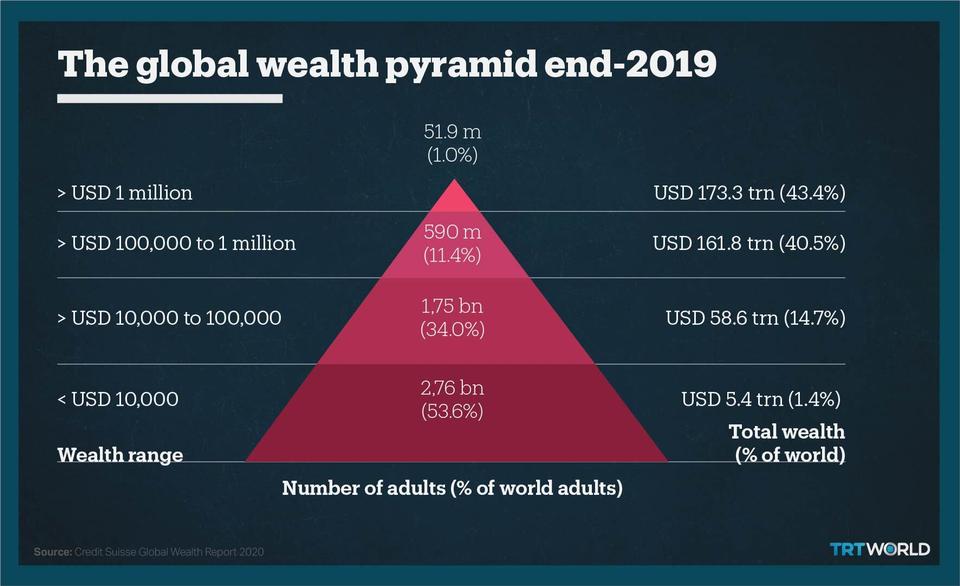
I think the utilitarian question is whether an additional 1200T in global wealth outweighs 35T of targeted assistance to the most vulnerable people in the world. If we look at the wealth distribution [3], the bottom 53% have 1.4% of the wealth. If that holds (which isn't necessarily a safe assumption, it could get worse), the bottom 53% would get 16T. Doesn't look so great compared to that 35T (probably targeted at the very bottom of that 53%), I admit. If we extend out to 200 years though, even these lines cross (if we make it that far :).
I think this tells me the most beneficial path forward is to maximize GDP growth while minimizing inequality to ensure that the fruits of that labor/growth help the vulnerable get food, not the rich buy another boat. That said, I think cutting global wealth by a factor of 3 in 100 years is not a great outcome. It would be like global wealth in 2020 being reverted back to that of 1980ish [4]. Life wasn't so different in the developed world then, but it was quite different outside of it (see [1]).
There is a valid criticism that perhaps the world doesn't need more wealth than that which can house, clothe, and feed everyone on earth. And we already produce that much wealth, it's just not distributed evenly enough to meet those needs. OTOH, what luxuries would you forgo to deliver those benefits? AC? Your laundry machine? Availability and quality of healthcare? We also need to motivate 8B people to continue working and producing the goods/services that yield a good life for everyone.
In the face of these questions, I don't find capitalism to be as evil as I once did when I was a bit younger. I don't mean to blindly support the invisible hand. The Keynesian approach balances government intervention ("distributions", above) with capital investment. My point is just that the trade-offs are not as simple as I once thought they were, and that growth is not the unmitigated evil many are eager to make it out to be.
> The concept of endless growth is a key ideological component of capitalism. Despite its devastating environmental and social consequences, growth for the sake of growth remains one of the main drivers of the global economy. Without it, the entire system comes crashing down like a gigantic house of cards.
I hear this a lot, but is it even true? Yes, our current system incentivizes increased consumption as a primary driver of growth. However, with the internet-era advent of 0-marginal cost goods/services, with extremely sublinear real-world resource usage (ie. electricity), aren't productivity increases just as valid a mode of growth as consumption increases? If we appropriately tax the consumptive inputs that feed an enterprise (eg. Carbon) isn't it reasonable to say that the growth of capital is not necessarily permanently hitched to the cart of otherwise limited real-world consumption?
This is a key part of my perspective that degrowth is not the only path forward. Innovation can yield us a carbon-neutral future. In the same vein, can't invention yield us an economy with fewer "devastating environmental and social consequences"?
It's incumbent upon us to price the negative externalities of consumption, not to abolish consumption entirely.
IANAEconomist, so I'd welcome critique on these points.

* Email/text/chat/social network? nope, people actually like communicating with other people * Google Maps/subway time app? nope, I don't want a generative model plotting me a "route" - that's what graph algorithms are for! * Video games? sure, levels may be generated, but I don't think games will just be "AI'd" into existence * e-reader, weather, camera apps, drawing apps? nope, nope, nope
I think there will be plenty of apps in our future.