Interview with Charlie Munger on Controversial UCSB Dorm(architecturalrecord.com)
architecturalrecord.com
Interview with Charlie Munger on Controversial UCSB Dorm
https://www.architecturalrecord.com/articles/15378-exclusive-interview-with-billionaire-charlie-munger-on-controversial-ucsb-dorm
316 comments
Charlie Munger seems like an insufferable asshole. I find it creepy a 97 year old wants to control the lives of 4,500 22-24 year old people, every year, for many years into the future basically for sport.
How is this different than any other billionaire? Perhaps allowing un-elected people to hoard and control such vast resources is simply incompatible with a democratic society...
Why is Bezos allowed to squash a tax to address homelessness? Why do Bill and Melinda gates dictate health policy for millions of people? And so on...
Why is Bezos allowed to squash a tax to address homelessness? Why do Bill and Melinda gates dictate health policy for millions of people? And so on...
He is giving the money, with conditions, and he is a 97yo, who at that age might have/might have not lost his mind.
The issue is that it is the university's administration that they are accepting those conditions. They shouldn't.
They are building something that looks dystopian, out of a Judge Dred movie. The administration should say: no thanks.
There are much better ways to deal with density without having to build such a compromised building.
The, no window in classrooms, is a very American thing. I have never seen a windowless classroom outside the US. In this case it is dorm rooms.
The issue is that it is the university's administration that they are accepting those conditions. They shouldn't.
They are building something that looks dystopian, out of a Judge Dred movie. The administration should say: no thanks.
There are much better ways to deal with density without having to build such a compromised building.
The, no window in classrooms, is a very American thing. I have never seen a windowless classroom outside the US. In this case it is dorm rooms.
To the best of my information, the use of that dorm is optional, there are other dorms with different prices and different drawbacks. The idea of "control" there seems completely absurd. Also that «for sport» applied to the conditions for participation is absurd: one only participates to projects one approves.
[deleted]
> But Munger didn’t return the favor. He said McFadden “reacted with his gut like an idiot. He didn’t look at the building intelligently.” In particular, he said, McFadden didn’t examine the models, which, he said, the chancellor would have happily shown him. “Everybody who sees the models goes ape-shit for them,” Munger said.
Incredible. This is the language of someone who has been surrounded by yes-men for so long that they’ve completely lost touch with how to be persuasive.
He can’t understand how anyone would disagree with his windowless dorm proposal because everyone in his near orbit has showered the idea with praise.
Incredible. This is the language of someone who has been surrounded by yes-men for so long that they’ve completely lost touch with how to be persuasive.
He can’t understand how anyone would disagree with his windowless dorm proposal because everyone in his near orbit has showered the idea with praise.
The man is 97 years old, and also one of the richest men in the world.
He has done so by maintaining an absolutely-no-fucks-given-get-straight-to-the-goddamn-point attitude.
He has done so by maintaining an absolutely-no-fucks-given-get-straight-to-the-goddamn-point attitude.
there are plenty of ppl with 'no fucks given' attitude who are far from rich
And plenty with both wealth and humility. I pity Munger and his victims.
For what it's worth, his other windowless student apartment building at the University of Michigan is rated 8.8/10, the highest on campus.
https://www.veryapt.com/ApartmentReview-a7222-munger-graduat...
https://www.veryapt.com/ApartmentReview-a7222-munger-graduat...
And all of the top reviews complain about the lack of windows. Even the positive reviews complain about the windows.
The top review is titled “No windows, no way”. The second review says it was great until COVID hit and they had to actually spend time in the windowless rooms.
Most of the positives seem to be about things like location and convenient access to other things, which has nothing to do with the architecture. The architecture is listed as the downside.
The top review is titled “No windows, no way”. The second review says it was great until COVID hit and they had to actually spend time in the windowless rooms.
Most of the positives seem to be about things like location and convenient access to other things, which has nothing to do with the architecture. The architecture is listed as the downside.
As a direct critique of the architecture, it's easy to shit on the building for lacking windows. But when taking a students budget and other tradeoffs into account it's actually one of the best places to live on campus.
Seems to me that HN users in this thread and UCS students aren't able to look past those tradeoffs.
As a student, I'm perfectly happy to have my own room with no windows. This is because (at least pre-covid when the facility was built), there's tons of stuff to do on campus and I won't be in my dorm room all that much anyway. The location is amazing. Even as an antisocial person, you get your own private space, which is something that many dorms don't provide on a budget. Yeah the lack of windows sucks, but I can live with it if it means I get my own private space and easy fast access to all the other things I need.
Seems to me that HN users in this thread and UCS students aren't able to look past those tradeoffs.
As a student, I'm perfectly happy to have my own room with no windows. This is because (at least pre-covid when the facility was built), there's tons of stuff to do on campus and I won't be in my dorm room all that much anyway. The location is amazing. Even as an antisocial person, you get your own private space, which is something that many dorms don't provide on a budget. Yeah the lack of windows sucks, but I can live with it if it means I get my own private space and easy fast access to all the other things I need.
> Seems to me that HN users in this thread and UCS students aren't able to look past those tradeoffs.
It seems like HN users (and architects) aren't even considering that those tradeoffs exist. It's like they want to design a building without any regard to land use, cost or how many students it serves.
I see no acknowledgement that:
1. UCSB is located on a narrow coastal plain, where land is at a premium.
2. Giving every bedroom a window implies blowing up the surface area/volume ratio of the building (so build it taller or build 2x or 3x as many buildings).
3. A bunch of long, skinny buildings requires more land (and probably more $) to house the same number of students as one borg cube.
Additionally, much of the criticism fails to acknowledge the actual design of the building.
Yes, each bedroom does not have a real window, but bedrooms are grouped into suites of 8, with a study area, kitchen and bathrooms... and that common space does have real windows!. An additional common area on each floor, shared among 8 suites, spanning the width of the building, has a wall covered with real windows!.
I agree that the borg cube is ugly, but I'd like to see the proposed alternative. The alternative needs to house the same number of students on the same amount of land and cost roughly the same amount. I don't think you can do the first two without building something 35 stories tall (more than twice the height of Storke Tower). And then you'll get the predictable comments about the "Manhattanization" of SB.
It seems like HN users (and architects) aren't even considering that those tradeoffs exist. It's like they want to design a building without any regard to land use, cost or how many students it serves.
I see no acknowledgement that:
1. UCSB is located on a narrow coastal plain, where land is at a premium.
2. Giving every bedroom a window implies blowing up the surface area/volume ratio of the building (so build it taller or build 2x or 3x as many buildings).
3. A bunch of long, skinny buildings requires more land (and probably more $) to house the same number of students as one borg cube.
Additionally, much of the criticism fails to acknowledge the actual design of the building.
Yes, each bedroom does not have a real window, but bedrooms are grouped into suites of 8, with a study area, kitchen and bathrooms... and that common space does have real windows!. An additional common area on each floor, shared among 8 suites, spanning the width of the building, has a wall covered with real windows!.
I agree that the borg cube is ugly, but I'd like to see the proposed alternative. The alternative needs to house the same number of students on the same amount of land and cost roughly the same amount. I don't think you can do the first two without building something 35 stories tall (more than twice the height of Storke Tower). And then you'll get the predictable comments about the "Manhattanization" of SB.
> bedrooms are grouped into suites of 8, with a study area, kitchen and bathrooms... and that common space does have real windows!
https://images.app.goo.gl/9s77YAvZXuEwEYaM6
This is the floorplan I could find. Where are the windows on the suites of house 4?
> The alternative needs to house the same number of students on the same amount of land and cost roughly the same amount.
Why? Did god gave us the number of students this university must accept? Sometimes the correct answer is that the question is wrong.
https://images.app.goo.gl/9s77YAvZXuEwEYaM6
This is the floorplan I could find. Where are the windows on the suites of house 4?
> The alternative needs to house the same number of students on the same amount of land and cost roughly the same amount.
Why? Did god gave us the number of students this university must accept? Sometimes the correct answer is that the question is wrong.
> This is the floorplan I could find. Where are the windows on the suites of house 4?
I stand corrected! I was going by the floorplan on the original article, which apparently didn't show the full building. You'd think that someone trying to make the point that it's a bad design would show the parts of the design that are actually bad.
> Why? Did god gave us the number of students this university must accept? Sometimes the correct answer is that the question is wrong.
Sure, that's a fair point, but then the problem isn't the building or its patron, so the criticism is misplaced.
I stand corrected! I was going by the floorplan on the original article, which apparently didn't show the full building. You'd think that someone trying to make the point that it's a bad design would show the parts of the design that are actually bad.
> Why? Did god gave us the number of students this university must accept? Sometimes the correct answer is that the question is wrong.
Sure, that's a fair point, but then the problem isn't the building or its patron, so the criticism is misplaced.
Well if that's the design I'd say just add 10 feet between the houses. Now every common space and 1/4 of the bedrooms can have windows.
This is a uniquely weird US PoV. Everywhere else in the world, university students as the adults they are, live in housing much like that of all other adults, maybe in self-organized groups. The whole problem starts with dorms.
Three of the 7 review "highlights" are positive and related directly to the design: "everyone gets their own bathroom", "spacious living area", and "best place to live in terms of value".
> Imagine how much praise it would receive if it had windows?
It would also be more expensive and have fewer rooms. In all likelihood, that would result in multiple people per room. All that makes the result unclear.
It would also be more expensive and have fewer rooms. In all likelihood, that would result in multiple people per room. All that makes the result unclear.
How? We can build rooms with Windows for less than 330 000$ per room. We don't even need to put multiple people per room at this price.
It's simple physics. If every bedroom has a window, the building needs to have a higher surface area to volume ratio.
The proposed building looks like a Borg Cube (maybe that's why architects don't like it?), but that's only possible because most bedrooms are not on exterior walls. Instead, each bedroom is part of a suite that opens to a common area that does have a real window!
If you take a look at the footprint of residential buildings, you'll notice that they are almost never square. In fact, they have a fairly high aspect ratio.
In the case of Santa Barbara, the major constraint is land. If you wanted to house the same number of students, you'd either need to make the building 2-3x taller or use 2-3x as much land. Otherwise the buildings would be so close that the real windows would get no natural light (but, hey, at least you'd have a real window).
The proposed building looks like a Borg Cube (maybe that's why architects don't like it?), but that's only possible because most bedrooms are not on exterior walls. Instead, each bedroom is part of a suite that opens to a common area that does have a real window!
If you take a look at the footprint of residential buildings, you'll notice that they are almost never square. In fact, they have a fairly high aspect ratio.
In the case of Santa Barbara, the major constraint is land. If you wanted to house the same number of students, you'd either need to make the building 2-3x taller or use 2-3x as much land. Otherwise the buildings would be so close that the real windows would get no natural light (but, hey, at least you'd have a real window).
Yes, it's not a problem to have a higher surface area to volume ratio. You can make a not so tall building with a budget of 330 000$ per room, by putting common area in the center.
The issue is not the aspect ratio. The issue is that Charlie is obsessed with having every room connected to a common space which is the one with natural light. It would be trivial to have a slightly higher aspect ratio, maybe one or two more floors, and have the common areas in the center.
The issue is not the aspect ratio. The issue is that Charlie is obsessed with having every room connected to a common space which is the one with natural light. It would be trivial to have a slightly higher aspect ratio, maybe one or two more floors, and have the common areas in the center.
[deleted]
> it's not a problem to have a higher surface area to volume ratio
Apparently the original article included only 1/8th of the building's floor plan. Another commenter linked me this floor plan: https://www.dezeen.com/2021/11/02/architect-resigns-grotesqu...
As you can see, the surface area problem even worse!
Each bedroom is 8x10 feet, but the building is only 87 * 4 by 200 * 2 feet. That's 1496 linear feet of exterior wall. That's only enough for 187 exterior rooms per floor, while the design calls for approximately 512 (8 rooms per suite * 8 suites per house * 8 housed per floor).
> It would be trivial to have a slightly higher aspect ratio, maybe one or two more floors
You'd need to add not just "one or two" more floors, but increase the residential part of the building from 9 floors to 24!. Even if you made very narrow (6 foot) rooms, it would still require 18 floors.
> You can make a not so tall building with a budget of 330 000$ per room
And they're paying over $1 million per bathroom! I consider this a fairly disingenuous comment because the article is clear that the building includes space for other things like convertible classrooms and rec areas.
Apparently the original article included only 1/8th of the building's floor plan. Another commenter linked me this floor plan: https://www.dezeen.com/2021/11/02/architect-resigns-grotesqu...
As you can see, the surface area problem even worse!
Each bedroom is 8x10 feet, but the building is only 87 * 4 by 200 * 2 feet. That's 1496 linear feet of exterior wall. That's only enough for 187 exterior rooms per floor, while the design calls for approximately 512 (8 rooms per suite * 8 suites per house * 8 housed per floor).
> It would be trivial to have a slightly higher aspect ratio, maybe one or two more floors
You'd need to add not just "one or two" more floors, but increase the residential part of the building from 9 floors to 24!. Even if you made very narrow (6 foot) rooms, it would still require 18 floors.
> You can make a not so tall building with a budget of 330 000$ per room
And they're paying over $1 million per bathroom! I consider this a fairly disingenuous comment because the article is clear that the building includes space for other things like convertible classrooms and rec areas.
Those living there who don't like it really don't like it. They could be a minority, that rating could be accurate otherwise... but I don't necessarily trust internet crowd ratings.
https://detroit.cbslocal.com/2021/11/03/heres-what-its-like-...
https://detroit.cbslocal.com/2021/11/03/heres-what-its-like-...
I certainly trust it more than that article.
Why?
I'm going to trust actual people quoted over an anonymous out-of-five rating site as being accurate and representative.
I'm going to trust actual people quoted over an anonymous out-of-five rating site as being accurate and representative.
That site has hundreds of people quoted and I don't trust the journalist to pick a representative sample, vs. focusing on the most negative or click-worthy takes.
Up to you. The article, though, also quotes a student who likes living there, and mentions the same 8.8 out of 10 rating that you mention. Perhaps that's just part of it's plan to appear balanced while actually misleading us.
Does anyone know if this dorm has the simulated window feature that the UCSB dorm has? No mention of it in the reviews that I can find so I'm guessing not. Either way, I wonder how far that goes to addressing the downside of no windows?
windowless is a piece of it. these are larger and have their own bathroom. this does not map well as as comparison.
and, for myself an essential differentiator, the University of Michigan's are for older grad students.
and, for myself an essential differentiator, the University of Michigan's are for older grad students.
This seems better for younger students than older.
There is a BIG difference, the existing high rated Michigan apartments linked do have windows in the living rooms, just the bedrooms are windowless[1]. While the new project have completely windowless apartments.
[1]https://www.mlive.com/resizer/er_cS_IEhTFMCZrSWuLnRZtwMEc=/8...
[1]https://www.mlive.com/resizer/er_cS_IEhTFMCZrSWuLnRZtwMEc=/8...

The Michigan building is a lot smaller and each bedroom has a private bathroom.
I'm not sure how I would respond if I were considering living in a windowless room for a bit less than a year. I think I might not like the idea, but I probably wouldn't make the lack of a window the only consideration.
I'm not sure how I would respond if I were considering living in a windowless room for a bit less than a year. I think I might not like the idea, but I probably wouldn't make the lack of a window the only consideration.
It’s Southern California. I went to school in Arizona. Pretty much everyone put foil over their dorm-room windows. My sister went to UCSB. Their house had blackout curtains.
As an adult, I adore windows. As a teenager and young adult, I wanted to sleep in after drinking too much or pulling an all nighter. (I passed this to a friend, an architect in Arizona. They think Munger’s spot on.)
It’s not a windowless building. It’s a building with windowless units. If someone really wants a window, they can get one. (Also, it’s UCSB. Most students move off campus after freshman year.)
As an adult, I adore windows. As a teenager and young adult, I wanted to sleep in after drinking too much or pulling an all nighter. (I passed this to a friend, an architect in Arizona. They think Munger’s spot on.)
It’s not a windowless building. It’s a building with windowless units. If someone really wants a window, they can get one. (Also, it’s UCSB. Most students move off campus after freshman year.)
Went to school at ASU, lived in Manzanita dorm. Can confirm, we had foil on our windows, too… but as much because the old building had weak air conditioning, though the sun could be brutal. More recent buildings at ASU have window treatments for variable sun conditions.
> More recent buildings at ASU have window treatments for variable sun conditions
Manzanita and Barrett. The latter, new. (And everyone had hacked the air conditioner controls to override the limiter on week one.) Still had foil. It’s hot and bright and even with dark skin I was frequently sunburned.
Manzanita and Barrett. The latter, new. (And everyone had hacked the air conditioner controls to override the limiter on week one.) Still had foil. It’s hot and bright and even with dark skin I was frequently sunburned.
Seems like if the school put exterior shades over the windows they could save on cooling.
> Their house had blackout curtains.
Most windows end up with coverings because it gives easy optionality.
Close the shades when you want it dark. Open them when you don’t.
Removing windows gives zero optionality.
Most windows end up with coverings because it gives easy optionality.
Close the shades when you want it dark. Open them when you don’t.
Removing windows gives zero optionality.
[deleted]
And this is the post of someone who doesn't know anything about Charlie Munger. If you think he has "been surrounded by yes-men for so long", I have some news for you. He doesn't manage anyone.
> And this is the post of someone who doesn't know anything about Charlie Munger.
“It’s okay actually because he always talks like this” is one of the weirdest arguments in this thread.
Why can’t we call out bad behavior just because it comes from a specific person?Bad behavior is bad behavior. Being consistent about being bad doesn’t make it good. I don’t understand why anything thinks this is okay just because it comes from a specific personality.
> If you think he has "been surrounded by yes-men for so long", I have some news for you. He doesn't manage anyone.
He’s dangling $1.2 billion dollars in front of people to get them to do his bidding with this construction. I really don’t understand how you think that’s less of an incentive than giving someone a paycheck a fraction of that magnitude.
“It’s okay actually because he always talks like this” is one of the weirdest arguments in this thread.
Why can’t we call out bad behavior just because it comes from a specific person?Bad behavior is bad behavior. Being consistent about being bad doesn’t make it good. I don’t understand why anything thinks this is okay just because it comes from a specific personality.
> If you think he has "been surrounded by yes-men for so long", I have some news for you. He doesn't manage anyone.
He’s dangling $1.2 billion dollars in front of people to get them to do his bidding with this construction. I really don’t understand how you think that’s less of an incentive than giving someone a paycheck a fraction of that magnitude.
The people he talks to are CEOs of architecture and engineering firms and university chancellors. If you think those are yes-men, I have more news for you. He's an investor. He doesn't have employees. He may have a few assistants but that's typical of any high-level (or even mid) professional. The yes-men bit about Munger is the last thing I would associate with Munger.
Weird take. The distinction you make between investor and manager completely ignores the context: he invests in yes-men, and doesn't invest in people who he deems idiots because they disagree with him. The common feature of 'manager' and 'investor' is that they have power.
Please name the yes-men. From which companies? Berkshire has a list of companies in its annual reports so I'm assuming you obviously can name the yes-men from your extensive research on Charlie Munger. This would be breaking news in the investment world and something that Warren Buffett doesn't know about.
I got one for ya. The chump building a prison-like dorm for $1.2B dollars with significant strings attached and only $200M in sugar.
He invests in yes men?
I must admit I probably don't know much about Charlie and Warren but if anything they seem to be bullshit detectors.
If he did invest in yes men, he would be broke, because they say yes all the time.
If he did invest in yes men, he would be broke, because they say yes all the time.
He’s only dangling $200M not $1.2B. The remainder is UCSB funded.
From the article: "Munger said he hadn’t decided how much of the building’s $1.2 billion cost he will cover, ..."
His way of saying "You'd better be nice to me"?
His way of saying "You'd better be nice to me"?
https://philanthropynewsdigest.org/news/charles-munger-pledg...
https://www.pacbiztimes.com/2021/11/02/ucsb-says-its-stickin...
This and more recent articles mention the 200M out of 1.2B.
https://www.pacbiztimes.com/2021/11/02/ucsb-says-its-stickin...
This and more recent articles mention the 200M out of 1.2B.
Or lets see what the final plan is before I commit to anything...
What bad behavior? He says what he thinks instead of bs'ing around and has huge track record of good decisions including his very high rated campus buildings.
We need more of that.
We need more of that.
> Surprisingly, he said he doesn’t believe universities should allow donors to choose architects. “If you allow the donor to pick the architect, which has been done in many places, the buildings look like shit. But this is a special case. I’ve been doing it for a long time and I know more about it. And I have a very good architect helping me, Navy F. Banvard [a principal at VTBS Architects], who’s one of California’s biggest apartment house architects.” VTBS is the architect of record for the project. [0]
> Munger said he based the dorm’s design on the Unité d'Habitation in Marseille by Le Corbusier. [0]
> Given that the concrete housing block [Unité d'Habitation] in question has also been known as ‘La Maison du Fada’, or the ‘House of the Crazy’, by local people and even residents with a sense of humour,[1]
> During the long phone interview, Munger said that with a large brood of children and grandchildren, he is “intimately familiar with university housing.” [0]
Local Nonagenarian billionaire, raised through the great depression, serving in World War II, somehow still allowed to make decisions concerning others. Whole world shocked.
[0] https://www.architecturalrecord.com/articles/15378-exclusive...
[1] https://www.bbc.com/culture/article/20130423-design-icon-or-...
> Munger said he based the dorm’s design on the Unité d'Habitation in Marseille by Le Corbusier. [0]
> Given that the concrete housing block [Unité d'Habitation] in question has also been known as ‘La Maison du Fada’, or the ‘House of the Crazy’, by local people and even residents with a sense of humour,[1]
> During the long phone interview, Munger said that with a large brood of children and grandchildren, he is “intimately familiar with university housing.” [0]
Local Nonagenarian billionaire, raised through the great depression, serving in World War II, somehow still allowed to make decisions concerning others. Whole world shocked.
[0] https://www.architecturalrecord.com/articles/15378-exclusive...
[1] https://www.bbc.com/culture/article/20130423-design-icon-or-...
> Munger said he based the dorm’s design on the Unité d'Habitation in Marseille by Le Corbusier.
And in typical LeCorb style: it’s a top-down design for little people who have no souls, to live like the people in charge think they ought. Personal space is unimportant; privacy is an afterthought, because your life is not important except as part of a unified collective, which we, the elites, will manage to our own ends.
Glorified common areas — dark and puny individual cells.
And in typical LeCorb style: it’s a top-down design for little people who have no souls, to live like the people in charge think they ought. Personal space is unimportant; privacy is an afterthought, because your life is not important except as part of a unified collective, which we, the elites, will manage to our own ends.
Glorified common areas — dark and puny individual cells.
No, it's the language of someone who's rational and so rich that he doesn't need to be persuasive (a.k.a. manipulative) to make people like him. He can instead say things exactly as they are, without concern for his approval ratings or the risk of getting cancelled.
The language of someone who's rational would respond to the issues raised by the interlocutor instead of just insulting him.
> The language of someone who's rational would respond to the issues raised by the interlocutor
Not necessarily. You are confusing social graces with rationality; rationality is optimized pursuit of one's own utility, not politeness.
Not necessarily. You are confusing social graces with rationality; rationality is optimized pursuit of one's own utility, not politeness.
Which happened in other contexts. There, he did not need to do differently and was just being concise.
Munger said McFadden would “go ape-shit” if he saw the models; McFadden did see all the material, including the models, and resigned. Munger is clearly unable to comprehend disagreement with himself, which is definitely not rational behaviour.
Think you’re missing the /s
No, Munger declared literally in the past that his best quality is to be «rational» and one of his best known recurrent expressions is, "you will agree with me, because you are smart and I am right".
I’m not disagreeing that he says that or that some people apparently find that endearing. It’s just hilarious to see it written out as an earnest sincere response.
Munger himself mention the thing while joking in public. For the rest, I am not sure about what you find hilarious, if the ground sincerity of the statement makes you react. Some are just confident.
> This is the language of someone who has been surrounded by yes-men for so long
Munger is an asshole, but that's not something that's happened over time - he's always been like that, there's the entire BRKB shareholders meeting records as tangible proof.
Munger is an asshole, but that's not something that's happened over time - he's always been like that, there's the entire BRKB shareholders meeting records as tangible proof.
Why are soo many people who have a proven track record in the markets going haywire? Zuck with his Metaverse, Elon with his Tesla Bot, Sam Altman „Lets scan every eyeball in the world“ now Charlie Munger with his windowless dorms. Is it just their ever-growing echo chambers of yes-men or has the flooding of the markets with money maybe gone too far to keep everyone honest/down to earth?
>Is it just their ever-growing echo chambers of yes-men
yes
yes
They can take chances on riskier more far out / potential technology. And they can actually make a go of it.
No, that is the language of somebody who does not need or want to speak differently than he thinks. And there is no hint that he does not understand the criticism he dismisses with his own good reasons.
Although, yes, that «Everybody who sees the models goes ape-shit for them» sounds a bit odd, off expected statistics.
Although, yes, that «Everybody who sees the models goes ape-shit for them» sounds a bit odd, off expected statistics.
[deleted]
Actually not a bad idea tbh. Of course that many students can’t have windows. The fact each student gets their own room is pretty sweet
This is ridiculous. In the UK it is accepted that all students get their own room, although they usually share facilities like bathrooms and kitchens etc. And they all have windows.
It is very different having a two week cruise, or working 9-5 in an office, but to have a windowless room as your only private space for 3 years+ is unhealthy and unfair on a segment of the community who get very little say in their living arrangements in any case.
This is a 98 year old man who thinks he is special because he is rich, and therefore everything he turns his hand to will be the best and damn those who disagree.
It is very different having a two week cruise, or working 9-5 in an office, but to have a windowless room as your only private space for 3 years+ is unhealthy and unfair on a segment of the community who get very little say in their living arrangements in any case.
This is a 98 year old man who thinks he is special because he is rich, and therefore everything he turns his hand to will be the best and damn those who disagree.
Consider that UCSB might not have enough space/money to provide each student with their own window.
Also, it’ a Santa Barbara. You get enough sun in Santa Barbara, and don’t have sunless winters. If this were proposed in e.g. New York, I would object.
So... they already did it in southeastern michigan, which I don't think is any warmer or brighter in the winter than new york.
https://detroit.cbslocal.com/2021/11/03/heres-what-its-like-...
https://detroit.cbslocal.com/2021/11/03/heres-what-its-like-...
Pray tell, how does this sunlight make it into the windowless rooms?
At UCSB many (most?) students live in private housing after 1 or two years.
It seems possible university requirements for this will change, if part of the motive for this construction is [from OP] that "UCSB is experiencing a severe housing shortage and is being pressured by area residents to build new dormitories" -- seems like it doesn't meet that pressure unless they increase the number of students living on campus, right?
They're going to have to fill those 4500 beds (about 20% of the total undergraduate enrollment of UCSB) once they're built... seems safe to assume one way or another the portion of students living on-campus will increase significantly once this dorm is built.
They're going to have to fill those 4500 beds (about 20% of the total undergraduate enrollment of UCSB) once they're built... seems safe to assume one way or another the portion of students living on-campus will increase significantly once this dorm is built.
It's also of note that private housing like this (or even more traditional dormitories) would be illegal in either Santa Barbara or Goleta; boarding houses are nearly impossible to get through zoning. Which would certainly make it more affordable for young, unmarried people to live in the area (who currently commute from Ventura, Solvang or Buelton).
Presumably this project is an attempt to address that
It's definitely possible for every room to have its own window. There's a well known solution to this: the courtyard.
I just stayed in the middle of Manhattan in London Terrace, in a one bedroom apartment where the living room, bedroom, kitchen, AND bathroom ALL HAD WINDOWS. This is rare in Manhattan (and in most parts of the country), simply because architects/owners decided to cut costs.
London Terrace is an entire city block of buildings designed around a big courtyard in the middle. I learned first hand what "pre-war" means :) Pre-war means "expensive apartments that people like because nobody builds them like this anymore". (It's not perfect, and I decided not to live there, but it has many good points)
https://en.wikipedia.org/wiki/London_Terrace
It was one of the biggest apartment buildings in the world at the time of construction (1930's). It has 1700 apartments, and every apartment has 3 or more rooms, so it's probably bigger than the 4500-room Munger building.
You obviously sacrifice density, but I can't imagine how that's a problem in Santa Barbara vs. Manhattan! You can build higher, or you can build 2 buildings on different sites rather than 1.
It's obviously more expensive than making a big storage cube, but I would argue it's worth it. And Munger could obviously afford it. Not sure why he would put his name on such a building.
I just stayed in the middle of Manhattan in London Terrace, in a one bedroom apartment where the living room, bedroom, kitchen, AND bathroom ALL HAD WINDOWS. This is rare in Manhattan (and in most parts of the country), simply because architects/owners decided to cut costs.
London Terrace is an entire city block of buildings designed around a big courtyard in the middle. I learned first hand what "pre-war" means :) Pre-war means "expensive apartments that people like because nobody builds them like this anymore". (It's not perfect, and I decided not to live there, but it has many good points)
https://en.wikipedia.org/wiki/London_Terrace
It was one of the biggest apartment buildings in the world at the time of construction (1930's). It has 1700 apartments, and every apartment has 3 or more rooms, so it's probably bigger than the 4500-room Munger building.
You obviously sacrifice density, but I can't imagine how that's a problem in Santa Barbara vs. Manhattan! You can build higher, or you can build 2 buildings on different sites rather than 1.
It's obviously more expensive than making a big storage cube, but I would argue it's worth it. And Munger could obviously afford it. Not sure why he would put his name on such a building.
Of course they can.
Instead of building one building with gigantic floorplates build half a dozen with smaller floorplates optimised to give each room a window. If that reduces the overall floor area just add a few more floors on top.
Instead of building one building with gigantic floorplates build half a dozen with smaller floorplates optimised to give each room a window. If that reduces the overall floor area just add a few more floors on top.
And they rarely need to leave with the Costco and the night club on the roof.
I had my own room in college, with a large bedroom window and then a living room and bathroom I shared with one other person. You don't need a shipping container approach to living to get your own room.
At my university (in France) we all had a room with a big window and a balcony, and a shared shower for two (each room had a door to the same shower, so you could go from one room to the other through the shower). The bathrooms were for the whole floor. It was very nice, if a little unusual.
[deleted]
I worked at a startup where the CEO thought everybody wanted "light" and put windows all around the offices. It was terrible. Everybody who worked on computers all day had a hard time. When I was in college, I would have killed for a simple room where I could close and lock the door and have no external light pollution.
Blinds are far less expensive than windows. It doesn’t make sense for a company to put windows everywhere but then not be able to afford some cheap window coverings. Every window-covered office I’ve ever worked in has had roller shades that were very effective at controlling glare. They’re even electronic so they can be automated. It’s not difficult or expensive.
As a counterpoint, I worked at a company where the engineering manager thought all engineers wanted to work I dark caves, so that’s what we got.
Except most adults don’t want to work in dark caves so a lot of us ended up working from the common spaces to be exposed to some natural light. Eventually we ended up working from home because there was no way I could last in a dark cave every single day.
> When I was in college, I would have killed for a simple room where I could close and lock the door and have no external light pollution.
Blocking out light is easy. Put up curtains or a sheet.
But you can’t go the other way. There’s no way to add natural light, exterior views, and opportunity for fresh air after the building has been constructed.
With windows, everyone can choose. Without windows, there is no choice.
As a counterpoint, I worked at a company where the engineering manager thought all engineers wanted to work I dark caves, so that’s what we got.
Except most adults don’t want to work in dark caves so a lot of us ended up working from the common spaces to be exposed to some natural light. Eventually we ended up working from home because there was no way I could last in a dark cave every single day.
> When I was in college, I would have killed for a simple room where I could close and lock the door and have no external light pollution.
Blocking out light is easy. Put up curtains or a sheet.
But you can’t go the other way. There’s no way to add natural light, exterior views, and opportunity for fresh air after the building has been constructed.
With windows, everyone can choose. Without windows, there is no choice.
There's a limited amount of exterior wall space. If you give the bedrooms windows then that pushes the living space to the interior and makes it window less.
That's how my freshman dorm was. Moving exterior to interior it was bedrooms, study space, and then a shared living room. The result was windows in the bedroom, where they were mostly covered with blinds, and no windows in the living area.
That's the wrong compromise. You want the light in the living areas where people are spending their days. Of all the different trade offs windowless bedrooms is 100% the right call.
That's how my freshman dorm was. Moving exterior to interior it was bedrooms, study space, and then a shared living room. The result was windows in the bedroom, where they were mostly covered with blinds, and no windows in the living area.
That's the wrong compromise. You want the light in the living areas where people are spending their days. Of all the different trade offs windowless bedrooms is 100% the right call.
> There's a limited amount of exterior wall space.
So add courtyards. Or build an E shaped building. Or build multiple smaller buildings.
You know, the things we do for other large institutional buildings like hospitals and dorms.
So add courtyards. Or build an E shaped building. Or build multiple smaller buildings.
You know, the things we do for other large institutional buildings like hospitals and dorms.
Sure, but those all come with increased construction cost and less efficient land usage.
Someone who can afford to invest one point five billion US dollars into a single student's dorm is under little pressure to be efficient, one would think.
> There's a limited amount of exterior wall space. If you give the bedrooms windows then that pushes the living space to the interior and makes it window less.
Or maybe you just make the floorplates smaller to increase the ratio of exterior walls to floor area like most residential buildings.
Or maybe you just make the floorplates smaller to increase the ratio of exterior walls to floor area like most residential buildings.
I work with computers 10 hours a day and I love having natural light. It kind of conects me with the real world and makes me feel better.
I live in a wooded area on a beautiful stream, and my house is full of giant windows. I still spend 10+ hours/day working and relaxing in the dark underground utility room, because that lets me control the light, and I’m only looking at the screen anyway.
Have you considered:
1. joining any one of the other 99.9% of companies where the CEO is not a sun worshipper?
2. if (1) not an option, using blinds?
1. joining any one of the other 99.9% of companies where the CEO is not a sun worshipper?
2. if (1) not an option, using blinds?
blinds don't work in a large open office. a small number of people want them open, a small number of people want them closed, and the rest of the people just want to get their job done.
blinds also don't produce the sort of light I want to work with. My preference would be no natural light, and only indirect diffused lighting for general illumination and point lights where I'm working with my hands.
blinds also don't produce the sort of light I want to work with. My preference would be no natural light, and only indirect diffused lighting for general illumination and point lights where I'm working with my hands.
Blinds literally work in a large office space. I work in such a space now. We get direct sunlight most of the year. If it’s too bright, people just go up to the window and put up the blinds. If it’s an overcast day, sometimes the blinds are up, sometimes they’re down, just based on any random person’s whim. As I said above, if you work in a place that literally makes the room so bright that you can’t see your screen, the solution is probably not to argue about your ideal setup with strangers on HN, but rather to have a conversation with your coworkers and make it so you can actually see your screen.
george carlin?
No, just personal experience. When I worked at Uber, the main office was so big that it meant that large parts of the office were dark. Some teams, like, super critical to the core business and highly compensated paid teams, actually hung a bunch of plants in their area as a way to cope with not seeing sunlight.
Someone going on a rant about how miserable they were about having too much sunlight, while at the same time being incapable of applying incredibly common trivial solutions to solve this calamity - I found this quite silly and it made me a bit upset.
Someone going on a rant about how miserable they were about having too much sunlight, while at the same time being incapable of applying incredibly common trivial solutions to solve this calamity - I found this quite silly and it made me a bit upset.
You’re describing an office, not a living space.
The building has all the charm of a temperature-controlled storage facility, which sadly, is what it seems to be.
Office buildings have the same layouts with windows at the ends and cubicles in the middle. I doubt the patrons feel stuck in a temperature storage facility. I prefer Munger's layout after looking more into it.
https://www.architecturalrecord.com/ext/resources/news/2021/...
https://www.architecturalrecord.com/ext/resources/news/2021/...
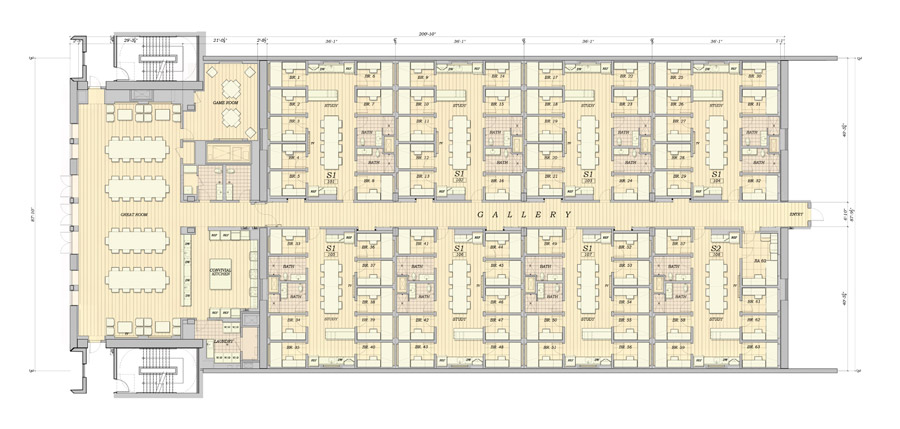
IMHO it's a terrible layout but not for the lack of windows in bedrooms. The pod shared space is basically useless. Why do students on a meal plan need a full kitchen? What are they going to do with a single big table? Why use 1/2 of each pods exterior wall for windowless bedrooms?
The common space should be the entire exterior wall. It should be a living room instead of a kitchen/table combo.
The proportions are off too, IMHO. The pod living spaces are too small and the great rooms too big.
The common space should be the entire exterior wall. It should be a living room instead of a kitchen/table combo.
The proportions are off too, IMHO. The pod living spaces are too small and the great rooms too big.
> I doubt the patrons feel stuck in a temperature storage facility.
They also aren't living in a windowless box. They still likely get natural light in their cubicles.
They also aren't living in a windowless box. They still likely get natural light in their cubicles.
It’s Southern California. I went to school in Arizona, and pretty much everyone put foil over their dorm-room windows. My sister went to UCSB. Their house had blackout curtains.
This building won’t win any architectural awards. But the idea makes sense and the objections don’t stand given the tradeoffs (fewer rooms, multiple students per room and/or higher cost) they would require.
This building won’t win any architectural awards. But the idea makes sense and the objections don’t stand given the tradeoffs (fewer rooms, multiple students per room and/or higher cost) they would require.
>tradeoffs (fewer rooms, multiple students per room and/or higher cost) they would require
You can increase the house plan from 22 windowed rooms (counting the double room twice) to 32 without changing the shape of the building by moving 4 of the dorm blocks to the other side of the multipurpose room and not having one of the washrooms face outside. That would also reduce the distance from the dorm rooms to the multipurpose room/staircase. Design's just bad.
Unrelated to the windows, it's also weird that the bathrooms from adjacent dorm blocks aren't back-to-back so that they could easily share plumbing.
You can increase the house plan from 22 windowed rooms (counting the double room twice) to 32 without changing the shape of the building by moving 4 of the dorm blocks to the other side of the multipurpose room and not having one of the washrooms face outside. That would also reduce the distance from the dorm rooms to the multipurpose room/staircase. Design's just bad.
Unrelated to the windows, it's also weird that the bathrooms from adjacent dorm blocks aren't back-to-back so that they could easily share plumbing.
My main thought is that with 150,000 Californians sleeping in the streets tonight, all new housing is good housing.
Also, the outrage here happened to go viral, which makes the discussion turn stupid.
Also, the outrage here happened to go viral, which makes the discussion turn stupid.
Or the many UCSB students who withdraw from college because of housing, or sleep in their cars.
https://www.kcrw.com/news/shows/greater-la/van-life-street-m...
https://www.kcrw.com/news/shows/greater-la/van-life-street-m...
Munger is suggesting a more expensive but less durable housing solution. The money was going to make housing anyways, he is using his influence insofar as clout and 17% of the funding to make buildings that most people won't be able to live in for very long, at prices that are higher than normal.
It's a loss even on those terms.
It's a loss even on those terms.
> he expects the 4,500-room building to be copied all over the country
Incredible move to make huge claims like this and then, presumably (he’s 97), die before you have the chance to be proven wrong.
Incredible move to make huge claims like this and then, presumably (he’s 97), die before you have the chance to be proven wrong.
[deleted]
> He said (...) "Nobody minds going into a basement restroom and peeing because there’s no window".
We don't mind peeing in a windowless room because we spend so little time there. Why does he think restrooms and bedrooms are the same? Being disingenuous on this level is just being stupid.
We don't mind peeing in a windowless room because we spend so little time there. Why does he think restrooms and bedrooms are the same? Being disingenuous on this level is just being stupid.
After reading his interview, I feel much better about what Munger says about bitcoin. If he is so wrong here...
He also paid for the dorm at the Stanford Law School 15 yrs back. He insisted that the single occupancy rooms for the law students will be very large. The University pushed back saying that neither Stanford, nor students who will pay larger rent, will be able to afford that. Munger said that you could cut these rooms in half later, if you so desire. His argument was that the smaller rooms would be harder to cut in half later. I suppose that’s right.
He also paid for the dorm at the Stanford Law School 15 yrs back. He insisted that the single occupancy rooms for the law students will be very large. The University pushed back saying that neither Stanford, nor students who will pay larger rent, will be able to afford that. Munger said that you could cut these rooms in half later, if you so desire. His argument was that the smaller rooms would be harder to cut in half later. I suppose that’s right.
[deleted]
Munger is something else. His opinions are almost that of a child. One could wager that it's due to his age, but he actually seems pretty sprite, so to speak, for his age, so I think he's just like that. Since the resignation article came out, I've watched some interviews with him, and he has unbridled confidence that the thing he's saying is right, and all the comments fawn over him. It isn't hard to understand how he's gotten to be this way.
Some quotes of his:
> “You’ve got to get used to the fact that billionaires aren’t the most popular people in our society,” he told MarketWatch. “I’d rather be a billionaire and not be loved by everybody than not have any money.”
I honestly struggle to understand what he means by this, but I have a hunch it's not good.
> “Everybody loves light and everybody prefers natural light. But it’s a game of tradeoffs,” Munger said in an interview. “If you build a big square building, everything is conveniently near to everybody in the building. If you maximize the light, you get fewer people in the building.”
Ahh, the maximal packing version of architecture.
> “What I learned was how stupid I was. Imagine taking years to decide that the kids should get their own bedroom.”
Plenty of designs allow students their own room. The fact that he considers this a design leap is problematic.
> “If this building fails, it will be the first Munger building that fails."
No introspection.
I think what is the sickest thing is the UCSB Chancellor's comment:
> UCSB Chancellor Henry T. Yang has called Munger’s proposal an “inspired and revolutionary” design that will offer “an unprecedented residential experience.”
What a sycophant.
Some quotes of his:
> “You’ve got to get used to the fact that billionaires aren’t the most popular people in our society,” he told MarketWatch. “I’d rather be a billionaire and not be loved by everybody than not have any money.”
I honestly struggle to understand what he means by this, but I have a hunch it's not good.
> “Everybody loves light and everybody prefers natural light. But it’s a game of tradeoffs,” Munger said in an interview. “If you build a big square building, everything is conveniently near to everybody in the building. If you maximize the light, you get fewer people in the building.”
Ahh, the maximal packing version of architecture.
> “What I learned was how stupid I was. Imagine taking years to decide that the kids should get their own bedroom.”
Plenty of designs allow students their own room. The fact that he considers this a design leap is problematic.
> “If this building fails, it will be the first Munger building that fails."
No introspection.
I think what is the sickest thing is the UCSB Chancellor's comment:
> UCSB Chancellor Henry T. Yang has called Munger’s proposal an “inspired and revolutionary” design that will offer “an unprecedented residential experience.”
What a sycophant.
You can’t figure out why he’d personally rather be a billionaire and not be liked by everyone vs. not have any money? Which would you prefer?
The people who are so negative about this are completely unrealistic. UCSB is putting students in off-campus hotels right now. There is an incredible housing shortage. Munger is taking a very tangible step to fix it. Some students there live in their cars (plenty of windows, I suppose) Give me a break.
The people who are so negative about this are completely unrealistic. UCSB is putting students in off-campus hotels right now. There is an incredible housing shortage. Munger is taking a very tangible step to fix it. Some students there live in their cars (plenty of windows, I suppose) Give me a break.
> Munger is taking a very tangible step to fix it.
He could just donate the money without trying to micromanage the project. That would help fix the housing shortage just as well.
He could just donate the money without trying to micromanage the project. That would help fix the housing shortage just as well.
You don't think setting out a dichotomy of either "being a billionaire" or "not having any money" is a just a tad narrow-minded?
Sure, tangible steps are nice. Even hobbyist billionaire architects are capable of taking tangible steps because it's quite a low bar to clear.
I do find it a bit ridiculous that you call any opposition to the plan "unrealistic", as though Munger is the only architect in the world who can save UCSB from its housing problem.
Sure, tangible steps are nice. Even hobbyist billionaire architects are capable of taking tangible steps because it's quite a low bar to clear.
I do find it a bit ridiculous that you call any opposition to the plan "unrealistic", as though Munger is the only architect in the world who can save UCSB from its housing problem.
[deleted]
Seems like a false dichotomy. I'd trade 999 thousandths of those billions to not be unlikable.
Also, they truly exhausted all other options?
Also, they truly exhausted all other options?
No idea why this got downvoted but this is exactly it. Also what's the point of getting a teeny sliver of money for "free" (read: by waiving your right to an opinion) when the entire project is demonstrably rather expensive to start with?
He and warren buffet both strike me, as a huge fan of buffet, as being incomplete humans somehow. They are like characters in a role playing game where you put all your points into “business intelligence” and severely neglected everything else. Then they grew up in an insulated bubble just thinking about money 24/7 their whole lives. Buffet himself said something along the lines of “if I was born at any other time in history I’d be eaten by an animal for lunch”. Jordan Peterson also made a good point about the very wealthy…why do we ask why there aren’t more billionaires instead of asking why some people are willing to do nothing but work 24/7 their whole lives for success. These are not people we should demean or aspire to be in my opinion. They are not healthy mentally.
Do you really struggle to understand what he means there? It's not exactly cryptic.
The implication that you have two choices, either zero dollars or a billion, isn't hard to understand because it's cryptic. It's hard to understand because it's completely irrational.
It was not in an essay. The implication was rhetorical, not logic. And, the context being missing, it could even have made sense there.
> Plenty of designs allow students their own room. The fact that he considers this a design leap is problematic.
I believe the architect, who resigned and wrote the letter he’s reacting to, suggested this as a compromise for getting every room a window.
I believe the architect, who resigned and wrote the letter he’s reacting to, suggested this as a compromise for getting every room a window.
Of course. If you want to have his vision of a building where students are forced to spend 90% of their waking hours in mixed spaces, and have all of those spaces in the same floor, and have windows in every room, you need to have two students per room.
If you go for a traditional design that isn't trying to force students into mixed spaces that are inside the same floor, but instead placing these mixed spaces inside different floors or different buildings, you can have every room in the same building.
If you go for a traditional design that isn't trying to force students into mixed spaces that are inside the same floor, but instead placing these mixed spaces inside different floors or different buildings, you can have every room in the same building.
> “You’ve got to get used to the fact that billionaires aren’t the most popular people in our society,” he told MarketWatch. “I’d rather be a billionaire and not be loved by everybody than not have any money.”
> I honestly struggle to understand what he means by this, but I have a hunch it's not good.
I think it's pretty clear. He doesn't give a rat's ass about what people think of him, he has enough money for him not to care. Good for him, I guess. The problem begins when these sociopaths try to impose their views on other people, and esp. if they want to "help".
We should not encourage them with tax deductions or other incentives.
Taxes good, charity bad.
> I honestly struggle to understand what he means by this, but I have a hunch it's not good.
I think it's pretty clear. He doesn't give a rat's ass about what people think of him, he has enough money for him not to care. Good for him, I guess. The problem begins when these sociopaths try to impose their views on other people, and esp. if they want to "help".
We should not encourage them with tax deductions or other incentives.
Taxes good, charity bad.
I agree with you, but I think it's actual deeper than him just not caring about what people think of him. I think it's more deeply engrained narcissism in that he doesn't trust others' expertise or opinions, thinks he's the chosen one of being right, and ultimately just likes the control he can wield over others.
Okay but now you're just making things up about him that he never said or implied. You are welcome to have whatever opinion of him you want, but it has nothing to do with his quote about preferring to be wealthy and unpopular over being popular but not wealthy.
> But Munger didn’t return the favor. He said McFadden “reacted with his gut like an idiot.
Actually taking a place of a qualified professional when you don't know shit, being infatuated and calling a professional who is showing you the mistakes you made, an idiot, makes you look like an idiot.
I wouldn't actually say that Munger is an idiot, I don't think an idiot can make that much money. Idiot no, infatuated yes.
Actually taking a place of a qualified professional when you don't know shit, being infatuated and calling a professional who is showing you the mistakes you made, an idiot, makes you look like an idiot.
I wouldn't actually say that Munger is an idiot, I don't think an idiot can make that much money. Idiot no, infatuated yes.
This is the original source of the interview:
https://www.cbc.ca/radio/asithappens/as-it-happens-the-tuesd...
Some quotes:
What would you say to [Denis McFadden] if you had the chance?
Well, if he knew more about it, he would have had more correct conclusions.
What else does he have to know, in your view?
The reason this building is the way it is, is because there are enormous advantages in having a lot of undergraduates conveniently near one another and conveniently near everything else they like to be near.
The logical way to do that is to make a building in a big footprint and devote the top floor of it — which is a penthouse floor normally given to rich people, you know, for condos — and give that to the students as their common space, and to put a certain amount of academic space into that gigantic top floor with all the light and air and so forth.
And so it's just that it was so novel, he's never seen that done, and he doesn't like it when it's different from what he's used to.
https://www.cbc.ca/radio/asithappens/as-it-happens-the-tuesd...
Some quotes:
What would you say to [Denis McFadden] if you had the chance?
Well, if he knew more about it, he would have had more correct conclusions.
What else does he have to know, in your view?
The reason this building is the way it is, is because there are enormous advantages in having a lot of undergraduates conveniently near one another and conveniently near everything else they like to be near.
The logical way to do that is to make a building in a big footprint and devote the top floor of it — which is a penthouse floor normally given to rich people, you know, for condos — and give that to the students as their common space, and to put a certain amount of academic space into that gigantic top floor with all the light and air and so forth.
And so it's just that it was so novel, he's never seen that done, and he doesn't like it when it's different from what he's used to.
He's trying to get credit for... not giving the top floor of a student doorm to rich people as a penthouse?
Are there other student dorms where the top floor is given to rich people for penthouse condos?
Are there other student dorms where the top floor is given to rich people for penthouse condos?
The rules of HN say you should give the most charitable interpretation to another’s comments, not the least.
In this case it would be instead of having premium student dorms on the top floor for wealthier students, or rooms for the student dorm administrators, instead every student gets access to that penthouse common space.
In this case it would be instead of having premium student dorms on the top floor for wealthier students, or rooms for the student dorm administrators, instead every student gets access to that penthouse common space.
> In this case it would be instead of having premium student dorms on the top floor for wealthier students, or rooms for the student dorm administrators, instead every student gets access to that penthouse common space.
I've never seen any dorms with "premium" student housing, let alone mixed in the building. There are certainly (especially older) dorms with more desirable rooms, but they were never "premium" or unavailable to any student.
I've never seen any dorms with "premium" student housing, let alone mixed in the building. There are certainly (especially older) dorms with more desirable rooms, but they were never "premium" or unavailable to any student.
Do the rules extend to people who are interviewed in articles, and never comment on HN?
It would be interesting if Charlie Munger were an HN commenter!
That's not in any way what he is saying there. He is saying open space on a top floor is great and one idea is to make that a common space.
> “It’s all about the happiness of the students. We want to keep the suicide rate low.”
If he's trying to come off as not out of touch... it's not working.
If he's trying to come off as not out of touch... it's not working.
His proposed building looks like an American Kowloon Walled City lol
Fun fact. I used to work in the Kowloon Walled City. It's really not anything like it.
would like to know a bit more ... how was it working there?
I worked in Hong Kong as a missionary from 1988 to 1990, and part of that time was spent in Kowloon City (a region of Hong Kong which contained the Kowloon Walled City). The Kowloon Walled City largely consisted of a large block of walk-up highrises so close to one another than there was no ventilation. The way you got into it was through what I'd describe as rat tunnels snaking underneath the buildings. The actual living environment was horrific. We'd often try to find out how to get up to the roof of the locally tallest building and watch the airplanes fly overhead and land at nearby Kai Tak airport. They were so close you could probably hit them with a rock.
One particularly vivid memory I have is of the illegal dental offices which ringed the outside street level. These shops all had skulls in the windows with teeth showing their handiwork.
I recently went back to visit the place -- the city had been torn down, revealing the original historic garrison at the center, and it's now a lovely park. When I was there the garrison was kid of like a little quad in the middle of the City where nobody dared build: many people thought it was originally a temple (it wasn't).
One particularly vivid memory I have is of the illegal dental offices which ringed the outside street level. These shops all had skulls in the windows with teeth showing their handiwork.
I recently went back to visit the place -- the city had been torn down, revealing the original historic garrison at the center, and it's now a lovely park. When I was there the garrison was kid of like a little quad in the middle of the City where nobody dared build: many people thought it was originally a temple (it wasn't).
There are windows at the ends, so not entirely windowless[1]. The layout is brilliant to be honest and I would have preferred my own space (especially as an introvert) than a traditional dorm room.
[1] https://www.architecturalrecord.com/ext/resources/news/2021/...
[1] https://www.architecturalrecord.com/ext/resources/news/2021/...
But why not having big windows just above the kitchens? This would provide natural light for the common areas, for the tables which can be used for studying, and for natural light for the bedrooms provided either the door is open or the bedroom door has some "obfuscating glass" part.
There are windows only on one side, and that is an extreme waste. If windows were placed on the longer sides, the "natural light" problem would have greatly diminished.
(In fact, I would also have placed windows in the bedrooms alongside the perimeter walls. Those who want the window get it, those who do not prioritize them will choose differently and maybe pay for a cheaper room.)
There are windows only on one side, and that is an extreme waste. If windows were placed on the longer sides, the "natural light" problem would have greatly diminished.
(In fact, I would also have placed windows in the bedrooms alongside the perimeter walls. Those who want the window get it, those who do not prioritize them will choose differently and maybe pay for a cheaper room.)
People want the standard of living everyone had in the US decades ago, it costs much more now.
There are more people, more competition, and things are much more expensive. He’s bringing a realistic solution given today’s capacity problems and a bias towards not wanting to share rooms.
He’s 97 with nothing to lose and it sounds like he doesn’t care about his legacy.
Honestly I think the solution is realistic and people don’t like it because they don’t want to acknowledge their quality of life is in decline when it comes to housing for themselves and their children.
There are more people, more competition, and things are much more expensive. He’s bringing a realistic solution given today’s capacity problems and a bias towards not wanting to share rooms.
He’s 97 with nothing to lose and it sounds like he doesn’t care about his legacy.
Honestly I think the solution is realistic and people don’t like it because they don’t want to acknowledge their quality of life is in decline when it comes to housing for themselves and their children.
> People want the standard of living everyone had in the US decades ago, it costs much more now.
I think you are right. But all the CPI data and real income data says people are much richer than 40 years ago. And as someone who has spent a lot of time digging through the methodology of these time series, I don't see any bias or obvious error that should make me suspect the government data.
Then the next step is to say "yes, a car of today is much better than a car sold in 1980, so in real terms, maybe cars are cheaper but you can't buy those cheap cars now." But if you really think about it, that's not true, either. You can still buy cheap cars, for example used cars, that will last longer as they are better built. You can still buy cheap housing, just in a different location. Remember there were no mobile phones in the 1980s, no internet, no personal computers, etc. But if you want to live like someone in the 1980s, you can do that and have more money left over than someone would have in the 1980s.
So you point me to one thing and I will show you how, with today's income, you can get it at same or better quality and have more money left over than if it was 1980. Except healthcare, you can't get the cheaper version of healthcare from the 1980s (since that would be illegal). But other than that, you really can, and you can't pin the entire difference on healthcare.
The best I can think of is a vague notion that people have lost the skills to be able to live like they did 40 years ago, possibly because being able to live like that requires some community support, and we don't have that support anymore. As one data point, take the Amish, who live like they did 200 years ago. And they are not poorer. But they make sacrifices to live like that as an entire community. If an individual tried to do it on their own, they would fail. For one thing, no one would marry them once they found out about the lack of electricity and 18th Century amenities.
But I'm not too happy with this characterization, either. It's something that still puzzles me.
I think you are right. But all the CPI data and real income data says people are much richer than 40 years ago. And as someone who has spent a lot of time digging through the methodology of these time series, I don't see any bias or obvious error that should make me suspect the government data.
Then the next step is to say "yes, a car of today is much better than a car sold in 1980, so in real terms, maybe cars are cheaper but you can't buy those cheap cars now." But if you really think about it, that's not true, either. You can still buy cheap cars, for example used cars, that will last longer as they are better built. You can still buy cheap housing, just in a different location. Remember there were no mobile phones in the 1980s, no internet, no personal computers, etc. But if you want to live like someone in the 1980s, you can do that and have more money left over than someone would have in the 1980s.
So you point me to one thing and I will show you how, with today's income, you can get it at same or better quality and have more money left over than if it was 1980. Except healthcare, you can't get the cheaper version of healthcare from the 1980s (since that would be illegal). But other than that, you really can, and you can't pin the entire difference on healthcare.
The best I can think of is a vague notion that people have lost the skills to be able to live like they did 40 years ago, possibly because being able to live like that requires some community support, and we don't have that support anymore. As one data point, take the Amish, who live like they did 200 years ago. And they are not poorer. But they make sacrifices to live like that as an entire community. If an individual tried to do it on their own, they would fail. For one thing, no one would marry them once they found out about the lack of electricity and 18th Century amenities.
But I'm not too happy with this characterization, either. It's something that still puzzles me.
I like Munger but I am certainly not one of those worships him nor one of those who calls him Bill Gates' lawyer (those who knows knows).
Reading through the article and the comments, I can only say it is his money and it should be a wakeup call for the college and the state of California. He has a vision of where and how he wants to spent his money and you can either accept it or not. Super rich people don't donate, they invest in social causes where their views are reflected in the long term and the goals are often not obvious. This is a very long discussion but that is how I see it.
Nothing is stopping the college to move around funds and having a tighter grip on the administrative expenses so they can invest not wisely but rather opinionatedly into projects. The mounting student debt on one side and the hypocratic song and dance to please billionaires for handouts is simply ridiculous.
Reading through the article and the comments, I can only say it is his money and it should be a wakeup call for the college and the state of California. He has a vision of where and how he wants to spent his money and you can either accept it or not. Super rich people don't donate, they invest in social causes where their views are reflected in the long term and the goals are often not obvious. This is a very long discussion but that is how I see it.
Nothing is stopping the college to move around funds and having a tighter grip on the administrative expenses so they can invest not wisely but rather opinionatedly into projects. The mounting student debt on one side and the hypocratic song and dance to please billionaires for handouts is simply ridiculous.
Is it his money though? I think he is putting in 200 millions and the university is footing another 1 billion.
I am not sure he threw an exact figure but it is his money regardless of what percent of the investment it represents. He gets to call the shots of how his money get used and he doesn't need to have it authorized by a board. He isn't controlling the plan but he has some rightful authority over the plan.
And the university doesn't? The protests are directed at the university, asking it not to fund this project. The architect who resigned in protest resign from UCSB, not from Charlie Munger's employ.
Funding a project is very straight forward. There are three things to cover 1. Who pays 2. What do they wants 3. What is the impact.
Munger pays some money and he wants the building to be built in a certain way. University pays some money, and they have many direct and indirect things they want from it. Also the university is accountable to many more people than Munger.
Munger is just person with limited/no accountability and he is very exact in his demand. On the other hand, the university is accountable to the trustees and the students.
There is a value for simple and exact demands with money being handed over to someone with a goal. If you take a step back and see this entire engagement as an investment with social goals and not a billionaire donating money the nuances the whole ordeal becomes very clear.
Munger pays some money and he wants the building to be built in a certain way. University pays some money, and they have many direct and indirect things they want from it. Also the university is accountable to many more people than Munger.
Munger is just person with limited/no accountability and he is very exact in his demand. On the other hand, the university is accountable to the trustees and the students.
There is a value for simple and exact demands with money being handed over to someone with a goal. If you take a step back and see this entire engagement as an investment with social goals and not a billionaire donating money the nuances the whole ordeal becomes very clear.
As a hundred-thousandaire with an architecture degree and my own don’t-give-a-rat’s-ass ‘tude, I’m here to say: this building is not fit for human habitation, Charlie Munger is a fool, and the UCSB chancellor will be lucky to get part of his tongue back out of Munger’s sphincter.
For a billion $ he could have built a lovely ‘academical village’ with every kind of amenity and a wide variety of rooms for every preference. This is a tenement, a warehouse for living people, in the worst 1900 Lower East Side sense, minus some of the fire and sanitation risk. Suitable for vermin, not scholars.
See also Jacob Riis, How the Other Half Lives, 1890.
A citizens’ movement resulted in the organization of a Board of Health and the adoption of the “Tenement-House Act” of 1867, the first step toward remedial legislation. ... The dark bedroom fell under the ban first. In that year the Board ordered the cutting of more than forty-six thousand windows in interior rooms, chiefly for ventilation—for little or no light was to be had from the dark hallways. Air-shafts were unknown. The saw had a job all that summer; by early fall nearly all the orders had been carried out. Not without opposition; obstacles were thrown in the way of the officials on the one side by the owners of the tenements, who saw in every order to repair or clean up only an item of added expense to diminish their income from the rent; on the other side by the tenants themselves, who had sunk, after a generation of unavailing protest, to the level of their surroundings, and were at last content to remain there.
https://www.gutenberg.org/files/45502/45502-h/45502-h.htm
For a billion $ he could have built a lovely ‘academical village’ with every kind of amenity and a wide variety of rooms for every preference. This is a tenement, a warehouse for living people, in the worst 1900 Lower East Side sense, minus some of the fire and sanitation risk. Suitable for vermin, not scholars.
See also Jacob Riis, How the Other Half Lives, 1890.
A citizens’ movement resulted in the organization of a Board of Health and the adoption of the “Tenement-House Act” of 1867, the first step toward remedial legislation. ... The dark bedroom fell under the ban first. In that year the Board ordered the cutting of more than forty-six thousand windows in interior rooms, chiefly for ventilation—for little or no light was to be had from the dark hallways. Air-shafts were unknown. The saw had a job all that summer; by early fall nearly all the orders had been carried out. Not without opposition; obstacles were thrown in the way of the officials on the one side by the owners of the tenements, who saw in every order to repair or clean up only an item of added expense to diminish their income from the rent; on the other side by the tenants themselves, who had sunk, after a generation of unavailing protest, to the level of their surroundings, and were at last content to remain there.
https://www.gutenberg.org/files/45502/45502-h/45502-h.htm
Housing and living costs have gone insane. Personally I don't care about a window, I care about having a space I can study, work, and not deal with a bad roommate. I care about it being affordable, with access to a kitchen.
The way munger is going about it is a ridiculous amount of money, and I heavily doubt it will be built right. But the concept itself, to me, is a worthy tradeoff if it means reduced costs and better benefits. A window is not a benefit I care about.
The way munger is going about it is a ridiculous amount of money, and I heavily doubt it will be built right. But the concept itself, to me, is a worthy tradeoff if it means reduced costs and better benefits. A window is not a benefit I care about.
Do you currently live in a windowless room?
Have you experienced being in a windowless room for a long period of time?
It’s not a luxury.
Have you experienced being in a windowless room for a long period of time?
It’s not a luxury.
It's not as though they won't ever see the sun, they just need to leave their room, its SoCal ffs
They will be living in a vibrant college community, with common areas, beaches, parks, libraries etc...
I've lived in a room with a Window against a brick wall in NYC.
They will be living in a vibrant college community, with common areas, beaches, parks, libraries etc...
I've lived in a room with a Window against a brick wall in NYC.
From my window I can see junkies shitting, but I still get some light, and air.
I’ve been in a windowless prison cell, it sucks.
I’ve been in a windowless prison cell, it sucks.
> I’ve been in a windowless prison cell, it sucks.
That doesn't sound pleasant but college students aren't prisoners locked in their dorm rooms.
That doesn't sound pleasant but college students aren't prisoners locked in their dorm rooms.
I studied computer science in Canada.
I recall being stuck in a room for days working in winter
I recall being stuck in a room for days working in winter
Not that relevant since at UCSB the "winter" is a chilly 60 degree's...
And FWIW I went to school in a similar climate to yours and was never "stuck in a room for days". How did you get to class? How did you get food?
And FWIW I went to school in a similar climate to yours and was never "stuck in a room for days". How did you get to class? How did you get food?
I lived in a room where the window had to be boarded up and insulated all through the winter. I would much rather be able to live in that room than nowhere at all.
College kids smell very bad, windows were the one thing that would let people air out their smelly rooms. Windowless rooms are a terrible idea.
Ventilation, and access to showers.
I know someone who lived out of his car at UC Berkeley because he couldn't afford the rent. He would have loved the option for a room with no windows.
I don't care for Munger. With that said, there's a huge disconnect here with your argument unless you can show a reasonable solution. There are poor people now who need housing. We can just build something subpar and help lift people out of homelessness.
I don't care for Munger. With that said, there's a huge disconnect here with your argument unless you can show a reasonable solution. There are poor people now who need housing. We can just build something subpar and help lift people out of homelessness.
The expected prices - 330k per room - is not an effective way to provide for poor people who need housing. If that is what you want to do, then you need to build cheap housing, not a monstrosity that manages to be both barely livable and also very expensive.
>If that is what you want to do, then you need to build cheap housing
The powerful land-speculation lobby (Monoplex owners) block every attempt at this. Munger Hall is the result. If you don't like that this is being built, your quarrel is with the suburban climate arsonists who hold up every development for extensive review until it dies.
The powerful land-speculation lobby (Monoplex owners) block every attempt at this. Munger Hall is the result. If you don't like that this is being built, your quarrel is with the suburban climate arsonists who hold up every development for extensive review until it dies.
I posted another comment comparing this to UC Berkeley's new dorm. Munger Hall is cheaper by $360 per sq ft.
https://news.ycombinator.com/item?id=29132614
https://news.ycombinator.com/item?id=29132614
Humans have been building buildings for a pretty long time. So I would propose that my reasonable solution is every other building that’s ever been built.
The problem is that labor and material cost continues to go up. As an architect yourself, I suspect you're not working for minimum wage. Given the thoughtful comment you posted originally, you seem like someone who puts in good work. People who put in good work deserve raises.
I dont know how to solve for rising costs. I do know that if I cannot afford something nice, I have to settle for something subpar. I'm not sure how else to deal with the issue.
I dont know how to solve for rising costs. I do know that if I cannot afford something nice, I have to settle for something subpar. I'm not sure how else to deal with the issue.
Architects needs to be paid, something something, therefore we build bedrooms without windows. Sounds a bit like the underpants gnome reasoning to me.
I would understand if someone crunched the numbers and after a long and detailed reasoning they would have come up with this solution as the only one which can potentially work. But as far as I understand that is not what happened here. The donor has aspirations to be an architecture too and stipulated that this is the only way his money can be spent. No deviations from the plan are acceptable.
I would understand if someone crunched the numbers and after a long and detailed reasoning they would have come up with this solution as the only one which can potentially work. But as far as I understand that is not what happened here. The donor has aspirations to be an architecture too and stipulated that this is the only way his money can be spent. No deviations from the plan are acceptable.
There is an infinity of solutions for any building program. Eliminating windows solves a couple of problems, but creates many others. Throughout human history, windowless cells have been reserved for very few situations, such as extreme punishment, or a cheap cabin on a Disney cruise (arguably overlapping cases).
These rooms cost 330 000$ US dollars to build, excluding the land.
For that price you can build a three bedroom condo with amenities.
This is a false dilemma. Little money is being saved here.
For that price you can build a three bedroom condo with amenities.
This is a false dilemma. Little money is being saved here.
I posted this in another comment:
"Given the high construction cost everywhere, this is not surprising. I had a friend with a backyard slopping down a hill. He got some quotes to put in a deck and redo his yard. No one quoted anything less than 200k."
Both of these situations are in California. Construction costs are extremely high right now.
"Given the high construction cost everywhere, this is not surprising. I had a friend with a backyard slopping down a hill. He got some quotes to put in a deck and redo his yard. No one quoted anything less than 200k."
Both of these situations are in California. Construction costs are extremely high right now.
Look. This isn't how it works. What happened is that no contractor thought it was worthwhile to take on a small project when they were busy with bigger fish. So they quoted him a ridiculous price.
It's not because it would actually cost them 200 000$ in labour and material to build a deck and redo a yard.
Besides, for a billion dollar you're not dealing with local contractors, at that price you can even contract international companies, let alone bring in labour from the rest of the country.
It's not because it would actually cost them 200 000$ in labour and material to build a deck and redo a yard.
Besides, for a billion dollar you're not dealing with local contractors, at that price you can even contract international companies, let alone bring in labour from the rest of the country.
What should a dorm building cost per room? Can you show a comparable project in California to support that estimate?
The average cost of a condo unit in the state of California is around 400 000$ :https://homeguides.sfgate.com/california-condo-vs-house-9255... https://la.curbed.com/2019/1/23/18194592/los-angeles-condos-...
Including the cost of land, for a full condo. It would correspond to a construction price of a condo of ~300 000$.
A dormitory room is going to cost less than a condo.
Including the cost of land, for a full condo. It would correspond to a construction price of a condo of ~300 000$.
A dormitory room is going to cost less than a condo.
Units built for the homeless in Los Angeles are costing $500,000 and up.
"When Los Angeles voters approved Prop. HHH in 2016, city officials predicted units would cost $350,000 to $414,000. In reality, prices have jumped to as much as $701,000 per unit, with 60 percent of the living spaces expected to exceed half a million dollars each."
You'll notice even the low end that was promoted to voters is higher than $330,000.
https://www.dailynews.com/2020/02/21/prop-hhh-projects-in-la...
"When Los Angeles voters approved Prop. HHH in 2016, city officials predicted units would cost $350,000 to $414,000. In reality, prices have jumped to as much as $701,000 per unit, with 60 percent of the living spaces expected to exceed half a million dollars each."
You'll notice even the low end that was promoted to voters is higher than $330,000.
https://www.dailynews.com/2020/02/21/prop-hhh-projects-in-la...
That includes the cost of the land. The UCSB proposal doesn't include it.
This construction has to deal with NIMBYs and related delays, again UCSB doesn't have to bother with that.
And most of all these aren't single occupancy units. They are units for 2-3 people.
So yes, construction costs would be around the 350k mark when you take into account the land, for multi bedroom units, versus a single bedroom.
This construction has to deal with NIMBYs and related delays, again UCSB doesn't have to bother with that.
And most of all these aren't single occupancy units. They are units for 2-3 people.
So yes, construction costs would be around the 350k mark when you take into account the land, for multi bedroom units, versus a single bedroom.
what kind of slope? what does "redo his yard" mean? How much earth has to be moved? The deck is likely a small addendum to the cost of the earthwork, so its silly to talk about the deck as if its the same project.
Everywhere I've looked, it appears that California building codes require that bedrooms have windows, but that never seems to come up in these discussions. Are you familiar with the area? Would this building even be legal, or is there a loophole for student housing or something?
The article mentions that UCSB essentially runs its own separate building department. Guess what, that department answers to the same idiot who decides whether to accept billion $ gifts from other idiots. Et voilà!
In general, commercial and institutional buildings do not have to meet the same building codes as private residences. Try to find an outlet in a hospital room the next time you visit a sick friend. None of this one outlet on every wall and every 8 ft.
"I think we're crazy to allow it.", Charles Munger, 2021
[deleted]
How is it that the US with some of the highest tuition and rent in the world can't deliver half the quality of Danish public universities?
For example: Tietgenkollegiet. It has great shared spaces, great rooms, amazing green spaces and water features, and has bike infrastructure and public transit readily available.
For example: Tietgenkollegiet. It has great shared spaces, great rooms, amazing green spaces and water features, and has bike infrastructure and public transit readily available.
Tietgenkollegiet is a small experimental project housing less than 400 students with apartments starting at $500 a month (not including electricity or heating). Hardly a fair comparing it to a project that needs to house thousands of students who cannot afford anything else.
Also no one would consider Tietgenkollegiet in any way typical Danish student housing.
Also no one would consider Tietgenkollegiet in any way typical Danish student housing.
> Also no one would consider Tietgenkollegiet in any way typical Danish student housing.
I consider it is fair to mention Tietgenkollegiet since this is a discussion around dormitory/college hall architecture and quality.
Most of the dorms in Europe and the rest of the world are more similar to normal apartment buildings however unlike Charlie Munger proposal they are lower density (more space per resident in both common and personal areas) and have windows to the outside world.
I would expect _any_ proposal to improve on designs to be more livable not less; the increasing in density of dormitories, decreasing common spaces, and removal of windows is indicative of American Decline[1].
Even soviet khrushchyovka[2] from the 60s/70s _are better_ than the proposed dorms and it is something normally derided by American discourse.
> starting at $500 a month (not including electricity or heating)
That seems very close to UF/UA rent:
- https://www.housing.ufl.edu/living-options/rental-rates-2/
- https://housing.arizona.edu/home/rates-applications-policies...
Couldn't find the UCSB monthly rent but seems it would be way higher than the previous two. ( https://www.housing.ucsb.edu/current-residents/move-in/resid... )
[1]: https://www.wikiwand.com/en/American_decline
[2]: https://www.wikiwand.com/en/Khrushchyovka
I consider it is fair to mention Tietgenkollegiet since this is a discussion around dormitory/college hall architecture and quality.
Most of the dorms in Europe and the rest of the world are more similar to normal apartment buildings however unlike Charlie Munger proposal they are lower density (more space per resident in both common and personal areas) and have windows to the outside world.
I would expect _any_ proposal to improve on designs to be more livable not less; the increasing in density of dormitories, decreasing common spaces, and removal of windows is indicative of American Decline[1].
Even soviet khrushchyovka[2] from the 60s/70s _are better_ than the proposed dorms and it is something normally derided by American discourse.
> starting at $500 a month (not including electricity or heating)
That seems very close to UF/UA rent:
- https://www.housing.ufl.edu/living-options/rental-rates-2/
- https://housing.arizona.edu/home/rates-applications-policies...
Couldn't find the UCSB monthly rent but seems it would be way higher than the previous two. ( https://www.housing.ucsb.edu/current-residents/move-in/resid... )
[1]: https://www.wikiwand.com/en/American_decline
[2]: https://www.wikiwand.com/en/Khrushchyovka
US universities have all these amenities, while also serving 40k+ students. How many students attend a Danish public university?
The university of Amsterdam has 32k+ students. So, around as much.
Generally countries have universities of similar sizes but fewer of them.
Generally countries have universities of similar sizes but fewer of them.
[deleted]
Copenhagen University has 38,000 students.
And Tietgenkollegiet mentioned above can house less than 400 of them. The fundamental difference is that the University of Copenhagen (like most European Universities) don't take on the responsibility of housing students. For various reasons many US Universities also provide the actual housing the students live in.
[deleted]
Mostly because of accessibility. Danish universities, while being free, are much less accessible than the U.S and also lower than the OECD average:
https://nces.ed.gov/programs/coe/indicator/cac
https://nces.ed.gov/programs/coe/indicator/cac
I realize this is somewhat tangential to the topic, but related questions:
1. The whole project is expected to cost $1.5 billion. Does that strike anyone else as insane? That's like 330k per room, and these rooms are really tiny with no windows. I get the point is to have tons of more inviting common spaces, but 1.5 billion just seems nuts to me. Especially since Munger decreed much of the building will be assembled off site in "pods".
2. All the beds are at the back of the room, essentially "walled in" on 3 sides. I'm too tall for a normal twin or full size mattress, which is what these images look like. Normally that's not much of an issue because I let my feet hang off the bed. I would feel super squished in this bed.
1. The whole project is expected to cost $1.5 billion. Does that strike anyone else as insane? That's like 330k per room, and these rooms are really tiny with no windows. I get the point is to have tons of more inviting common spaces, but 1.5 billion just seems nuts to me. Especially since Munger decreed much of the building will be assembled off site in "pods".
2. All the beds are at the back of the room, essentially "walled in" on 3 sides. I'm too tall for a normal twin or full size mattress, which is what these images look like. Normally that's not much of an issue because I let my feet hang off the bed. I would feel super squished in this bed.
UCSB is very close to the Pacific Ocean and much of the ground is sandy cliffs that frequently fall into the Pacific Ocean. The university is trying to build for the long term and is very concerned about the possible impacts of climate change that might accelerate erosion. Those factors contribute to increase building costs.
The building location is one of the most northern spots on campus, i.e. it is basically further from the ocean than nearly every other spot in the university. While Santa Barbara construction prices certainly influence the cost, protecting against "sandy cliffs" do not.
Building location: https://goo.gl/maps/f2SxAxgajfFotQ8K8
Building location: https://goo.gl/maps/f2SxAxgajfFotQ8K8
> 2. All the beds are at the back of the room, essentially "walled in" on 3 sides.
The rooms are 10x7 so these beds would need to be twin longs like (all?) US dorms.
The rooms are 10x7 so these beds would need to be twin longs like (all?) US dorms.
It is around $1k square foot, which seems about double what houses would cost, but universities have a lot of requirements. I.e. stricter fire safety adds costs all around.
The room is $70k, the shared space in the module per room is about $70k. The other $90k is convertible classrooms, a Costco, etc which would normally be entirely separate building projects.
The room is $70k, the shared space in the module per room is about $70k. The other $90k is convertible classrooms, a Costco, etc which would normally be entirely separate building projects.
[deleted]
I think this building has more than just these pods, eg. open space, the shop he is talking about etc. So much more real estate than just rooms get covered with this money.
> Does that strike anyone else as insane? That's like 330k per room
It is expensive but Room & Board is 16.5k for 9 months at UCSB, so it will break even in 30 years or so depending how you model it.
https://www.finaid.ucsb.edu/cost-of-attendance
It is expensive but Room & Board is 16.5k for 9 months at UCSB, so it will break even in 30 years or so depending how you model it.
https://www.finaid.ucsb.edu/cost-of-attendance
I would expect a huge portion of that Room & Board is actually the "Board" component, i.e. food, utilities, maintenance, etc. The portion that just goes to the capital costs of the building itself (and the $1.5 billion is just the total estimated capital cost of the project), is much smaller.
>I would expect a huge portion of that Room & Board is actually the "Board" component, i.e. food, utilities, maintenance, etc.
"Huge Portion"... not really its about 2k each semester for food.
https://www.dining.ucsb.edu/off-campus-meal-plans
"Huge Portion"... not really its about 2k each semester for food.
https://www.dining.ucsb.edu/off-campus-meal-plans
College construction and the related contractors and unions in the US are really effective at extracting money from even "small" projects. The goal is certainly not to be efficient.
I posted a comparison to UC Berkeley's new proposed dorm. TLDR; this is cheaper per sq ft by $360.
https://news.ycombinator.com/item?id=29132614
https://news.ycombinator.com/item?id=29132614
Yeah, 330k is a lot per room seeing as you can buy an entire house for that money in many parts of the US.
As somebody who went to UCSB, has lived in LA, TX, NYC, NOVA, etc. you cannot compare the price of the average house in flyover country to housing next to UCSB
The dorms I’ve been in have twin XL, but you make a good point if these are not.
Given the high construction cost everywhere, this is not surprising. I had a friend with a backyard slopping down a hill. He got some quotes to put in a deck and redo his yard. No one quoted anything less than 200k.
Oh come on. Yes construction costs increased and then started to go back down, but if no one quoted less 200K for a deck and a yard either his yard is the size of a plantation or the quotes were simply from people who had better things to do and were short staffed.
You know, a problem that doesn't apply to billion dollar construction.
You know, a problem that doesn't apply to billion dollar construction.
Supply and demand do dictate prices, yes.
What you're seeing isn't supply and demand, it's prices given to you by people who want you to decline.
I understand that you're saying these contractors have better jobs to do than someone's yard. The guys who came out to give bids specialized in residential landscaping work. The fact that they came out to give quotes means that some of these 200k jobs are actually happening.
In my experience, contractors who do not want your job will not come out to give bids.
In my experience, contractors who do not want your job will not come out to give bids.
No one is paying 200k for a deck and some yard work. Either your friend had some insane demands that would fetch a high price, or they were just giving a high price.
It has been my experience that charging 5x the usual amount for a job you don't want to do is something many contractoes do.
It has been my experience that charging 5x the usual amount for a job you don't want to do is something many contractoes do.
I actually agree with him here. Windows are nice, but by eliminating them he was able to provide many other amenities. These are dorms, not luxury apartments. Better than the bunk bed and concrete walls you usually get in college.
> Munger said he based the dorm’s design on the Unité d'Habitation in Marseille by Le Corbusier.
Ugh, that is one of the ugliest, soul crushing building I've ever visited.
I went to see it on a trip to Marseilles, dragged there by my art major girlfriend of the time who was into Le Corbusier big time, including his furniture designs.
Much like his sofas which - while stylish - are entirely unfit for any kind of sitting on longer than a minute, Le Corbusier's buildings are the ultimate exercise in not caring for the people who will live in it.
Ugh, that is one of the ugliest, soul crushing building I've ever visited.
I went to see it on a trip to Marseilles, dragged there by my art major girlfriend of the time who was into Le Corbusier big time, including his furniture designs.
Much like his sofas which - while stylish - are entirely unfit for any kind of sitting on longer than a minute, Le Corbusier's buildings are the ultimate exercise in not caring for the people who will live in it.
I must say that I agree about the paradox: Le Corbusier called his designs "functional machines" and they require much modification to fit the purpose.
Nobody needs windows - says the guy with a window in the background of his TV interview.
His money his call. I'm sure there are plenty of other colleges who would accept his terms.
He's only contributing $200m of the total $1.5b construction cost.
Mr. Munger has clearly read J. G. Ballard's "Highrise" and taken it as an inspiration instead of the social critique it is.
This is the architectural equivalent of Soylent.
Here is a good documentary if you want to understand Charlie Munger:
https://youtu.be/bx5ThG6HyZk
He is widely respected and that is well-justified.
https://youtu.be/bx5ThG6HyZk
He is widely respected and that is well-justified.
Risk $1.3b on an unproven design by an eccentric amateur that has some pretty clear shortcomings in "user experience" for the *vast majority* of users? I can't believe UCSB leadership is still seriously considering this rather than seeing what a risk this is. Pro tip: build some condos with windows.
One of the things that I'm betting is true here is that most of us don't have any _detailed_ information about the building. Charlie Munger says: I never allow myself to have an opinion on anything that I don't know the other side's argument better than they do.” Whether he always adheres to this or not, I don't know, but as someone who has become one of the wealthiest men in the world, I have to believe he has excellent judgement.
As for windowless rooms: Monastics live in windowless rooms. Teenagers sometimes prefer shutting out all natural light. Most of the work environments I worked in for 40 years didn't have windows where I could look out. Everybody that lives in this dorm will have some level of choice as to whether to be there or not. The building is not windowless, it has (many) windowless rooms. Part of the tradeoff is that each student gets a room of their own. Sharing a space with someone you don't like sucks, I can say from my own experience.
As for windowless rooms: Monastics live in windowless rooms. Teenagers sometimes prefer shutting out all natural light. Most of the work environments I worked in for 40 years didn't have windows where I could look out. Everybody that lives in this dorm will have some level of choice as to whether to be there or not. The building is not windowless, it has (many) windowless rooms. Part of the tradeoff is that each student gets a room of their own. Sharing a space with someone you don't like sucks, I can say from my own experience.
Plenty of 2D and 3D drawings have been posted. Extrapolating from (and distilling to) these sorts of representations in order to understand built spaces is the core competency of architects.
Well, seeing how the building is going to be when built, and knowing the reasoning for the design is two different things, yes? He may have given an interview, but this is hardly a full explication of the reasoning behind the decisions. We have to know the reasoning before we can agree or disagree with it. It's not as if this is some "oops, I hadn't thought about the lack of windows."
He’s explained plenty in the interview and other news reports.
Quite intentionally plopping this fatuous, self-gratifying excrescence onto the UCSB campus to a laughtrack of joyous encouragement from the panic-desperate “leadership” of a public-yet-autonomous “institution”.
Viva Pruitt-Igoe!
Quite intentionally plopping this fatuous, self-gratifying excrescence onto the UCSB campus to a laughtrack of joyous encouragement from the panic-desperate “leadership” of a public-yet-autonomous “institution”.
Viva Pruitt-Igoe!
"In-depth" interviews and news reports seldom even scratch the surface of complex subjects. Thinking that a man who has spent years working with architecture, even if he's not a licensed architect, can explain his rationale in such a short span is, frankly, laughable.
> Monastics live in windowless rooms
I have visited dozens of european monasteries – I can't remember ever seeing a windowless cell or a dormitorium. Even anchorites’ cells have windows.
Which makes sense given the medieval times: available light sources are candles and outside light. But also monastic life was focused on the Liturgy of the Hours which as the name says takes place on determined hours – and since it was late antiquity/early middle ages these were temporal, seasonal hours, depended on daylight. If you read the Rule of St Benedict you'll find diverse chapters which try to fit the monastic schedule into the available daylight and arrange the schedule to the seasons.
I have visited dozens of european monasteries – I can't remember ever seeing a windowless cell or a dormitorium. Even anchorites’ cells have windows.
Which makes sense given the medieval times: available light sources are candles and outside light. But also monastic life was focused on the Liturgy of the Hours which as the name says takes place on determined hours – and since it was late antiquity/early middle ages these were temporal, seasonal hours, depended on daylight. If you read the Rule of St Benedict you'll find diverse chapters which try to fit the monastic schedule into the available daylight and arrange the schedule to the seasons.
I've stayed in a couple in the U.S. that had no windows, both built in the modern era, which perhaps accounts for the difference. Both with Jesuit roots.
Christopher Alexandar listed IIRC "light on two sides of a room" as a design pattern.
He also went into detail about the need for "intimacy gradient" in housing designs -- another design pattern.
Room for tradeoffs.
If you want to talk about harm reduction, he also suggested a case against high-rises with million-dollar views. Apparently above the ca 12th floor or so, occupants mental health began to suffer. Perhaps too removed from ground-level experience.
He also went into detail about the need for "intimacy gradient" in housing designs -- another design pattern.
Room for tradeoffs.
If you want to talk about harm reduction, he also suggested a case against high-rises with million-dollar views. Apparently above the ca 12th floor or so, occupants mental health began to suffer. Perhaps too removed from ground-level experience.
Shouldn't there some kind of lower threshold for how badly you can treat people? I could offer people €10/hour for peeing in their mouths and some people would defend it saying "Yeah, well, I'm sure some people would prefer that over being homeless or starving to death!" Shoving students into windowless prison cells is mean and cruel. Especially when you yourself would never ever live in anything resembling that.
Having that much money combined with that much hubris must be similar to having a disease that permanently affects your ability to reason.
For example-- I was going to suggest that if Munger believed his idea is so glaringly positive, he should give nearly all of his money away and then pitch the idea. Hell, he is 97-- what does he really need to guarantee comfort in the years he has left?
But of course that's the reasoning of an outsider. If I possessed a gazillion dollars, who knows-- maybe I'd shoot it all at some bone-headed campaign to teach every citizen how to use GPG-encrypted email correctly.
Perhaps the one factor keeping most of us from achieving maximum assholery is we run out of gas before it happens.
For example-- I was going to suggest that if Munger believed his idea is so glaringly positive, he should give nearly all of his money away and then pitch the idea. Hell, he is 97-- what does he really need to guarantee comfort in the years he has left?
But of course that's the reasoning of an outsider. If I possessed a gazillion dollars, who knows-- maybe I'd shoot it all at some bone-headed campaign to teach every citizen how to use GPG-encrypted email correctly.
Perhaps the one factor keeping most of us from achieving maximum assholery is we run out of gas before it happens.
Archive link for those who get thrown an 'accept unknown GDPR policy' notice:
https://web.archive.org/web/20211106164904/https://www.archi...
https://web.archive.org/web/20211106164904/https://www.archi...
Continuing on my last comment regarding this pile of plutocratic insanity[1], I ask Munger’s supporters to please cite references to support their implicit assertion that humans don’t need natural light in their living spaces. I really want to see that evidence.
The people in charge of the University of California system should be fired for wasting public employees’ time and taxpayers’ dollars on this weird-rich-guy-hobby idiocy. If you’re a California taxpayer, please remember that you’re going to end up double-paying for Munger’s delusion: you have to cover the tax revenue that’s lost in his “donation,” and you have to pay for the time that your public servants are spending on this mess. Oh yeah, and then you’ll pay for it over and over with the under-funded pensions collected on the time spent working on this thing...
1: https://news.ycombinator.com/item?id=29105435
The people in charge of the University of California system should be fired for wasting public employees’ time and taxpayers’ dollars on this weird-rich-guy-hobby idiocy. If you’re a California taxpayer, please remember that you’re going to end up double-paying for Munger’s delusion: you have to cover the tax revenue that’s lost in his “donation,” and you have to pay for the time that your public servants are spending on this mess. Oh yeah, and then you’ll pay for it over and over with the under-funded pensions collected on the time spent working on this thing...
1: https://news.ycombinator.com/item?id=29105435
> I ask Munger’s supporters to please cite references to support their implicit assertion that humans don’t need natural light in their living spaces
I'm not in favor of this project, and I've posted in other comments that it also feels like plutocratic insanity, but I admit I'm becoming more open to the architectural plan in general after reading additional information.
I don't believe anyone is arguing "humans don’t need natural light in their living spaces". The proposed Munger dorm actually has a lot of living spaces with natural light, it's just that these are common spaces, with the goal being that the dorm room itself is primarily just for sleeping.
Not saying one needs to agree with that thesis (I don't think I do), but one should at least argue about what the proposal actually is.
I'm not in favor of this project, and I've posted in other comments that it also feels like plutocratic insanity, but I admit I'm becoming more open to the architectural plan in general after reading additional information.
I don't believe anyone is arguing "humans don’t need natural light in their living spaces". The proposed Munger dorm actually has a lot of living spaces with natural light, it's just that these are common spaces, with the goal being that the dorm room itself is primarily just for sleeping.
Not saying one needs to agree with that thesis (I don't think I do), but one should at least argue about what the proposal actually is.
> I ask Munger’s supporters to please cite references to support their implicit assertion that humans don’t need natural light in their living spaces
I would ask the opposite: what's the evidence that it's harmful to have a window in the living room but not the bedroom? To my knowledge most laws requiring windows in bedrooms comes from antiquated fire safety standards, not any sort of natural need to sleep close to a window.
For what it's worth I keep the blackout blinds in my bedroom closed and the blinds in my living room open. I haven't died an unnatural death yet.
I would ask the opposite: what's the evidence that it's harmful to have a window in the living room but not the bedroom? To my knowledge most laws requiring windows in bedrooms comes from antiquated fire safety standards, not any sort of natural need to sleep close to a window.
For what it's worth I keep the blackout blinds in my bedroom closed and the blinds in my living room open. I haven't died an unnatural death yet.
who’s to say having a window is an antiquated fire standard?
The planned Munger apartments also don't have windows in the living rooms either. Each apartment contains 8 bedrooms, 2 bathrooms, a central living room + kitchen, and no windows in any of those rooms. The only windows in the building are in some far communal halls shared by 8 apartments each.
For what is worth, I also wouldn't mind a windowless bedroom if it opened to a naturally lit living room, unfortunate that is not the case in this project.
For what is worth, I also wouldn't mind a windowless bedroom if it opened to a naturally lit living room, unfortunate that is not the case in this project.
There's a window in each of the kitchen areas.
That is absolutely not true. Here is an image linked elsewhere in this thread.
https://static.dezeen.com/uploads/2021/11/munger-hall-univer...
And from the fine article itself, 2nd para: only about 6 percent of the rooms — the end rooms in each row of 32 — have windows.
https://static.dezeen.com/uploads/2021/11/munger-hall-univer...
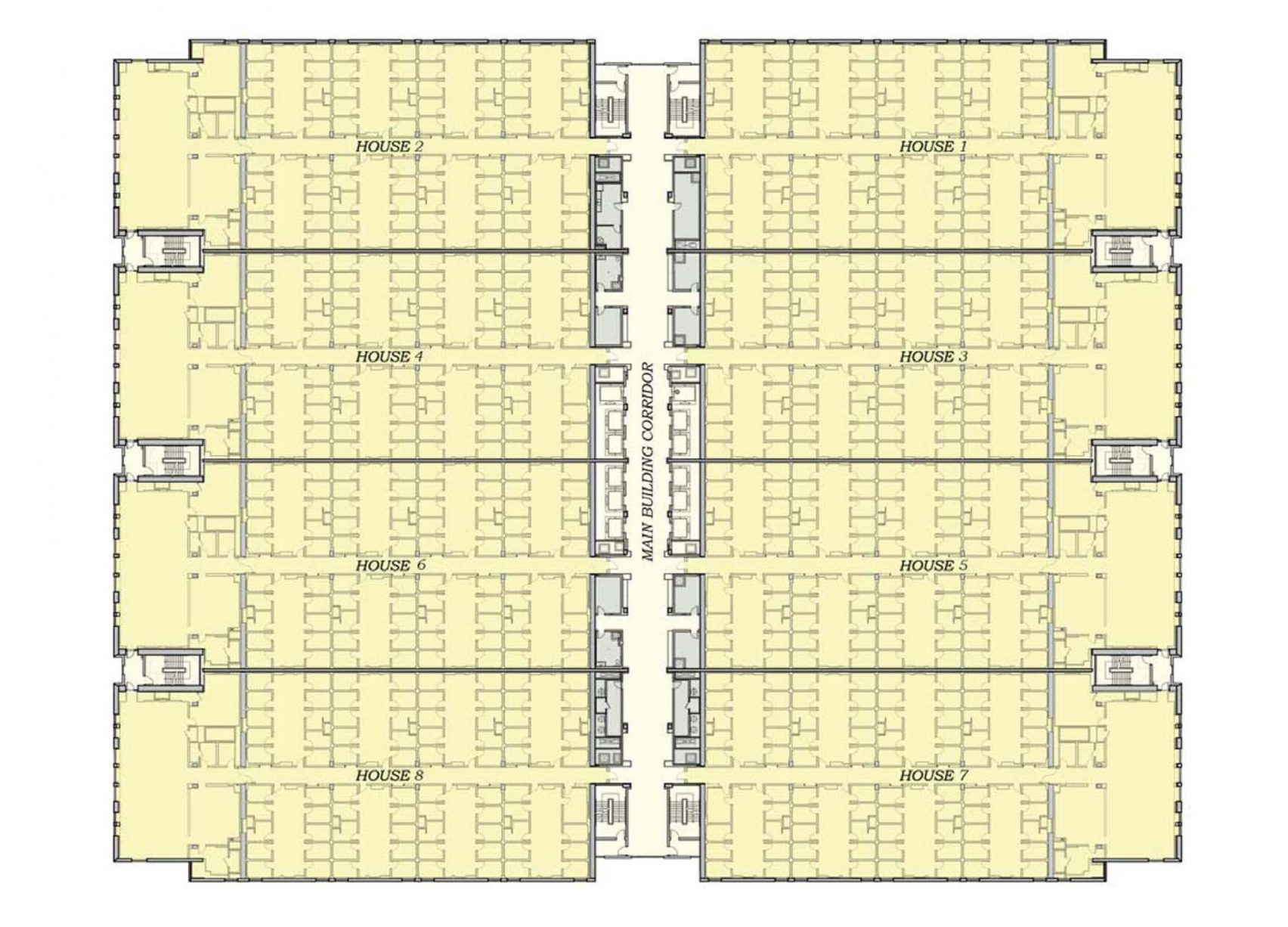
And from the fine article itself, 2nd para: only about 6 percent of the rooms — the end rooms in each row of 32 — have windows.
> Munger’s supporters
Billionaires shouldn't have supporters between working class people I swear. It's like Stockholm syndrome on a national scale.
Dude can literally own entire countries and islands, no one should relate to him lol.
Billionaires shouldn't have supporters between working class people I swear. It's like Stockholm syndrome on a national scale.
Dude can literally own entire countries and islands, no one should relate to him lol.
The presence of money or lack thereof is to you a surefire way to judge the quality of a man?! Because, really, some people see the human person behind the marginal pile of money or lack thereof, and look at the quality. And of these, some like, some dislike, appreciate, disagree, sympathize, misunderstand...
[deleted]
This monstrosity totals at around 1.68 million square feet [1], which places the cost at around $900/sq ft.
New York City for various reasons has some of the highest construction costs in the world. Residential high-rise construction costs are estimated at $562/sq ft [2]. Obviously there is variance in building costs based on the quality of finishings, ceiling height, facilities, etc. I guarantee you, you'd prefer to live in a modern residential high-rise pretty much anywhere in the country rather than in these windowless cells (sorry, "rooms").
Why is this so high? Doesn't UCSB already own the land so this isn't a factor?
There are a ton of problems with this building. I mean windowless is fine until the AC fails or is inadequate or there's just a power failure.
These are I believe arranged in suites of 10 that are "private" with some common facilities. 10 is rather high. I know people who had a similar arrangement with groups as small as 4 and it was a problem.
This just strikes me as pure ego from someone who is never told "no" who wants to enforce his view on the world so that even more sycophants can tell him how amazing he is. And then there's the university that doesn't care about anything other than the donation check clearing.
Student housing simply shouldn't be this way.
[1]: https://www.nbcnews.com/news/uc-santa-barbara-mega-dorm-mung...
[2]: https://www.constructiondive.com/news/construction-costs-in-....
New York City for various reasons has some of the highest construction costs in the world. Residential high-rise construction costs are estimated at $562/sq ft [2]. Obviously there is variance in building costs based on the quality of finishings, ceiling height, facilities, etc. I guarantee you, you'd prefer to live in a modern residential high-rise pretty much anywhere in the country rather than in these windowless cells (sorry, "rooms").
Why is this so high? Doesn't UCSB already own the land so this isn't a factor?
There are a ton of problems with this building. I mean windowless is fine until the AC fails or is inadequate or there's just a power failure.
These are I believe arranged in suites of 10 that are "private" with some common facilities. 10 is rather high. I know people who had a similar arrangement with groups as small as 4 and it was a problem.
This just strikes me as pure ego from someone who is never told "no" who wants to enforce his view on the world so that even more sycophants can tell him how amazing he is. And then there's the university that doesn't care about anything other than the donation check clearing.
Student housing simply shouldn't be this way.
[1]: https://www.nbcnews.com/news/uc-santa-barbara-mega-dorm-mung...
[2]: https://www.constructiondive.com/news/construction-costs-in-....
UC Berkeley is building a new dorm at a cost of $388,601 per bed. It will cost $300m for 772 beds.
I couldn't find the actual square footage but it did say that it is 14 stories and there is a 17000 sq ft retail/commercial space. So using that as a _very_ rough estimate, the total estimate is 238,000 sq ft, which comes out to $1260/sq ft to build.
Due to earthquakes, building in California should be more expensive than New York. I dont have any numbers to back that up though.
https://www.berkeleyside.org/2021/07/07/berkeley-new-dorm-he...
I couldn't find the actual square footage but it did say that it is 14 stories and there is a 17000 sq ft retail/commercial space. So using that as a _very_ rough estimate, the total estimate is 238,000 sq ft, which comes out to $1260/sq ft to build.
Due to earthquakes, building in California should be more expensive than New York. I dont have any numbers to back that up though.
https://www.berkeleyside.org/2021/07/07/berkeley-new-dorm-he...
I hadn't been following this too closely but now looking at the designs it looks more like an office building then a traditional dorm. I can see the logic and efficiency in the design.
A lot of dorms I've seen would end up with long interior hallways with bathrooms and shared spaces at the ends. While each room had a windows and an exterior wall the amenities would be far away. Some even only had common areas (kitchens etc) on the ground floor.
Rooms with immediately shared common areas make them more accessible. Multiple shared areas makes for less overcrowding at busy times of the day. Kitchen areas close by rooms also means students aren't overheating their rooms with small refrigerators to keep their beer cold.
The common rooms at the end of the hall on each floor also makes for more easily accessible non-room space to live in. So long as the dorm rooms themselves are kept single occupancy there's always a private study space available in addition to shared study spaces like in the library and wherever.
If you wanted to get a similar number of rooms in the same areal footprint but give everyone a window it seems like you'd need a central courtyard. But then the building couldn't be more than a few stories tall or the lower floors would be in constant shade except for noon a few days a year. So you'd fit fewer students in the same plot. Central common spaces with dorms lining the exterior walls would also have lower density and the large common areas would still need a bunch of interior walls for sound abatement lest the floor have a constant din of noise.
A gruff billionaire and soundbite headlines are the only thing driving this "story" in my opinion. The design looks sound and can pack a lot of people comfortably into the lot available for the building. I'm not an architect so I don't know if there's some big detail I'm missing.
A lot of dorms I've seen would end up with long interior hallways with bathrooms and shared spaces at the ends. While each room had a windows and an exterior wall the amenities would be far away. Some even only had common areas (kitchens etc) on the ground floor.
Rooms with immediately shared common areas make them more accessible. Multiple shared areas makes for less overcrowding at busy times of the day. Kitchen areas close by rooms also means students aren't overheating their rooms with small refrigerators to keep their beer cold.
The common rooms at the end of the hall on each floor also makes for more easily accessible non-room space to live in. So long as the dorm rooms themselves are kept single occupancy there's always a private study space available in addition to shared study spaces like in the library and wherever.
If you wanted to get a similar number of rooms in the same areal footprint but give everyone a window it seems like you'd need a central courtyard. But then the building couldn't be more than a few stories tall or the lower floors would be in constant shade except for noon a few days a year. So you'd fit fewer students in the same plot. Central common spaces with dorms lining the exterior walls would also have lower density and the large common areas would still need a bunch of interior walls for sound abatement lest the floor have a constant din of noise.
A gruff billionaire and soundbite headlines are the only thing driving this "story" in my opinion. The design looks sound and can pack a lot of people comfortably into the lot available for the building. I'm not an architect so I don't know if there's some big detail I'm missing.
Those are prison cells, period. The fact that they don't have natural sunlight means Munger doesn't have the first clue about circadian biology and how light affects the brain,mood, wakefulness, and sleep. This is a great example of how people with extreme wealth are given carte blanche simply because they have money, and no brains. As a former architectural student, albeit, high school, and professional sleep researcher (12 yrs), I hope this never gets built.
As much as it would be incredibly funny for Munger to be wrong after talking so much shit, I really don't think that he is. There's a lot of whining about "muh windows" and "you live in a cell". That's cool, but there's plenty of windows available to you when you leave your room, and a lot of people would rather have a small room without a window that's properly private than a marginally bigger one that you share with an asshole roommate.
It's not perfect, but it's enough for this job, and I would take it in a heartbeat over a lot of the options that were available at the university I went to.
It's not perfect, but it's enough for this job, and I would take it in a heartbeat over a lot of the options that were available at the university I went to.
> a lot of people would rather have a small room without a window that's properly private than a marginally bigger one that you share with an asshole roommate.
Not an American, so maybe I missed some cultural thing here - but what does one have to do with the other? Single-occupancy bedrooms with windows seem to be the standard in many European countries at least.
Not an American, so maybe I missed some cultural thing here - but what does one have to do with the other? Single-occupancy bedrooms with windows seem to be the standard in many European countries at least.
Real estate is extremely pricey and the number one priority for a university in the US is making money. We have a lot of universities here with 50k, 60k, even 70k students enrolled, so you're either packing people in close and forgoing things like windows for a lot of residents, or building a lot of sprawling housing. One is obviously much more affordable for a college student in the US.
This is Bonn University's largest dorm:
https://www.studierendenwerk-bonn.de/wohnen/unsere-wohnheime...
575 single-occupancy rooms with individual bathroom, kitchen and window(!) in two buildings with a total footprint of ~9600m². Seems pretty packed to me.
https://www.studierendenwerk-bonn.de/wohnen/unsere-wohnheime...
575 single-occupancy rooms with individual bathroom, kitchen and window(!) in two buildings with a total footprint of ~9600m². Seems pretty packed to me.
"Basement dweller" culture is overrepresented on the internet. "I don't care about windows", "I shower once a week" and "I’ve never seen my friends in person" are sentiments I hear often on imageboards and not in real life.
Not wanting to sleep in the same room with somebody who has zero respect for you doesn't mean that you shower once a week and don't have any actual friends. I know a lot of people whose roommates resulted in constant headache, lost sleep, etc. and moved somewhere where they could have a room to themselves as soon as they could. I even know a couple people whose university-assigned roommates developed raging drug addictions, and they would have to live and sleep in the same room with these people.
If I'm a basement dweller because I want to have a place (even a very small one) where I have some semblance of privacy, then I guess it is what it is.
If I'm a basement dweller because I want to have a place (even a very small one) where I have some semblance of privacy, then I guess it is what it is.
Lots of university dorms in the US are setup so that two people share the same bedroom.
Did you ever lived or worked in a windowless room (or a room whose window doesn't directly take sunlight or see anything besides a wall) for any amount of time?
Yep, you're describing the offices and schools I've worked and studied in for the last 5 or 6 years. 8-16 hours a day in rooms without sunlight. It rarely crosses my mind. I can say that I would in a heartbeat, no questions asked, choose a single-person room with no windows that I only sleep and study in, over a shared room where I have minimal privacy and I run the risk of having my sleep schedule be completely trashed by an inconsiderate roommate.
This design is asking you to walk out of your room if you want sunlight. It's not ideal. Some students would rather not. They're doing sardine-packing here as a matter of necessity and there's going to be some tradeoffs, but frankly this is a pretty minor one.
This design is asking you to walk out of your room if you want sunlight. It's not ideal. Some students would rather not. They're doing sardine-packing here as a matter of necessity and there's going to be some tradeoffs, but frankly this is a pretty minor one.
> They're doing sardine-packing here as a matter of necessity and there's going to be some tradeoffs, but frankly this is a pretty minor one.
I honestly don't understand this. It's not like this is a new problem. There are plenty of ways to pack a building and still give each room a window - a famous example being the Pentagon building. The view way not be particularly nice, but at least it would give you fresh air and a sense of time and space.
He said has has copied architecture patterns from cruise ships. Of course you can't design a ship with courtyards, so windowless cabins sort of make sense there. But he is not building a cruise ship.
I honestly don't understand this. It's not like this is a new problem. There are plenty of ways to pack a building and still give each room a window - a famous example being the Pentagon building. The view way not be particularly nice, but at least it would give you fresh air and a sense of time and space.
He said has has copied architecture patterns from cruise ships. Of course you can't design a ship with courtyards, so windowless cabins sort of make sense there. But he is not building a cruise ship.
Cruise ship with a courtyard.
https://en.m.wikipedia.org/wiki/Oasis_of_the_Seas
Almost 3000 rooms, but easily could have been more as all the cabins are bigger than in Munger Hall. Total pricetag is about the same at $1.4B. Does UCSB have a pier? Hmm...
https://en.m.wikipedia.org/wiki/Oasis_of_the_Seas
Almost 3000 rooms, but easily could have been more as all the cabins are bigger than in Munger Hall. Total pricetag is about the same at $1.4B. Does UCSB have a pier? Hmm...
Ha, wouldn't have thought - thanks for the info.
I found this: https://www.cruisecritic.co.uk/articles.cfm?ID=668&stay=1&po...
I found this: https://www.cruisecritic.co.uk/articles.cfm?ID=668&stay=1&po...
The idea for this dorm is that the students wouldn’t do that. They would go to their bunk to sleep and dress and have sex, and spend all the rest of their time in huge, luxuriously-windowed common spaces.
Except that the luxuriously-windowed common spaces (two for the 64 occupants of one floor) are a fair bit away from the rooms. The common kitchens that connect each 8-room group don't have windows either.
I have worked in a windowless room from the beginning of COVID. I would prefer this to having a roommate. Currently I could commute into the office and work in our big window'd office with others, but regardless of COVID (and even assuming a pre-COVID lively office), I'd still work at home a lot. I usually go in one day a week for collaboration or hardware stuff that needs me there.
In my best working arrangements, we all had our own offices, but would often collaborate and invite people into pair-program (and spacious with big windows). I've worked both in single offices, shared workspaces, and cubicle farms. I would sacrifice a lot for privacy and solitude.
In my best working arrangements, we all had our own offices, but would often collaborate and invite people into pair-program (and spacious with big windows). I've worked both in single offices, shared workspaces, and cubicle farms. I would sacrifice a lot for privacy and solitude.
[deleted]
Wrong or right, this is what we get not taxing rich - they get to decide what is good for us and our children.
this 1000%, let me finish the sentence for you, they get to decide what is good for us and our children, while sending their own children to schools that have better accomodations, or they just pay for their kids' accomodations (buying houses, condos, etc and flipping them after their kids are done living there) after they're no longer required to stay on campus. Some high end US univ's require at least 1yr on campus residency, so it's back to the penthouse loft after that.
I didn’t see “introvert” mentioned, but having 8 people stuffed together means that the loud ones win until the introverts just flip out. Guess they want such undesirables going to a different school or living somewhere else. Mixing people with different level of academic rigor will be messy and inserting anybody with a stereo or musical instruments will lead to physical harm.
The whole point of this dorm is that singles are way too hard for UCSB students to get, and triples are much too common.
This dorm would be all singles, and would eliminate the need for any triples campus-wide. Introverts would be able to choose to either live here and get a single, or go for any of the other existing housing options on campus.
This dorm would be all singles, and would eliminate the need for any triples campus-wide. Introverts would be able to choose to either live here and get a single, or go for any of the other existing housing options on campus.
Sort of - everyone having a single rather than doubles helps with that too. Introverts can retreat, as needed, to their, albeit tiny and windowless, rooms.
Munger has clearly been very involved with this project. I'm not gonna try to wade into the windows vs not thing. I can see how there's a trade-off especially given that having a single-person room is something of a luxury for college students.
But I do want to question whether it's appropriate for philanthropists to be so involved in what they fund, or whether it should still be considered philanthropy at that point.
Economists sometimes talk about the inefficiency of gift-giving. Compared with the amount expended, perhaps substantially less value will be captured by the receiver. This seems like the billionaire equivalent of giving someone a painting you did, if you're not especially renowned as an artist.
If the UC system had received an equivalent amount of funding from another source would they have chosen to spend it all on this building? Or perhaps, would some have gone to scholarships, and some to more faculty, and some to a misguided new institute for whatever? Even if they had wanted to build a dorm, had Munger not been involved, would they have preferred to go in a very different direction?
Munger gets to put his name on this thing, but it sounds like he also enjoys getting to play architect or designer but without having to compete on the merits of his skills in those fields. He gets to build a thing the way he wants, put his name on it, and put it on UC land. And if we're having a conversation about how in this specific instance it may be out of line with actual benefits to the future residents, then can we also talk about how it's maybe in general a bad idea to keep congratulating rich people for pushing their personal vanity/hobby projects onto the public and calling it benevolence?
Meanwhile, Munger has been vocal in opposition to the idea of introducing a wealth tax, or a tax on corporate stock buybacks, and has suggested that the capital gains tax is too high rather than too low. To Munger, even at a public school, private entities should decide how much to spend and how to spend it.
But I do want to question whether it's appropriate for philanthropists to be so involved in what they fund, or whether it should still be considered philanthropy at that point.
Economists sometimes talk about the inefficiency of gift-giving. Compared with the amount expended, perhaps substantially less value will be captured by the receiver. This seems like the billionaire equivalent of giving someone a painting you did, if you're not especially renowned as an artist.
If the UC system had received an equivalent amount of funding from another source would they have chosen to spend it all on this building? Or perhaps, would some have gone to scholarships, and some to more faculty, and some to a misguided new institute for whatever? Even if they had wanted to build a dorm, had Munger not been involved, would they have preferred to go in a very different direction?
Munger gets to put his name on this thing, but it sounds like he also enjoys getting to play architect or designer but without having to compete on the merits of his skills in those fields. He gets to build a thing the way he wants, put his name on it, and put it on UC land. And if we're having a conversation about how in this specific instance it may be out of line with actual benefits to the future residents, then can we also talk about how it's maybe in general a bad idea to keep congratulating rich people for pushing their personal vanity/hobby projects onto the public and calling it benevolence?
Meanwhile, Munger has been vocal in opposition to the idea of introducing a wealth tax, or a tax on corporate stock buybacks, and has suggested that the capital gains tax is too high rather than too low. To Munger, even at a public school, private entities should decide how much to spend and how to spend it.
> Munger said he based the dorm’s design on the Unité d'Habitation in Marseille by Le Corbusier.
Well there’s your problem. Le Corbusier’s designs were beautiful dystopias.
Well there’s your problem. Le Corbusier’s designs were beautiful dystopias.
Here's my question: For an interior windowless room, what's the expected CO2 concentration after someone's been in there for 8 hours?
I'd bet $1000 their HVAC system will be inadequate.
I'd bet $1000 their HVAC system will be inadequate.
I'd bet $1000 their HVAC system will be inadequate.
Yeah, in the "age of Covid" there are few things as stupid as sharing HVAC with 4,499 other people.
Yeah, in the "age of Covid" there are few things as stupid as sharing HVAC with 4,499 other people.
> Once he decided that every student would have a single room, he realized, “We had a window shortage. So we just copied what Disney Cruises did. The way Disney does it, the window is really a television set. Those work beautifully on the ships. But I wanted to have a spectrum of sunlight, so with a curtain hanging over it you couldn’t tell if it was artificial or real. I figured out how to do that. Programming the lights to copy the sun was too expensive. So we will give the students knobs, and they can have whatever light they want. Real windows don’t do that.”
So just to recap: The rooms neither give you a sense where you are in the building, nor any sense of time of day.
You wake up and literally are unable to tell if it's day or night.
So just to recap: The rooms neither give you a sense where you are in the building, nor any sense of time of day.
You wake up and literally are unable to tell if it's day or night.
you can bring your own led lights. they have those anti seasonal depression lamps. can an arduino or other act as a dimmer? sprinkle in a sun worshipping library (e.g. astral in python, or rip it out of the redshift code for C) and you have a light that mimicks the sun.
I know you can build or buy such a lamp. However, this requires a lot of effort on the side of individual students. Not everyone is a techie and can build/program this. Many might not know about those products or understand why they should buy one.
Why weren't light courts or courtyards considered here?
Someone asked rem Koolhaas a while ago what his residence looks like and while he tried to dodge the question he ended up answering "a 19th century victorian apartment" seems like the same sort of ego at work here
Someone asked rem Koolhaas a while ago what his residence looks like and while he tried to dodge the question he ended up answering "a 19th century victorian apartment" seems like the same sort of ego at work here
Has anyone asked students, current or prospective, what they think?
It's easy to criticize what someone ELSE is doing - much harder to do it yourself.
To me it seams like Munger has offered up a nice solution given the incentives and constraints that exist in this particular case. This doesn't mean it's perfect, or that it would be best in all other scenarios - just that it's a very reasonable compromise that optimizes overall good for the students in this particular case.
Perhaps someone else, rather than criticizing, would offer up a detailed alternative, and then subject that to the scrutiny of students, faculty, environmental and zoning boards, finance, etc - and see where that gets them. My guess is not very far. It's likely that all of the "better" options folks are suggestion have already been thoroughly considered and rejected for good reasons in favor of this option.
To me it seams like Munger has offered up a nice solution given the incentives and constraints that exist in this particular case. This doesn't mean it's perfect, or that it would be best in all other scenarios - just that it's a very reasonable compromise that optimizes overall good for the students in this particular case.
Perhaps someone else, rather than criticizing, would offer up a detailed alternative, and then subject that to the scrutiny of students, faculty, environmental and zoning boards, finance, etc - and see where that gets them. My guess is not very far. It's likely that all of the "better" options folks are suggestion have already been thoroughly considered and rejected for good reasons in favor of this option.
Let’s put old billionaires in windowless dorms instead.
They could do this a lot cheaper just by stacking some of the glut of empty shipping containers in a huge block.